




Abstract
Low-cost low-power consumption small wireless sensor devices have empowered the development of wireless body area networks (WBANs). In WBANs many sensors are attached to human body for sensing particular health related information to improve healthcare and quality of life. Obesity is one of the most common problems all over the world, which is amongst main causes of cardiovascular diseases. In this research, we explore hardware and software architecture of WBAN for obesity monitoring. The proposed framework consists of few sensor nodes that monitor body motion, calories calculator, and a personal server running on a personal smart phone or a personal computer. The focus of this research is to make obesity patients easier to get rid of this disease.
1. Introduction
A wireless sensor network (WSN) has many applications in which wireless body area network (WBAN) has gained significant importance. In WBAN [1, 2], small electronic devices are attached with human to monitor specific health related problem such as blood pressure, blood sugar level, and organ movement. The concept of WBAN is presented to facilitate the healthcare issues distantly or to monitor athletes [3]. WBAN consists of small intelligent electronic devices termed as sensors, which are low in power and processing [4]. These small sensors collect heath related data and communicate that data to some medical officers or medical servers so that it can be analyzed and monitor the patient health parameters or to track their fatigue and muscle stress. This kind of mechanism created ease in patient life to enjoy mobility and need not to stay at hospital all the time [5]. In WBAN, three layers play an important role for sensing precise readings of patient health and transmitting accurate information to medical servers, that is, physical layer, MAC layer, and network layer.
At physical layer, WBAN normally faces significant signal loss using narrow band or ultrawide band [6]. Furthermore, less path loss is observed in line of sight (LOS) communication as compared to nonline of sight due to capability of body fluid to absorb waves [7, 8]. Furthermore, mobility can also greatly affect the signal loss; by increasing movement and degree of movement, more signal loss occurs [9–11]. There are many research and design issues in antenna and radios that must be resolved to enable efficient and flawless deployment of WBAN. WBAN is playing role in improving e-healthcare and quality of life.
At MAC layer, it is useful to implement wireless sensor protocols in WBAN [6, 12]. Several protocols have been proposed to guarantee emergency handling in WBAN, such as the one presented in [13].
Due to resource constraints, routing protocols designed for mobile ad hoc networks or wireless sensor networks cannot be used in WBAN. Research community is trying to design specialized routing protocols for WBAN such as TARA [14], ALTR [15]. These protocols are concerned with body heat and finding alternate path. Few LEACH based clustered routing protocols are also presented [16]. Moreover, other alternatives for m-health and low-power wearable sensor networks, such as delay tolerant routing protocols [17] and cooperation mechanisms [18], have been proposed. In the recent years, there have appeared security proposals that take into account energy harvesting and could be implemented in e-health and m-health systems [19, 20].
Research fields such as mobile sensing [21] and data gathering algorithms for mobile sensors [22] are experiencing huge advances which benefit tremendously m-health and e-health systems.
Overweight or obesity is one of the most common problems all over the world. Most of cardiovascular diseases (CVD) are associated with it, which is the main cause of death in the world. According to the World Health Organization (WHO), worldwide about 17.5 million people die of heart attacks or strokes each year; in 2015, almost 20 million people will die from CVD. These deaths can often be prevented with proper healthcare [23].
In this paper, we present a framework for controlling obesity to facilitate all such patients. This research has two main contributions.
One is designing of a communication system which consists of WBAN, wireless personal area network (WPAN), and wireless metropolitan area network (WMAN). WBAN deals with communication amongst sensor nodes deployed over human body. WPAN enables our proposed system to communicate WBAN with personal computer or smart phone, while WMAN is capable of transferring data from personal server to medical server for medical advice in case of emergency. The other is devising personalized body mass index (BMI) and calories calculator. This calculator calculates personalized BMI depending on current weight, height, gender, and so forth. Similarly calories calculator keeps track of daily calories intake and calories burnt. This module also gives intelligent suggestions at the end of the day.
The rest of the paper is organized as follows. Section 2 discusses related work. Section 3 briefly introduces background of the problem. Section 4 explains proposed architecture. Section 5 discusses results. Finally Section 6 concludes the paper.
2. Related Work
WBAN is currently being used in a variety of healthcare applications. In [24], WBAN architecture is proposed for physiological signal monitoring and health consulting in ubiquitous environment. In this mechanism ZigBee is used to communicate mobile system and physiological devices. Furthermore, this paper proposes few algorithms such as scanning, dynamic discovery, and healthcare profile. Hip rehabilitation system using WBAN is proposed in [25]. In this paper, the author pointed out few challenges such as energy efficiency, reliability, network operation, and low latency. Furthermore, hip rehabilitation system is proposed for such patients who suffer from hip surgery. To measure the force between hip and shoe, capacitive insole sensors are used, while magnetic sensors are used to measure hip and leg position of patients. A complete survey is conducted in [6]. The focus of this survey is to highlight few patient monitoring systems and discussion about different WBAN technologies. Furthermore, the author discusses recent and current research work done in physical, MAC, and network layers of WBAN. Some security issues and mechanisms are also highlighted in this survey paper.
Ambulatory health status monitoring system with the help of software and hardware architecture is presented in [26]. This system monitors body motion and heart activities using multiple sensor nodes and personal server.
In [27], WBAN challenges and opportunities are discussed in detail regarding application areas, communication, storage, energy harvesting, and compatibility issues. Another body area network survey is presented in [28]. In this survey, the focus of discussion is on WBAN intra-BAN and inter-BAN communication modeling, different hardware and devices, physical, MAC and network layer issues, and energy conservation strategies. Furthermore, taxonomy of body sensor projects is highlighted.
In [29], Lopes et al. present SapoFitness, a mobile health application for dietetic monitoring and assessment, which is focused on keeping a daily personal health record of a user for obesity prevention. The application is able to send alerts and messages concerning the user's diet program taking into account his/her physical activity. Its main goal is to help the user to lose weight and have a good and balanced nutritional state.
3. Problem Background
In this section, we will discuss obesity and other related information to the proposed architecture.
3.1. Obesity
Obesity is a medical condition in which excess body fat has accumulated to the extent that it may have an adverse effect on health, leading to reduced life expectancy and increased health problems [30]. Obesity is a state of body which is overweight with high degree of fat. There are a number of risks involved in obesity such as diabetes, heart diseases, and depression. Obesity can be controlled gradually by taking prevention mechanisms such as exercise and dieting.
3.2. Body Mass Index
Body mass index (BMI) is a simple index of weight-to-height which is used to identify overweight in people. The World Health Organization (WHO) definition of overweight and obesity is as follows.
BMI greater than or equal to 25 is overweight. BMI greater than or equal to 30 is obesity.
BMI can be calculated using the following expression:

BMI classification is presented in Table 1.
BMI classification.

3.3. Calories Requirements
A calorie is a unit of energy which is used to power our body. All foods have certain amount of calories. Major sources of calories are carbohydrates, fats, and proteins. Fats have the highest number of calories, where one gram of pure fat contains nine calories, whereas pure protein and pure carbohydrate contain four calories each. Calories play an important role in our diet and understanding calories can help in weight management. One important fact is that calories requirements depend on many factors such as age, weight, height, and gender.
4. Proposed Architecture
In this section, we discuss our proposed architecture for obesity control using WBAN. The proposed architecture consists of software and hardware architecture as shown in Figure 1.

Proposed framework.
The system procedure follows the algorithm shown in Figure 2. When data are received from the body sensors, the algorithm first checks if values are higher (or lower, depending on the case) than a threshold. Then, the system is able to estimate the BMI, the ideal weight, and the calories, based on the input parameters. Taking into account the values, the system takes information from its database and provides some intelligent suggestions.
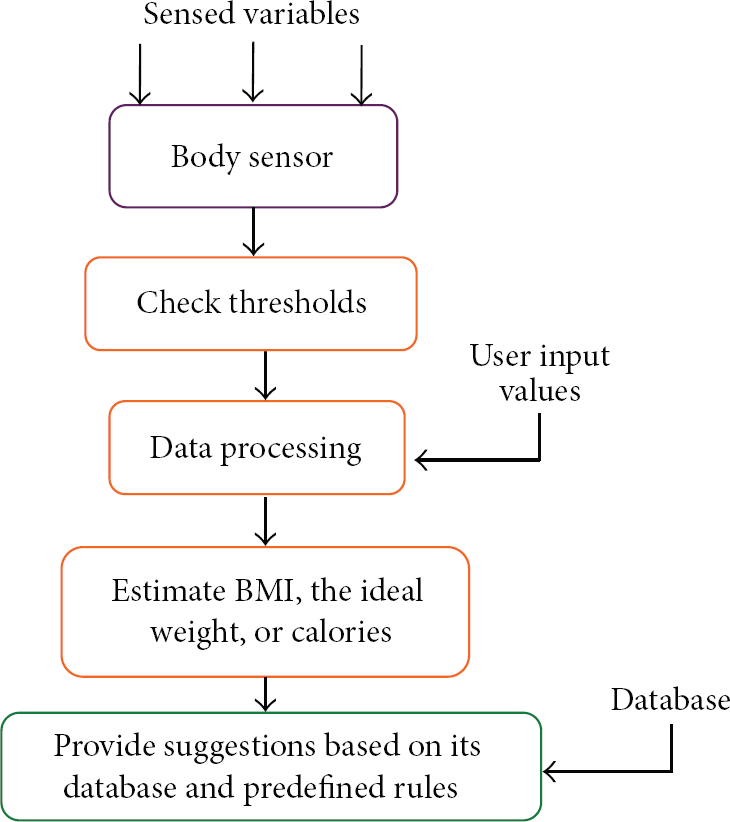
System procedure.
In the following subsections we present the hardware and communication model and the software model.
4.1. Hardware and Communication Model
Generally, WBAN devices are equipped with low-power small-size sensors (less than 1 cm3). The hardware used in the proposed architecture is four small-size sensors which are attached to hands and feet and a computing device which can be smart phone or small personal computer acting as a server. They are connected using a star network topology. We used iMote2 sensors, which have TinyOS and use IEEE 802.15.4 standard for communication with other sensor nodes [31]. Communication distance can be up to 20 meters, with a data rate of 250 kbps. IEEE 801.15.4 standard operates at 2.4 GHz frequency band. The primary objective of these sensor nodes is to monitor the body motion. Body motion readings are transmitted to the server for further processing.
In such cases, where a lot of body sensor nodes are used to cover several parts of the patient body, the end to end delay and congestion would be the main concerns due to the few available nonoverlapping channels. If the medical condition of the patient needs to transmit images or multimedia data to the medical servers, high data rates are needed. Sensor nodes use CSMA/CA at MAC layer. MAC layer performs some vital tasks such as data rate management, load balancing, error control, power control, and collision avoidance. It should be noted that there are many contention free MAC protocols such as TDMA and FDMA which can perform better under centralized mechanism. However, we used CSMA/CA with RTC/CTS mechanism in order to reduce the interference among nodes.
4.2. Software Model
The proposed system is equipped with a software application which includes
BMI calculator, personalized calories calculator, calories adder module, calories consumption module, suggestion module.
BMI calculator is used to calculate personalized mass index for users as given in Figure 3.

BMI calculator.
The experimental values are presented in Figure 4.

BMI calculation.
Calories calculator computes daily the calorie requirements of a user based on the age, gender, weight, and height as given in Figure 5.

Calories calculator.
This calculator estimates the number of calories to maintain current weight. It can estimate the personalized calorie requirements for each user as given in Figure 6.

Calories calculation of a user.
The number 2540 calories means that the user Alex needs this amount of calories to maintain his/her current weight. If he/she consumes more than this value, the weight will be increased, but if he/she reduces the consumption of calories, the weight can be reduced.
We included a module called calories in the proposed mechanism, in which the user is capable of adding intake calories. The calories adder keeps record of the total calories taken during a day. Calories adder uses a database with the calories of the food. If some food is not mentioned in calories database, it can be entered manually. At the end of the day, the user will be able to know the total amount of calories taken.
Calories consumption module operates in association with the sensors attached to the human body. The values are estimated based on the sensed parameters.
Another important module of proposed system is the suggestion module. This module is activated at the end of the day. It provides useful suggestions after computing daily intake calories and estimating the total consumed calories as given in Figure 7.

Suggestion module.
5. Results
Efficient data delivery is one of the most desirable aspects of WBAN. Figure 8 presents the data delivery ratio from sensor nodes to a server when the user is in mobility, that is, when the user is running. There is significant difference between data delivery when the user is in motion than when it is not. The reason is that when human body is in fast motion, there is significant drop in data delivery in ad hoc networks, especially in WBAN.
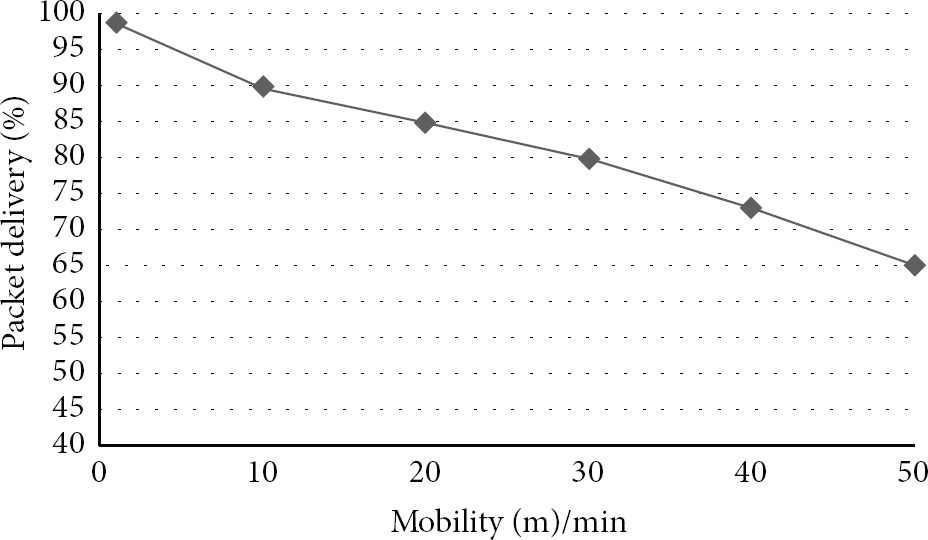
Data delivery rates.
Figure 9 represents end to end delay when human body is in motion. As soon as the movement increases, end to end delay increases as well.

End to end delay in case of body motion.
6. Conclusion and Future Work
One of the major causes of heart attacks is obesity. In this paper, we presented a mechanism of weight management and weight control using WBAN. The proposed mechanism consists of both software architecture and hardware architecture. The hardware architecture deals with sensor nodes and personal server, while software architecture consists of calories calculator, BMI calculator, adder, calories consumption module, and suggestion module. Our results show that when the user is in fast motion, some performance degradation occurs in terms of data delivery and more end to end delay is observed. In future works we are planning to include in the system a device with efficient energy conservation and multiradio multichannel mechanism in order to increase data delivery and reduce end to end delay.
Footnotes
Conflict of Interests
The authors have no conflict of interests.
Acknowledgment
The authors would like to extend their sincere appreciation to the Deanship of Scientific Research at King Saud University for funding this Research Group no. RG-1435-037.