




Abstract
In mobile ad hoc networks the congestion is a major issue, which affects the overall performance of the networks. The load balancing in the network alongside the congestion is another major problem in mobile ad hoc network (MANET) routing due to difference in link cost of the route. Most of the existing routing protocols provide solutions to load balancing or congestion adaptivity separately. In this paper, a congestion adaptive routing along with load balancing, that is, load balanced congestion adaptive routing (LBCAR), has been proposed. Transferring of load from congested nodes to less busy nodes and involvement of other nodes in transmission that can take part in route can improve the overall network life. In the proposed protocol two metrics, traffic load density and link cost associated with a routing path, have been used to determine the congestion status. The route with low traffic load density and maximum life time is selected for packet transmission using this protocol. Performance of the network using LBCAR has been analyzed and compared with congestion adaptive routing protocol (CRP) for packet delivery ratio, average end-to-end delay, and normalized routing overhead.
1. Introduction
It is due to the effect of advancements in wireless technology that all communication systems are going wireless. It is expected to have all such systems and devices connected with certain network. The wireless networks of the day are one of the major areas of communication, which are flooded with multimedia and other allied services with various data types. It is also true that wired communication systems cannot be done away with as it has high bandwidth and uncomparable reliability. The main difference between wireless and wired networks is only in communication channel and their mode of communication. In past, most common networks were only wired communication networks having fixed infrastructure and even wireless networks used to have fixed infrastructure and control like cordless telephone, cellular networks, Wi-Fi, microwave and satellite communication, and so forth. Ad hoc wireless networks are kind of infrastructure less network in which two or more devices are equipped with wireless communication and networking capability along with routing capabilities even in mobility. Ad hoc networks do not have fix topologies to cover a large area. These topologies may change dynamically and unpredictably at any moment as nodes might be on mobility. Traditional routing protocols that are normally used for internet based wireless networks cannot be applied directly to ad hoc wireless networks because some common assumptions are not valid in all cases for such dynamically changing networks and may be not true for mobile nodes. The availability of bandwidth is an important issue of ad hoc networks. Thus, these network types present a difficult challenge in the design of routing protocols, where each node participates in routing by forwarding data dynamically based on the network connectivity. As network uses wireless channel for communication, the links are affected by propagation loss, shadow fading, and multipath Rayleigh fading. In ad hoc networks, due to the movement of mobile nodes and the multipath effect, a packet transmission is subjected to Rayleigh fades. If the signal-to-noise ratio (SNR) at some stages becomes lower than a certain threshold, packets will contain excessive number of errors and will be dropped due to high noise. This cause of packet loss degrades the network performance significantly. Thus signal-to-noise ratio (SNR) is a good indicator of link quality and can be determined from the hardware. Different SNRs cause different bit error rates (BERs). The mathematical formula for calculating BER [1] is given as follows:


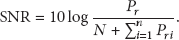
When a sending node is broadcasting packets, it piggybacks its transmissions power P. On receiving the packets, the intended node measures the signal strength received which holds the following relationship for free-space propagation model [2] as follows:

The wireless ad hoc network shown in Figure 1 considers mobile nodes, which are not supported by an external device or control mechanism and have their communication range according to coverage area of the individual node. It may be seen that sending and destination nodes are connected using multihop communication and thus need congestion free path to achieve reliable communication.

Wireless ad hoc network concept.
Devices in mobile ad hoc networks should be able to detect the presence of other devices and perform the necessary setup to facilitate communications and the sharing of data and services. However, due to limitation of bandwidth and sharing common channel for all the nodes, the congestion has become more challenging in the wireless ad hoc networks [3]. Congestion is always considered to be the main factor for degrading the performance of the network and leads to packet losses and bandwidth degradation and also leads into wastage of time and energy by invoking congestion recovery algorithms. Various techniques have been developed in attempt to minimize congestion and to increase the capacity of wireless ad hoc network. There have been some protocols proposed, which inform the transmitting nodes about the current level of network congestion and help transmitting stations to reroute or delay their transmission according to congestion levels and protocols used. A load balancing technique shares the traffic load evenly among all the nodes that can take part in transmission, which has been proposed recently [4] and proposed to enhance the overall capacity and throughput of the network. Transferring of load from congested nodes to less busy nodes and involvement of other nodes in transmission that can take part in route can improve the overall network life as per the proposal. A number of congestion adaptive and load balanced algorithms have been proposed separately, but, in this paper, a congestion adaptive routing along with load balancing, that is, load balanced congestion adaptive routing (LBCAR), has been proposed, which has considered two metrics, traffic load density and lifetime associated with a routing path, to determine the congestion status and weakest node of the route and the route with low traffic load density and maximum lifetime is selected for packet transmission. The proposed scheme is expected to adapt to the sudden changes and level of traffic load and to find suitable path even in congestion scenario and node energy constraints. The proposed algorithm is suitable for burst traffic also and performs well for higher traffic conditions in the network.
The remainder of the paper is organised as follows.
Review of all four routing protocols is presented in Section 2. The detailed observation on constraint environment is discussed in Section 3. Section 4 depicts congestion and some congestion control mechanism. The proposed congestion control protocol is presented in Section 5. Section 6 has simulation parameter, Section 7 has analysis of simulation results for proposed congestion adaptive protocol. Finally, Section 8 concludes this paper and defines topics for further research.
2. Related Work
A wireless MANET has become most promising and rapidly growing area, which is based on a self-organized and rapidly deployable network. Due to its flexible features, MANET attracts different real-world application areas where the networks topology changes very quickly. However, it has certain drawbacks, which are being taken care of at various levels of the research. The main weaknesses of MANET are such as limited bandwidth, battery power, computational power, and security. Research is continuously going on by many researchers on MANETs: routing, congestion control techniques, congestion adaptive techniques, load balancing in MANETs, and security. Many congestion adaptive mechanisms have been proposed in the literature. Some of the important congestion adaptive techniques for MANETs have been considered here for the purpose of improvement of the work. Research in MANETs has been mainly focused on designing routing protocols to cope with dynamics of ad hoc networks. There are several protocols in the literature that have been specifically developed to cope with the limitations imposed by ad hoc networking environments due to various constraints. In [5], a distance vector algorithm, ad hoc on-demand distance vector (AODV), was presented which is on-demand route acquisition system; nodes that do not lie on active paths neither maintain any routing information nor participate in any periodic routing table exchanges. In [6], further improvements to the performance of dynamic source routing (DSR) have been presented, for example, to allow scaling to very large networks and the addition of new features to the protocol, such as multicast routing and adaptive quality of service (QoS) reservations and resource management. In [7], an innovative approach, highly dynamic destination-sequenced distance-vector routing (DSDV), has been presented which models the mobile computers as routers, which are cooperating to forward packets as needed to each other. This approach can be utilized at either the network layer (layer 3) or below the network layer but still above the MAC layer software in layer 2. In [8], a new distributed routing protocol, WRP, has been presented for a packet radio network, which works on the notion of second-to-last hop node to a destination. In [1, 2, 9], a routing with congestion awareness and adaptivity in MANETs (CRP) has been presented. This protocol tries to prevent congestion from occurring in the first place and to be adaptive should congestion occur. Every node appearing on a route warns its previous node when it is prone to be congested. The previous node uses a “bypass” route for bypassing the potential congestion area to the first noncongested node on the primary route. Traffic is split probabilistically over these two routes, primary and bypass, thus effectively lessening the chance of congestion occurrence. In [10], an efficient congestion adaptive routing protocol (ECARP) for MANETs has been proposed that outperforms all the other routing protocols during heavy traffic loads. The ECARP is designed to ensure the high availability of alternative routes and reduce the rate of stale route. This can be achieved by increasing the parameters of routing protocols (especially in AODV) that normally take more time for link recovery. The number of packets in buffer has been used to determine the congestion status of nodes. In [11], a congestion aware routing protocol for mobile ad hoc networks (CARM) has been proposed which employs the retransmission count weighted channel delay and buffer queuing delay, with preference for less congested high throughput links to improve channel utilization. Whenever streaming of multimedia based data such as video, audio, and text is performed traffic will be more and network becomes congested in mobile ad hoc networks. In [12], a congestion adaptive AODV (CA-AODV) routing protocol has been developed for streaming video in mobile ad hoc networks especially designed for multimedia applications. Since video data is very sensitive in delay and packet loss, the measurement of congestion has been considered here depending on average packet delivery time and packet delivery ratio. In [13], a congestion adaptive routing mechanism has been presented which is applied to reactive ad hoc routing protocol, denoted as congestion adaptive ad hoc on-demand distance vector routing protocol. The main characteristics of the mechanism are its support of finding alternate route, in case of congestion on the primary route, on the basis of status of the buffer size of the neighbor and the status of the buffer size of the next node on the primary route. This approach works in coordination with AODV. In [14], a hop-by-hop congestion aware routing protocol (CARP) has been developed which employs a combined weight value as a routing metric, based on the data rate, queuing delay, link quality, and MAC overhead in its standard cost function to account for the congestion level. The route with minimum cost index is selected, which is based on the node weight of all the in-network nodes from the source node to the destination node.
Due to interference in the channels of the paths, multipath increases the end-to-end delay and does not work well in highly congested networks. In [15], a congestion aware multipath dynamic source routing protocol (CAWMP-DSR) has been proposed for maximum number of node disjoint paths using multipath DSR. A set of disjoint multipaths is generated and handles the problem of end-to-end delay using the correlation factor measurement and as a result end-to-end delay improved and overhead as well. In [16], original DSR protocol has been modified to define the occurrence of congestion by monitoring and reporting multiple resource utilization thresholds as QoS attributes and uses multipath routing and load balancing during the periods of congestion to improve QoS in MANETs for CBR multimedia applications. In this proposed protocol, the battery level and queue length are used as the key resource utilization parameters. In [17] authors have discussed protocols for all-to-all dissemination in ad hoc wireless networks. They have evaluated the performance of the GOSSIP3 dissemination protocol under varying network loads and have concluded that MAC layer congestion awareness is important for improving application-level efficiency. In [18], a congestion aware routing protocol for mobile ad hoc networks (CARM) was proposed, which employs the retransmission count weighted channel delay and buffer queuing delay, with preference for less congested high throughput links to improve channel utilization. In [4], congestion adoptive load-aware routing protocol, DLAR, defined the network load of a mobile node as the number of packets in its interface queue. In [3] authors developed congestion adaptive AODV (CA-AODV) routing protocol for streaming video in mobile ad hoc networks that provides alternate noncongested path if node becomes congested. In [19], a hop-by-hop congestion aware routing mechanism was proposed; however, it was directed toward congestion adaptivity only. In [20], a work load based algorithm was proposed, which considered the workload of the path and the network for finding the route with less congestion, and was appropriate for low load only. In [21] an efficient congestion adaptive routing protocol (ECARP) is proposed for MANETs designed to ensure the high availability of alternative routes and reduce the rate of stale routes and also reduce the rate of broken route removal process by increasing the parameters of the routing protocols (especially in AODV) such as active_route_time-out, route_reply_wait_time, reverse_route_life, TTL_start, TTL_increment, TTL_threshold, and delete_period that normally take more time for link recovery. In [22] a multipath routing with load balancing was proposed but did not consider the variable congestion status of the network. In [23], congestion aware routing methods have been studied and it was found that none of the algorithms has taken both parameters into consideration in the same protocol, which has prompted us to find solution by considering load balancing as well as congestion adaptive scheme in the proposed method.
3. Congestion and Congestion Adaptive Routings
In wireless ad hoc network the congestion is the cause of concern and needs to be rectified for having better performance of the network. To know the basics of these terms, it has been revisited in short below.
3.1. Congestion in MANETs
In mobile ad hoc network, congestion is a global issue, involving the behavior of all the hosts, all the routers, the store-and-forward processing within the routers, and so forth, which occurs with limited sources. Congestion is a situation in which too many packets are present in (a part of) the subnet and performance degrades. Congestion results from applications sending more packets than the network devices (i.e., router and switches) can accommodate, thus causing the buffers on such devices to fill up and possibly overflow. Traditionally, congestion occurs when the total volume of traffic offered to the network or part of the network exceeds the resource availability. Congestion typically manifests itself in excessive end-to-end delay and packet drops due to buffer overflow. There are a variety of conditions that can contribute to congestion and they include but are not limited to traffic volume, the underlying network architecture, and the specification of devices in the network (e.g., buffer space, transmission rate, processing power, etc.). Network congestion can severely deteriorate network throughput. Congestion not only leads to packet losses and bandwidth degradation but also wastes time and energy on congestion recovery. If no appropriate congestion control is performed this can lead to a congestion collapse of the network, where almost no data is successfully delivered.
Congestion control is necessary in avoiding congestion and/or improving performance after congestion. Congestion control schemes are usually composed of three components: congestion detection, congestion feedback, and sending-rate control. Practically, congestion detection can be processed in intermediate nodes or receivers. The criteria for congestion detection vary with protocols. Congestion can be determined by checking queues length. It can also be indirectly detected by monitoring the trend of throughput or response time. Chief metrics for monitoring the congestion are the percentage of all packets discarded for lack of buffer space, the average queues lengths, and the number of packets that timed out and are retransmitted, the average packet delay, and the standard deviation of packet delay. Congestion control is a method used for monitoring the process of regulating the total amount of data entering the network so as to keep traffic levels at an acceptable value. Various techniques have been developed in an attempt to minimize congestion in communication networks. In addition to increasing capacity and data compression, they include protocols for informing transmitting devices about the current levels of network congestion and reroute or delay their transmission according to congestion levels. When the input traffic rate exceeds the capacity of the output lines, the routers are too slow to perform bookkeeping tasks (queuing buffers, updating tables, etc.) and the router's buffer is too limited and congestion occurs.
3.2. Congestion Adaptive routings in MANETs
The routing protocols have been classified according to their basic initiation and counter mechanism. Besides the classification of routing protocols based on the network structure, there is another dimension for categorizing routing protocols: congestion adaptive routing versus congestion unadaptive routing. The routing protocols in which the congestion is reduced after it has occurred are congestion unadaptive, and all the congestion control routings belong to this group and the routings in which the chances of congestion occurrence are minimized are congestion adaptive. Congestion adaptive routing tries to prevent congestion from occurring in the first place, rather than dealing with it reactively. In congestion adaptive routing, the route is adaptively changeable based on the congestion status of the network. Every node appearing on a route warns its previous node when prone to be congested. The previous node uses a “bypass” route for bypassing the potential congestion area to the first noncongested node on the primary route. Traffic is split probabilistically over these routes, thus effectively lessening the chance of congestion occurrence. If a node is aware of a potential congestion ahead, it finds a bypass that will be used in case the congestion actually occurs or is about to occur. Part of the incoming traffic will be sent on the bypass, making the traffic coming to the potentially congested node less. The congestion may be avoided as a result.
3.3. Load Balancing in MANETs
Load balancing can be defined as a methodology to distribute or divide the traffic load evenly across two or more network nodes in order to mediate the communication and also to achieve redundancy in case that one of the links fails. Load balancing can be optimal resource utilization, increased throughput, and lesser overhead. The load can also be unequally distributed over multiple links by manipulating the path cost involved. In mobile ad hoc networks, balancing the load can evenly distribute the traffic over the network and prevent early expiration of overloaded nodes due to excessive power consumption in forwarding packets. It can also allow an appropriate usage of the available network resources. The existing ad hoc routing protocols do not have a mechanism to convey the load information to the neighbors and cannot evenly distribute the load in the network. On-demand routing protocols such as AODV initiate the route discovery only if the current topology changes and the current routes are not available. In high mobility situations where the topology is highly dynamic, existing links may break quickly. It may be safe to assume that in such scenarios the on-demand routing protocol like AODV and DSR can achieve load balancing effect automatically by searching for new routes and using different intermediate nodes to forward traffic.
Whereas, in the scenarios where the same intermediate nodes are used for longer period of time, the on-demand behavior may create bottlenecks and cause network degradation due to the congestion and lead to long delays, in addition, the caching mechanism in most on-demand routing protocols for intermediate nodes to reply from cache can cause concentration of load on certain nodes. It had been shown that the increase in traffic load degrades the network performance in MANETs. In other words, if the topology changes are minimal then this behavior results in the same routes being used for a longer period of time which in turn increases the traffic concentration on specific intermediate nodes. The early expiration of nodes can cause an increase in the control packets and the transmission power of other nodes to compensate the loss. Furthermore, it can result in network degradation and even an early expiration of the entire ad hoc network. Besides, using the same node for routing traffic for a longer duration may result in an uneven usage of the available network resources, like bandwidth. A network is less reliable if the load among network nodes is not well balanced.
4. Protocol Description
The wireless ad hoc networks have two types of routing protocols. The protocols considered here are mostly from reactive category as these have been trusted for wireless ad hoc networks for higher traffic scenarios. In reactive routing protocols, the node does not attempt to continuously determine the routes within the network topology; instead, a route is searched when it is required and saves bandwidth of the channel. Example of such protocols is ad hoc on-demand distance vector routing protocol (AODV).
4.1. AODV (Ad Hoc On-Demand Distance Vector Routing) Protocol
AODV builds routes using a route request/route reply query cycle. When a source node desires to transmit data to a destination it searches for route to reach target node. As it does not have a route, it broadcasts a route request (RREQ) packet across the network. Nodes receiving this packet update their information for the source node and set up backwards pointers to the source node in the route tables. In addition to the source node's IP address, current sequence number, and broadcast ID, the RREQ also contains the most recent sequence number for the destination of which the source node is aware. A node receiving the RREQ may send a route reply (RREP) either if it is the destination or if it has a route to the destination with corresponding sequence number greater than or equal to that contained in the RREQ. If this is the case, it unicasts a RREP back to the source. Otherwise, it rebroadcasts the RREQ and nodes keep track of the RREQ's source IP address and broadcast ID. If they receive a RREQ which they have already processed, they discard the RREQ and do not forward it. As RREP propagates back to the source, node sets up forward pointers to the destination. Once the source node receives the RREP, it may begin to forward data packets to the destination. If the source later receives a RREP containing a greater sequence number or contains the same sequence number with a smaller hop count, it may update its routing information for that destination and begin using the better route. As long as the route remains active, it will continue to be maintained. A route is considered active as long as there are data packets periodically travelling from the source to the destination along that path. Once the source stops sending data packets, the links will time out and eventually be deleted from the intermediate node routing tables. If a link break occurs while the route is active, the node upstream of the break propagates a route error (RERR) message to the source node to inform it of the now unreachable destination(s). After receiving the RERR, if the source node still desires the route, it can reinitiate route discovery. Various techniques have been developed in attempt to minimize congestion in communication networks like congestion adaptive routing (CRP) which tries to prevent congestion from occurring in the first place and be adaptive should congestion occur.
4.2. CRP (Congestion Adaptive Routing Protocol)
This protocol tries to prevent congestion from occurring in the first place and to be adaptive should congestion occur. CRP [9] is a congestion adaptive unicast routing protocol for MANETs. Every node appearing on a route warns its previous node when prone to be congested. The previous node uses a “bypass” route for bypassing the potential congestion area to the first noncongested node on the primary route. Traffic is split probabilistically over these two routes, primary and bypass, thus effectively lessening the chance of congestion occurrence. CRP is on-demand and consists of the following components:
congestion monitoring, primary route discovery, bypass discovery, traffic splitting and congestion adaptivity, multipath minimization, and failure recovery.
When the number of packets coming to a node exceeds its carrying capacity, the node becomes congested and starts losing packets. A variety of metrics can be used for a node to monitor congestion status. The major techniques among these are the percentage of all packets discarded for lack of buffer space, the average queue length, the number of packets timed out and retransmitted, the average packet delay, and the standard deviation of packet delay. In all of these cases, the rising numbers indicate growing congestion. To determine the congestion status, a node is said to be green (i.e., far from congested), yellow (i.e., likely congested), or red (very likely or already congested). A node N periodically broadcasts a UDT (update) packet, which contains node's congestion status and a set of tuples [destination R, next green node G, and distance to green node m]. When a node N receives a UDT packet from its next primary node
These protocols generally help in managing the congestion but are not capable of considering congestion state of the network and adapt to the change in traffic and find solution by adopting the new state and do away with the congestion to enhance the performance of the network.
5. Proposed Load Balanced Congestion Adaptive Routing (LBCAR) Protocol
In a process to find the solution for avoiding the congestion in the network by adapting to the instant changes in the congestion state a new algorithm has been proposed in this paper. The proposed congestion adaptive algorithm is capable of countering congestion in the network and is referred to as load balanced congestion adaptive routing (LBCAR) algorithm. In this protocol each node maintains a record of the latest traffic load estimations at each of its neighbors in a table called the neighborhood table. This table is used to keep the load information of local neighbors at each node. Neighbors that receive this packet update the corresponding neighbor's load information in their neighborhood tables. LBCAR is a new load balanced congestion adaptive technique proposed to reduce congestion and to maximize the network operational lifetime. The metric traffic load density is used to determine the congestion status of the route and link cost is used to determine the lifetime of the route. The route with low traffic load intensity and maximum lifetime is selected for packet transmission and this algorithm practically limits the idealized maximum number of packets transmittable through the route having weakest node with minimum lifetime and high traffic load intensity.
Node

The total length of interface queue of node

The link cost for a link


It is considered that the number of neighboring nodes of

According to the network load the calculation at node is done for link cost using formulae above. In this way, traffic is split according to the traffic load intensity and link cost. The overloaded nodes are protected by using the nodes of lighter traffic load to establish the route, so as to balance the network load, lessen the congestion of the network, improve the data transmission efficiency, and maximize the network lifetime. Flowchart of this algorithm is shown in Figure 2.
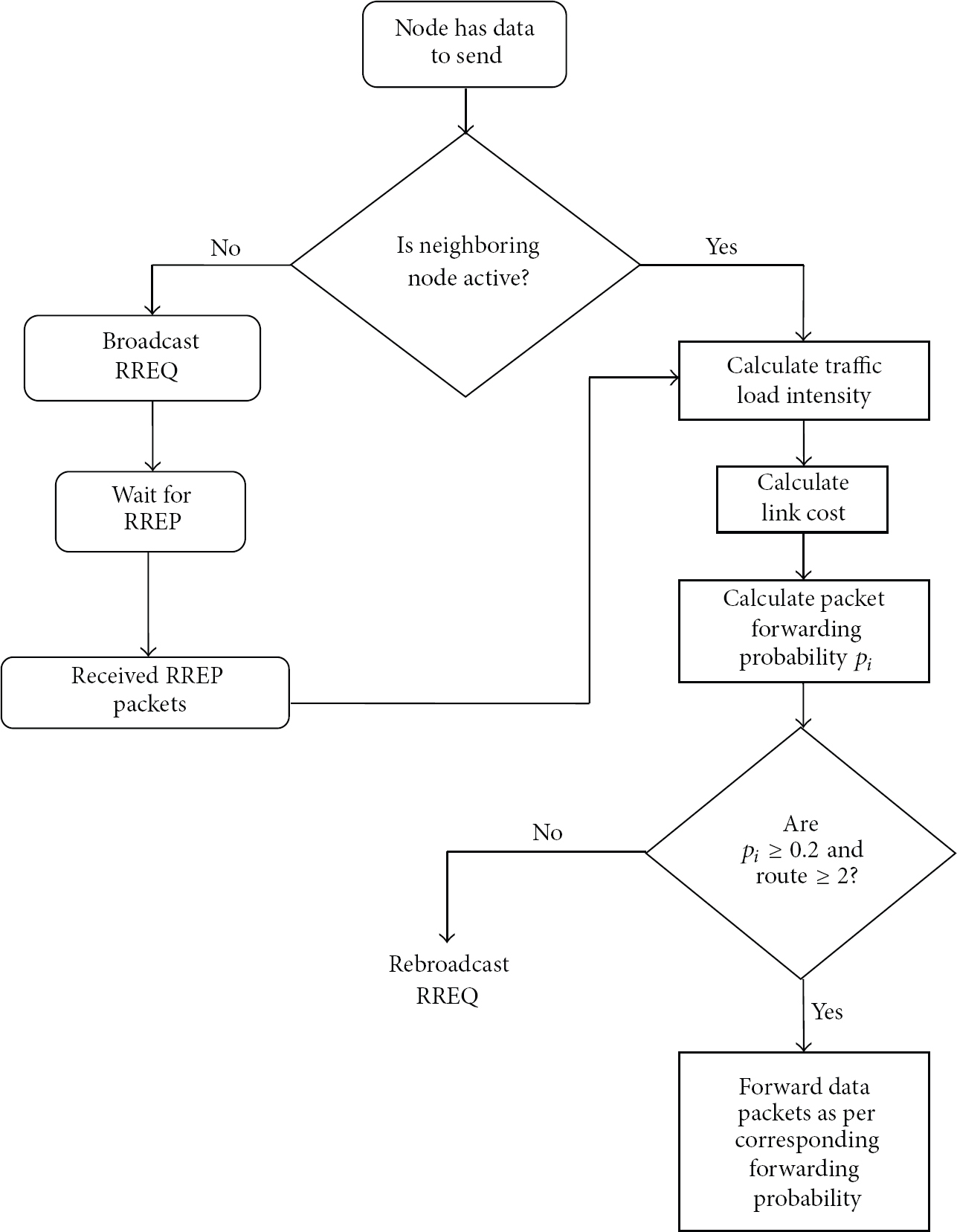
Flowchart of LBCAR processing.
The flowchart is clearly indicative according to the link cost and other parameters being considered for load balancing and congestion adaptivity in the network.
6. Simulation Parameters
6.1. Simulation Setup
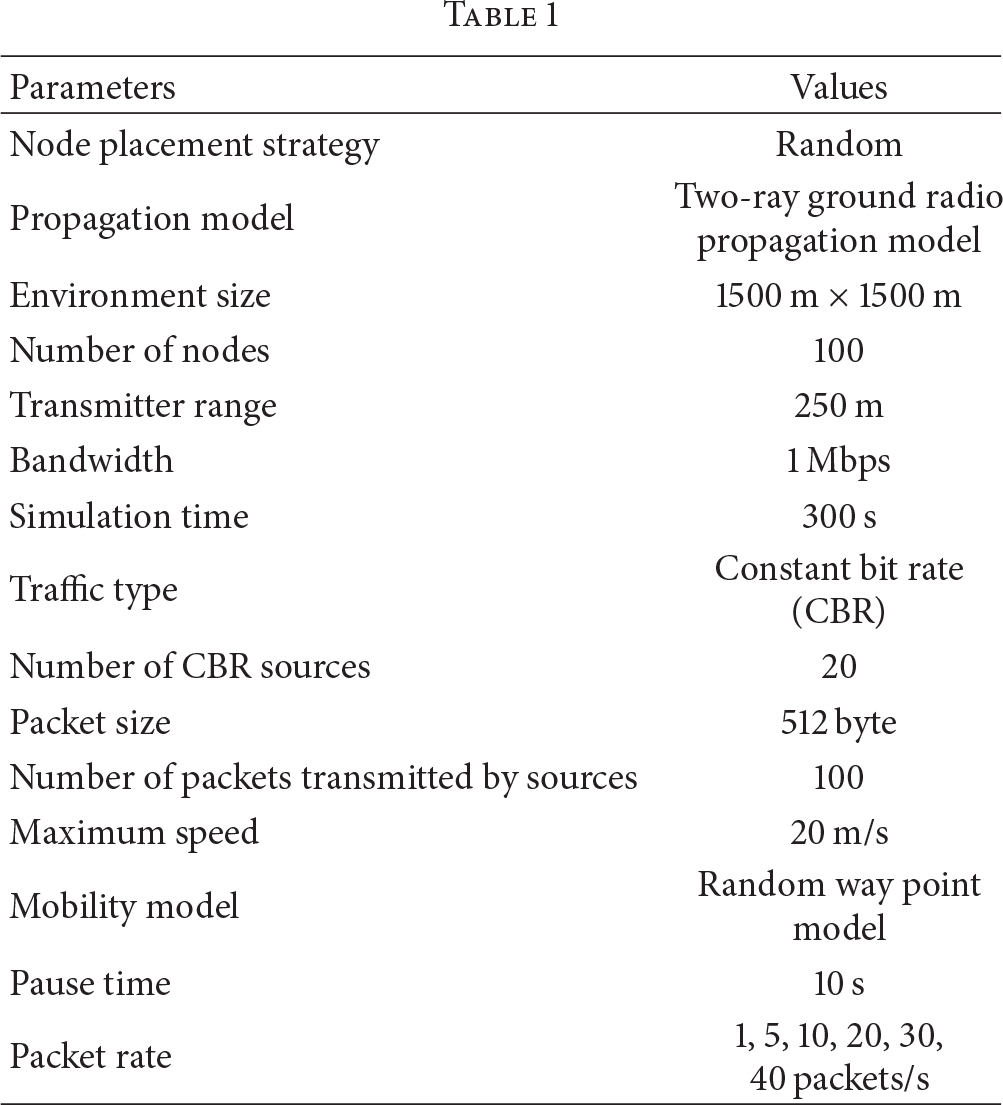
The simulations of network have been carried out using Qualnet 5.2. The simulation parameters are given in Table 1.
6.2. Performance Metrics
In this paper, the performance metrics such as packet delivery ratio, average end-to-end delay, and normalized routing overhead were calculated and evaluated for AODV, CRP, and LBCAR.
6.2.1. Packet Delivery Ratio
Packet delivery ratio is the ratio of the number of data packets successfully received at the destinations to the number of data packets generated by the sources.
6.2.2. Average End-to-End Delay
The average end-to-end delay is a measure of average time taken to transmit each packet of data from the source to the destination. Higher end-to-end delay is an indication of network congestion.
6.2.3. Normalized Routing Overhead
The ratio of the amount in bytes of control packets transmitted to the amount in bytes of data received.
According to the performance parameters and the selected variations for the proposed algorithm the simulation has been undertaken and results are recorded according to the set parameters.
7. Simulation Results
In this paper, the results have been presented by taking average of over 10 runs of each simulation setting. LBCAR has been compared with AODV and CRP.
7.1. Comparison of LBCAR with AODV
Figures 3–5 show packet delivery ratio, average end-to-end delay, and normalized routing load with varying packet rates for AODV and LBCAR. Figure 3 shows packet delivery ratio for AODV and LBCAR with varying packet rates. This figure shows that packet delivery ratio for LBCAR is greater than that of AODV for all values of packet rates. When the traffic load was high, AODV could not handle congestion. The reason, again, was the ability of LBCAR to adapt to network congestion. Figure 3 shows average end-to-end delay for AODV and LBCAR with varying packet rates. This figure shows that LBCAR has nearly the same or somewhat smaller delay as that of AODV. An interesting observation was that the delay variation in LBCAR was less than that of AODV making LBCAR more suitable for multimedia applications. Hence LBCAR outperforms AODV in terms of average end-to-end delay. Figure 4 shows normalized routing load for AODV and LBCAR with varying packet rates. This figure shows that packet delivery ratio for LBCAR is smaller than that of AODV for all values of packet rates. Thus normalized routing overheads have also decreased to an extent. Thus, out of LBCAR and AODV, performance of LBCAR is slightly better than that of AODV in all respects.

Packet delivery ratio at different packet rates.

Average end-to-end delay at different packet rates.
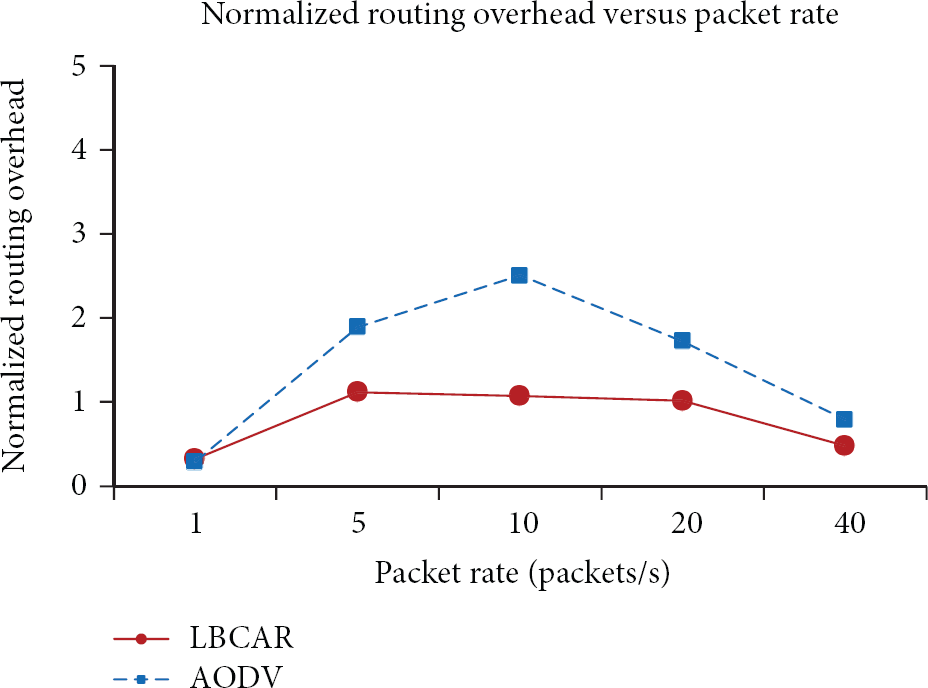
Normalized routing overhead at different packet rates.
7.2. Comparison of LBCAR with CRP
In this section the proposed protocol has been compared with CRP algorithm, as shown in Figures 6–8. Figure 6 shows packet delivery ratio for LBCAR and CRP with varying packet rates. Both routings give almost the same packet delivery ratio except at high packet rates. Figure 7 shows average end-to-end delay for LBCAR and CRP with varying packet rates. LBCAR gives slightly less average delay than CRP. Therefore, LBCAR outperforms CRP in terms of average end-to-end delay. Figure 8 shows normalized routing overhead for LBCAR and CRP with varying packet rates. LBCAR shows higher normalized routing overhead than CRP. Thus LBCAR is outperformed in terms of packet delivery ratio and average delay.

Packet delivery ratio at different packet rates.
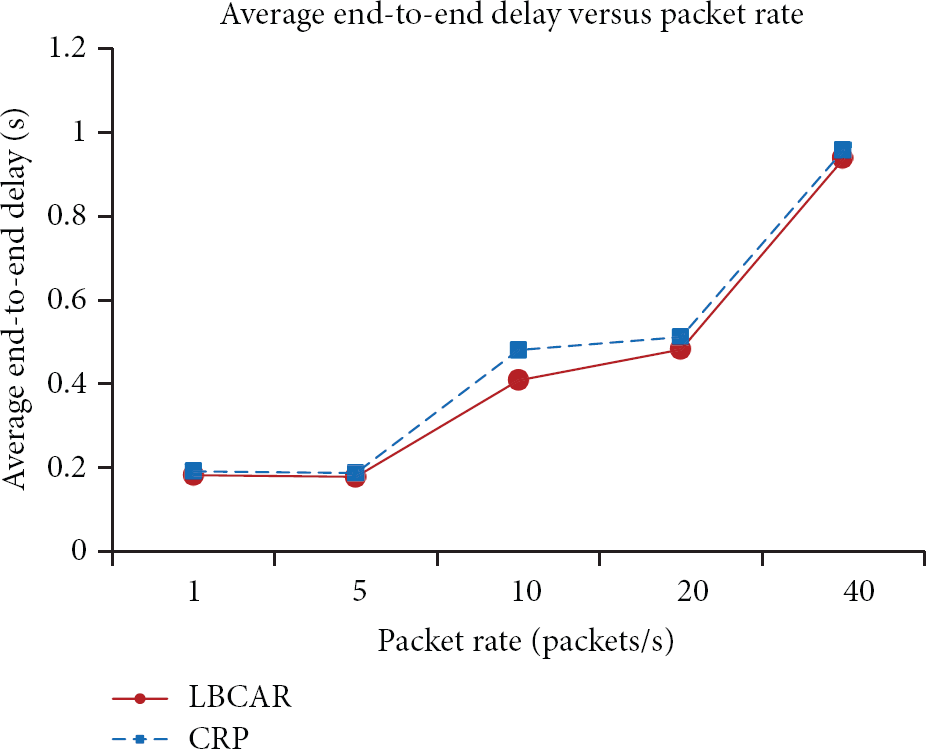
Average end-to-end delay at different packet rates.

Normalized routing overhead at different packet rates.
8. Conclusion
In this paper, a load balanced congestion adaptive routing (LBCAR) has been proposed. The simulation has been done as per parameter selected. The performance of the MANET has been analyzed and compared with AODV in terms of packet delivery ratio, average end-to-end delay, and normalized routing overhead. LBCAR outperformed the AODV and reduced the congestion. LBCAR has also been compared with the congestion adaptive routing (CRP) and it has been found that packet delivery ratio is almost the same in both routing protocols. Average delay is slightly less in LBCAR compared to CRP but normalized routing overhead of LBCAR is higher than that of CRP. The property of LBCAR is its adaptability to congestion. LBCAR enjoys fewer packet losses than routing protocols that are not adaptive to congestion. This is because LBCAR tries to prevent congestion from occurring in the first place, rather than dealing with it reactively. The noncongested route concept in the algorithm helps next node that may go congested. If a node is aware of congestion ahead, it finds a noncongested route that will be used in case that congestion is about to occur. The part of incoming traffic is split and sent on the noncongested route, making the traffic coming to the congested node less. Thus congestion can be avoided and with LBCAR the traffic load is more balanced, and the probability of packet loss is reduced. The results also show the scalability of the protocol having robustness for large network.
Footnotes
Conflict of Interests
The authors declare that there is no conflict of interests regarding the publication of this paper.