




Abstract
We first address the problem of power allocation at cognitive users (CUs) to maximize the throughput of a nonselfish symbiotic cognitive radio scheme, in which the CUs may assist the data transmission of primary users (PUs) via nonorthogonal amplify-and-forward (AF) cognitive relaying and obtain an incentive time for their own data transmission in a nonselfish manner. Then, an optimal power allocation algorithm is proposed based on the full channel state information (CSI) among PUs, CUs, and base station (BS). In order to reduce the feedback overhead, another power allocation algorithm is devised based only on the partial CSI, that is, the CSI of BS-PU and the CSI of BS-CUs. Simulation results demonstrate that, compared with the optimal power allocation algorithm, the power allocation algorithm with only the partial CSI can achieve a similar performance with a smaller channel feedback overhead.
1. Introduction
With underutilized time or frequency resources, the Federal Communications Commission (FCC) has recommended that more efficient spectrum utilization could be realized by implementing devices that can coexist with licensed users or PUs [1]. In consequence, cognitive radio (CR) has been considered as an essential candidate for exploiting spectrum at a higher efficiency [2, 3]. Based on the original CR concept [2], the data transmission of a conventional cognitive radio scheme (CCR) [1] is performed as a passive approach. The CUs need to sense the spectrum and wait for spectrum holes for their data transmission without any interaction between primary and cognitive networks. In this case, there is no need for any modification in the primary network, but, instead, the achievable performance, for example, spectrum efficiency, is quite limited.
The relay systems have been actively studied to increase the throughput as well as to increase the service coverage in wireless networks [4–6]. In order to further enhance the performance of the cognitive network, the relay function is actively enabled at the CUs to assist the primary transmission, which may bring the benefits to the CUs, for example, creating more spectrum holes for the cognitive network. As the CUs with relay function come into play, the optimal power allocation at CUs to increase the spectrum efficiency becomes a critical issue for coexisting primary and cognitive networks [7–13]. However, to efficiently utilize the spectrum holes created by cognitive relaying, some interaction between primary and cognitive networks is inevitable, despite that it may break the rule of original CR concept. (Strictly speaking, this may not be said CR from its original point of view. However, we call it cognitive relaying herein, since CR concept and relay function are combined together.) For instance, rather than a passive approach in CCR, a spectrum leasing algorithm was introduced as an active approach, in which a common control channel was assumed for the CSI exchange and the decision delivery, for example, cooperation parameters and cooperation decision [7]. As a reward for the decode-and-forward (DF) cooperation from CUs, the PU might lease part of its own time slot to the cooperative CUs; herein, a CU that cooperates with a PU is called a cooperative CU, and is the only user that can immediately access the channel in the leased time; accordingly, this type of CU is called a selfish one.
For the selfish scheme in [7], the cooperative CUs might not be the CUs with the best link quality in the leased time. So, allocation of leased time only to the cooperative CUs is inefficient for maximizing the overall throughput of coexisting primary and cognitive networks, especially for the cognitive network. Thus, a nonselfish symbiotic cognitive relaying scheme (NSCRS) [8] was introduced. Owing to the nonselfish behavior, the CUs can selflessly grant a concession to give the incentive time to a CU with the best link quality for better utilization of the incentive time than that in [7]. However, only the constant transmit power is assumed at each CU for the cooperative transmission in [8], which is inefficient at managing the received signal power at the receiver side and controlling the potential interference to the neighbor cell. Even though a suboptimal power allocation algorithm was introduced for a symbiotic cognitive relaying scheme to maximize the throughput of cognitive network in [9], the problem for maximizing the throughput of primary and cognitive networks by optimally allocating power at CUs has not been taken into account.
Originated from the symbiosis in [8, 9], the suboptimal algorithms for joint power allocation, subcarrier allocation, and routing selection were investigated in an orthogonal frequency division multiplexing (OFDM) based symbiotic cognitive relaying architecture to maximize the incentive time [10]. This work was further extended to develop an optimum utility-based decision-making process to allocate the fraction of time to the PU and CUs [11]. In addition, a closed form expression of the outage probability for data transmissions at CUs was presented under the constraint of a target outage probability of primary transmissions [12]. A cross-layer approach was presented to jointly consider optimal relay selection, adaptive modulation and coding, and data-link layer frame size to maximize the transmission control protocol throughput in cognitive networks with limited interference to the primary link [13]. However, all the cognitive relaying schemes in [7, 10–13] assumed the orthogonal transmission at the CUs and the power allocation problem with nonorthogonal AF relaying was not considered.
In this paper, we intend to maximize the overall throughput of NSCRS with the nonorthogonal AF relaying by optimally allocating the power among CUs, while minimizing the required interaction between primary and cognitive networks as well as the overhead of CSI feedback. We first formulate the power allocation problem to maximize the throughput of NSCRS under a sum power constraint at CUs. With the nonorthogonal AF cognitive relaying transmission at CUs, all the amplified noise and interference from multiple CUs are taken into account at PUs, since all the CUs are simultaneously transmitting their amplified signals to PUs. Then, an optimal power allocation algorithm is proposed based on the full CSI feedback. To alleviate the overhead of CSI feedback, another power allocation algorithm is additionally proposed based only on the partial CSI, that is, CSI of BS-PU and BS-CUs. We investigate the performances of NSCRS in three cases: with ideal assumption of full CSI, with partial CSI, and with no CSI for comparative purpose.
The rest of this paper is organized as follows. Section 2 gives a preliminary description of CCR and NSCRS. In Section 3, we formulate the power allocation problems for NSCRS. In Sections 4 and 5, the proposed algorithms are presented and evaluated by intensive simulations, respectively. Finally, Conclusions are drawn in Section 6.
2. Preliminary
In this section, we introduce the system architecture for the coexistence of primary and CR networks as well as the transmission approaches for both CCR and NSCRS.
2.1. System Architecture for Coexistence of Primary and Cognitive Networks
We consider a system architecture with coexistence of primary and cognitive networks, as shown in Figure 1. The primary network is assumed to be a time division multiple access (TDMA)-based cellular network, where the BS transmits the data to the PUs in different time slots. In the cognitive network, the CUs seek opportunities to access the AP of cognitive network. For the cognitive network, only the AP can communicate with the BS and all the CUs can only communicate with the AP. For the symbiotic architecture, the data transmission of CU itself happens only when such CU is allocated with an incentive time, which can be obtained when the CUs provide cooperation to the PUs. In addition, a control channel for CSI exchange and decision delivery, for example, cooperation parameters and incentive time allocation, is considered [7, 8]. In the relay assisted networks, the BS makes the decision for cooperation, for example, power allocation at relays, with the aid of the dedicated pilots for CSI estimation and the specific channels for CSI feedback [14, 15]. However, in the case of NSCRS, to alleviate the overhead of primary network, for example, in terms of signaling exchange, CSI feedback, and decision delivery for cooperation, an AP of the cognitive network is assumed to coordinate the cooperation between primary and cognitive networks rather than the BS or the PU as in [7, 10–15]. In other words, only the AP in the cognitive network can communicate with the BS and all the CUs can only communicate with the AP. For the NSCRS, the CUs are assumed to be able to estimate the CSI of BS-CUs for the cooperation for the PU by sensing the radio environment and detecting the transmitted pilots in the primary network [16]. The CUs may fail to estimate the CSI of CUs-PU, for example, when the PU may report the channel quality information instead of sending the pilots to the BS [17]. In addition, the incentive time in [8–10] was utilized in a segregated manner; that is, CUs immediately take the incentive time after each primary transmission, which requires the CUs to frequently access the AP via signaling for their own data transmission in the segregated incentive times. Thus, the segregated manner in [8–10] may bring a serious amount of overhead on signaling exchange between CUs and the AP of the cognitive network.
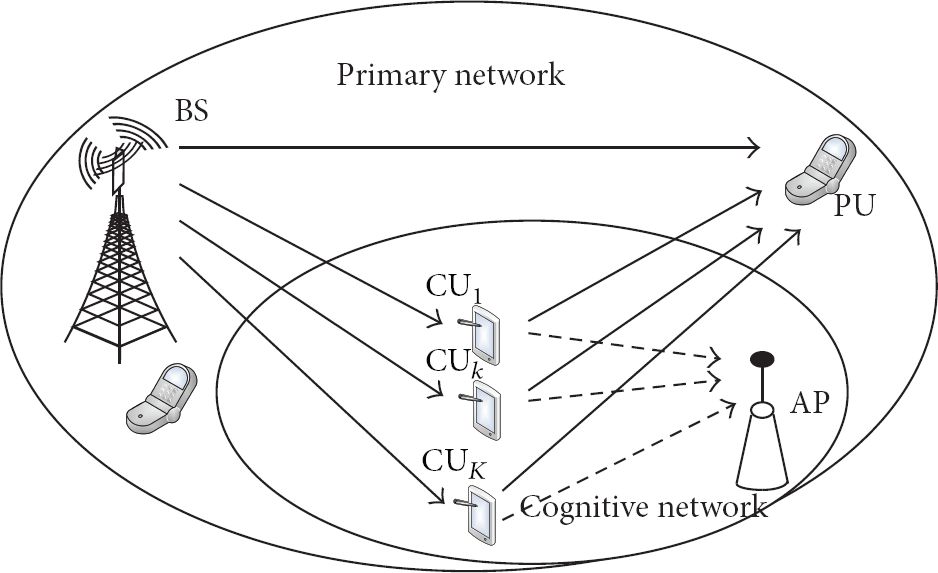
System architecture with coexisting primary and cognitive networks.
2.2. Transmission Approaches for CCR and NSCRS
Figure 2 shows an example of transmission approaches for both CCR and NSCRS. In the CCR, the M PUs, even with poor link quality, fully occupy the time of a data frame, as shown in Figure 2(a). With different number of information bits to receive, dissimilar time durations are reserved for different PUs, for example,

where


Transmission approaches for CCR and NSCRS.
Figure 2(b) shows an example of the transmission approach of NSCRS with a conventional half-duplex (HD) AF relaying, where two phases with identical time duration exist. In the NSCRS, the PUs can obtain the half-duplex AF cooperation from the CUs and, then, a higher level of modulation and coding rate may be adopted to achieve a higher transmission rate; thus, the required time for transmitting the same amount of information from BS to the
3. Problem Formulation for Nonselfish Symbiotic Cognitive Relaying Scheme
3.1. Cooperative Transmission for PU
Figure 3 describes an example of data transmission to the mth

Cooperative transmission for PU.
In phase 1, the BS transmits a signal to CUs and the mth PU. Then, in phase 2, the received signals at CUs are, respectively, amplified and retransmitted to the mth PU, where the nonorthogonal AF relaying is considered and all the CUs are allowed to transmit their signals simultaneously [6]. Delay diversity can be used to combine the received signals from CUs in phase 2; it is assumed that the transmitted signals from CUs may arrive at the PU with different delays. Then, the mth PU can coherently combine the entire received signals along the paths by the Rake receiver with maximum ratio combining (MRC) in phase 2 [19]. Thanks to the excellent autocorrelation property of well-designed spreading code or interference cancellation, the interference at the PU from CUs can be neglected [19, 20]. Then, the received SNR at the mth PU with cooperation from CUs,


where
For the NSCRS, if

where the function
3.2. Transmission in Incentive Time
Let

Then, the remaining time of the mth PU,

To maximize the transmission rate in the aggregated incentive time, the aggregated incentive time is allocated to a CU with the highest transmission rate to the AP among the entire set of CUs.
Thus, the
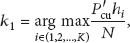
where
3.3. Problem Formulation for NSCRS
Now, we intend to maximize the throughput of NSCRS by optimally allocating the power to the CUs, where the throughput is defined as the total number of transmitted bits divided by the measurement time. In the NSCRS, the same amount of information of PUs as that is transmitted in the CCR, for example,


The objective function of (9a) aims to maximize the throughput of NSCRS by optimally allocating the power of
With the assumption of slow fading, the value of


Due to the TDMA nature for the cooperative transmissions to PUs,


According to (6), we can further simplify the problem of (11a)-(11b) as


Thus, the optimization problem of (9a)-(9b) finally can be simplified into the power allocation problems to individually maximize the transmission rate to PUs by optimally allocating the power at CUs as in (12a)-(12b).
According to (5), we can decompose the optimization problem of (12a)-(12b) into two cases.
Case 1.
Consider
Case 2.
Consider
In Case 1, the objective function of (12a) becomes a constant value of


4. Proposed Power Allocation Algorithm with Full or Partial CSI Feedback
If the CUs can estimate the CSI of
4.1. Optimal Power Allocation Algorithm in Scenario 1
For Case 1, we have the optimal solution of
Proposition 1.
With a sum power constraint at CUs, that is,

Proof.
Owing to the constant power consumption of
Proposition 1 implies that the optimal solution for the problem of (13a)-(13b) can be obtained by allocating full available power of CUs to a single CU, as shown in (14), rather than allocating the power in a shared manner among CUs. Consequently, a complicated power allocation problem is reduced to a simple CU selection problem, which is very desirable for practical implementation. For Case 2, the highest transmission rate is achieved at the mth PU by allocating full power of

Thus, the corresponding transmission rate at the mth PU can be calculated as
For (1) Collect (2) Calculate optimal power at CUs and corresponding transmission rate in Case 2 by (15). (i) (ii) (3) Decide the optimum power at CUs by comparing the maximum transmission rate in Cases 1 and 2. (i) If (ii) Else, then (4) AP informs CUs of the allocated power with
For the OPA, since only the index of the selected CU, that is,
4.2. Power Allocation Algorithm in Scenario 2
Although the proposed optimal power allocation algorithm in Scenario 1 maximizes the throughput of NSCRS, the full CSI of
For Case 2, if the link qualities from CUs to the mth PU are assumed to be much better than those from BS to CUs, that is,

Obviously, the solution for the problem of (16) can be obtained by allocating

And the corresponding received SNR at the mth PU can be given as

Thus, a power allocation algorithm based only on partial CSI, that is,
For (1) Collecting (2) Calculate optimal power at CUs and corresponding transmission rate in Case 2 by (17). (i) (ii) (3) Decide on the optimum power at CUs by comparing to the mth PU is effective or not. (i) If (ii) Else, then (4) AP informs CUs of the allocated power by
Similar to the OPA, only one CU, that is, the
4.3. Working Procedure for NSCRS with OPA or PPA
Figure 4 shows the working procedure for NSCRS with OPA or PPA. A BS intends to transmit data to M PUs in a TDMA manner and the CUs can actively monitor the radio environment and estimate the CSI by detecting the transmitted pilots in the primary network [16]. We also assume the system works at a time division duplex (TDD) manner to alleviate the CSI feedback overhead, where the channel reciprocity is preserved [21]. The CUs are able to estimate

Working procedure for NSCRS with OPA or PPA.
5. Simulations and Results
Figure 5 shows the simulation model for the coexistence of primary and cognitive networks. BS, PU, AP, and CUs are placed within a 2-dimensional region (

Simulation model for coexistence of primary and cognitive networks.
Figure 6 compares the average throughput of CCR and NSCRS with different power allocation algorithms, that is, OPA, PPA, and EPA, by varying the power constraint of
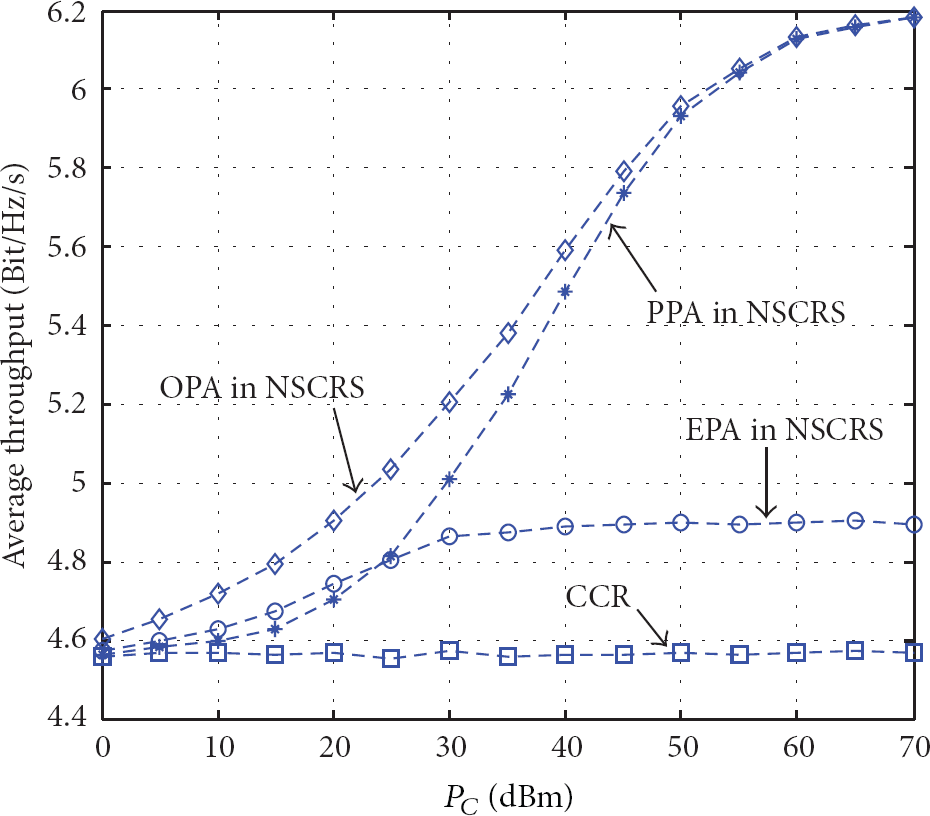
Average throughput for CCR and NSCRS in the cases of OPA, PPA, and EPA by varying the power constraint of
Figure 7 compares the average ratio of aggregated incentive time in a frame in the cases of OPA and PPA as a function of the number of CUs. The average ratio of aggregated incentive time in the measurement time is defined as

Average ratio of aggregated incentive time in the measurement time for both OPA and PPA as a function of the number of CUs.
Figure 8 shows the normalized average power consumption at the BS for both OPA and PPA with different numbers of CUs. The average transmitting power consumption at the BS in the case of OPA or PPA is normalized to that of CCR, where the same amounts of information bits are assumed to be transmitted to the PUs in the cases of CCR, OPA, and PPA. With a larger number of CUs, the possibility to achieve a higher transmission rate for the PUs increases, which results in a shorter transmission time at the BS. Thus, the power consumption at the BS decreases as the number of CUs increases. At low
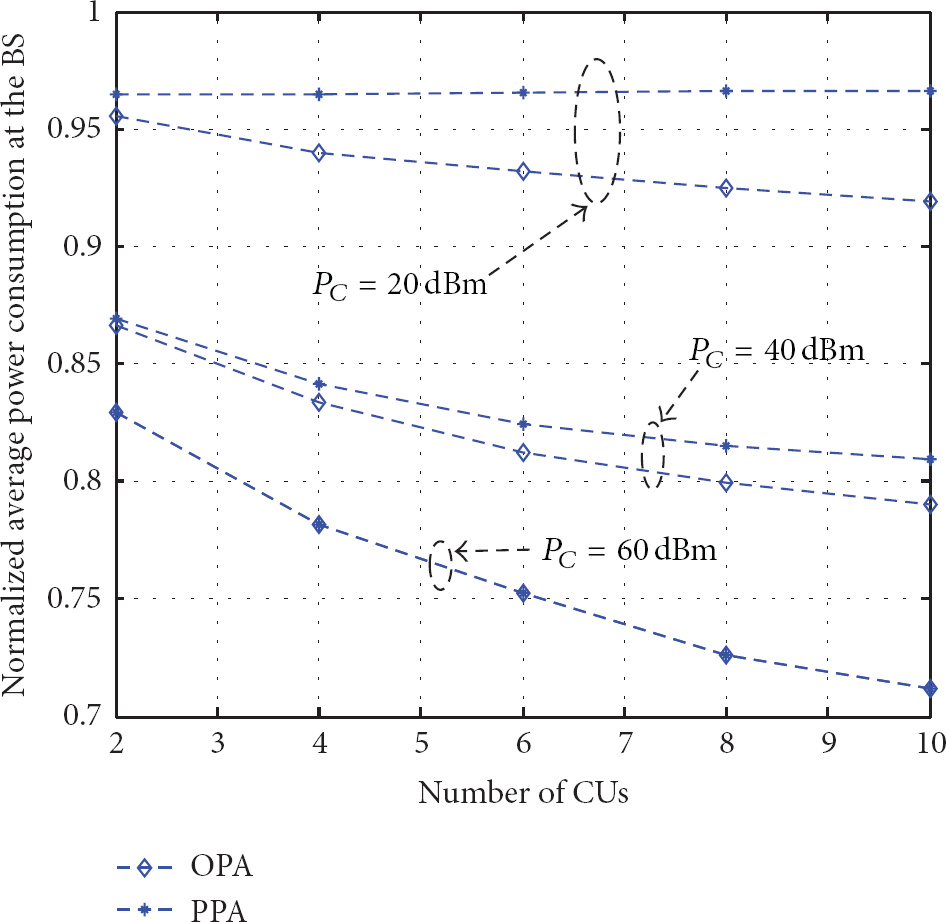
Normalized average power consumption of PU in OPA and PPA as a function of the number of CUs.
Table 1 compares the three algorithms of OPA, PPA, and EPA in detail. Owing to the full CSI feedback to the AP, that is,
Comparisons of OPA, PPA, and EPA in NSCRS.

We can consider the OPA as the ideal cognitive relaying case, since all of the CSI is available for power allocation. However, in the NSCRS, the CSI of BS-CUs and the CSI of CUs-PU mainly rely on the radio environment monitoring and the detection on the pilots from primary networks at CUs [16]. In addition, the selection criterion for the PPA depends on the long-term observation of link qualities among BS, CUs, and PUs and whether the CUs can estimate the CSI of CUs-PU by detecting the pilots from PUs or not. In practice, the PPA may just need to measure the path loss and the shadowing attenuations by some kind of sliding window measurement and then periodically reports the link qualities to the AP of cognitive network, especially in a slow fading environment. When the link qualities from CUs to PUs are much better than those from BS to CUs in a long-term observation, the PPA can be chosen to reduce the complexity in terms of the CSI feedback compared to the OPA. When the CUs fail to estimate the CSI of CUs-PU, for example, when the PU sends the CQI rather than the pilots [17], the PPA can be a more appropriate power allocation algorithm for the NSCRS.
6. Conclusions
We first devised an optimal power allocation algorithm for the throughput maximization of NSCRS with nonorthogonal AF cognitive relaying based on the full CSI among BS, PUs, and CUs. Moreover, a suboptimal power allocation algorithm was further proposed for the NSCRS with only the partial CSI, that is, CSI of BS-PU and CSI of BS-CUs. Simulation results demonstrated that the proposed power allocation algorithm based only on the partial CSI is able to work effectively with a smaller feedback overhead compared to the optimal power allocation algorithm with full CSI. In addition, we also found that the optimal power allocation problem among CUs can be simplified into a single CU selection problem. So, only the index of the selected CU is required to be fed back in both proposed power allocation algorithms, which results in a smaller feedback overhead and makes those methods desirable for the practical implementation.
Footnotes
Conflict of Interests
The authors declare that there is no conflict of interests regarding the publication of this paper.
Acknowledgments
This research was supported in part by Basic Science Research Program through the NRF (NRF-2013R1A1A2A10059215), National Natural Science Foundation of China (the no. 61201180), Beijing Natural Science Foundation (the no. 4132055), and the Excellent Young Scholars Research Fund of Beijing Institute of Technology.