




Abstract
In order to accurately identify the change of shearer cutting load, a novel approach was proposed through integration of improved particle swarm optimization and wavelet neural network. An improved updating strategy for inertia weight was presented to avoid falling into the local optimum. Moreover, immune mechanism was applied in the proposed approach to enhance the population diversity and improve the quality of solution, and the flowchart of the proposed approach was designed. Furthermore, a simulation example was carried out and comparison results indicated that the proposed approach was feasible, efficient, and outperforming others. Finally, an industrial application example of coal mining face was demonstrated to specify the effect of the proposed system.
1. Introduction
Nowadays, coal machinery and electrical parts are usually damaged because of the uncertainty of cutting load change in the process of complex coal mining. Moreover, many safe accidents in collieries are caused by the change of shearer cutting load. Thus, an efficient identification approach for shearer cutting load is a challenging issue and decides whether the coal can be mined with high efficiency and low risk.
Due to the poor working conditions of coal mining, direct identification approaches for shearer cutting load are hard to be presented, so several indirect identification methods are proposed through some physical quantities reflecting shearer cutting load such as cutting current, cutting shaft torque, and other associated variables [1, 2]. However, the disadvantage of cutting shaft torque is vulnerable to outside interference and the cutting current can be detected by current sensors with strong antijamming [3]. Therefore, the shearer cutting loads identification method based on cutting current has become an active research field since the latest decades.
Many researchers have worked on the problem and proposed different solutions. However, most of them have worked on the qualitative relationship between cutting current and cutting load, and few researchers study the quantitative relationship between cutting current and cutting load [1]. To the best of our knowledge, the quantitative relationship has almost not been dealt with. Considering the nonlinearity and fuzziness of quantitative relationship, artificial intelligent (AI) algorithm would be an effective way to solve the problem. Based on the past work on particle swarm optimization and wavelet neural network, this paper tries to tackle this problem.
Bearing the above observation in mind, we apply an integration approach of improved particle swarm optimization and wavelet neural network to solving the problem of shearer cutting load identification and the rest of this paper is organized as follows. In Section 2, some related works are outlined based on literatures. Section 3 describes the integration approach of improved particle swarm optimization and wavelet neural network and designs the flowchart of proposed algorithm. Section 4 provides a simulation example and carries out the comparison with other algorithms to verify the feasibility, efficiency, and outperforming others. An industrial example of mine automation production based on proposed system was demonstrated to specify the application effect in Section 5. Our conclusions and future work are summarized in Section 6.
2. Literature Review
Recent publications relevant to this paper are mainly concerned with two research streams: shearer cutting load identification approach and wavelet neural network. In this section, we try to summarize the relevant literatures.
2.1. Shearer Cutting Load Identification Approach
For shearer cutting load identification approach, many researchers had worked on the problem and proposed different solutions since the last decades. England and the Mine Bureau of the United States studied the cutting drum automatic adjustment methods based on the pick stress and judged cutting load changes by analyzing the stress of cutting picks on the simulation test platform [4–6]. An experimental approach was presented to identify cutting load by cutting shaft torque and analyzed the cuttability assessment of different coal and rock [7]. The cutting status could be judged by the use of the adjustable high oil cylinder pressure and the automatical adjustment of height of drum could be realized [8]. The interface of the coal and rock through the analysis of relationship between the torsional vibration signal and cutting force was identified and studied [9]. The drum output torque and rotational speed of constant power shearer were controlled and identified by contact sensing technology of magnetorheological fluid through the simulation test [10]. The cuttability of different kinds of rock and cutting performance of different cutting picks through the basic principle of torque and bending strain reflecting cutting force were studied [11–13].
2.2. Wavelet Neural Network
Traditionally, AI-based algorithms such as artificial neural network [14–17], particle swarm optimization algorithm [18, 19], wavelet neural network [20–22], and some coupling algorithms [23–25] were used to solve the problems with nonlinearity and fuzziness. In fact, as a perfect integration approach of wavelet transform and neural network, wavelet neural network could solve complex nonlinear systems in a manner of high nonlinear mapping ability, fine local characteristic, and better generalization performance compared with traditional neural network [26–28]. As a vital task of WNN, the network parameters have a great influence on the generalization performance and prediction effect, and the process of parameters selection was complex and would consume vast calculation time. Applying traditional gradient descent methods in parameters selection could cause local extremum and slow the convergence speed. Thus, several AI-based algorithms were proposed to solve this problem such as basic particle swarm algorithm [29–31], BP algorithm [32], and genetic algorithm (GA) [33, 34].
2.3. Discussion
However, although many approaches to identify and detect shearer cutting load and some simulation and prediction methods for nonlinear problems have been proposed in the above literatures, they have some common disadvantages summarized as follows. Firstly, the usual method through cylinder pressure to reflect the change of cutting load is suitable for specific shearer and it is needed to update the relation model for a new type of shearer. Secondly, the methods through analyzing the stress of cutting picks and torque senor signal to identify the shearer cutting load are only realized on the simulation test platform, and these data usually cannot be acquired from the poor mining environment. Finally, few researches have focused on the three-dimensional mapping model for shearer cutting load identification.
In this paper, an integration approach based on improved particle swarm optimization and wavelet neural network is proposed to identify the shearer cutting load. Simulation example and comparison with other algorithms are carried out, and the proposed approach is proved to be feasible and efficient.
3. The Proposed Approach
In order to formulate the problem in mathematical expression, the following notations are introduced first:
zi: the sequence of input signal,
h(j): output of hidden layer node j,
ω ij : connection weight of input and hidden layer,
ω jk : connection weight of hidden and output layer,
J(x): wavelet basis function,
aj: expansion factor of hidden layer j,
bj: shift factor of hidden layer j,
l: number of hidden layer nodes,
m: number of output layer nodes,
k: number of input layer nodes,
X i : position of particle i,
V i : update rate of particle i,
K: number of training samples,
fi: fitness of particle i,
ya: network output of sample a,
qa: desired output of sample a,
P i : individual minimum of particle i,
P g : global minimum of all particles,
M: initial particle population size,
n: current iteration time,
C1, C2: learning factors,
R1, R2: random numbers,
ω: inertia weight factor,
v max : maximum update rate of particles,
T: maximum iteration time,
Minerr: iteration termination error,
f max : maximum fitness of each iteration particle,
favg: average fitness of each iteration particle,
favg′: average fitness of particles for fi < favg,
ω max : maximum of inertia weight,
ω min : minimum of inertia weight,
affu,w: affinity between particles u and w,
cu: concentration of particle u,
S: memory library,
W1: 20% of particles with higher concentration except max concentration,
W2: 10% of particles with lowest concentration.
3.1. Parameters Optimization through Particle Swarm Optimization
On the basis of BP neural network topology structure, wavelet neural network, regarding the wavelet basis function as transfer function of the hidden layer nodes, is a neural network with signal forward transmission and error backpropagation. The topology structure is shown in Figure 1.

Topology structure of WNN.
The shearer cutting load is determined by the motor current and speed. In the proposed approach, the input signals are the motor current and speed, and the output signal is the shearer cutting load.
The output of hidden layer and WNN can be calculated as follows:

In particle swarm optimization (PSO), each potential solution for an optimization problem can be regarded as a “particle” in the search space. The parameters of WNN (ω ij , ω jk , aj, and bj) form a D = l·(k + m + 2) dimensional search space and each parameter value expresses the position of a particle. So the vector of particle i is X i = (xi1,xi2,…, x iD ) and the update rate is V i = (vi1,vi2,…, v iD ). The fitness of particle can be evaluated by the following mean square error energy function:
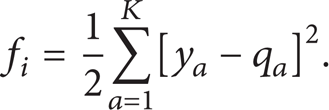
The individual extremum is P i = (pi1,pi2,…, p iD ) and the global extremum of particle swarm is P g = (Pg1,Pg2,…, P gD ). The particles can be updated as follows:

In the process of particles updating, in order to prevent particles away from search space, the update rate v id must be restricted between -v max and v max . An appropriate v max can not only guarantee the global search ability but also refine the local search ability of particle swarm.
3.2. Improved Updating Strategy for Inertia Weight
In PSO, inertia weight ω has great influence on the optimal performance. Larger value of ω can enhance the global search ability and smaller value of ω can improve the local search ability. Generally, the updating method is a linear decreasing weight strategy described as follows:

However, in the linear updating strategy, ω is only relevant to the iterative times and cannot adapt to the characteristics of complexity and high nonlinearity. If the problem is extremely complicated, the global search ability is insufficient in the later iteration.
In order to overcome the above defect, one improved method for PSO is proposed, which can perfect the updating strategy for inertia weight ω. Inertia weight ω can be specially updated as follows:

where f max is the maximum fitness of each iteration particles and can be determined easily. favg is the average fitness of each iteration particles and favg′ is the average fitness of particles whose fitness values are smaller than favg. They can be calculated through the following formulas:

Obviously, inertia weigh ω of excellent particles should be decreased in order to avoid skipping the global optimum. For ordinary particles, inertia weigh ω is not adjusted as they own fine search ability. For some particles with greater fitness, inertia weigh ω should be increased properly to tend to better search space. This improved strategy can not only ensure the convergence of PSO algorithm but also effectively balance the global and local search ability.
3.3. Immune Mechanism
Although the ability of search optimum solution has been improved through the improved updating strategy for inertia weight, there still are the problems such as the unicity of particle type and lack of diversity. Due to the unique antibody promotion, suppression mechanisms, and immune memory function, immune algorithm can keep the diversity of antibody in the iteration course and enhance the global search ability. Thus, the information-processing mechanism based on immune algorithm is applied to improving the proposed approach. In order to describe this mechanism, the concepts of affinity and concentration are defined firstly.
Definition 1 (affinity). The affinity between immune particles u and w reflects their similarity degree and can be defined as follows:
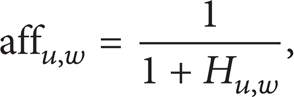
where Hu,w is the 2-norm distance between the two immune particles in Euclid space and can be described as follows:
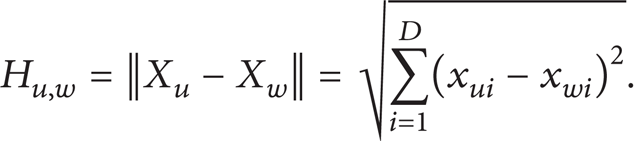
Definition 2 (concentration). The concentration of particle u can be defined as follows:

In the immune algorithm, two important operations are presented to overcome the problems on unicity of particle type and lack of diversity.
Immune memory is that 10% of optimal particles are selected and stored as memory particles into memory library S before particles updating, and the particles with greater fitness will be replaced by the stored particles after particles updating.
Immune regulation is that 20% of particles with higher concentration except max concentration will be replaced by the random particles to strengthen the linking of different swarms and assure the diversity of particles in the course of evolution.
3.4. Flowchart of the Proposed Approach
According to the above description about the improved particle swarm optimization based algorithm, the proposed approach is an iterative algorithm and can be coded easily on the computer, and the flowchart can be summarized as shown in Figure 2.
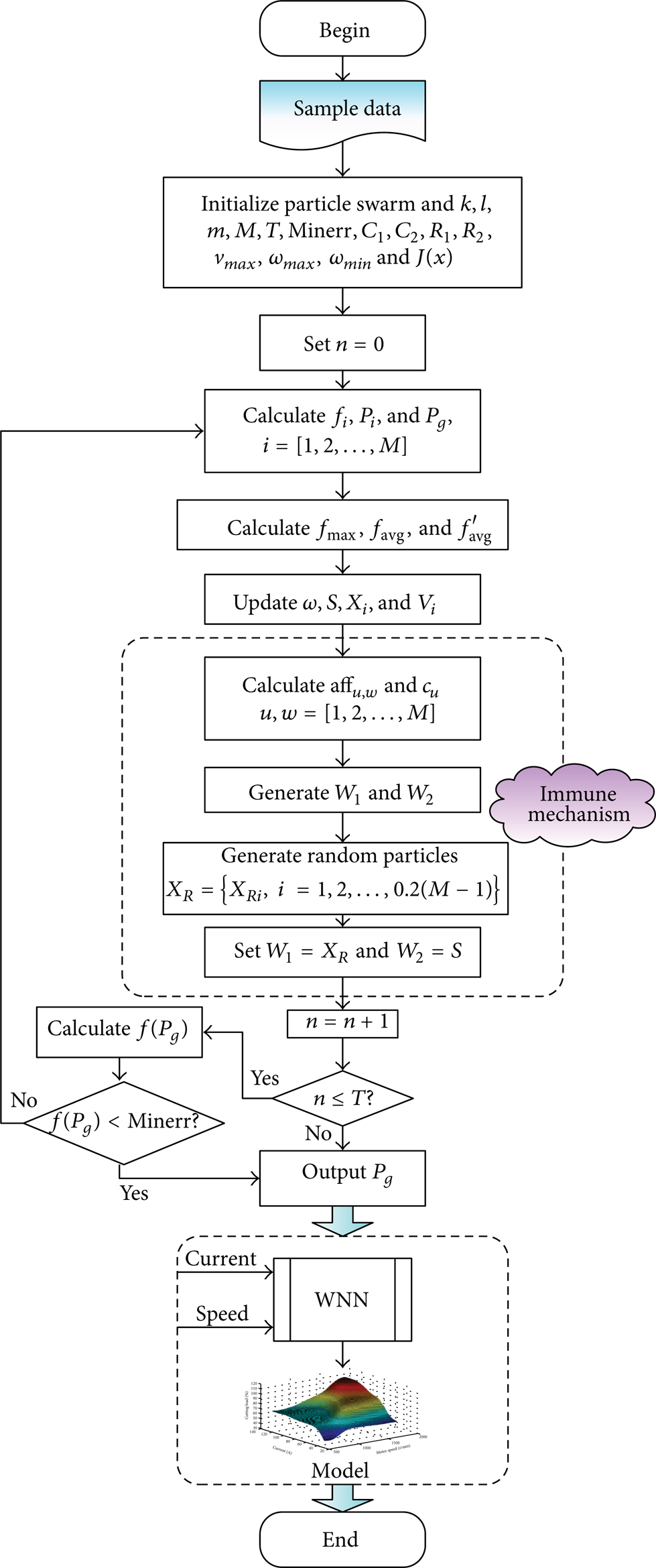
Flowchart of the proposed approach.
4. Simulation Example and Discussion
In this section, a simulation example was put forward to verify the feasibility and efficiency of the proposed approach. The relation model of motor speed and current and cutting load was established and the shearer cutting load could be effectively identified by the motor current through the relation model. Then, the comparison of three algorithms was provided to prove the outperforming others of the proposed approach.
4.1. Sample Data Preparation
The sample data were acquired from a motor load simulation test platform in the electric branch factory of Xi'an Coal Mining Machinery Co. Ltd, as shown in Figure 3. The test platform was mainly composed of motor loading device and motor speed governing device which were used to regulate the motor speed and current, as shown in Figure 4.
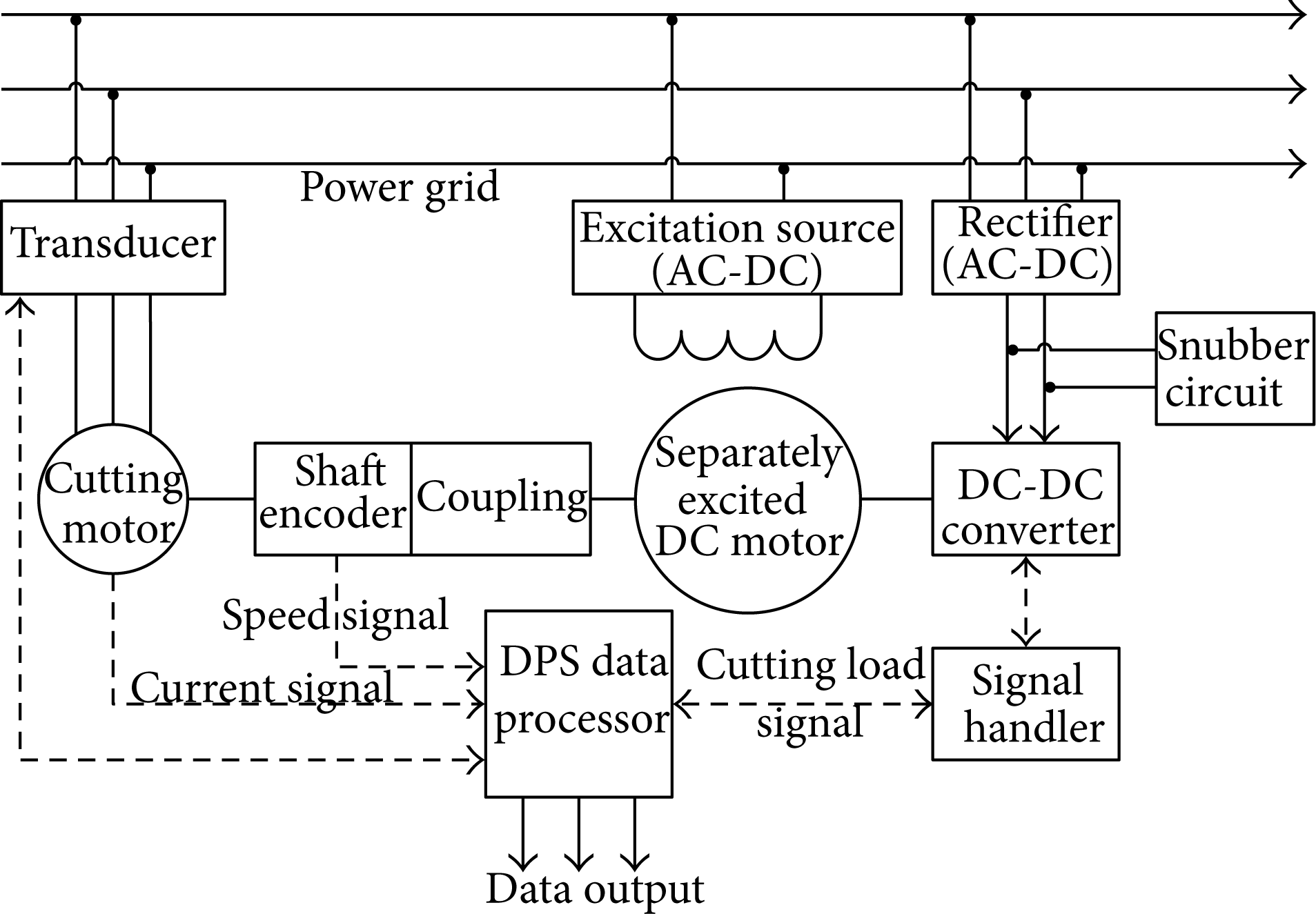
Principle of motor load simulation test platform.

The main devices to regulate the motor speed and current.
In order to specify the noise level of collected signals from the above test platform, such as current signal, we had researched the problem of system noise through wavelet analysis. The research results indicated that the system noise fluctuated in the interval of [−1, 1] and had little impact on the subsequent application of cutting current signal, as shown in Figure 5. The collected signals could be directly used as the sample data and were listed in Table 1.
Sample data from simulation test platform.
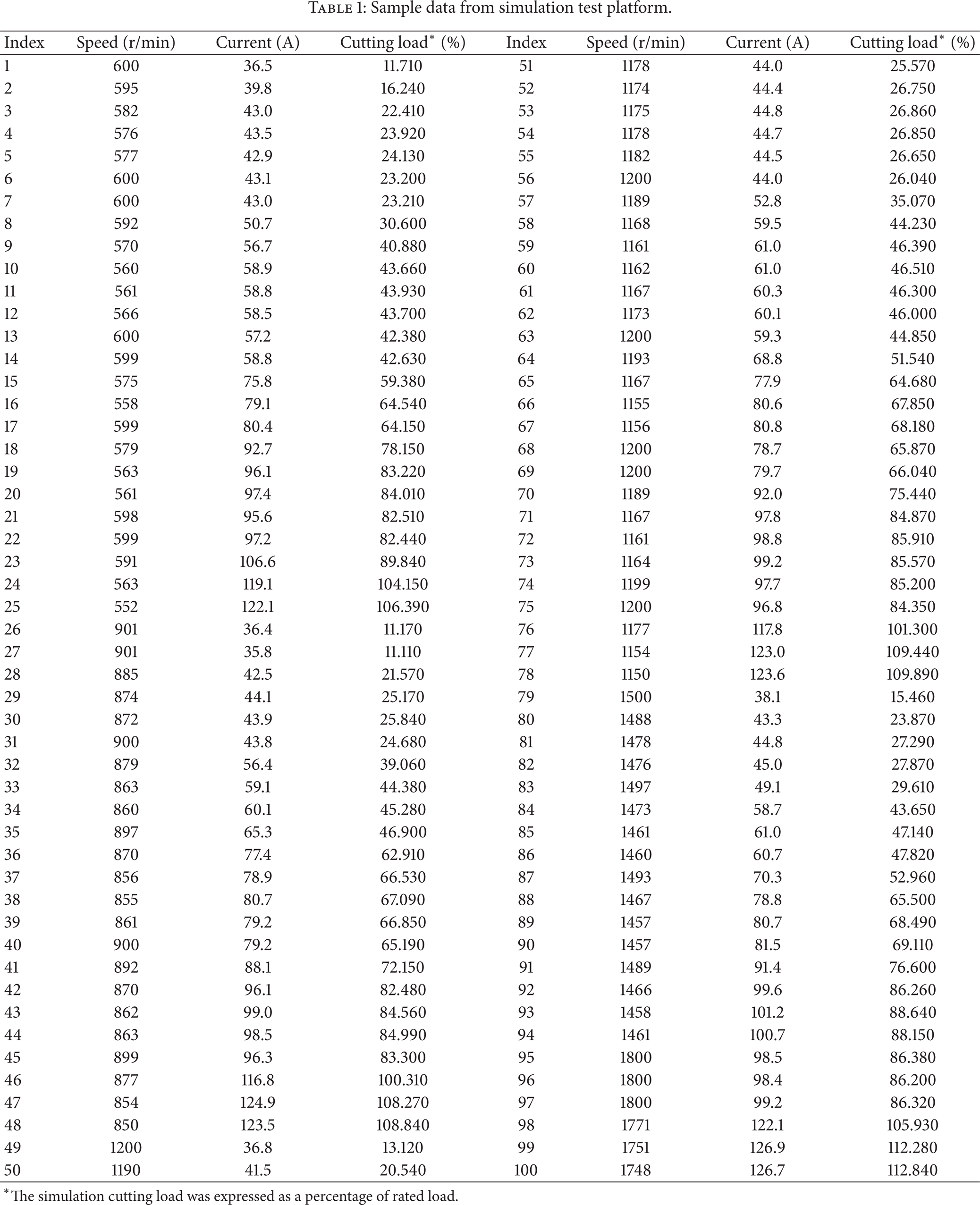
The simulation cutting load was expressed as a percentage of rated load.
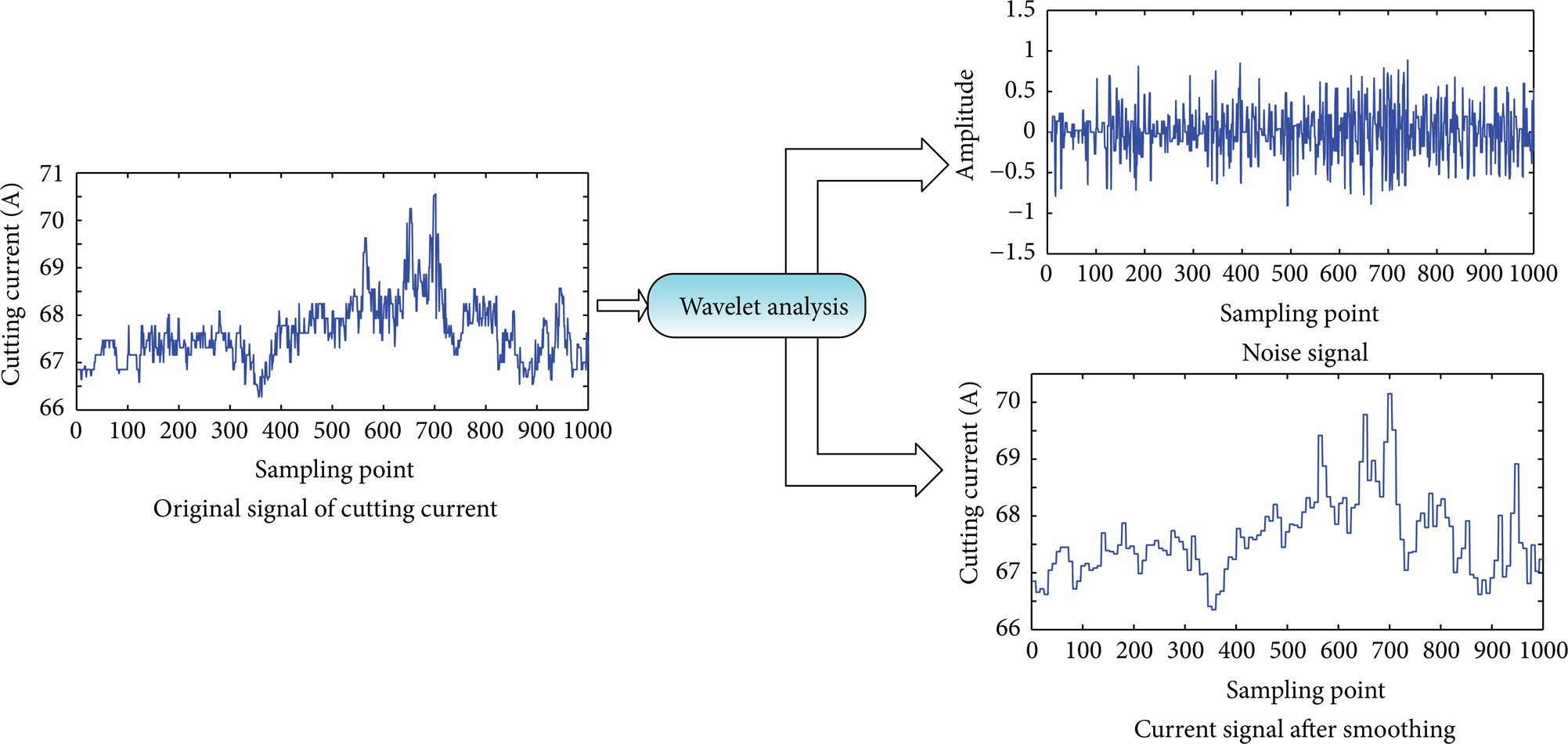
Noise analysis for input signal.
4.2. Parameters for the Simulation Example
The parameters of ω
ij
, ω
jk
, aj, and bj were optimized by the improved particle swarm optimization algorithm. In this simulation example, input layer nodes included motor speed and current, and output layer node was the shearer cutting load, so k = 2 and m = 1. The data sets in Table 1 were used as training sample for selecting network parameters. The training time and training deviation (fitness of P
g
) were presented as the selection criteria of network parameters and the iteration times for selecting parameters were set as 1000. The values of parameters greatly affected the quality of solution and searching speed, and the influence of parameters l, C1, C2, M, and v
max
on the performance of the proposed algorithm was shown in Figure 6. It was observed that the optimal solution could be achieved with proper values of l, M, and v
max
. If C1 and C2 were equal or greater than 1.6, the training time did not significantly decrease and the training deviation obviously increased. ω
max
and ω
min
were two parameters which affected the change of inertia weight and could be determined though the experience and some literatures. Minerr and T were constants which were determined by several simulation results and experience. Generally, there were several kinds of wavelet basis function. Due to the reasons that state that the adjusted parameters had a linear relation with the output of network and could be optimized easily, Morlet wavelet function was applied in our paper. Therefore, in this simulation example, the parameters of the proposed algorithm were configured as follows: K = 2, l = 12, m = 1, M = 16, T = 1000, Minerr = 0.01, C1 = C2 = 1.6, R1 and R2 are random numbers, ω
max
= 0.9, ω
min
= 0.1, v
max
= 0.85, and

Influence of parameters on the performance of the proposed algorithm.
4.3. Simulation Results
The sample data in Table 1 were run in the above approach elaborated in Section 3. After about 725 times of iteration, the training deviation was smaller than termination error and the iteration was stopped. Then, in order to improve the commonality of proposed method, the trained model was applied to obtain the corresponding values of motor current and shear cutting load under arbitrary motor speed ranging from 500 to 1800 r/min, and the “speed-current-load” relation model was further established as shown in Figure 7.

Relation model of “speed-current-load” through the proposed algorithm.
In actual mining process, the cutting motor speed was usually constant for a specific shearer, and then a 2D relation curve of current and load would be obtained. Therefore, the shearer cutting load could be effectively identified by the current of cutting motor through the above relation model. For any type of shearer, it was unnecessary to resample and retrain the relation model, and this demonstrated the favorable commonality of proposed method.
In order to verify the accuracy of the relation model, other 50 samples of experiment data were presented and compared with the prediction data from the relation model, as shown in Figure 8. The average deviation was 2.02% and the maximum deviation was 6.32% which satisfied the accuracy requirement.

Comparison of proposed approach output and experiment data.
To illustrate the application effect in actual mining condition of the proposed approach, 40 groups of data collected from the controllers on four different types of shearers (with speeds of 1440, 1460, 1470, and 1485) were used to test the relation model. These collected data were shown in Table 2, and the contrast of prediction values and actual values was shown brightly in Figure 9.
The collected data from the coal face.

The cutting load was expressed as a percentage of rated load.

The contrast of prediction values and actual values in actual mining condition.
The above illustration revealed that the maximum relative error of the proposed method was 6.64% and the average error was 2.88% which satisfied the engineering requirements. The testing results indicated that the proposed approach performed with lower deviation and could be applied in the identification of shearer cutting load.
4.4. Discussion
In order to differ from the basic PSO and the improved PSO, we called the basic PSO as BPSO and the improved PSO was named after IAPSO (immune adaptive particle swarm optimization). The two algorithms were used to optimize the parameters of WNN and, respectively, formed the algorithms of BPSO-WNN and IAPSO-WNN.
In this section, WNN, BPSO-WNN, and IAPSO-WNN were provided to solve the problem of the above simulation example. The data in Table 1 were the training samples and the data in Table 2 were the testing samples to verify the identification effect of various methods after they were trained. The configurations of simulation environment for three algorithms were uniform and in common with the above simulation example.
In order to avoid the random error, each algorithm run 100 times and calculated the average values. The average deviation, max deviation, training deviation, percent of best solution, and simulation time of three algorithms were shown in Table 3.
Comparison of WNN, BPSO-WNN, and IAPSO-WNN.

It was observed that the performance of IAPSO-WNN was better than BPSO-WNN and WNN. Through the application of improved updating strategy for inertia weight and immune mechanism, the IAPSO-WNN algorithm performed with lower average deviation, max deviation, training deviation, and higher solution quality although the simulation time was unremarkably longer than others, and the outperforming others of proposed algorithm were verified.
5. Industrial Application
In this section, a system based on proposed approach had been developed and applied in the field of coal mining face as shown in Figure 10.
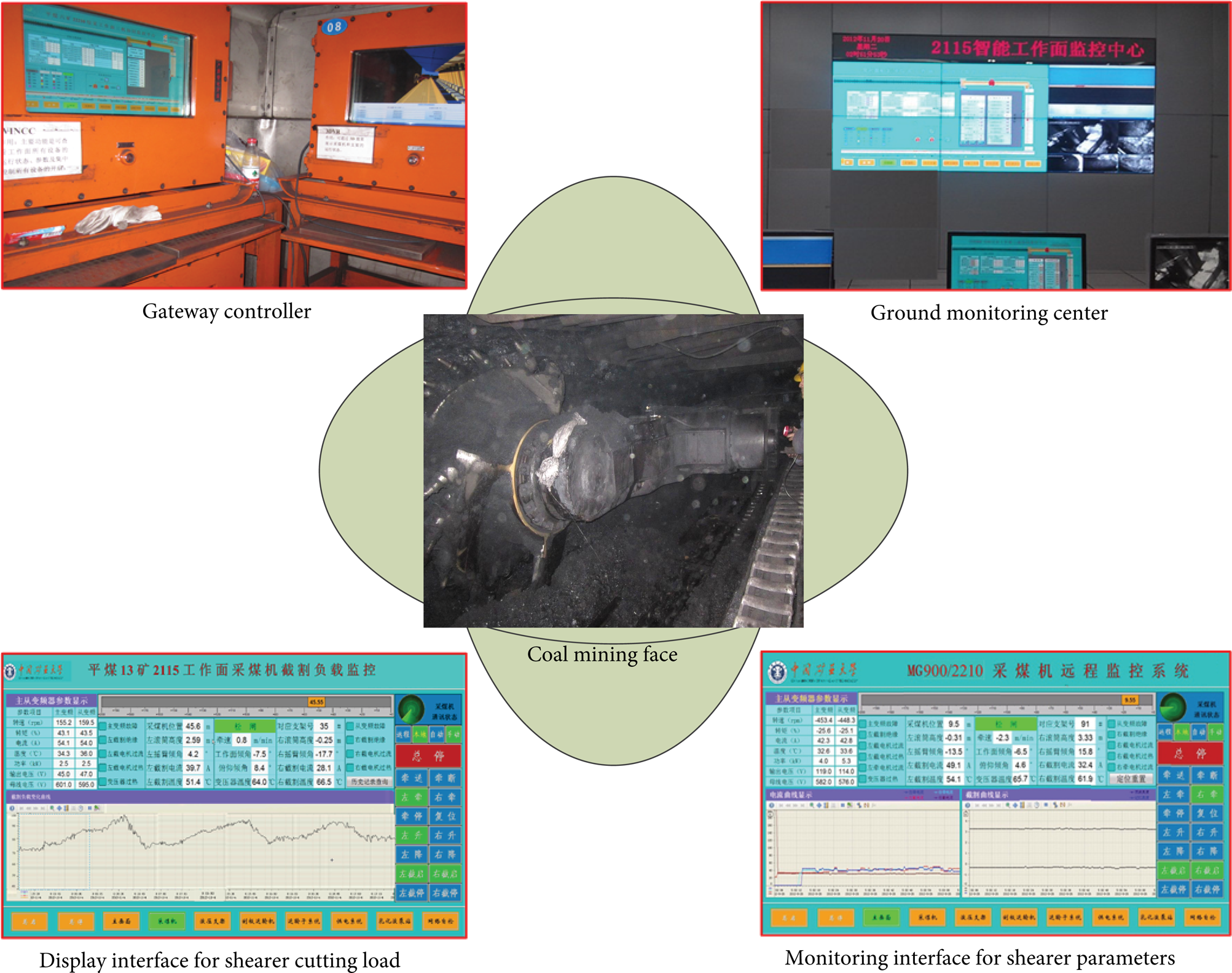
Industrial application example of proposed method.
As Figure 10 shows, the “gateway controller” and “ground monitoring center” were used to control and monitor the shearer running parameters. The system based on the proposed approach was uploaded into the gateway controller. The cutting motor current was collected every 1 Hz from the shearer controller and the collected data were transmitted to the gateway controller. Then, the changes of shearer cutting load were identified and showed on “display interface for shearer cutting load.”
In order to illustrate the application effect of the proposed system, the shearer operator judged whether shearer drum cut the rock depending on the vibration noise of shearer mining and manual visualization and then recorded the location of cutting rock. The contrast of identified values and actual cutting status was shown in Figure 11. As seen from Figure 11, when the cutting load was more than 85%, shearer was cutting rock, and, for other situations, shearer was cutting coal. The results of cutting load identification based on proposed system were almost completely consistent with the actual cutting status of shearer.
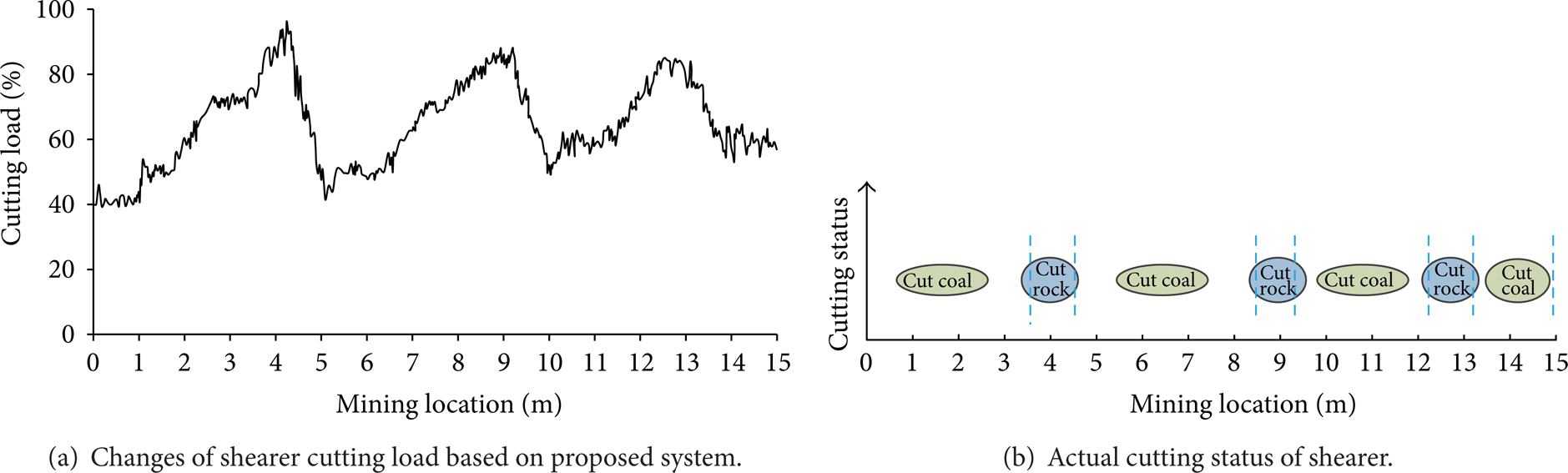
Application situation of proposed system.
6. Conclusions and Future Work
Aiming at the disadvantages of traditional identification approaches for shearer cutting load, this paper proposed a novel approach through integration of improved particle swarm optimization and wavelet neural network to establish the “speed-current-load” relation model. The improved updating strategy for inertia weight and immune mechanism was applied in PSO to avoid falling into the local optimum, enhance population diversity, and improve the quality of solution. In order to verify the feasibility and efficiency of the proposed algorithm, a simulation example was provided and some comparisons with other algorithms were carried out. The simulation example, comparison results, and industrial application showed that the shearer cutting load could be effectively identified and the proposed approach was the outperforming others.
In future studies, the authors plan to investigate some improvements for the proposed algorithm. Possible improvements may include the combination of IAPSO with other intelligent algorithms for better performance. In addition, the applications of the proposed algorithm in fault diagnosis domain are worth further study by the authors.
Conflict of Interests
The authors declare that there is no conflict of interests regarding the publication of this paper.
Footnotes
Acknowledgments
The support of National High Technology Research and Development Program of China (no. 2013AA06A411), National Natural Science Foundation of China (no. 51005231), Xuyi Mine Equipment and Materials R&D Center Innovation Fund Project (no. CXJJ201306), and the Priority Academic Program Development of Jiangsu Higher Education Institutions in carrying out this research is gratefully acknowledged.