




Abstract
The steady boundary-layer flow of a nanofluid past a permeable moving flat plate in the presence of a coflowing fluid is theoretically investigated. The plate is assumed to move in the same or opposite direction of the free stream. The governing partial differential equations are first transformed into ordinary differential (similarity) equations before they are solved numerically using a finite-difference scheme along with a shooting method. Numerical results are obtained for the skin-friction coefficient, the local Nusselt number, and the local Sherwood number as well as the velocity, temperature, and nanoparticle volume fraction profiles for some values of the governing parameters, namely, the plate velocity parameter, the Prandtl number, the Lewis number, the Brownian motion parameter, the thermophoresis parameter, and the nanoparticle volume fraction parameter. The numerical results indicate that dual solutions exist when the plate and the free stream move in the opposite directions.
1. Introduction
Conventional fluids, such as water, ethylene glycol, and engine oil are widely used as heat transfer fluids in thermal system. However, low heat transfer performance of these conventional fluids limits the performance enhancement and the efficiency of heat exchangers. Therefore, effective thermal conductivity of the nanofluids is expected to enhance the heat transfer performance (Masuda et al. [1]). Choi [2] was the first who introduced the term nanofluid and it refers to the fluids with suspended nanoparticles (Nield and Kuznetsov [3]). Most commonly used nanoparticles are aluminium, copper, iron, and titanium or their oxides.
Experimental studies by Masuda et al. [1], Pak and Cho [4], Eastman et al. [5], Das et al. [6], Xuan and Li [7], and Minsta et al. [8] show that only a small volumetric fraction of nanoparticles (usually less than 5%) is needed to enhance the thermal conductivity of the base liquid by 5–15%. The improved thermal conductivity of nanofluid together with the thermal conductivity of the base liquid and turbulence induced by their motion contributes to a remarkable improvement in the convective heat transfer coefficient. This phenomenon suggests the possibility of using nanofluids in advanced nuclear systems (Buongiorno and Hu [9]) and cylindrical heat pipes (Shukla et al. [10]). The comprehensive references on nanofluids can be found in the recent book by Das et al. [11] and in the review papers by Buongiorno [12], Kakaç and Pramuanjaroenkij [13], Lee et al. [14], Wong and de Leon [15], Yu and Lin [16], Ghadimi et al. [17], Ramesh and Prabhu [18], Sarkar [19], Fan and Wang [20], Saidur et al. [21], Thomas and Panicker Sobhan [22], and Mahian et al. [23].
It is worth mentioning that the nanofluid model proposed by Buongiorno [12] was frequently used by Nield and Kuznetsov [3, 24], Kuznetsov and Nield [25, 26], Khan and Pop [27], Bachok et al. [28], Khan and Aziz [29], and Tham et al. [30] in their papers. Besides the above model, another nanofluid model proposed by Tiwari and Das [31] has also been used by several authors such as Ahmad et al. [32], Rohni et al. [33], Bachok et al. [28, 34, 35], Nazar et al. [36], and Yasin et al. [37]. Different from the previous approach, the present paper considers a problem using a combination of both nanofluid models (see Buongiorno [12] and Tiwari and Das [31]) stated above. Results for the reduced Nusselt and Sherwood numbers are presented in tables and graphs for various values of the involved parameters. Dual (upper and lower branch) solutions of the similarity equations are shown to exist and based on the stability analysis proposed by Weidman et al. [38] it can be shown that the upper branch solution is stable and, therefore, physically realizable in practice, while the lower branch solution is unstable and not physically realizable. It should be mentioned that this new type of shrinking sheet flow is essentially a backward flow as discussed by Goldstein [39]. To the best of our knowledge, the present problem along with the combined nanofluid models has not been considered before; therefore, the reported results are new and original.
2. Problem Formulation
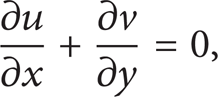
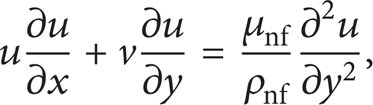
Steady boundary-layer flow due to a permeable moving flat plate in the presence of a coflowing water-based nanofluid containing Cu (copper), Al2O3 (alumina), and TiO2 (titania) nanoparticles is considered. It is assumed that the plate moves with the velocity λU, where λ is the moving plate velocity parameter and U is the constant positive velocity of the ambient (inviscid) nanofluid as shown in Figure 1. It is also assumed that the constant surface temperature of the plate is T w and the constant surface nanoparticle volume fraction is C w , while the ambient nanofluid has a temperature T∞ and a nanoparticle concentration C∞. The boundary layer equations for the steady flow on the moving surface can be written as


subject to the boundary conditions

where x and y are the Cartesian coordinates measured along the flat plate and normal to it, respectively, u and v are the velocity component along the x and y axes, respectively, T is the nanofluid temperature, C is the nanoparticle volume fraction, D
B
is the Brownian diffusion coefficient, D
T
is the thermophoretic diffusion coefficient,

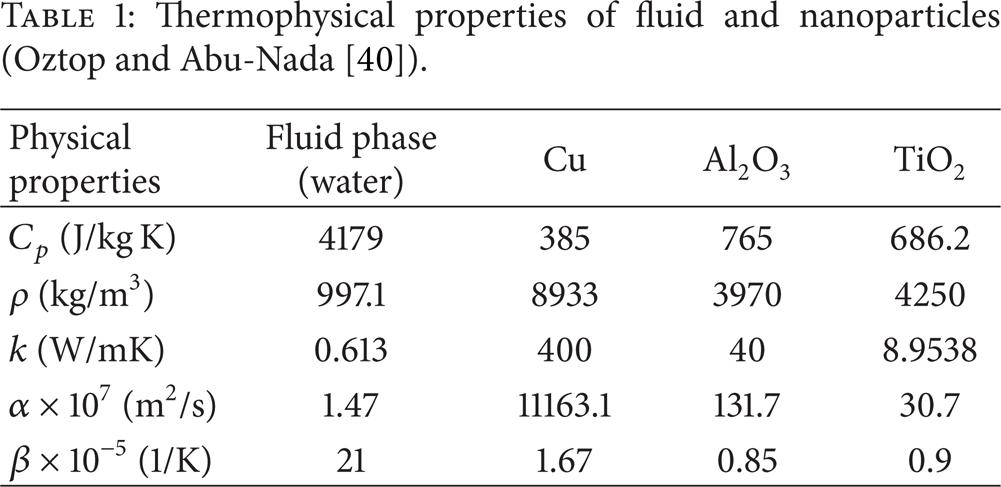
Here, ϕ is the solid volume fraction of the nanofluid or the nanoparticle volume fraction parameter and knf is the effective thermal conductivity of the nanofluid. The thermophysical properties of the fluid and nanoparticles are given in Table 1.
Thermophysical properties of fluid and nanoparticles (Oztop and Abu-Nada [40]).

Physical model and coordinate system.
Following Weidman et al. [38], we express the similarity solutions of (1)–(4) in terms of the following variables:

where ψ is the stream function, which is defined as u = ∂ψ/∂y and v = −∂ψ/∂x, which automatically satisfies (1). Thus, we have

where prime denotes differentiation with respect to η. The velocity v in (8) shows that the suction/injection velocity v w (x) must have the form

so that v
w
(x) should be
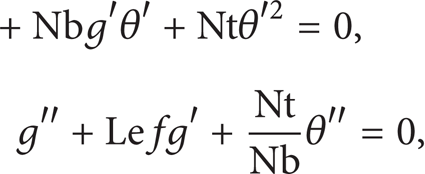
Substituting (7) into (2)–(4), we obtain the following nonlinear ordinary differential equations:


with the boundary conditions (5) taking the form
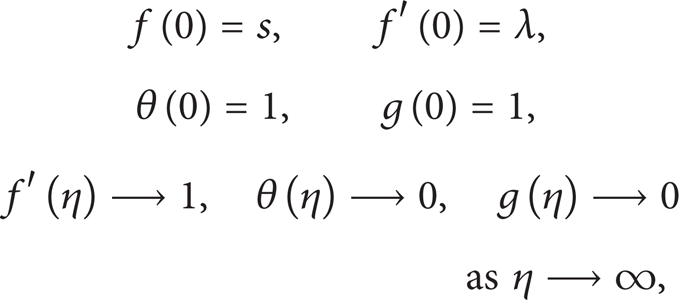
where Pr is the Prandtl number, Le is the Lewis number for the base fluid, Nb is the modified Brownian motion parameter, and Nt is the modified thermophoresis parameter of the nanofluids, which are defined as
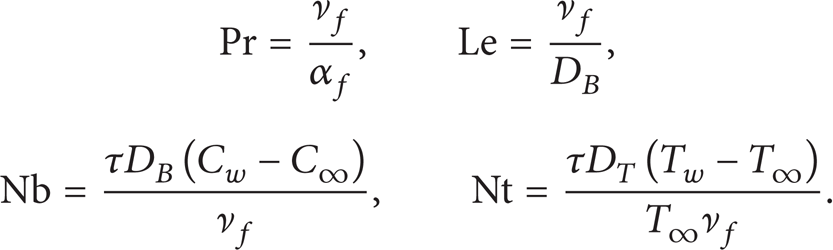
It should be noted that when ϕ = 0 (regular fluid) and Nb=Nt = 0, (10) and (11) involve only two dependent variables, namely, f(η) and θ(η). The boundary-value problem for f(η) reduces to the classical problem studied by Weidman et al. [38] and the boundary-value problem for g(η) then becomes ill-posed and is of no physical significance.
The physical quantities of practical interest are the skin friction coefficient C f , the local Nusselt number Nu x , and the local Sherwood number Sh x , which are defined as

where τ w is the skin friction or the shear stress along the surface of the plate, qw is the wall heat flux, and qm is the wall mass flux, which are given by

respectively. Using (7), (15), and (16), we get

where Re x = Ux/ν f is the local Reynolds number.
3. Results and Discussion
The nonlinear transformed (similarity) boundary layer equations (10), (11), and (12) subject to the boundary conditions (13) have been solved numerically using two different methods, namely, the Keller-box method and the Runge-Kutta-Fehlberg (RKF) method with shooting technique. The Keller-box method is a very efficient and flexible implicit finite-difference scheme with second order truncation error (Cebeci and Bradshaw [41, 42]). Meanwhile the well-known and more simple shooting method is an iterative algorithm technique implemented in MAPLE program which attempts to identify the appropriate initial conditions for a related initial value problem (IVP) that provides the solution to the original boundary value problem (BVP) (Meade et al. [43]). In this method, the dual (first and second) solutions were obtained by setting different initial guesses for the missing values of f″(0), θ′(0), and g′(0), where all profiles satisfy the far field boundary conditions (13) asymptotically. The results obtained by both methods show a favorable agreement. Thus, this gives confidence to the accuracy of the numerical results presented in this paper. The effects of the solid volume fraction of nanofluid ϕ and the Prandtl number Pr are analyzed for three different nanofluids, namely, Cu-water, Al2O3-water, and TiO2-water, as the working fluids. Following Oztop and Abu-Nada [40], the value of the Prandtl number Pr is taken as 6.2 (water) and the range of nanoparticle volume fraction is considered as 0 ≤ ϕ ≤ 0.2, in which ϕ = 0 corresponds to the regular base fluid. The variation of the reduced skin friction coefficient f″(0) with λ is shown in Figure 2(a) when f0 = 0, Nb = 0.5, and Nt = 0.5 As seen from the figure, the values of f″(0) are positive when λ<1, while they are negative when λ>1. Physically, a positive sign for f″(0) implies that the fluid exerts a drag force on the plate and a negative sign implies the opposite. The value f″(0) = 0.4696 when λ = 0 (Blasius problem [44] as given in Figure 2(a) is in excellent agreement with that reported by White [45]). Figure 2(a) shows the existence of dual (upper and lower branches) solutions when λ<0, that is, when the plate and the free stream move in the opposite directions. Dual solutions of (10)–(12) subject to the boundary conditions (13) exist in the range λ c ≤ λ<0, where λ c is the critical value of λ<0 for the existence of the dual solutions. For λ ≤ λ c <0 the solution of the above mentioned equations based upon the boundary layer approximations is not possible and the full Navier-Stokes equations, energy, and nanoparticle volume fraction equations need to be solved. The present computation gives λ c = −0.3541 and it is in agreement with that reported by Weidman et al. [38].
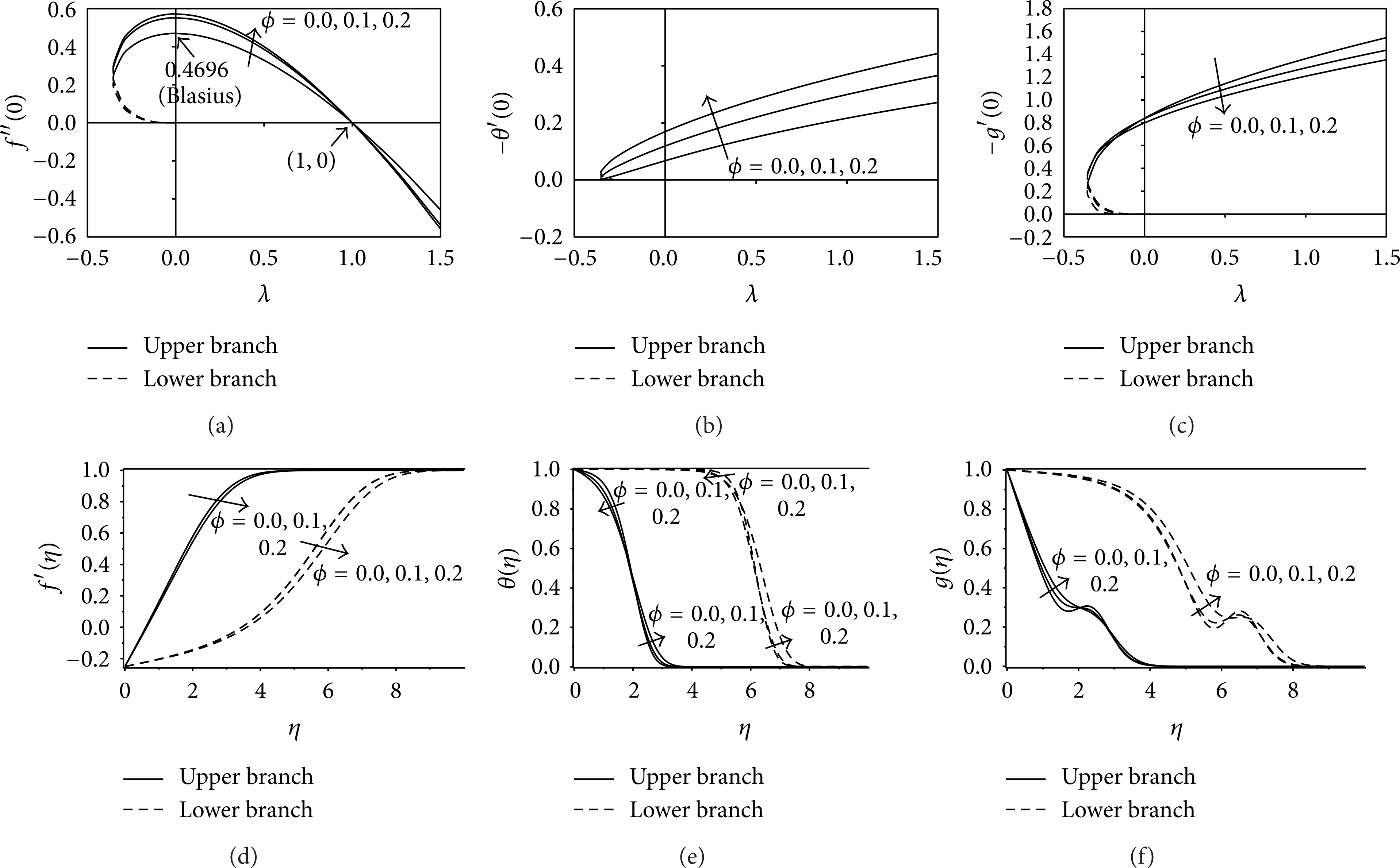
(a) Variation of reduced skin friction coefficient f″(0) with λ for different values of ϕ, (b) variation of reduced heat transfer
The variation of the reduced local Nusselt number
Figures 3(a)–3(c) illustrate the variations of the reduced skin friction coefficient f″(0), reduced Nusselt number
Variation of λ c with suction/injection parameter f0.


(a) Variation of reduced skin friction coefficient
Meanwhile the effect of the suction/injection parameter f0 on the streamwise velocity profiles, temperature profiles, and nanoparticle volume fraction profiles is shown in Figures 3(d)–3(f), respectively, when λ = 0.5 and f0 = 0.5 (suction case).
Figures 4(a)–4(c) show the variations of the reduced skin friction coefficient, reduced Nusselt number, and reduced Sherwood number with λ, respectively, for different types of nanofluid when ϕ = 0.2, f0 = 0, Le = 2, and Nb=Nt = 0.5. The value of reduced skin friction coefficient is significantly higher for Cu-water based nanofluid, while its value for TiO2-water based nanofluid is just slightly higher compared to Al2O3-water based nanofluid. It can be seen that Cu-water based nanofluid has the highest heat transfer rate when λ ≤ 1, while Al2O3-based nanofluid has the highest heat transfer rate when λ>1. Meanwhile TiO3-water based nanofluid has the lowest heat transfer rate among the three for the whole observed domain of λ. It is worth mentioning that the critical value of suction/injection parameter λ c is unique (λ c = −0.3541) no matter what type of nanofluid is being used and it is again in agreement with that reported by Weidman et al. [38]. The effect of the different nanofluids used on the streamwise velocity profile, temperature profile, and nanoparticle volume fraction profile is shown in Figure 4(d) when λ = 0.

(a) Variation of reduced skin friction coefficient f″(0) with λ for different types of nanofluid, (b) variation of reduced Nusselt number with λ for different types of nanofluids, (c) variation of reduced Sherwood number with λ for different types of nanofluids, and (d) velocity, temperature, and nanoparticle volume fraction profiles for different nanoparticles.
Figures 5(a) and 5(b) show the effect of Lewis number Le on temperature profile and nanoparticle volume fraction profile, respectively, when Nb=Nt = λ = 0.5, ϕ = 0.2, and f0 = 0. It can be seen that the effect is more significant on nanoparticle volume fraction profile where increasing the Lewis number resulted in a decrease in the nanoparticle volume fraction boundary layer thickness, which agrees with Bachok et al. [28].

(a) Temperature profiles θ(η) for various values of Le and (b) nanoparticle volume fraction profiles g(η) for various values of Le.
Figures 6(a) and 6(b) demonstrate the effect of Brownian motion parameter Nb on the temperature profile and nanoparticle volume fraction profile when Le = 2, Nt = 0.5, λ = 0.5, ϕ = 0.2, and f0 = 0. As seen from the figures, increasing Nb thickens the thermal boundary layer but the reverse effect is seen on nanoparticle volume fraction boundary layer thickness. Similarly, increasing the thermophoresis parameter Nt thickens the thermal boundary layer but there are inconsistent patterns for the nanoparticle volume fraction profile, as shown in Figures 7(a) and 7(b).

(a) Temperature profiles θ(η) for various values of Nb and (b) nanoparticle volume fraction profiles g(η) for various values of Nb.

(a) Temperature profiles θ(η) for various values of Nt when Le = 2, Nb = 0.5, λ = 0.25, ϕ = 0.2, and f0 = 0 and (b) nanoparticle volume fraction profiles ϕ(η) for various values of Nt when Le = 2, Nb = 0.5, λ = 0.25, ϕ = 0.2, and f0 = 0.
The effect of Prandtl number Pr on the temperature profile and the nanoparticle volume fraction profile is depicted in Figures 8(a) and 8(b), respectively. The temperature at every location in the thermal boundary layer decreases as Pr increases. On the other hand, significant effects of Prandtl number on the nanoparticle volume fraction profile occur in the middle of the boundary layer, specifically when 0.8 ≤ η ≤ 1.6 as shown in Figure 8(b). As Pr increases, the nanoparticle boundary layer thickness increases until η = 1.6, beyond which it decreases to satisfy the far field boundary condition asymptotically, thus supporting the numerical result obtained.

(a) Temperature profiles θ(η) for various values of Pr when Le = 2, Nb = 0.5, Nt = 0.5, λ = 0.25, ϕ = 0.2, and f0 = 0 and (b) nanoparticle volume fraction profiles g(η) for various values of Pr when Le = 2, Nb = 0.5, Nt = 0.5, λ = 0.25, ϕ = 0.2, and f0 = 0.
4. Conclusions
In the present paper, we have studied theoretically the problem of the steady boundary-layer flow of a nanofluid past a permeable moving surface. The governing partial differential equations are transformed into ordinary differential equations, a more convenient form for numerical computation, using a similarity transformation. These equations are solved numerically using the Keller-box method and the shooting method. Numerical results for the skin-friction coefficient, the local Nusselt number, and the local Sherwood number as well as for the velocity, temperature, and the nanoparticle volume fraction profiles are illustrated in some graphs for various parameter conditions. It is found that the reduced skin-friction coefficient and the reduced Nusselt number increase as the nanoparticle volume fraction parameter increases while the opposite effect is seen on the reduced Sherwood number. Besides the reduced skin-friction coefficient, the reduced Nusselt number and the reduced Sherwood number increase due to suction while they decrease due to injection. The surface heat transfer rate in Cu-water nanofluid and Al2O3-water nanofluid is consistently higher compared to the rate in TiO3-water nanofluid. The results also indicate that dual solutions exist when the plate and the free stream flow move in the opposite directions.
Footnotes
Nomenclatures
Conflict of Interests
The authors declare that there is no conflict of interests regarding the publication of this paper.
Acknowledgments
This work is supported by a research university Grant (AP-2013-009) from the Universiti Kebangsaan Malaysia and an FRGS research Grant (Project Code: FRGS/1/2012/SG04/UKM/03/3) from the Ministry of Higher Education, Malaysia. The authors would also like to express their very sincere thanks to the competent reviewers for the very good comments and suggestions.