




Abstract
The fractal heat flow within local fractional derivative is investigated. The nonhomogeneous heat equations arising in fractal heat flow are discussed. The local fractional Fourier series solutions for one-dimensional nonhomogeneous heat equations are obtained. The nondifferentiable series solutions are given to show the efficiency and implementation of the present method.
1. Introduction
In porous media, there are fractals [1], which are applied to describe the heat transfer [2–12]. For example, Yu and Cheng considered the fractal characteristics of effective thermal conductivity in porous media [3]. Xiao and coauthors studied the fractal behaviors of the nucleate pool boiling heat transfer of nanofluids [4]. Le Mehaute and Crepy investigated the geometry of kinetics arising in fractal transfer [5]. Ghodoossi analyzed the thermal behavior for fractal microchannel network [6]. Lahey Jr. suggested the application of heat transfer in fractal geometry theory [7]. Pence proposed the effective heat transport in fractal-like flow networks [8]. Hu and coauthors reported the discontinuous heat transfer in fractal one-phase flows [9]. Liu and coauthors presented fractal heat transfer in microchannel heat sink for cooling of electronic chips [10]. Cai and Huai used the lattice Boltzmann method to model the fluid-solid coupling heat transfer in fractal porous medium [11]. Blyth and Pozrikidis discussed the heat conduction in fractal-like surfaces [12].
There are some models for the differential equation arising in heat transfer [13–16] in fractal media by using fractional calculus [17]. Recently, the local fractional model for heat conduction arising in fractal heat transfer was considered in [18–21]. In [18], the local fractional variational iteration method was applied to solve the heat conduction equations with local fractional derivative. Local fractional Adomian decomposition method was used to obtain the solution for the one-dimensional heat equations with the heat generation arising in fractal transient conduction in [20]. The heat conduction equation with local fractional derivative by using the Cantor-type cylindrical-coordinate method was presented [21].
The aim of this paper is to investigate the nonhomogeneous heat equations arising in fractal heat flow with local fractional derivative and to deal with the one-dimension nonhomogeneous heat equation by using the local fractional Fourier series method. This paper is structured as follows. In Section 2, we investigate the fractal heat flow via local fractional derivative. In Section 3, the notion for local fractional Fourier series method is presented. The solution for the one-dimensional nonhomogeneous heat equation arising fractal heat flow is shown in Section 4. Finally, Section 5 is conclusions.
2. Fractal Heat Flow via Local Fractional Derivative
In order to investigate the governing equations for fractal heat flow, we consider that u(x,y,z,t) is the temperature at the point (x,y,z) ∈ Ω, time t∈T, and H(t) is the total amount of heat contained in Ω. We have

where the local fractional volume integral of the function

with the elements of volume
From (1) the change in heat is given by

Local fractional Fourier's law of the material in fractal media gives [19]

where

with N elements of area with a unit normal local fractional vector
Making use of (3) and (4), we obtain
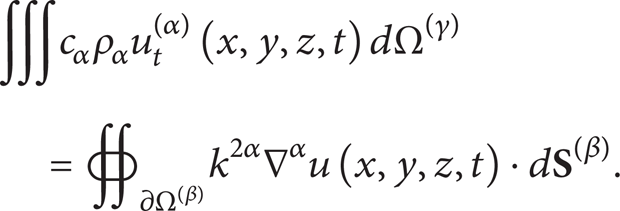
Using the local fractional divergence theorem [19, 22], from (6) we get

which leads to

In view of (8), we arrive at

Hence, (9) can be rewritten as follows:

where
Therefore, from (10) we obtain the one-dimensional heat equation for fractal heat flow in the following form:

The above result is presented in [18, 19].
When t = lτ, x = mη, y = sζ and z = jξ, (10) changes into

where
When κ = 1, we have

From (13) the one-dimensional heat equation for fractal heat flow reads as

Meanwhile, an initial value condition of (14) is presented as follows:

The Dirichlet boundary value conductions of (14) are considered as follows:

The Neumann boundary value conductions of (14) read as follows:

The Robin boundary value conductions of (14) are suggested as follows:

The periodic boundary value conductions of (14) are given by

If there is a heat source term g(η,τ), (14) can be rewritten as

and the initial and Dirichlet boundary value conductions of (14) are considered as follows:

3. Local Fractional Fourier Series Method
In this section, the local fractional Fourier series is a generalized Fourier series based upon the local fractional calculus. We introduce the basic concept of local fractional Fourier series [23, 24].
Suppose that the quantity f(x) is a local fractional continuous function on the interval (a,b); we denote it as follows [18–20]:

Definition 1. Let f(x)∈Cα(a,b). Local fractional derivative of f(x) of order α at x = x0 is given by [18–22]
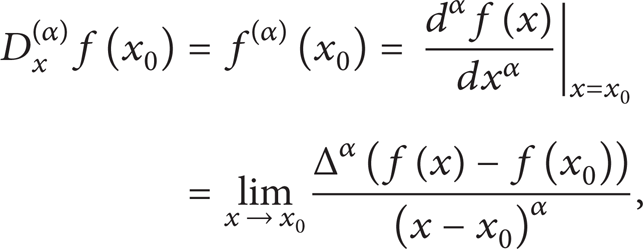
where
Definition 2. Let f(x)∈Cα(a,b). Local fractional integral operator f(x) of order α is given by [18–20, 23, 24]

where Δt
j
= tj + 1-t
j
,
Definition 3. Let f(x)∈Cα(–∞, + ∞) and f(x) be 2l-periodic. For k∈Z, local fraction Fourier series of f(x) is defined as (see [23, 24])

where the local fraction Fourier coefficients are as follows:
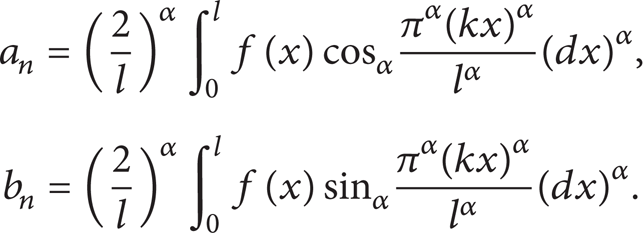
Making use of (26), we have the weight forms of the local fractional Fourier series as follows:

4. Solution for the One-Dimensional Nonhomogeneous Heat Equation Arising Fractal Heat Flow
In this section, we present the local fractional Fourier series solutions for nonhomogeneous heat equation arising in fractal heat flow in one-dimensional case. In order to discuss it, we give the special example as follows.
We take the heat source term,

When the fractal dimension α is equal to ln2/ln3, the graph of the heat source term is shown in Figure 1.

The graph of the heat source term
Hence, (20) can be rewritten as follows:

subject to the initial boundary value conditions

When the fractal dimension α is equal to ln2/ln3, the graph of the initial value condition is shown in Figure 2.
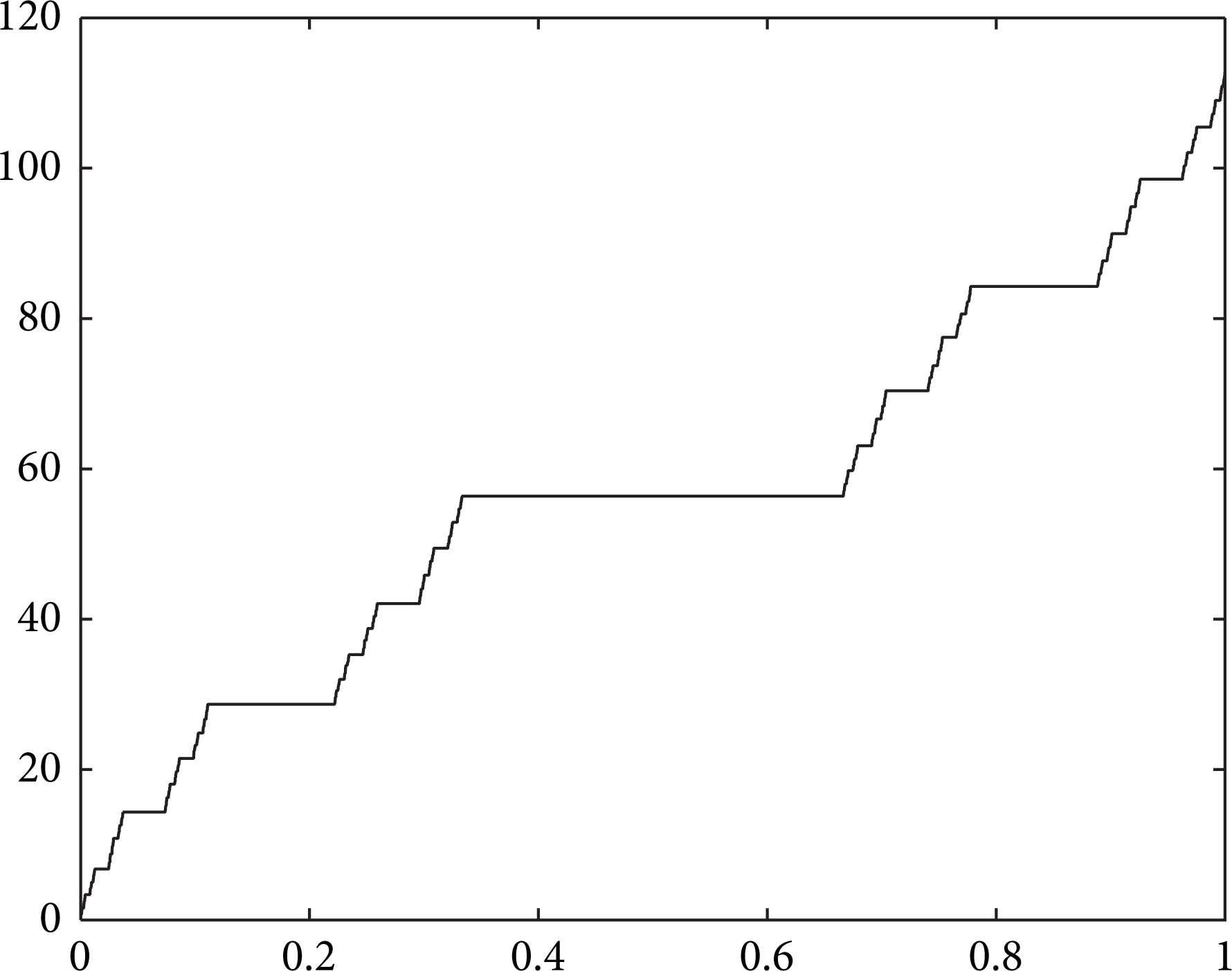
The graph of initial value condition
We now consider the local fractional Fourier solution in the following form:

Here, we have

and
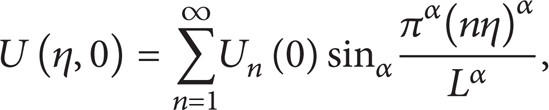
where


Submitting (31), (32), and (34) into (29) yields

which leads to

Making use of (30), (33), and (35) with τ = 0, we have

such that

where

In view of (37) and (39), we get the system of boundary value problem in the following form:
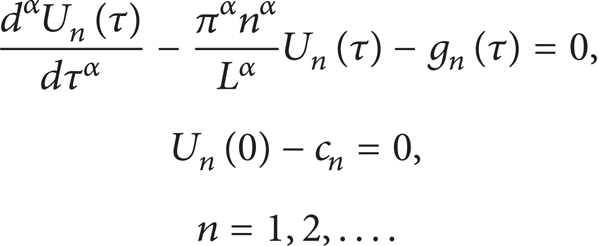
So, we obtain the solution of (40) in the following form:

Hence, the local fractional Fourier series solution reads as follows:

5. Conclusions
In this work we derived the nonhomogeneous heat equations arising in fractal heat flow based upon the local fractional vector calculus. Meanwhile, we presented the different classes of boundary value problems for local fractional heat equations. Finally, the local fractional Fourier solution for nonhomogeneous heat equations arising in fractal heat flow was obtained by using the local fractional series. It is shown that the components of the result are nondifferentiable functions.
Conflict of Interests
The authors declare that there is no conflict of interests regarding the publication of this paper.
Footnotes
Acknowledgments
This work was supported by National Scientific and Technological Support Projects (no. 2012BAE09B00), the National Natural Science Foundation of China (nos. 11126213 and 61170317), and the National Natural Science Foundation of Hebei Province (nos. A2012209043 and E2013209215).