




Abstract
Energy harvesting technology potentially solves the problem of energy efficiency, which is the biggest challenge in wireless sensor networks. The sensor node, which has a capability of harvesting energy from the surrounding environment, is able to achieve infinitive lifetime. The technology promisingly changes the fundamental principle of communication protocols in wireless sensor networks. Instead of saving energy as much as possible, the protocols should guarantee that the harvested energy is equal to or bigger than the consumed energy. At the same time, the protocols are designed to have the efficient operation and maximum network performance. In this paper, we propose ERI-MAC, a new receiver-initiated MAC protocol for energy harvesting sensor networks. ERI-MAC leverages the benefit of receiver-initiated and packet concatenation to achieve good performance both in latency and in energy efficiency. Moreover, ERI-MAC employs a queueing mechanism to adjust the operation of a sensor node following the energy harvesting rate from the surrounding environment. We have extensively evaluated ERI-MAC in a large scale network with a realistic traffic model using the network simulator ns-2. The simulation results show that ERI-MAC achieves good network performance, as well as enabling infinitive lifetime of sensor networks.
1. Introduction
The developments of sensing, computing technologies, and wireless communication drive the appearance of wireless sensor networks (WSNs) with various types of applications such as structure health [1], environmental monitoring [2–4], or healthcare [5, 6]. A WSN usually contains numerous inexpensive sensor nodes, which are spatially distributed over a monitored commonplace. The sensor nodes sense the physical changes of their surrounding environments and wirelessly forward the sensing data to a base station, that is, a sink. An individual sensor node normally has a small size, and it is powered with a limited capacity battery. Therefore, the operation and performance of WSNs largely depend on the finite capacity of power sources. Traditionally, most of the research in WSNs pays attention to designing energy efficient communication protocols, especially medium access control (MAC) protocols. That is because the MAC protocols control the operation of radio module, which is the biggest consumer of energy on sensor nodes. In general, the MAC protocols save consumed energy by adopting the duty cycling mechanism, which periodically turns on and off the radio modules. There are a huge number of power-saving MAC protocols that have been published. The protocols aim to achieve low duty cycle [7–9] or adaptive duty cycle in order to have good performance under different types of traffic [10, 11]. However, when the WSN applications require a long lifetime (months or years), the capacity of battery is still not sufficient. On the other hand, the recent advances in energy harvesting technology give a promising solution for the energy problem on WSNs.
Energy harvesting refers to the capability of extracting energy from ambient environment of a sensor node (e.g., from the solar energy, wind power, etc. [12–14]). Moreover, the extracted or harvested energy can be used to recharge the node's battery. As a result, the sensor node potentially maintains an infinite lifetime of battery. The technology therefore will change the fundamental principle of designing MAC protocols for WSNs. Instead of focusing on the power-saving aspect, the objectives of new MAC protocol on energy harvesting WSNs include increasing both the network performance and the lifetime under a given condition of harvested energy. Different to the traditional MAC protocols, the one in energy harvesting WSN achieves infinite lifetime by keeping the sensor node operating at the so-called energy neutral operation (ENO) state [12]. When a node is in the ENO state, its energy consumption is always less than or equal to the energy harvested from the environment. Besides that, WSNs with energy harvesting capability assume the correlation between the performance and energy harvesting. The more energy a sensor node is harvested the better performance it achieves. A sensor node is said to reach the state of ENO-Max when it operates at the maximum performance as well as remaining at the state of ENO [15]. Generally, the MAC protocols in energy-harvested sensor networks are designed with new algorithms of dynamically adapting the duty cycle at a node in order to maximize both the lifetime and the performance.
In this paper, we propose a new energy-harvested MAC protocol for WSNs named ERI-MAC, which is a duty cycling protocol with carrier sensing. The protocol lets the nodes share wireless medium in a receiver-initiated manner in which a receiver plays an active role in communication. ERI-MAC inherits advance features of the receiver-initiated and packet concatenation mechanisms from the previous works [10, 16] in order to achieve a good trade-off between latency and energy consumption. The former mechanism is not only energy efficient but also latency and error-handling efficient. The latter one improves the energy and latency efficiency by saving the transmission of control overhead. Besides that, ERI-MAC's nodes maintain their ENO states by dynamically tuning their upcoming wake-up time following the energy harvesting condition of the network. The tuning mechanism is an extension of the queuing mechanism in [10], which statically queues the packets with a threshold. The simulation results show that ERI-MAC's node achieves good network performance while potentially keeping infinitive network lifetime.
The remainder of the paper is organized as follows. Section 2 presents the related work in designing MAC protocol for WSNs. Sections 3 and 4 describe the operation of ERI-MAC protocol and the evaluation of ERI-MAC, respectively. Finally, Section 5 concludes the paper.
2. Related Work
Designing MAC protocols for WSNs is an active research area, which attracts many researchers and practitioners with a plenty of proposed MAC protocols. In the early period of WSN field, energy efficiency is the primary goal in MAC as well as other layer protocol designs for WSNs [17]. The requirement comes from the fact of battery capacity limitation on a sensor node. As a result, the proposed protocols during the period pay attention to the power saving at the expense of other parameters (e.g., throughput, latency, and fairness). It is widely recognized that the work of Ye et al. [18] is the first one that proposes the concept of duty cycling the radio for energy efficiency. The authors have measured and reported that the main source of energy wastage is the so-called idle listening energy. Moreover, they proposed sensor-MAC protocol (S-MAC) with duty cycling to avoid the wastage. S-MAC has been proven to be more energy efficient than the full awake IEEE 802.11 MAC protocol, but it introduces a very large end-to-end latency and low throughput. S-MAC also introduces the synchronization protocol which assumingly synchronizes the clock of all sensors in a network. S-MAC is a basis for many other protocols in an approach called synchronous MAC protocols for WSNs.
There are several modified versions of S-MAC aiming to either shorten the delivery latency or increase the throughput, for example, S-MAC with adaptive listening [7]. This protocol and timeout MAC (T-MAC) [19] use smart adaptive mechanisms and physical layer characteristics in order to adapt the operation of radio following the traffic. They improve the latency performance but still incur large overhead. The main reason is the protocol designed for the single hop case. Addressing many problems in single hop MAC protocols, Shu et al. [20] propose RMAC that can forward a data packet via multiple (more than two) hops in a cycle. The multihop forwarding is achieved by using cross-layer information and intelligent wake-up during sleep time in an operation cycle. There are several improvements of RMAC that have been introduced such as [21, 22], which can convey more data or more hops in a cycle but still share the basic forwarding mechanism as in RMAC. Demand wake-up MAC (DW-MAC) [9] is an advanced development of RMAC. DW-MAC with a demand wake-up manner can support dynamic traffic loads; hence DW-MAC outperforms RMAC under high traffic loads, but DW-MAC consumes same overhead and achieves higher latency under low traffic loads. There exist many multihop protocols, which solve the problem in DW-MAC and RMAC in both low and high traffic loads such as
The duty cycling concept is greatly efficient in terms of power saving. However, following the S-MAC-based approach the network performance is limited and affected by the synchronization protocol. The protocol, however, is very hard or impractically implemented in real networks. Therefore, along with the synchronous MAC approach, another main stream in designing MAC for WSN is the asynchronous MAC protocols that free the synchronization overhead. The asynchronous protocols can be classified into two categories: sender-initiated such as B-MAC [24], X-MAC [25], and AS-MAC [26] and receiver-initiated such as RI-MAC [16], A-MAC [27], PW-MAC [28], and CyMAC [29]. In the sender-initiated protocols, sensor nodes independently wake-up and sleep. A sender broadcasts preambles (i.e., small size packets) to the wireless channel and waits for a potential receiver. On the other hand, in the receiver-initiated protocol the sender normally listens to the channel and waits for the signal from the potential receiver. The receiver-initiated protocols outperform the sender-initiated ones because of two reasons. The first one is that they reduce the big overhead by collision between senders. The second one is that the protocols enable new data exchange right after the previous completed exchange without going to sleep.
Although there are many proposed energy efficient MAC protocols, there is still a lack of key technology which thoroughly solves the energy problem in WSNs. That is because, in most typical applications of WSNs, the network lifetime is expectedly from months to years. It is also noted that the development of battery technology is much slower than the ones of computing and wireless communication. Fortunately, there exists the energy harvesting technology in which a sensor node has the capability of recharging battery from energy sources around it. The technology therefore potentially solves the energy efficiency problem lasted a long time in WSNs. In the energy harvesting WSNs, the network performance normally depends on the amount of energy harvested from the environment. Therefore, the fundamental of designing MAC protocol is changed; the focusing point is maximizing network performances but conserving the battery capacity. That network state is defined as the ENO state. There are several energy-harvested MAC protocols [30, 31], in which OD-MAC [31] shares several design features with our proposed ERI-MAC. However, OD-MAC has been evaluated on a small scale network with predetermined traffic pattern. Moreover, OD-MAC does not handle the cases of contention or retransmission, which are very popular in WSNs. Therefore, there is a lack of reliable evidence in the protocol's evaluation. On the other hand, the ERI-MAC protocol is actually an inheritance of our previous work [10], which originally follows the approach of balancing energy efficiency and other QoS parameters in the MAC protocol design [32, 33]. Besides that, ERI-MAC contains the advanced modifications tailored for the energy harvesting environments. Hence, ERI-MAC effectively handles the problems of retransmission or contention. The evaluation of ERI-MAC protocol is also implemented on a large-scale network with realistic traffic patterns.
3. ERI-MAC: Energy-Harvested Receiver-Initiated for Sensor Networks
In this section, we describe the operation of ERI-MAC protocol. We initially present the basic communication scheme in ERI-MAC, and then we discuss the adoption of packet concatenation. Finally, we mention how the use of a dynamic queuing mechanism achieves ENO states in energy harvesting sensor networks.
3.1. Basic Communication Scheme
ERI-MAC is generally a carrier sense multiple access/collision avoidance (CSMA/CA) protocol, in which a receiver listens to wireless channel to avoid collision and a sender uses carrier wave to make the channel busy. CSMA/CA is popularly used in various wireless technologies such as IEEE 802.11 (Wi-Fi) and IEEE 802.15.4.
3.1.1. Receiver-Initiated Mechanism
Receiver-initiated mechanism is always adopted by asynchronous duty cycling protocols, which do not require any clock synchronization between sensor nodes. The MAC protocols equipped the mechanism which has been proven to outperform the state-of-the-art of traditional sender-initiated protocols and the synchronous protocols [16]. Moreover, the mechanism is taking part in the main stream of designing MAC protocols on real sensor motes, as well as in real deployments of WSNs [27]. Figure 1 shows a basic operation of receiver-initiated communication between a sender and a receiver, which exchange two data packets. In the figure, SIFS is abbreviated for short interframe space, which is the duration needed to process a packet and switching radio mode. The mechanism is always combined with duty cycling radio (i.e., sleep/wake-up), which lets sensor nodes follow the so-called operational cycles. In an operational cycle, after waking up each nonsender node immediately broadcasts a beacon packet. The beacon contains the node's address aiming to announce that the node is ready for receiving a data packet. The node then samples the wireless channel for a short period (called dwell time) to determine there is any potential incoming packet.

Basic communication scheme in ERI-MAC.
On the other hand, a sender that is holding a data packet keeps in the listening mode and waits for a beacon from its intended receiver. When the sender receives the expected beacon, it immediately sends the pending packet. A successful transmission is completed when a beacon with acknowledge (ACK) function arrives at the sender. This beacon however can serve not only as an ACK packet but also as a new receiver-initiated beacon. After the completed transmission if the sender has no queued packet, it becomes a nonsender. The node then broadcasts a beacon right after its next wake-up time. ERI-MAC also adopts the same collision detection and retransmission schemes from RI-MAC and AQ-MAC [10]. When a collision occurs at a receiver, it retransmits a new beacon, which includes a value of backoff window. Each contending sender utilizes a random backoff period before a retransmission to avoid collisions.
3.1.2. Packet Concatenation Scheme
Packet concatenation refers to the implementation of concatenating or aggregating several small packets, which normally share one or several same characteristics, into a bigger packet. In WSNs, the concatenation scheme is common and necessary because of three major reasons. The first one is that the packet size is usually small, and the sending process of a packet costs an overhead of exchanging control packets (e.g., beacon packets in ERI-MAC). The second reason is that the sensor nodes periodically sleep to save energy while the sensing activities are continuous; hence the sensing data has to be stored and queued. The third reason is that the packets in WSNs are normally routed and destined to one sink. Therefore, the scheme improves the network performance both in latency, by sending several packets at once, and in energy efficiency by reducing control overhead and queuing time.
The implementation of packet concatenation at MAC layer is originally proposed in our previous work [23]. The structure of single packet in a queue before adding MAC header is shown in Figure 2. The packet includes typical fields such as length, packetID, and cyclic redundancy check (CRC). The concatenation scheme is originally equipped to a synchronous multihop duty cycling MAC protocol that lets concatenated packets traverse via multiple hops in an operational cycle. However, the scheme has been efficiently adopted by other duty cycling protocols whenever the protocols have to handle queuing packets such as [10]. In our packet concatenation, we define the big packet concatenating

Structure of a single packet.
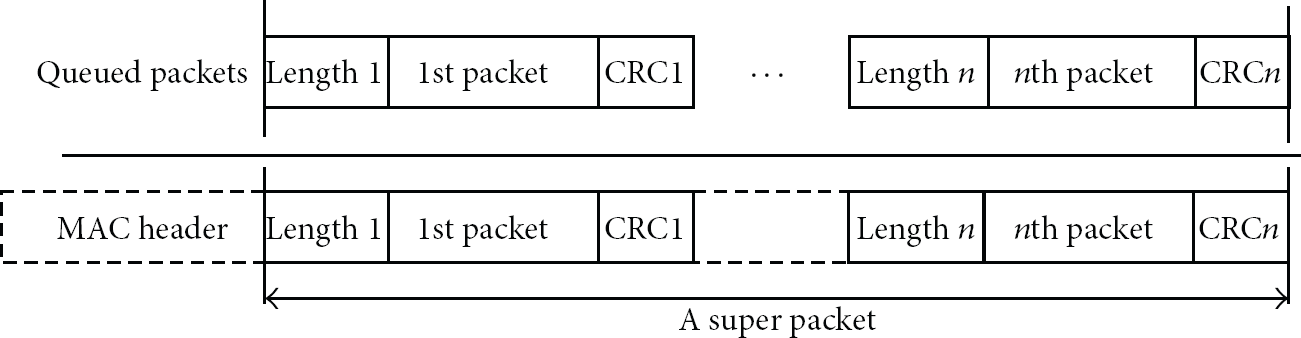
Structure of a superpacket concatenating n single packets.
3.2. Queueing Mechanism to Achieve Energy Neutral Operation
There are many queueing mechanisms appearing in the theory of computer networking as well as in the subfield of wireless sensor networks [34]. In our previous work, the queueing mechanism is utilized in order to deal with quality of service (QoS) provision for low priority traffic in AQ-MAC. The low priority packets are queued at a node until a timeout value before sending out. The original mechanism achieves a good performance in terms of energy and latency efficiency although it uses a fix and predetermined values of timeout. We have found that the mechanism has potential in the context of energy harvesting sensor networks. Therefore, we extend the mechanism in order to achieve the energy neutral operation (ENO) state at a ERI-MAC's sensor node. The timeout value becomes dynamic and is controlled by the sensor node. The node knows the capability of harvesting energy rate from the surrounding source. The node then compares the amount of energy consumption with the one of harvested energy. If the amount of energy consumption is bigger than the other, the sensor node reduces its transmissions and waits for the harvested energy. Therefore, a node can reach the desired state of ENO as shown in Figure 4. In the figure, the linear function

Determination of energy neutral operation state.
In ERI-MAC, we assume that the node knows the energy harvesting rate, its capacity of battery, and a safe duration. The safe duration is determined by the maximum period of awake state of radio during which the battery can be in a safe condition. If the node keeps its radio on over that duration, the battery can be fully exhausted and impossibly recharged. After each safe duration, the ERI-MAC's node compares the amount of consumed energy to the harvested energy by investigating the proportion between the two amounts. When the proportional value is less than one, the node knows that it consumes an exceeded energy. Therefore, it immediately goes to sleep and stays in the sleep mode until the battery is sufficiently recharged. In our evaluation in Section 4, we use the operational cycle with the length of one second. Besides that, the safe duration is determined following the appropriate energy harvesting rate and the consumed energy rate in the real sensor nodes' specifications.
4. Evaluation
4.1. Evaluation Settings
We evaluate the performance of ERI-MAC using the network simulator ns-2 [35]. In the evaluation, we demonstrate correlations of energy consumption to the performance of wireless sensor networks by modifying the energy module of ns-2. Specifically, the amount of harvested energy is continuously added to the capacity of sensor nodes depending on the harvesting rate. Besides that, the consumed energy is calculated following the three states: transmission, receive, and idle. Table 1 lists the networking and energy parameters of the sensor node, which appears in the evaluation. Those parameters are collected from in Micaz mote and Radio CC2420's specifications except the transmission range (Tx range) and carrier sensing range. Regarding the concatenation scheme,
Networking parameters adopted from the specifications of CC2420 and Micaz mote.
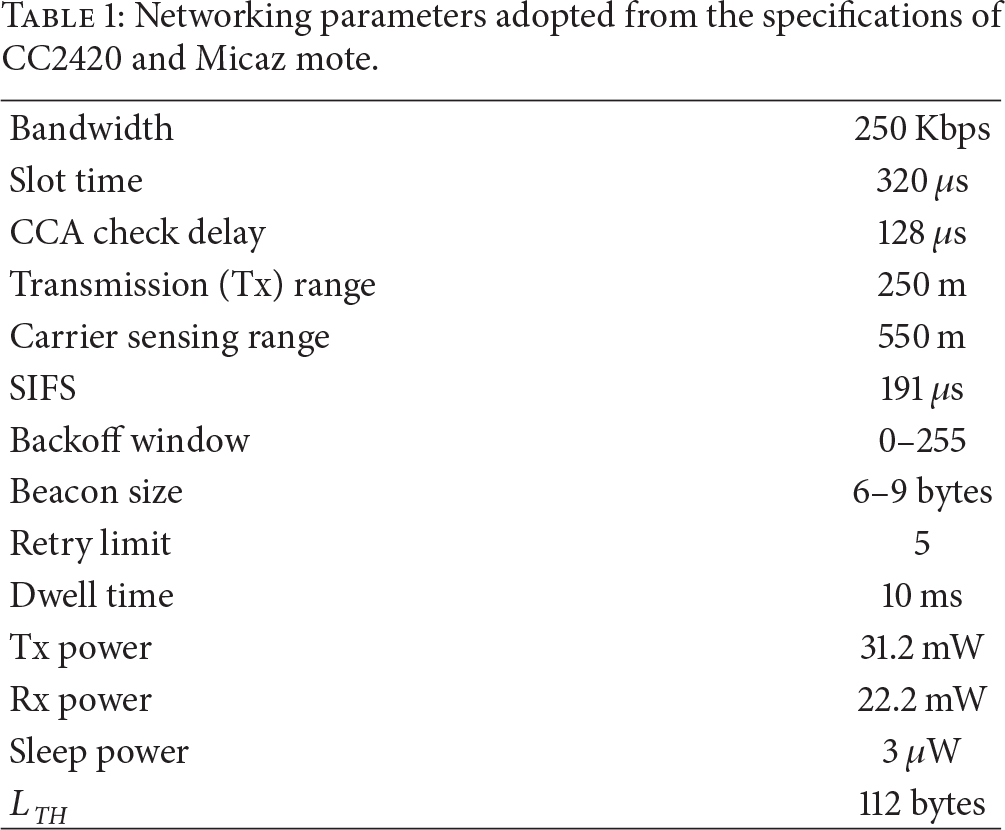
The network is a 49-node grid scenario as shown in Figure 5, in which the distance between two neighbors in the grid is 200 meters. All the data traffic is routed and destined to the sink node located at the center of grid. We select the grid scenario in order to avoid the possible overhead of routing on the networks. Besides that, we use the random correlated event (RCE) traffic model in the evaluation. The model simulates a sensing event, which occurred at a random location within the sensor deployment area. A sensing event is characterised by the so-called sensing range associated with the event. The sensing range affects the number of generated packets as follows. Each node, which is within the sensing range of one event, is going to generate one packet to the sink. For example, in Figure 5 an event with a 200-meter sensing range occurs, and it affects four blue sensing nodes within the red circle. In turn, each of the blue nodes will send one packet to the sink. In the evaluation, in order to make the traffic more realistic, we set the interevent values randomly within zero to five seconds. The total number of generated events is 100, and each event is predetermined with the 500-meter sensing range. The length of an operational cycle in ERI-MAC is one second, and the safe duration is set at five seconds. Additionally, we adopt the energy harvesting model from the evaluation in previous work [31]. The energy harvesting rates in the evaluations are constant at 0.3 mWatt and 0.6 mWatt.

The 49-node grid scenario and an simulated event with a 200-meter sensing range.
4.2. Evaluation Results
This section presents the performance results collected from the ERI-MAC's evaluation. We observe the two important performance metrics in WSNs: delivery latency and energy efficiency. The results and correlations are shown in Figures 6, 7, and 8.

The cumulative distribution of latency values.

The cumulative distribution of consumed to harvested energy ratio.

The ratio of consumed to harvested energy of all 49 nodes in case of 0.3 mW harvesting rate.
Each value of latency shown in Figure 6 is calculated between the generated and received time of a packet at the sink. In the case of superpacket, the generated time of the packet is considered as the one of the earliest packet in the concatenated form. Note that ERI-MAC equipped an efficient retransmission mechanism; therefore the delivery latency values include the period consumed by the retransmission. The red curve of cumulative distribution function (CDF) shows that most of the packets reach the sink in less than 20 seconds (nearly 100%) in case the energy harvesting rate equals 0.6 mW. However, when the rate is 0.3 mW the percentage of less than 20 s latency is decreased to 60% as in the blue curve. Hence, the energy harvesting truly affects the latency performance of wireless sensor networks. More specifically, when the rate of energy harvesting is small, ERI-MAC's nodes tend to excess the safe duration more frequently. As a result, the data packets in that scenario have to be queued, which leads to the higher values of latency. On the other hand, the value of 0.6 mW harvesting rate is sufficient to guarantee the safe duration on all the ERI-MAC's nodes. The network hence guaranteed a good latency performance.
In order to investigate the ERI-MAC's energy efficiency, the ratio of consumed energy to harvested energy is observed. As mentioned earlier, when the ratio is smaller than one at a node, the node is confirmed in an ENO state. In the case of energy harvesting rate at 0.6 mW, from the previous investigation, we know that ERI-MAC's nodes do not excess the safe duration with queued packets. Hence, there is no appearance of adapting duty cycle as confirmed in the CDF values of ratio in Figure 7. Even at the node with heaviest traffic condition, the ratio value is still less than 0.9. However, the behavior of ERI-MAC is different in the case of 0.3 mW harvesting rate. The evaluation results in such scenario are plotted in Figure 8. In the figure, z-axis shows the ratio values and the coordinators x and y are associated with the nodes' locations.
Figure 8 first shows that the nodes that are near the sink consume more energy than the nodes far from the sink. That is an intuitive conclusion and is always true since the packets normally traverse several hops to reach the sink. It is apparent from Figure 8 that all the values of consumed to harvested energy ratio are smaller than one. That confirms the efficiency of queuing mechanism with the dynamic timeout in ERI-MAC. Each time the sensor nodes check and recognize that the amount of consumed energy is larger than the amount of harvested energy. They themselves turn and keep their radios off in order to reach or maintain the ENO states. We can conclude that the ERI-MAC's nodes achieve the infinitive lifetime.
5. Conclusion
In WSN, power saving has been addressed as one of the most demanding features in designing MAC protocol. However, the recent advances of energy harvesting technology, which lets a battery on a node be recharged by energy sources from the surrounding environment, potentially change the fundamental of the MAC design. Instead of maximizing the energy efficiency, the new MAC protocol is expected to efficiently operate while the sensor nodes are in ENO states. Leveraging the harvesting technology, we propose ERI-MAC, a new energy-harvested receiver-initiated MAC protocol for WSNs. ERI-MAC inherits the advantages of receiver-initiated communication and packet concatenation in order to achieve good network performances in terms of throughput and latency. Moreover, ERI-MAC's nodes use the queuing packet mechanism to adapt the operation of a sensor node with the rate of harvested energy. When the ratio between the consumed to harvested energy is larger than one (i.e., not in the ENO state), ERI-MAC's nodes switch to and stay in the sleep mode until the batteries are safe (i.e., sufficiently recharged). We have extensively evaluated ERI-MAC in a large-scale network with a realistic traffic model. The simulation results show that ERI-MAC achieves good network performances while keeping all nodes in ENO state, that is, achieving infinitive lifetime.
In the future, we are going to investigate the potential effects of different energy harvesting models on ERI-MAC. Besides that, we plan to extend our investigation of packet concatenation on normal WSNs [36] to the energy harvesting WSNs.
Footnotes
Conflict of Interests
The authors declare that there is no conflict of interests regarding the publication of this paper.
Acknowledgments
The authors would like to thank the anonymous reviewers for their valuable comments and suggestions to improve the quality of the paper. This research is funded by Vietnam National University HoChiMinh City (VNU-HCM) under Grant no. DHQG-C20132601.