




Abstract
Based on the analysis of notch-root stresses and strains in bodies subjected to multiaxial loading, a quantitative relationship between Neuber rule and the equivalent strain energy density method is found. In the case of elastic range, both Neuber rule and the equivalent strain energy density method get the same estimation of the local stresses and strains. Whereas in the case of elastic-plastic range, Neuber rule generally overestimates the notch-root stresses and strains and the equivalent strain energy density method tends to underestimate the notch-root stresses and strains. A modified method is presented considering the material constants of elastic-plastic Poisson's ratio, elastic modulus, shear elastic modulus, and yield stress. The essence of the modified model is to add a modified coefficient to Neuber rule, which makes the calculated results tend to be more precise and reveals its energy meaning. This approach considers the elastic-plastic properties of the material itself and avoids the blindness of selecting coefficient values. Finally the calculation results using the modified model are validated with the experimental data.
1. Introduction
All kinds of notches exist in mechanical structures which tend to produce stress concentration. Fatigue life prediction of notched components in complex service conditions requires the local stress-strain relationship of a material element at the notch-root to be known [1]. The notch stress-strain analysis and low-cycle fatigue concepts are often used in fatigue analysis to estimate crack initiation lives [2]. It is necessary to measure or calculate the local elastic-plastic notch-root stresses and strains in order to perform such analysis. In many situations, measurements are impractical or impossible. So the calculations are necessary. However accurate calculations of these stresses and strains are not intractable; they are difficult and lengthy especially for a long arbitrary cyclic loading. Therefore, approximate methods are widely used in engineering practice. So far, a few approximate methods for description of the nonlinear stress-strain behavior of notches have been developed [3]. Among these, the most popularly and frequently used relation is Neuber rule, which has been extended to fatigue problems [4]. However, in most cases Neuber rule overestimates the notch-root stresses and strains. An alternative method for predicting elastic-plastic notch-root strain, based on strain energy density considerations, has been proposed [5]. Contrary to Neuber rule, the equivalent strain energy density method tends to underestimate the plastic strain in notch-root. Both Neuber rule and the ESED method have been derived for simple stress states such as pure shear or plane stress. For notched bodies in plane strain, extensions of Neuber rule have been proposed by Hoffman et al. [6] and of the ESED method by Glinka [7]. However, neither simplified method has been successfully extended to address notched bodies subjected to a general multiaxial loading. As we all know that the additional elastic-plastic notch stress-strain relationship, the one developed by Seeger et al. [8], is nowadays implemented in some commercial software packages (MSC Fatigue, FEMFAT, and n-Code). Moreover, there are a lot of successful applications and capabilities of this relationship to notches subjected to uniaxial cyclic loading in [9], multiaxial-proportional cyclic loading in [10, 11], and nonproportional cyclic loading in [12, 13]. It should be noted that althoughSavaidis et al. [11] and Das and Sivakumar [14] have proposed an extension to Neuber rule, the use of equivalent concentration factors in the formulation neglects the effects of dilatational deformation. The aim of this paper is to derive a modified method enabling the notch-root stresses and strains to be determined for multiaxial loading.
2. Stress-Strain Analysis and Constitutive Relations
When the stress range of notch-root is under the uniaxial state (Figure 1), its components can be expressed as


Notch-root stress and strain state.
At the same time, in the case of multiaxial loading, its components can be represented as

The elastic-plastic stress-strain constitutive relation is usually derived from uniaxial stress-strain curve based on elastic-plastic theory and it can be written in the form

where

Here,
3. Neuber Rule
Neuber rule was initially derived in the case of pure plane shearing [15]. On the basis of experimental measurement of strain at the notch-root, it is further found that Neuber rule is of more general validity and can also be used for other types of loading [16]. In the case of simple uniaxial tension, Neuber rule can be written as a general form as follows [17–19]:
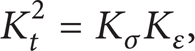
where
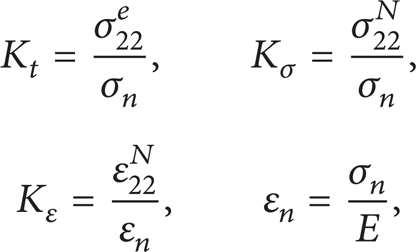
where K t is the theory elastic stress concentration factor, Kε is the strain concentration factor, Kσ is the stress concentration factor, σ n is the nominal stress, superscript e represents the corresponding item analyzed by linear elastic, and superscript N represents the corresponding item calculated by Neuber rule. The following equation can be given by substituting (6) into (5):

There are three stress components and four strain components when the structures are subjected to multiaxial loading. That is, there are a total of seven unknown parameters. The constitutive equations can only provide four equations. Therefore three additional equations are required. Equation (7) can be expanded in the case of multiaxial loading and its tensor form is given by

It has been proven that this equation has energy meaning. Figure 2 shows that, in the case of uniaxial stress state (such as plane stress), the total strain energy density in plastic state equals to that in the linear elastic state; namely, the rectangular A and the rectangular B have the same area.

Principle of Neuber rule.
It has been reported that it is more convenient to describe (8) using the principal stresses and strains in the case of multiaxial loading, so there are five unknown parameters σ2, σ3, ε1, ε2, and ε3 and five equations are required. Then (8) can be rewritten as

Numerical and experimental data indicate that when the applied loads are proportional, the fractional contribution of the largest principal notch-root stresses and strains to the total notch-root strain energy density is virtually equal to the corresponding fraction calculated elastically for a geometrically identical notched body subjected to the same load. That is,
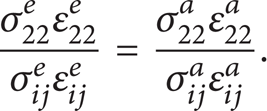
The constitutive equations can provide the following three equations:

where
So (9)∼(11) can be employed to calculate the stresses and strains components by Neuber rule.
4. ESED Method
Based on the assumption that the strain energy density distribution in the plastic zone ahead of a notch-root is the same as that determined on the basis of the pure elastic stress-strain solution, Mücke and Bernhardi [20], Molski and Glinka [21], and Singh et al. [22] developed a similar local elastic-plastic calculation method called the equivalent strain energy density method. In the case of monotonic loading and uniaxial stress condition at the notch-root, ESED method can be expressed in the form

where superscript E represents the corresponding item calculated by ESED method.
Figure 3 shows that although the stress range of notch is in the plastic region, the strain energy density equals to that in elastic state; namely, the shadow area and the triangle area consisting of straight line OB and horizontal axis are equal. The equivalent strain energy density method needs the following expression to solve the problem under multiaxial loading:

where

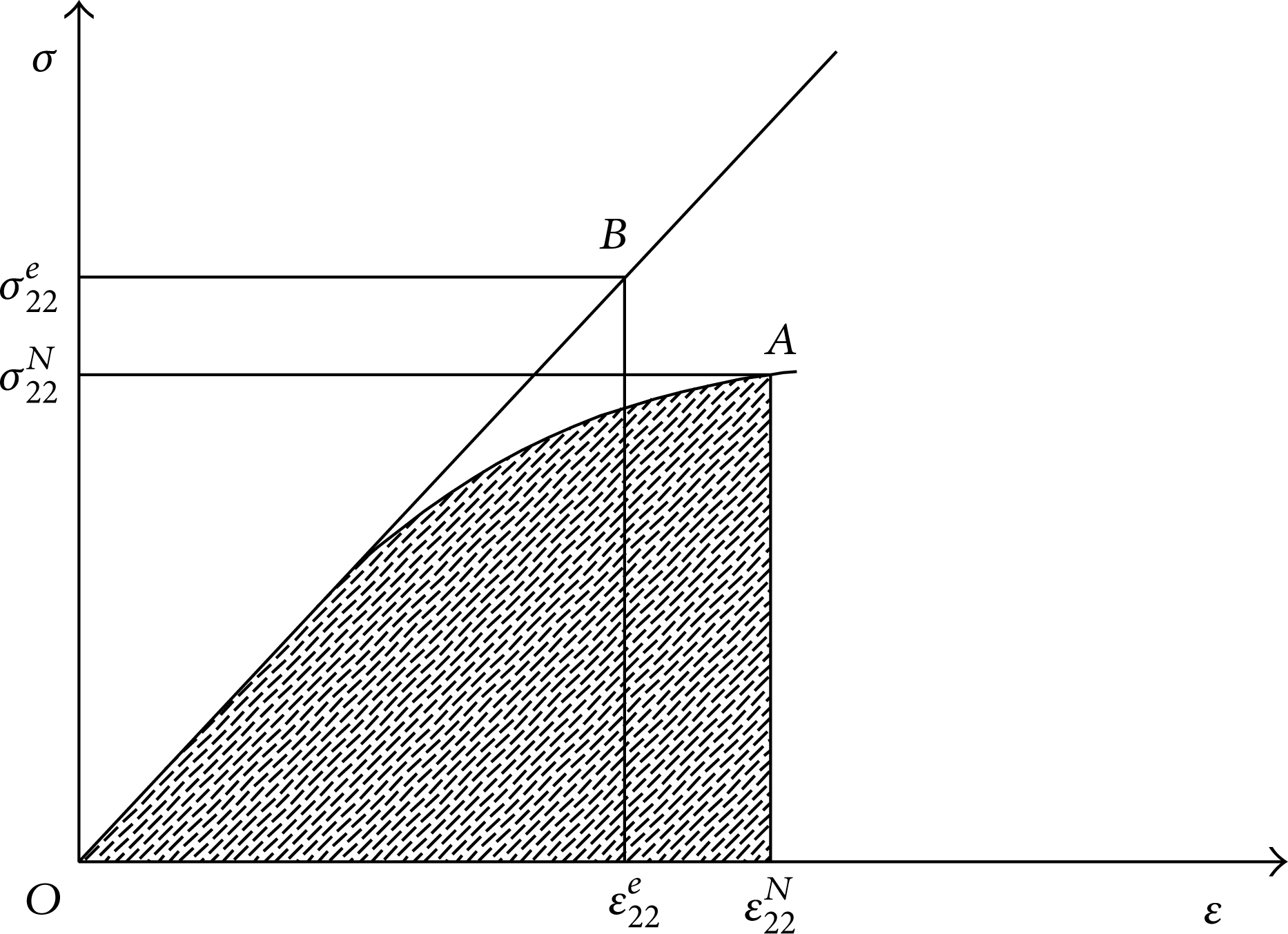
Principle of ESED method.
Similarly, the distribution ratio can be given as

Therefore (13)∼(15) and constitutive equations are used to calculate the stresses and strains components by ESED method.
5. Modified Model
On the basis of the analysis of results calculated by Neuber rule and ESED method, two points could be summarized up: first, the yield strength limit should be reflected in response to the difference between pre- and postplastic phase; secondly, the results calculated by modified model should locate between the upper limit and lower limit in order to avoid large errors of calculation results. So calculation model should be modified based on the above two reasons [23, 24].
Providing the further quantitative analysis for Figures 2 and 3 and considering the relationship of the stress-strain, it can be found that the shaded area calculated by Neuber rule is larger than that calculated by the equivalent strain energy density method. Difference area roughly equal to trapezoidal area consists of BCFE (Figure 4), which provides the idea to modify the stresses and strains calculation model under multiaxial loading.

Principle of modified model.
In this paper, the essence of the modified model is to add a modified coefficient to Neuber rule, considering the influence of the yield strength on energy density curve. And the results calculated by modified model should locate between the results calculated by Neuber rule and ESED method. Then calculation model is processed by using the principal stresses and strains. That is,

where νeq is elastic-plastic Poisson's ratio, superscript M represents the corresponding item calculated by modified model, E
M
is elastic modulus for the selected material, and E
G
is general elastic modulus and its upper limit is 200 GPa. If E
M
>E
G
,
The elastic-plastic Poisson's ratio is defined as
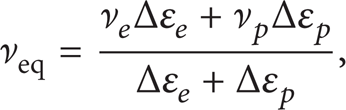
where ν e is the elastic Poisson's ratio, ν p is the plastic Poisson's ratio, Δε e is the elastic strain range, and Δε p is the plastic strain range.
Multiplied by a coefficient, less than 1, on the left side of (9) to subtract the redundant trapezoidal area. Coefficient is related to the material constant

It should be pointed out that, in this paper, the approach joining the material constant

Therefore (16), (19), and constitutive equations enable the notch-root stresses and strains components to be calculated.
6. Application Example
In order to assess the validity of the modified solutions, the calculated strain is compared with available experimental data. The data was taken from Knop et al. [25], who studied a cylindrical specimen with a circumferential notch subjected to simultaneous tension and torsion loading. The shape and dimensions of specimen are simplified as shown in Figure 5 and the material constants of LD5 aluminum alloy are listed in Table 1.
Material constants of LD5 aluminum alloy.


Shape and dimensions of specimen.
The ratio of the notch-root nominal shear to tensile stress τ n /σ nF = 2.5 and they can be calculated by the formula as follows:

where F is axial loading, D is cylinder radius, t is the depth of the notch, R is radius of notch, and T is torque.
Since the ratio between the torsional and tensile applied load was fixed, the notch-root stress components σ ij e were given in terms of the nominal tension stress σ nF . Thus, the local hypothetical linear elastic notch-root stress components given in the coordinate system that coincides with the axis of symmetry of the cylinder (Figure 5) were σ22 e = 3.89σ nF , σ23 e = 5.475σ nF , and σ33 e = 1.05σ nF . The angle of the principal axes, the magnitude, and the ratio of principal stress components were ασ = 37.7°, σ2 e = 8.126σ nF , and σ3 e = −3.186σ nF , respectively.
The stress-strain relationship can be expressed as
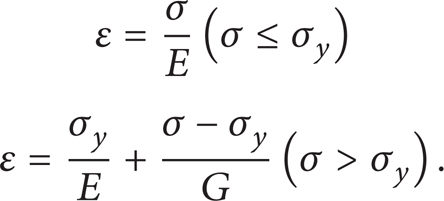
The stresses and strains components can be calculated by Neuber rule, ESED method, and modified model, respectively (Tables 2 and 3).
Results of notch stresses.

Results of notch strains.

The calculated results using the above three methods are compared with the experimental results [25], and the comparison is shown in Figures 6 and 7.

Comparison of stress between experimental and calculated results.

Comparison of strain between experimental and calculated results.
Figures 6 and 7 show the plots of the calculated and the measured local amplitude against the ratio of the average nominal stress S
n
to yield stress σ
ys
. The average nominal stress can be defined as
7. Conclusion
It has been found that the generalized Neuber rule, which represents the equality of the total strain energy density at the notch-root, gives upper limit estimates for the elastic-plastic notch-root stresses and strains. On the other hand, the generalized equation of the equivalence of the strain energy density yields lower limit solutions for the notch-root stresses and strains. A modified method for calculating elastic-plastic notch-root stresses and strains has been proposed on the basis of the analysis of difference between Neuber rule and ESED method for a general multiaxial loading. The method considers the material constants of elastic-plastic Poisson's ratio, elastic modulus, shear elastic modulus, and yield stress. So it relatively accurately calculates the stresses and strains of notch-root. The modified method has been verified by comparison with numerical and experimental data.
Conflict of Interests
The authors declare that there is no conflict of interests regarding the publication of this paper.
Footnotes
Acknowledgment
The authors acknowledge that this paper has been supported by the National Natural Science Foundation of China (Grant no. 11072099).