




Abstract
In mobile cooperative orthogonal frequency division multiplexing (OFDM) systems with amplify-and-forward (AF) relays, in which the source and relay terminals are moving, Doppler frequency might become very large due to the formation of double-hop channels, possibly causing very large intercarrier interference (ICI). Therefore, ICI mitigation technique capable of reducing the impact of high Doppler frequency is required. This paper reports the study of ICI mitigation technique that uses frequency domain equalizer (FDE) with improvements in three aspects, namely, better channel estimation using cubic-spline approximation, use of selection combining to utilize cooperative diversity in order to suppress ICI, and simple error correcting code with double interleaving to suppress errors due to residual ICI. By using the proposed ICI mitigation technique, error rate performance of mobile cooperative OFDM systems can be improved significantly. Even at high Doppler frequencies, error floors due to residual ICI can be decreased by up to two decades.
1. Introduction
Orthogonal frequency division multiplexing (OFDM) using a number of mutually orthogonal carriers to transmit data simultaneously has been widely used for high-speed data transmission. Orthogonality between subcarriers allows signal spectra of the OFDM subchannels to be separated without interference or power loss due to leakage to other subcarriers. However, time-varying channel because of large Doppler shift can damage the orthogonality nature, leading to ICI (intercarrier interference) and degradation of the performance of system BER.
Doppler shift can increase if the communicating terminals move faster or if there is a multihop channel with moving amplify-and-forward (AF) relays as in cooperative communication for such applications as vehicular communication network, robotic communications, and communications among distributed moving sensors. The greater the Doppler shift the greater the shift in the carrier frequency and widening spectrum. In this situation, ICI mitigation techniques adopted in OFDM systems must be able to deal with large ICI generated by high Doppler frequencies. Various attempts have been reported to find a way to overcome the ICI. Generally, ICI mitigation techniques can be divided into two types: the first seeks to prevent ICI that will occur and suppress it as small as possible, whereas the second type attempts to overcome ICI that has occurred. Both have their own weaknesses: the first requires higher bandwidth for coding to shape the subcarrier spectra to minimize ICI [1, 2], whereas the second requires more complex signal processing to eliminate ICI. In this paper, we are concerned with the second-type ICI mitigation techniques, considering bandwidth limitation to be an inevitable factor.
The second type of ICI mitigation technique that has been proposed is the one using frequency domain equalizer (FDE) [3–6]. FDE is designed based on channel estimation. In time-varying channels, channel estimation and FDE filter coefficients should be updated at every detection of one OFDM symbol. Therefore, it needs a low-complexity channel estimation technique. A simple channel estimation method with piecewise linear approach that has been proposed in [7] has simple interpolation computational advantages. However, the approach can only work well when the normalized maximum Doppler shift, defined as the maximum Doppler shift normalized to the subcarrier spacing, is less than 0.2. Our paper proposes several techniques to improve the performance of ICI mitigation technique with FDE, so that the technique can still work well on mobile cooperative OFDM system with moving AF relays, in which Doppler frequency tends to be high.
This paper describes some techniques to improve the performance of ICI mitigation based on FDE applied in three different systems. In the first system, block-type arrangement of pilots is used with alternating polarity to suppress midpoint channel estimation error, so that the channel influence can be cancelled by the equalizer. The alternating polarity for pilots in block is used because the pilot's side lobe spectra will cancel each other so that the power leakage on other pilots’ main lobe spectrum can be minimized and ICI distortion due to orthogonality loss will be reduced [8]. Selection combining is selected because when the equalizer fails to reduce ICI in one OFDM symbol, most of the symbols will be in error and should be replaced with the correct ones from the other branch. In this paper, this system is referred to as LI system because it still uses piece-wise approach to linear interpolation.
The second system is obtained by replacing the piecewise linear approximation interpolation with cubic-spline interpolation (third-order polynomial) to anticipate a fast channel change due to high Doppler so that channel estimation error can be suppressed using interpolation. We call this second system CI, which stands for cubic-spline interpolation.
The third system referred to as the CI-CDI is realized by adding a simple error correcting code technique with double interleaving to the CI system. This addition is applied to correct errors bursts due to residual ICI in OFDM symbols that cannot be replaced by symbols from the other branch because the substitutes also experience burst errors.
Hence, there are two main contributions of this paper. Firstly, we evaluate the use of linear and cubic interpolation for channel estimation, coupled with double interleaving and coding in a cooperative network with MM channels. By combining the strengths of the individual techniques, the overall scheme shows an increase in performance. Secondly, we propose and evaluate the use of selection combining between direct and relay link to reduce residual ICI.
Numerical results show that, by exploiting the nature of cooperative diversity with selection combining, performance of ICI mitigation technique can be improved. In addition, at relatively high Doppler frequency, use of pilot with alternating polarity in the LI systems can improve the performance of ICI mitigation technique significantly. With the CI system, the use of cubic-spline interpolation can reduce the error floor by up to one decade. While in the CI-CDI system, combined application of simple error correcting technique and double interleaving can reduce the error floor by at least another decade.
Section 2 of this paper discusses the mobile channel and the system under study. Section 3 focuses on the proposed ICI mitigation techniques, namely, the LI, CI, and CI-CDI system. Simulation results are reported and analyzed in Section 4 and conclusions are given in Section 5.
2. Description of Channel and System
2.1. Mobile Channel Models
In a simple cooperative system with moving source and relay terminals as shown in Figure 1, there are three types of mobile channels, namely, mobile-to-fixed (MF), mobile-to-mobile (MM), and, if such cooperative systems use AF relaying scheme, mobile-to-mobile-to-fixed (MMF). The mobile channel model used in this analysis is derived from the normalized MM channel complex envelope with double-ring scatterers model which is given as [9, 10]

where

Simple cooperative diversity.
For the MF channel, it is assumed that there is only one ring of scatterers which is located around the transmitter, so that (1) is reduced to [11, 12]

where

where
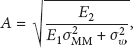
where


where

where N is the number of subcarriers, whereas
2.2. System Description
A block diagram of the OFDM system with ICI mitigation technique is given in Figure 2. Output from the fast Fourier transform (FFT) block is expressed as follows:

where
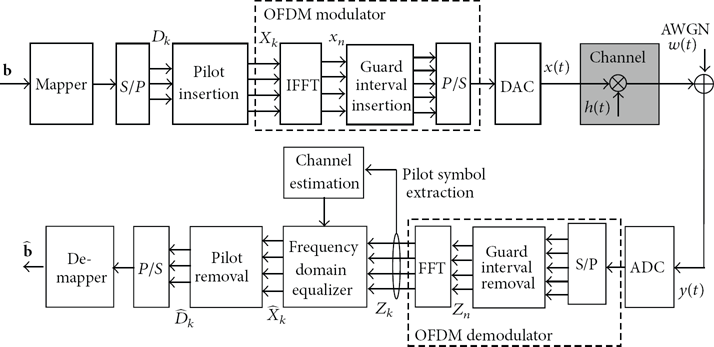
OFDM system and ICI mitigation.
3. ICI Mitigation Technique Improvement
FDE-based ICI mitigation requires inverse operation of channel frequency response matrix, so that its performance depends on the accuracy of channel estimation. As described in Section 1, for ICI mitigation techniques improvement, there are three systems proposed. Explanation of each system is given as follows.
3.1. LI System
Channel estimation here is done in the time domain. There are two stages in the channel response estimation. The first stage involves channel estimation at each symbol midpoint, the result of which is denoted by

where

in (10),

From these pilots, samples from the channel frequency response at subcarrier frequency points carrying pilot signals,

where

In this case the midpoint value of the channel response is assumed to be represented by its average value, that is,

where

piecewise linear interpolation is quite simple and only requires information of two midpoints to estimate along one symbol duration. The estimation error with this approach is relatively low when the normalized maximum Doppler shift is small, that is,

where

The symbol vector contained in each OFDM symbol is estimated using the following equation:

where
Performance of mitigation technique can also be improved by adopting cooperative diversity. To maximize the improvement, the most suitable combining technique must be chosen. Because FDE does not work when the channel gain is very low or

where vector

The diagram block of LI system.
3.2. CI System
To get small channel estimation error when Doppler frequency is high, in the second system, the cubic-spline interpolation technique is proposed to replace the piecewise linear approach [15, 16]. Cubic-spline interpolation requires at least 3 midpoint samples of the channel response,
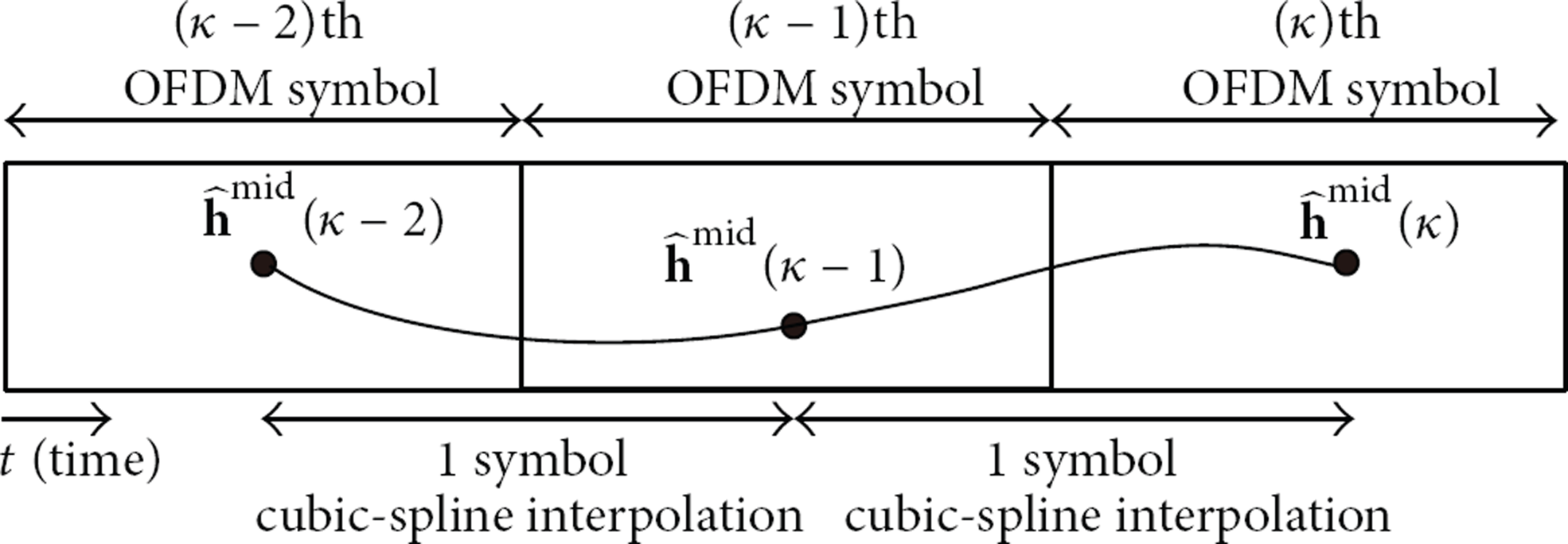
Cubic-spline interpolation.
For every cubic-spline interpolation, vectors

Each

Cubic-spline interpolation is done separately for the real and imaginary parts but the interpolation steps between the real and imaginary parts are identical. Therefore, cubic-spline interpolation steps are described herein for the real part only. The elements of these three-point coordinates in the image above, for the real part, can be expressed in vector

In the above equations,
For the qth segment, where
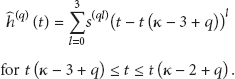
To get

Matrix

Then, by using equation

vector

where

The coefficients on the cubic-spline interpolation equation for the first and second segment, namely,
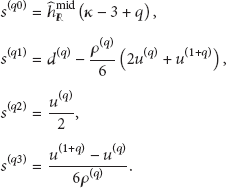
For the imaginary part,
3.3. CI-CDI System
The performance of the second ICI mitigation technique above, that is, the CI system, can be improved further by incorporating error correcting codes. When ICI mitigation in OFDM symbol fails, the ICI distortion on the symbols contained in OFDM symbol will cause burst errors. To overcome these burst errors, the third system is proposed using CI-CDI system, that is, with the addition of double interleaving technique with simple error correcting code to the CI systems. In the CI-CDI system, simple error correcting codes can be used, such as cyclic code
3.3.1. Simple Error Correcting Code
The cyclic code

After the error-correction encoding and before the modulation stage, double interleaving is performed in two stages, as described in the following.
3.3.2. Bit Interleaving
Bit interleaving is intended to separate the double-bit errors that may occur when a 4-ary symbol modulation (QPSK) encountered an error. To get a bigger possibility to spread burst errors into a single error in each block, separation between the in-phase and quadrature bits should be far enough. When the number of subcarriers for data is
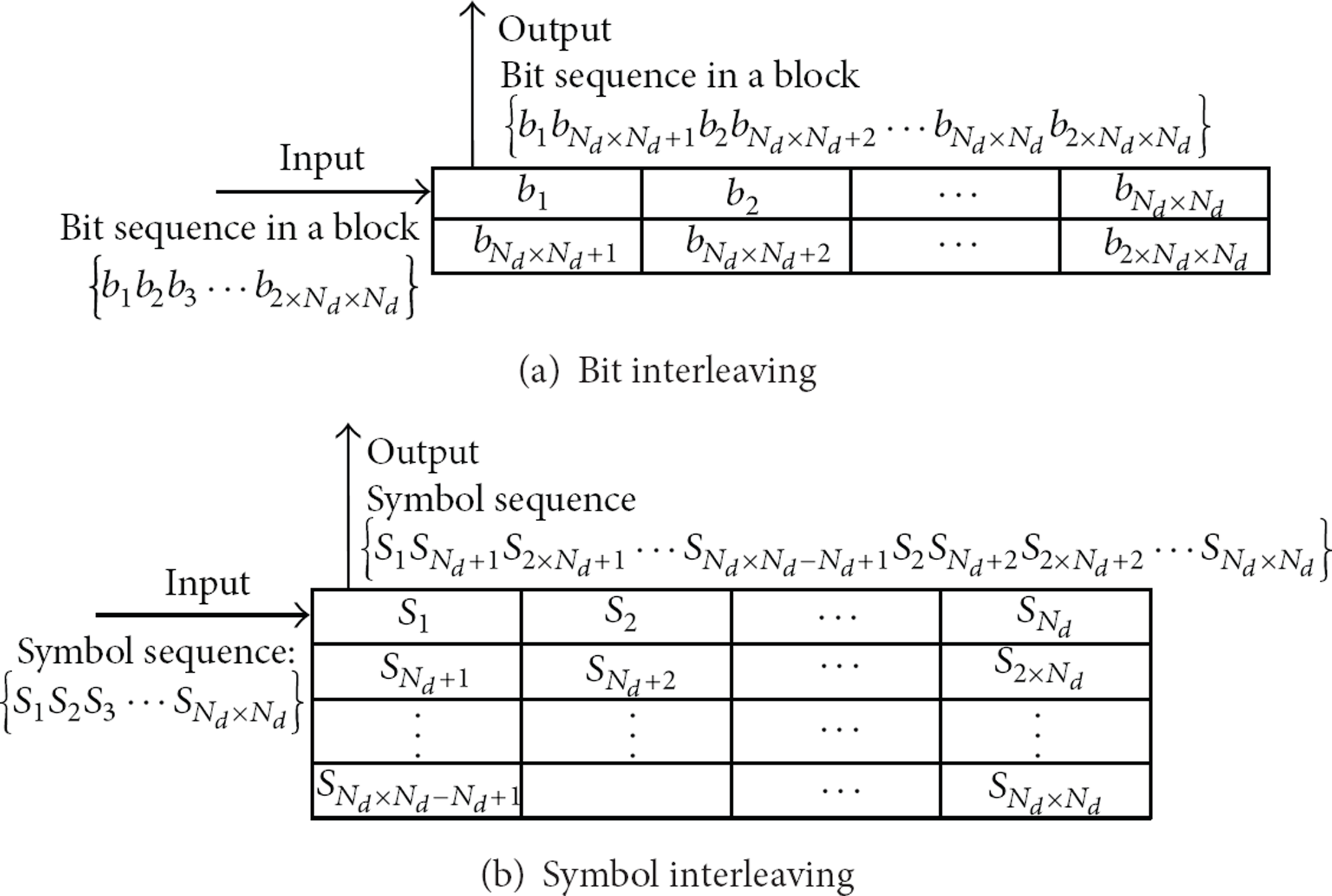
Interleaving mechanism.
3.3.3. Symbol Interleaving
Symbol interleaving is intended to separate the burst errors occurring in the symbols occupying adjacent subcarriers in an OFDM symbol. Burst errors occurring in one OFDM symbol are spread into a single error in one block of OFDM symbols. The symbol interleaving requires a buffer of the size
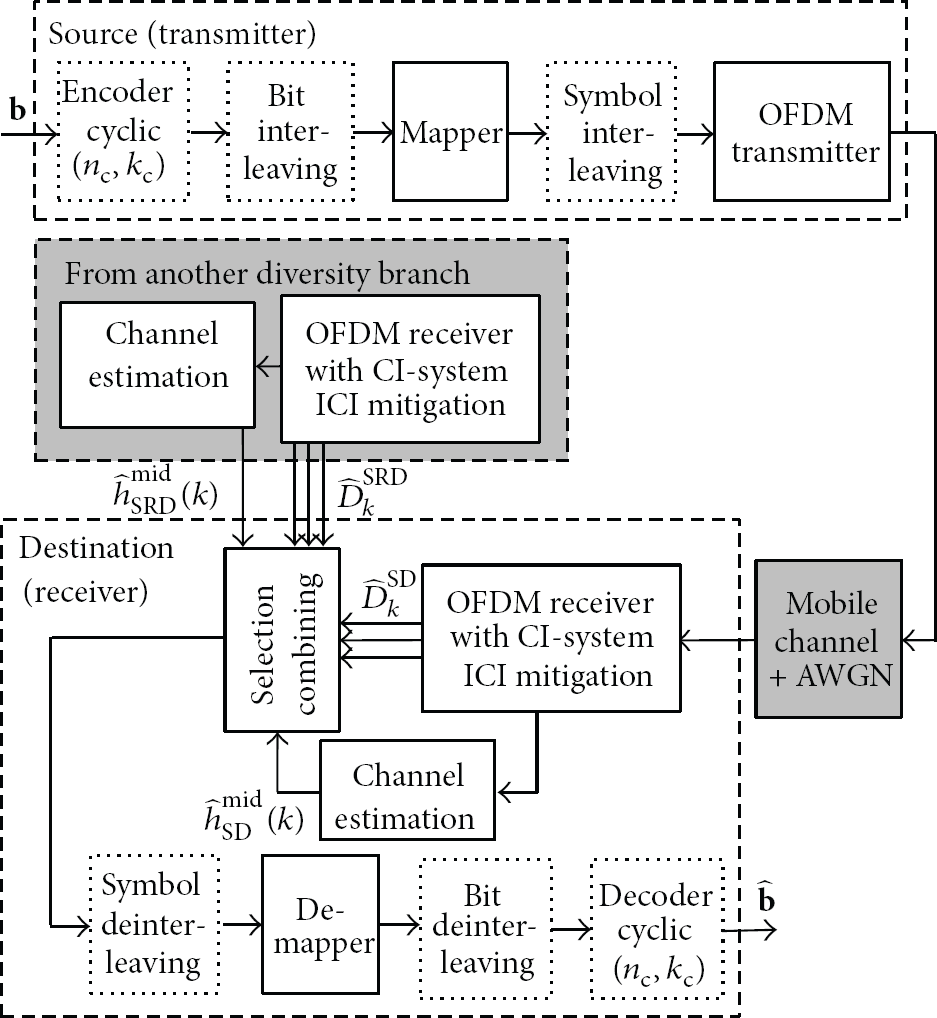
The CI-CDI system block diagram.
4. Performance Analysis by Simulation
4.1. Simulation Description
The OFDM system parameters used in the simulation are given in Table 1. Intersymbol interference (ISI) is assumed to be eliminated completely by using a guard interval longer than the maximum delay spread. Simulation parameter observed is the resulting bit error rate (BER) as a function of the ratio between energy per bit and power spectral density
Parameters in simulation.

4.2. Simulation Result and Analysis
In Figure 7, ICI mitigation technique that incorporates a change in pilot from the comb type into the block type with alternating polarity indicates considerable performance improvement for both cooperative and noncooperative systems with or without AF relay. The performance of noncooperative system using AF relay is not better than system without relay because the moving relay contributes two maximum Doppler shift components, that is,

BER performance of mobile cooperative OFDM system with ICI mitigation technique for
For the CI-CDI system, use of two types of cyclic code is evaluated, that is, the (15, 11) cyclic code representing
Simulation results of the systems performances to investigate the combining techniques between selection combining (SC) as is proposed and maximum ratio combining (MRC) are given in Figure 8. In this figure, MRC combining is slightly better than SC for small

BER performance comparison of SC (selection combining) and MRC (maximum ratio combining) in mobile cooperative OFDM system with and without coding
To investigate the effect of channel parameter on system performance, in Figure 9, the system performances are investigated with various maximum Doppler shifts at relay branch (source-relay-destination link). In this figure, the CI-CDI system is unable to mitigate ICI if the normalized Doppler shift on relay branch is more than 0.5.

BER performance of OFDM cooperative system for various normalized maximum Doppler shift at relay branch,
5. Conclusion
In cooperative OFDM systems, performance of ICI mitigation with FDE can be enhanced by exploiting the diversity nature coupled with selection combining. The improvement of channel estimation is very important, which in this case is achieved by employing cubic-spline interpolation in place of piecewise linear approach. Aside from that, the addition of a simple error correcting code and double interleaving improves the system BER performance significantly, especially at high Doppler shifts. With normalized maximum Doppler shift at source branch = 0.2, using CI-CDI system, the total performance improvement can produce a reduction in the error floor by more than two decades provided that the normalized maximum Doppler shift at relay branch does not exceed 0.4.
Footnotes
Conflict of Interests
The authors declare that there is no conflict of interests regarding the publication of this paper.
Acknowledgments
The graduate study of Titiek Suryani is supported by a BPPS Scholarship from the Indonesia Government. The reported work is part of research program funded by Graduate Research Grant BOPTN 2012 from the Indonesian Ministry of National Education.