




Abstract
Given its importance, the problem of secure data aggregation in wireless multimedia sensor networks has attracted great attention in the literature. Wireless multimedia sensor networks present some challenges that are common to wireless sensor networks, such as the existence of limited resources, like sensors memory, energy consumption, and CPU performance. Many methods have been proposed to attempt to solve the problem. However, the existing data aggregations do not take into account the redundancy of the multimedia data. In order to improve the energy efficiency for multimedia data, we propose a similarity model and power model. The proposal scheme divides multimedia data into multiple different pieces, and transmits the effective pieces to the selected sensor nodes. Through theoretical justifications and empirical studies, we demonstrate that the proposed scheme achieves substantially superior performances over conventional methods in terms of energy efficiency and data transmission under the resource-constrained wireless multimedia sensor networks.
1. Introduction
A wireless sensor network consists of a large number of small, inexpensive, disposable, and autonomous sensor nodes which gather and summarize information from various applications and environments that are difficult for us to approach directly [1]. Research and development in wireless sensor networks are becoming increasingly widespread due to their low cost and low maintenance in deployment. Wireless multimedia sensor networks (WMSNs) enable the transmission of different kinds of data such as still images, multimedia streaming, and audio due to the availability of low cost hardware such as CMOS and CCD cameras. Thus, WMSNs are expected to be solutions to variety fields, such as environmental monitoring, military applications, disaster management, and advanced health care delivery [2].
WMSNs suffer from many constraints, including low computation capability, small memory, limited energy performances, susceptibility to physical capture, tremendous transmission of multimedia data, and the use of insecure wireless communication channels [3]. As the various applications of WMSNs increase, the problems of security are also complex. Secure data aggregation is efficient in power consumption, so it plays a positive role in the computationally constrained and resource-constrained wireless sensor nodes. Ideally secure data aggregation for WMSNs should have less computational complexity, have longer lifetime, and have less latency for data transmission from sensor nodes to sinks [4]. Due to these limitations, it is essential to maximize the lifetime of sensors by reducing the amount of information that traverses the network. The data aggregation that we present in this work is designed to comply with the above-mentioned characteristics of secure data aggregation.
In this paper, we propose a novel application of similarity matching, namely, a security-enhanced energy-efficient data aggregation for WMSNs security. We build our design on ideas from fuzzy similarity matching. By analyzing the fact that multimedia data in WMSNs involves large amount of similar information, we establish a similarity model and power model. Firstly we divide the multimedia data into multiple pieces and extract the feature from the different pieces. Then, comparing the difference between the pieces feature and the standard feature, we only present a few significant pieces in order to decrease the volume of multimedia data and transmit multimedia data efficiently. According to the standard data feature, we make the sensor node chooser for effective multimedia data and update the power value of sensor nodes. The framework of proposed algorithm is illustrated in Figure 1.

The framework of the algorithm.
This paper is organized as follows. In Section 2, we overview the existing secure data aggregation scheme for WMSNs. Section 3 describes the proposed lightweight data aggregation scheme for WMSNs security based on similarity matching. Security analysis and performance evaluation are given in Section 4. Finally, Section 5 offers conclusions and future directions.
2. The Related Works
Sensor nodes in WMSNs have limited computing capability and energy resources without the aid of any established infrastructures, so many studies are conducted considering these limitations for various applications [5–11]. Multimedia data has a large volume which is different from traditional wireless sensor networks that transmit the simple numerical values, so important distinctions exist which greatly affects how security is achieved. Some of the related works in secure data aggregation are as follows.
Wu and Abouzeid [7] studied distributed image compression that the whole compression process of a single image was distributed among different groups of sensor nodes. The paper reduced the maximum energy needed in sensor nodes and did not decrease the total energy. Hongxia and Bangxu [8] proposed a perceptual hashing-based robust image authentication scheme, which applied the distributed processing strategy for perceptual image hashes. The scheme protected multimedia data from unauthorized access but increased the energy consumption simultaneously. Fucai et al. [9] presented a novel partial dynamic reconfiguration image sensor node prototype for WMSNs to transmit sensitive images. The paper enabled the partial dynamic reconfiguration to decrease the volume of image data. Czarlinska and Kundur [10] used back transmission to the cluster head when frames contain event of interest and studied the detection performance of event-driven WMSNs. The scheme overcooked the hostile attacks using image processing techniques and supported a scalar sensor. Zhang et al. [11] focused on the design of transport protocols optimized for achieving fast transmission rates and fast error recovery, offering the application layer a better throughput of information which allowed using better resolution for the multimedia information. Ozdemir and Xiao [12] used integrity protecting hierarchical to conceal data aggregation for wireless sensor networks, but the volume of the multimedia data was not given significant consideration. Harjito et al. [13] provided a secure communication framework for WMSNs by developing new technique and developed a lightweight digital watermarking technique as a secure approach to ensure secure wireless communication. But the research did not describe the specific methods.
The existing schemes regarding sensor data aggregation for multimedia data sensors have just been studied from data transmission or energy efficiency. The volume of the multimedia data is not given significant consideration in some schemes, and even if some schemes have the advantages in energy efficiency or limited bandwidth, it has a security problem specifically. In short, evidence justifies that WMSNs security is indeed a very young research field, and the crucial question is how to prolong the resource-constrained WMSNs lifetime to the longest time in secured mode. We propose a secure data aggregation scheme based on similarity matching for multimedia data transmission to overcome bandwidth limitations and to solve the security problem.
3. The Proposed Scheme
In the paper, we describe a secure data aggregation scheme for multimedia data transmission. Firstly, we describe the similarity model and show how multimedia data is divided into some significant pieces data. Secondly, the process of the power model will be described in more detail.
3.1. The Similarity Model
In this section, we propose a method to provide the data aggregation for multimedia data (e.g., still image) transmission. To utilize the limited bandwidth efficiently and compress the multimedia data economically, the large volume of multimedia data is divided into several significant pieces of data and each piece is transmitted through the selected multipath. In the existing schemes, although these schemes are efficient approaches in data transmission, they do not make use of the similarity information which consists in the surrounding environment of WMSNs. In order to reduce the amount of multimedia data transmission, we propose a similarity model. The concept of the similarity model is shown in Figure 2.

The similarity model.
Considering the changes of surrounding, we capture one image data as the standard data once in a while and set other image data as the compared data. The proposed scheme splits the standard image data and the compared data into
We define the similarity specific value function as

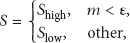
When
In sum, the similarity matching algorithms are summarized in Algorithm 1.
(1) Initialization (2) Compute the histogram normalization (3) Compute the similarity specific value function m (4) Compute the similarity matching function S (5) Determine the similarity matching of x and y, and choose the diverse divided piece y
According to the redundancy and similarity information of WMSNs surroundings, we compress the volume of multimedia data, decrease the data transmission, and enable sensor nodes to minimize the energy consumption of multimedia data transmission.
3.2. The Power Model
Data aggregation and data security are both indispensable aspects for WMSNs, but there is a significant risk of data aggregation. Under the model described above, we propose a similarity model to achieve the data aggregation. In the power model, we provide the data origin verification and authentication for secure data aggregation in WMSNs.
As sensor nodes are often deployed in noncontrolled environments, it will be possible for the attacker to access them and to imitate them. By compromising a node, the attacker may control all nodes actions [13]. The danger of data transmission requires data verification and authentication. Consequently, by legally adding an arbitrary number of malicious nodes and imitating good long-term behavior, all compromised nodes work together and transmit data. The major challenge for data verification and authentication is to exactly know which sensor nodes are malicious in WMSNs. The power model uses multimedia data regular statistic approach to define the rules within the fuzzy system. Three power values are defined as

The power model.
Specifically when the power value is
Under the power model described above, we utilize three power values to identify the valid nodes, so as to enhance the security of data aggregation and provide the data origin verification and authentication for multimedia data.
4. Performance Analysis and Result
4.1. Experiment Configuration
In this section, we perform extensive simulations to measure the performance of our proposed scheme and validate the analytical results. In order to evaluate the effectiveness of our proposed algorithm, we first compare our proposed scheme with the scheme without processing and the distributed image compression scheme proposed in [7] with respect to the total transmission volume as well as the energy consumption of each sensor node when the sensor nodes transmit the multimedia data on single hop networks. Considering the security verification, we describe the malicious node detection rate and the false alarm rate with the variation of the malicious nodes proportion. Balancing image quality and energy consumption, the image quality is measured by the mean square error (MSE).
We run the simulation on each generated input file for target tracking scenarios with each of the parameters described in Table 1.
Default parameters.

In order to evaluate our approach in a simulated scenario, the wireless sensor network simulator is implemented in MATLAB. Assume that 50, 100, and 150 sensors are, respectively, deployed uniformly in a
4.2. Experiment Analysis and Result
In this section, Figure 4 demonstrates the results in terms of the total transmission volume in different numbers of sensor nodes. With the numbers of sensor nodes growing, the total transmission increases. Obviously, the proposed scheme provides a less transmission volume than the existing schemes and the scheme without processing. From the result of simulation analysis, the amount of transmission volume is reduced by about 20%.

Total transmission volume of sensors nodes.
Sensor nodes of various functionalities have been put into use, and then the energy consumed by different sensor nodes are disparate during different operations. For comparison purposes, the paper supposes that 50 sensors on single hop networks transfer the multimedia data in order. As shown in Figure 5, the 1st node consumes about 800 mA energy while the average consumption of other nodes is 210 mA. The energy consumption of the 1st node consumes is more than twice times that of other nodes. But the proposed scheme decreases the total energy consumption and reduces the total transmission volume in wireless multimedia sensor networks. The comparison empirically shows that our proposed method is efficient and can achieve results that compare favorably with the existing methods.
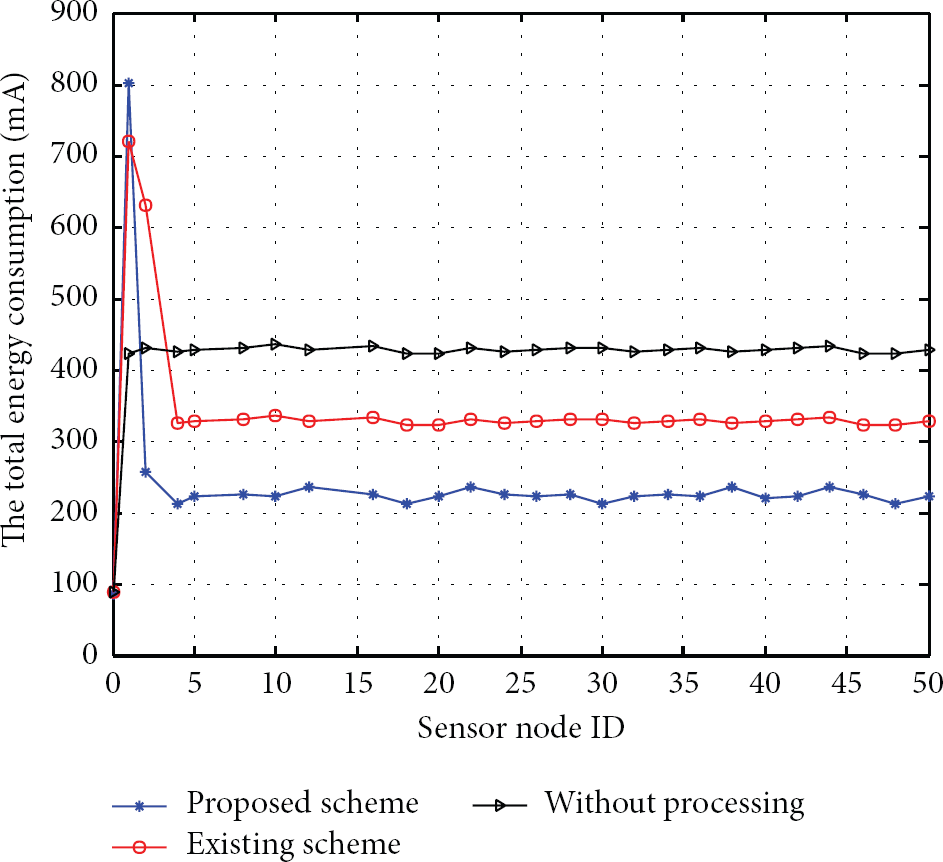
Total energy consumption of every sensor node.
Considering the security scheme, the paper analyzes the security performance of multimedia data transmission. Figure 6 describes the malicious node detection rate (DR) with the variation of the malicious nodes proportion. Our work supposes that attack probabilities are 0.02, 0.25, and 0.5. With the increase in the proportion of malicious nodes, the DR shows a slowly downward trend. When the proportion of malicious nodes in the range [0, 0.25], we can obtain a higher malicious node detection rate. Figure 7 describes the false alarm rate (FAR) with the variation of the malicious nodes proportion. The paper supposes that attack probabilities are 0.02, 0.25, and 0.5. With the increase in the proportion of malicious nodes, the FAR continues with the upward trend correspondingly. The result achieves a low false alarm rate.

DR versus proportion of malicious nodes.

FAR versus proportion of malicious nodes.
Considering the complexity of the image data, we group scenarios into three different types: simple, general, and complex. Figure 8 shows the overall MSE of the whole reconstructed still image from various scenarios. The overall MSE is the average value of the MSEs of each block of data. It can be observed that the image qualities of our proposed scheme, exiting scheme, and without processing have some errors introduced in the process of similarity model during the data aggregation at intermediate nodes. Along with the scene complexity increases, the proposed scheme makes more obvious immediate advantage.
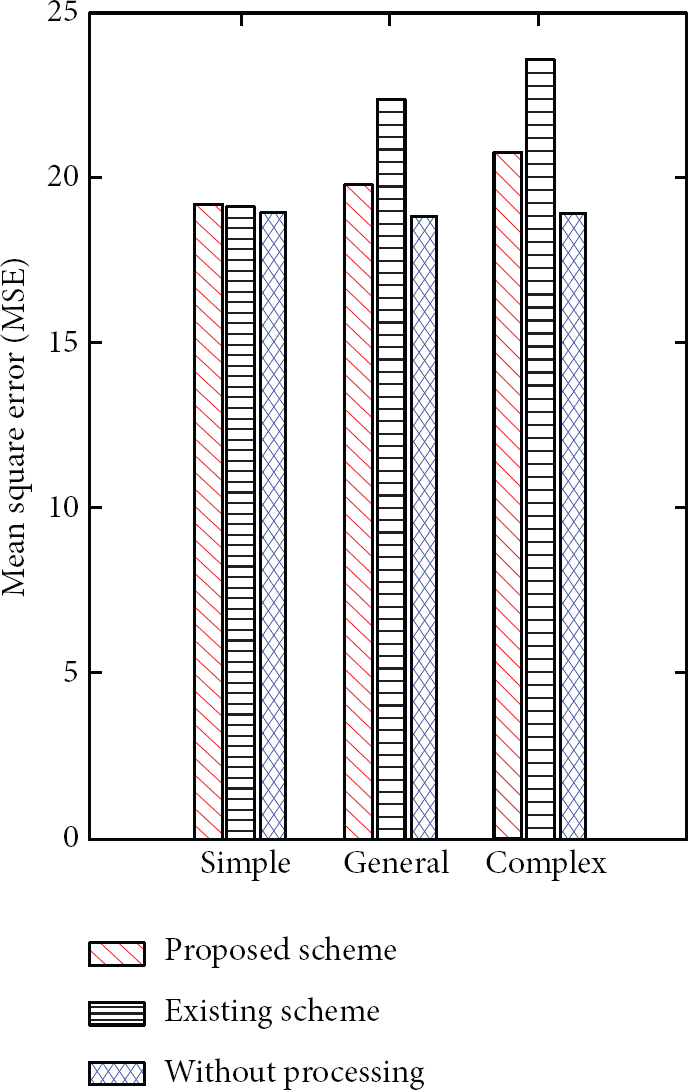
Mean square error of various scenarios.
5. Conclusions
Wireless multimedia sensor networks will become ubiquitous in our daily life and they have already been a hot research area for the past couple of years. In order to improve the performance of the multimedia transmissions in WMSNs, we propose a novel secure data aggregation algorithm by making use of certain knowledge about the characteristics of the transmitted multimedia information. We define a similarity specific value function and describe the similarity model according to the redundancy information of WMSNs surroundings, which enable sensor nodes to minimize the energy consumption of data transmission. Then, with the similarity surroundings, we develop the power model to provide data verification and authentication for security in WMSNs. Through performance evaluation, the proposed scheme has shown that the amount of energy consumption is reduced by about 20% and data origin verification and authentication provides the basis security in an aggregating sensor network. Finally, we show the overall MSE of the whole reconstructed still image from various scenarios. Along with the scene complexity increases, the proposed scheme makes more obvious immediate advantage. As a result, the scheme can be applied to provide optimal secure data aggregation and ensure minimum energy consumption. In future work, we plan to take multimedia data encryption into account and further improve similarity matching performance.
Footnotes
Conflict of Interests
The authors declare that they do not have any commercial or associative interest that represents a conflict of interests in connection with the work submitted.
Acknowledgments
This work was supported by the Special Fund from the Central Collegiate Basic Scientific Research Bursary of China (Grant no. 110818001 and Grant no. 100218001) and in part by Grants from the National Natural Science Foundation of China (Grant nos. 60903159, 61173153, and 61300196).