




Abstract
A simple approach for calculating the interfacial component of frictional pressure gradient in two-phase flow at microscales is presented. This approach is developed using superposition of three pressure gradients: single-phase liquid, single-phase gas, and interfacial pressure gradient. The proposed model can be transformed in two different ways: first, two-phase interfacial multiplier for liquid flowing alone (
1. Introduction
This paper presents the results of modeling of interfacial component for two-phase frictional pressure gradient in microchannels and minichannels. This paper contains three major sections. The first section presents a review of the data and correlations, which are recently available in the open literature. Next, a discussion on the development of a simple model for the prediction of the interfacial component for two-phase frictional pressure gradient in microchannels and minichannels is presented. Finally, a discussion of the proposed models and a comparison with published data are presented.
2. Literature Review
The literature review on two-phase frictional pressure gradient in microchannels and minichannels can be found in tabular form in a number of textbooks [1–5].
Also, Awad and Muzychka [6] covered the literature review on two-phase frictional pressure gradient in microchannels and minichannels that was published until 2006.
A number of recent studies on two-phase frictional pressure gradient in microchannels and minichannels, especially that presented the Chisholm parameter (C) as a function of many factors like mass flux, have been reviewed for this work.
There are two basic models in two-phase pressured drop: homogeneous flow model and separated flow model. Many previous researchers have developed correlations for two-phase pressure drop in microchannels and minichannels. Most correlations were the modified Lockhart-Martinelli correlation [7] that was based on the separated flow model.
Qu and Mudawar [8] studied hydrodynamic instability and pressure drop in a water-cooled two-phase microchannel heat sink containing 21 parallel 231 × 713 μm microchannels. The researchers identified two types of two-phase hydrodynamic instability: severe pressure drop oscillation and mild parallel channel instability. They found that the severe pressure drop oscillation that could trigger premature critical heat flux could be eliminated simply by throttling the flow upstream of the heat sink. Various methods for predicting two-phase pressure drop were assessed for suitability for microchannel heat-sink design. First, generalized two-phase pressure drop correlations were examined that included 10 correlations developed for both macro- and mini/microchannels. A new correlation incorporating the effects of both channel size and coolant mass flux was proposed as follows:

Their new correlation showed better accuracy than prior correlations. The second method consisted of a theoretical annular two-phase flow model that aside from excellent predictive capability possessed the unique attributes of providing a detailed description of the different transport processes occurring in the microchannel, as well as fundamental appeal and broader application range than correlations.
Yue et al. [9] presented preliminary experimental results on pressure drop characteristics of single- and two-phase flows through two T-type rectangular microchannel mixers with d h = 528 and 333 μm, respectively. For N2-water two-phase flow in micromixers, the researchers analyzed and compared the obtained pressure drop data with existing flow pattern-independent models. They found that the Lockhart-Martinelli method [7] generally underpredicted the frictional pressure drop. As a result, a modified correlation of C value in Chisholm's equation [10] based on linear regression of experimental data was proposed to provide a better prediction of the two-phase frictional pressure drop. Their correlation was


The range of variables in (2) is X = 0.67–6.16 and Re lo = 88–461. In addition, among the homogeneous flow models investigated, the viscosity correlation of McAdams et al. [11] indicated the best performance in correlating the frictional pressure drop data (mean deviations within ± 20% for two T-type rectangular microchannel mixers).
Cubaud and Ho [12] investigated experimentally liquid/gas flows in 200 and 525 mm square microchannels made of glass and silicon. Two-phase flow pressure drop was measured and compared to single liquid flow pressure drop. It showed two flow regimes, one in which the liquid was essentially pushing the bubbles and another in which the liquid was flowing in the corners. Taking into account the homogeneous liquid fraction along the channel, an expression for the two-phase frictional multiplier was developed over the range of liquid and gas flow rates investigated. For the bubbly and the wedging flows, their pressure drop correlation could be written as follows:

For smaller liquid fraction, their pressure drop correlation could be written as follows:

Lee and Mudawar [13] measured two-phase pressure drop across a microchannel heat sink, which served as an evaporator in a refrigeration cycle. The microchannels were formed by machining 231 μm wide × 713 μm deep grooves into the surface of a copper block. They performed experiments with refrigerant R134a, which spanned the following conditions: inlet pressure of pin = 1.44–6.60 bar, mass flux of G = 127–654 kg/m2·s, inlet quality of xe,in = 0.001–0.25, outlet quality of xe,out = 0.49-superheat, and heat flux of q = 31.6–93.8 W/cm2. Predictions of the homogeneous equilibrium flow model and prior separated flow models and correlations yielded relatively poor predictions of pressure drop. They suggested a new correlation scheme, which incorporated the effect of liquid viscosity and surface tension in the separated flow model's two-phase pressure drop multiplier. To enhance the predictive capability of the new correlation, both their R134a data and prior microchannel water data of Qu and Mudawar [8] were examined. Large differences between the thermophysical properties of R134a and water were deemed highly effective at broadening the application range of the new correlation. Another key difference between the two data sets was the fact that both the liquid and vapor flows were laminar for the water data, while low viscosity rendered the vapor flow turbulent for R134a. Typical microchannel operating conditions rarely produced turbulent liquid flow. Two separate correlations were derived for C based on the flow states of the liquid and vapor as follows:

The stronger effect of surface tension should be noted where both liquid and vapor were laminar. Their correlation showed excellent agreement with the R134a data as well as previous microchannel water data.
Ide et al. [14] reported on the results of investigations into the characteristics of an air-water isothermal two-phase flow in minichannels, that was in capillary tubes with d = 1 mm, 2.4 mm, and 4.9 mm and also in capillary rectangular channels with AR = 1–9. The directions of flow were vertical upward, horizontal and vertical downward. The researchers investigated the effects of the tube diameters and aspect ratios of the channels on these flow parameters and the flow patterns. Also, they proposed the correlations of the holdup and the frictional pressure drop. Their frictional pressure drop correlations were as follows.
For the LT region in a capillary circular tube,

For the LL region in a capillary rectangular channel,

For the LT region in a capillary rectangular channel,

In their study, the critical Reynolds number from laminar flow to turbulent flow was taken as 2400. The predictions obtained from their frictional pressure drop correlations had sufficient accuracy for both the vertical and the horizontal cases.
Yue et al. [15] investigated experimental hydrodynamics and mass transfer characteristics in cocurrent gas-liquid flow through a horizontal rectangular microchannel of d h = 667 μm. They obtained and analyzed two-phase flow patterns and pressure drop data. For both physical and chemical mass transfer experiments, they found that two-phase frictional pressure drop in the microchannel could be well predicted by the Lockhart-Martinelli method [7] if a new correlation of C value in Chisholm's equation [10] was used. Their new correlation was

Harirchian and Garimella [16] studied microchannel size effects on two-phase local heat transfer and pressure drop in silicon microchannel heat sinks with the dielectric fluid Fluorinert FC-77 for G = 250–1600 kg/m2·s. The test sections consisted of parallel microchannels with nominal widths of 100, 250, 400, 700, and 1000 μm, all with a depth of 400 μm, cut into 12.7 mm × 12.7 mm silicon substrates. 25 microheaters embedded in the substrate allowed local control of the imposed heat flux, while 25 temperature microsensors integrated into the back of the substrates enabled local measurements of temperature. The results of their study served to quantify the effectiveness of microchannel heat transport while simultaneously assessing the pressure drop trade-offs.
Lee and Garimella [17] investigated flow boiling in arrays of parallel microchannels using a silicon test piece with imbedded discrete heat sources and integrated local temperature sensors. The microchannels considered range in width from 102 μm to 997 μm, with the channel depth being nominally 400 μm in each case (d h = 160–538). They conducted the experiments with deionized water that entered the channels in a purely liquid state. Results were presented in terms of temperatures and pressure drop as a function of imposed heat flux. They found that the Lockhart and Martinelli correlation gave poor predictions in microchannels two-phase flow of imposed heat flux because it was developed for adiabatic flow. After a critical assessment of 5 correlations available in the literature, they developed a new correlation to predict the two-phase pressure drop by considering the effect of mass flux and hydraulic diameter as follows:

Saisorn and Wongwises [18] provided a literature review of recent research on two-phase flow in microchannels in their study. They discussed researches on the microhydrodynamics concerned with two-phase gas-liquid adiabatic flow characteristics in both circular and noncircular microchannels. Their review aimed to survey and identify new findings obtained from this attractive area that might contribute to optimum design and process control of high performance miniature devices comprising extremely small channels. The results obtained from a number of previous studies showed that the flow behaviors in the microchannels deviated significantly from those in ordinarily sized channels. Similar to the ordinarily sized channels, it was expected that the flow pattern, pressure drop, and void fraction would affect the two-phase pressure drop, holdup, system stability, exchange rates of momentum, heat, and mass during the phase-change heat transfer processes.
C. Y. Lee and S. Y. Lee [19] investigated the pressure drop of two-phase plug flows in round minichannels in this experimental study for three different tube materials, that is, glass, polyurethane, and Teflon, respectively, with d = 1.62–2.16 mm. The researchers used air and water as the test fluids. In the wet-plug flow regime (wet wall condition at the gas portions), the pressure drop was reasonably predicted by the homogeneous flow model or by the correlations of Mishima and Hibiki [20] and Chisholm [10]. On the other hand, in the dry-plug flow regime (dry wall condition at the gas portions), the role of the moving contact lines affected the interface curvature and dynamic contact angles. As the contact lines moved faster, the advancing angles of the interfaces increased while receding angles decreased [21], and eventually, the change of the dynamic contact angles resulted in the increase of the pressure drop. As a result, they proposed a modified Lockhart-Martinelli type correlation in order to take into account the effect of the moving contact lines. They modified the Chisholm constant (C) as follows:

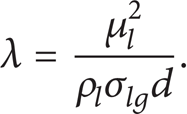


According to the dynamic contact angle models [22–24], the capillary number (Ca), equivalent to the group which represents the relative importance of the viscosity and the surface tension effects (Ψ = Uμ l /σ lg ), was considered as an important dimensionless parameter in predicting the pressure drop. They obtained the appropriate values for the coefficient and the exponents in (12) for dry-plug flows with the polyurethane and Teflon tubes based on their current experiments. Their correlation fitted the measured pressure drop data within the mean deviation of 6%.
Yue et al. [25] studied two-phase flow pattern and pressure drop characteristics during the absorption of CO2 into water in three horizontal microchannel contactors that consisted of Y-type rectangular microchannels of d h = 667, 400 and 200 μm, respectively. With the help of a high-speed photography system, the observed flow patterns in these microchannels were bubbly flow, slug flow (including two subregimes, the Taylor flow and unstable slug flow), slug-annular flow, churn flow, and annular flow. They found that two-phase frictional pressure drop in microchannels should be described by different models depending on the flow pattern investigated. The homogeneous flow model might be only applicable to bubbly flow. However, the deviation from the homogenous flow assumption could be seen in the Taylor flow. Also, the Taylor flow could not be regarded as a separated flow due to the alternate movement of the Taylor bubbles and liquid slugs down the channel. Actually the Taylor flow was eliminated from consideration in the separated flow model developed by Lockhart and Martinelli [7]. As a result, detailed flow analysis should be performed in order to formulate reasonable correlations for the prediction of pressure drop in the Taylor flow. For flow patterns like slug-annular flow, churn flow, and annular flow, the separated flow model seemed to be more realistic because the two-phase interface configuration in these flow patterns was close to the model assumption where a continuous gas flow was seen in the center part of the microchannel while liquid film flowed adjacently to the microchannel wall. For the square microchannel with d h = 400 μm, the following correlation was proposed:


The constant and the exponent associated with Re l at the right side of (16) were derived based on the linear least square regression analysis of the obtained data, where the standard deviation was 9.68%. For the square microchannel with d h = 200 μm, (16) seemed to be further corroborated by little data already obtained. For the rectangular microchannel with d h = 667 μm, (16) could not be applied directly due to the inherently higher aspect ratio in this case. However, the aspect ratio effect on ϕ l 2 in this microchannel could be resolved by simply placing a different constant in (16) as follows:

Using (18), the standard deviation of 21.5% was achieved.
Niu et al. [26] studied flow pattern, pressure drop, and mass transfer characteristics for the gas-liquid two-phase flow in a circular quartz-glass and stainless steel microchannel reactor of d = 1.0 mm. They used a mixture of CO2, N2, and polyethylene glycol dimethyl ether to represent the gas and liquid phases, respectively. The observed flow patterns in their work were bubbly, slug, churn, and slug-annular. They analyzed and compared their two-phase pressure drop data with the homogeneous model and the separate flow model to assess their predictive capabilities. Considering the effect of the mass flux, the tube diameter, and other physical properties, they correlated the C value as follows:

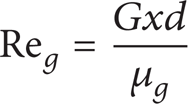
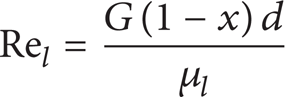
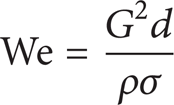
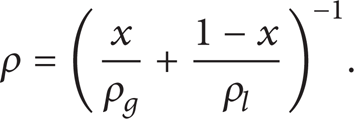
They tested the validity of (19) for the prediction of the two-phase frictional pressure gradient for a quartz-glass and stainless steel microchannel reactor. They found that the agreement between their experimental data and the separated flow model with the C value of (19) was generally good, with an absolute mean deviation of 3.45%, and 6.8%, respectively.
Dutkowski [27] presented results of experimental investigations of pressure drop in two-phase adiabatic flow in tubular minichannels. The researcher used air-water mixture as a working fluid. He used eight tubular minichannels with internal diameter of 1.05–2.30 mm and the test section length of 300 mm made from stainless steel. His investigations were conducted within the range: mass flow rate of water 0.65–59 kg/h, mass flow rate of air 0.011–0.72 kg/h, mass fraction of air in the two-phase mixture (x) = 0.0003–0.22, and total mass flux (G) = 139–8582 kg/(m2·s). On the basis of his experimental investigations, he found that the application of commonly used methods to evaluation of pressure drop in two-phase flow provided poor results. Therefore, it was necessary to make some corrections and modifications for the two-phase flow in minichannels correlations.
Kawahara et al. [28] conducted an adiabatic experiment to investigate the effects of liquid properties on the characteristics of two-phase flows in a horizontal circular microchannel. Distilled water, aqueous solutions of ethanol with two different mass concentrations (49 wt% and 4.8 wt%), and pure ethanol were used as the test liquids. The researchers varied the ethanol concentration to change the surface tension and the viscosity. They injected nitrogen gas with one of the four liquids together through a T-junction mixer to the test microchannel. Two mixers with different inner diameters of 250 μm and 500 μm were used at a fixed microchannel diameter of 250 μm to study flow contraction effects at the channel inlet. Liquid was injected into the main channel (line 1), while the gas was injected into the branch (line 2). When 500 μm inner diameter mixer was used, flow contraction occurred at the inlet of the test section because the T-junction was directly connected to the 250 μm inner diameter microchannel. The observed types of flow pattern were the quasi-homogeneous flow [29, 30] and the quasi-separated flow [29, 30]. Also, flows with the contraction had longer bubbles even at the same gas and liquid flow rates condition. They found that bubble velocity data correlated with the drift-flux model showed that the distribution parameter (C0) increased with increasing of liquid viscosity and/or decreasing of surface tension, and C0 for flows with the contraction was higher. Also, the pressure drop data correlated with the Lockhart-Martinelli method [7] showed that the two-phase friction multiplier (ϕ
l
2) for flows with the contraction was lower. From data analysis, new correlations of C0 and ϕ
l
2 were developed with some dimensionless numbers. For two-phase frictional pressure drop, they correlated their resulting C data with three dimensionless numbers, that is, the Bond number (Bo), the liquid Reynolds number

They found that their two-phase frictional pressure drop correlation agreed well with their present data within 20% rms errors, irrespective of the test liquids.
Choi et al. [31] studied the wettability effect on pressure drop and flow pattern of two-phase flow in rectangular microchannel. The researchers fabricated a hydrophilic rectangular microchannel using a photosensitive glass and prepared a hydrophobic rectangular microchannel using silanization of glass surfaces with OTS (octa-dethyl-trichloro-siliane). They conducted experiments of two-phase flow in the hydrophilic and the hydrophobic rectangular microchannels using water and nitrogen gas. Their visualization results showed that the wettability was important for two-phase flow pattern in rectangular microchannel. Also, two-phase frictional pressure drop was highly related with flow patterns. Finally, two-phase frictional pressure drop was analyzed with flow patterns.
Megahed and Hassan [32] investigated experimentally the pressure drop characteristics and flow visualization of a two-phase flow in a silicon microchannel heat sink. The microchannel heat sink consisted of a rectangular silicon chip in which 45 rectangular microchannels were chemically etched with a depth of 276 μm, width of 225 μm, and a length of 16 mm. Experiments were carried out for G = 341–531 kg/m2·s and q = 60.4–130.6 kW/m2 using FC-72 as the working fluid. They observed bubble growth and flow regimes using high-speed visualization. Three major flow regimes were identified: bubbly, slug, and annular. The frictional two-phase pressure drop increased with exit quality for a constant mass flux. An assessment of different pressure drop correlations reported in the literature was conducted for validation. They obtained a new general correlation to predict the two-phase pressure drop in microchannel heat sinks for five different refrigerants from their present work employing different values of d h = 70–304 μm and its applicability extended to five different refrigerants as follows:

Their new correlation showed a good agreement with the experimental data and predicted the evaporative pressure drop data in microchannels for laminar-liquid laminar-vapor and laminar-liquid turbulent-vapor flow with mean absolute errors of 10.4% and 14.5%, respectively.
C. Y. Lee and S. Y. Lee [33] investigated experimentally the pressure drop of the two-phase dry-plug flow (dry wall condition at the gas portions) in round minichannels. The air-water mixtures were flowed through the round minichannels made of polyurethane and Teflon, respectively, with d = 1.62–2.16 mm. In the dry-plug flow regime, the pressure drop measured became larger either by increasing the liquid superficial velocity (U l ) or by decreasing the gas superficial velocity (U g ) due to the increase of the number of the moving contact lines in the test section. In such a case, the role of the moving contact lines turned out to be significant. As a result, they proposed a pressure drop model of dry-plug flow through modification of the dynamic contact angle analysis taking account of the energy dissipation by the moving contact lines that represented the experimental data within the mean deviation of 4%.
Based on the separated flow model and drift-flux model, Zhang et al. [34] explored alternative correlations of two-phase friction pressure drop and void fraction for minichannels. By applying the artificial neural network (ANN), dominant parameters to correlate the two-phase friction multiplier and void fraction were picked out. It was found that in minichannels the nondimensional Laplace constant (Lo*) was a main parameter to correlate the Chisholm parameter (C) as well as the distribution parameter. By noting the asymptotic values as C = 21 for conventional channels and C = 0 for extremely narrow gaps, they correlated the Chisholm parameter (C) by the following equation:


The applicable ranges of this correlation were as follows: 0.014 ≤ d
h
≤ 6.25 mm,
For adiabatic liquid-gas two-phase flow

For adiabatic liquid-vapor two-phase flow

Choi et al. [35] conducted experiments for adiabatic liquid water and nitrogen gas flow in rectangular microchannels to investigate two-phase pressure drop in the rectangular microchannels. The researchers found that two-phase frictional pressure drop in the rectangular microchannels was highly related with flow regime. They assessed homogeneous model with six two-phase viscosity models and six separated flow models with their experimental data. The best two-phase viscosity model was Beattie and Whalley's model [36]. The best separated flow model was Qu and Mudawar's correlation [8]. Flow regime dependency in both homogeneous and separated flow models was observed. As a result, they proposed individually new flow pattern based correlations for both homogeneous and separated flow models. Their new flow pattern based correlations for homogeneous model were
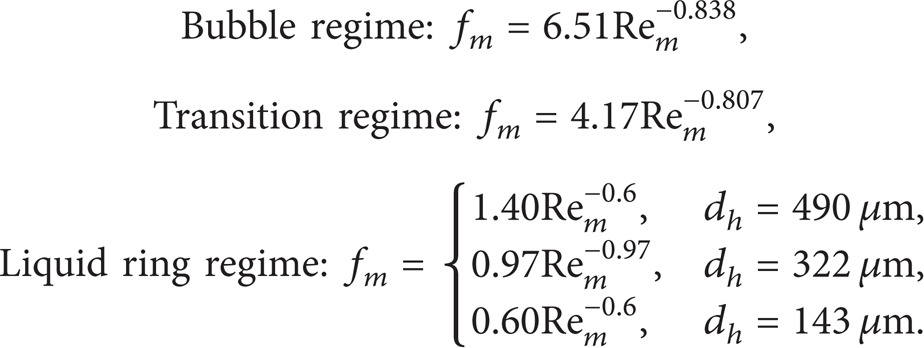
Their new flow pattern based correlations for separated flow model were

Liquid ring regime

where C is defined by (26), (28), and (29) [34].
Lee et al. [37] reviewed the existing databases and correlations in the literature on the microchannel pressure drop and heat transfer. Based on this review, the researchers found that none of the existing correlations could cover the wide range of working fluids, operational conditions, and different microchannel dimensions. As a result, they revealed the importance of the Bond number that related the nominal bubble dimension or capillary parameter with the channel size. Using the Bond number, improved correlations of pressure drop and heat transfer were established. To consider the effect of the exit mass quality (x e ) with the Bond number in the Chisholm parameter, a monomial function was determined using least square fitting with experimental data. Therefore, a new correlation was established in terms of both the Bond number and exit mass quality as follows:

This new correlation was a continuous function. As a reference, when the Bond number (Bo) was very large (extreme condition of the conventional channel), the Chisholm parameter (C) would be 5, 10, 12, and 20 at the corresponding exit quality (x e ) of 0.18, 0.26, 0.29, and 0.39 by this new correlation, respectively. Therefore, this new correlation at the condition of an extremely large channel dimension did not conflict with the traditional understanding of the Chisholm parameter in a macrochannel.
Pamitran et al. [38] presented an experimental investigation into the characteristics of two-phase flow pattern transitions and pressure drop of R-22, R-134a, R-410A, R-290, and R-744 in horizontal small stainless steel tubes of d = 0.5, 1.5 and 3.0 mm. The researchers obtained experimental data over a heat flux range of 5–40 kW/m2, mass flux range of 50–600 kg/(m2·s), saturation temperature range of 0–15°C, and mass quality up to 1.0. The effects of heat flux, mass flux, saturation temperature, and inner tube diameter on the pressure drop of the working refrigerants were reported. The researchers compared experimental pressure drop with the predictions from some existing correlations. They presented a new two-phase pressure drop model that was based on a superposition model for two-phase flow boiling of refrigerants in small tubes. They developed their new pressure drop correlation on the basis of the Lockhart-Martinelli method [7] as a function of the Weber number (We) and the Reynolds number (Re) by considering the laminar-turbulent flow conditions. Using a regression method with 812 data points, a new factor C was developed as follows:

They found that this correlation provided mean and average deviations of 21.66% and −2.47%, respectively, based on comparison. This correlation would contribute to the design of heat exchangers with small tubes.
Kaji et al. [39] measured simultaneously heat transfer, pressure drop, and void fraction for upward heated air-water nonboiling two-phase flow in a Pyrex glass tube of d = 0.51 mm to investigate thermohydrodynamic characteristics of two-phase flow in microchannels. They found that frictional pressure drop agreed with Mishima-Hibiki's correlation [20] at low liquid superficial velocity (U l ), whereas it agreed with Chisholm-Laird's correlation [40] at relatively high liquid superficial velocity (U l ). Heat transfer coefficient fairly agreed with the data for d = 1.03 and 2.01 mm when U l was relatively high. But it became lower than that for larger diameter tubes when U l was low. Analogy between heat transfer and frictional pressure drop was proved to hold roughly for the two-phase flow in microchannel as follows:

Li and Wu [41] obtained experimental results of adiabatic two-phase pressure drop in micro/minichannels for both multi- and single-channel configurations from the literature. Their collected database contained 769 data points and covered 12 fluids, for a wide range of operational conditions and channel dimensions. The researchers analyzed the whole database using eleven existing correlations to verify their respective accuracies. Also, they introduced the Bond number and the Reynolds number to modify the Chisholm parameter of two-phase multipliers to develop new generalized correlations. A particular trend was observed with the Bond number that distinguished the data in three ranges, indicating the relative importance of surface tension. When 1.5 ≤ Bo, in the region dominated by surface tension, inertia and viscous forces could be neglected. When 1.5 < Bo ≤ 11, surface tension, inertia force, and viscous force were all important in the micro/minichannels. However, when 11 < Bo, the effect of surface tension could be ignored. Their newly proposed correlations were

The Chisholm parameter had no obvious relationship with the Bond number when Bo > 11 that was not drawn in their present paper. They found that their newly proposed correlations could predict the datasets accurately for different working fluids at various operational conditions for different dimensions of micro/minichannels in the range where Bo ≤ 11. Their newly proposed correlation could predict 72.6% and 89.7% of the data points within the ± 30% and ± 50% error band, respectively, in the region 1.5 < Bo ≤ 11. Their newly proposed correlation attributed the predictive improvement to the combined number BoRe l 0.5. Thus, except for surface tension, inertia force and viscous force also presented nonignorable effects in the region 1.5 < Bo ≤ 11. For the range where 11 < Bo, the Beattie and Whalley correlation [36] was adopted to predict the datasets. It predicted 60.0% and 88.9% of the data points within the ± 30% and ± 50% error band, respectively.
Maqbool et al. [42] performed experiments to investigate two-phase pressure drop in a circular vertical minichannel made of stainless steel (AISI 316) with internal diameter of 1.70 mm and a uniformly heated length of 245 mm using NH3 as working fluid. The researchers conducted the experiments for the following ranges: q = 15–350 kW/m2 and G = 100–500 kg/m2·s. A uniform heat flux was applied to the test section by DC power supply. They determined two-phase frictional pressure drop variation with mass flux (G), mass quality (x), and heat flux (q). They compared their experimental results to predictive methods available in the literature for frictional pressure drop. They found that the homogeneous model and the Müller-Steinhagen and Heck [43] correlation were in good agreement with their experimental data with mean absolute deviation (MAD) of 27% and 26%, respectively.
Choi et al. [44] conducted experiments of adiabatic liquid water and nitrogen gas two-phase flow in rectangular microchannels to study the aspect ratio effect on the flow pattern, pressure drop, and void fraction. The widths and heights of rectangular microchannels were 510 μm × 470 μm, 608 μm × 410 μm, 501 μm × 237 μm, and 503 μm × 85 μm. As a result, the aspect ratios (AR) of these rectangular microchannels were 0.92, 0.67, 0.47, and 0.16, and the hydraulic diameters (d h ) of the rectangular microchannels were 490, 490, 322, and 143 μm, respectively. Experimental ranges were liquid superficial velocities (U l ) = 0.06–1.0 m/s and gas superficial velocities (U g ) = 0.06–71 m/s. The researchers fabricated visible rectangular microchannels using a photosensitive glass and measured pressure drop in these microchannels directly through embedded ports. Typical flow patterns in the rectangular microchannels observed in their study were bubbly flow, slug bubble flow, elongated bubble flow, transitional flow (multiple flow), and liquid ring flow. As the aspect ratio decreased, the bubble flow regime became dominant due to the confinement effect and the thickness of liquid film in corner was decreased. In addition, the two-phase flow became homogeneous with decreasing aspect ratio owing to the reduction of the liquid film thickness. They proposed the transitions of slug, elongated, and multiple regimes in the following equation form.
For transition of slug between elongated bubble regimes

For transition of elongated bubble between multiple regimes

They found that the C value in the Lockhart and Martinelli correlation decreased like the Zhang et al. [34] correlation (28) as the nondimensional Laplace constant (Lo*) increased. The frictional pressure drop in the rectangular microchannels was highly related with the flow pattern. Also, the void fraction in the rectangular microchannels (α) had a linear relation with the volumetric quality (β).
Choi et al. [45] studied behaviors and pressure drop for a single bubble in a rectangular microchannel. Based on the experiments in [44, Part I], the researchers analyzed data for liquid superficial velocities (U l ) = 0.06–0.8 m/s, gas superficial velocities (U g ) = 0.06–0.66 m/s, and aspect ratios (AR) = 0.92, 0.67, 0.47 and 0.16. The pressure drop for the single bubble in the rectangular microchannels was evaluated using the information of the bubble behavior. The pressure drop in the single elongated bubble was proportional to the bubble velocity. As the aspect ratio decreased, the pressure drop in the single elongated bubble in the rectangular microchannel increased.
Saisorn and Wongwises [46] studied experimentally adiabatic two-phase air-water flow. The researchers used two channels, made of fused silica, with d = 0.53 and 0.15 mm as test sections. They compared the measured frictional pressure drop data with the predictions regarding the homogeneous flow assumption. Many well-known two-phase viscosity models were subsequently evaluated for applicability to microchannels.
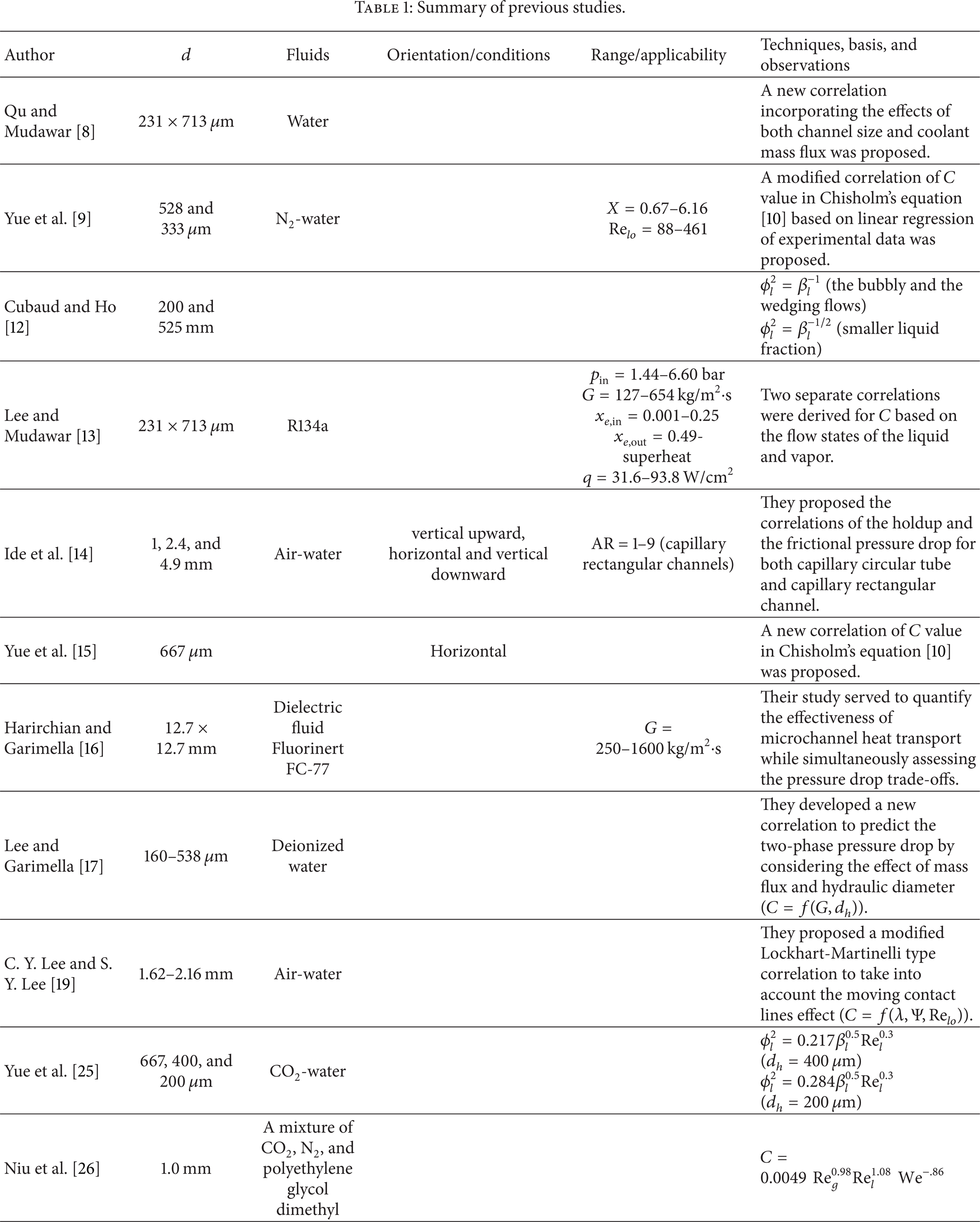
Table 1 presents a summary of previous studies.
Summary of previous studies.


3. Proposed Methodology
Recently, Muzychka and Awad [47] developed an alternative approach for predicting two-phase frictional pressure drop using superposition of three pressure gradients, single-phase liquid, single-phase gas, and interfacial pressure drop, as follows:

When there is no contribution to the pressure gradient through phase interaction, the second term of the right hand side in (39) is equal to zero. The case can be represented with the Chisholm constant (C) = 0 [6, 48]. This can also be obtained using the asymptotic model for two-phase frictional pressure gradient with linear superposition (n = 1) [6].
Rearranging (39), we obtain

From (40), it is clear that we can calculate the two-phase interfacial pressure gradient,

On the other hand, dividing both sides of (40) by the single-phase gas frictional pressure gradient, we obtain

Comparing (41)–(42) with the Chisholm [10] formulation gives
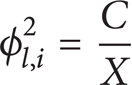
for the liquid multiplier formulation or

for the gas multiplier formulation.
This represents a simple one-parameter model, whereby closure can be found with comparison with experiment. If the interfacial effects can be modeled by Chisholm's proposed model [10], then all of the reduced data should show trends indicated by (43) or (44). However, if data do not scale according to (43) or (44), that is, a slope of −1 or + 1, then a two-parameter model is clearly required. This will be shown in Figures 2 and 3, which show that all interfacial effects have the same slope but their intensity is governed by the value of C.
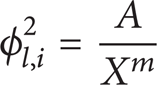
Equations (43) and (44) may be extended to develop a simple two-parameter power law model such that
for the liquid multiplier formulation or

for the gas multiplier formulation.
Equations (45) and (46) can lead to the following equations:

or

These forms have the advantage that experimental data for a particular flow regime can be fitted to the simple power law after the removal of the single-phase pressure gradients from the experimental data. Additional modifications may be introduced if the coefficients A and m can be shown to depend on other variables like mass flow rate, fluid properties, and mass quality or void fraction. These issues will be examined next considering a few data sets from the open literature.
4. Results and Discussion
In this section, we will apply the approach outlined above to recent selected correlations and data sets. Given that two-phase flow data are widely reported using the Lockhart-Martinelli parameters ϕ l or ϕ g versus X, we can present two-phase flow data simply as an interfacial two-phase multiplier using (41) and (42).
Figure 1 shows ϕl,i versus X for the Zhang et al. [34] correlation at the different values of the nondimensional Laplace constant (Lo*) = 0.01, 0.1, 1, 10, and 100, respectively. Figure 1 is obtained by substituting (26) into (41). It is clear that ϕl,i decreases with increasing X for the different values of the nondimensional Laplace constant (Lo*) = 0.01, 0.1, 1, 10, and 100, respectively. Also, ϕl,i decreases with increasing Lo* for the same value of X.
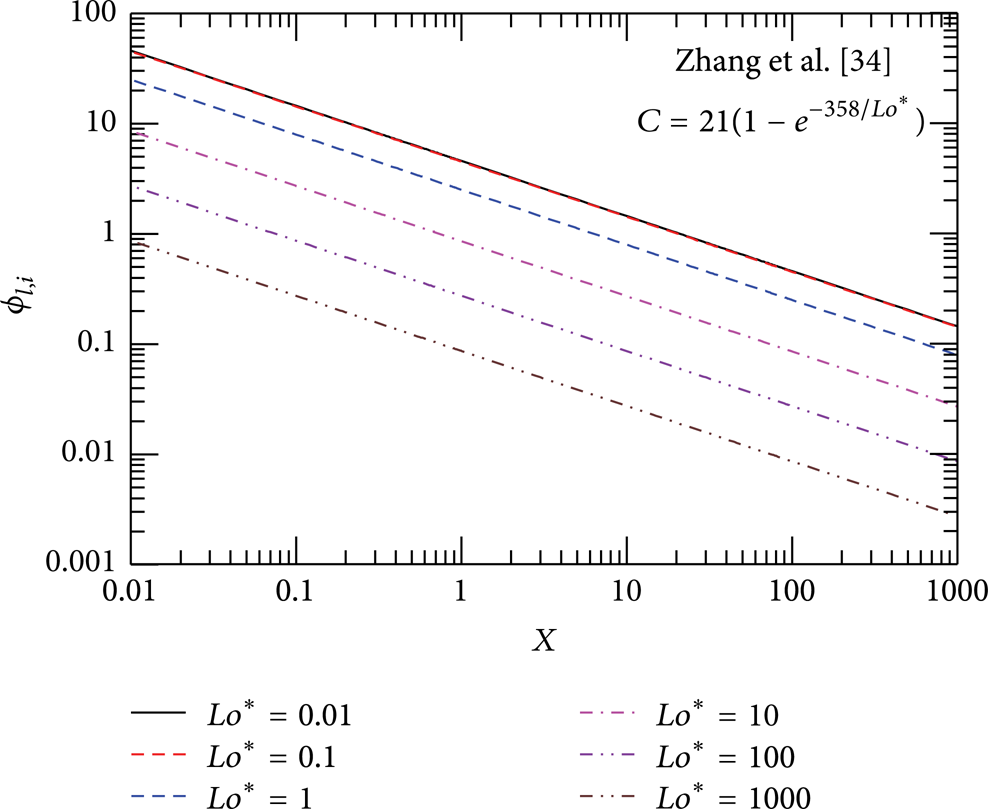
Interfacial two-phase multiplier for the Zhang et al. [34] correlation.
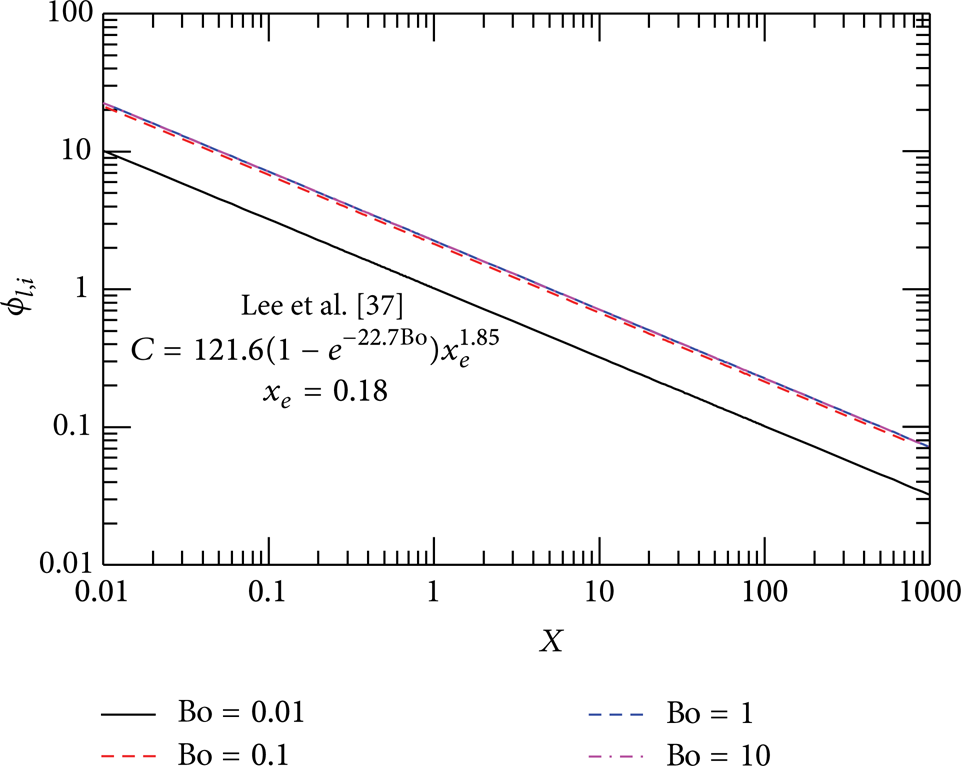
Interfacial two-phase multiplier for the Lee et al. [37] correlation.
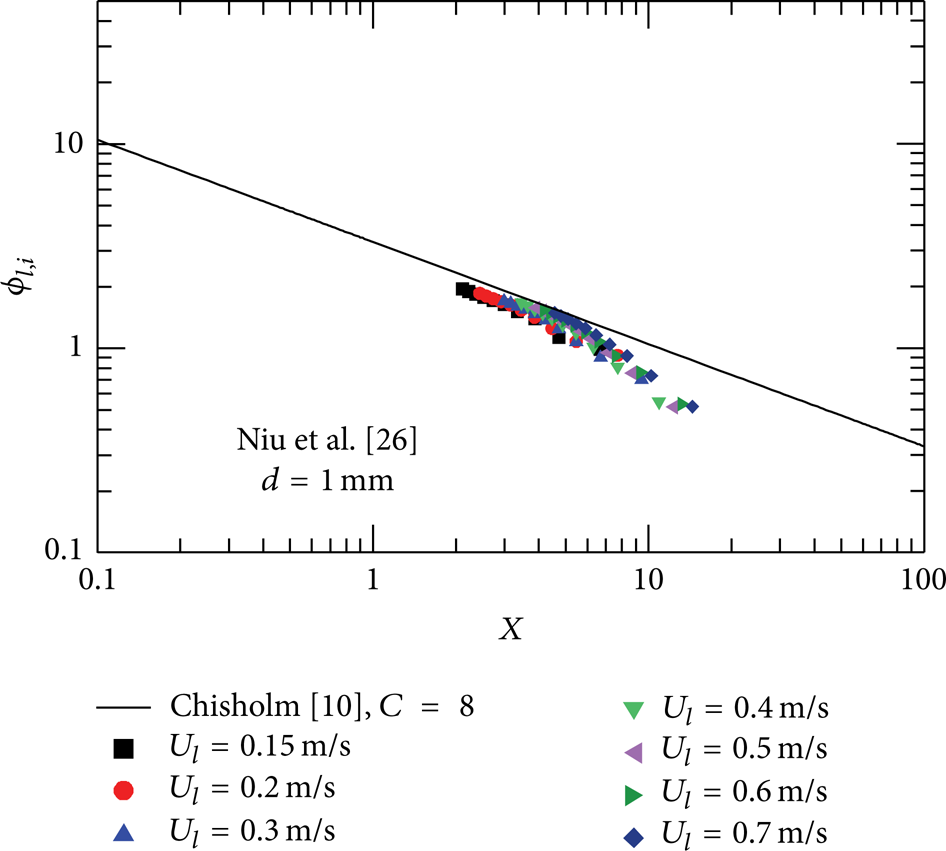
Interfacial two-phase multiplier for the Niu et al. [26] data in d = 1 mm.
Figure 2 shows ϕl,i versus X for the Lee et al. [37] correlation at the exit quality (xe) of 0.18 and different values of the Bond number (Bo) = 0.01, 0.1, 1, and 10, respectively. Figure 2 is obtained by substituting (33) into (41). It is clear that ϕl,i decreases with increasing Xfor the different values of the Bond number (Bo) = 0.01, 0.1, 1, and 10, respectively. Also, ϕl,i increases with increasing Bo for the same value of X.
Figure 3 shows ϕl,i versus X for the Niu et al. [26] data in d = 1 mm at U l = 0.15, 0.2, 0.3, 0.4, 0.5, 0.6, and 0.7 m/s, respectively. U l can be nondimensionalized using Fr l = U l /(gd)0.5. As a result, the corresponding values of Fr l = 1.515, 2.020, 3.029, 4.039, 5.049, 6.059, and 7.069, respectively. Figure 3 is obtained by using (41). Solving for A and m for each data set of U l , we obtain A = 9.955, 11.053, 18.456, 32.679, 38.237, 37.124, and 39.653, respectively, while m = −1.242, −1.277, −1.597, −1.931, −1.946, −1.855, and −1.845, respectively. Table 2 shows comparison of one- (the best Chisholm constant and the asymptotic model) and two- (A and m) parameter models for ϕ l of the Niu et al. [26] data. It is clear from Table 2 that the two-parameter model for ϕ l is better than the one-parameter model (the best Chisholm constant, C = 8, and the asymptotic model, n = 1/3.15) for ϕ l . The corresponding values of %rms are 1.96%, 5.67%, and 7.31%, respectively.
Comparison of one- and two-parameter models for ϕ l of the Niu et al. [26] data.

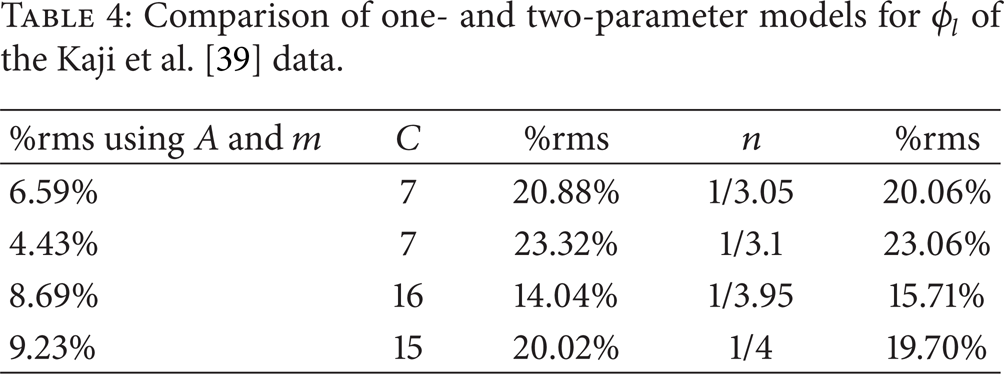
Figure 4 shows ϕl,i versus X for the Kaji et al. [39] data in d = 0.51 mm (vertical heated flow) at U l = 1.567–0.077 m/s (Fr l = 22.158–1.089), respectively. Figure 5 shows ϕl,i versus X for the Kaji et al. [39] data in d = 0.514 mm (horizontal adiabatic flow) at U l = 2.409–0.086 m/s (Fr l = 33.931–1.211), respectively. Figure 6 shows ϕl,i versus X for the Kaji et al. [39] data in d = 1.03 mm (vertical heated flow) at U l = 1.874–0.200 m/s (Fr l = 18.647–1.990), respectively. Figure 7 shows ϕl,i versus X for the Kaji et al. [39] data in d = 2.01 mm (vertical heated flow) at U l = 1.126-0.105 m/s (Fr l = 8.020–0.749), respectively. Figures 4–7 are obtained by using (41). Solving for A and m for each data set of U l in Figures 4–7, we can obtain the different values of the constant (A) and the exponent (m) for each data set of U l in Figures 4–7. Table 3 presents a summary of the Kaji et al. [39] data. Table 4 shows comparison of one- (the best Chisholm constant and the asymptotic model) and two- (A and m) parameter models for ϕ l of the Kaji et al. [39] data in d = 0.51 mm (vertical heated flow), d = 0.514 mm (horizontal adiabatic flow), d = 1.03 mm (vertical heated flow), and d = 2.01 mm (vertical heated flow), respectively. Based on the corresponding values of %rms in Table 4 using the simple models (either one- or two-parameter correlation schemes), it is clear that the two-parameter model for ϕ l is better than the one-parameter model (the best Chisholm constant (C) and the asymptotic model (n)) for ϕ l . Also, as d increases from 0.51 mm for vertical heated flow and 0.514 mm for horizontal adiabatic flow to 1.03 and 2.01 mm for vertical heated flow, the best Chisholm constant (C) increases while the fitting parameter of the asymptotic model (n) decreases because the flow goes from laminar to turbulent.
Summary of the Kaji et al. [39] data.

Comparison of one- and two-parameter models for ϕ l of the Kaji et al. [39] data.

Interfacial two-phase multiplier for the Kaji et al. [39] data in d = 0.51 mm (vertical heated flow).

Interfacial two-phase multiplier for the Kaji et al. [39] data in d = 0.514 mm (horizontal adiabatic flow).
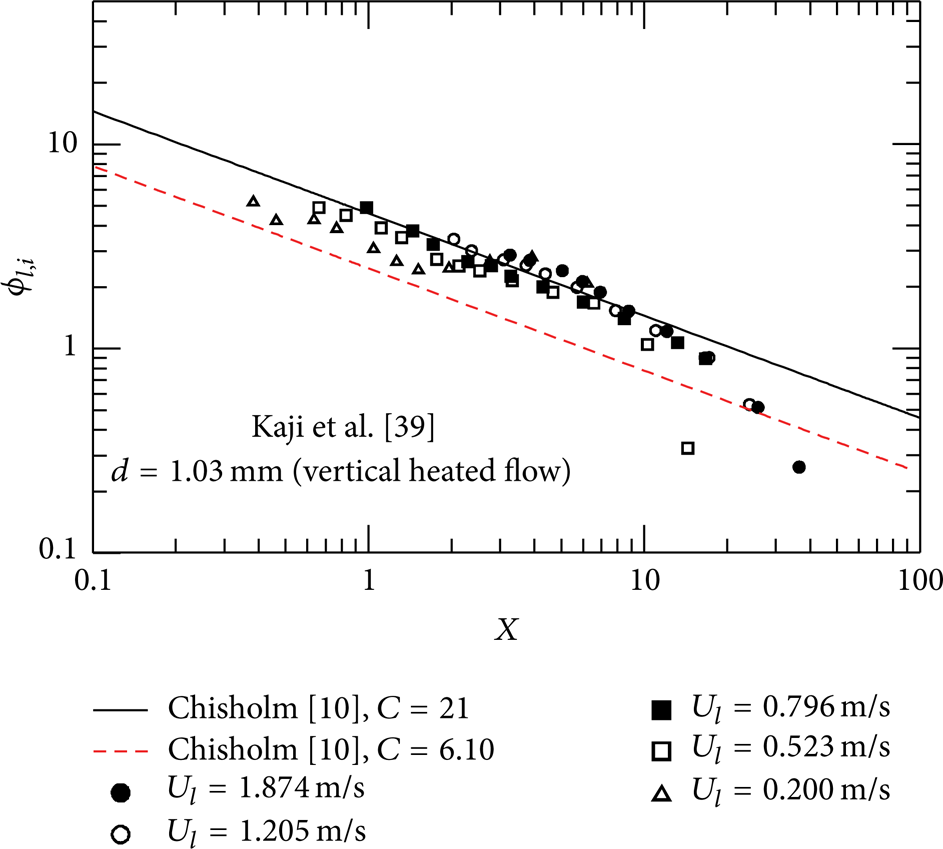
Interfacial two-phase multiplier for the Kaji et al. [39] data in d = 1.03 mm (vertical heated flow).

Interfacial two-phase multiplier for the Kaji et al. [39] data in d = 2.01 mm (vertical heated flow).
Based on the results for the comparison of one- (the best Chisholm constant and the asymptotic model) and two- (A and m) parameter models for ϕ l of the Niu et al. [26] data shown in Table 2 and the results for the comparison of one- (the best Chisholm constant and the asymptotic model) and two- (A and m) parameter models for ϕ l of the Kaji et al. [39] data shown in Table 4, it is obvious that the two- (A and m) parameter model works better than the one- (the best Chisholm constant and the asymptotic model) parameter model for examining data with strong interfacial effects. Therefore, decomposing the Lockhart-Martinelli approach into single-phase and interfacial components would appear to provide better understanding of experimental data and leads to better model/correlation development.
5. Summary and Conclusions
In the present study, modeling of interfacial component for two-phase frictional pressure gradient in microchannels and minichannels was considered. A review of the classic Lockhart-Martinelli method and other representations of two-phase flow that were recently available in the open literature was examined. These approaches can all be considered one- (the best Chisholm constant and the asymptotic model) and two-parameter models. The two-parameter models offer more flexibility for developing empirical models for specific flow regimes when the simple Chisholm model fails to capture the slope of the interfacial two-phase multiplier. The above approaches were compared for a few selected data sets and it was found that the proposed two-parameter modeling approach is the best and offers the greatest flexibility.
Two-phase flow modeling from the viewpoint of interfacial phenomena is deemed to be a better approach from the standpoint of understanding what variables will affect the data in the interfacial region. The true impact of the two-phase flow interfacial effects is more clearly seen, only after the removal of the single-phase flow contributions from the Lockhart-Martinelli two-phase multiplier. This is evident where the assumed Chisholm model clearly does not model the interfacial effects adequately. Decomposing the Lockhart-Martinelli approach into single-phase and interfacial components would appear to provide better understanding of experimental data and lead to better model/correlation development.
Footnotes
Nomenclature
Conflict of Interests
The authors certify that they have no actual or potential conflict of interests including any financial, personal, or other relationships with other people or organizations within three years of beginning the submitted work that could inappropriately influence, or be perceived to influence, their work.
Acknowledgment
The authors acknowledge the financial support of the Natural Sciences and Engineering Research Council of Canada (NSERC) through the Discovery Grants program.