




Abstract
The first results of the movable multipurpose probe (MPP) experiments performed on the IR-T1 Tokamak are presented. For this purpose, a moveable MPP was designed, constructed, and installed on the IR-T1 Tokamak for the first time. MPP can measure radial variation of floating potential and ion saturation current, electrostatic fluctuation, magnetic fluctuation, and flow velocity simultaneously. The relation between gradient of Reynolds stress and poloidal particle flux can be investigated by MPP. It can measure the radial variation of radial electric field and poloidal electric field. The most advantage of MPP is to measure electric and magnetic plasma fluctuations simultaneously. MPP is composed of three sections: electrical part, magnetic part, and flow measurement section. This is a compact probe in which do not disturb plasma. The results are presented and discussed.
1. Introduction
Recent progress in the control of plasma turbulence and transport in magnetically confined plasmas has opened a new era in plasma transport physics research [1, 2]. It has been recognized that the cross-field plasma transport through the edge is dominated by turbulence [3–5]. Turbulence is responsible for anomalously high losses of particles and energy in the edge plasma. In order to suppress the negative effects caused by turbulence, proper understanding of the phenomena occurring in the plasma edge is needed [6]. The mechanism for generation of mean poloidal flow by turbulence is identified and elucidated. Flow generation links to the quasilinear radial current or the Reynolds stress. Poloidal acceleration will occur if the turbulence supports radially propagating waves and if radii gradients in the turbulent Reynolds stress and wave energy density flux are present. Poloidal flows can improve confinement regimes in fusion plasmas [7]. They can modify transport by influence of the turbulence. Several mechanisms have been proposed to explain the generation of sheared poloidal rotation in the plasma boundary region including ion orbit losses [8] and Reynolds stress [9]. To investigate the relation between turbulence and transport at the edge of plasma and the effect of Reynolds stress on suppression of turbulence and to investigate the relation between poloidal flow and transport, we design and construct a new moveable multipurpose probe in IR-T1 Tokamak poloidal flux. For this purpose a new probe was designed and constructed in IR-T1 Tokamak. This paper is organized as follows. A description of the IR-T1 and the MPP is presented in Section 2, results and discussion are presented in Section 3, and conclusions are given in Section 4.
2. Experimental Setup
The experiment is performed on the IR-T1 Tokamak which is a small Tokamak with a circular cross section (R = 45 cm, a = 12.5 cm, I P = 20–30 kA). The edge plasma parameters have been measured by a novel multipurpose probe (MPP). MPP can measure the electric and magnetic turbulence transport at the edge of plasma simultaneously. Also the poloidal flow can be measured by this probe. MPP is composed of three sections: electrical part, magnetic part, and flow measurement section. The structure of these parts has been explained in the following subsections.
2.1. Electrical Measurement
The electrical part of MPP consists of four arrays. Each array has four tips which can be in the floating potential or ion saturation current state. Each tip has a diameter of 0.54 mm. In each array one tip is higher than the other tips (three tips of one array protrude 1 mm above the state and one of them protrudes 2 mm). The tips have been made from tungsten rod that can bear high temperature (see Figure 1). The radial electric field can be measured by this part according to
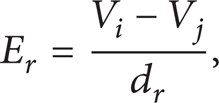
where E r is the radial electric field, V i , V j is the floating potential, and dr is the radial distance between two arbitrary tips which have been in the floating potential state. The poloidal electric field can be obtained from

where E P is poloidal electric field, V i ′, V j ′ is floating potential, and dp is the distance between two arbitrary tips which have been in different poloidal position. The radial and poloidal particle flux can be obtained from electric field according to

where Γ r , Γ P are the radial and poloidal particle flux. The density fluctuation n is deduced from the ion saturation current. Also the Reynolds stress can be measured by each electrical array according to

R is the Reynolds stress and B T is toroidal magnetic field. Also the radial profile of the electric field and Reynolds stress can be obtained by this part.
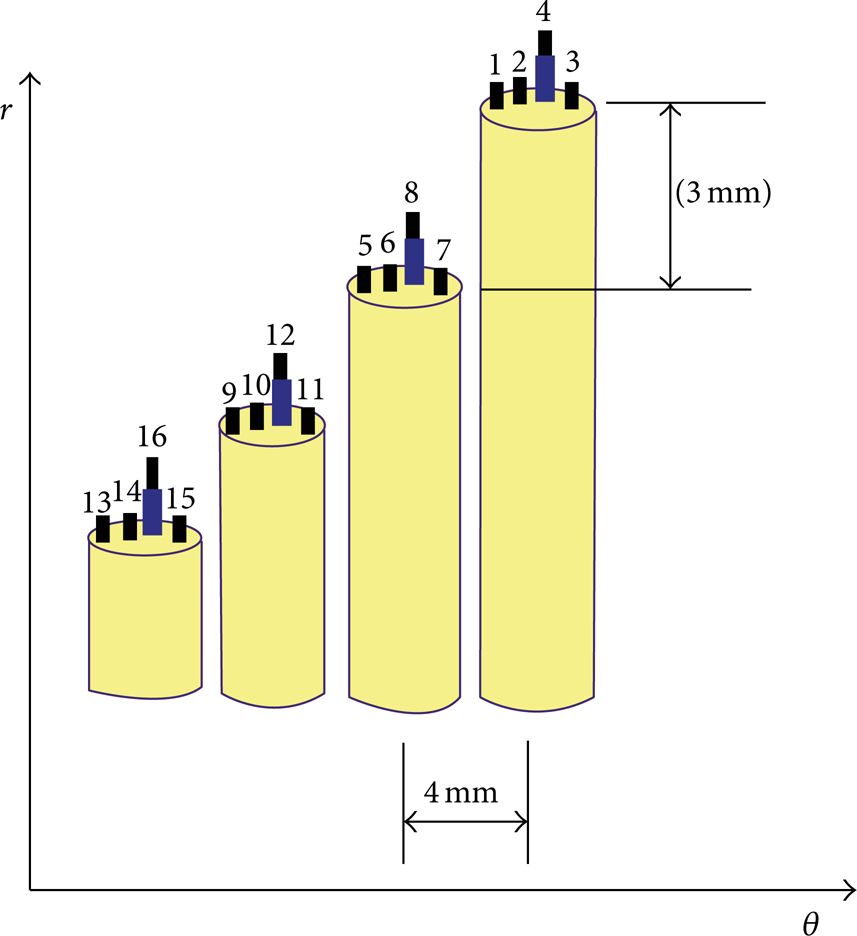
Schematic diagram of the electrical part of multipurpose probe in IR-T1 Tokamak.
2.2. Flow Measurement
The direct measurements of flow velocities with a sufficient spatial resolution are highly desirable for a better understanding of the reduction of the turbulent transport and the consequent formation of transport barriers [10]. In its simplest manifestation, the flow velocities can be measured by Mach probe [11, 12]. This probe consists of two tips separated by an insulator. The two tips measure the currents collected parallel and antiparallel to the magnetic field. The aim of our experiment is to understand the relation between the Reynolds stress and the flow velocity in poloidal direction and toroidal direction. So the flow measurement part has been designed and constructed. This part can measure the flow velocity in toroidal and poloidal direction. It is located behind the electrical part of the probe as shown in Figure 2. It consists of 4 tips which are in the ion saturation current state. Each tip has a diameter of 0.54 mm. They have been made from tungsten. The distance between two tips is 1 mm and the length of ceramic is 6 mm. The tips have to separate by an insulator. For this purpose, ceramic with 4 apertures has been used. The sides of apertures have been prepared by filing as shown in Figure 2. So the central part of ceramic acts as an isolator.

The scheme of flow measurement part of multipurpose probe and its position in IR-T1 Tokamak.
2.3. Magnetic Measurement Part
With this part, the fluctuation-induced Maxwell stress has been measured. The Maxwell stress has been calculated by

where B r is radial component of magnetic field and Bθ is poloidal component of magnetic field. The magnetic measurement part consists of three coils. The radius of each coil is equal to 1.15 mm. The number of turns of coil is 80. The coils can measure total magnetic flux in radial, poloidal, and toroidal direction. As shown in Figure 3 the magnetic coils have been placed on the top of ceramic tube. In order to private the contact between plasma and coils, the ceramic tube covers the coils.

The scheme of magnetic measurement part of multipurpose probe and its position in IR-T1 Tokamak.
During the experiments, tips 4, 8, 12, and 16 have been in the ion saturation current, while other tips have been in floating potential.
3. Discussion
The radial profile of floating potential in which has been measured by MPP are shown in Figure 4. The radial profiles of radial electric field (E r ) and poloidal electric field (E P ) have been obtained from floating potential according to (1) and (2). As shown in Figure 5, E r has its maximum amount in the last closed flux surface (LCFS), while E P is the minimum at this point. The particle flux can be obtained from electric field. With MPP, the time variation of particle flux at different radii can be obtained. The time variation of radial and poloidal particle flux at different radii is shown in Figure 6. It can be seen that the amount of poloidal particle flux at LCFS is higher than its amount in the other radii. This means that the radial transport is decreased around the LCFS. For the purpose of understanding the reason of turbulence suppression in the plasma boundary region, the radial gradient of Reynolds stress has been measured.

The radial profile of floating potential measured by electrical part of multipurpose probe in IR-T1 Tokamak.

The radial profile of (a) radial electric field and (b) poloidal electric field measured by electrical part of multipurpose probe in IR-T1 Tokamak.
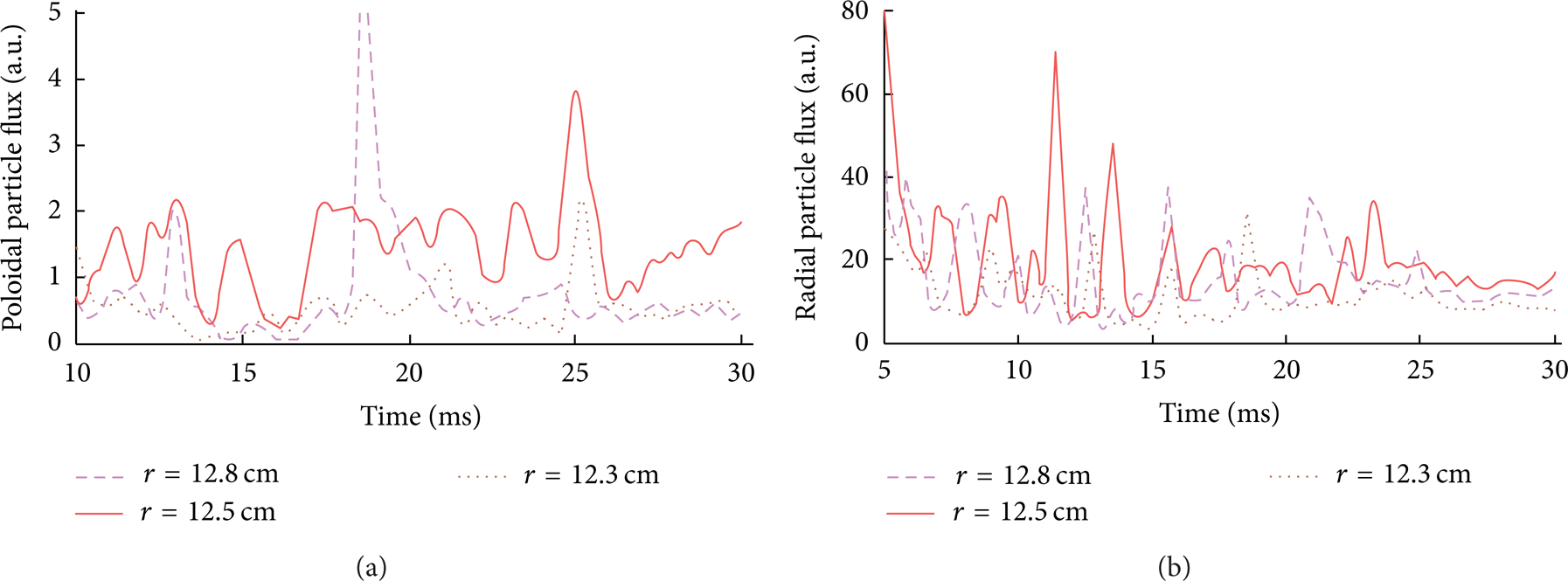
The time variation of (a) radial particle flux and (b) poloidal particle flux at different radii measured by electrical part of multipurpose probe in IR-T1 Tokamak.
Also MPP can measure time evaluation of Reynolds stress at different radii. So the relation between Reynolds stress and particle flux in different radii and different time can be clarified by MPP simultaneously. The radial profile of Reynolds stress is shown in Figure 7. Its minimum value has accrued at LCFS.
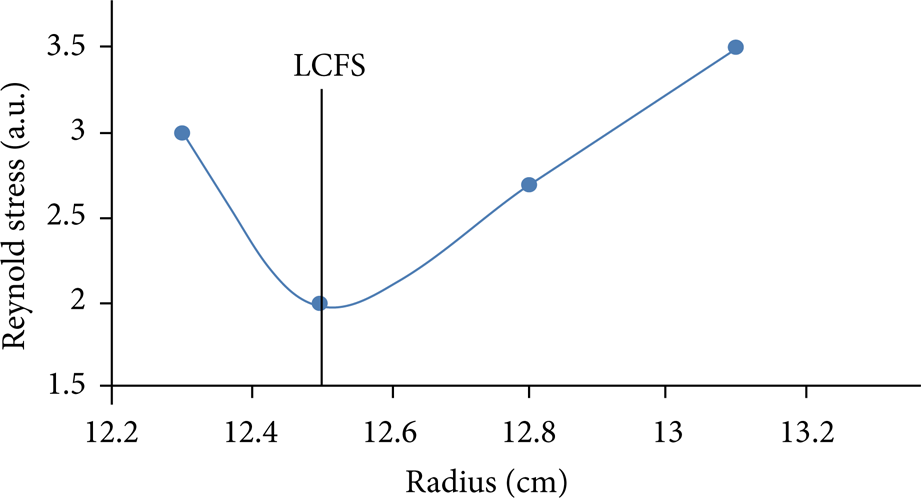
The radii variation of Reynolds stress measured by electrical part of multipurpose probe in IR-T1 Tokamak.
It can be concluded that by decreasing the Reynolds stress, the poloidal particle flux increased remarkability. The radial gradient of Reynolds stress plays an important role in the driving of poloidal flows in the plasma boundary region.
4. Conclusion
In this work, a moveable multipurpose probe (MPP) was designed, constructed, and installed on the IR-T1 Tokamak. MPP can measure electrostatic fluctuation, magnetic fluctuation, and flow velocity simultaneously. The relation between gradient of Reynolds stress and poloidal particle flux can be investigated by MPP. It can measure the radial variation of radial and poloidal electric field. E r has its maximum amount in the last closed flux surface (LCFS), while E P is minimum at this point. Also the Reynolds stress is minimum at LCFS. By comparing the radial profile of poloidal particle flux and Reynolds stress it can be concluded that by decreasing the Reynolds stress the poloidal particle flux increased remarkability. The radial gradient of Reynolds stress plays an important role in the driving of poloidal flows in the plasma boundary region. The amount of radial electric field and poloidal flow has been changed in the vicinity of the LCFS. This means that Reynolds stress can suppress turbulence and can modify turbulence transport.
Conflict of Interests
The authors declare that there is no conflict of interests regarding the publication of this paper.