




Abstract
Modern health care system is one of the most popular Wireless Body Area Sensor Network (WBASN) applications and a hot area of research subject to present work. In this paper, we present Reliability Enhanced-Adaptive Threshold based Thermal-unaware Energy-efficient Multi-hop ProTocol (RE-ATTEMPT) for WBASNs. The proposed routing protocol uses fixed deployment of wireless sensors (nodes) such that these are placed according to energy levels. Moreover, we use direct communication for the delivery of emergency data and multihop communication for the delivery of normal data. RE-ATTEMPT selects route with minimum hop count to deliver data which downplays the delay factor. Furthermore, we conduct a comprehensive analysis supported by MATLAB simulations to provide an estimation of path loss, and problem formulation with its solution via linear programming model for network lifetime maximization is also provided. In simulations, we analyze our protocol in terms of network lifetime, packet drops, and throughput. Results show better performance for the proposed protocol as compared to the existing one.
1. Introduction
WBASN is a particular type of Wireless Sensor Network (WSN), normally concerned with human body. A small set of wireless sensors (nodes) are used to gather real time data and forward it to sink directly or indirectly through relay nodes. Each node is provided with radio transceiver, processor, and battery source [1]. Sink is supplied with extensive battery power; however, nodes are shared with limited resources. Most commonly used application of WBASNs is the modern health care system which enables patient to be monitored, diagnosed, and prescribed remotely. In health care domain, WBASNs are used to monitor patients suffering from diabetes, temperature, blood pressure, heart attack, and many more.
Route selection between any two nodes starts with the selection of neighbours based on some sort of information which is shared among the adjacent neighbours and then all around the network. This whole scenario depends on the capability of nodes and major objectives associated with these are battery lifetime extension along with recharging as seldom as possible. Routing protocols are prominently involved in sustaining the lifetime of nodes. A specific route with minimum energy cost needs to be selected for data transmission; in subject to this many routing protocols are proposed and many more needs to be proposed.
In this paper, we present a new routing protocol for WBASNs; RE-ATTEMPT. The protocol operation of the proposed protocol is completed in four phases. Firstly, nodes broadcast HELLO messages to update their routing tables. Secondly, for data transmission a priority based route is selected. Thirdly, sink assigns time slots to nodes for data transmission. Finally, communication within the allocated time slots to complete the process.
The rest of the paper is organized as follows: in Section 2 related work is provided, Section 3 deals with motivation, Section 4 contains brief explanation of our proposed protocol, and Sections 5 and 6 contain energy consumption and path loss analyses. Section 7 enlists linear programming based mathematical modeling and Section 8 is provided with the performance evaluation comparison of the proposed technique with the widely used existing ones. Conclusion along with future work is given in Section 9.
2. Related Work
Authors in [2] use single-hop communication to send data from nodes to sink. This technique is effective to overcome delay; however, distant nodes are penalized in terms of energy consumption. In [3] authors use multihop communication between nodes and sink. However, increased delay and more energy consumption of nodes nearer to sink are the major points of concern.
Authors in [4] propose Wireless Autonomous Spanning Tree Protocol (WASP) in which message is broadcasted to inform parent nodes with the data of child nodes. This strategy is used to accomplish low delay and high network reliability. However, power is not balanced uniformly.
Environment Adaptive Routing (EAR) protocol, proposed by authors in [5], uses both single-hop and multihop communication between nodes and sink. However, multihop communication is not suitable for emergency data because it results in delayed data delivery.
Authors in [6] use priority based tree algorithm for WBASNs. They use dedicated channels for emergency data and when emergency data is successfully delivered, normal data is put forward for transmission. However, dedicated channels cause frequent loss of available resources.
Authors in [7] propose Energy-Balanced Rate Assignment and Routing Protocol (EBRAR) in which data is intelligently transmitted through adaptive route selection based on residual energy. Adaptive resource allocation guarantees uniform load on the nodes which results in network lifetime extension.
Authors in [8] present a survey paper on routing protocols for WBASNs, specifically modern health care systems. They categorize routing protocols into cluster based, cross layer based, quality of service aware, thermal aware, and delay tolerant. Moreover, advantages and issues associated with each category are briefly discussed.
Authors in [9] conduct a comprehensive study on existing research in the field of WBASNs. They review WBASN standards and protocols engaging cross layer protocol stack. Moreover, the research highlights the challenges in health care monitoring.
Authors in [10] propose a cross layer protocol, Cascading Information Retrieval by Controlling Access with Distributed Slot Assignment (CICADA), for WBASNs. By using a distributed approach, the proposed protocol sets up a network tree which guarantees collision-free channel access and also helps in routing data to the sink. By using control as well as data subcycles, CICADA achieves energy efficiency with low delays. However, this protocol does not support traffic from sink to nodes.
In [11], the authors compare the performance of three existing quality link metrics in Static Wireless Multihop Networks (SWMhNs): Expected Transmission Count (ETX), Minimum Delay (MD), and Minimum Loss (ML). A novel contribution of this work is the proposition of a new quality link metric, Inverse ETX (InvETX). These metrics also achieve delay minimization like RE-ATTEMPT. On the other hand, authors in [12] highlight some interesting challenges in WBASNs. To be socially acceptable, the nodes must be noninvasive. The size of BASN is relatively smaller than conventional WSN, implying smaller batteries, thus leading to energy constraint. Moreover, placement as well as packaging of nodes is also among the essential design considerations due to neither prominent nor uncomfortable requirement of WBASNs.
Authors in [13] propose a multihop protocol in WBASNs which is robust against frequent network changes due to changes in posture and variation in the quality of wireless links. Moreover, this protocol uses an adaptive transmit power mechanism for nodes and thus improves energy efficiency. However, all the sensed data is forwarded with equal probability, which is problematic whenever different quality of service data is taken into consideration.
3. Motivation
The basic aim to design a routing protocol is uniform distribution of load, such that energy consumption at every round is even and network lifetime is increased. Single-hop communication causes increased load on distant nodes and multihop communication drains the battery power of nearer nodes quickly. Thus, authors in [14] propose Adaptive Threshold based Thermal-aware Energy Efficient Multihop proTocol (ATTEMPT) in which nodes are placed according to data rates. However, deficiencies of ATTEMPT are as follows.
There is no alternative route selection in case of dead nodes. Nonuniform load on the nodes causes unbalanced energy consumption which in turn causes shrinkage in network lifetime as well as stability period. Nodes of different data rates are equipped with unbalanced energy which results in quick energy depletion of high data rate nodes as compared to the ones with lower data rate. Unnecessary relaying of data causes the nodes to die at a faster rate. Placement of nodes is not according to energy levels. For in-body nodes hot spot detection is very important; however, on-body sensor is not capable of acting like a hot spot due to inadequate energy source. So, surplus energy is consumed for the detection of hot spot which is not required.
Thus, we propose a routing protocol which overcomes the aforementioned deficiencies.
4. Proposed Protocol
In our proposed protocol, sink is placed at the centre of human body. A path with minimum number of hops (multi-hop communication) is selected for normal data delivery whereas direct communication is preferred for emergency data. Deficiencies mentioned in previous section are set in the following order: (1) nodes are placed according to energy levels, (2) to communicate effectively, alternative routes are selected in case of dead nodes, (3) initial energy is distributed in such a way that nodes acting as relays for data transmission to sink are equipped with more energy and these relay nodes are decreased in number, and (4) hot spot detection is disabled to save extraenergy consumption in doing so. Thus, relay nodes can easily forward received data to sink due to higher energy levels. Additionally, we analyze the newly proposed RE-ATTEMPT protocol in terms of path loss as well. In order to have a fair comparison between the proposed protocol and the existing one; we choose, for RE-ATTEMPT, the number of nodes as well as their locations the same as that of ATTEMPT protocol. More importantly, increase in the network size (more human bodies) does not affect the performance of RE-ATTEMPT protocol. Because the network topology is simply replicated for each human body (acting as a subunit), the algorithm is independently implemented on each subunit, having own sink and nodes (Figure 2). Detailed description about the phases involved in the operation of our proposed protocol is in the following subsections.
4.1. Initialization Phase
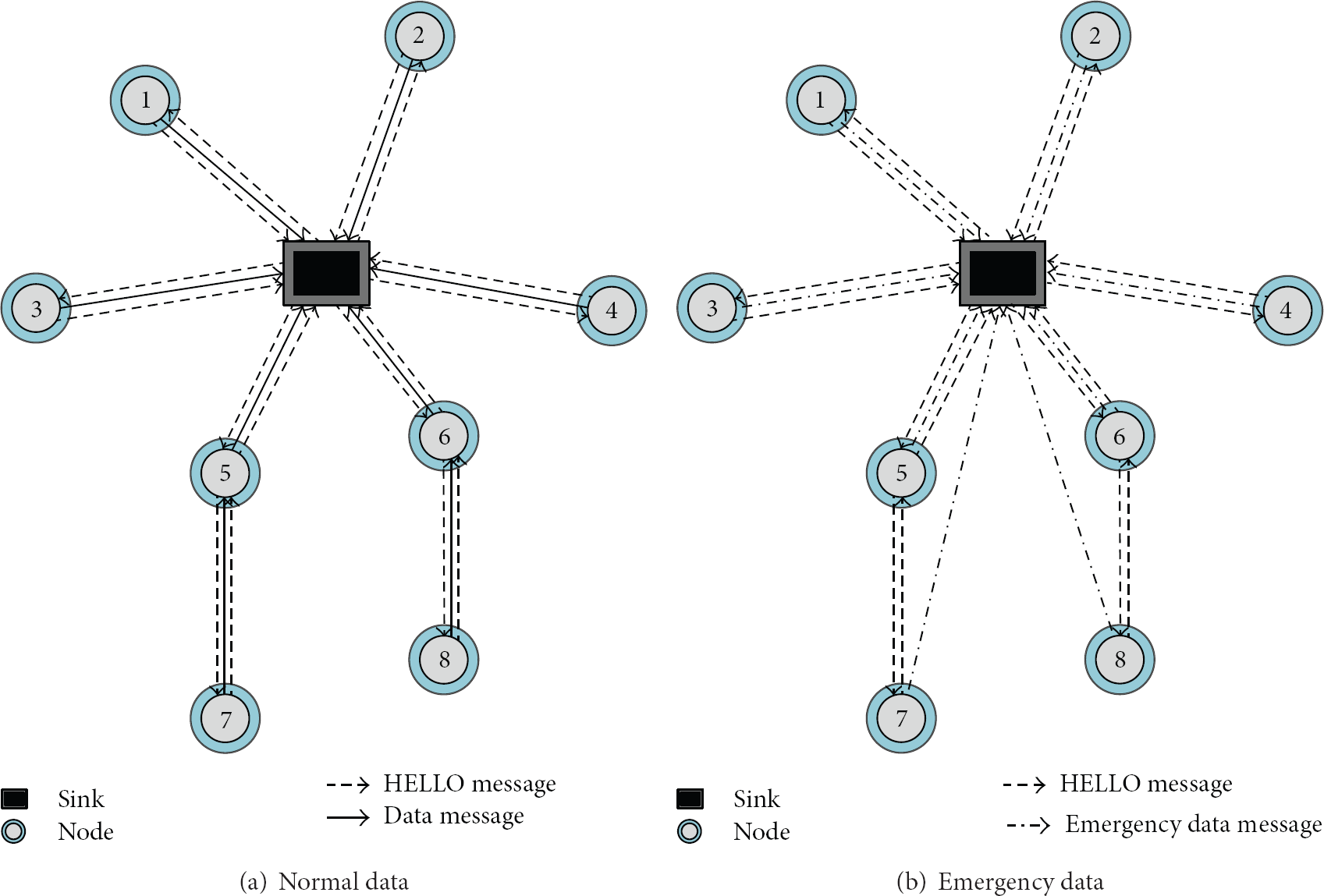
In this phase, three tasks are performed; each node is informed with its neighbours, position of sink, and all the possible routes to sink. Nodes update their routing table through the exchange of HELLO messages. This is made possible, when each node broadcasts HELLO messages as shown in Figure 1, containing information about neighbours in the form of hop count from sink.

HELLO message format.

WBASN topology.
4.2. Routing Phase
In this phase, a priority based route for data transmission to sink is selected from the set of available routes. The highest priority is set for nodes having emergency data; that is, these send data directly to sink and in case of normal data, route with minimum number of hops to sink is selected. In Figure 2 route selection is as follows.
Nodes 1, 2, 3, and 4 communicate directly with sink whether their data is emergency or normal.
Nodes 7 and 8 send emergency data directly to sink and normal data to 5 and 6, respectively; however before doing so these check whether the receiving nodes are alive or not. If they are dead, then nodes 7 and 8 communicate directly with sink.
Nodes 5 and 6 aggregate their own data with received data and forward compressed data to sink.
In direct communication, delay is much shorter as compared to multihop communication. Furthermore, emergency data should be transmitted as soon as possible in comparison to normal data. That is why we choose direct communication for emergency data and multihop communication for normal data delivery. Moreover, normal data's transmission delay is minimized by selecting route with a minimum number of hops. In Figure 3, flow diagram of the routing phase is shown.

Flow diagram: routing phase.
4.3. Scheduling Phase
Routing phase is followed by scheduling phase as shown in Figure 4. Sink allocates Time Division Multiple Access (TDMA) slots to nodes, thereby enabling nodes to share the same frequency band on the basis of different time slots. For emergency data, guaranteed time slots are assigned to nodes in Contention Free Period (CFP) of the Medium Access Control (MAC) superframe structure, thereby ensuring rapid data delivery in case of emergency. On the other hand, Contention Access Period (CAP) is adopted for normal data; time slots are assigned to each node in quick succession one after the other.
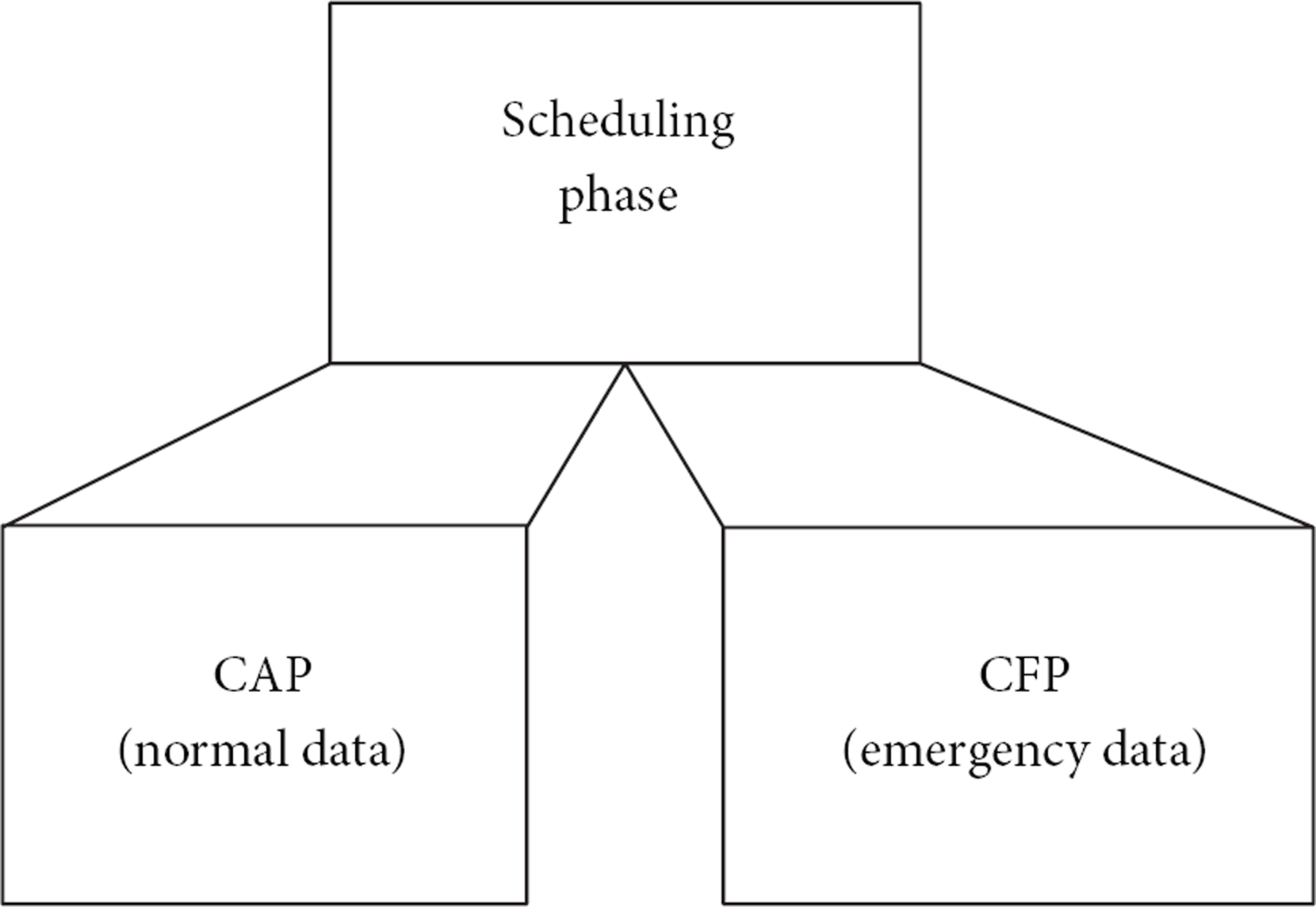
Scheduling phase.
4.4. Data Transmission Phase
Once sink allocates time slots to nodes, these communicate within their allocated time slots to overcome collision. After this, sink receives data and waits for some time to aggregate it.
Soon after the data transmission, next round is started where the phases are repeated in the same manner. This process continues till the energy resources of each node are completely depleted.
5. Energy Consumption Analysis
The amount of energy consumed depends on the mode of communication used: single hop or multi hop. For single-hop communication, we calculate the consumed energy as


Now, we calculate energy consumption due to multihop communication as

Comparison of different wearable sensors.

6. Path Loss Analysis
By nature human body is partially conductive, and various substances having varied thickness, characteristics of impedance, and dielectric constants are embodied there. Subject to the operating frequency band, high losses may occur in response to the communication protocol adopted for nodes. At present, many standards are in use for communication in WBASNs. However, most frequently used among these are IEEE 802.15.1 (Bluetooth), MICS, ZigBee, and IEEE 802.15.6 (UWB) [17]. When devices communicate, losses between them cause degradation in the performance of monitoring system. The available Industrial Scientific and Medical (ISM) radio bands for on body nodes are listed in Table 2 [18].
Available ISM bands for on-body nodes.

Path loss includes all the consequences linked with distance and interaction of the propagating wave with physical objects in the environment between transmitter and receiver. Thus, path loss is attenuation in power level at the receiving end, mainly due to distance. In subject to WBASNs, path loss depends on distance and frequency. In [19] path loss model (in dB) as a function of distance between transmitter and receiver is worked out as
n is path loss exponent (for space its value is 2 and for human body its value varies from 4 to 7), d is distance between transmitter and receiver,
In WBASNs path loss occurs due to many reasons such as reflection, refraction, diffraction, and free space loss. 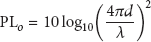

We use operating frequency of
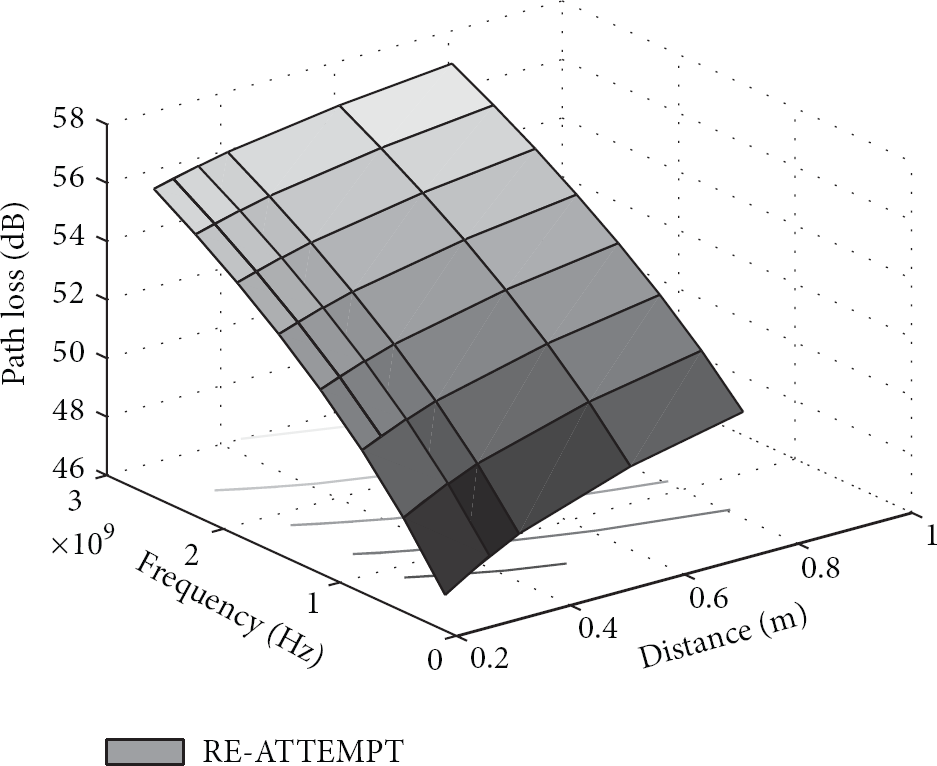
Path loss (dB).
7. Problem Formulation and Modeling
We consider n nodes
Nodes deployment.
Network flow tree.
Problem Statement. We define the lifetime of the network to be the duration in terms of rounds until all nodes cease transmissions. The main objective is to maximize the network lifetime within the given constraints.
Solution. Consider network lifetime R rounds and let 


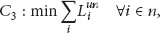


The objective function in (7) is to maximize the network lifetime
8. Performance Evaluation
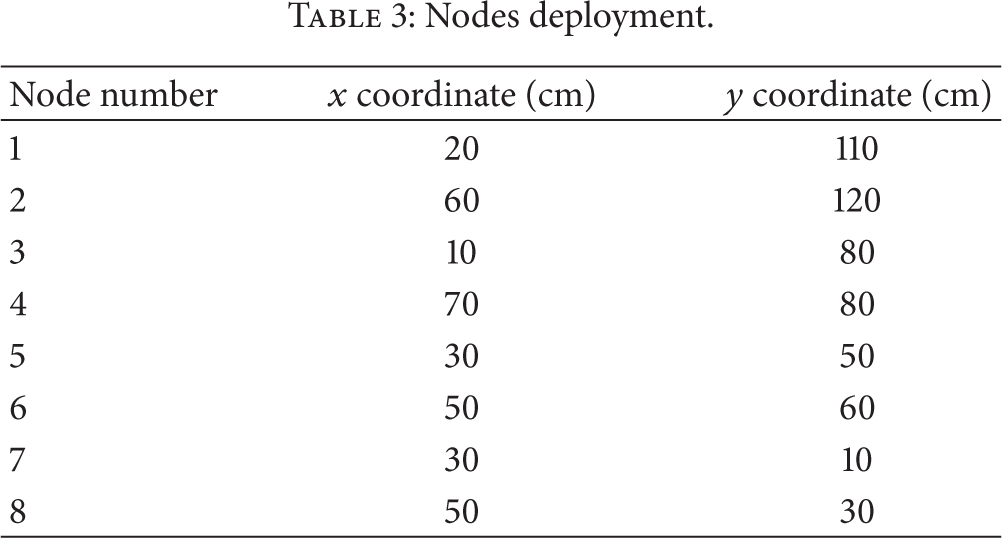
We evaluate the performance of our proposed RE-ATTEMPT protocol with the help of MATLAB simulations, in which it is compared with ATTEMPT protocol. We assume 80 cm × 160 cm network area, where on body nodes are deployed at fixed positions as shown in Table 3 and sink is placed at (40 cm, 90 cm). Initially, nodes 5 and 6 are equipped with 0.525 J and rest of the nodes with 0.3 J of energy. With the assumption of collision-free channel, the radio parameters used in simulation are shown in Table 4. We execute our protocol 5 times; average results with discussions are provided in this section.
Radio parameters.

The time from the establishment of the network till the death of first node is known as stability period. Here time is presented in terms of rounds and one round is the time duration in which the protocol operation is performed once. Similarly, the number of rounds from start of the network till the death of all nodes is termed as network lifetime. Figure 7 shows that on average RE-ATTEMPT consumes 7.46% less amount of energy as compared to ATTEMPT. Figure 8 shows that RE-ATTEMPT takes more rounds in terms of stability period and network lifetime as compared to ATTEMPT. In ATTEMPT first node death occurs at round number 691 while for RE-ATTEMPT it is round number 1479. Network lifetime of ATTEMPT is 1450 rounds and that for RE-ATTEMPT is 1577 rounds. Moreover, ATTEMPT shows nonuniform distribution of energy in comparison to RE-ATTEMPT as depicted from Figure 8. Reasons for all of the abovementioned characteristics are as follows: (i) relay nodes consume more energy than nonrelay nodes and in ATTEMPT protocol these nodes are provided with initial energy less than the required amount, (ii) unnecessary multihopping of data is avoided in RE-ATTEMPT, (iii) alternative route selection in case of dead node, and (iv) hot spot detection is disabled in RE-ATTEMPT. Moreover, we compare the attributes of existing routing protocols with our proposed RE-ATTEMPT as shown in Table 5.
Comparison of RE-ATTEMPT protocol with existing protocols.


Average energy consumption per round.

Average rate of dead nodes.
Throughput is the number of successfully received packets at the receiver end, and for its calculation packet drops are taken into consideration. We use random uniformed model [23] for packet drop calculation. The status of a given link might be good or bad, in case of good status packet is successfully received and it is dropped for bad status. We suppose the probability of link to be in good status as 0.7. Figure 9 depicts that more packets are sent to sink by our protocol as compared to its counterpart protocol. This is due to decreased multihopping and extended lifetime of our protocol. From Figure 10, it is clear that ATTEMPT results in more packet drops than RE-ATTEMPT. The reason behind this is proper scheduling of data in RE-ATTEMPT protocol, that is, emergency data transmission in CFP and normal data transmission in CAP. Moreover, multihopping increases the number of packets in transit which means more contention, thereby increasing the chances of collision or alternatively more packets being dropped. Finally, the number of received packets is shown in Figure 11; in RE-ATTEMPT more packets are received at sink as compared to ATTEMPT. This is obvious because proper scheduling makes RE-ATTEMPT more reliable in terms of successful packet delivery as compared to ATTEMPT protocol. Numerically, according to ATTEMPT the number of sent packets is 2902, and received packets are 2014 while that of RE-ATTEMPT is 9889 and 6930, respectively.

Average number of packets sent to sink (aggregated).

Average number of packets dropped (per round).

Average throughput (aggregated).
9. Conclusion and Future Work
In this paper, we proposed RE-ATTEMPT routing protocol for WBASNs in which the merits of single-hop and multihop routing are utilized, priority based route selection for the delivery of normal and emergency data. The first point of concern with multihop routing is delay, this issue is resolved by minimum hop count based route selection. The second point of concern with multihop routing is high energy consumption of relay nodes; this issue is resolved by minimizing the number of relay nodes and balancing them with reference to energy distribution. Moreover, time domain analysis of the proposed RE-ATTEMPT protocol in terms of path loss as well as problem formulation and its solution via linear programming based mathematical modeling is also provided. Improved results in terms of network lifetime and throughput of the proposed RE-ATTEMPT protocol as compared to the existing ATTEMPT protocol are due to the reasons highlighted in Sections 3, 4, and 8, respectively.
Our future directions are focused on cross layer design protocols in WBASNs. Initially, a joint, Medium Access Control (MAC) layer [24] and network layer, model development is under consideration.
Footnotes
Conflict of Interests
The authors declare that there is no conflict of interests regarding the publication of this paper.