




Abstract
Water is essential for life. Considering its importance for humans, it must be periodically analyzed to ensure its quality. In this study, a wireless water quality network is deployed to collect water quality parameters periodically and an artificial neural network-based estimation method is proposed to estimate groundwater quality. Estimating groundwater quality enables the authorities to take immediate actions for ensuring water quality. Compared to traditional water quality analysis methods, the proposed method has the advantage of letting the authorities know the quality of their water resources beforehand. A set of simulation studies given in this paper proves the efficiency and accuracy of the proposed method.
1. Introduction
Water is the most critical parameter for life. Although 70 percent of the Earth's surface is water covered, the vast majority of the water (95 percent of it) is saline [1]. Therefore preserving the quality of fresh water is important. Almost 1 billion people lack access to a proper drinking water supply and 2 million deaths are annually attributed to unsafe water, sanitation, and hygiene [2].
Water quality assessment is an important process to ensure the access to safe water. Therefore, national standards for water quality are developed by the authorities of each country. Water quality is determined by assessing biological, chemical, and physical classes of quality indicators. Drinking water standards determine the organic and inorganic chemicals, microbial pathogens, and radioactive elements that may affect the safety of drinking water. These standards set a limit to the highest concentrations of certain chemicals allowed in the drinking water supplied by a public water system [3]. Conventional water quality assessment is carried out in two steps. First, in situ analysis of some parameters is performed in the field; second, analysis of the rest of the parameters is performed at the laboratory. During the laboratory analysis many different methods are being used. As stated by the associated existing directives such as these of [3, 4], dissolved oxygen (DO), electrical conductivity (EC), pH, turbidity, nitrate, and temperature are the typical parameters for assessing drinking water quality [5]. For drinking water, as stated by [3, 4], the maximum permissible limit for DO is 5 mg/L, for EC is 2.5 mS/cm, for pH is 6.5–8.5 units, and for nitrate is 10–50 mg/L [5]. Turbidity has no actual limit according to both [3, 4].
Automatic water quality monitoring stations are supported by the authorities [4, 6]. As a basis for water management, water quality surveillance (monitoring) stations are being used in different countries including USA, Canada, and Germany [7]. These stations form a network and provide the possibility to control the long-term and short-term changes in water quality by accessing the data obtained by the individual stations over Internet. In contrast with the conventional sampling and analyzing techniques these automated monitoring stations networks provide data very rapidly. This enables the early detection of incidents and assessment of hazard potential arising from any discharges. Also, clues to the identity of water pollution offenders could be obtained from such monitoring stations.
Different from the traditional water quality monitoring approaches, in this study, a wireless water quality network (WWQN) supported by an artificial neural network- (ANN-) based estimation system is proposed. In the proposed system, a group of battery-operated sondes with wireless interfaces are installed in water wells. The sondes form a WWQN in which each of them acts as a WWQN node as shown in Figure 1. The sondes are equipped with probes for DO, EC, pH, and nitrate and regularly analyze groundwater quality and send the measurement data to the control center over the WWQN. Thus, the proposed system provides online water quality data to the authorities. The data provided to the control center can be made publicly accessible via a web server. At the same time, the ANN-based estimation system uses a large data set collected periodically over a long time period and provides estimates of water quality parameters.

A Wireless water quality monitoring network for monitoring of groundwater quality.
Although all wireless water quality monitoring systems have a few disadvantages like limited lifetime and performance restrictions, they offer unbeatable advantages such as portability and cost effectiveness over traditional water quality monitoring systems [5]. However, the applicability of wireless water quality monitoring systems depends on both network-related parameters such as transmission frequency, transmission power, and packet size and node-related parameters [5]. A major disadvantage of wireless water quality monitoring systems, limited lifetime expectations, can be alleviated by integrating solar and wind panels to sondes [8, 9].
This paper is structured as follows. Section 2 explains the details of implementing an artificial neural network for estimation of groundwater quality parameters. Section 3 reports the results of a set of simulation studies. Finally, Section 4 concludes the paper.
2. Artificial Neural Network-Based Estimation of Groundwater Quality
ANNs are efficiently used in a wide variety of applications. For instance, prediction, trajectory tracking, control of different systems, and so forth are some of them. ANNs are parallel information-processing systems. The information flows from the inputs to the outputs through a network structure; this consists of layers of interconnected nodes. These nodes are elementary processing units referred to as neurons; each one of them receives the information from different inputs and produces an output according to the value that its activation function takes when the argument is the weighted sum of its inputs. An ANN is characterized by a network structure and a set of parameters. The structure refers to the number of interconnected neuron layers, the number of neurons per layer, the connection topology between the neurons (the network), and the type of activation (transfer) function per neuron, while the parameters are the weights used in each neuron for the aforementioned weighted sums [10]. Actually, ANNs are usually of network structure that is a priori set by the designer and then their weights are automatically trained using an optimization algorithm, like the very popular back-propagation (BP) algorithm (a gradient descent type algorithm) [11] and the Levenberg-Marquardt optimization (an approximation of the Gauss-Newton method) [12]. In addition to this common approach, the resilient back-propagation neural network can successfully be employed for the prediction of parameters with confidence [13]. On the other hand, as proven in [14], an adaptive neurofuzzy inference system can be more efficient than single layered feed forward artificial neural networks in some specific cases. The following set of equations describes the operation of the BP algorithm [15–17]:



In this study, a two-hidden-layer feedforward neural network was employed, where tangent sigmoid activation functions were used for the hidden layers and linear activation functions were used for the output layer. The Levenberg-Marquardt optimization method was used for the training of the ANN's parameters [18]. Figure 2 shows the architecture of this system for the estimation of sulfate and sodium adsorption ratio (SAR). In this case, there are 5 inputs, specifically, pH, electrical conductivity (EC), total dissolved solids (TDS), chloride ion (CI−) and total hardness (TH), 2 hidden layers which consist of 15 and 14 neurons, respectively, and 2 outputs called sulfate (

Architecture of the system for estimation of sulfate and SAR.
Table 1 shows the dataset available for the training of the proposed system consisting of 108 sets of input-output vectors. Note that these measurements were taken from 9 different wells once per month for a total time period of one year, while only 107 of them were available since on January 2004 the water in the well number 9 was frozen and no measurements could be taken. In this study, we used 90 out of the 107 available sets (84.1% of the total available sets) for training and 17 (15.9% of the total available sets) for testing. The sets were chosen randomly. Before entering the ANN model, the data set was normalized for more reliable results [18] and then restored to original data set.
Measurement dataset used for the training and testing of the proposed system.

3. Simulation Studies
The dataset was used to estimate the sulfate and SAR density in the 9 investigation wells. Figure 3 shows the time evolution of the 5 employed input parameters.
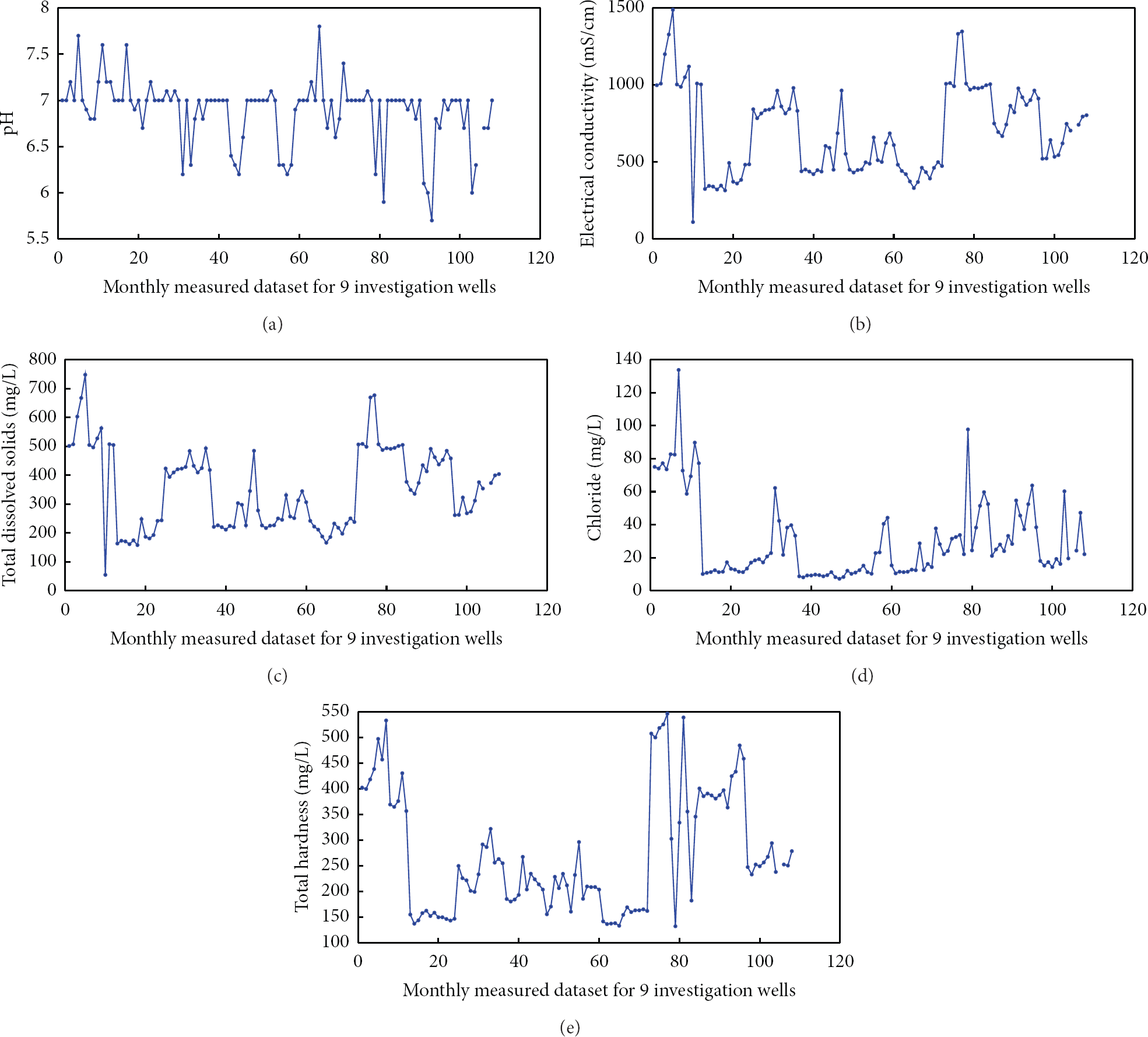
(a), (b), (c), (d), and (e) The value change of the considered 5 input parameters versus set number (cf. Table 1). Note that the set number expresses time evolution since the measurements were acquired in constant time intervals of 1 month.
Test and training mean squared error (MSE) for the Levenberg-Marquardt algorithm is shown in Figure 4. The MSE training threshold was accomplished after 338 epochs. The time evolution of the predicted and the measured values for the two outputs (SAR and sulfate) are shown in Figures 5 and 6, respectively. The SAR measured and predicted values shown in Figure 5 are practically coinciding, while in Figure 6 the predicted sulfate values are very closely following the corresponding measurements.
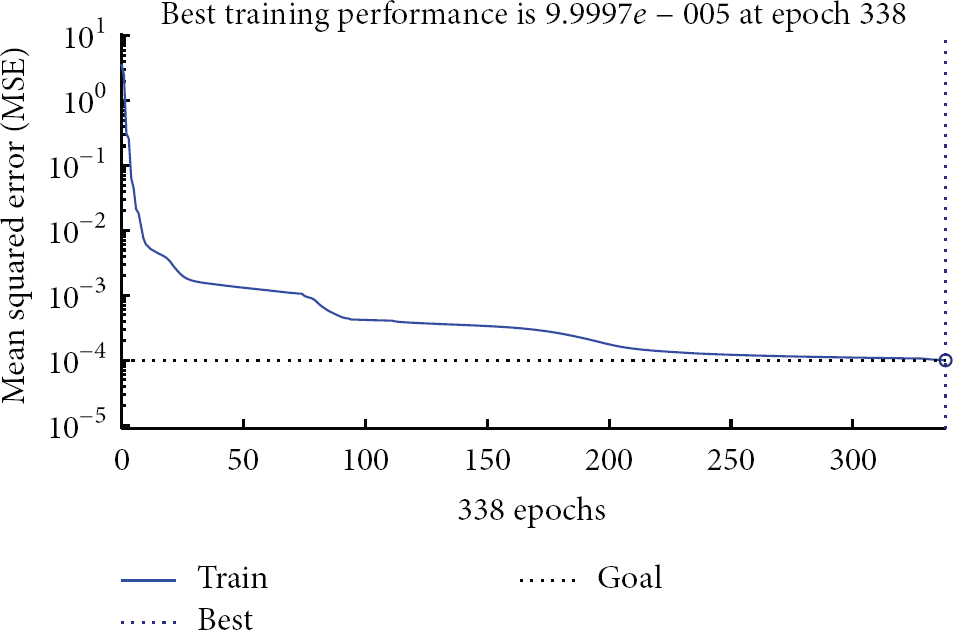
The performance of the neural network system.
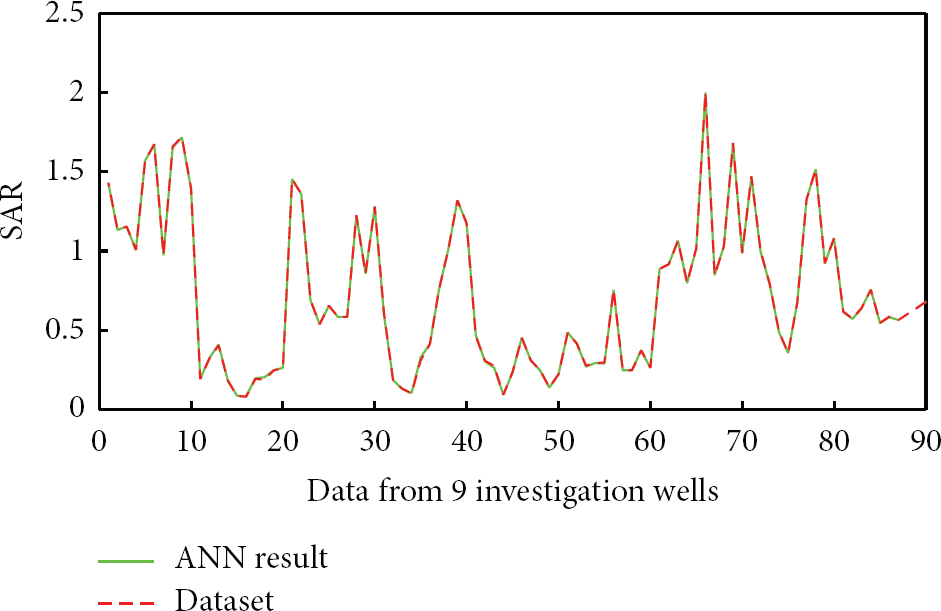
Comparison of the neural network predicted SAR values to the corresponding measured ones.

Comparison of the neural network predicted sulfate values to the corresponding measured ones.
4. Conclusions
Water is very essential for human life. In this respect, its quality must be periodically analyzed. While traditional water quality analysis methods enable the authorities to assess the quality of their water resources, they do not let the authorities know what the quality of their water resources will be in the near future. To address this need, a wireless groundwater quality monitoring network that uses an artificial neural network-based estimation technique has been proposed in this study. A set of simulation studies has been carried out to evaluate the accuracy of the proposed method. The proposed system provides both real-time water quality data and estimates of water quality parameters and allows the authorities to take immediate actions for improving groundwater quality. Limitations of the proposed approach are time required to train the ANN, large sample sets fed into the model to train the ANN, and deployment of WSN infrastructure for collecting various groundwater quality parameters. In addition, since BP algorithm adjusts the weights to reach the minima of the error function, the ANN may be trapped in local minima. Future work consists of a set of field tests that will be conducted in Edirne, Turkey.
Footnotes
Conflict of Interests
The authors declare that there is no conflict of interests regarding the publication of this paper.
Acknowledgment
This research has been supported by Yildiz Technical University Scientific Research Projects Coordination Department (Project no. 2013-04-04-KAP02).