




Abstract
Optimization design of centrifugal pump is a typical multiobjective optimization (MOO) problem. This paper presents an MOO design of centrifugal pump with five decision variables and three objective functions, and a set of centrifugal pumps with various impeller shroud shapes are studied by CFD numerical simulations. The important performance indexes for centrifugal pump such as head, efficiency, and required net positive suction head (NPSHr) are investigated, and the results indicate that the geometry shape of impeller shroud has strong effect on the pump's performance indexes. Based on these, radial basis function (RBF) metamodels are constructed to approximate the functional relationship between the shape parameters of impeller shroud and the performance indexes of pump. To achieve the objectives of maximizing head and efficiency and minimizing NPSHr simultaneously, multiobjective evolutionary algorithm based on decomposition (MOEA/D) is applied to solve the triobjective optimization problem, and a final design point is selected from the Pareto solution set by means of robust design. Compared with the values of prototype test and CFD simulation, the solution of the final design point exhibits a good consistency.
1. Introduction
Centrifugal pump, the most frequently used type of pump up to now, is an important member of turbomachine family for transporting liquids from a low level to a high level. As a typical kind of centrifugal pump, double suction centrifugal pumps with large flux and high lift are widely used in industry. However, traditional methods for pump design and optimization mainly adopt the trial-and-error strategy by manufacturing and testing prototype pumps, which are expensive and time consuming [1]. Since the huge market demand for centrifugal pumps is around 20 billion US dollar per year [2], even one percent increment of pump efficiency is of important significance. As the “heart” of centrifugal pump, the geometry shape of pump impeller has strong effect on the pump performance, so that the optimization of impeller shape should be paid much attention in order to enhance pump efficiency.
Pierret and van den Braembussche [3] optimized the blade shapes by means of artificial neural networks and simulated annealing to improve pump performance. Anagnostopoulos [4] studied the characteristic performance curves of centrifugal pump using CFD software and found the optimal geometry shape of impeller blade that could maximize the pump efficiency among a set of blade angles. Using incomplete sensitivity method and genetic algorithms, Derakhshan et al. [5] redesigned the shape of impeller blades to obtain a higher efficiency. Besides, Zhou et al. [6] investigated the best shape parameter combination of impeller to obtain higher pump efficiency by means of orthogonal experiment and CFD simulation. Obviously, these researches only viewed the design and optimization of centrifugal pump as a single objective optimization for pump efficiency but ignored other performance indexes such as head and NPSHr. Although higher efficiency seemed to be the most important performance for pumps which could produce considerable economic benefit, other performance indexes were also significant. Therefore, the optimization of double suction centrifugal pumps was actually a multiobjective optimization (MOO) problem with multiple design requirements.
MOO, also called as vector optimization, is a numerical process of optimizing a collection of individual objective functions simultaneously and systematically [7]. Many practical engineering problems usually involve multiple design requirements conflicting with each other, and the optimization of those problems essentially belongs to MOO problems [8]. There are some works related to MOO and design for centrifugal pumps. For example, Oyama and Liou [9] used evolutionary algorithm to find the Pareto front of total head and input power of centrifugal pump, which were two conflictive objectives; Safikhani et al. [10] presented an MOO progress on centrifugal pumps and proposed the Pareto optimal solutions using genetic algorithm based on neural network metamodels; Papierski and Błaszczyk [11] decomposed the MOO and design problem of centrifugal pump to maximize the efficiency and simultaneously minimize NPSHr. These researches had good contributions to the MOO of centrifugal pump, which could provide meaningful references for the design of centrifugal pump. However, the optimization and design of centrifugal pump are an integrated process, and more than two performance indexes should be taken into account simultaneously.
In practical optimization and design of centrifugal pump, there are several important performance indexes that are usually considered as the optimization objectives, such as head, efficiency, and NPSHr. Among these objectives, head and efficiency are required to be maximized, while NPSHr needs to be minimized. As a matter of fact, some of the optimization objectives conflict with each other and it is practically impossible to optimize the three objectives at the same time. Moreover, these three performance indexes are often obtained by means of experiment tests or CFD simulations and cannot be used for the optimization of pump performance iteratively, unless appropriate metamodels are established between the decision variables and the concerned objective functions.
Radial basis function (RBF) was originally developed by Hardy to fit the irregular topographic contours of geographical data [12]. Compared with other metamodels such as Kriging and neural networks, RBF is relatively simple to implement [13]. Jin et al. [14] deeply compared four popular types of metamodels and concluded that RBF was the most reliable method in most situations in terms of accuracy and robustness.
As aforementioned, head, efficiency, and NPSHr are usually the most concerned objectives in pump design. Therefore, an effective and powerful MOO algorithm is needed to obtain the Pareto optimal solutions. Since 1990s, many researchers have proposed a large amount of multiobjective evolutionary algorithms [15–18], which are considered as the most successful approaches in identifying the Pareto optimal set of MOO problems [19]. Thereinto, MOEA/D proposed by Zhang and Li is a well-known multiobjective evolutionary algorithm [20], which is characterized by the scalarizing functions with uniformly distributed weight vectors. Due to the good performance of global searching, MOEA/D is usually a good choice for dealing with multiobjective problems involving multiple conflictive objectives.
The objective of this work is to improve head, efficiency, and cavitation performance of centrifugal pump simultaneously, and MOEA/D is employed to solve the triobjective optimization problem of centrifugal pump. Although previous researches have optimized some indexes, they do not consider all these performance indexes at the same time. Moreover, most previous works about design optimization of centrifugal pump can be summarized into two categories: the first category of optimization methods couples CFD simulation with experiment, which is of high cost and time consuming; the other one combines metamodels with CFD simulation, which cannot guarantee the accuracy of the results without the verification of experiment. In this paper, the proposed method reasonably takes the advantages of CFD simulation, RBF metamodels, and experiment, and thus the above faults in the practical optimization of centrifugal pump can be well overcome.
2. Basic Concepts
2.1. Multiobjective Optimization
A general multiobjective optimization problem mainly consists of decision variables, objective functions, and constraint conditions. Multiobjective optimization is to find the decision variables
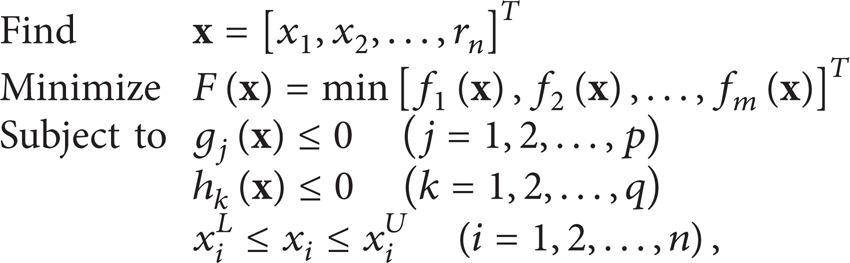
where the vector function
In practical engineering MOO problem, the objective functions and constraint conditions are often expensive computational models, such as computational fluid dynamics (CFD), multibody dynamics (MBD), and finite element analysis (FEA).
2.2. Pareto Optimal Set
The concept of Pareto optimal set is generally used to characterize the compromising solutions to an MOO problem, and the Pareto optimality is defined as follows [21]. A vector of
3. Description and CFD Numerical Simulation of Centrifugal Pump
3.1. Decision Variables
The working process of centrifugal pump is actually accompanied with energy conversion and loss. Impeller is the core component of a centrifugal pump, which converts the mechanical rotation to the kinetic energy of the fluid. As aforementioned, the geometry shape of impeller shroud has strong effect on pump performance. Therefore, the impeller design is significant for obtaining high performance centrifugal pump. Notably, too many blades may cause low blade loading due to higher friction losses; while fewer blades may result in a higher blade loading, and the turbulent dissipation losses will rise because of increased secondary flow and stronger deviation between blade and flow direction. For most centrifugal pumps, the number of impeller blade is usually recommended between 5 and 7 while the range of specific speed is 10∼120 [2]. Thus, six blades are adopted here. Figure 1 shows the geometric models of the double suction centrifugal pump, including (a) pump impeller and (b) pump volute casing. Due to the symmetry character, the design of double suction impeller can be translated into the design of a single suction type.

The double suction centrifugal pump.
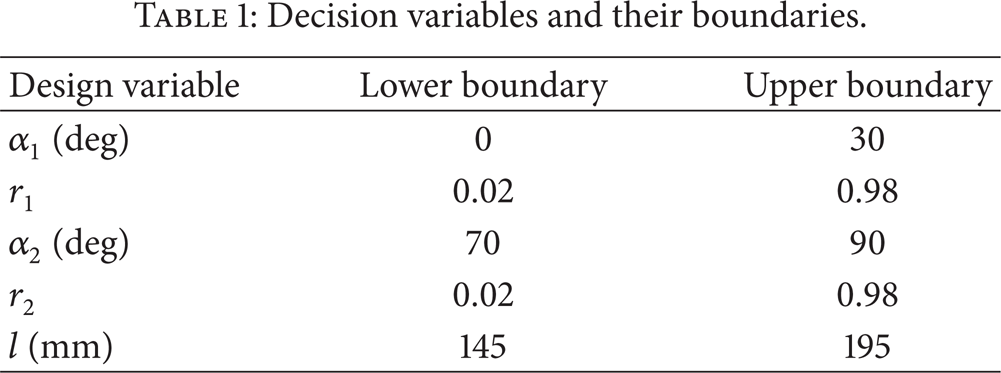
The impeller's main dimensions in this paper are shown in Figure 2(a), and the meridional section of the impeller is also given in Figure 2(b), in which the solid line is controlled by quartic Bézier curve with five control points. It is clear that the meridional section of pump impeller can be parameterized by five decision variables of α1, r1, α2, r2, and l. Here, r is the relative position in the line segment. Taking line segment
Decision variables and their boundaries.

The main dimensions and meridional section of impeller (unit: mm).
3.2. Objective Functions
Head, efficiency, and NPSHr are significant performance indexes of centrifugal pump, which are usually the most concerned objectives in pump design. Therefore, they are chosen as the objective functions in this paper.
3.2.1. Head
Head is also termed as total dynamic head. The monometric head represents the total useful mechanical energy transferred by the pump to the fluid per unit mass. In practice, head can be expressed as the energy difference between pump inlet and outlet in unit of length, which can be formulated as the following equation:

where E1 and E2 denote total energy of per unit mass of fluid at pump inlet and outlet, respectively; P1 and P2 are pump inlet pressure and outlet pressure, respectively; z1 and z2 are used to denote pump inlet and outlet position head, respectively; u1 and u2 denote the fluid velocity at pump inlet and outlet, respectively.
3.2.2. Efficiency
The efficiency of centrifugal pump represents the ratio of useful power to shaft power, which can be defined as follows:

where P u denotes the useful power; P s is the shaft power which is also called input power. Owing to various losses in the working process such as disc friction loss, mechanical loss, and frictional loss, the kinetic energy cannot be completely converted to pressure energy, so that P s is larger than P u .
3.2.3. NPSHr
Cavitation is a very dangerous phenomenon that must be avoided for centrifugal pump, and the damages caused by cavitation may range from minor pitting to catastrophic failure. Impeller is usually the component where most damages occur, since cavitation may erode the pump impeller after some period of time.
NPSHr is a significant performance index of pump cavitation, which relates to the minimum pressure required at the suction port of the pump to prevent the pump from cavitation. NPSHr can be formulated with the following equation:

where P min is the minimum pressure of the impeller blade. The pump with lower value of NPSHr performs better in cavitation resistance.
3.3. CFD Numerical Simulation
CFD numerical simulation has been proved as a very effective method to investigate the flow inside centrifugal pumps at the stages of both pump design and performance analysis. Moreover, CFD numerical simulation can reduce the construction cost in the design and optimization of pump components [22].
Latin hypercube design (LHD) is a space-filling design technique, which can ensure that each decision variable has all portions of its represented range. Using the LHD method, 119 sample points and 30 test points can be obtained. The sample points are used as the input data of RBF metamodels, while the test points are used to validate the accuracy of the RBF metamodels. Based on the sample points and test points, CFD models of pumps can be built. Figure 3 shows one CFD model of the double suction centrifugal pumps, including a detailed view of the pump impeller.
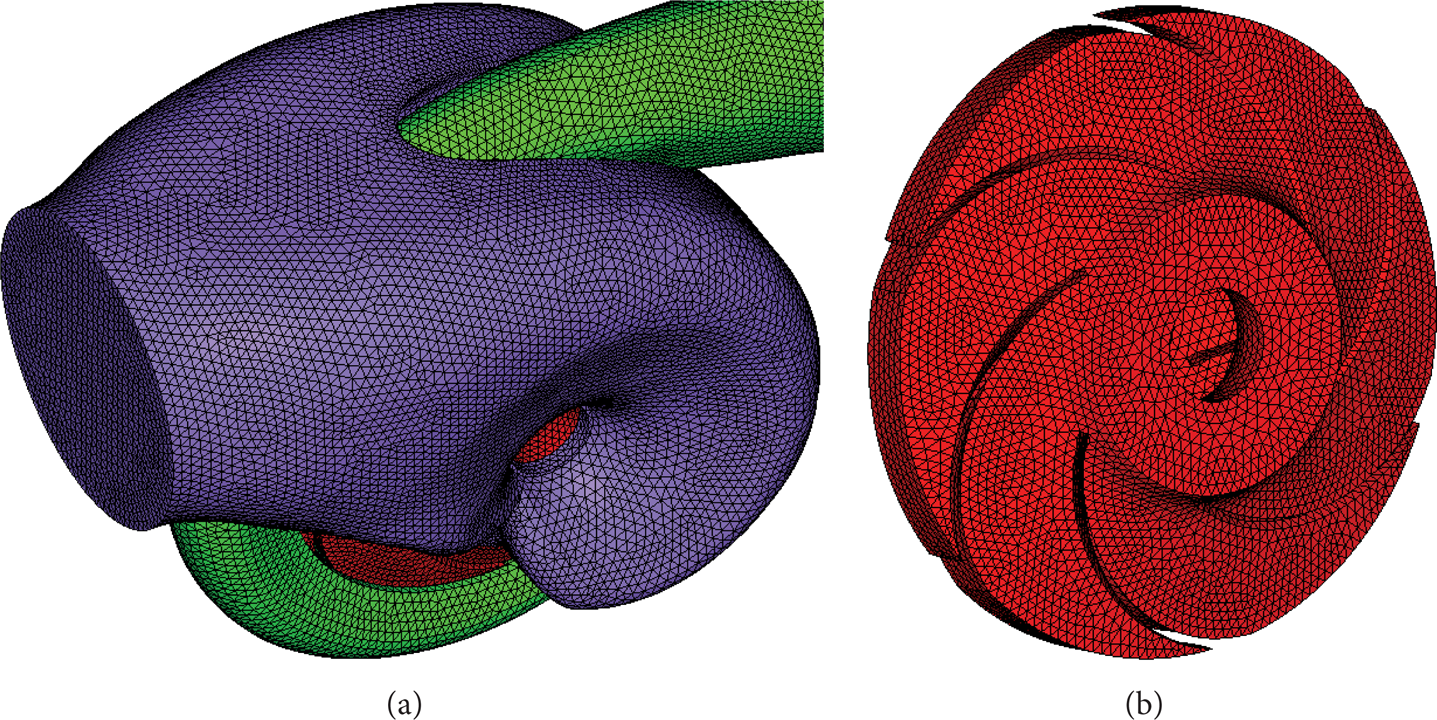
Three-dimensional mesh model of double suction centrifugal pump.
In this paper, the basic parameters used in CFD numerical simulations are shown in Table 2. The flow through the modeled centrifugal pump is simulated using the commercial code Fluent, and the flow models are established with the standard k-ε turbulence models and logarithmic law functions, which are consistent with the no-slip condition. Static boundary condition is imposed on the boundary of volute flow domain, while rotary boundary condition is imposed on the boundary of impeller flow domain. Furthermore, the interaction between these two boundaries is taken into account through the multiple reference frame (MRF) model. The RANS equations are solved by finite volume method (FVM), and the pressure-velocity coupling is calculated by means of the SIMPLEC algorithm. Second order upwind discretizations are used for convective and diffusive terms of the turbulence model equations. The residual error is set as 1 × 10⁻⁵ to judge whether the calculation is convergent.
Basic parameters for numerical simulations.

Figure 4 shows the pressure and velocity distribution from one case of the CFD simulations, which provides an intuitive reflection on the characteristics of the pump's internal flow field. As shown in the figure, after the fluid flows into the pump impeller, the pressure and velocity of each flow passage mainly present a uniform distribution along the flow direction. The pressure first drops to the minimum from the impeller inlet to outlet and then rises gradually to the maximum at the outlet. During this process, the lowest pressure appears at the inlet, closing to the blade inlet side, where cavitation is easy to occur. As for the velocity, it rises gradually from the impeller inlet to outlet, and no velocity decline occurs all the way. Because of the volute, the pressure and velocity distributions are not symmetric, whereas both change periodically with the continuous rotation of the impeller.

One case of CFD simulation results.
4. RBF Modeling and Verification
RBF model uses linear combinations of some radial basis functions based on Euclidean distance, and it is mathematically defined as follows:
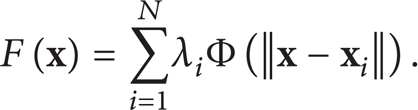
Equation (5) can also be rewritten in the form of matrix:

where
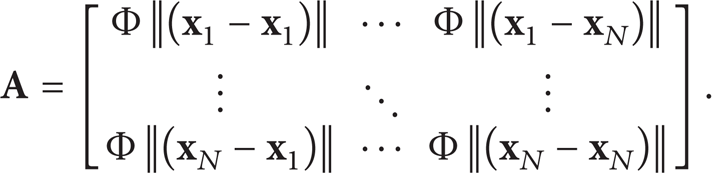
There are several classes of radial basis functions that can be chosen for Φ, such as cubic, thin plate spline, Gaussian, multiquadric, and inverse multiquadric functions. However, the most popular radial function is Gaussian radial basis function in the form of (8). The value of user-defined constant c is usually recommended between 0.002 and 0.03 [23], and the most commonly used is 0.01 [24]. In this paper, the Gaussian basis function with c = 0.01 is used to develop and test the metamodels for centrifugal pump:

The sample points obtained by LHD and corresponding results of CFD simulation are shown in Table 3. According to the CFD numerical simulation results, pump head, efficiency η, and NPSHr can be calculated as the output data of the metamodels using (2), (3), and (4), respectively.
The sample points and corresponding results of CFD simulations.

Based on the input-output data in Table 3, the RBF metamodels can finally be established after calculating the interpolation coefficient vector
In order to validate the accuracy of the RBF predictor, an additional set of 30 points obtained by LHD are used as test points. The root mean square error (RMSE) between the estimated values obtained by the RBF metamodels and the simulated values from the CFD simulation is defined as follows:

RSME is generally used to measure the average error between values predicted by a model and the actual values, which is an indicator of whether the metamodels satisfy the requirement or not. The RSME values of head, efficiency, and NPSHr calculated by (9) are shown in Table 4, and the results indicate that the prediction accuracy of the RBF metamodels is pretty reliable.
The RSME values of head, efficiency, and NPSHr.

Figures 5, 6, and 7 show the comparison between the RBF predication values and the CFD simulation results of head, efficiency, and NPSHr, respectively. It can be found that the estimated values of RBF metamodels coincide well with the CFD simulation values at the test points. Therefore, the triobjective optimization design of centrifugal pump can be executed based on the RBF metamodels.
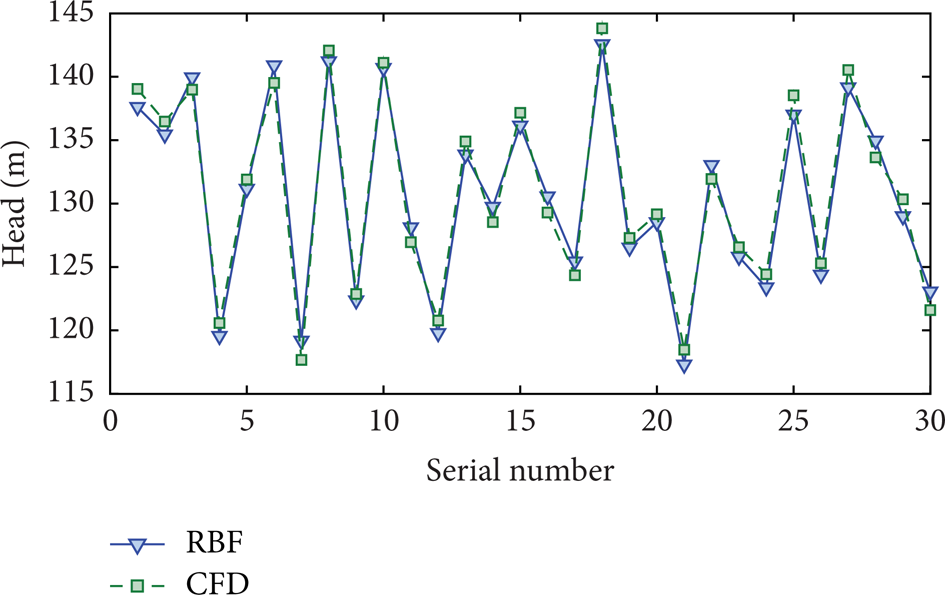
The results of pump head at test points.

The results of efficiency at test points.
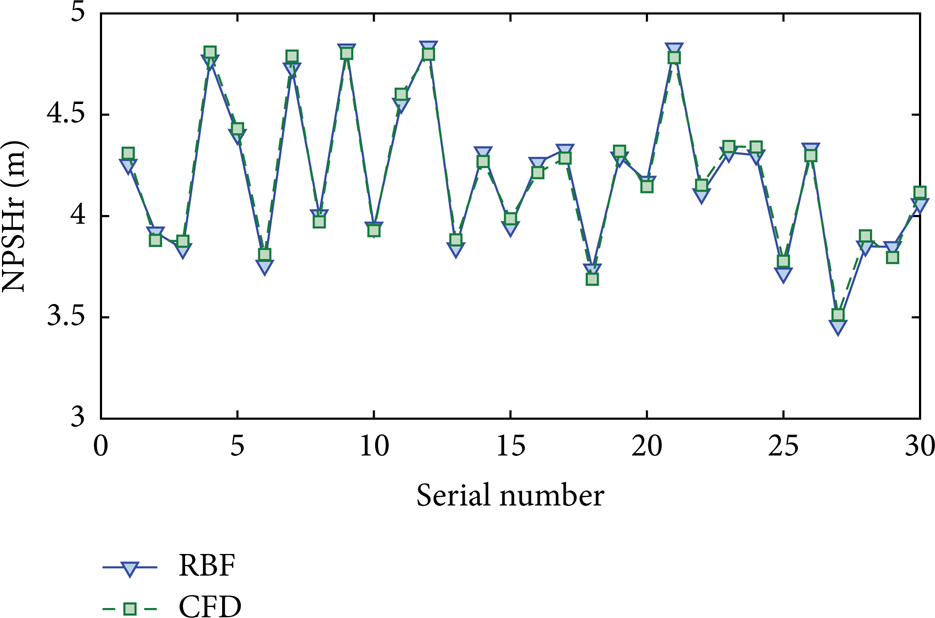
The results of NPSHr at test points.
5. Multiobjective Optimization and Design of Centrifugal Pump
5.1. Problem Description
As aforementioned, the optimization design of double suction centrifugal pump is an MOO problem with more than two objectives, rather than a single objective optimization problem. This MOO problem can be described as follows:
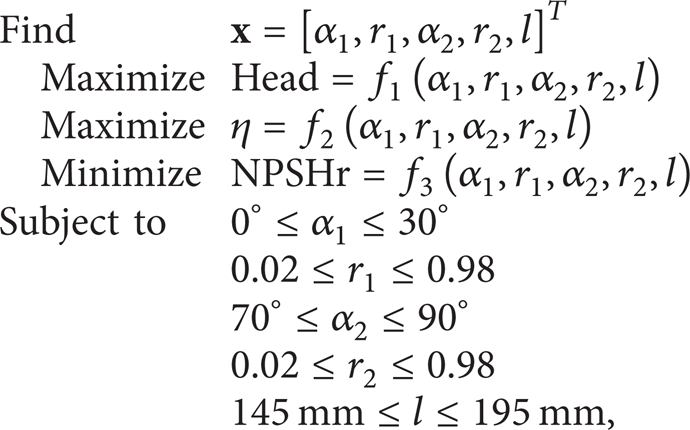
where f1, f2, and f3 are the RBF approximation of head, efficiency η, and NPSHr, respectively.
MOEA/D algorithm is employed to solve the MOO problem. Parameters of the MOEA/D algorithm are set as follows: SBX and polynomial mutation are used as operators for crossover and mutation, respectively, and the distribution indexes for both operators are κ c = 20 and κ m = 20, respectively; the crossover probability is set as 0.9 and the mutation probability as 1/n, where n is the number of decision variables; the weight vectors consist of 100 uniformly distributed vectors; T is set as 25, which is the number of the weight vectors in the neighborhood of each weight vector. The MOEA/D algorithm runs with the population size of 150 and the maximum generation number of 300. In order to provide results with statistical confidence, the MOEA/D algorithm runs 30 times independently for the problem.
5.2. Optimization Results
Figure 8 shows the Pareto optimal front of the three objectives: head, efficiency, and NPSHr, among which head and efficiency are required to be maximized in order to improve the economic benefits while NPSHr should be minimized for the sake of enhancing cavitation resistance. Both Figures 8(a) and 8(b) present multilinearity more or less, while Figure 8(c) exhibits nonlinearity. In addition, some objectives in this triobjective optimization problem conflict with each other. As shown in Figures 8(a) and 8(c), when a beneficial choice leans to one objective, the others will go worse, and vice versa. These nondominated optimal points obviously present tradeoffs between the objective function efficiency and head, as well as NPSHr and efficiency.
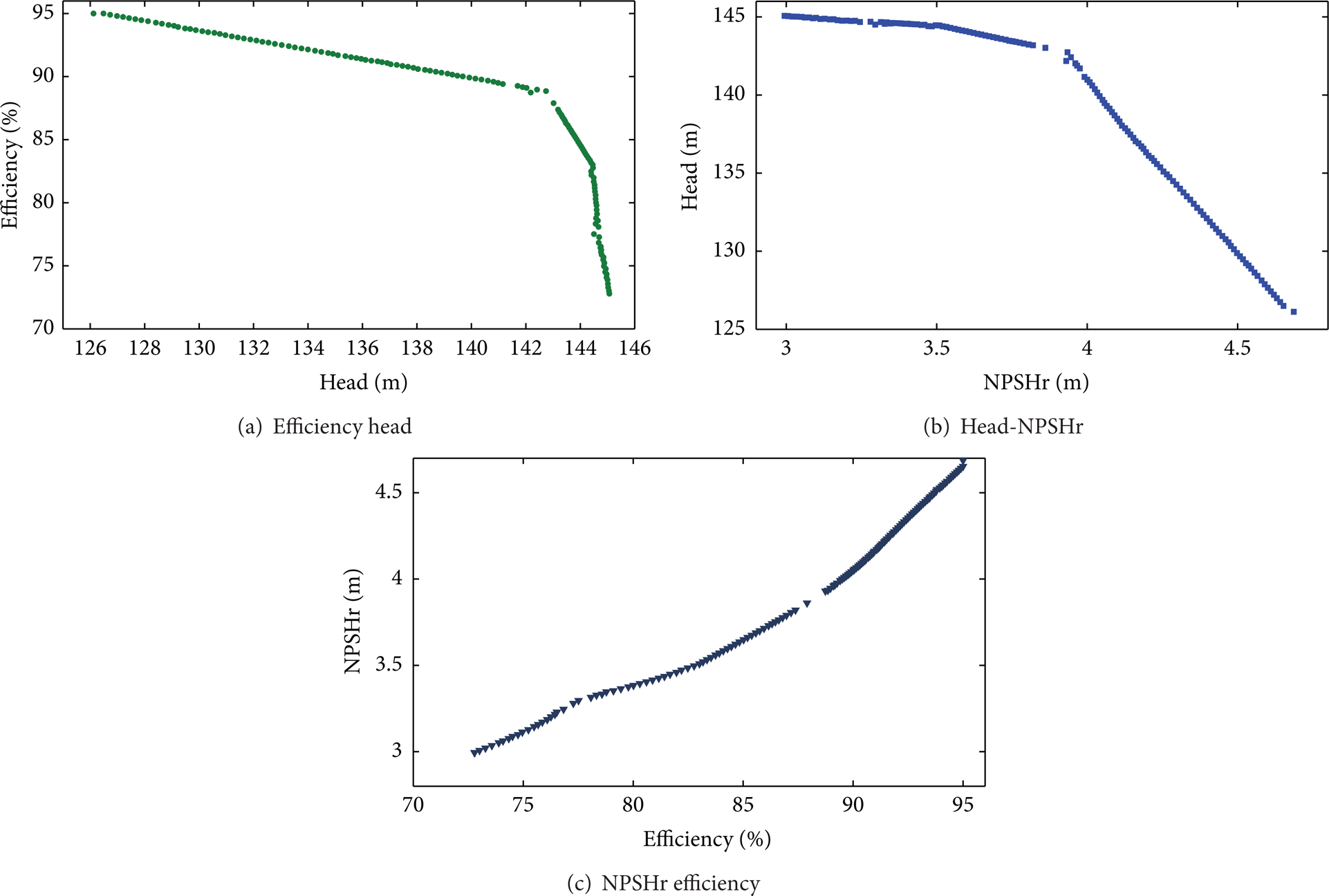
Pareto fronts for the triobjective optimization problem.
For a centrifugal pump designer, each point in the Pareto optimal set is a feasible choice. As a matter of fact, it is impossible and not realistic to select all of the Pareto optimal solutions as the design schemes, especially for the practical engineering problem. Instead, a tradeoff point should be chosen among the Pareto optimal solutions as the final pump design point. However, the variation of design parameters is inevitable in the practical manufacturing process of centrifugal pumps, which can influence the characteristic parameters of centrifugal pumps. Thus, the final pump design point obtained by traditional methods cannot smoothly settle this problem.
In order to overcome the defect of the traditional methods and to guide the tradeoff selection, a robust design method based on Monte Carlo simulation is developed to determine the best point. By evaluating a set of random design alternatives, Monte Carlo simulation can obtain the stochastic characteristics of an objective variable, including the mean value and variance. Besides, robust design can be used to improve the quality and reliability by reducing the functional variation of a system without removing the causes of variation [25]. More details of robust design can be found in the literature [26]. The formulation for implementing the proposed method is given as follows:
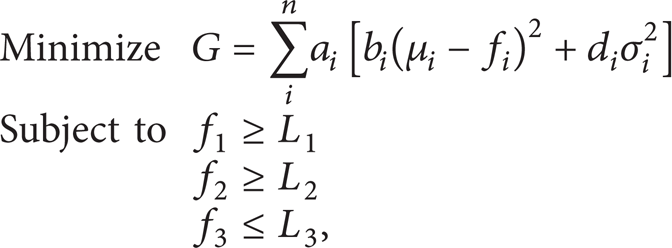
where μ
i
and σ
i
2 are the mean values and variance of fi in each point of the Pareto optimal solutions, respectively, and L1, L2, and L3 are initial values of f1, f2, and f3, respectively. In order to obtain μ
i
and σ
i
2 of fi in each point of the Pareto optimal front, the decision variables α1, r1, α2, r2, and l are assumed to obey normal distribution and Monte Carlo method is carried out with 1000 simulations. Exemplifying by point
The tradeoff optimal point is the point that makes the value of index function F minimum, which indicates the lowest functional variation that can guarantee the robust of the selected point. Table 5 lists the values of decision variables at the optimal point and summarizes the rate of change between the robust results and the nondominated points with highest head and best efficiency, but smallest NPSHr. The results indicate that the change rate of NPSHr is larger than that of head and efficiency.
Results of optimization.

Figure 9 shows the optimized impeller and a common impeller, which are both from the Pareto solution set. It is clear that the impeller configurations are different and that the optimized impeller has a better comprehensive performance owing to the robust design.
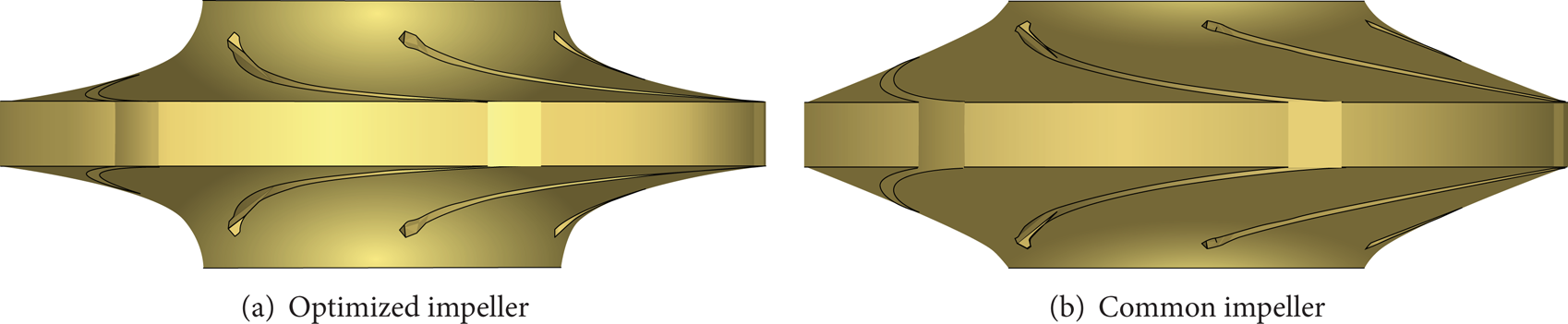
The optimized impeller and common impeller.
5.3. Verification of Prototype Test
Prototype test plays an indispensable role in the design of centrifugal pump. However, both prototype pump and experiment equipment are expensive. Hence, it is essential to develop centrifugal pumps with best comprehensive performance at a minimum cost. Figure 10 shows the prototype of centrifugal pump corresponding to the tradeoff point, and Figure 11 shows the schematic layout of the prototype pump test. As shown in the Figures, the prototype pump is fixed on the test bench, and the electric machinery drives the impeller rotating continuously. The water in the test pool is transferred from the suction inlet to discharge outlet circularly, and the basic test parameters are kept the same with those of CFD simulation in Table 2.
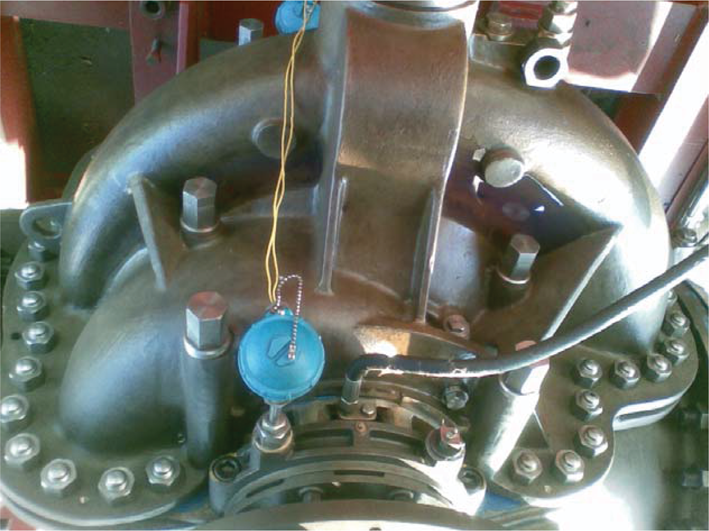
The prototype of centrifugal pump corresponding to the tradeoff point.

Schematic layout of the prototype pump test.
Table 6 shows the CFD simulation, RBF predictor, and test values at the tradeoff optimal point, which indicates that the values at the tradeoff point obtained by the CFD simulation, RBF metamodels, and experimental test agree with each other well. The decision variables of the optimized pump can be obtained only by one experiment test. Considering the expensive cost (time and money) of preparing the prototype pump and experiment equipment, the proposed optimization design method in this paper can reduce the consumption to minimum.
Results of CFD simulation, RBF predictor, and test experiment.

6. Conclusions
This paper presented a new optimization design method for double suction centrifugal pump, and it was proved to be effective on improving pump performance at a minimum cost.
The RBF metamodels of pump performance indexes were established, and the Pareto optimal solutions were obtained using MOEA/D, which revealed the conflict among the objective functions of head, efficiency, and NPSHr.
The RBF metamodels agreed with the CFD numerical simulation well at the test points, and the CFD simulation results showed the significant influence of decision variables on the behavior of centrifugal pump.
A tradeoff point was selected from the Pareto optimal set using a robust design method based on Monte Carlo simulation, and the prototype pump was produced according to a set of decision variables provided by the tradeoff point. Based on the prototype pump, the results of CFD simulation and RBF predictor were in accord with those of experiment test.
Footnotes
Nomenclature
Conflict of Interests
The authors declare that there is no conflict of interests regarding the publication of this paper.
Acknowledgment
This research was supported by the National Natural Science Foundation of China (no. 11172108). This financial support is gratefully acknowledged.