




Abstract
Wireless sensor networks have grown rapidly with the innovation in Information Technology. Sensor nodes are distributed and deployed over the area for gathering requisite information. Sensor nodes possess a negative characteristic of limited energy which pulls back the network from exploiting its peak capabilities. Hence, it is necessary to gather and transfer the information in an optimized way which reduces the energy dissipation. Ant Colony Optimization (ACO) is being widely used in optimizing the network routing protocols. Ant Based Routing can play a significant role in the enhancement of network life time. In this paper, Intercluster Ant Colony Optimization algorithm (IC-ACO) has been proposed that relies upon ACO algorithm for routing of data packets in the network and an attempt has been made to minimize the efforts wasted in transferring the redundant data sent by the sensors which lie in the close proximity of each other in a densely deployed network. The IC-ACO algorithm was studied by simulation for various network scenarios. The results depict the lead of IC-ACO as compared to LEACH protocol by indicating higher energy efficiency, prolonged network lifetime, enhanced stability period, and the elevated amount of data packets in a densely deployed wireless sensor network.
1. Introduction
A WSN (wireless sensor network) consists of 100–1000 small battery operated, self-organizing, localized decision making, self-coordinating wireless sensors spread throughout the area [1]. These sensor nodes have various negative characteristics such as limited energy, limited analytical and computational ability, and limited memory storage. These devices also have low data rate as well as short range for wireless radio transmission. These sensor nodes are composed of motes or sensors, transceiver, battery, and the processor for performing local processing. The processor converts the analog information which is sensed by the sensors about their environment in which they are deployed in to digital format [2]. These wireless sensors can also perform simple calculations and communicate locally over a small area. They have multiple applications in detecting volcanic eruptions, military, monitoring medical condition of patients, vehicle tracking, and so on. But typically, they are designed to collect and report data to the base stations [2]. Although WSNs have various applications in different domains, they have several limitations such as limited energy and limited computation and communication abilities as already discussed [1]. In sensor networks, minimization of energy consumption is considered to be a major performance criterion, in order to provide maximum network lifetime.
ACO (Ant Colony Optimization). Routing is categorized to be a combinatorial optimization problem in finding the shortest path from source to the destination [3]. From millions of years of survival, ants use stigmergy in successfully detecting the shortest path between the nest and the food sources [4]. Ant Colony Optimization (ACO), a Swarm Intelligence based optimization technique, is inspired from the ant behavior. An ant secretes a volatile chemical substance called pheromone which helps to converge over the shortest path among multiple paths. While moving, ants secrete pheromone over the ground and follow the path with maximum pheromone concentration. This mechanism has been proved to be an optimum way to mark paths which guide other ants and generate optimum paths from the overall behavior of the ant colony [5]. This behavior of ants has been successfully mapped in electronic devices for solving various combinatorial problems. It includes asynchronous agents or ants that produce partial solutions of the problem while traversing through different phases of the problem. While traversing, these agents follow a greedy local decision policy which rely over two parameters, namely, attractiveness and trail information. Each ant while traversing through different phases of the problem incrementally produces partial solution to the problem. Search of the future ants are directed by the trail value which is updated by the ants which earlier traversed through the same path [6].
In this paper an approach Intercluster Ant Colony Optimization algorithm (IC-ACO) has been proposed that backs upon ACO algorithm for routing of data packets in wireless sensor networks. Performance of IC-ACO is significantly improved as compared to LEACH protocol in terms of higher energy efficiency, prolonged network lifetime, enhanced stability period, and the higher amount of data packets transmitted to base station in a densely deployed wireless sensor network.
In Section 2 we have mentioned various research and algorithms related to ant colony optimization. Section 3 describes the radio model used for the proposed algorithm. Section 4 describes the proposed algorithm IC-ACO (Intercluster Ant Colony Optimization). Further Section 5 portrays the simulation results. Finally Section 6 concludes the research and states the future work that can be carried out over the proposed algorithm.
2. Related Work
ACO (Ant Colony Optimization). Asynchronous agents or ants are constantly released from different nodes to produce partial solution to the problem while traversing through different phases of the problem. While traversing, these agents follow a greedy local decision policy which rely over two parameters, namely, attractiveness and trail information [7]. Each ant while traversing through different phases of the problem incrementally produces a partial solution to the problem. Search of the future ants are directed by the trail value which is updated by the ants which earlier traversed through the same path [8]. Furthermore, an ACO algorithm involves two mechanisms which enhance the capabilities of the algorithm which are trail evaporation and daemon actions. Trail evaporation decreases the trail values over time to abstain unlimited accumulation of trail over a specific component [6]. Daemon actions are used to implement the centralized actions or the actions which cannot be performed by a single ant, such as update of global information. As Energy is proved to be a major shortcoming in WSN, ACO provides us a minimum cost path in terms of energy.
2.1. Basic Ant Based Routing (BABR)
The ACO has been successfully applied to various combinatorial optimisation problems [9]. The ant based approach has been successfully applied in wireless sensor network. A basic based algorithm can be described as follows.
A forward ant is launched at regular intervals from each network node with an aim to find the optimum path from the node to the destination at regular intervals. Each forward ant tries to position the destination with equal probability by using neighboring nodes with minimum cost joining its source and sink. Each agent moves step-by-step towards its destination node. At each intermediate node a greedy stochastic policy is applied to choose the next node to move to. During the movement, the agents collect information about the time length, the congestion status, and the node identifiers of the followed path. Once destination is reached, a backward ant is created which takes the same path as the forward ant, but in an opposite direction. During this backward travel, local models of the network status and the local routing table of each visited node are modified by the agents as a function of the path they followed and of its goodness. Once they have returned to their source node, the agents die.
2.2. LEACH Protocol
LEACH (Low-Energy Adaptive Clustering Hierarchy) employs the technique of random rotation of job of a cluster head among all the sensor nodes deployed in the network. The operation of LEACH is organized in rounds where each round consists of a setup phase and a transmission phase [10]. In the setup phase, the nodes classify themselves into clusters with one node selected as the cluster head in each cluster as shown in Figure 1. During the transmission phase, cluster heads collect data from the nodes within their respective clusters and they transfer the processed information to the base station. LEACH provides significant energy savings and prolonged network lifetime over fixed clustering and other conventional algorithms [10]. Although LEACH protocol has been proved to provide good performance, it suffers from many drawbacks too, such as random selection of CH and not considering energy consumption, not suitable for large area, not suitable for densely deployed network nonuniform distribution of CHs.
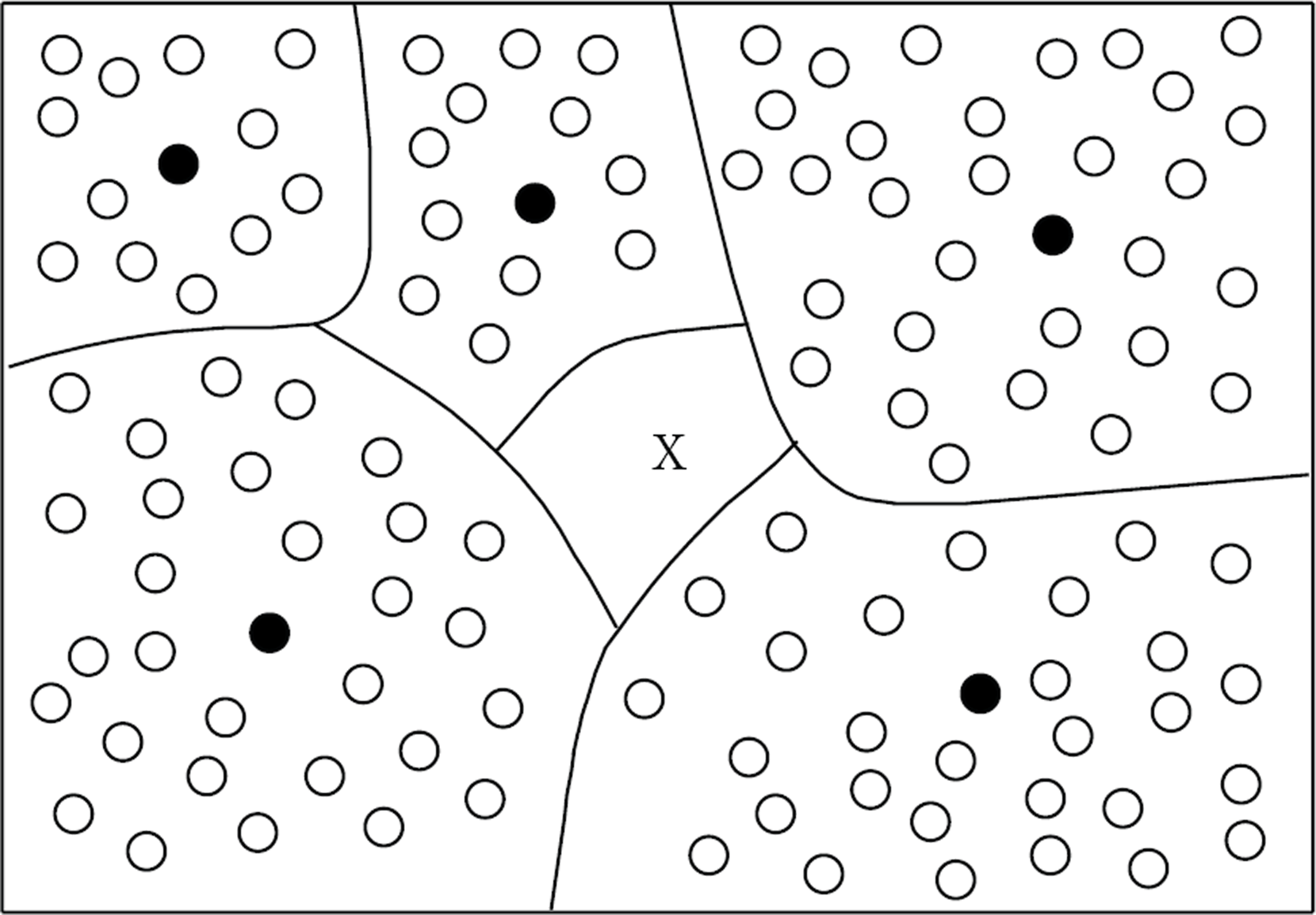
Cluster formation in LEACH.
2.3. Sensor Driven and Cost-Aware Ant Routing (SC)
SC [11] is based on the assumption that ants having sensors can smell the food and sense the most appropriate direction that the ant would precede initially. Also the estimated cost of path to destination from each neighboring node and their respective probability distribution is stored by each node. This algorithm might produce misleading solutions due to obstacle or loss of visibility of the node, which proves to be biggest disadvantage of this algorithm.
2.4. Flooded Forward Ant Routing (FF)
FF [11] is based on flooding of agents (ants) from the source node to the sink and strongly contends that even the ants equipped with sensors might get mislead due to loss of visibility of nodes or obstacles. There exists a situation when the destination is not known to the ants or the cost of the path cannot be estimated. In this situation a problem of wandering around the network to find the destination has occurred [5]. FF solves this problem by employing the broadcast method for routing the data packets over wireless sensor network. For this FF uses flooding of forward ants to the destination.
2.5. Flooded Piggyback Ant Routing (FP)
FP [11] defines a new type of ant called data ant which carries the forward list, whereas basic functioning of the forward ant is same as it was in FF [5]. FP minimizes the energy dissipation of the network while sending data packets to the destination by coupling data ant carrying the forward list to the forward flooding ant. Data ants perform the dual task of forwarding the data along with storing the node identity which come across the path to the destination which can be later used by the backward ants.
2.6. Energy Efficient Ant Based Routing (EEABR)
EEABR [12] is considered to be an improvised version of ant based routing. This algorithm considers the energy level along with distance while selecting the node over the path to be traversed. In the basic ant algorithm, the routing table of the nodes stored the identity of each neighboring node and their corresponding pheromone information, which require a large amount of memory in order to store this information. EEABR fixes this problem, by storing the information about only the last two nodes which significantly reduces the memory requirement [12]. This algorithm possesses a drawback of delay in packet delivery.
2.7. ACO-Based Quality-of-Service Routing (ACO-QoSR)
ACO-QoSR deals with the problem of limited energy and the delay requirements of the data packets [13]. This algorithm uses a threshold bounding parameters for both end to end delay and the energy. Whenever a sensor node has its data to be sent to the sink, it checks its routing table and if no such path exists, then the procedure for finding a new path is initiated [5]. For finding these new paths, forward ants are deployed which selects the next hop to traverse using a probabilistic approach.
This algorithm stores the heuristic information in the form of a ration of residual energy and the summation of residual energy of all the nodes.

2.8. Self-Organizing Data Gathering for Multisink Sensor Networks (SDG)
This protocol proposes an algorithm in which only backward ants are produced and that too by the sink. These ants update the pheromone information of each node using a pheromone value. When the backward ant reaches a node, then that node stores the pheromone value, generating sink ID and the neighboring nodes. The algorithm was able to achieve the reliability of 90% even in the presence of lossy channels. The main disadvantage of this algorithm is that significant amount of energy is wasted due to the packet exchange by hello ants and the proactive nature.
2.9. Many-to-One Improved Ant Routing (MO-IAR)
MO-IAR, a two-phase algorithm, was established by Ghasemaghaei et al. [17]. The first phase establishes the shortest path and the second phase provides the procedure for actual data routing. For minimizing the packet loss, proactive congestion control mechanism is adopted by the second phase. It is presumed that the neighboring nodes as well as the destination are already known to the sensor.
2.10. AntChain
AntChain, an efficient algorithm, is proposed by Ding and Xiaoping Liu, with an objective of energy optimization and minimizing the delay [5]. In AntChain, identities of the nodes along with their respective locations are known in advance. This information is used for efficient transmission of data. AntChain is proved to be a better algorithm in comparison to its counter parts LEACH [10] and PEGASIS [18] on the grounds of energy efficiency.
Table 1 shows the comparison of various routing protocols discussed above based on energy efficiency, data aggregation, location awareness, route selection, and either being query based or not [5].
Comparison of routing protocols in WSNs.

3. Radio Model
There has been a considerable amount of research in the field of radio and electronics in the last decade. In the proposed approach simple first order radio model proposed by Heinzelman et al. has been used, because it suits our purpose for the matter presented and is easier to simulate [10]. The model consists of transmitting and receiving electronics and a transmitting amplifier as shown in Figure 2.

Heinzelman first order radio model used for simulation.
Using the model described above, we find that to achieve a suitable SNR for transmission, the energy expended by the system is represented mathematically as

The free space model and the multipath fading channel model are used in the construction of the radio model [10]. When the distance between the transmitter and receiver is less than threshold value
4. IC-ACO (Intercluster Ant Colony Optimization Algorithm)
ACO algorithms have been devoted in solving various combinatorial and optimization problems effectively and efficiently [4]. Whenever a wireless sensor network protocol is designed, it is important to consider the energy efficiency and network lifetime of the underlying algorithm since these are the limitations of WSN. In this section proposed algorithm IC-ACO has been discussed, which is based on the Ant Colony Optimization heuristic and focuses on the primary WSN constraints. In IC-ACO, Ant Colony Optimization is applied within the cluster to transmit the data packets from the source node to the sink in densely deployed network. An effort has been made to minimize the redundant data transmission.
Section 4.1 summarizes the concept of basic ant based routing protocol for wireless sensor network. Section 4.2 describes the concept of proposed approach IC-ACO (Intercluster Ant Colony Optimization).
4.1. Basic Ant Based Routing for Wireless Sensor Network
Agents which are considered as ants are deployed by the source sensor node and these ants iteratively traverse through different phases of the solution and produce the partial solution to the problem. For traversing through these phases, these ants use the probabilistic approach for selection of particular route which in turn depends on the heuristic and the pheromone information (goodness of path). This process is repeated until the termination condition is achieved, that is, when whole network system die out. The flowchart for the generalized algorithm for the ACO approach is as shown in Figure 3.
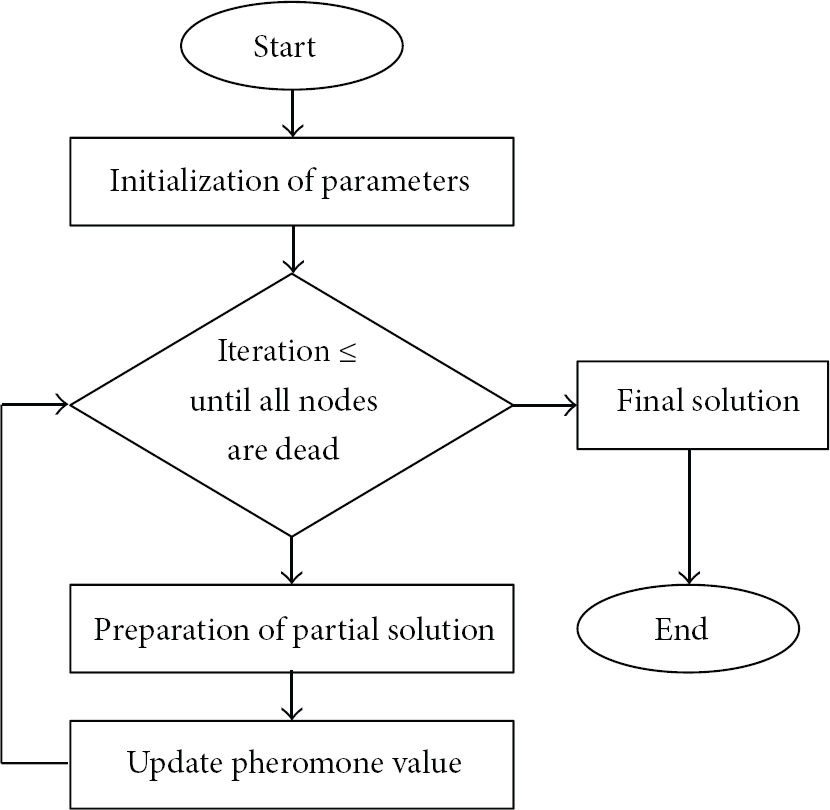
Flowchart of ACO (Ant Colony Optimization).
4.2. IC-ACO (Intercluster Ant Colony Optimization Algorithm) for Wireless Sensor Network
The flowchart of the proposed approach IC-ACO is shown in Figure 4. In this approach, LEACH algorithm is used as the basis for the randomized selection of cluster heads. The proposed approach works in two phases. In the first phase, the cluster heads have been selected and nodes classify themselves into clusters. In the second phase, minimization of redundant data transmission and routing of data based on ant colony optimization are performed with in the cluster. The following steps are repeated until all the nodes are dead in the sensor network.
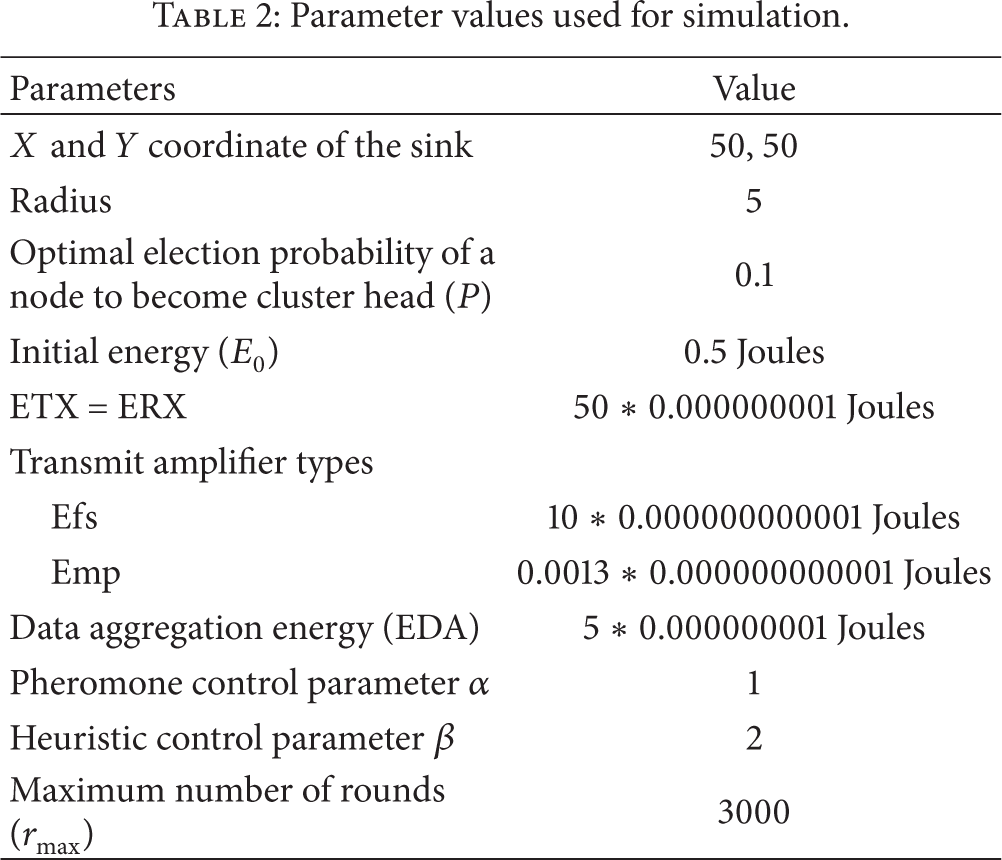
Selection of Cluster Heads. Clusters are built around the cluster heads which are randomly selected among the live sensor nodes. The selection procedure of cluster heads in this work is similar to LEACH protocol. Minimization of Redundancy. The nodes which lie in close proximity of each other are highly probable to send the redundant information; in order to save the energy wasted in sending this redundant information, a radius has been chosen experimentally. Five is chosen as the optimum radius in the experimental setup of (100*100) network. Out of the nodes which lie within the chosen radius, the node with the highest energy is selected for the transmission of data to the cluster head, provided the selected node is closer to cluster head than the base station. Remaining nodes within the radius will be in sleep mode in current round and they will not participate in transmission. If the selected node is closer to the base station, then it will not send data to the cluster head but it will participate with remaining nodes which do not lie within the radius for routing the data. The information received and processed by the cluster head is then transmitted to base station. Apply IC-ACO to Route the Data Packets within the Cluster. Within the cluster, the nodes which are neither in sleep mode nor selected for the transmission of sensed information to the base station will then initiate the routing task by transferring the sensed data to the different neighbor nodes. Each node then chooses its neighbor node. Optimum paths towards the base station are formed by the agents (ants) to achieve the efficient routing. This routing algorithm follows the probabilistic approach for constructing the solution, that is, selection of suitable path for transmission towards the base station. In this routing approach, the probabilistic selection is based on pheromone and heuristic information, which is updated continuously. While performing this operation of routing based on these two pieces of information, ants choose their optimal path towards the base station. The constructing solution for this operation is explained in Section 4.3.

Flowchart of proposed algorithm (Intercluster ACO).
4.3. Constructing Solution for IC-ACO (Intercluster Ant Colony Optimization)
An ACO algorithm is an artificial intelligence technique based on the pheromone-laying behavior of ants [7]. In AS (ant system), ants start from a source node and move through neighbor nodes and reach a final destination node (base station), when the data packets need to be sent by the source nodes launching of ant will be performed. After launching of ant, probability of each adjacent node for the selection of next hop is calculated using pheromone value of the path between nodes and the heuristic value of these nodes [19]. Each ant tries to find the optimum path on the basis of heuristic value that results in minimum cost in terms of energy dissipation. In IC-ACO, only the nodes that lie outside the radius participate in sending information directly to base station. Equation (3) given below calculates the probability that is used for calculation of optimum path between node i and node j. In the proposed approach, the ants check the probability of their adjacent node for being selected as next hop for data transmission to sink;


The α and β are two parameters that control the relative weight of the pheromone trail and heuristic value.
One has

Each node selects the next adjacent node with the maximum probability for the optimum path for sending the sensed information to the sink or base station.
Algorithm 1 represents the steps to be followed for the implementation of proposed approach (IC-ACO) for finding the shortest path to the destination or base station.
(1) Initialize all the parameters. (2) Repeat Steps 3 to 13 while the network is alive. (3) Repeat Step 3 for each node in the system. (4) If (Node.energy < 0) Set Node.status = dead Else Set Node.status = alive return (5) Randomly select cluster head nodes with Node. Status = alive and repeat Step 6 for each selected node. (6) Set CH (7) Make clusters around these selected cluster head nodes by assigning nodes to a cluster with minimum distance. (8) Repeat Steps 8 to 12 for each cluster. (9) Repeat Steps 9 to 12 for each node lying within the cluster. (10) If (distance of the node from other nodes < radius) (11) If (distance of node to base station > distance of node to cluster head) (Node Send the data packet from node to cluster head. else Set (Node (12) If (distance of the node from other node > radius) Apply ACO in routing the data packet to the base station from the nodes. (13) Send the data packet received by the cluster head to the base station. (14) return
Algorithm 1
5. Simulation Results
In simulation performance of LEACH algorithm is compared with the proposed algorithm. These sensor nodes may be distributed randomly in 100*100 square. All the nodes have same transmission range. The sink node, that is, base station, lies at the center of this square area (50, 50). The nodes have their horizontal and vertical coordinates located between 0 and maximum value of the dimension which is 100. Simulation results depict that IC-ACO has more stability period than LEACH protocol and higher energy efficiency in dense environment than the existing LEACH protocol. In Leach when the number of nodes increases from 100 to 200 or 300, the performance of LEACH protocol decreases while the performance of IC-ACO either increases or remains stable.
These two algorithms are compared on the basis of following parameters:
Stability period: stability period is the time interval from the start of network operation until the death of the first sensor node; we also refer to this period as “stable region”; network lifetime: network lifetime is the time interval from the start of operation (of the sensor network) until the death of the last alive node; total number of packets transmitted to the base station at different rounds of iterations.
5.1. Network Simulation Parameters
For simulation 100, 200, and 300 nodes are deployed within a region of 100*100. Table 2 shows the various parameter values used for simulation.
Parameter values used for simulation.
Figures 5, 6, and 7 show the improvement in the stability period and enhanced network life time of the proposed algorithm in comparison to the existing LEACH algorithm. There is significant improvement in stable period and network life time. Table 3 shows values of FND (first node dead) of respective algorithms when the numbers of nodes are 100, 200, and 300. Figures 8, 9, and 10 depict the comparison on the basis of total energy remaining within the system and the total number of rounds. It is clearly seen that the proposed algorithm has higher energy efficiency as compared to the LEACH algorithm. Figures 11, 12, and 13 show the information received by the base station and it is clear from these figures that total number of packets received by the base station in case of proposed algorithm is much greater than the existing LEACH algorithm.
Number of nodes at which first node dies for LEACH and IC-ACO (stability period).

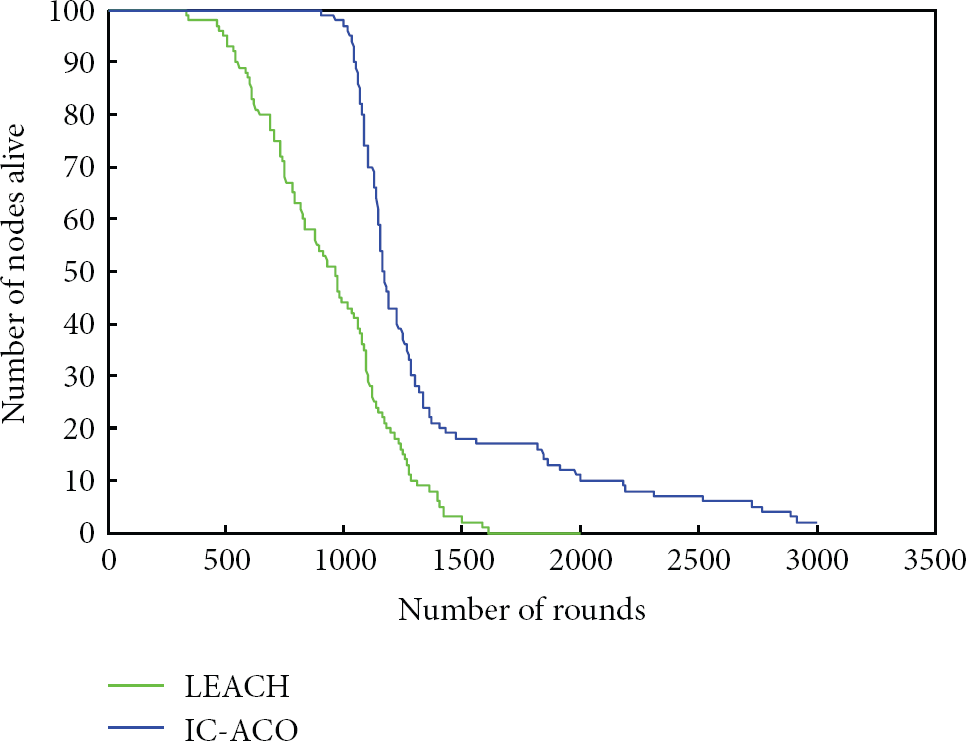
Total number of nodes alive within the system at different rounds of iterations (number of nodes is 100).

Total number of nodes alive within the system at different rounds of iterations (number of nodes is 200).

Total number of nodes alive within the system at different rounds of iterations (number of nodes is 300).
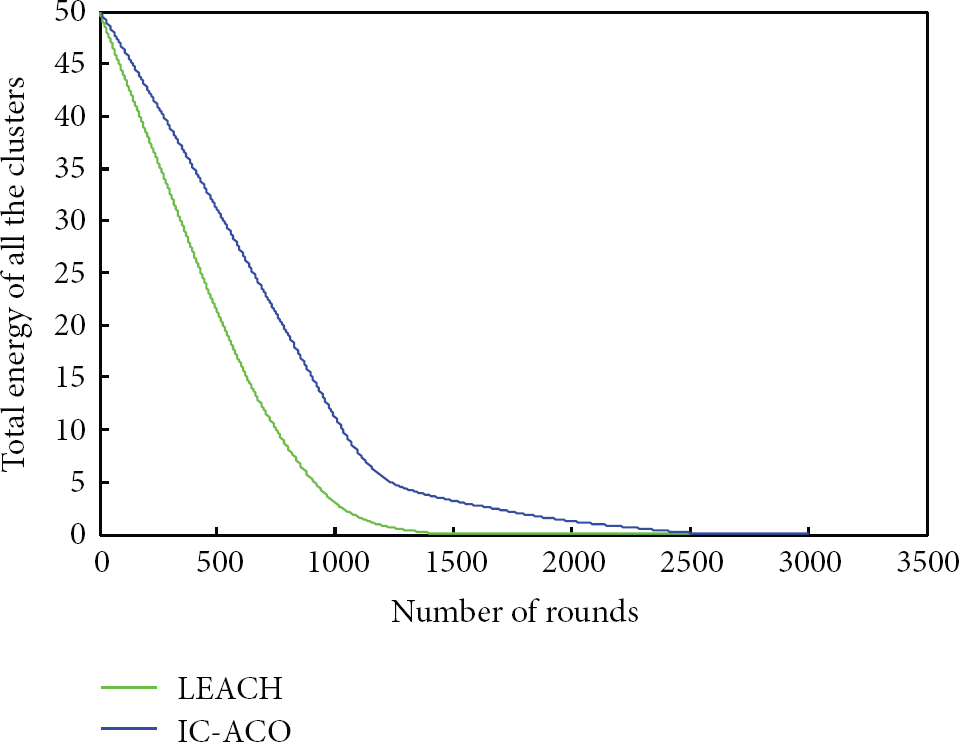
Total energy of the system at different rounds of iterations (number of nodes is 100).

Total energy of the system at different rounds of iterations (number of nodes is 200).

Total energy of the system at different rounds of iterations (number of nodes is 300).

Total number of packets transmitted to the base station at different rounds of iterations (number of nodes is 100).
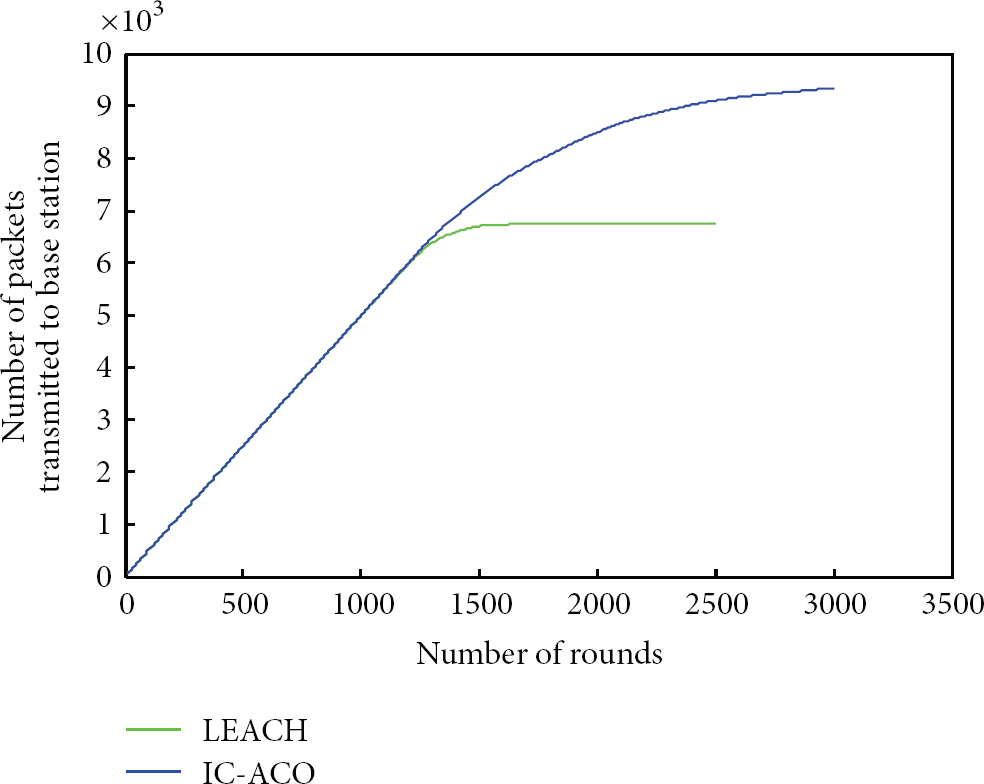
Total number of packets transmitted to the base station at different rounds of iterations (number of nodes is 200).

Total number of packets transmitted to the base station at different rounds of iterations (number of nodes is 300).
Figure 5 illustrates the total number of nodes alive over the time which indicates the lifetime of network when 100 sensor nodes are deployed in the network; the figure shows that IC-ACO performs much better than LEACH. First node is dead at 436 rounds in LEACH protocol and at 930 rounds in IC-ACO, which shows the significant improvement in the stability period.
Figure 6 depicts the total number of nodes alive over the time which indicates the lifetime of network when 200 sensor nodes are deployed in the network; the figure shows that the IC-ACO performs much better than LEACH in dense environment also. First node is dead at 222 rounds in LEACH protocol and at 948 rounds in IC-ACO which shows that the performance of LEACH protocol degrades in dense environment and there is significant improvement in the stability periodof IC-ACO algorithm.
Figure 7 shows the total number of nodes alive over the time which indicates the lifetime of network when 300 sensor nodes are deployed in the network; the figure illustrates that the IC-ACO performs much better than LEACH. First node is dead at 145 rounds in LEACH protocol and at 895 rounds in IC-ACO which shows that the performance of LEACH protocol degrades rapidly in dense environment or when the number of sensor nodes increased. It is clearly seen from the figure that the IC-ACO algorithm outperforms the existing LEACH protocol.
Figure 8 depicts the comparison on the basis of total energy remaining within the system and the total number of rounds and it is clearly seen that the proposed algorithm has higher energy efficiency as compared to the LEACH algorithm. The figure shows the total energy remaining within the system when 100 sensor nodes are deployed in the network considering all nodes have homogeneous initial energy 0.5 Joules.
Figure 9 depicts the comparison on the basis of total energy remaining within the system and the total number of rounds and it is clearly seen that the proposed algorithm has higher energy efficiency as compared to the LEACH algorithm. The figure shows the total energy remaining within the system when 200 sensor nodes are deployed in the network.
Figure 10 depicts the comparison on the basis of total energy remaining within the system and the total number of rounds and it is clearly seen that the proposed algorithm has higher energy efficiency as compared to the LEACH algorithm. The figure shows the total energy remaining within the system when 300 sensor nodes are deployed in the network.
Figure 11 shows that the information received by the base station when 100 wireless sensor nodes are deployed in the network. It is clearly visible that even if the redundant information has not been transmitted in IC-ACO approach, the total number of packets received by the base station is increased because IC-ACO has increased network life time compared to the existing LEACH protocol.
Figure 12 shows the information received by the base station when 200 wireless sensor nodes are deployed in the network. It is clearly seen that in IC-ACO approach, the total number of packets received by the base station is substantially increased compared to the existing LEACH protocol in densely deployed network.
Figure 13 shows the information received by the base station when 300 wireless sensor nodes are deployed in the network. It is clearly seen that in IC-ACO approach, the total number of packets received by the base station is increased compared to the existing LEACH protocol in dense environment also.
From the simulation, following results are obtained.
There is an improvement in stability period as compared to existing LEACH algorithm in dense environment. IC-ACO algorithm has higher energy efficiency as compared to existing LEACH algorithm. Information received by the base station has increased considerably in the IC-ACO algorithm.
6. Conclusion and Future Work
Finding optimal path in a dynamic changing environment of WSN is a challenging issue. The primary goal of the proposed work is to prolong the network life time in a dense environment, since in a densely deployed network, it is highly probable that the sensor nodes in close proximity transmit redundant data to the base station and energy is wasted. Thus the overall life time of the network gets reduced. In the proposed framework, the application of Ant Colony metaheuristic approach to identify the optimal path between a sensor node and the base station, in a densely deployed network, has been studied. The optimal path has been calculated based on pheromone concentration in homogeneous environment. The experimental results show that despite the extra overhead of selecting intermediate nodes, proposed algorithm is able to give better results in terms of elevated amount of packet transmitted, prolonged network lifetime, enhanced stability period, and higher energy efficiency in a densely deployed network. The proposed protocol was studied for several wireless sensor network scenarios by varying the number of nodes for a dense environment and the results clearly capture the prolonged network lifetime, improved energy efficiency, and higher number of packet transmission.
In this algorithm, cluster heads are selected randomly. In future work, cluster head selection mechanism can be applied along with ACO to get the optimal cluster head. In the proposed algorithm, the experiments have been carried out for the homogeneous environment; further result can be improved for the heterogeneous environment. In future various approaches such as integration of multiple sink nodes and mobility context of sensors in dense environment shall be studied, which are considered as a big challenge in wireless sensor network.
Footnotes
Conflict of Interests
The authors declare that there is no conflict of interests regarding the publication of this paper.