




Abstract
The force acting on hydrate particles is the critical factor to hydrate slurry stability which serves as fundamental basis for slurry flow assurance. A comprehensive analysis of forces acting on the hydrate particles was executed to determine the major agglomeration forces and separation forces, and comparison of forces reveals that the main agglomeration force is capillary force and the main separation force is shear force. Furthermore, four main influencing factors deciding the hydrate particle agglomeration were also analyzed and calculated, which shows contacting angle of capillary bridge is the most important factor for hydrate particles agglomeration, while interface tension of oil and water is the least important one. Some methods must be adopted to change the surface of hydrate agglomerates from hydrophile to lipophilicity so as to control the agglomeration of hydrate particle, which is the significant guarantee for safe flow of oil and gas transporting pipeline with hydrate particles.
1. Introduction
Rapid development of deep-sea oil and gas fields brings out the problem of hydrate plugging which is an increasingly severe problem for normal operation of oil pipeline. And the main methods for hydrate plugging prevention include thermodynamic inhibitors and kinetic inhibitors. However, the thermodynamic inhibitors have been proved to be environmentally harmful; thus a new method, cold flow technique, which concentrates on addition of antiagglomerants (AA) or kinetic inhibitors to assure the particles dispersed in continuous phase during flowing other than prevention of hydrate formation, is brought to light and shows great advantages. Forces acting on hydrate particles and agglomeration characteristic of hydrate particles which are crucial for the application of the new technique in engineering field should be studied thoroughly so as to offer instruction for hydrate slurry steady flow.
Based on literatures, force balance model based on hydrate agglomeration force analysis to predict critical agglomeration size has been studied [1–6], and Camargo and Palermo had put forward a force balance model for hydrate agglomerate [7], which was proposed based on force balance between agglomeration force and separation force of hydrate particles and combination with the porous characteristic of hydrate agglomerate, while the agglomeration force in the theoretical method is in need of further study and a popular way to determine value of forces was to measure adhesion force between hydrate particles by means of micromechanical force apparatus (MMF) [8–11]. However, relative researches are far from satisfaction; in this paper, agglomerating forces among hydrate particles influencing factors on agglomeration were analyzed and calculated so as to give some advice for controlling agglomeration and safeguarding the flow of oil and gas pipelines.
2. Main Forces on Hydrate Particles of Water-in-Oil System
Main forces on hydrate agglomeration in a flowing system include gravity, buoyancy, Van der Waals force, capillary bridge force, solid bridge force, collision force, and shear force. The forces may be divided into three different categories according to different roles played during agglomeration process [12]: agglomeration forces including Van der Waals force, capillary bridge force, solid bridge force, and electrostatic force, separation forces which include collision force and shear force, and forces that make hydrate agglomerate prone to spin: sliding friction, rolling friction, and so forth, which are not considered in this paper.
2.1. Van der Waals Force
The Van der Waals force between hydrate agglomerate 1 and agglomerate 1 is a basic agglomeration force and can be expressed as follows:

2.2. Capillary Bridge Force
A liquid bridge, which is stick to the surface of the agglomerates and attracts them with capillary action, can form and be shown in Figure 1 when two hydrate particles are close enough to each other for strongly hydrophilic characters on the hydrate particle surfaces. And capillary bridge force which changes the force character of hydrate agglomerate is generated and can be expressed as follows:


Outline of liquid bridge among hydrate particles.
2.3. Solid Bridge Force
Based on theory of hydrate particles contact-inducing agglomeration [16], water contacted with hydrate particles or agglomerates may form hydrates, which can lead to the formation of solid bridge from the liquid bridge and new bigger hydrate agglomerates. There is no well acknowledged formula for solid bridge force calculation, which is usually acquired by experiments. The agglomeration force is not considered in this paper and the formation of solid bridge means that agglomeration has occurred and the agglomerate size has increased. The size of new formed agglomerate instead of the old one should be applied for further calculation of other forces.
2.4. Electrostatic Force
The friction and collision among hydrate particles as well as the one between hydrate particles and pipeline wall surface generate electrostatic attraction on the surface of agglomerate; however, the existence of water, which works as electric conductor, diminishes the electrostatic force rapidly [17]; thus the contribution of electrostatic force on agglomeration process is ignored.
2.5. Collision Force
For a regular hard sphere collision, the collision force is the key factor to determine if agglomeration happened or not; however, for hydrate particles, the liquid bridge hinders the particle deformation and the collision force is no longer considered as an influencing factor of agglomeration process.
2.6. Shear Force
Shear force on the hydrate agglomerates is formed with the flow of the materials in the pipeline always to make the agglomerates flow homogeneously. And shear force is proportional to velocity gradient of fluid media around them:

2.7. Net Gravity Force
The net gravity forces of hydrate agglomerates are defined as the difference between gravity and buoyancy of the hydrate agglomerates and can lead to the deposition of the agglomerates and can be calculated as follows:

3. Determination of Main Agglomeration Force of Hydrate Agglomerate
3.1. Basic Parameters
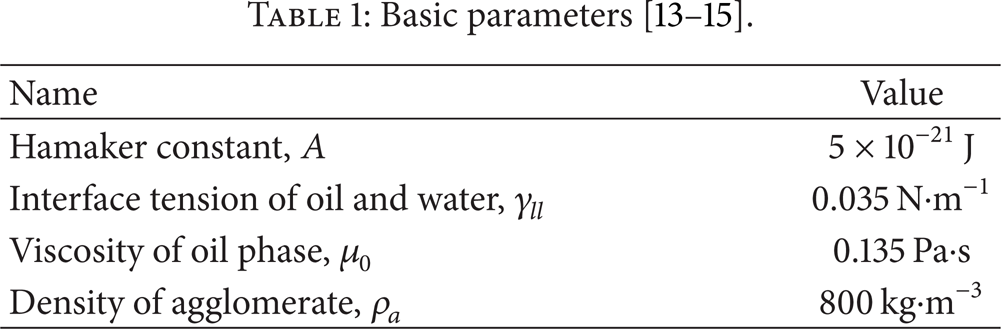
Some basic parameters used in calculating the agglomerate force of hydrate agglomerate are listed in Table 1.
3.2. Determination of Main Agglomerate Force of Hydrate Agglomerate
Calculation of hydrate agglomeration forces was carried out based on the previous force analysis, the results of which were shown in Figure 2. Conclusion can be drawn that the value of capillary bridge force is much larger than that of Van der Waals force and net gravity when the hydrate agglomerates have a size from several to several hundreds of micron; thus capillary force is selected as the main agglomeration force of hydrate agglomerate. On the other hand, the main separation force is shear force.

Forces between hydrate agglomerates.
4. Calculation and Verification of the Main Forces
From the previous force analysis of hydrate agglomerate, we reach a conclusion that the capillary bridge force is much larger than Van der Waals force, so the main agglomeration force of hydrate agglomerate in flowing system is capillary bridge force, and capillary force is used to take place of F a in the force balance model presented by Camargo and Palermo with a result as follows:

The d A in the formula actually represents the maximum critical agglomeration size dAmax . In the initial period, hydrate particles are formed and agglomerated with relative small diameters, and then agglomeration goes on with the agglomeration force on the agglomerates larger than separation force. However the agglomeration stops when the diameters of agglomerates reach dAmax . Calculation and verification of hydrate critical agglomeration size with Camargo model were carried out with experimental results from literature (for more details about the experiments, please refer to the literature [11]) and some parameters were decided as follows: fractal dimension f = 2.5, initial hydrate particle size d p = 1.5 μm, viscosity of oil phase μ0 = 60 cP, and hydrate volume fraction φ = 0.274.
Hydrate agglomerate size was calculated by hydrate slurry viscosity, and then agglomeration forces were achieved based on model equation and were shown in Table 2. At the same time, values of Van der Waals force and capillary force were calculated by corresponding calculation formula and listed in Table 2.
Agglomerating force calculated by model and the main forces.

From the calculation results above, a conclusion can be reached that the capillary force is much closer to agglomeration force with an order of 10−7 and more marked than Van der Waals force with an order of 10−9. So the capillary bridge force is consistent with calculated agglomeration force and can be used instead of the agglomerating forces among hydrate particles and agglomerates.
5. Factors Influencing Agglomeration of Hydrate Particles
The maximum critical agglomeration size dAmax , which can be calculated by the Camargo and Palermo model with capillary force taking place of F a and reflects the agglomerating level of hydrate particles, was used as an indicator to study the factors influencing agglomeration of hydrae particles in this paper. And four primary factors including contacting angle of capillary bridge, interface tension of oil and water, viscosity of oil, and shear rate of flow were selected to analyze their influences on hydrate particles.
5.1. Influence of Contacting Angle of Capillary Bridge on Agglomeration
Influence of contacting angle of capillary bridge on agglomeration is shown in Figure 3, which indicates that the maximum critical agglomeration size decreases with the increasing of contacting angle of capillary bridge. According to the discussion above, capillary bridge force is the main force deciding the hydrate agglomerates, while the capillary bridge force decreases with the increasing of contacting angles of capillary bridge. Moreover, the surface of hydrate agglomerates changes from hydrophile to lipophilicity with a contacting angle close to 90°, while in the lipophilicity system hydrate agglomerates are apt to spread around and are difficult to agglomerate, which shows that the surface hydrophilic of hydrate agglomerates is a prime factor for the agglomeration of hydrate particles.

Agglomeration size for different contact angles.
5.2. Influence of Interface Tension of Oil and Water on Agglomeration
Influence of interface tensions of oil and water on agglomeration is shown in Figure 4, which indicates that the maximum critical agglomeration size increases almost linearly with the increasing of interface tensions of oil and water. According to the discussion above, capillary bridge force is the main force deciding the hydrate agglomerates, while the capillary bridge force increases linearly with the increasing of interface tensions of oil and water.

Agglomeration size for different interfacial tensions.
5.3. Influence of Oil Viscosity on Agglomeration
Influence of oil viscosity on agglomeration is shown in Figure 5, which indicates that the maximum critical agglomeration size decreases with the increasing of oil viscosity. According to the discussion above, shear force is the main separating force among hydrate agglomerates, while shear force increases with the increasing of oil viscosity.
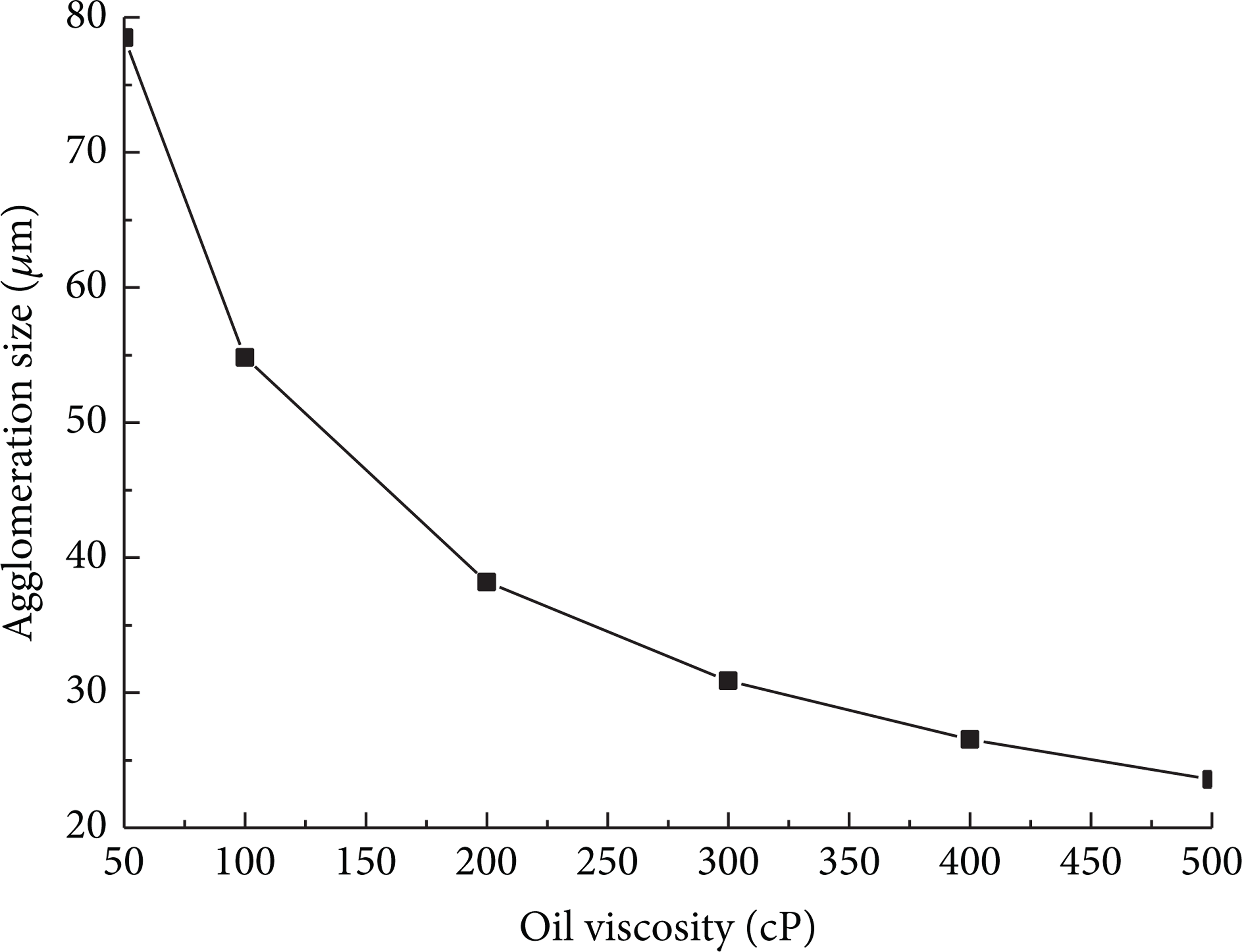
Agglomeration size for different oil viscosity.
5.4. Influence of Flow Shearing Rate on Agglomeration
Influence of flow shearing rate on agglomeration is shown in Figure 6, which indicates that the maximum critical agglomeration size decreases with the increasing of flow shearing rate. While all the hydrate agglomerates stop and deposit when the shear rate approaches zero, which means all the hydrates agglomerate to one with a very large size according to calculation, all the agglomerates deposit and form a stationary bed instead of forming one large agglomerate in this situation, which also means the calculation when the shear rate approaches zero will lead to authentic results. According to the discussion above, shear force is the main separating force among hydrate agglomerates, while shear force increases with the increasing of flow shearing rate.

Agglomeration size for different shear rates.
5.5. Orthogonal Testing of the Influencing Factors
Four factors discussed above are not isolated with their acting on hydrate agglomeration. Orthogonal testing analysis was used to study the importance of these factors in this paper, in which the maximum critical agglomeration size was used as the evaluating indicator and three levels were selected for each factor as listed in Table 3.
Level table for factors of hydrate particle agglomeration.

Based on the values in Table 3, extreme differences were calculated with orthogonal testing method and listed in Table 4, from which a conclusion can be achieved that contacting angle of capillary bridge is the most important factor for hydrate particles agglomeration, while interface tension of oil and water is the least important one. Some methods must be adopted to change the surface of hydrate agglomerates from hydrophile to lipophilicity so as to control the agglomeration of hydrate particle, which is the significant guarantee for safe flow of oil and gas transporting pipeline with hydrate particles.
Range analysis table for factors of hydrate particle agglomeration.

6. Conclusions
A comprehensive analysis of forces acting on the hydrate particles was executed to determine the major agglomeration force and separation forces, and then four main influencing factors deciding the hydrate particle agglomeration were also analyzed and calculated, based on which the following conclusions are drawn.
The main agglomeration forces among hydrate particles in a flowing system include capillary bridge force and Van der Waals force, while the main separation force is shear force. Comparison of forces reveals that the main agglomerate force is capillary force and the main separation force is shear force.
Capillary bridge force is consistent with calculated agglomeration force and can be used to decide the maximum critical agglomeration size among hydrate particles and agglomerates instead of the agglomerating forces.
Contacting angle of capillary bridge is the most important factor for hydrate particles agglomeration, while interface tension of oil and water is the least important one. Some methods must be adopted to change the surface of hydrate agglomerates from hydrophile to lipophilicity so as to control the agglomeration of hydrate particle.
Footnotes
Notation
Conflict of Interests
The authors declare that there is no conflict of interests regarding the publication of this paper.
Acknowledgments
This study benefits from financial support of National Natural Science Foundation of China (Grant no. 51006120) and Specialized Research Fund for the Doctoral Program of Higher Education (Grant no. 20110133110004).