




Abstract
This work presents finite element analysis (FEA) and results for rolling contact of a cylindrical roller on an elastic substrate coated by functionally graded material (FGM). The rolling process and the graded coating material property and layers arrangement are modeled using finite element codes which lead to a new methodology. This novel methodology provides a trend in determining surface contact stresses, deformations, contact zones, and energy dissipation through the contact area. Effects of stiffness ratio, friction, and exponentially variation of material property on the contact stresses and deformations are studied. Some of the results are verified with analytical solutions. The study results may be beneficial in graded coated cylindrical components analysis against rolling contact failure and wear.
1. Introduction
A medium subjected to rolling contact of hard materials can accumulate very high levels of strain near the contact surface. Contact stresses lead to surface material detachment which causes the components to lose their integrity and fails prematurely. Critical stresses and inappropriate material selection are some of the main causes of component failure in rolling/sliding contacts. In contrast, the surface coating and finishing have strong influence on the components life in contact situations.
Functionally graded materials (FGMs) are multiphase materials that pass smooth spatial variations in the volume fractions of the constituent phases. Using these materials as coating and interfacial zones, they tend to reduce stresses resulting from material property mismatch, increase the bonding strength, and improve the surface properties. While there are numbers of known applications of FGM such as thermal benefits which have been studied in the recent decade, there are also important potential applications of FGMs in the contact situations [1] when the components make some problems in contact [2]. Using these materials for coating of components in contact situations would increase the frictional capabilities of rolling contact against wear while the lubricants disadvantages are omitted. On the other hand, the industry demands new materials that can operate at higher stresses for automotive components, the engine cams, some gears and bearings. Thus, analysis of FGM coatings as new materials in rolling contact is highly urged by industry.
There are mostly load transfer problems in deformable and semirigid solids, generally in the presence of friction like bearings, gears, cams, and machine tools. Other applications of contact are as resistive components against wear like clutches and cylinder linings [2–4]. In both groups, the main objective is finding the effective parameters on stress distribution and singularities arising at the edges of the film or the stiffener solids.
Several studies have been carried out to explain the different factors to resist the failures such as elastoplastic stress and strain, material properties and surface roughness in rolling/sliding contact [5], and effects of nonzero coefficient of friction [6]. Furthermore, recent study of rolling contact problems [7] indicates that the peak of the contact pressure and the creepage significantly affect the wear rate of rolling components. A number of works have been carried out on the FGM coating properties and their influence on stresses but more study on coating performance in rolling contact is needed. One of the reasons for this weakness is the coating dependency on various properties of heterogeneous materials.
FE analysis of cylindrical components contact on thin films [8] was used and then the FE analysis of softening and stiffening graded coatings may improve the literature results. Other works investigated the influence of design parameters such as the type of deposition process, coating material, and mechanical properties on stress analysis [9, 10]. Other finite element based simulations are implemented to estimate the stress distribution in rolling contact [11] and the influence of geometrical variations while the wear rate on contact surface is important [12].
The technical literature on FGM contact problems is very extensive, but rolling contact on FGM coatings has not been dealt with adequately. Suresh and other researchers [13, 14] proposed computational and experimental results on the evolution of graded substrate contact stresses and deformation by spherical nonfrictional indentation.
The strength and local fracture toughness of the contact surface markedly deteriorates as a result of elastic modulus gradation. The elastic parameter of a graded medium changes exponentially in a plain strain crack/contact problem of a sliding punch [1]. Nonfrictional sliding contact with linear variation of inhomogeneity constant while FGM is simulated with few layers showed that maximum tensile plane stress in sliding stamp is on trailing edge [15, 16].
Sliding contact on graded coating in the presence of friction is studied in order to find critical stresses in inhomogeneity constants variation [4, 17]. Integral equations of contact problem have been solved [18, 19] to examine the positive influence of frictional contact constants. In a series of articles, models of finite element are proposed based on nonlinear behavior of materials and methods of simulation [20, 21]. FEM codes discretization approaches in the numerical analysis of functionally graded materials and some homogeneous parts with variations in mechanical properties [22–26].
FEM modeling of sliding contact on laterally graded substrates is investigated with exact verification by Dag et al. [27] and continued by Adibnazari et al. [28, 29] in micro- and macroscales for frictional sliding. The mathematical modeling of rolling contact problems leads to a system of two coupled Cauchy singular integral equations were done recent years by Guler et al. [3, 30, 31]. Franklin et al. [32] developed a computational modeling of wear analysis in rolling contact of ductile materials.
In all the studies mentioned in the foregoing paragraphs, some works have been carried out on sliding contact of FGM parts or coatings. Few papers have dealt with the rolling contact problem involved graded coatings. Therefore these few analytical and mathematical studies would need a complementary and novel finite element analysis which is absent in pervious works. Also the results and effects of some parameters are studied which have not been considered in analytical approaches. Contact mechanics approach which deals with the singular stress field at the free edge is the study method in the present paper. Pure rolling of two bodies with respect to their initial geometries and external loading makes the stresses variations and surface deformations.
The main objective of this paper is monitoring the changes of material properties and performance of coating with respect to stress analysis while a frictional rolling contact occurred on a flat graded coating. Finite element analysis in a general contact with variable contact length shows that the material property and variation rate of mechanical parameters have a strong effect on traction and contact stresses. In recent years the demands for improved life, reliability, and load bearing capacity of coatings in contact situations are increased; also the prevention of wear and rolling contact failures is becoming a considerable theme which this paper's results help.
2. Problem Definition
Surface stresses are the first and the most significant parameters in wear and contact failure analysis of a coated surface. Zum Gahr [33] has shown that the failures could be divided into many types (See Figure 1); the surface contact stresses are the most impressive factors in rolling contact problems. A rolling contact of a rigid cylinder and a homogenous elastic substrate with graded coating are shown in Figure 2. A cylindrical roller of radius R rolls on the FGM coating in the presence of two concentrated loads, P & Q. The thickness of FGM medium, h, is too much thinner than substrate dimensions, so it can be named as coating and this rolling problem may differ from rolling of normal graded parts. Cylinder rolls with constant velocity, V, in the negative x direction are shown in Figure 2. Pure rolling without sliding is supposed and no dynamic load or acceleration is considered.
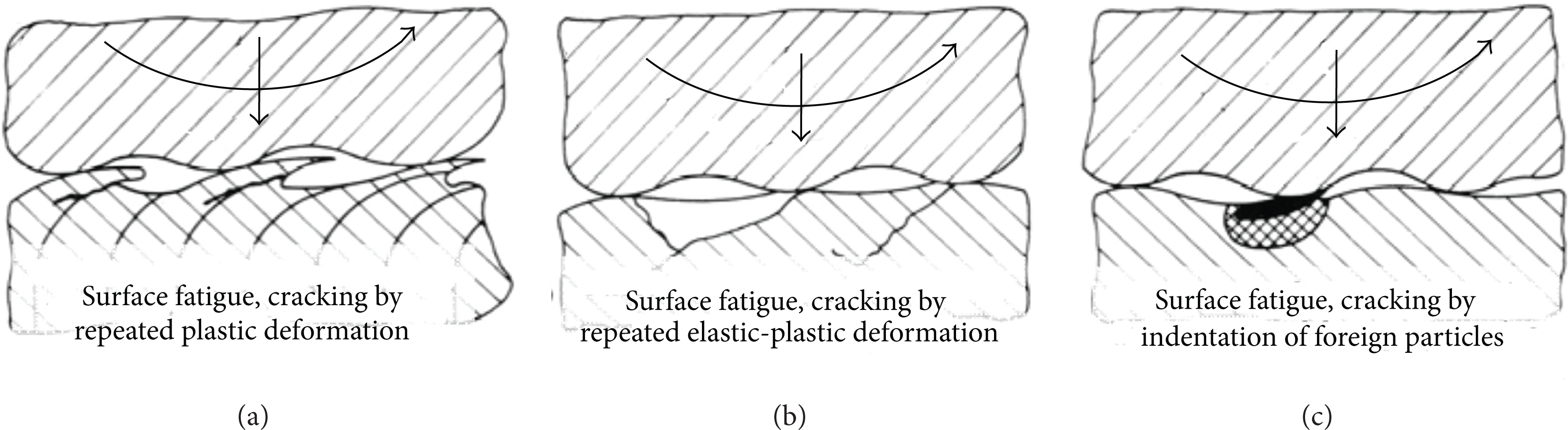
Wear mechanisms in a sliding/rolling contact situation [33].
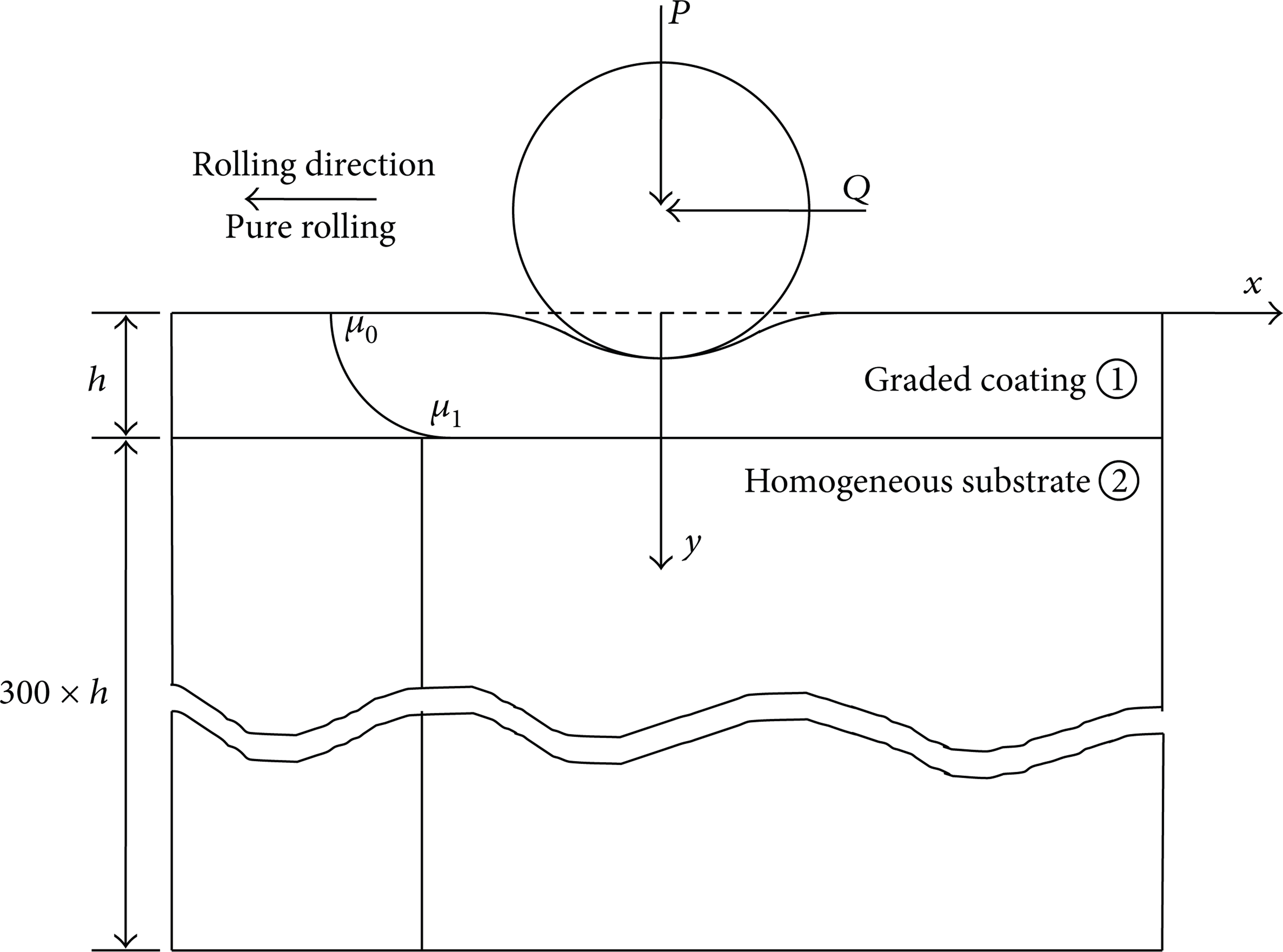
Rolling contact on a homogeneous substrate with FGM coating.
Generally the shear modulus and Poisson's ratio of the functionally graded coating may be described in an exponential format as (1). Poisson's ratios for both coating and substrate are constants with the same value, υ. The shear modulus of substrate is μ1 and the modulus in graded coating surface is μ0. Continuity in shear modulus of the graded coating and substrate may lead to decrease the mismatch between the coating and substrate which is critical in metallic and ceramic coatings failure. Consider

Γ is the stiffness ratio and can be defined as

where γ is inhomogeneity parameter and can be calculated by inserting μ1 value in exponential form of shear modulus variation. Γ has an important effect on stress variation in contact area, because this parameter can make FGM coating different from normal ceramic and metallic coatings (both stiffening and softening ratios).
Fundamental equations for 2D contact of homogeneous bodies would be extracted in elasticity theorems [34]. If two parts are in contact with external P (normal force) and Q (tangential force) loads, the integral equations can be written as


where h(x) and g(x) are normal and tangential overlaps of bodies, β, elasticity difference coefficient, A, composite compliance as follow:
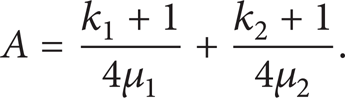
μ1 and μ2 are shear modulus of both parts, k i is Kolosov's constant. While equilibrium equations are satisfied, p(x) and q(x) are continuous functions of normal and tangential loads in contact area. Thus, P and Q are the summation of local contact forces as
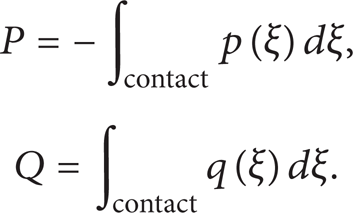
Previous relations (see (3a) and (3b)) are in coupled form which can be decoupled if both contact parts are the same material (β = 0). In present research, the equations cannot be decoupled unless using numerical methods in finite element codes. Goodman approximation would be used in some numerical methods with acceptable approximated results [3].
Related to mixed boundary-value contact problems, Guler and Erdogan [4, 19] found the following form of governing equations associated with the contact problem of a graded coating/substrate system:
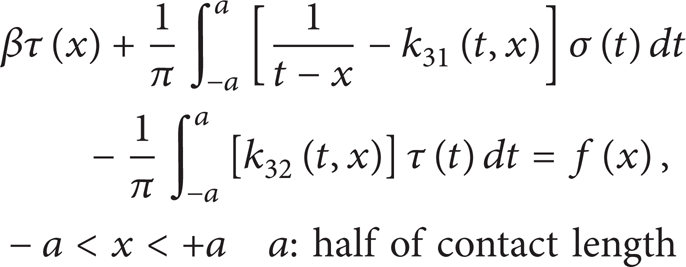
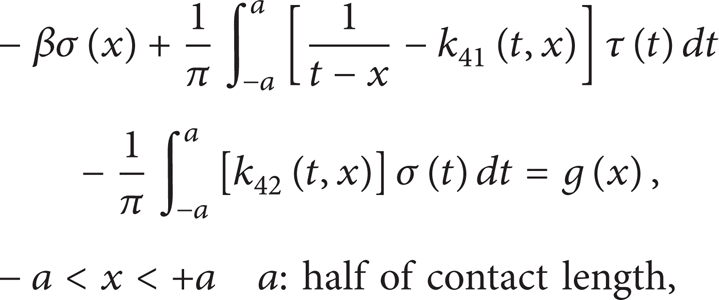
where the functions k ij (t, x), i = 3, 4; j = 1, 2 are the Fredholm kernels which be defined by Guler [35]; knowing u(x, y) and v(x, y) as displacement components inside the contact zone and k as Kolosov's constant and then the functions are described as follows:

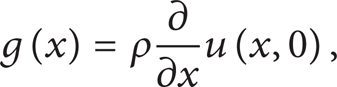
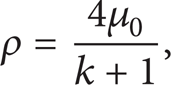

Comparing the sliding and rolling frictional contacts of solids on half-plane results to a braking momentum for rolling contact. This momentum is generated by F B which is against spin and rolling direction (See Figure 3). A frictional work or energy dissipation due to friction force is considered which is effective in wear rate of coating.
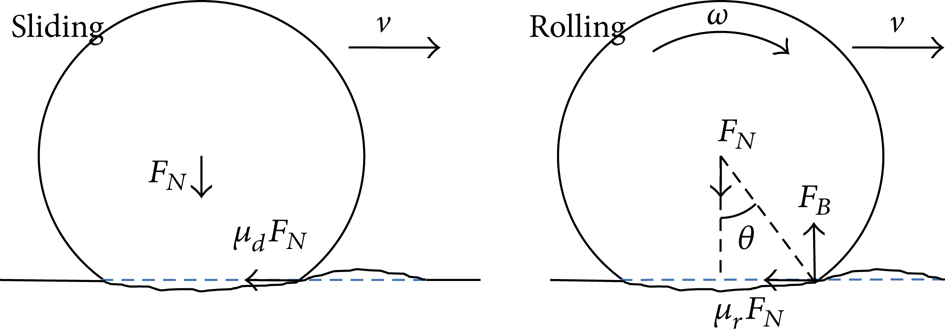
Comparing sliding and rolling frictional contact forces.
Kolosov's constant in a simplified 2D plain strain problem would be as

The substrate basement is fixed in all directions and roller moves in x-y coordinates. When a coating delaminates at the substrate interface, the failure occurs due to poor adhesive strength as a result of thermal and mechanical mismatch between the coating and substrate. This point is considered for graded coating while the continuity in stresses and deformations are as follows:
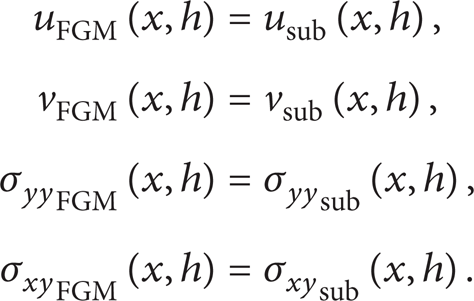
Usually the dimensions of half-planes are too much larger than other parts in models; so the elasticity theorem defines the approximate zero stresses far from the applied contact loads. Consider

Using finite element codes to simulate the frictional rolling on a coating renders the unknowns of the present problem such as tractions and stresses as well as influence of mechanical and geometrical parameters.
3. Finite Element Solution
Two special modeling of different meshing and elements with their own loading have been developed and modeling is verified by analytical results. The first is a 2D model which concentrates on FGM coating. Only the normal concentrated force, P, may be applied in a concurrent meshed FEM code to check the coating model shown in detail in Figure 4. The force makes a constant vertical deformation about 20% of coating thickness in elastic range of coating and substrate, the aim is only to find the number of layers. This model simulates a graded material with several layers of directional materials. The quantities of layers would be increased while the mechanical properties of coating make a no steady results in stress variations. The ratio of coating thickness to substrate is less than 1: 300. Also the half-plane width is more than 6 times of roller radius that makes steady state surface far from contact area.

Graded coating FEM modeling in several layers; material property varies in coating thickness in order to simulate homogenous and nonhomogenous coatings.
A supplementary finite element subroutine is written to apply the material properties and graded coating constants in modeling layers. In fact, the function of variation of shear modulus in an exponential format; also constant values of stiffness and Poisson ratio are defined in code and then number of layers and distribution of modulus in coating thickness is calculated by subroutine for convergence error of less than 0.1%. The code's output data are linked to first 2D contact model which was described in previous paragraph. The subroutine changes the number of layers while the convergence error of results in 2D model is more than desired value. This dual FEM code methodology helps us to model more loading and material conditions, for example, other functions of modulus variation or several stiffness ratios could be modeled.
The second finite element modeling aimed to simulate the rolling process. A long roller is used to simulate the contact and special attention is paid to the contact surfaces, where the roller would play the master rule and the coating and substrate are the slaves. A preferred global coordinate direction exists in the initial directions of x and y shown in Figure 2, and local coordinates are used for deformation of elements. Nonlinear quadrilateral elements are used, less than 2% of them are triangular related to nonlinear geometry. In addition, typical element formulation is based on the use of second order polynomial interpolation functions of the dependent variables, for example, displacements or stresses. This model uses R/h = 100 and L/R > 20 (L, length of both roller and half-plane). The roller/coating contact surfaces were modeled using surface-to-surface with respect to node place contact discretization and the Lagrange multiplier method was used for contact simulation. With this node to surface point discretization, the contact conditions are established such that each “slave” node on one side of a contact interface effectively interacts with a point of projection on the “master” surface on the opposite side of the contact interface. The Lagrange multiplier formulation adds more degrees of freedom to the model in order to guarantee nonpenetration between contact bodies [36].
Present FEM code solutions are based on infinitesimal strain theory which is due of constant loads in steady conditions of contact. Small deformations and controlled time periods are logical assumptions which are needed in contact of coatings and films. Boundary conditions are applied in the first steps and external loads are applied in next steps to simulate the exact contact and simply the equations solution.
It is necessary to use a mesh refinement in order to predict accurate stress distribution in highly stressed region through contact area (see Figure 5). The attention is on meshing size while it becomes smaller to give no variation in results by element size changes. The size variation of the elements from the center of roller to both sides of contact area is constructed in a special pattern to reduce the number of elements and computation time while highly accuracy is considered. No symmetry is seen in loading which makes the rolling movement to negative x direction, so the elements size and meshing are different in reference by roller center shown in Figure 5. Elements in right hand of roller are coarse while too much fine meshing with more accuracy is used in left hand, so the contact analysis and results are calculated in left half of coating where the meshing is uniform.

FEM model of roller on FGM coating before loading and rolling; different element shapes and meshing are shown related to rotation direction.
Coulomb friction and linear elasticity are considered. This friction law is held in contact area as penalty friction. This friction method permits some relative motion of the surfaces, an elastic slip and sticking zones. The FEM code continually adjusts the magnitude of the penalty constraint to enforce this condition. Moreover, it is supposed that the graded coating and the homogeneous substrate are perfectly bonded to each other.
In the finite element method, Abaqus 6.12-1 as a commercial finite element software which is linked with a manual FEM code in Matlab is used. As explained before, our subroutine code changes the material and mechanical properties and determines the variation of graded coating constants which are used in second FEM model as inputs. Variation of friction and material properties of surface layer in our subroutine leads to stress and material analysis of different coatings.
4. Results and Discussion
The present FEM modeling is validated in Figure 6 through direct comparisons with existing solutions of contact area and stress distributions in surface of graded coating under rolling condition. In Fact, some of our results can be verified by Guler et al. [3] in which the conventional Goodman approximation is employed to decouple the governing singular integral equations. The results are compared in two sections which are shown in Figure 6. First the normal stresses on contact surface are verified for sample loading and constant contact area (a/h = cte .) in two stiffness ratios. Also the relationship between vertical force and contact area length is verified for a stiffening (Γ > 1) graded coating. Comparing both sections simultaneously helps us to verify the reliability of FEM results such as stress analysis and force to material property ratio of contact area. These results verifications show that our finite element codes can model the material property and contact process in good agreement with the analytical solution. The maximum relative difference between these two results was about 10% at stress peak point and larger contact area length. Also the FEM code is tested on a simple rolling contact of 2D long roller on a homogenous nonfrictional half-plane as the initial checking of models. The contact length ratio, a/h, is constant in analytical solutions and therefore should be constant in verification of our results, but in fact our model considers a general form of contact with variable contact length which makes complementary results.
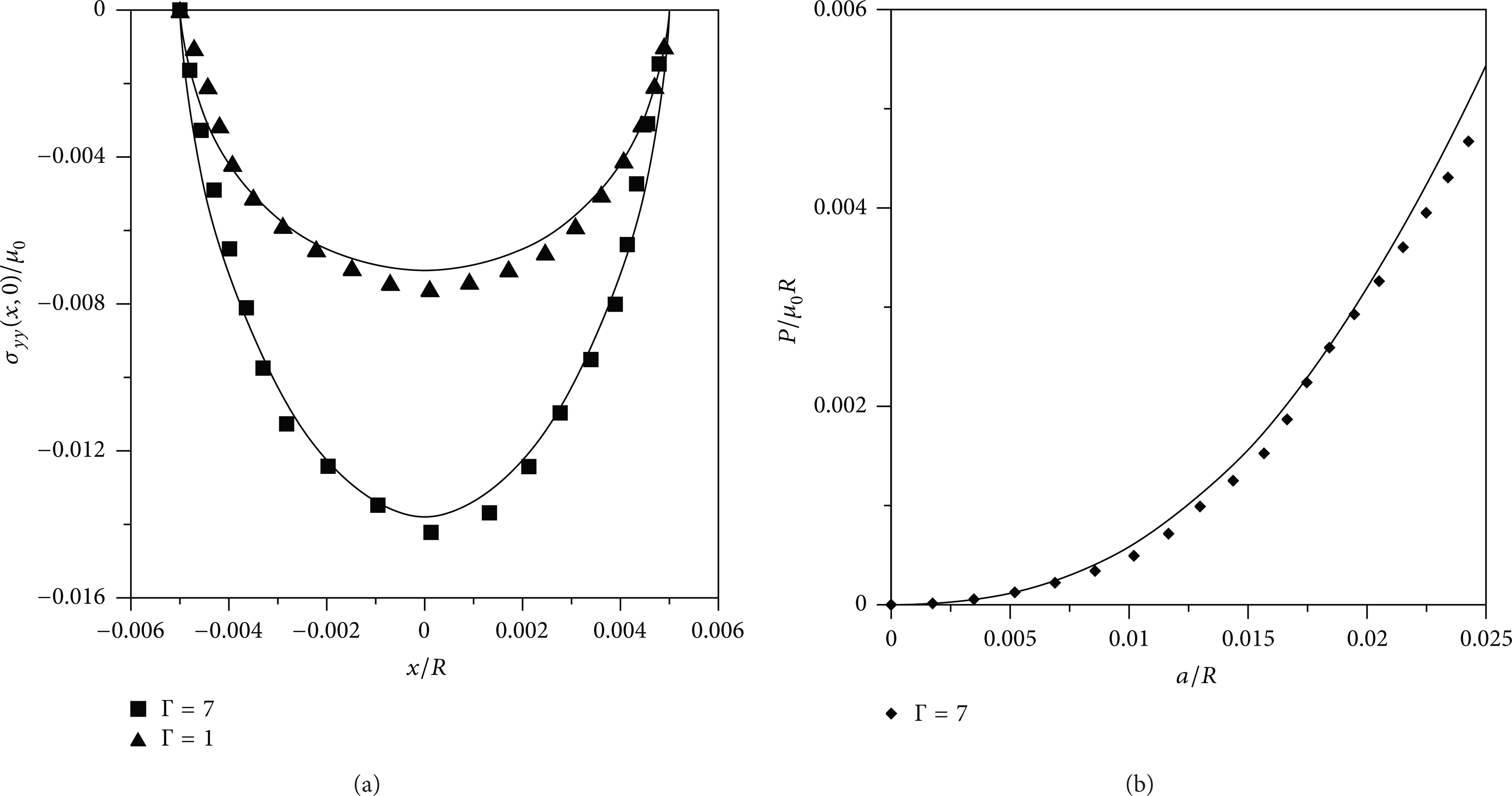
Verification of FEM results with analytical Guler et al. [3], solid curves present Guler results and symbols present proposed modeling (υ = 0.3, Q/ηP = − 0.75, β/η = − 1, a/h = 0.5).
4.1. FGM Coating Behavior
It has been proposed that if a rolling element is properly loaded, lubricated, installed, and kept free of foreign contaminants, then the main mode of failure is material surface failure which would be controlled by proper coatings, so the material modeling plays an important role in our analysis. The capability of the present finite element code in graded coating modeling is tested by simulating in several layers. The dimensionless results which are shown in Figure 7 compare the trend of stress variation by increasing the number of layers. Both normal contact and Von Misses stresses are decreased and converged to a constant value in contact zone. The error curve shows about 0.003% difference in stresses in comparison of 5 and 6 layers of graded coatings. Although the coating thickness is too much less than half-plane thickness, but using 6 layers in modeling the graded coating is adequate to have exact results. One innovation in this paper is modeling of FGM coating by two linked finite element codes which can design the material property and layers thickness to converge the solution in an implicit approach.
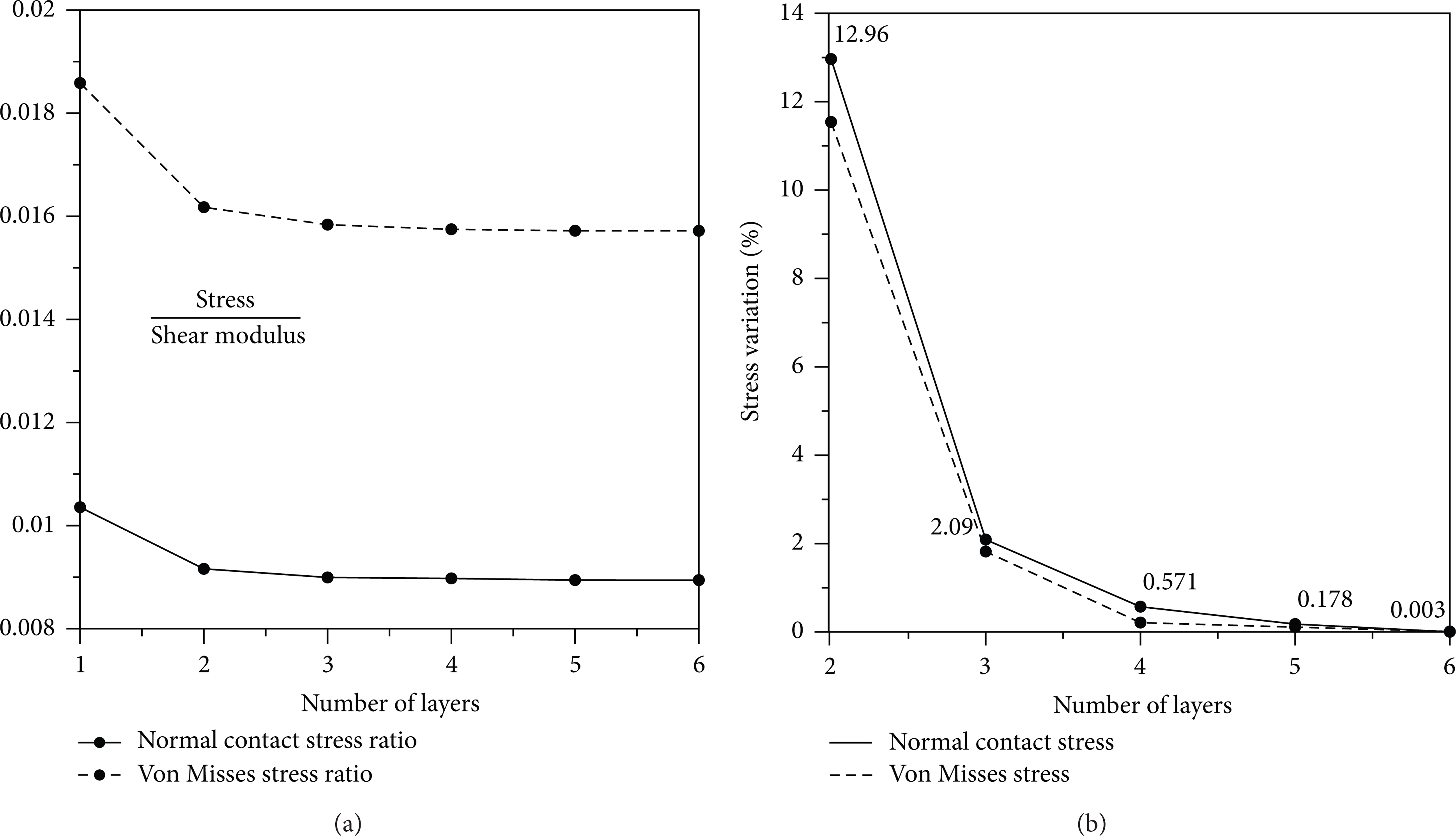
Convergence of solution by increase in number of layers of graded coating, (a) variation of normal and Von Misses stresses and (b) percent of difference in variation of stresses.
4.2. Effect of Friction Coefficient on Coating Stress
Friction coefficient may be the most effective material property of graded coatings on rolling contact stresses. The friction force provokes changes in the stress field generated by the contact of bodies, thus it applies great influence on the contact failure. This parameter is neglected in some previous studies of graded coatings which make this work different. It can be seen that friction coefficient is strongly effective on normal and tangential contact stresses in graded surface (σ yy (x, 0) and σ xx (x, 0)). Figure 8 shows the stress variation with friction coefficient; as the coefficient increases, the normal compressive stress and in-plane one in both compressive and tensile areas increase (See Figure 8). Furthermore, when the contact area length is not fixed as other researchers work (a/h is not constant), both normal and vertical forces ratio (Q/ηP) and contact parameters would fix the contact area position, so the figures show to some extent similar start (Leading edge) and more different end (Trailing edge) of contact area. The normal pressure contact increases by larger friction, but the trends of curves are similar. Normal stress is fully compressive while the in-plane stress (σ xx ) is compressive in leading half contact area and tensile in trailing half. Figure 8 demonstrates the variation of the in-plane stress component on coating surface while a tensile peak is seen in trailing edge of the roller.
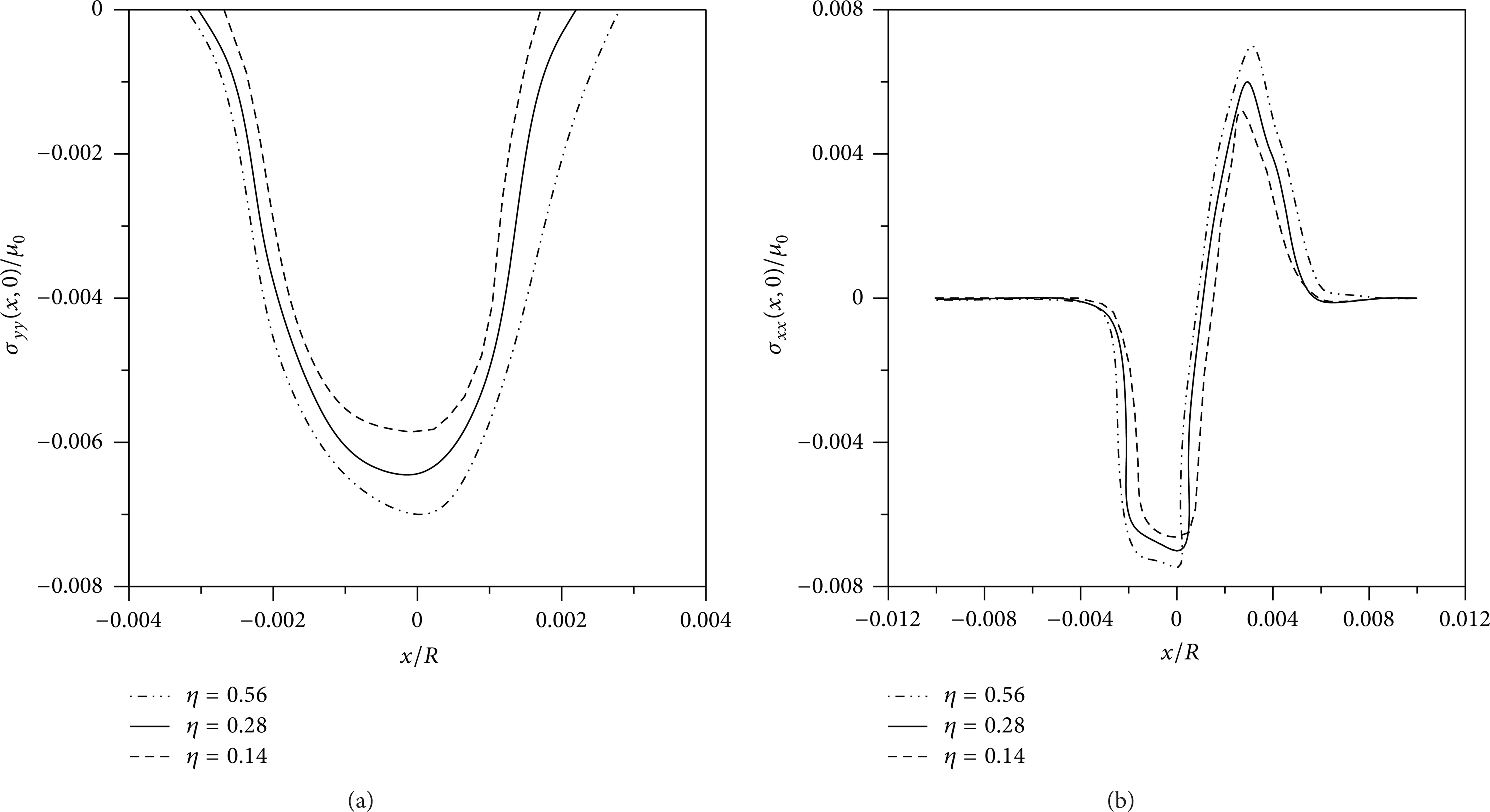
Contact stress variation in contact area by the effect of friction coefficient, (a) normal contact stress and (b) inplane stress (υ = 0.3, Q/P = − 0.2, β/η = not cte ., a/h = not cte ., Γ = 7).
Tangential slip and friction have influence on relative movement of roller and coating. Friction acts as a resistant contact force which produces a tensile surface stress in the forward rolling direction. The maximum tensile stress was greatly influenced by slip and coefficient of friction.
These critical tensile peaks become smaller by decrease in friction coefficient. This point may be useful in material selection in coating designs. Nonlinear geometry meshing makes some inappropriate variations in uniform stress curves due to the changes in nodes position. The peaks of curves and some results are different from previous researches; the reason is solution methodology and capability of our finite element codes which let us solve the equations with more than one variable; so parameters like β/η and a/h would not be constant. The effect of friction on leading edge of roller is much less than trailing edge, the starts of contact areas are near to each other (See Figure 8), but the end is more different.
Rolling contact failure results in material particles flaking from the surface of the graded coating. This is the reason this paper focuses on stress analysis of contact surface. Decreasing the roller friction on coating causes the reduction in effect of this phenomenon and stresses.
4.3. Frictional Work in Contact Surface
A braking momentum is generated during a rolling contact which makes it different from sliding one. Figure 9 shows the dimensionless frictional work (the work done by friction force), through the contact area where W fx is the frictional work at surface of coating and Wf0 in center of contact area (x = 0). It can be seen that as the distance from the contact center increases, the frictional work increases. In fact, the maximum energy dissipation due to friction is at both edges of roller. A remarkable point is that the frictional work variation in graded coating surface shows a peak at trailing and leading edges and designing the components against wear may need to pay more attention to these ends. The symmetry of results with respect to center of contact is due to sliding regions in this type of contacts which are symmetric in both sides of stick zone.
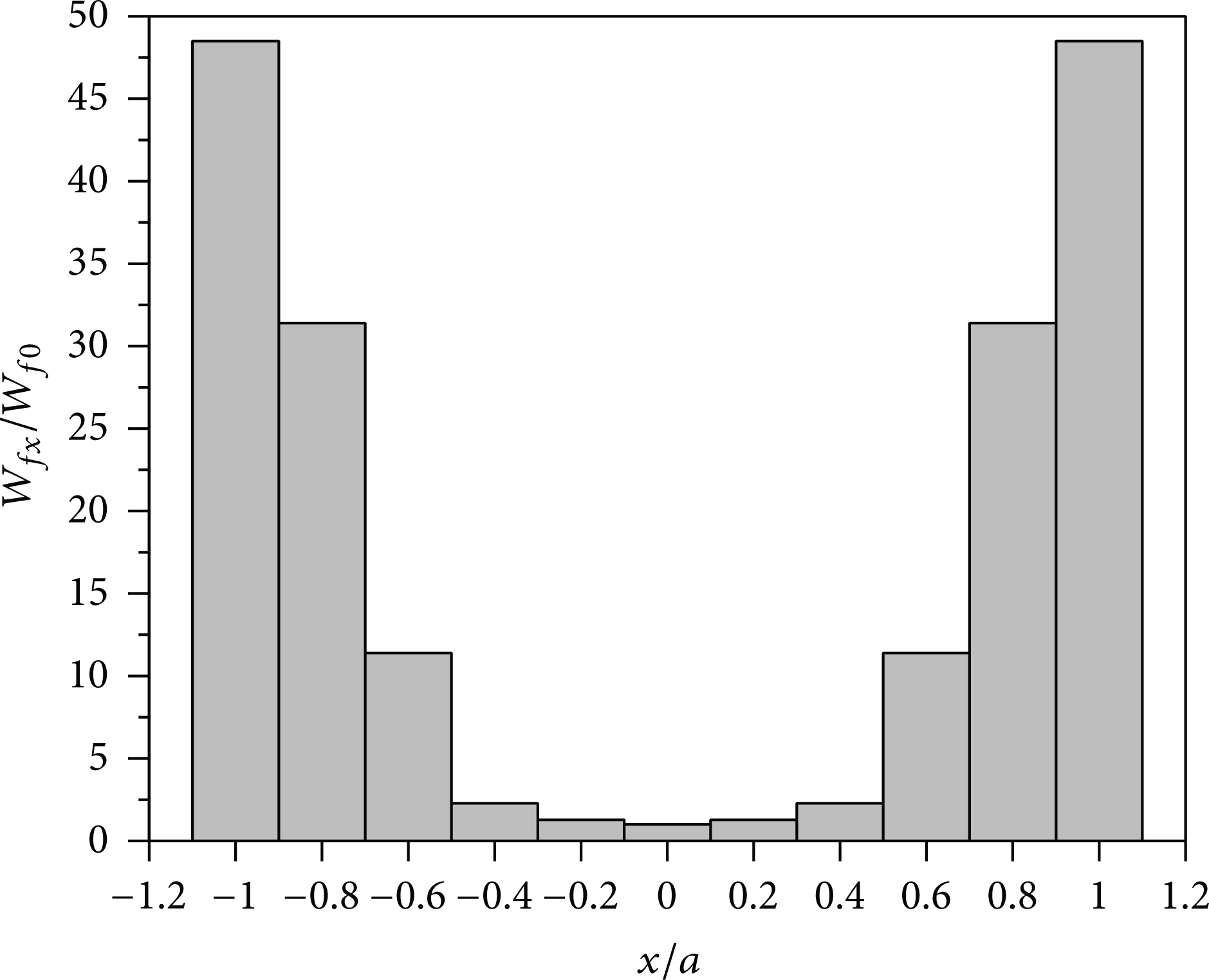
Frictional work in rolling contact, calculated for 11 positions on graded coating surface through the contact area, (− a < x < a).
4.4. Coating Deformations due to Surface Property
One of the approaches for wear analysis is the division of coating into layers, and then the surface layer accumulates deformation dependent on the stress at contact area. Once a layer has accumulated a critical strain and deformation it is deemed to have failed. In the work presented here, the model is improved by allowing variation of material properties such as shear modulus through the coating thickness. This reflects the effect of friction coefficient of graded coatings on wear failure of components.
The localized contact stresses and resulted surface deformations in ball and rolling components are extremely high as compared with stresses and deformations acting on rotating structural components (e.g., shafts). The reason may be explained by Hertzian theory which governs these types of problems. This behavior is taken up for investigation under vertical and horizontal forces.
An important factor in minimizing the failures is the deformation behavior of substrate under the action of rolling contact. During the rolling process, the component material will experience an elastic response. The elastic deformation in contact area is shown in Figure 10. Graded coatings elastic normal and tangential deformations are affected by surface friction.
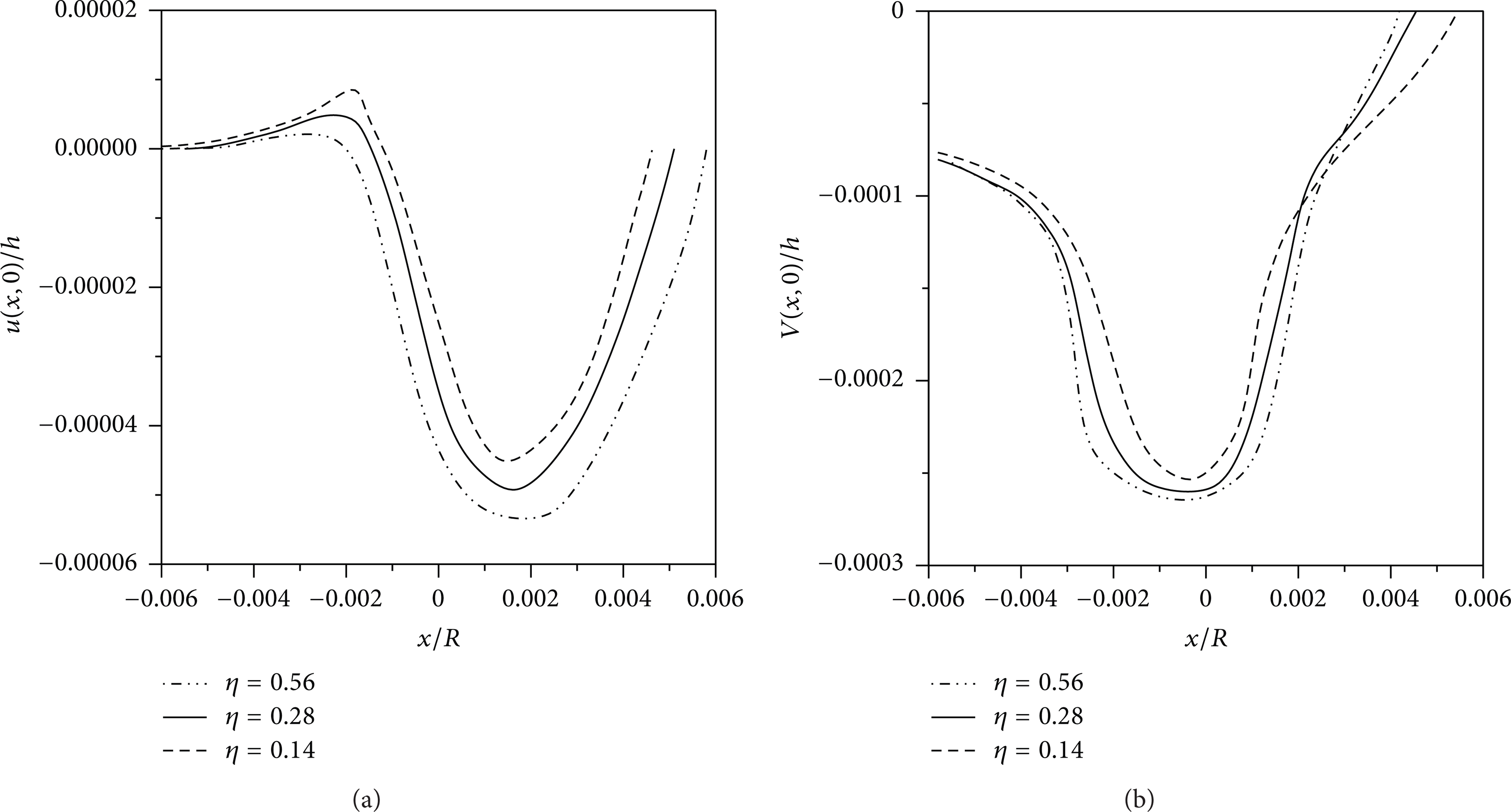
Surface deformation of FGM coating in effect of surface physical properties, (a) horizontal deformation and (b) vertical deformation (υ = 0.3, Q/ηP = − 0.75, β/η = not cte ., a/h = not cte ., Γ = 7).
Figure 10(a) shows the horizontal deformation of graded coating which emphasizes on effect of friction coefficient on start and end of deformation. It is seen that there is a peak in elastic curve at the leading edge of roller. It can be observed that ∂u(x, 0)/∂x is constant within the stick zone of contact area. Discontinuity of strain in contact area of rolling contact problems is impossible; the reason is described by flow of material in contact area which needs infinite acceleration to pass from discontinuity.
The surface vertical deformations are obtained from Figure 10(b) and the physical properties are more effective on trailing edge of roller; more friction force in contact increases the vertical and horizontal deformations. This result arises from the fact that increasing the friction coefficient restricts the relative slip velocity of the particles within the slip zones.
Finite sliding formulation is used to model the rolling contact of roller. This method redounds to more exact and realistic results which is too important in verification of our solution. Guler et al. [3] studied a general trend of the tangential displacement gradient, ∂u(x, 0)/∂x. The slope and trend of our curves (refer to Figure 10) can be verified by their results in a good compatibility.
4.5. Effect of Stiffness Ratio
Stiffness ratio, Γ, is the main difference of graded materials and homogenous ones. Investigation of roller contact length, 2a, according to variation of stiffness ratio is another required result which is so important in designing of rolling contact parts like gears. Stiffening coating (Γ > 1), softening coating (Γ < 1), and homogenous one (Γ = 1) are studied in Figure 11(a). Some properties such as friction and loading are controlled and only the effect of shear modulus changes is investigated. Decreasing the shear modulus of graded coating in free surface increases the contact length and this curve rate has a maximum slope around 1 < Γ < 2. Generally speaking, the contact zone expands over the free surface of graded coating as the stiffness ratio, Γ, increases. Contact length for present problem is approximately 20% of coating thickness which is useful for coating design of components. Surface failures in a graded coating depend on more factors than stress and deformations. Controlled material strength and stiffness ratio or high wear rates suppress surface failures.
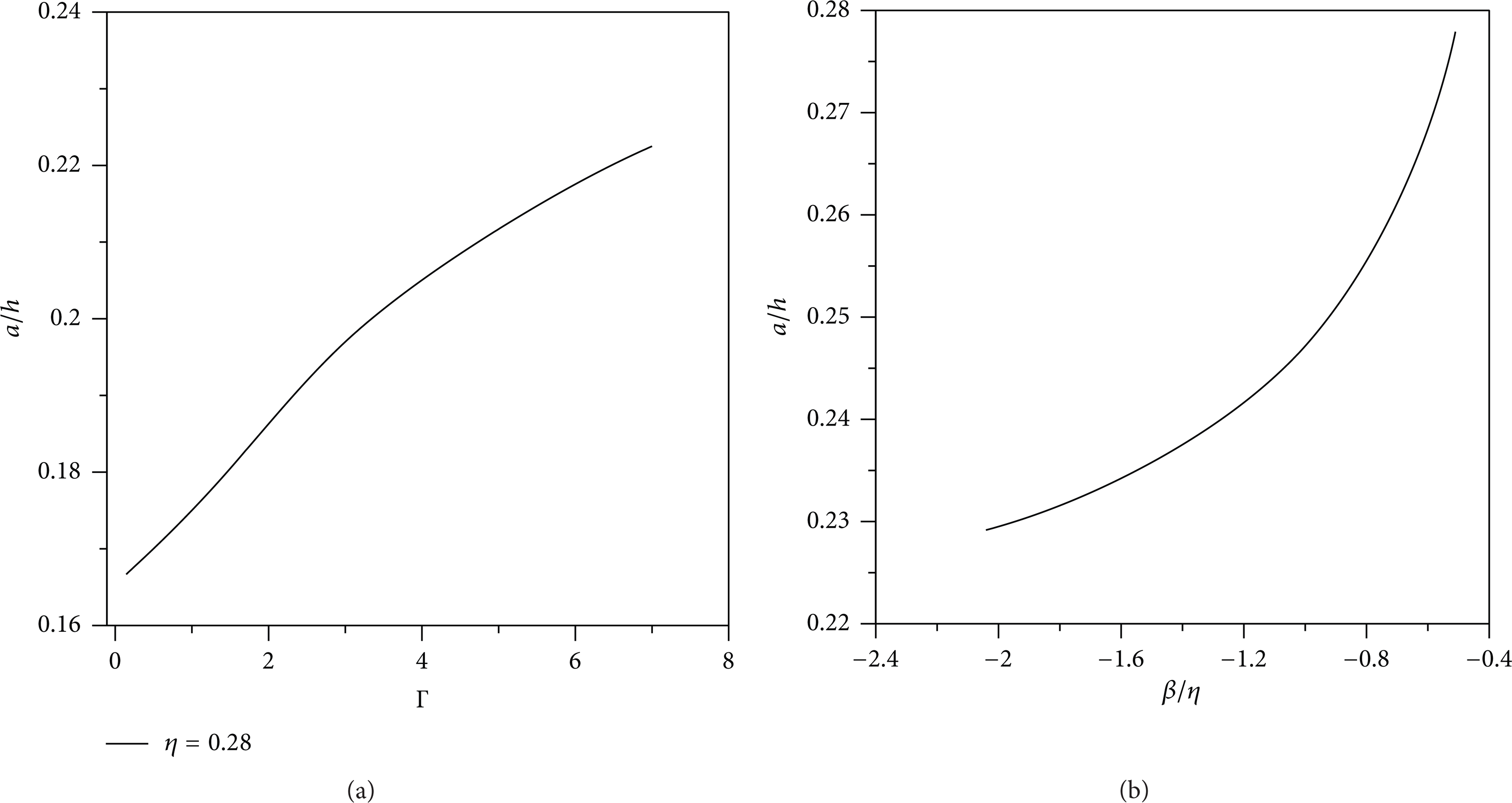
Contact area variation by (a) stiffness ratio, Γ, in a constant friction and loading condition and (b) β/η in a stiffening material ratio, Γ = 7, Q/P = cte . and υ = 0.3 in a 2D problem.
As shown in Figure 11(a), the contact area for the softening coating is less than that of the homogeneous material while it is opposite for the stiffening one.
Compressive normal stress component varies through the thickness shown in Figure 12. Normal stress at trailing edge, σ yy (a, y), increases by distance from the surface. Three coatings with different stiffness ratios are compared and results show more increase in compressive stress for stiffening coatings (Γ > 1). Softening graded coatings (Γ < 1) lead to less stresses in compare to homogenous coatings (Γ = 1). Figure 12 indicates the stress in coatings resulted by rolling contact may be reduced or improved in design by using graded coatings; also softening coatings help to increase uniform stress variation through the coating and substrate thickness.

Stress variation through the thickness of coating and substrate by the effect of stiffness ratio (υ = 0.3, Q/ηP = − 0.75, β/η = − 1).
4.6. Effect of β/η on Behavior of Contact Area
One of the other mechanical and physical properties of contact surfaces which affects their behavior is studied in Figure 11(b). It demonstrates the variation of a/h (dimensionless half-length of contact zone) by β/η. β is calculated related to Poisson's ratio (See (9) and (10)). β/η is negative while the β is negative in a plain strain problem.
It is difficult to determine precisely the actual stress level purely by a numerical method due to problems in measurement of friction coefficient in some experimental methods. The coefficients of friction for some tests are guessed based on observations. Our methodology and contact analysis of graded coating would simplify the study against this failure. Thus, the contact area length and position in frictional rolling contact are design factors. As the β/η approaches to zero, increases the contact length. Figure 11(b) shows a larger slope in larger friction coefficients which can be verified indirectly by Figure 10(b), in fact increasing the coefficient of friction restricts the slip velocity of particles within the slip zones and affects contact length of roller.
5. Conclusion
In this paper, a contact problem was analyzed in order to investigate the material properties effects on performance of a graded coating. The stress distribution and contact zone in mechanical components were studied.
Graded coatings in frictional contact would have specific advantages against surface and other mechanical failures of components. 2D finite element models are developed to simulate the frictional rolling contact of a rigid cylinder on a graded coating. The surface stress distribution, deformations of coating, and contact zone length for various material properties are shown. Verification of results with analytical literature shows a fairly good accuracy for finite element method. The effect of friction on leading edge of the roller is much less than the trailing edge. The start of contact areas for various coefficients of friction are almost the same, but the ends in trailing part of the roller are different. So the contact zone's start position and its length could be controlled by stiffness ratio and friction coefficient simultaneously. Also as the friction coefficient increases, the tensile and compressive stresses increases and this may lead to critical positions for failures. In fact, the surface cracks could be initiated near the deformed surface zone, in the region of maximum cyclic stress caused by rolling contact. Also the stress in contact direction increases through the coating thickness. This increase for stiffening coatings are more than homogenous ones while softening coatings experience less increase in stresses.
More friction force in contact area increases the vertical and horizontal deformations. It is seen that there is a peak in elastic curve at the leading edge of roller and constant slope in first half of contact area. As the negative β/η approaches to zero, larger friction coefficient increases the contact length which leads to more wear in rolling contact of some components like gears and bearings. The dissipated energy and frictional work done through the contact area are maximized in both sides of rolling contact area, leading and trailing edges.
Contact length of present problem is approximately 20% of coating thickness while changes in Γ and material properties can make variations in contact area. The contact area for the softening coating is less than that of homogeneous material while it is opposite for the softening one; so it can be shown that a softening graded coating helps to more resistance against wear in frictional rolling. Larger coefficients of friction increase the contact length variation rate; so the surface lubricating decreases the variation rate of a/h.
The methodology can be employed for analysis of frictional and nonfrictional rolling contact on graded coatings.
Conflict of Interests
The authors declare that there is no conflict of interests regarding the publication of the paper.