




Abstract
Wireless Sensor Networks (WSNs) and Cloud computing are two emerging technologies, respectively, in the networking and computing fields. Sensor Cloud integrates WSNs and Clouds into an extended form of cloud infrastructure that manages sensors scattered throughout WSNs. Networking plays a crucial role in Cloud computing and becomes a particularly challenging issue in sensor Clouds due to resource limitation of WSNs as the underlying network of the Cloud infrastructure. Therefore, data transmission from sensors to servers in sensor Clouds must be carefully controlled to avoid network congestion. In this paper, we study Random Early Detection-Based (RED-based) congestion control for data transmission in sensor Clouds. Specifically we propose an improved RED (IRED) algorithm that meets sensor Cloud networking requirements better and develop a queueing model coupled with analysis technique to evaluate the performance of the proposed congestion control scheme. We also conduct extensive simulations to evaluate performance of IRED compared with the regular RED algorithm. Our analysis and simulation results demonstrate that the proposed IRED congestion control achieves comparable delay performance and preferable throughput performance in comparison with the standard RED for data transmission in sensor Clouds. The easily implemented control mechanism and low complexity of our proposed algorithm make it more suitable for sensor Clouds.
1. Introduction
In the past decade, Wireless Sensor Networks (WSN) have been widely deployed in various applications, including industrial automation, environmental monitoring, transportation, and health-care, as a promising technology for enabling a broad spectrum of novel and attractive solutions. WSNs have become an indispensable component of the future information infrastructure upon which a large number of computing applications can be developed. In order to simplify system operation and maintenance as well as to reduce costs, WSNs must become an infrastructure that is capable of supporting various applications for multiple users concurrently, instead of having to roll out individual networks for specific purposes.
Cloud computing has emerged as a new computing paradigm that enables infrastructure resources to be visualized and provisioned as services on demand. Inspired by such a new service model sensor Clouds have been evolved as an extended form of Cloud computing to manage sensors scattered in WSNs. Sensor Clouds integrate WSNs and Cloud computing, two promoting technologies in the networking and computing domains, and offer a novel platform that stimulates development and deployment of advanced WSN-based sensor Cloud applications.
Networking systems play a crucial role in Cloud computing and have a significant impact on performance of the services that can be offered by Clouds. Recent study on Cloud performance has indicated that in many cases data communications in Cloud infrastructure form a bottleneck that limits Clouds from supporting high-performance applications [1, 2]. High-performance networking becomes an even more challenging issue in sensor Clouds, where a large amount of data collected by sensors need to be transmitted across WSNs to servers for processing in order to support various applications. Due to the limited bandwidth in typical WSNs, data transmissions in sensor Clouds must be carefully controlled to avoid network congestion.
Transport control protocols are used to mitigate congestion and reduce packet loss, to provide fairness in bandwidth allocation, and to guarantee end-to-end reliability. A variety of works have been reported in the literature for revising traditional TCP and UDP protocols to meet WSN requirements [3]. Active queue management is to complement the work of end-to-end protocols such as TCP in congestion control so as to increase network utilization and limit packet loss and delay. Random Early Detection (RED), a typical active queue management scheme for network congestion control, offers a promising congestion control mechanism for data transmission in sensor Clouds. Although RED is well studied and widely applied in computer networks, the existing research mainly considered regular networking scenarios instead of WSNs for data transmissions in sensor Clouds.
Common constraints related to the nature of WSNs have to be tackled. Network nodes in WSNs typically have very limited computational abilities, memory space, and power resources. Regular RED as an active queue management scheme requires a relatively complex procedure for processing each incoming packet, including calculating weighted average queue length, predicting a drop probability, and making packet drop decision. Such a procedure may become a burden to sensor network nodes that limits data transmission performance and shortens network lifetime. Therefore, it becomes necessary to investigate appropriate application of RED-based control scheme in sensor Clouds for achieving comparable networking performance with low control overhead. It is important to develop modeling and analysis techniques in order to obtain thorough understanding of performance of the new RED mechanism, which has a direct impact on performance of sensor Cloud applications. This is the focus of our research work presented in this paper. Specifically our major contributions are summarized as below.
We propose an improved Random Early Detection (IRED) algorithm for data transmission control in sensor Clouds. This algorithm employs the instantaneous queue length to calculate drop rate for congestion control, which fits the data transmission features in sensor Clouds better. We apply queueing theory to develop a model coupled with analysis techniques to evaluate performance of the proposed control mechanism for data transmission in sensor Cloud and obtain the significant performance metrics including average queue length, average packet delay, and packet loss probability. We conduct extensive simulations to evaluate performance of the proposed IRED and compare it with the standard RED algorithm. The obtained results indicate that IRED can achieve preferable throughput performance without sacrificing delay performance. The easily implemented control mechanism of IRED makes it more suitable to be applied in sensor Clouds.
The rest of this paper is organized as follows. Section 2 briefly reviews related work. In Section 3, the improved RED algorithm is presented and IRED-based congestion control for sensor Cloud data transmission is modeled. Section 4 analyzes performance of the proposed IRED for sensor Cloud data transmission. Section 5 shows simulation results and compares the performance of IRED algorithm with the standard algorithm. Conclusions are drawn in Section 6.
2. Related Work
Research efforts on queue management have been made to avoid network congestion in the last decades. The current queue management mechanisms can be classified into two categories: Passive Queue Management (PQM) and Active Queue Management (AQM). Drop tail (DT) is a typical PQM, in which a maximum queue length is set to accept packets. When the queue is full, the packets will be discarded until the queue length is below the maximum threshold, and then the newly arriving packets will be reaccepted. Nevertheless, this approach is limited by the problem of lock-out and global synchronization. Lock-out may cause long latency and global synchronization rejects most of packets in a burst, thus degrading service performance. Therefore, DT is not suitable to control data transmissions for supporting high-performance sensor Cloud applications.
AQM has been proposed to proactively detect indicators of network congestion and drop or mark packets randomly in order to overcome the limitation of PQM. RED is a widely used active queue management scheme that was first proposed by Floyd and Jacobson [4]. RED is expected to continue in foreseeable future as a typical AQM for network congestion control. Standard RED calculates drop rate using the average queue length and packets will be dropped probabilistically depending on threshold settings in the queue. There is a large number of research works related to the subject. For example, [5–7] focused on the parameter settings to improve the service performance. In order to enhance the robustness of RED, researchers developed some algorithms based on RED such as Adaptive RED [8], Blue [9], and Weighted RED [10].
The aforementioned works on RED algorithms are mostly dedicated to RED parameters adjustment for performance improvement. These works mainly considered regular computer networks, for example, the Internet backbone, as the main networking scenarios. The underlying networking platform of sensor Cloud consists of WSNs, which have many special features that distinguish them from traditional networking scenarios and bring in new challenges to congestion control. Various technologies have been developed to address this issue. For example, a buffer occupancy-based cross-layer control method was reported in [11] for rate and congestion regulation. Lee and Chung developed an adaptive duty cycle based congestion control scheme in [12]. In the receiver assisted congestion control method [13] senders perform loss-based control and receivers perform delay-based congestion detection. In [14] a learning automata-based congestion avoidance scheme was developed to allow intermediate nodes detect and control congestion. The authors of [15] proposed a rate-based mechanism to control congestion and achieve approximately fair bandwidth allocation for different flows in WSNs. The limited amount of resources in WSNs, including bandwidth on transmission links and processing capacities at network nodes, requires a simple and effective active queue management for congestion control. In this paper we propose an improved RED algorithm that simplifies the calculation of packet drop probability in order to make RED implemented easily in WSNs to support real-time applications offered by sensor Clouds.
Queueing theory has been applied to develop analytical methods for evaluating Cloud service performance. Xiong and Perros modeled a Cloud computing system as an open queue network consisting of two tandem servers with finite buffer space, where both interarrival and service times are assumed to have exponential distributions [16]. In order to study resource allocation for meeting performance requirements of clients with different priority levels, the authors of [17] modeled a Cloud center as an M/M/C/C queueing system, which has C servers with no buffer space and Markov processes for both arrival and departure. Yang et al. developed an
The abovementioned research focused on regular Cloud data centers instead of sensor Cloud infrastructure. In addition, these works did not pay sufficient attention to the impact of networking on Cloud service performance. In sensor Clouds with WSNs as the underlying networking platform, data transmissions will form a performance bottleneck that have decisive influence on service performance that can be achieved by sensor Clouds. In this paper, we employ queueing theory to model the combined data transmission and data processing systems (links and servers) in sensor Clouds and evaluate the service performance provided by sensor Clouds.
3. Modeling Congestion Control for Data Transmission in Sensor Cloud
In this section, we first present a system framework of data transmission in a sensor Cloud for service provisioning and then develop a model for data transmission with congestion control in the framework and propose an improved RED algorithm for congestion control in sensor Clouds.
3.1. System Overview
As service computing technologies bridge the gap between sensor applications and WSN infrastructure, there should be a data processing platform that processes the raw data collected in WSNs. An illustrative system framework is shown in Figure 1, which consists of three layers: sensing layer, data processing layer, and service layer.

An illustrative system framework for sensor Cloud networking.
The sensing layer contains sensor nodes for collecting data from the physical world. This layer only briefly processes the large amount of collected data and then delivers them to the data processing layer. Acting as the “brain” of a sensor Cloud the servers on the data processing layer perform computation functions to process collected data and store the obtained results as information resources in order to provide services requested by applications via the service layer. The service layer provides a common upper-level interface to sensor applications for utilizing sensor Cloud infrastructure. This layer hides the details of data collection, transmission, and processing in the sensor Cloud infrastructure, thus facilitating service provisioning to support various sensor applications deployed upon the sensor Cloud.
In order to provide sensor Clouds services to application users, the huge amount of data collected at the sensing layer, after being briefly processed, needs to be transmitted to the processing layer for further analysis according to the service requirements. For many sensor Cloud applications with real-time and reliability expectation, delay and packet loss during such data transmission have a significant impact on service performance. On the other hand, network links in WSNs of a sensor Cloud often have limited transmission bandwidth and servers in the processing layer also have finite capacities. Therefore, congestion control with active queue management is important in sensor Clouds for meeting the performance requirements of service provisioning.
3.2. Model for RED Controlled Data Transmission in Sensor Cloud
A model for data transmission in sensor Clouds with RED-based congestion control is shown in Figure 2. In this system data transmission from sensor nodes to servers is controlled by a RED-based active queue management mechanism. There are two thresholds for the queue, the minimum threshold L and the maximum threshold H. No packet will be dropped when the queue length is below the minimum threshold. If the queue length exceeds the maximum threshold, packets will be dropped with a probability

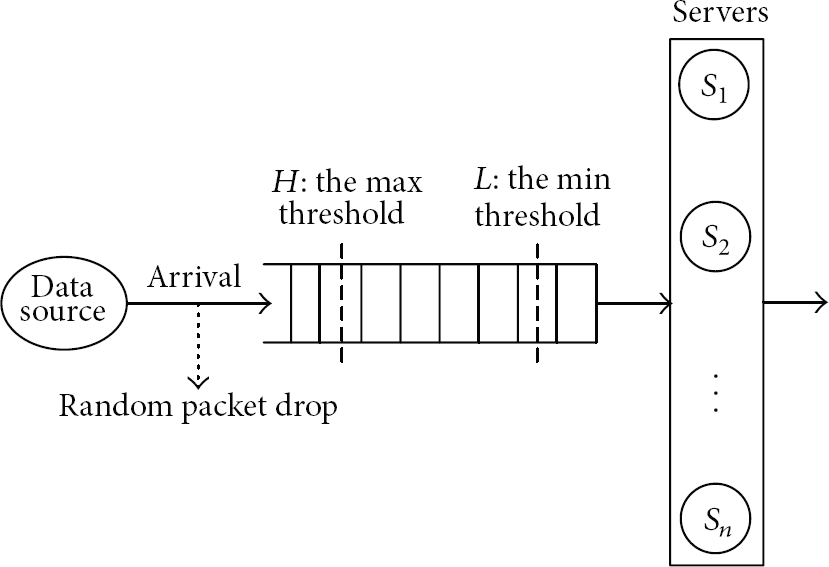
A model of RED-based congestion control for data transmission in sensor Cloud.
We use the instantaneous queue length to calculate packet drop probability for the RED algorithm in our congestion control scheme. Compared to using weighted running average queue length as in typical RED queue management algorithms, calculating drop probability using instantaneous queue length reduces time and space complexity of the RED algorithm due to its simplified implementation. Lower implementation complexity allows the proposed RED algorithm to satisfy the resource limited networking scenarios in WSNs, thus enabling the algorithm to meet the requirement of real-time sensor Cloud applications better than regular RED algorithms do. In addition, as shown in [19] using instantaneous queue length can improve RED performance for handling some special cases. For instance, when the queue is full but the average queue length is below the minimum threshold or between the two thresholds, it prevents RED from dropping a sufficient number of packets to avoid occurrence of network congestion.
3.3. Improved RED Algorithm for Congestion Control in Sensor Clouds
The proposed improved RED algorithm (IRED) is summarized in Algorithm 1. The algorithm is executed for each arrival packet. First, the instantaneous queue length is calculated and compared with the minimum threshold and the maximum threshold of the queue. If the current queue length is less than the minimum threshold, this packet is added into the queue and the queue length is increased by one; else if the current queue length is between the minimum threshold and the maximum threshold, the system will calculate the dropping probability and drop the arrival packet with this probability. If the packet is dropped, the number of lost packets will be increased by one and the mark packets are set to zero; otherwise the queue length will be increased by one. The packet will be dropped with the probability
(1) (2) calculate the instantaneous queue length k; (3) (4) add this packet into queue; (5) (6) (7) (8) calculate the packet dropping probability; (9) drop the arriving packet p with probability (10) (11) (12) (13) (14) add this packet into queue; (15) (16) (17) (18) (19) drop the packet with probability (20) (21) (22) (23) (24) add the packet p into the queue; (25) (26) (27) (28) (29) drop the arriving packet; (30) (31) (32) (33)
4. Performance Analysis on Congestion Control for Data Transmission in Sensor Cloud
In this section we employ queuing theory to analyze performance of the proposed IRED algorithm for data transmission control in sensor Cloud. The analysis leads us to derive several performance metrics, including the average queue length, average packet delay, and total loss probability, which are significant factors that directly affect the performance of sensor applications running upon the Cloud infrastructure.
In terms of the system, we suppose that there are n servers with the same service capacity and the minimum queue length threshold L is greater than n. When all n servers are busy, the arriving packets will be enqueued in the buffer with a certain drop probability determined by the IRED algorithm. When the buffer is full, the system will drop any arriving packet. We assume the packet arrival process follows Poisson distribution and each server has exponentially distributed service time. Considering the number of packet in the system, including both packets being served at servers and packets waiting in the buffer, as the system state, we model the system as a Markov Chain with a transition diagram illustrated in Figure 3.

State transition diagram of a IRED-based congestion control system for data transmission in sensor Cloud.
Denote the average packet arrival rate as λ, average service rate of each server is μ, and the steady probability for state k as
For state

For states

For states

For states

For states

For state

Let

From

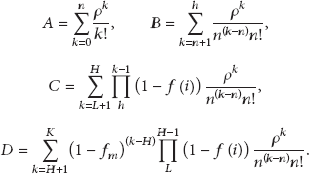
After solving the steady state distribution probability



5. Simulation Results
In this section, extensive simulations are conducted to evaluate performance of the proposed IRED-based congestion control for data transmission in sensor Cloud infrastructure. Our experiments are performed by using the OMNet++ simulator with IDE toolkit, which is an object-oriented C++ component-based discrete event simulation framework primarily used for network simulation [19].
In our simulations we set the minimum queue length threshold for the proposed RED algorithm as
We first examine the performance of data transmission controlled by the IRED algorithm under various traffic loads compared with corresponding performance achieved by the regular RED mechanism. We measure several important performance metrics in typical sensor applications, including average queue length, average packet delay, and packet drop rate, with different traffic arrival rates. In order to evaluate the impact of traffic load on data transmission performance, we define traffic load ρ as the ratio of average arrival rate and the average service rate of a single server; that is,
Figure 4 plots the average queue lengths of the system with various traffic loads, under congestion control of IRED and regular RED. It is shown that the average queue lengths of both IRED and RED increase with traffic load. We also observe that the increasing rates of both curves slow down (the curves tend to become flat) when the queue lengths approach the maximum threshold (set as 30 packets in this experiment). This is because that probability for random packet dropping increases with queue lengths in both control algorithms, which effectively prevents the queues from being filled up too quickly. Comparison between the queue length curves of IRED and RED in this figure shows that they are quite close (nearly overlap each other for most traffic load values). This indicates that IRED is able to control the increment in average queue length as effectively as the regular RED.

Average queue length versus arrival traffic load.
Figure 5 shows the average packet delay performance achieved by IRED and RED control algorithms under various traffic loads. We can see from this figure that both delay curves increase with traffic load by following a similar pattern as what the queue length curves show in Figure 4. Average delay increases with traffic load and the increasing rates of both delay curves tend to slow down when traffic load becomes heavier, which is due to the packet dropping effect caused by the control mechanisms. Comparing these two delay curves shows that average data transmission delay under the control of IRED is very close to (and slightly better than) the packet delay obtained with regular RED. This indicates that the proposed IRED can achieve comparable delay performance for data transmission as regular RED does. However, IRED computes packet dropping probability with a simpler algorithm that reduces implementation complexity, thus consuming less amount of processing capacities at network nodes. This makes IRED more appropriate to be applied in WSNs for supporting data transmission in sensor Clouds.

Average packet delay versus arrival traffic load.
Figure 6 gives the packet drop rates for RED and IRED algorithms under various traffic loads. The figure shows that both IRED and RED have a negligible (close to zero) packet drop rate under light arrival traffic load. Packet drop rates of both algorithms gradually increase with traffic load and then rise significantly for relatively heavy traffic load. This pattern matches the random packet dropping mechanism that a longer queue leads to more dropping packets. Comparison between these two curves shows that IRED drops less packets than what the regular RED does under all traffic loads, and the gap between packet dropping rates of these two algorithms is wider under heavier traffic load. This implies that IRED can achieve preferable throughput performance for data transmission by dropping less packets compared with the regular RED, especially under heavier traffic load. Considering the limited link bandwidth and node processing capacities of WSNs in sensor Cloud infrastructure, data transmission can easily cause a relatively high load (the ratio of arrival rate and service rate) in such a networking environment. Therefore, results shown in Figure 6 indicate that IRED meets the requirements of high throughput sensor Cloud applications better than regular RED does.
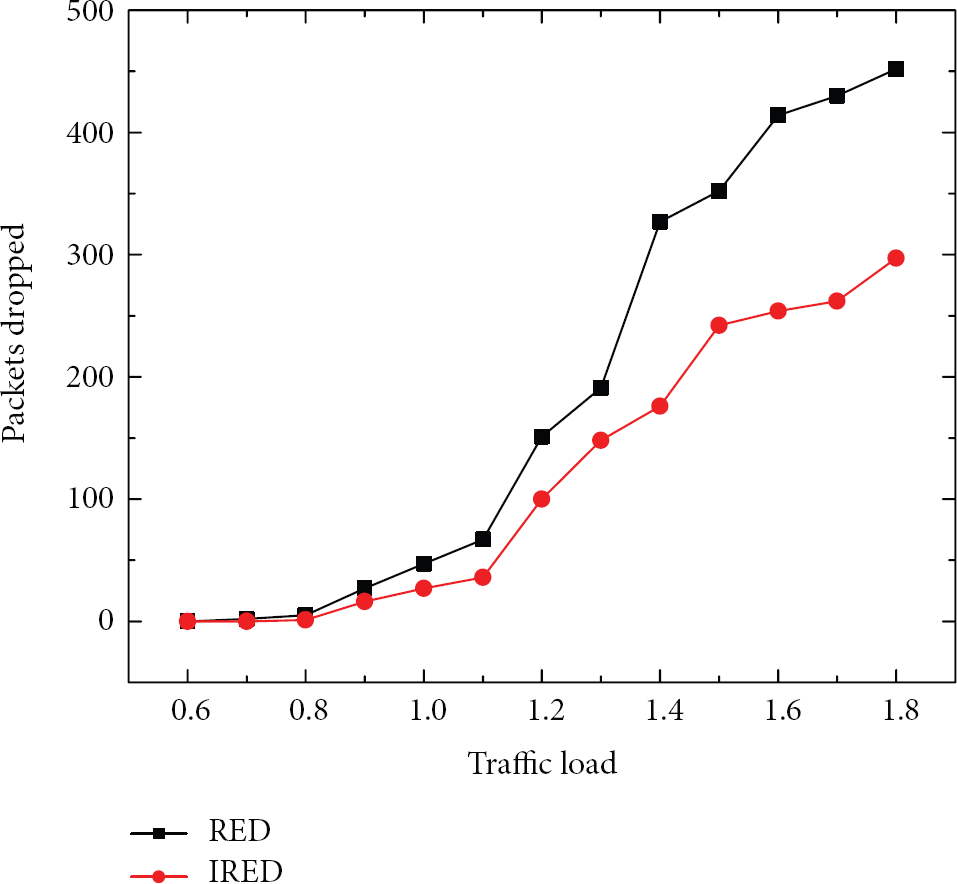
Packet drop rate versus arrival traffic load.
Figures 5 and 6 together illustrate that IRED can achieve higher throughput without sacrificing average packet delay performance for data transmission in sensor Clouds. Here the average delay metric is measured at packet level. On the transport control layer, packet dropping often triggers end-to-end retransmission and decrement in congestion window size, which will significantly increase the delay experienced by upper layer applications. Therefore, the lower packet dropping rate of IRED actually helps to reduce the end-to-end data transmission latency for sensor applications. This implies that IRED also provides better support to real-time applications built upon sensor Cloud infrastructure.
We also investigate the impact of queue length thresholds setting on data transmission performance. We vary the maximum and minimum thresholds and tested the average queue length, average delay, and packet drop performance metrics for IRED controlled data transmission under various differences between the maximum and the minimum threshold values. The obtained results are plotted in Figures 7, 8, and 9. From Figures 7 and 8 it can be seen that both average queue length and average packet delay increase observably when the threshold gap becomes wider. Figure 9 shows that the number of dropped packets decreases when the gap between the maximum and minimum thresholds increases. This is because a large maximum threshold tends to generate a smaller packet dropping probability, thus making an arrival packet more likely to be accepted into the queue. Therefore larger maximum threshold and bigger gap between thresholds reduce the number of dropped packet and increase the average queue length and packet delay.
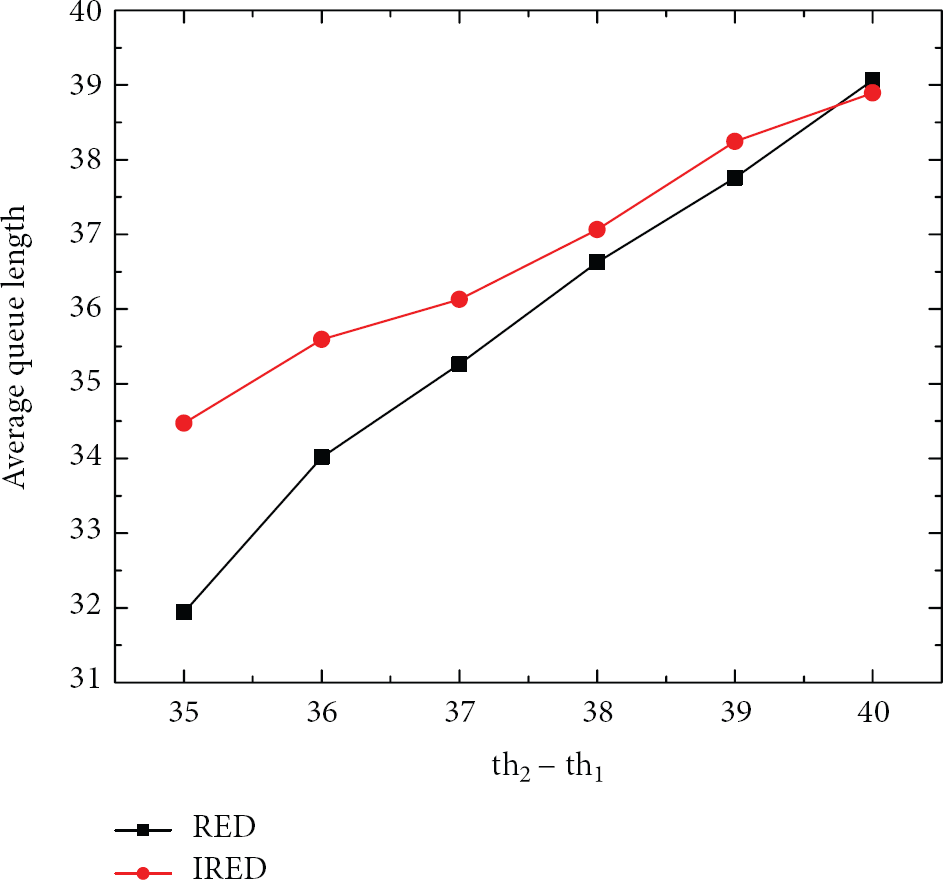
Average queue length versus difference between thresholds.

Average packet delay versus difference between thresholds.

Packet drop rate versus difference between thresholds.
In summary, the above reported simulation results clearly indicate that the proposed IRED congestion control can achieve a preferable throughput performance than the regular RED without compromising average delay performance. Our analysis shows that IRED support both high-throughput and real-time requirements of applications built upon sensor Cloud infrastructure. Due to its easily implemented control mechanism the proposed IRED is more suitable to be implemented in WSNs of sensor Clouds, where network link bandwidth and node processing capacities are often limited.
6. Conclusion
In this paper we have studied the problem of congestion control for data transmission in sensor Clouds for improving service performance to support various sensor applications. We have presented a model for a RED-based congestion control system and proposed IRED algorithm that is suitable to be implemented in WSNs of sensor Cloud infrastructure. We have employed queueing analysis technique for analyzing the performance of the proposed congestion control system. We have also conducted extensive simulations to evaluate performance of IRED and compared it with the regular RED scheme. Analysis and simulation results have indicated that the proposed congestion control achieves comparable delay performance and better throughput performance compared to the standard RED. The easier implementation of IRED makes it more suitable to be deployed in the networking systems for sensor Clouds.
Footnotes
Conflict of Interests
The authors declare that there is no conflict of interests regarding the publication of this paper.
Acknowledgments
This work is supported by NSFC (Grant nos. 61309031 and 61272400), Program for Innovation Team Building at Institutions of Higher Education in Chongqing (Grant no. KJTD201310), Natural Science Foundation of Chongqing, (Grant no. cstc2013jcyjA40026), Scientific and Technological Research Program of Chongqing Municipal Education Commission (Grant no. KJ130523), and CQUPT Research Fund for Young Scholars (Grant no. A2012-79).