




Abstract
Energy is an extremely critical resource for battery-powered wireless sensor networks. Since data transmission typically consumes more energy than any other activities on a sensor node, it is of great importance to design energy optimized routing algorithm to achieve both energy efficiency and energy balance together, in order to prolong the network lifetime. In this paper, with the help of the concept of potential field in physics, we design a distributed energy optimized routing by constructing a hybrid potential field. The goal of this basic approach is to force packets to move toward the sink at the same time to achieve energy balance among neighbors. We adopt the social welfare function from social sciences to predict equality of residual energy of neighbors after selecting different next nodes, which is used to compute the potential value in energy balance potential field. Simulation results show that the algorithm effectively extends the network lifetime, has good performance on energy balance of sensors, and decreases the average hop of data transmission with the increase of the number of sinks, compared with similar algorithms.
1. Introduction
Long and narrow tunnels in underground mine are complex and dangerous workplace, which will continue to stretch with further exploitation. Existing coal mine safety monitoring systems require laying of a large number of wired communication cables, which are difficult to move with the ongoing exploitation. At the same time, communication cables have often been damaged, affecting the continuity of monitoring. Wireless sensor networks (WSNs) are composed of a large number of microsensors through wireless communication, which are suitable for underground mine safety monitoring. Wireless sensor networks in underground mine can realize wireless access, rapid reconstruction of gas detection, and monitoring system after a disaster.
The deteriorated and complex environments of areas of application affected by a disaster create difficulty for replacing the batteries of wireless sensor networks. After exhausting their energy supply, sensors are no longer able to execute tasks, making optimized energy consumption as one of the most important issues in WSNs research. Since the radio transceiver typically consumes more energy than any other hardware component onboard a sensor node, designing energy optimized routing algorithm is of great impact on prolonging network lifetime [1].
Sensors have limited energy supply. Therefore, the routing must be designed to seek for energy efficiency and find less energy-consuming paths to transmit data [2, 3]. Intuitively, the network lifetime should be extended. However, most routing algorithms tend to route data via sensors on a certain path which consumes the least energy, and the sensors on the path will drain their energy quickly. Since the ultimate goal of WSNs is to maximize network lifetime, significant efforts have been made to improve energy-efficient routing for the perspective of energy balance.
In [4], an energy-efficient data gathering method in wireless sensor networks is proposed, named ODAS/SS. ODAS/SS applies a sleep scheduling mechanism, which lets some nodes transit to the sleep mode while guaranteeing the coverage in the target region, in order to further reduce the energy consumption and suppress the variation in residual energy among nodes. In [5] the authors proposed a fully distributed sleep schedule which adaptively adjusts the duty cycles of sensors within the same sensing area based on the relative difference in their remaining energy budget. The main advantage of the proposed adaptive scheme is to balance energy consumption among sensors. In [6] the authors proposed an energy-efficient distributed clustering protocol, named Geodesic sensor clustering (GESC). GESC aims to prolong the network lifetime by distributing energy consumption evenly, considering the localized network structure and the remaining energy of neighboring nodes. However, all the phases in the protocol will be performed whenever a node failure occurs, which is prone to produce large overhead. In [7], an energy-balanced data gathering (EBDG) took full advantage of corona-based network partition, mixed-routing, and data aggregation to balance energy consumption. The authors of robust and energy-efficient multipath routing (REER) [8] proposed a method to select the best next hop during the paths construction phase based on the residual energy, signal-to-noise ratio, and node available buffer size. The main objective of this protocol is to maximize the network lifetime through the traffic distribution across node-disjoint multiple paths. The main drawback of this protocol is that the source should periodically flood KEEPALIVE messages over the multiple paths in path maintenance stage, which will impose high overhead. In [9], a proactive multipath routing algorithm is provided to achieve spatial energy balance, but it is actually a load balancing mechanism because of the assumption that “energy burden” and “traffic load” can be assimilated. However, it is not an optimal solution because spreading traffic unaware of residual energy distribution is somewhat blindfold. In [10], using the variance of residual energy of sensors to measure the energy balance, predicting based distributed energy-balancing routing algorithm has been proposed. In [11], maximizing network lifetime by energy-aware routing has been formulated as integer programming problem, achieving energy efficiency as well as energy balance. But this algorithm has the central control architecture, and sink needs to collect information of nodes and broadcast data transmission matrix to determine routes periodically, leading to heavy overhead of communication.
In the study of issues on WSNs, the routing problems are abstracted as physical problems, which can be solved by mathematical physics methods. In [12], the process of data forwarding in WSNs is analyzed as electric charge moving in electrostatic field. The corresponding positive and negative charges are assigned to sink and the data of sensors depending on the amount of residual energy of sink's neighbors and sensors. The routing is constructed according to the electrostatic force between the charges. In [13, 14], multisink wireless sensor networks are simulated as electrostatic field and a series of partial differential equations are exported depending on the nature of electrostatic field. By solving partial differential equations, the optimal route and load distribution are determined. In [15], sink is abstracted as the magnet and the data of sensors are abstracted as iron which can be attracted by the magnet. The routing is formed according to the intensity of magnetic field. In [16, 17], the data transmission in WSNs is abstracted as the propagation of light in the medium with a fixed refractive index. The routing is derived based on the principle of geometrical optics. In [18], the temperature field which is inspired by the heat source is used to simulate WSNs. The temperature of sensors is applied to make routing decisions. In [19], an attribute-aware data aggregation (ADA) scheme consisting of a packet-driven timing algorithm and a special dynamic routing protocol are proposed. Based on the concept of potential in physics and pheromone in ant colony, a potential-based dynamic routing is designed to support an ADA strategy.
The above works have established the relationship between the routing of WSNs and potential field. But the routing decision is made according to only one attribute of the network based on the mathematical physics method. So, hybrid virtual potential field should be built to support multiple strategies routing, based on multiattribute of WSNs [20]. In this paper, we develop a distributed energy optimized routing using virtual potential (DERVP) field for wireless sensor networks. The cornerstone of the DERVP is to construct a hybrid virtual potential field based on the hop count and energy balance of sensors. In the role of the depth potential field, the shortest path will be established and energy efficiency will be achieved. In the role of the energy balance potential field, the data will be routed among sensors to achieve energy balance. The hybrid potential field combines these two potential fields together to realize energy optimized routing.
In the social sciences, considerable efforts have been made to define the so-called social welfare function to compare income welfare between space and time. In general, social welfare is a function of average and equality of an income population. In this paper, we adopt the social welfare function to predict equality of residual energy of neighbors when selecting different next hop. Based on energy equality, the energy balance potential field is constructed. Simulation results show that the proposed DERVP algorithm has achieved better balance for energy consumption of sensors and has prolonged network lifetime compared with other existing algorithms.
2. System Model
2.1. Definitions and Notations
In multisink wireless sensor networks, sensors periodically sense the environment and transmit the data to sinks. In order to describe the routing algorithm more clearly, we define wireless sensor networks and neighbors.
Wireless Sensor Networks. A wireless sensor network can be expressed by an undirected graph
Consider
Consider
Neighbor. The neighbor set of node i is defined as
2.2. Energy Consumption Model
The energy consumption of each sensor consists of three components: sensing energy, communication energy, and data processing energy. Sensing and data processing require much less energy than communication, so we consider only communication energy consumption. We use the same energy consumption model as Heinzelman used for wireless communicating hardware [21]. In this model, the transmitter dissipates energy to run the radio electronics and the power amplifier, and the receiver dissipates energy to run the radio electronics, which is consistent with the real situation better on energy consumption for wireless communication module.
If the sensor transmits an l-bit packet over distance d, the radio expends

When receiving an l-bit packet, the energy consumed is

2.3. Atkinson Welfare Function
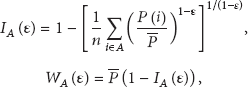
The existing energy-balancing routing algorithms generally transform next hop based on the residual energy of sensors, which is a kind of passive method of routing decision. When the data forwarding path is updated, the inequality of residual energy of sensors has already emerged. To address this issue, we introduce a function to predict the energy balance of sensors, which is usually used by social scientists to judge a society's welfare income. The welfare function
3. Abstract from WSNs to the Virtual Potential Field
The partial view of a typical wireless sensor network is shown in Figure 1. Sensors in the working area collect data and transmit to the sink through intermediate relay nodes. So, it is obvious that the data transmission in WSNs has the many-to-one feature and the concentric spatial distribution. In [24, 25], the steepest gradient search method is used to design a potential-based routing paradigm in the context of traditional networks and mobile ad hoc network, respectively. However, it does not attract widespread attention because of its huge management cost. It is indeed expensive to build an exclusive virtual field for each destination in traditional networks where numerous destinations distribute arbitrarily. On the contrary, the centralized traffic pattern in WSNs with single or at most several sinks will drastically decrease management overhead to implement a practicable potential-based routing algorithm.

Topology of wireless sensor network and hop count of sensors.
Before starting to design the concrete algorithm, we first show the relationship between the virtual potential field and wireless sensor networks. For the detection of network topology, the sink broadcasts the update message; sensors one hop away from the sink will get their own hop count by adding 1 to the hop in the update message. Then, the other nodes will also obtain their own hop by receiving update messages from their neighbors which already have their hop just in the same way. In physics, the physical quantity distributed in space is defined as potential field. For example, if each point in the space has the corresponding temperature values or the electric field intensity, the temperature field or the electrostatic field has formed.
As shown in Figure 1, if we define the hop count of sensors as their depth, the wireless sensor network can be abstracted as the depth potential field. Intuitively, the potential field can be viewed as a “bowl” and the data packet can be viewed as “water” flowing down to the bottom where sink resides along the surface of the bowl. The trajectory of this packet is determined by the “force” from the gravity potential field. The packet will move along the direction of the steepest potential gradient and finally reach the sink at the bottom, which will realize the basic function of routing.
In the independent effect of depth potential field, we can only find the shortest path. The depth potential field can be superimposed with virtual potential field constructed by other network parameters to achieve multiple policy routing. The direction of maximum change of potential gradient depends only on the potential difference between adjacent nodes, which means that local information is required to make routing decisions. For large-scale WSNs, the potential-based routing algorithm will dispense with the global network knowledge and state parameters and, therefore, has lower overhead and better scalability.
4. Design of Potential Fields
4.1. Depth Potential Field
The depth potential field aims to ensure packets to be transmitted to the sink. Let

To provide the basic routing function, namely, to relay packets toward the sink, we define the depth of sensor i as the potential value in depth potential field

In accordance with the definition of the potential field, the virtual force between node i and its neighbor j is given by


The depth differences between sensor i and its neighbor j can only be one of −1, 0, or 1, because the sensors which are two hops away from sensor i cannot be its neighbors. Thus, we calculate
4.2. Energy Balance Potential Field
4.2.1. Prediction of Energy Balance
The Atkinson inequality index is used to compute the expected energy balance of a set of sensors according to the following equation:

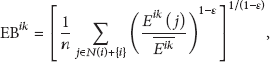
To evaluate the alternative next hop, sensor i calculates expected
Direct Transmission. The expected residual energy of sensor i and its neighbors can be computed as follows:

Using the expected residual energy from (9), sensor i can calculate the expected


Neighbor k
Selected as the Next Hop. The expected residual energy of sensor i is

The expected residual energy of sensor k after receiving and sending the same packet is

There is no change on residual energy of other neighbors not involved in data transmission, which is shown as

Using the expected residual energy from (12), (13), and (14), sensor i can calculate the expected

4.2.2. Energy Balance Potential Field
Since the packets will be forwarded to the sink in the steepest gradient direction, the sensor that achieved better energy balance should have lower energy balance potential value. Therefore, the energy balance potential value of sensors is defined as

Hence, the virtual force in energy balance potential field from node i to its neighbor j is

In energy balance potential field, the neighbor node with the most energy balanced effect will be chosen as the next hop node. This method can achieve the balanced energy consumption among sensors, but cannot guarantee that data sent towards the sink and eliminate the routing loops.
4.3. Hybrid Potential Field
To ensure that packets reach the sink as well as being more energy balanced, we linearly combine the depth potential field and the energy balance potential field to form a hybrid potential field as follows:

Hybrid potential field has both characteristics of depth potential field and energy balance potential field and adjusts the proportion of these two potential fields through variable
Virtual force between node i and its neighbor j in hybrid potential field is given by

From (7), (18), and (20), the virtual force can be simplified as follows:

In hybrid potential field, the neighbor node with maximum virtual force is selected to forward the packet, which will guarantee the packet flows to the sink and achieve balanced energy consumption among sensors.
5. Distributed Energy Optimized Routing Using Virtual Potential Field
In the DERVP routing algorithm designed in this paper, sensors make local routing decisions by using the virtual force in hybrid potential field as the choice criterion.
5.1. Routing Table
Each sensor keeps a routing table only for its neighbors. The routing table contains identification number, distance to sink, and current residual energy, for each neighbor. During the initial setup period, sensors determine their direct distance to the sink by the received signal strength sent from the sink. Then, each sensor broadcasts a setup message to its neighbors with a presetting transmission power based on the neighbor distance. The setup message contains identification number, distance to sink, and current residual energy of the transmitting sensor itself. Every sensor receiving this setup message registers the transmitting sensor as one of its neighbors. After the setup period, all sensors initialize their routing tables.
During the process of data transmission, we attach the information on residual energy of nodes (1 byte) behind the data (500 bytes) to the sink. Because the information on residual energy is much less than the data sent to sink, the energy consumption for the transmission of information on residual energy is negligible. When the sink has received the information on residual energy of nodes in one data transmission round, it will broadcast it across the network. So, sensors will update the residual energy of each neighbor.
5.2. Routing Decision
When sensors get the data or relay the data, they need to determine its next hop for data transmission. They calculate the virtual force and select the node with the maximum virtual force as next hop. Known from the previous definition of the virtual force, it is determined by the depth and the expected energy balance of sensors. Therefore, using virtual force as routing decision criteria can achieve effective and balanced utilization of sensor energy. For example, the choice of next hop of sensor i can be expressed as

From the above description of routing, sensors only need the information of neighbors to make routing decisions. For the large scale WSNs, sensors do not need to master the global network topology and status parameters, and routing algorithm has less overhead and better scalability.
5.3. Sleep-Scheduling for Low-Energy Nodes
Nodes with less residual energy should be put into sleep-mode and reduce the opportunity to be selected as the relay node through dynamically adjusting its potential value in energy balance potential field. In this paper, we set the node as low-energy node when its residual energy is less than 10% of the initial energy. In the routing process, the low-energy node with less hops is set into sleep-mode and avoided by adjusting its potential value and the node with the same hop will be selected as relay node. In this section, we will describe the sleep-scheduling and avoiding strategy for low-energy nodes.
When

If low-hop node k is the low-energy node, it should be avoided in the routing process.

Due to

If the potential value of low-energy node k is set to

5.4. An Example
This section provides an example to clarify the mechanism of the DERVP algorithm. In Figure 2, sensor a has a data packet to be sent to the sink. Since it has three neighbors, there are three alternative paths to the sink. Table 1 lists the residual energy, depth, and energy consumption, for each sensor in the local society
Residual energy, depth, and energy consumption for data transmission of sensors.


An example of DERVP algorithm.
For each alternative path, sensor a computes the expected residual energy of itself and its neighbors. The expected residual energy for each alternative path is shown in the second column of Table 2. With this expected residual energy, sensor a calculates the expected
Expected residual energy and virtual force in hybrid potential field.

6. Results and Discussion
In this section, we evaluate the performance of our proposed distributed energy optimized routing algorithm using virtual potential field (DERVP) via MATLAB. We calculate the energy consumption for data sending and receiving. We define the network lifetime as the time when the residual energy of the earliest sensor node becomes zero, which is counted by round. We compare the performance of DERVP algorithm with an energy level based routing (ELBR) [26], a shortest path based routing (SPBR) [27], and an energy-balanced routing protocol (EBRP) [28] on the network lifetime, energy balance, and energy efficiency. In our simulations, sensors are randomly and uniformly deployed over the square monitoring area. Sinks are uniformly distributed at the outside of the monitoring area. Other simulation parameters are given in Table 3. The wireless sensor network is shown in Figure 3, which contains 4 sinks distributed at peripheral 10 m outside of the monitoring area. In the subsequent simulations, the amount of sinks will change from 1 to 8.
Simulation parameters.


Distribution of nodes in experimental wireless sensor network.
6.1. Network Lifetime
Figure 4 gives the network lifetime with different routing algorithms when the number of sinks changes from 1 to 8. It can be seen from the figure that DERVP has extended the network lifetime compared with ELBR, SPBR, and EBRP. SPBR only considers the hop count of sensors when making routing decisions. The routing path once constructed will no longer change, so the sensors on the forwarding path suffer heavy load and have serious impact on network lifetime. SPBR has the shortest network lifetime and the growth of the network lifetime is slow with the increase of the number of sinks. ELBR has considered the residual energy of sensors in routing, but more energy is consumed in the process to obtain the energy level of the path. In EBRP, energy density and residual energy of sensors are considered when making routing decisions. But the uneven energy consumption has already emerged before the data dissemination route changed, which will affect energy balance. In DERVP, we use social welfare function to predict equality of residual energy of neighbors after selecting different next nodes and select the node with good energy balance effect as next hop, which will put off the appearance of node exhausting energy. So its network lifetime is longer than EBRP and ELBR.

Network lifetime.
6.2. Energy Balance and Energy Efficiency
Figure 5 shows the average residual energy of sensors when the first node fails. The figure shows that the average residual energy of sensors in DERVP is less than ELBR, SPBR, and EBRP, which means good performance on energy balance of sensors. In DERVP, social welfare function is adopted to predict equality of residual energy of neighbors after selecting different next hop. The routing will be altered based on the expected property of energy balance, which will prevent the emerging of unbalanced residual energy of sensors and have a good effect on energy balance. SPBR has not taken any measure to balance energy consumption of sensors, so the average residual energy of nodes is the most.

Average residual energy of sensors.
Figure 6 describes the average hop when data packets are transmitted to sink in different routing algorithms. As shown in this figure, the average hop in all these routing algorithms decreases with the increase of the number of sinks, because the average distance from sensors to sink is decreased. Compared with other routing algorithms on the average hop of data packets, the average hop in SPBR is the least, because shortest path is its routing decision criterion. In DERVP and EBRP, energy balance is considered when making routing decisions and some sensors select long path to transmit data, so their average hop of data packets is the most.
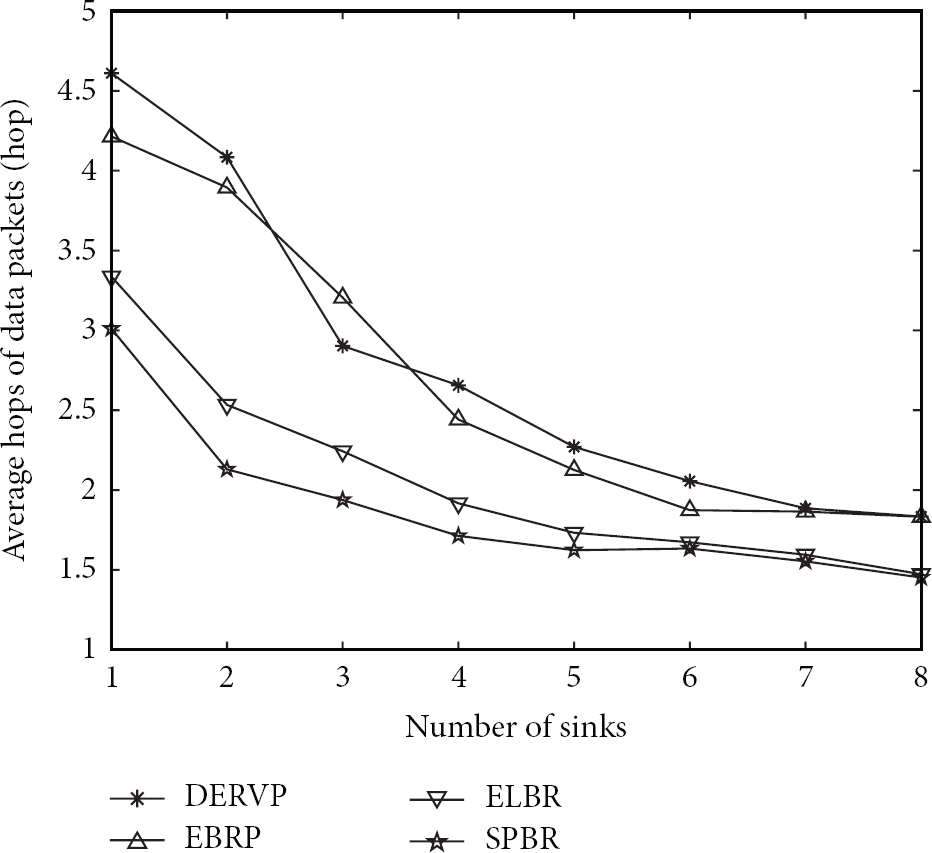
Average hop of data packets.
From the above experimental results, DERVP has prolonged the network lifetime and shows a good performance on energy balance and energy efficiency, compared with some similar routing algorithms. It has constructed hybrid potential field based on depth potential field and energy balance potential field, which has achieved the combination of energy efficiency and energy balance together, and it adjusts its proportion through variable α.
6.3. Impact of α and ε
The parameter α plays an important role in our DERVP algorithm. We conduct experiments to evaluate its impact on the performance of network lifetime, and its value changes from 0 to 1 with the step set as 0.05, which is shown in Figure 7. From this figure, we can see that the network lifetime of DERVP is very close to SPBR, when α is set to be zero. Here, only the depth potential field is effective, which implies DERVP degenerates to the shortest path based routing. When α equals 1, DERVP only takes energy balance factor into consideration when making routing decisions. The performance shows worse trend because data transmissions among sensors with better energy balance effect make no contribution to reaching the sink. Energy of sensors is wasted by these frequent and useless transmissions. When α equals 0.75, the network lifetime achieves the maximal value, which implies an optimal combination of depth potential field and energy balance potential field and achieves an appropriate trade-off between energy efficiency and energy balance.

Impact of α on network lifetime.
The DERVP routing algorithm can use any value of ε in
Network lifetime driven by Atkinson welfare function with different value of ε.

7. Conclusions
Energy is one of the most critical resources for WSNs. Most of works in the literatures about routing in WSNs have emphasized energy efficiency as an important optimization goal. However, merely saving energy is not enough to effectively prolong the network lifetime. It should make an appropriate trade-off between energy efficiency and energy balance.
In this paper, social welfare function, originally used in social sciences to compute income welfare, has been applied to compute the expected energy balance of neighbors when selecting different next hop. Since data transmission pattern and data spatial distribution have similarities with the potential field in physics, we have borrowed the concept of potentiality in classical physics and construct a hybrid virtual potential field based on the depth of sensors to the sink and energy balance of neighbors. The neighbor node with maximum virtual force is selected as next hop, which will force packets to flow toward the sink and achieve balanced energy consumption among sensors.
The designed algorithm DERVP demonstrates its superiority to shortest path based routing (SPBR), energy level based routing (ELBR), and energy-balanced routing protocol (EBRP) with the network lifetime metric. In summary, the proposed algorithm has several desirable properties. First, sensors only need the information of neighbors to make routing decisions, which will cause less overhead and support scalability. Second, through constructing the hybrid potential field and making routing decisions based on the virtual force in it, the algorithm maintains energy efficiency while keeping energy balance. Third, Atkinson welfare function is used to predict the energy balance among neighbors, and routing path will change before the inequality of residual energy of sensors has emerged.
Though the performance of DERVP has been demonstrated by empirical study, the understanding of this approach can be deepened by building theoretical foundations. Two theoretical works are being considered. One is the building of the analytical models of the dynamics of the time-varying potential field, and another is the perfect weight (α) of the hybrid potential field obtained through theoretical analysis.
The algorithm can be extended by considering other problem variants. While achieving optimized energy consumption of the whole networks, the Qos, such as bandwidth, latency, and packet loss rate, will be considered to meet the requirements of the application for multimedia.
Footnotes
Conflict of Interests
The authors declare that there is no conflict of interests regarding the publication of this paper.
Acknowledgment
Financial support for this work provided by the Fundamental Research Funds for the Central Universities (no. 2014QNB22) is gratefully acknowledged.