This work presents a study of detection performance of energy detector in relay-based multihop cooperative diversity networks operating over independent Rayleigh fading channels. In particular, upper bound average detection probability expressions are obtained for three scenarios: (i) multihop cooperative relay communication; (ii) multi-hop cooperative relay communication with direct link and maximum ratio combiner (MRC) at destination; and (iii) multi-hop cooperative relay communication with direct link and selection combiner (SC) at destination. Classical method of performance evaluation based on probability density function (PDF) of received signal-to-noise ratio (SNR) is used. Furthermore, an alternative series form representation of generalized Marcum-Q function is employed in order to simplify the ensuing mathematical derivations. Because the obtained detection probability expressions are in the form of infinite summation series, their respective truncation error bounds are also derived. In the end, analyses are validated with the help of simulations and several observations regarding the impact of different parameters on detector's performance are outlined.
1. Introduction
Recently, a plethora of new wireless services are being introduced, which has in turn increased the demand for radio spectrum. As a result, radio spectrum is facing scarcity problem since most portions of the available spectrum are already allocated for different uses. However, it was reported in [1] that some frequency bands in the spectrum are largely underutilized most of the time. Cognitive radio (CR) [2, 3] has emerged as a firm candidate to address this spectrum scarcity problem. CR allows the unlicensed users to use licensed spectrum when it is vacant due to idle licensed users.
Spectrum sensing is the primary task of a CR transceiver and there are different detection methods to achieve it. These methods include matched filter detection, cyclostationary feature detection, and energy detection [4]. Among these, energy detector has the least implementation complexity and it was first analyzed over noisy channels by Urkowitz [5] to give mathematical expressions for false alarm probability () and detection probability (). Few decades later, [6] revisited the energy detection problem and extended the work of [5] to fading channels. Kostylev [6] analyzed the energy detectors over Rayleigh, Rice, and Nakagami fading channels.
Since the advent of CR, energy detectors have gained enormous attention from researchers due to their simple structure and applicability to CR [7–15]. In particular, [7–9] studied the energy detectors with various diversity combiners over various fading environments. For instance, authors in [7] analyzed the energy detectors with combiners such as equal gain combiner (EGC), selection combiner (SC), and switch-and-stay combiner (SSC) to yield average expressions. Reference [8] further expanded the work of [7] to analyze energy detectors with square-law combiner (SLC) and square-law selection combiner (SLS). Herath et al. [9] considered the same problem for maximum-ratio combiner (MRC) and EGC, using both probability density function (PDF) method and moment generating function (MGF) method. On the other hand, SC was analyzed only with PDF method in [9] because MGF method fails to give complete analytical solution for SC. The motivation for considering diversity combining was to increase the received signal-to-noise ratio (SNR), which in turn improves the detection performance.
Likewise, relay-based cooperative diversity may also improve the detection performance. It was illustrated by [10, 11] that cooperation not only improves the detection performance, but also improves the agility of the overall network. More recently, energy detectors were studied in dual-hop cooperative diversity networks operating over Rayleigh fading channels in [12–15]. Authors in [12] utilized the moment-generating function (MGF) method to derive closed-form upper bound expressions of the average for dual-hop multiple relay cooperative diversity system, utilizing fixed-gain amplify-and-forward (AF) relays. On the other hand, authors in [13, 14] followed the classical probability density function (PDF) method to analyze variable-gain AF relay-based dual-hop three-node cooperative diversity system with MRC and SC at the destination, respectively. In addition, [14] also computed the truncation error bounds for truncating the infinite summation series in the final expressions. Reference [15] considered fixed-gain AF relay-based three-node system to compute exact average expressions, as opposed to the upper-bounds presented in [12–14]. Authors in [15] also calculated the truncation error bounds to truncate infinite summation series in final expressions to finite terms.
Over the past few years, multihop relay communications have gained attention from the radiocommunication research community due to their capability in rendering wider coverage with low transmitting powers. Therefore, in [12], authors briefly outlined the formulation of multihop relaying (without incorporating direct link) for average analysis. An upper-bound on end-to-end SNR was considered in [12], which was further approximated using Padé approximation to find out the MGF of SNR in the multihop relay link. (For details on Padé approximation and ensuing derivations of the MGF, readers are suggested to refer [16].) This MGF was then utilized to obtain an approximate average expression for multihop relay link transmission. It seems that the MGF method of [12] does not grant the analytical solution for average in a multihop cooperative diversity system.
Due to this, we revert back to the classical PDF method of performance analysis in order to obtain analytical average expressions for multihop cooperative diversity network. First, we model an analytical framework to obtain average expression for multihop relay path communication. For this, the PDF of signal's SNR received over the multihop relay path is derived. This PDF is then utilized along with canonical series form representation of generalized Marcum-Q function to obtain average expression of the multihop relay transmission. After that, the PDF of multihop cooperative diversity system is derived where the destination is assumed to combine the received direct and relay path signals using MRC. This PDF is then used to compute the overall average of the multihop cooperative diversity system. In the end, SC is also considered for combining direct and relay path signals. Closed-form PDF expression is obtained for multihop cooperative diversity system with SC, which is then utilized to compute the average of the considered system. Because the obtained analytical expressions were in the form of infinite summation series, their respective truncation error bounds are also calculated. These error bounds can be used to compute the finite number of terms required to achieve a given figure of accuracy. To the best of our knowledge, energy detection problem in multihop cooperative diversity networks is not reported so far in the open literature. It is expected that these analysis will assist in the study of future communication networks such as CRs.
The paper is structured as follows. Section 2 outlines the channel and system model. Section 3 covers the analysis of energy detection in nonfading and fading environments. Section 4 is dedicated to detail the simulation and analytical results and finally the paper is concluded in Section 5.
2. Channel and System Model
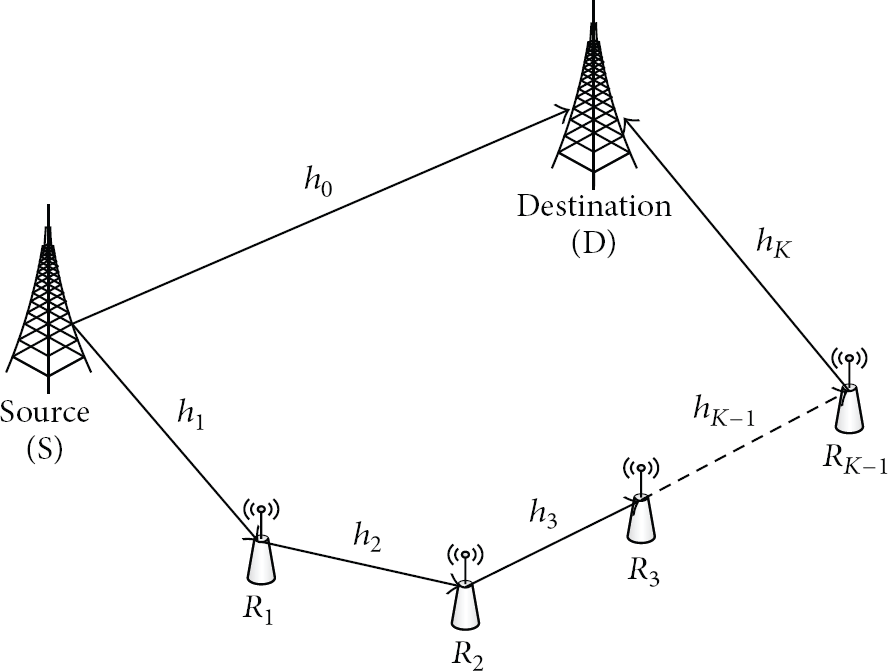
A cooperative network is assumed where the source terminal (S) communicates with the destination terminal (D) with the help of relays (), as shown in Figure 1. Each relay amplifies the signal it receives either from source or from the previous relay and forwards the amplified signal only from previous hop to the next hop neighbour. The system is assumed to be operating over independent and identically distributed (IID), slowly varying, and flat Rayleigh fading channels, where is the channel gain of the direct path and () corresponds to the channel gain for each link in the multihop relay path. Total communication time is divided into K time slots such that each transmitting terminal uses only one time slot to communicate with the next terminal (as in time division multiple access systems). Therefore, the signals received at the destination side from the direct link and multihop relay link [17, equation ], over different time-slots can be, respectively, expressed as
where is the source transmitted unknown deterministic signal and is the additive white Gaussian noise (AWGN) on the direct link. Additionally, and represent the channel gain and AWGN for the kth link while and are the channel gain and noise for the Kth link, in the multihop relay path. We assume that all the AWGNs are modeled as zero mean and variance. For our system model, we choose the relay-gain as . Note that the relays employing this kind of relay-gain are referred to as variable-gain relays [13, 14]. They are on the contrary to fixed-gain relays which were assumed in [12, 15] and have gain, , where is the mathematical expectation operator. An advantage of variable-gain relays over fixed-gain relays is a slightly better performance of the former, which comes at a cost of additional processing overhead. It is because variable-gain relays require the instantaneous channel state information of the preceding hop to produce their gain while forwarding received signals over the next hop. The total end-to-end SNR for the multihop relay path is expressed as [18]
where is the instantaneous SNR of the kth hop. Because channels are assumed to follow Rayleigh distribution, the instantaneous SNR () follows exponential distribution, with cumulative distribution function (CDF) and PDF, respectively, expressed as
where is the average SNR of the kth link and is the mathematical expectation operator.
A multihop cooperative network consisting of a source terminal (S), a destination terminal (D), and multiple relay nodes ().
It is well known that the performance of the multihop relay path is dominated by that of the weakest hop or link [18], because outage in the single hop can cause the entire relay path to fail. Therefore, can be tightly upper-bounded as follows:
This bound is common for the asymptotic analysis of dual-hop relay links; for example, see [12–14]. Furthermore, using the above bound greatly simplifies the ensuing mathematical analysis because of the convenience in finding the associated CDF and PDF statistics, as will become clear in the next section.
3. Mathematical Analysis
In what follows, formulation of energy detection in nonfading environment is outlined first, followed by the mathematical analysis of energy detection in fading channels using cooperative diversity technique.
3.1. Energy Detection in Nonfading Environment
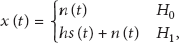
It is well known that spectrum sensing task is the decision problem on the following two hypotheses:
where and are the hypotheses for the absence and presence of signal, respectively. The situation of interest is shown in the block diagram of an energy detector in Figure 2. At the destination, the input signal is fed to the noise prefilter of bandwidth W. The output of this filter is then squared and integrated over the time interval T in order to measure the received energy. Now the output of the integrator, Y, is compared with a predefined threshold, λ, to test the binary hypotheses and . Although this process is of band-pass type, we can still deal with its low-pass equivalent because it has been proved in [5] that both low-pass and band-pass processes are equivalent from a decision statistics point of view, which is our main point of attention. The PDF of Y, , is expressed as [7, 8]
where is restricted to integer values, is the gamma function [19, Section 8.31], and is the vth order modified Bessel function of the first kind [19, Section 8.40].
A generic block diagram of an energy detector.
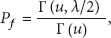
In a nonfading environment, the probabilities of false alarm () and detection () are expressed as [8]
where is the upper incomplete gamma function [19, equation (8.350.2)] and is the uth order generalized Marcum Q-function defined as [20]
An alternate canonical series form representation of the generalized Marcum Q-function is reported in [21, equation (4.74)], which can be further simplified by noting the relationship of finite summation series with upper incomplete gamma function as outlined in [19, Section 8.352] to give
Although the above expression of requires summation up to infinite terms, we will be using this expression subsequently because it aids in simplifying the involved mathematical analysis. The problem of infinite summation will be dealt with by deriving truncation error bounds when truncating the series to finite terms.
3.2. Energy Detection in Fading Environment: Relay Link Only
It is clearly observable that false alarm probability is independent of γ. Therefore, average for the fading channels can be calculated from (7). On the other hand, the detection probability is conditioned on γ. In this case, average may be derived by averaging (8) over the fading statistics:
In order to obtain average for the multihop relay path, it is required to obtain the PDF of . However, a tight upper-bound on , namely, , was noted in previous section to aid in simplification of the involved mathematical derivations. Therefore, we will proceed with the derivation of PDF of in the following to arrive at average expression for the multihop relay communication.
From probability theory, it is well known that if are independent exponential random variables with parameters , then is also exponential with [22, page 246]. Therefore, PDF of can be expressed as
Taking first-order integral of the above with respect to γ, we get the CDF of as shown below:
Substituting (12) and (10) into (11), average for multihop relay path is expressed in integral form as
and the integral in above expression can be solved using the identity reported in [19, equation (3.351.3)] to give as follows:
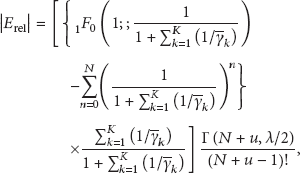
The above expression gives the average for the multihop relay path but is in the form of infinite summation series. The error bound in truncating the infinite summation series in above expression can be obtained as shown in [14]
where the function is a special case of generalized hypergeometric series [19, equation (9.14.1)] and denotes the Pochhammer symbol such that . Finite number of terms required to achieve given figure of accuracy can be easily calculated from the above expression.
3.3. Energy Detection in Fading Environment: Incorporating Direct Link Using MRC
In the preceding subsection, only relay path signals were used for energy detection. Now suppose that direct path signals can also be received at the destination. Then, the destination can combine the direct and relay path signals by means of a predetection diversity combiner as shown in Figure 3, where, and are the weight factors which are different for different combining schemes. All predetection combiners such as MRC, EGC and SC require channel state information (CSI) of each branch in order to combine the received signals. This CSI may be available to relays and destination nodes over control channel or over a broadcast channel through an access point in a cognitive radio network [23, 24].
A hypothetical diagram of a dual-branch predetection combiner followed by an energy detector.
Although the idea of using a predetection combiner with energy detector appears to be contrasting, the main objective of this assumption is to obtain the optimum achievable performance for energy detector. Hence, the analyses presented in this paper clarify the fundamental performance limits of energy detector in a multihop cooperative diversity system. Furthermore, the use of predetection combiners followed by the noncoherent detector have been under investigation by many researches lately. For example, [7, 9, 25] used different predetection combiners to coherently combine the received signals on multiple diversity branches in conjunction with noncoherent detector (Please note that our system model is different from these references as we consider relay-based cooperative diversity system.).
Among various diversity combiners, MRC is considered the optimum combiner because it maximizes the SNR at its output; that is, and correspond to the weights which maximizes the output SNR. Needless to say that the best option for MRC is to choose the weights to be the fading of each branch. The instantaneous SNR at the destination due to MRC combiner can be expressed as
Because of the independence of channels, the PDF of can be computed by convolving the individual PDFs of and as follows:
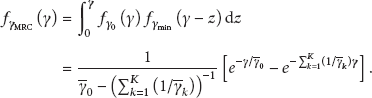
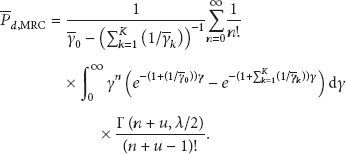
Now, using (10), (11), and (18), the overall average for multihop cooperative diversity system can be expressed in integral form as
Now it is easy to solve the integral in above expression by using [19, equation (3.351.3)] as before. Finally, after some mathematical simplifications, can be expressed as
Note that when (i.e., dual-hop), (20) reduces to the results presented in [13]. Hence, average expression of multihop cooperative diversity system with MRC at the destination, derived in this work is a generalization of the results presented in [13]. The truncation error bound in this case can be expressed as
Using above expression, finite number of terms required to obtain given accuracy figure can be computed.
3.4. Energy Detection in Fading Environment: Incorporating Direct Link Using SC
Although MRC is the optimum combiner for diversity systems, it comes at the cost of increased computational burden on the receiver terminal. SC on the other hand provides comparable performance to that of MRC with less computational burden. It selects the branch with the maximum SNR and performs detection on the signal from the selected path. Therefore, at any instant in SC, the best SNR branch's weight factor will be “1” while the other will be “0.” The instantaneous SNR for the SC is expressed as
Utilizing the CDFs and PDFs of and , the PDF of can be computed using the equation reported in [22, Section 6.2] as follows:
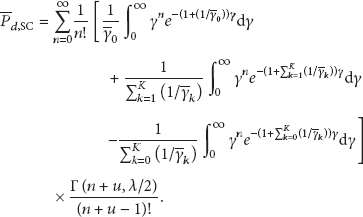
Substituting (10) and (23) into (11), average for multihop cooperative networks with SC at the destination is expressed as
Now all the integrals in above expression are in such form that they can be solved using [19, equation 3.351.3] as before. Therefore, average in this case is
Interesting to note is that, for dual-hop case, the above expression reduces to the results reported in [14, equation ]. Hence average expression of multihop cooperative diversity system with SC at the destination, derived in this work, is a generalization of the results stated in [14]. To the best of our knowledge, no average expression for cooperative multihop diversity system is reported so far in the literature and hence, (20) and (25) are novel.
The truncation error bound while truncating the infinite summation series in above expression is given as
In next section, we show the simulation results and outline several observations based on them.
4. Simulation Results
Analyses of the previous sections are validated using the simulations. Receiver operating characteristic (ROC) curves are plotted with the assumption that all channels are under the influence of independent and identically distributed (IID) Rayleigh fading and average SNR on each link is equal, that is, . Threshold (λ) values are computed by varying from to , using (7). Several observations are made which are outlined below.
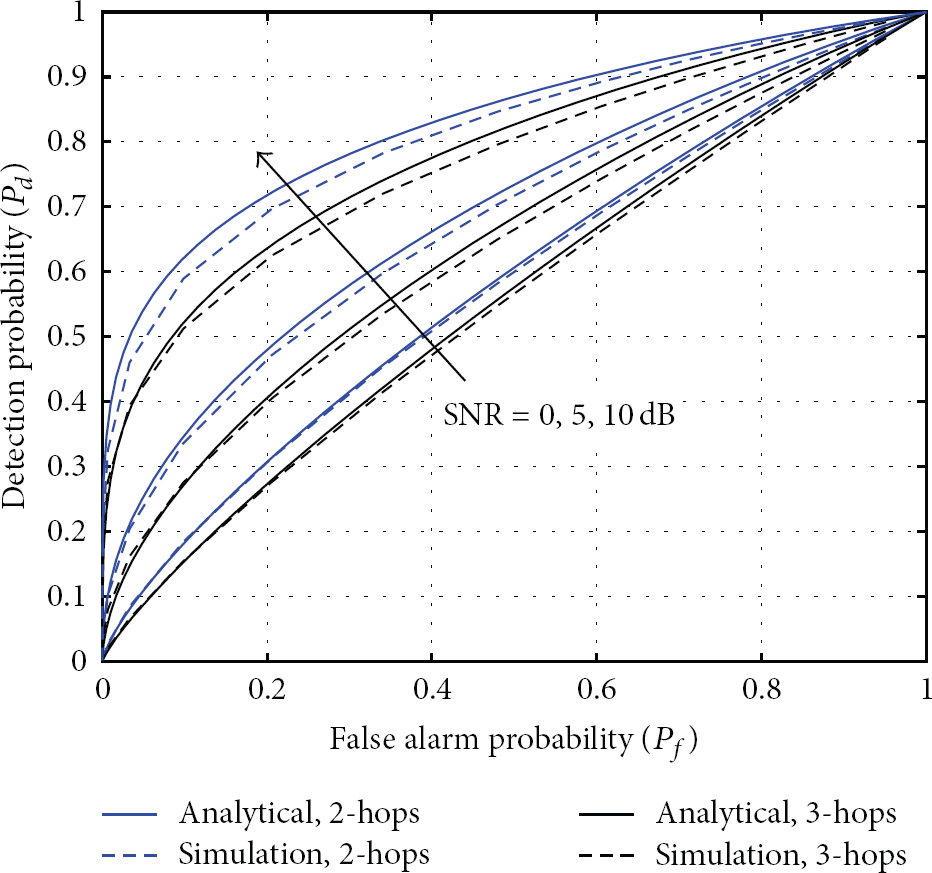
Figure 4 shows the comparison of analytical equation (15) with its simulation counterpart. The curves are plotted against different number of hops (K) on varying values of SNR. Furthermore, the value of u is fixed at . It is clearly observable that the analytical curves of this study lie tightly above their corresponding simulation curves at different values of SNR and K, indicating the accuracy of our analysis. Secondly, it is evident from this figure that, with increasing SNR, the detection performance of energy detector also improves, as expected.
ROC curves comparing analytical with its simulation counterpart at different values of SNR and different number of hops (K).
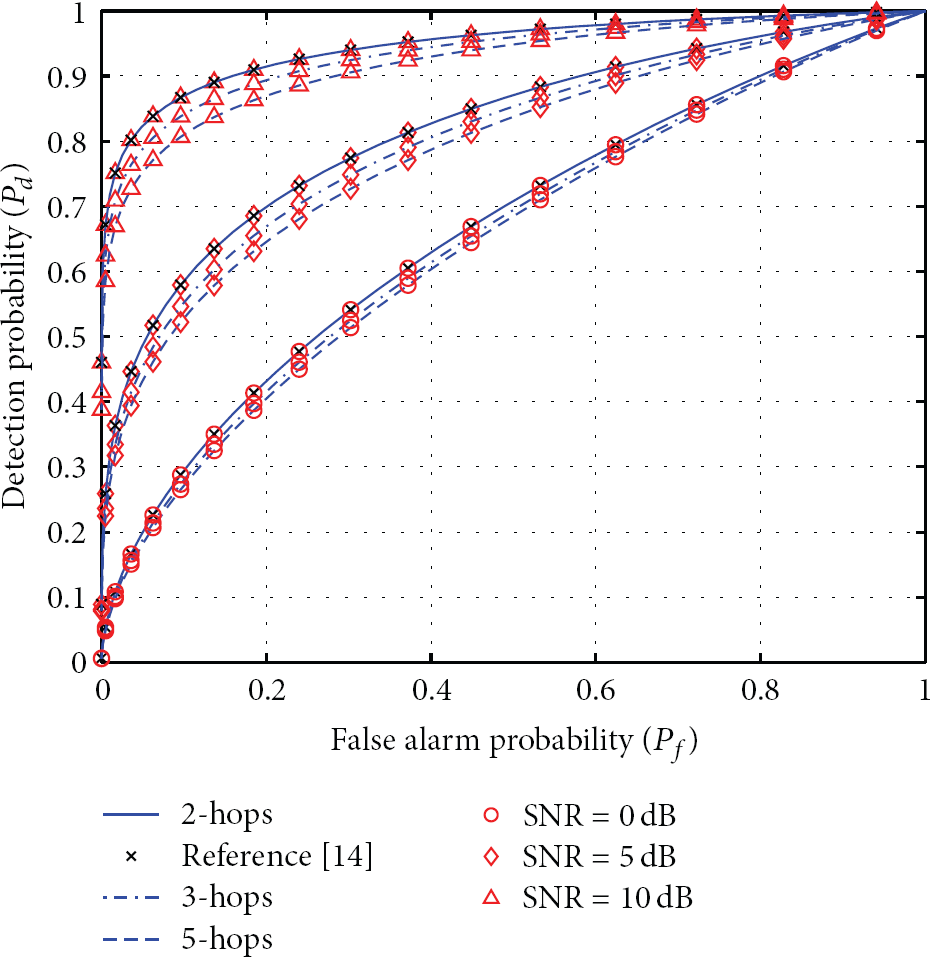
In Figures 5 and 6, the analytical curves for (20) and (25) are plotted against different number of hops at varying values of SNR, respectively. For comparison, analytical results of [13], which considers dual-hop cooperative diversity system with MRC at destination, are also plotted in Figure 5. Likewise, the results of [14] are shown in Figure 6 for comparison with (25) of this study. As was noted in the previous section, the analytical curves of [13, 14] coincide with the analytical curves of (20) and (25), respectively. Hence, it shows that this study is a generalization of the results presented in [13, 14]. Furthermore, from the study of multihop systems [17, 18], it was substantiated that the performance of such systems decrease with the increase in number of hops. This is also consolidated through this study because with increasing number of hops, the detection performance deteriorates, as can be seen in both figures. Moreover, it should be noted that, with increasing number of hops, the ensuing communication delay also increases. Therefore, it seems optimal to keep the number of hops minimal to ensure signal detection within feasible time.
ROC curves of with different number of hops at various SNR values along with the results of [13] for comparison.
ROC curves of with different number of hops at various SNR values along with the results of [14] for comparison.
To see the effect of number of samples (u) on detection performance, ROC curves for and are plotted over different SNRs and varying values of u, in Figure 7. At each given SNR value, detection performance deteriorates when u is increased. It is in agreement with various previous studies of the energy detectors because for a same signal energy, energy detector exhibits better performance with fewer number of samples [14]. Finally note that MRC provides slightly better detection performance than SC at each value of SNR and u. However, this performance improvement comes at the cost of increased implementation complexity of MRC over SC. Hence, choice of combiner can be made depending on the flexibility of desired performance matrices.
ROC curves comparing and at various SNR values and different number of samples ().
Required number of terms for a given figure of accuracy, as per (16), (21), and (26), is listed in Table 1. For fixed values of and , the table is populated by varying SNRs and number of hops. The number of terms listed in Table 1 is used to simulate the analytical results in Figures 4–7.
Required number of terms for four figure accuracy.
Energy detector appears as a preferred choice for spectrum sensing in cognitive radio-based systems because of its low implementation complexity. Because of this, energy detectors are under investigation by many researches lately. Nevertheless, energy detectors are known for poor performance at low SNR values. Therefore, relay-based cooperative diversity was proposed as one of the solutions to cope with this problem.
In this work, detailed mathematical analysis was presented to quantify the energy detector in multihop cooperative relay networks. Average detection probability expressions were derived both for the multihop relay transmission and for the multihop cooperative diversity system where the system was assumed to be operating over IID Rayleigh fading channels. Truncation error bounds were also calculated because the obtained expressions were in the form of infinite summation series. In the end, the derived analytical results were validated with the help of simulations. It is expected that these analyses will turn out to be helpful in the study of future communication technologies such as cognitive radio.
Footnotes
Conflict of Interests
The authors declare that there is no conflict of interests regarding the publication of this paper.
Acknowledgment
This work was developed within nSHIELD project () cofunded by the ARTEMIS JOINT UNDERTAKING (Subprogramme SP6) focused on the research of SPD (Security, Privacy, Dependability) in the context of Embedded Systems.
References
1.
Spectrum policy task forceReport ET Docket200202-135Federal Communications Commission
2.
MitolaJ.IIIMaguireG. Q.Jr.Cognitive radio: making software radios more personalIEEE Personal Communications19996413182-s2.0-003317133010.1109/98.788210
3.
HaykinS.Cognitive radio: brain-empowered wireless communicationsIEEE Journal on Selected Areas in Communications20052322012202-s2.0-1384429640810.1109/JSAC.2004.839380
4.
AkyildizI. F.LeeW.-Y.VuranM. C.MohantyS.Next generation/dynamic spectrum access/cognitive radio wireless networks: a surveyComputer Networks20065013212721592-s2.0-3374564809110.1016/j.comnet.2006.05.001
5.
UrkowitzH.Energy detection of unknown deterministic signalsProceedings of the IEEE196734523531
6.
KostylevV.Energy detection of a signal with random amplitude3Proceedings of the IEEE International Conference on CommunicationsApril 200216061610
7.
DighamF. F.AlouiniM.-S.SimonM. K.On the energy detection of unknown signals over fading channels5Proceedings of the International Conference on Communications (ICC '03)May 2003357535792-s2.0-0038648984
8.
DighamF. F.AlouiniM.-S.SimonM. K.On the energy detection of unknown signals over fading channelsIEEE Transactions on Communications200755121242-s2.0-3384767484610.1109/TCOMM.2006.887483
9.
HerathS. P.RajathevaN.TellamburaC.Energy detection of unknown signals in fading and diversity receptionIEEE Transactions on Communications2011599244324532-s2.0-8005295169610.1109/TCOMM.2011.071111.090349
10.
GanesanG.LiY.Cooperative spectrum sensing in cognitive radio, part I: two user networksIEEE Transactions on Wireless Communications200766220422132-s2.0-3454775038810.1109/TWC.2007.05775
11.
GanesanG.LiY.Cooperative spectrum sensing in cognitive radio, part II: multiuser networksIEEE Transactions on Wireless Communications200766221422222-s2.0-3454777625310.1109/TWC.2007.05776
12.
AtapattuS.TellamburaC.JiangH.Energy detection based cooperative spectrum sensing in cognitive radio networksIEEE Transactions on Wireless Communications2011104123212412-s2.0-7995547362510.1109/TWC.2011.012411.100611
13.
MughalM. O.GuJ.KimJ.Detection probability analysis for AF assisted cooperative spectrum sensing in cognitive radio networksProceedings of the International Conference on ICT Convergence (ICTC '11)September 20114614642-s2.0-8375517270910.1109/ICTC.2011.6082638
14.
MughalM. O.RaziA.KimJ. M.Tight upper bounds on average detection probability in cooperative relay networks with selection combinerTransactions on Emerging Telecommunications Technologies201310.1002/ett.2649
15.
MughalM. O.RaziA.AlamS. S.MarcenaroL.RegazzoniC. S.Analysis of energy detector in cooperative relay networks for cognitive radiosProceedings of the 7th International Conference on Next Generation Mobile Apps, Services and Technologies (NGMAST '13)2013220225
16.
KaragiannidisG. K.Moments-based approach to the performance analysis of equal gain diversity in Nakagami-m fadingIEEE Transactions on Communications20045256856902-s2.0-294255065310.1109/TCOMM.2004.826255
17.
AsghariV.da CostaD. B.AissaS.Performance analysis for multihop relaying channels with nakagami-m fading: ergodic capacity upper-bounds and outage probabilityIEEE Transactions on Communications201260102761276710.1109/TCOMM.2012.081012.100156
18.
HasnaM. O.AlouiniM.-S.Outage probability of multihop transmission over Nakagami fading channelsIEEE Communications Letters2003752162182-s2.0-003760450610.1109/LCOMM.2003.812178
19.
GradshteynI. S.RyzhikI. M.Table of Integrals, Series, and Products20077thAcademic PressMR2360010
20.
NuttallA. H.Some integrals involving the functionIEEE Transactions on Information Theory197521195962-s2.0-0016431391
21.
SimonM. K.AlouiniM. S.Digital Communications over Fading Channels20052ndWiley
22.
PapoulisA.Probability, Random Variables, and Stochastic Processes19654thNew York, NY, USAMcGraw-HillMR0176501
23.
Carlos de CordeiroM.Kiran ChallapaliS.BirruD.ShankarS. N.Ieee 802. 22: an introduction to the first wireless standard based on cognitive radiosJournal of Clinical Microbiology2006113847
24.
AlmalfouhS. M.StüberG. L.Uplink resource allocation in cognitive radio networks with imperfect spectrum sensingProceedings of the IEEE 72nd Vehicular Technology Conference Fall (VTC '10)-FallSeptember 2010162-s2.0-7864939865610.1109/VETECF.2010.5594305
25.
MaJ.ZhaoG.LiY.Soft combination and detection for cooperative spectrum sensing in cognitive radio networksIEEE Transactions on Wireless Communications2008711450245072-s2.0-5714914616410.1109/T-WC.2008.070941