




Abstract
Monitoring vital signs in athletes, mainly during training, is of crucial importance for both the athlete and the coach, in order to avoid overtraining. Overtraining is an extreme state of fatigue that forces athletes to rest for several weeks having a negative impact on athlete's performance, health, and daily life. A wireless sensor network (WSN) combines embedded computing technology with communication technology in order to collect information of the network coverage area and send it to the observer. In this paper, we present results of system's performance evaluation for the IEEE 802.15.4 standard, including the physical (PHY) layer and media access control (MAC) sublayer, in order to collect and store large sets of athletes’ data as well as providing results about network values such as end-to-end delay, load, and throughput captured from global and objects statistics.
1. Introduction
Wireless sensor networks (WSNs) are a technology that has been used in a vast number of applications such as environmental monitoring, acoustic detection, seismic detection, military surveillance, inventory tracking, and medical monitoring with successful results. Because of their fast development, the WSNs are getting more and more popular in the scientific and technological field. Several studies on medical, commercial, and industrial applications have shown successful and promising outcomes, increasing the interest of new users towards this type of monitoring solutions. This type of network is defined as a group of autonomous sensor nodes that send their sensed data to a main network gateway by using a radio frequency channel of communication. Wireless sensor networks consist of light-weight, low power, and small size sensor nodes (SNs). They have ability to monitor, calculate, and communicate wirelessly. These devices are mostly based on a low power consumption design, making it possible to power the network's sensor nodes with their own individual batteries and keep an extended lifetime through even several years of operation without having to restore any of them [1].
Monitoring vital signs in athletes, during training, is highly important in order to avoid overtraining. In order to detect overtraining, the training load of each athlete needs to be monitored and individualized. Training load is the product of training volume times the training intensity, where training volume usually refers to the duration of training and training intensity refers to how hard someone is training. The intensity of training can be objectively measured via vital signs and specialized indexes, such as heart rate, oxygen consumption, weight lifted, power output, blood lactate concentration [2], and hormonal levels [3]. The main advantage of the first four indexes is that their monitoring is noninvasive. Another noninvasive measure of training load, often used by coaches, is maximal oxygen consumption (VO2max). More specifically, Billat et al. [4] studied the effect of normal and overload interval training at VO2max on aerobic parameters and overtraining markers such as subjective ratings of fatigue and muscle soreness. On the other hand Borresen and Lambert [5] tried to establish the relationship between the session rating of perceived exertion, which is subjective, and the training impulse as well as heart rate zones that are objective in order to quantify the training load. In order to do so they monitored the heart rate and the perceived exertion of thirty-three participants trained ad libitum for 2 weeks. Finally Caretti et al. [6] monitored ventilatory patterns and respiratory timing in 14 subjects during cycling and treadmill exercise at similar leg frequencies to determine if mode of exercise affects patterns of ventilation and respiratory timing and proved their independency.
Nowadays sensors which make feasible the monitoring of the abovementioned indexes are available [7–12]. In more detail Tikkanen et al. [7] used shorts with textile electromyographic (EMG) electrodes to detect ventilatory threshold during running in typical training conditions. The shorts were made of knitted fabric similar to elastic clothes used for sport activities and due to special textile sensors had the capability to measure EMG from the skin surface of the thigh areas. The shorts were also equipped with conductive electrodes and wires integrated into the fabric, which transfer the EMG signals from the electrodes to the electronics module. Another textile sensor is referenced in the work performed by Li and Kim [10] which is a patch-type sensor module that monitors one-channel ECG and three-axis acceleration making the real-time analysis of movement status and heart rate possible. A communication module is also integrated into the device to transmit heart rate and acceleration information. Finally, Choi and Jiang [12] have developed wearable cardiorespiratory signal sensor which consists of a belt-type sensor head including a couple of conductive fabric sheets and a PVDF film, signal acquisition circuits, and a USB communication module which is used to transmit the signal to computer for data display and analysis.
In order for the data collected by the sensors to be useful these should be available in real time. The raising question concerns the use of the proper communication protocol that is going to make the data provided by these sensors reliable and usable. In the literature, wired protocols such as RS232 [13] and serial peripheral interface (SPI) [14, 15] have been used in combination with electrocardiogram (ECG) and respiration rate sensors. As far as wireless communication protocols are concerned Wi-Fi [16] and Bluetooth [17] have been used coupled to sensors monitoring heart rate, breathing rate, body temperature, position, activity, and posture. It is obvious that for athletic applications only wireless communication protocols are suitable.
In this paper we focus on the performance evaluation of the IEEE 802.15.4 standard in an athletic field area through star topology using the OPNET simulator. We simulate and analyzed a specific scenario, where we examine network values and performance of the ZigBee standard such as end-to-end delay, load, and throughput. The aim of this paper is not to contribute to basic research in the area of wireless standards, but to present and to investigate whether the specific protocol is appropriate for the specific application of vital signs sensors’ WSN for the monitoring of athletes.
Through the remaining sections, the presentation is organized as follows. First, the architecture of wireless communication protocols specified for wireless sensor networks is described in Section 2. Furthermore, the experimental system hardware, which is currently under development and will be used for future field measurement purposes, is described in Section 3. Following that, Section 4 presents the simulation results achieved by using OPNET simulator for physical and MAC layer performance estimation. Finally, conclusions are given, offering quantitative evaluation of the proposed approach in Section 5.
2. Wireless Communications Protocols
The RF category (short-range radio frequency) includes a broader range of technologies and has become synonymous with Bluetooth, Wi-Fi, and ZigBee. Although the material presented in this section is widely available in the literature, we provide key information about these technologies for completeness reasons. We especially focus on a brief overview about ZigBee since the scope of this paper is to evaluate its performance customized for vital signs sensors athletic applications.
Bluetooth [18] is an industrial standard for wireless personal area networks (WPAN). It is a wireless short-range telecommunications technology, which can transmit signals through microwaves to digital devises, using a globally available short-range radio frequency. Bluetooth operates in the 2.4 GHz frequency range, thus providing the ability to operate devices anywhere in the globe. This technology allows both point-to-point connection of devices and the concurrent connection of up to 7 devices using a single frequency. The transmission range of the radio devices using Bluetooth technology is limited to 10 meters, while the transmission rate can reach 720 kbps. The key specifications of Bluetooth refer to the physical layer and MAC sublayer, where different protocols have been developed for different applications.
The 802.11 standards, which are widely known with term Wi-Fi, constitute a set of IEEE standards for the creation of wireless local area networks (WLAN) and when initially introduced were destined to expand the wired computer connection (Ethernet) to the wireless area. The 802.11 family contains a series of standards, the basics of which are 802.11a, 802.11b, and 802.11g. These standards use the orthogonal frequency division multiplexing method (OFDM) and provide theoretical speeds up to 54 Mbps. The 802.11a uses the frequency band of 5 GHz but does not provide compatibility with the respective network cards used by the other two standards. The 802.11b and 802.11g transmit at 2.4 GHz and are compatible between them and provide maximum possible speed when communicating between them. Wi-Fi became known during the last years, creating a new method for devices to access the Internet. Any device bearing a wireless Wi-Fi networking card found within the area of coverage of another wireless network (access node) which has access to the Internet can also connect to the Internet. Moreover, in an area there can be more than one wireless network with Internet access which can connect between them. This is called a hotspot. It is understood that Wi-Fi technology allows the connection of any device (laptop, cellular phone, etc.) to the Internet. It should be noted that several standards belong to the 802.11 family, which constitute upgrades of services, additions, and expansions to the already existing specifications [19]. For 802.11p it should be noted that it started in the USA in 1999 by FCC (Federal Communications Commission), which granted a spectrum of 75 MHz in the frequency range 5.850–5.925 GHz; this was named 5.9 GHz DSRC (Dedicated Short-Range Communication) and was developed in order to be used between vehicles and elements on the various sides of a road.
The Wi-Fi standard defines the following networking topologies [20, 21]:
IBSS (independent basic service set) or ad hoc topology,
infrastructure.
The ZigBee protocol is an excellent choice for low power, low cost, and low data rate communication applications. Some of the advantages of ZigBee are that it offers support of multiple network topologies such as point-to-point and mesh networks with up to 65000 nodes per network and features a 128-bit AES encryption for increased security between data connections. These make ZigBee a good choice for wireless local area networking. Furthermore the network capabilities of ZigBee provide more functionalities especially for the field of medical body area networks [22]. Due to lower power consumption this wireless technology offers longer run time for battery powered sensor devices and makes it ideal for our project. The following subsections give an overview of the specific protocol.
2.1. The ZigBee Protocol
The specific technology was proposed by many to be used in automatic counter networks in conjunction with IEEE 802.15.4 standard, in order to create a wireless grid-like network. This protocol and installation combination could guarantee real-time data gathering. The key element of 802.15.4 standard is the device or node. The possible types used are the following two: the full function device (FFD) and the reduced function device (RFD).
A network based on 802.15.4 standard has at least one FFD node, which plays the role of the central coordinator of the network, or of a private area network coordinator (PAN coordinator). In addition, FFD can function as the local coordinator in a network area, or as simple device. These networks consist of FFD nodes that can communicate with any other node within their range and of RFD nodes that have the ability to communicate only with the nearest FFD or the central FFD node, which are usually connected to another network or computer. The backbone of the network consists of the FFD nodes, while RFD performs simple tasks. Moreover, each node is defined by an address which can be either a 64-bit Ι Ε Ε Ε address or a 16-bit one.
The topologies supported by Ι Ε Ε Ε 802.15.4 standard are the following three.
2.1.1. Peer-to-Peer Topology (Mesh Network)
Under this topology, each device communicates with any other device in its range and it is also possible to derive other topologies (the other two types). The device defined as PAN coordinator is one and it is usually the one to connect first with the network (Figure 1).

Peer-to-peer topology.
2.1.2. Star Topology
In this case, upon first activation of the FFD device, this installs its network and can operate as PAN coordinator. In addition there is also a PAN identifier, which is unique to each network in its range and provides the ability for all the star networks to operate independently of the other similar networks at the specific mode (Figure 2).
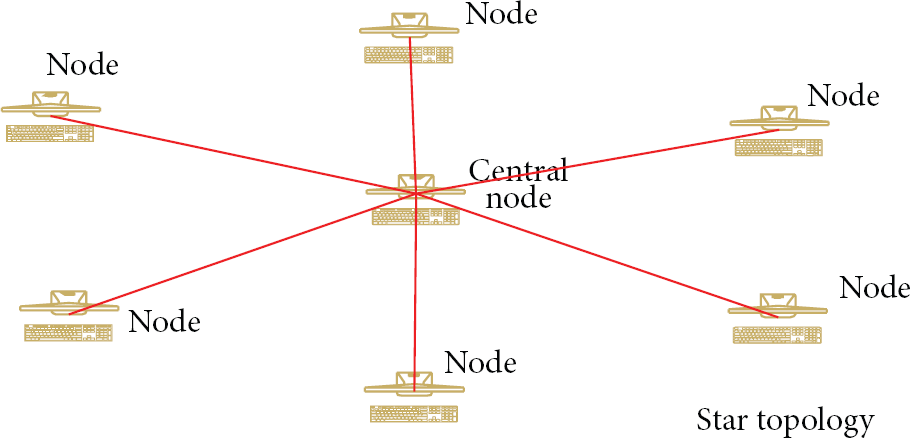
Star topology.
2.1.3. Cluster-Tree Topology
Most devices of this topology are mainly FFD, while an RFD device, given that it can only communicate with a single FFD at a time, must be located at the end of the cluster. This topology is a special case of peer-to-peer topology. Its key advantage is the coverage of a broader area, but it lacks in message transmission speed. Each FFD can function as a coordinator and coordinate the actions of the other devices or coordinators. However, the PAN coordinator of the entire network, which has the greatest demands and consumption, can only be one coordinator (Figure 3).

Cluster-tree topology.
PAN coordinator forms the first cluster, in which it plays the role of cluster head (CLH), and which has as cluster identifier (CID) value 0. Moreover, CLH selects a nonused PAN identifier and starts data transmission to neighboring devices. Any device that wishes to connect must receive an authorization through CLH by PAN coordinator. If connection is allowed, then it is characterized by the neighboring devices as a child, while it characterizes CLH as the parent and starts data transmission. If connection license is not provided, then it searches for another CLH of another cluster. On the other hand ZigBee protocol complements 802.15.4 standard determining the stack of protocols used by the network layer and above. The ZigBee protocol stack is found immediately above the physical layer and MAC sublayer is determined by standard 802.15.4. The protocols defined are provided in Section 2.2.
2.2. 802.15.4 MAC Layers
2.2.1. NWK Network Layer (ZigBee Network Layer)
This is essentially the connection of standard 802.15.4 and ZigBee as it ensures the proper function of MAC sublayer and offers the adequate services at applications layer. Moreover, it avails all possible networking topologies and is responsible for the organization and operation of a multihop network based on IEEE 802.15.4. Finally, it maintains the proper and reliable communication between the devices, while at the same time checking for neighboring networks that are active so as to avoid usage of common frequencies by different devices.
2.2.2. Application Layer, APL (ZigBee Application Layer)
This is the most complex layer and it provides the appropriate structure for the development and communication of applications. It consists of the application objects, ZigBee application object ZigBee, and sublayer application support sublayer—APS. Application objects are applications executed on a device, while a ZigBee application object offers the interconnection of application objects so as to identify other devices and the services they provide. Moreover, application support sublayer—APS—is responsible for ensuring the connections between devices and for forwarding the data packages of the devices. In addition, this layer communicates with the security service provider.
2.2.3. Application Operation Framework, AF (ZigBee Application Framework)
This layer is responsible for maintaining and preserving all application objects in the network. It avails up to 240 application objectsas well as user-defined applications, which are also part of ZigBee application.
In this technology, special attention has been paid to its use as a solution for the connection of counters, as it is designed for low rate applications consuming minimum power, extending thus the devices life-cycle. However, a series of drawbacks must be pointed out. Bandwidth is particularly low (20 Kbps at 868 GHz and 250 Kbps at 2.4 GHz). Moreover, upon increase of the network nodes, interference increases drastically and this renders the connections and routing paths unstable.
Although RF technology is used by many countries in counters connection, the services it offers are particularly limited. For this reason, it is imperative to use an alternative method which shall be able to cater for the disadvantages and limited abilities of RF.
3. Research Methodology: Hardware Description
One of the goals of our research is to have a better insight of the circumstances under which training can become ineffective and to recognize the factors that are connected to this unwanted result. This will require monitoring multiple athletes in their everyday training program and gathering data of their vital signs such as temperature, sweating, and heart rate.
The most basic data acquisition system is going to consist of a “coach terminal” device and a “sensors’ node” device. The sensors’ node will be attached on the athlete and transmit the sensors’ data wirelessly to the “coach terminal.” The amount of the data required to get a reliable result should be as much as possible. The use of wireless sensor networks instead of just a single wireless channel allows us to have multiple sensors’ nodes all monitored at the same time. This will dramatically increase the acquired data volume and can also contribute to having a better overview of the training state of each and every athlete in the court.
The processing of these data will give us a first impression of the way the body of an athlete reacts to overtraining. Combining these data with other relevant research results and the coach's professional knowledge we will be able to export some objective and easily applicable criteria, such as thresholds in vital signs that prevent overtraining and fatigue.
Hopefully, the observation in everyday training of athletes through our monitoring system, in order to keep training compliant with the resulting criteria, will provide coaches and athletes with a useful and reliable tool to work with; it will improve athletes’ performance in the long term and reveal new approaches of making coaching easier, more objective, and more effective.
The hardware (HW) of this project which is currently at the development stage and will be used for future field measurement purposes is based on the Arduino development boards [23]. Arduino development boards are based on Atmel's AVR family of microcontrollers. Some of the advantages of Arduino boards are that they provide an inexpensive solution for new developers and that they are open-source hardware. This means that the schematics and printed circuit boards (PCBs) of the boards are open-access published so that any end user can improve, extend, or modify it according to his needs.
The extensibility of the boards is assured not only by its open-source hardware nature but also by the availability of a wide variety of interchangeable add-on modules known as “shields.” The shields provide a plug “n” play interface between sensors or modules and the main board. The functionality of the modules on shields defines its use.
Our monitoring system consists of two HW devices: the “coach terminal” device and the “sensors’ node” device. One sensors’ node will be attached on each one of the athletes that will be monitored. These will be responsible for reading different sensors and sending wirelessly the accumulated data to the coach terminal. The coach terminal is the interface between the sensors’ nodes and the computer where the received data will be stored and processed.
The main board of the sensors’ nodes is based on the architecture of a very popular Arduino board, namely, the “Arduino UNO” which is using the ATmega328 microcontroller. In order to get readings of the vital signs a commercially available shield is used as the basis of our design. Specifically, the e-health sensor platform [24] which includes a variety of sensors and implements their interface in a single board was selected. This can be of great use in order to monitor the athletes in any possible aspect. As already mentioned in Section 2, the wireless communication is provided by a ZigBee wireless module.
The coach terminal device is developed in the same sense as the sensors’ node device. The only differences are that the coach terminal board is designed to offer increased connectivity to peripherals and has no so strict portability restrictions (size, weight, and power consumption). It is based on the architecture of the “Arduino Leonardo” board which provides native USB functionality. Another key connectivity feature is based on the “Arduino Ethernet” shield which provides an easy interface between the microcontroller and a computer through a LAN network.
4. Simulation Results
4.1. The OPNET Simulation Platform
In the field of industry, OPNET modeler [25] is one of the fundamental and dominant network implementation and simulation tools. This platform allows the design and thorough study of devices, applications, protocols, and telecommunication networks offering great flexibility and scalability depending on the level (layer) of the network concerned. It offers wireless protocols and technologies design, testing, and demonstration of designs in real-world scenarios before the development and design of mobile communication networks applications, taking into account the effect of geographical characteristics of soil, wireless network protocols design for maximum support of military operations, and an assessment of the battlefield from the standpoint of telecommunications capabilities.
4.2. Simulation Model Implementation Description
The main objective was the development and study of a communication network between athletes and coordinator (coach) as shown in Figure 4. This requirement stemmed from the need to link and identify the athlete in an athletic field area network, anywhere within the area, with the aim of exchanging data with the coordinator. Thus, the primary objectives were the simulation of a ZigBee wireless communication network with star topology that would contain four subscribers (subscriber stations), the athletes, who would be able to communicate in real time with a database (coordinator), and the coach and send their identification and status data over a short period of time, so as to enable fast processing and direct communication of the users with the central nodes of the network.

Geographic positioning in simulation environment.
The area selected for the simulation was a typical stadium. The International Association of Athletics Federations (IAAF) [26] sets standards for tracks used in international and elite competitions, as well as minimum standards for a track to meet the requirements for world record performances. An outdoor track measures 400 meters (m) around, with standard IAAF measurements of 84.39 m for the straights and 115.61 m for the curves. The subscribers are moving anticlockwise to a specific circular trajectory round the area with different speeds (8 to 10 Km/h). Thus, through OPNET there would be implementation and simulation of the specific network and, depending on the results, conclusions would arise on whether the specific service was to operate in real time, without congestion issues.
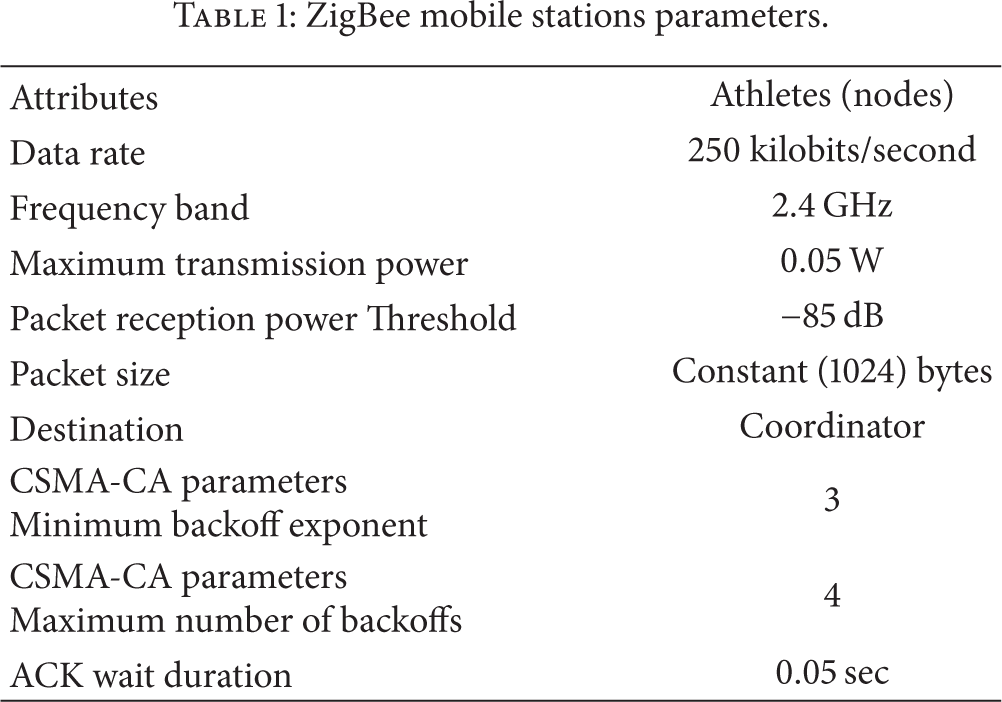
In our ZigBee mobile stations there was determination of certain attributes that were necessary in order to perform the simulation. These are shown in Table 1 and were defined in the various nodes through the attributes window.
ZigBee mobile stations parameters.
At the beginning, mobile stations of the network were requested to send a large amount of information related to their status. One can collect values from individual nodes in the network (node statistics) or from the entire network (global statistics). Global statistics can be used to gather information about the network as a whole. Node statistics provide information about individual node such as coordinator, router, or end device. The five nodes (one coordinator and four athletes) in the athletic field topology were identical. The Global Statistics of the network, whose graphs will be examined, are listed and analyzed in the following.
End-to-End Delay (sec). It is the time that lapsed between creation and reception of an application packet.
Traffic Received (bits/sec). It represents the application traffic received by the layer across the network.
Traffic Sent (bits/sec). It represents the application traffic sent by the layer in bits/sec through the network.
The node statistics of the network are analyzed below.
Data Traffic Received (bits/sec). It represents the average number of bits per second for traffic successfully received by the MAC from the physical layer. This includes retransmissions.
Data Traffic Sent (bits/sec). It represents the traffic transmitted by the MAC in bits/sec. While computing the size of the transmitted packets for this statistic, the physical layer and MAC headers of the packet are also included.
Delay (sec). It represents the end-to-end delay of all the packets received by the 802.15.4 MAC of this WPAN node and forwarded to the higher layer.
Load (bits/sec). It represents the total load submitted to the 802.15.4 MAC by its higher layers in this node.
Throughput (bits/sec). It represents the total data traffic in bits/sec successfully received and forwarded to the higher layer by the 802.15.4 MAC.
Traffic Received by Destination (bits/sec). It represents the application traffic sent by this node that is received at the destination.
Traffic Sent (bits/sec). It represents the application traffic sent by the node.
The duration of the simulation was selected to be 1 minute due to the amount of data required to be processed. The results and graphs are presented in Figures 5–11.
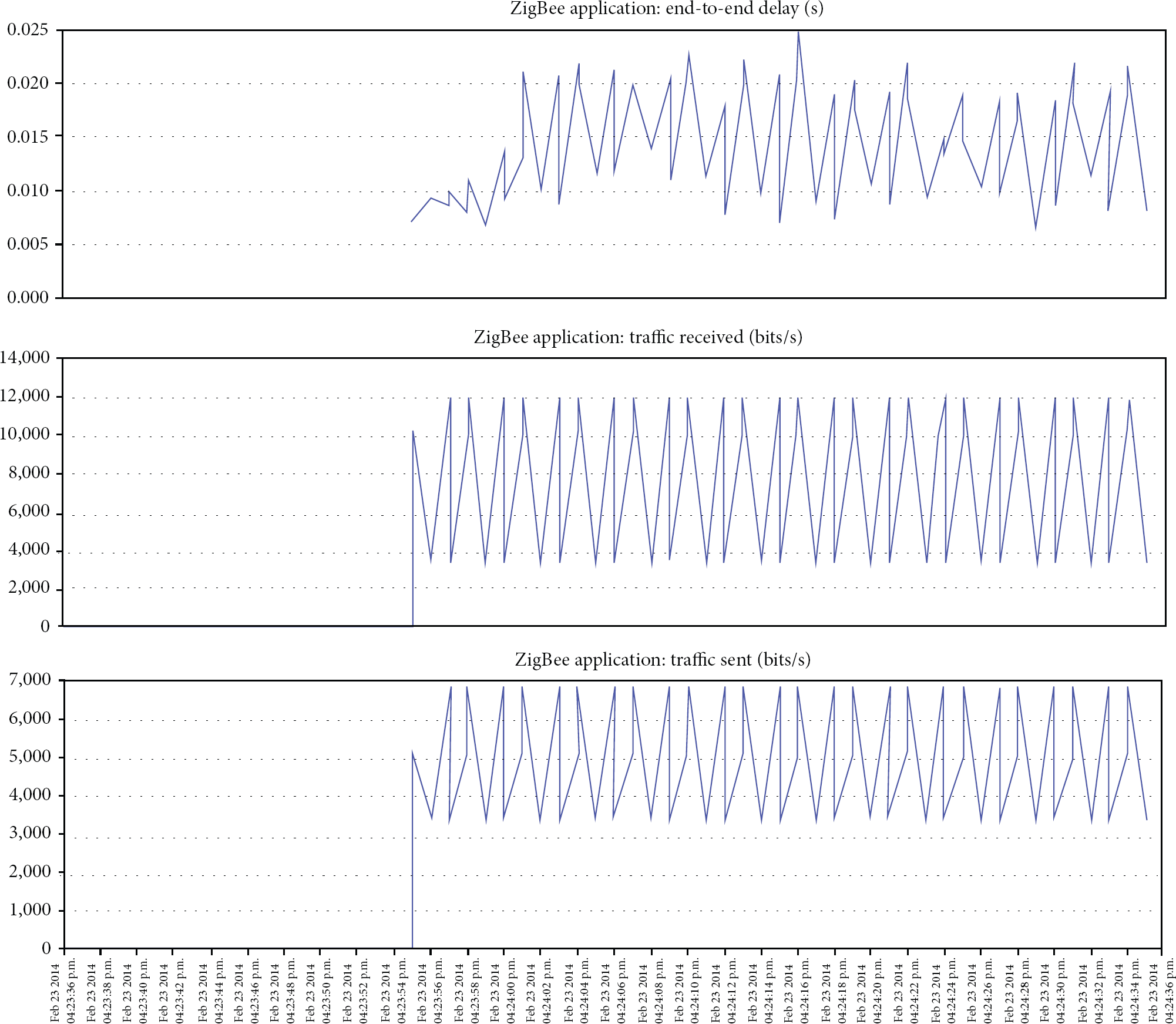
Global statistics (end-to-end delay, traffic received, and traffic sent).

Coordinator statistics (end-to-end delay, traffic received, and traffic sent).

Coordinator statistics (MAC traffic received, MAC traffic sent, MAC delay, MAC load, and MAC throughput).
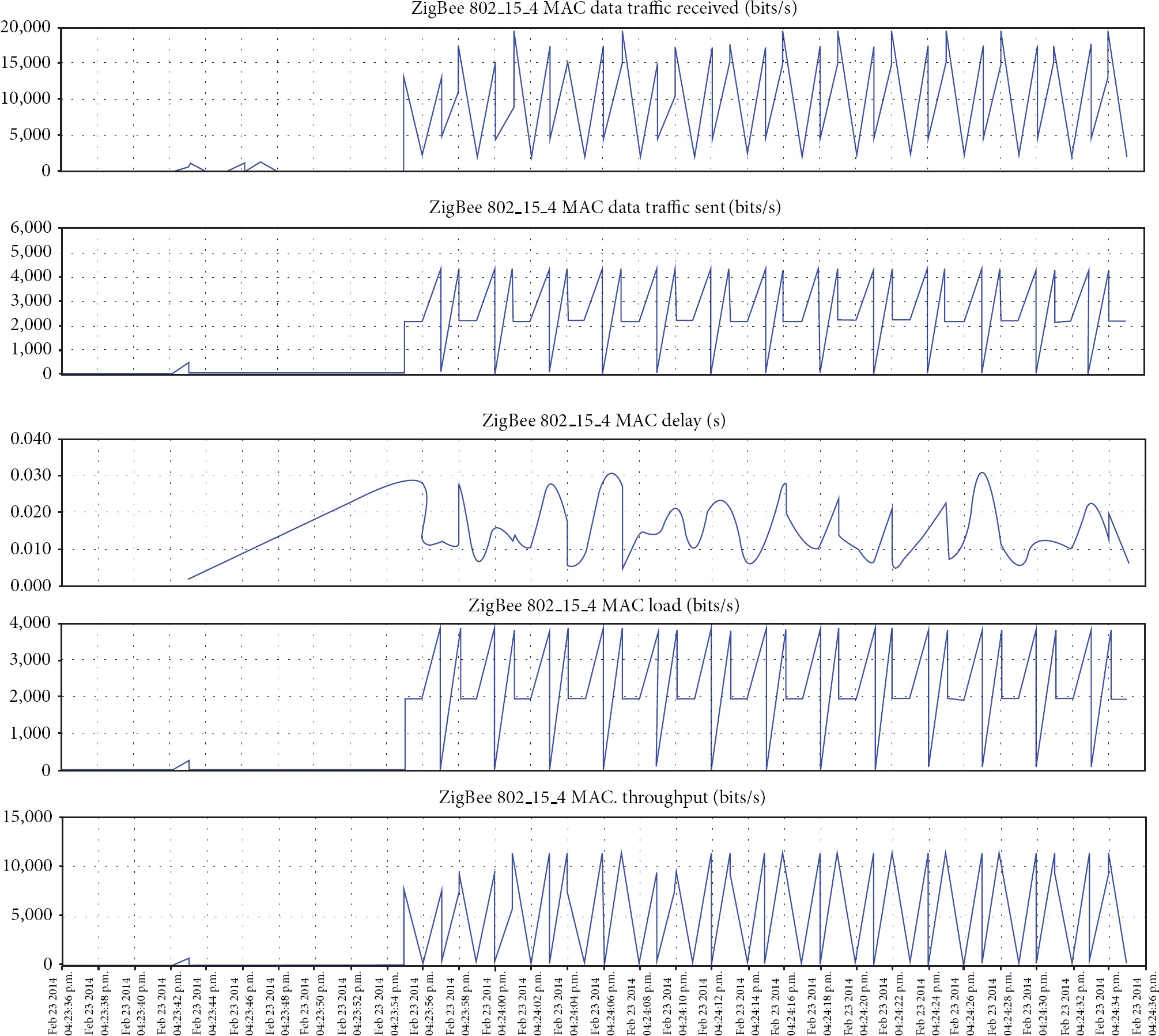
Athletes (1, 2, and 3) statistics (MAC traffic received, MAC traffic sent, MAC delay, MAC load, and MAC throughput).

Athletes (1, 2, and 3) statistics (end-to-end delay, traffic received, and traffic sent).

Athlete 4-end device (MAC traffic received, MAC traffic sent, MAC delay, MAC load, and MAC throughput).

Athlete 4-end device statistics (end-to-end delay, traffic received, and traffic sent).
Figure 5 shows the global statistics of the entire network. It can be seen that steady stream of traffic is sent without disruption and the delay time varies in reasonable time limits. Small spikes at the beginning of the simulation are indications of management of the control traffic due to the presence of devices. Figure 6 represents end-to-end delay, traffic received and sent (bits/sec) values of coordinator. Similarly for node statistics will be observed (Figures 9 and 11). Figures 7, 8, and 10 show the MAC traffic received, MAC traffic sent, MAC delay, MAC load, and MAC throughput of the coordinator, athletes 1, 2, 3, and 4 end device, respectively. The throughput is highest in the coordinator and lowest in other athletes. The results of Figures 9 and 11 showed that all the athletes have more or less equivalent traffics (athlete 4 presents higher traffic due to the fact that it is an end device) and at the beginning of the simulation (Figure 11) athlete 4 shows delay time drops while for the other athletes it increases. Coordinator collects the data from all athletes and for this reason has increased end-to-end delay for the whole duration of the simulation.
5. Conclusions
In this paper, we presented an overview of the wireless sensor networks with special emphasis on IEEE 802.15.4/ZigBee protocol adapted in monitoring vital signs of athletes, mainly during training. Monitoring vital signs of athletes is highly important in order to avoid overtraining. The IEEE 802.15.4/ZigBee is widely used in wireless sensor networks applications and offers a practical solution for applications such as monitoring, tracking, and surveillance. The purpose of this paper was to investigate the performance of the aforementioned network through simulations in the OPNET modeler simulation environment. To examine topological features of WSNs, we simulated and analyzed a scenario with star topology. Mobile subscribers yielded more or less equivalent values compared with the fixed coordinator subscriber. The trajectory on each mobile node is configured on specific destination round the field. From the simulation results it can be concluded that the ZigBee protocol is well suited for monitoring athletes subscribers and similar applications. In the future we intend to perform further experiments examining another way of topology (mesh or tree). In order to get a more realistic channel model for wireless scenarios, we are going to develop a specific channel simulator and see the effects of traffic density, multihop, and athletes directions. Extending this work a testbed with Arduino board is under development for real-time implementations and sees the theoretical model variations.
Footnotes
Conflict of Interests
The authors declare that there is no conflict of interests regarding the publication of this paper.
Acknowledgments
This research has been supported by Yildiz Technical University Scientific Research Projects Coordination Department Project no. 2013-04-04-KAP02. It was also partially supported by the Research Project “PIMACTeX,” cofunded by European Union, European Regional Development Fund and Greek Ministry of Education/EYDE-ETAK through the National Strategic Reference Framework (NSRF-ESPA) 2007–2013/EPAN II/Action “SYNERGASIA” (09ΣYN-82-847).