




Abstract
An error control method is investigated and obtained by combination of the modulation and linear block code in sensor networks. The constructed coding scheme is multistage decoded using a new low-complexity soft-decision decoding method in sensor networks. Computer simulations of the proposed method are presented and compared with the reunion junction technique. The proposed method shows a better performance than the reunion junction technique. The low complexity of the method allows the use of long linear block codes. It is possible to construct an efficient bandwidth multilevel code on signal set partitioning. A wide range of design tradeoffs are possible with multilevel codes. Composite codes are possible using component codes.
1. Introduction
Sensor networks are composed of battery-supplied small devices. Sensor networks suffer from errors due to random noise and fading, which may increase the bit error rate, cause several retransmissions, and consume extra energy [1]. Sensor networks require reliability of communication while keeping energy efficiency.
In view of reliable communication, many efforts have been made to improve the performance and reduce bit error probability. Zarei and Wu [2] have proposed an energy-efficient error control mechanism based on redundant residue number system for wireless sensor networks. In [3], a scheme to enhance localization in terms of accuracy and transmission overhead in wireless sensor networks has been proposed. In [4], a distributed algorithm is developed to effectively detect, locate, and isolate the Byzantine attackers in a wireless ad hoc network with random linear network coding. Park et al. [5] have suggested an enhanced approach for reliable bulk data transmission of image files, multimedia video files, and successive log files for monitoring systems over wireless sensor networks.
Linear block codes are often used in practical sensor networks to protect the signals. Error control coding is a technique where a code is combined with modulation. In this paper, the concatenation of a block encoder with a modulator containing memory is considered.
A sequential machine [6] is a module which can be modeled as a finite-state sequential circuit. In this paper, there are two cases corresponding to machine. The first one is for a continuous phase modulation signal. The case of partial response baseband channel is the second one. Matched encoding concept [7–9] is based on the observation that for number of states may correspond to the optimum receivers with two different states.
The coding scheme based on a single step partitioning of signal constellations gives an asymptotic gain [10–16] less than 3 dB. The scheme based on a two-step partitioning increases the minimum Euclidean distance by 6 dB. The expansion of the signal constellation may cause a penalty of 1.5 dB. The asymptotic coding gain cannot exceed 4.5 dB.
The purpose of this paper is to propose an error control method. For this method, the maximum number of code words considered and the error performance depend on the set of tested positions. The most likely candidate code word is chosen as decoded one. The soft-decision decoder makes use of the relative magnitudes of the receiver code symbols. For a fixed machine, the encoder corresponds to the tamed frequency modulation (TFM) scheme.
2. An Error Control Method
We consider a scheme with
The individual subchannels

From the sensor network channel, we get two vectors. One is hard-decision vector

The decoder has to select the code word whose error pattern minimizes the analog weight. There are two sufficient conditions that an estimated code word
For linear code, a candidate code word is denoted as
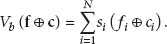
For linear code, the minimum Hamming distance
Unreliable position i means small value of
Let
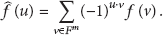



Let

An affine plane of order n is an

We set
3. Computer Simulations
Computer simulations of the (64, 42) RM code, the (128, 99) extended BCH code, and the (128, 64) extended BCH code have been performed in order to evaluate their error correction properties. An AWGN channel in sensor networks was assumed for the simulation. Figures 1, 2, 3, 4, 5, and 6 depict results of the (64, 42) RM code, the (128, 99) extended BCH code, and the (128, 64) extended BCH code, respectively.

Bit error probability of (64, 42) RM code.

Bit error probability of (128, 99) extended BCH code.

Bit error probability rate of (128, 64) extended BCH code.

The calculation amount of (64, 42) RM code.

The calculation amount of (128, 99) extended BCH code.
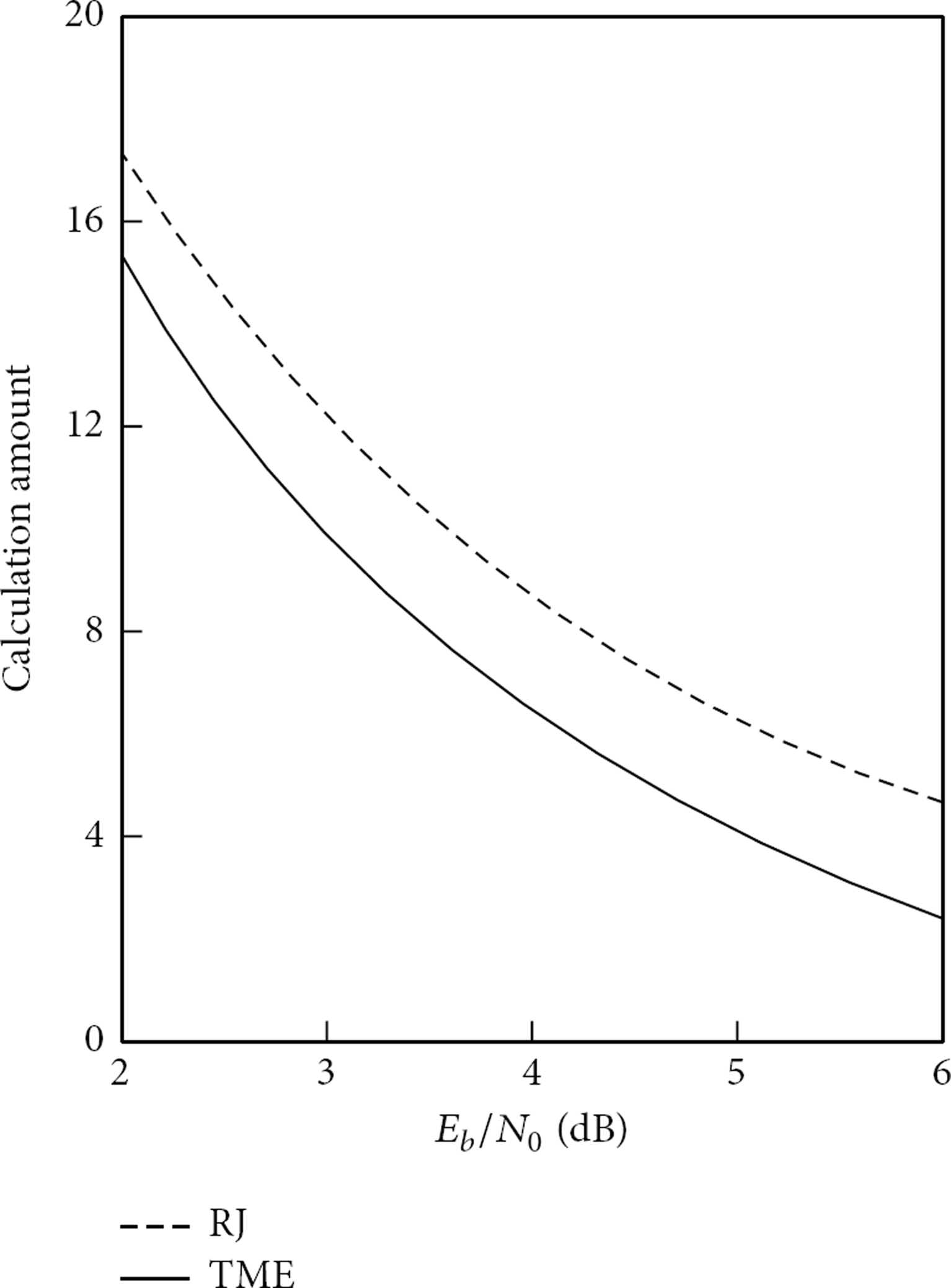
The calculation amount of (128, 64) extended BCH code.
For each code, the simulated result of the proposed transform matching evaluation (TME) method is plotted and compared with that of the reunion junction (RJ) technique. It should be noted here that the structural conditions on the pattern of connections have been found. The structural conditions are necessary and sufficient conditions for an encoder to be matched. However, since such conditions must be individually determined for each CPM modulator and each code rate considered, their use is limited.
4. Conclusion
The construction of the transform matching evaluation method has been proposed. The proposed method shows a better performance than the reunion junction technique. The low complexity of the method allows the use of long linear block codes in sensor networks.
It should be noted here that the structural conditions on the pattern of connections have been found. The structural conditions are necessary and sufficient conditions for an encoder to be matched. Such conditions must be individually determined for each CPM modulator and each code rate in sensor networks.
For this method, the maximum number of code words considered and the error performance depend on the set of tested positions in sensor networks. The most likely candidate code word is chosen as decoded one. The soft-decision decoder makes use of the relative magnitudes of the receiver code symbols. For a fixed machine, the encoder corresponds to the tamed frequency modulation scheme.
It is possible to construct an efficient bandwidth multilevel code on signal set partitioning. A wide range of design tradeoffs are possible with multilevel codes. Composite codes are also possible by using component codes.
Footnotes
Conflict of Interests
The author declares that there is no conflict of interests regarding the publication of this paper.