




Abstract
Wireless networks comprise of small devices that are typically deployed in environments where paucity of energy seriously restricts essential operations. The energy source of these devices decreases very quickly during continuous operation and it is pivotal to replace or recharge frequently the power sources. Sometimes, it is very difficult to perform these functions through conventional methods. One attractive solution to this problem is the use of the energy, scattered around us in the environment. The availability of energy from the environment is random and uncertain. In this paper, we present a model, schematically and analytically, for solar energy harvesting with appropriate energy management. We provide analysis and simulations for a solar cell for standard and different irradiance levels. The power of the storage device is also simulated for different times of the day. The proposed model not only scavenges the energy but also assures the connectivity of the network by optimizing the energy consumption.
1. Introduction
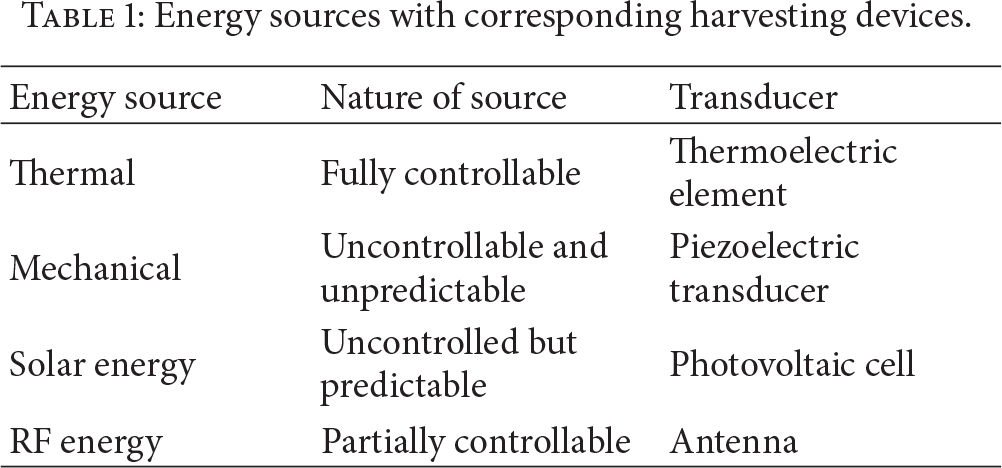
Although wireless networking is not a new field, in the recent era, it has gained a considerable amount of attention. Cellular networks and ad hoc networks are the key constituents of the modern wireless networks. Devices in the cellular networks are controlled by the fixed base stations, whereas, in ad hoc networks, the nodes are individually responsible for establishing communication links. Each node in ad hoc network functions not only as a host but also as a router. The devices in both types of networks are small and usually battery powered [1]. The battery has a limited capacity and, therefore, must be replenished periodically or has to be replaced frequently. During operational time or in the time of any emergency, it seems to be difficult to perform these tasks. Sometimes, the network is in a difficult to reach area and it is not possible to replace or recharge the battery. One of the possible solutions to this problem is to use the energy present in the surrounding environment. Energy harvesting is the process of accumulating and utilizing the energy such as solar [2], mechanical [3], and/or thermal energy [4] present in the surroundings of the device. All the nodes of the network are well equipped with energy harvesting devices that can extract or scavenge energy from the environmental energy sources. The harvested energy can be used as a supplement to the primary power source of the device or even sometimes directly as a primary source. A basic framework for energy harvesting is presented in [5], which emphasizes on learning the environment. Although the energy harvesting is not so common in cellular and ad hoc networks, it is widely used in sensor networks in recent years. Energy source, harvesting device, storage device, and consumer of energy are the essential parts of any energy harvesting model [6]. The two basic concepts about energy harvesting theory are the total dependence of any system on ambient energy or using it as a supplementary source. The first idea is very ancient and sometimes not applicable due to the random and stochastic nature of the environmental energy. The most fundamental component of any energy harvesting system is the energy source. The environmental energy sources, due to their stochastic nature, are categorized as uncontrollable but predictable, uncontrollable and unpredictable, fully controllable, and partially controllable [7]. There is a variety of energy sources in the environment, but the most famous and widely used sources are thermal energy sources, mechanical energy sources, solar radiations, and radiofrequency energy sources. The second most important component of any energy harvesting model is the energy harvesting device, also called transducer. The transducers generate electric energy from their surrounding energy sources using specific methods [8]. Different energy harvesting devices, regarding various energy sources, are described in Table 1.
Energy sources with corresponding harvesting devices.
Due to the random nature of the environmental energy and unavailability of solar energy during night, the harvested energy needs to be stored in an energy buffer. There are two basic methods to store the harvested energy. It can be stored by using an electrochemical process (rechargeable battery) or by performing a physical separation between electrical charges in a dielectric medium (super capacitors) [9]. Both of the choices have some deficiencies. Batteries have higher energy density than super capacitors but limited number of charge discharge cycles. On the other hand, super capacitors have millions of recharge cycles and have relatively higher power densities than batteries [10]. The most important component of the harvesting model, which utilizes harvested and stored energy, is the load. It can be a small sensor node or any electronic device consisting of a processing unit, transceiver, and regulators. The characteristics of the load, heavily affect the modeling of an energy harvesting architecture. The transceiver of any device (load) is usually the most energy consuming component. At any moment in time, the available energy should be greater or equal to the required energy for supporting the load [11]. This fact is defined as

The rest of the paper is organized as follows. Section 2 briefly describes the different approaches and the relevant energy harvesting models, available in the literature. Section 3 presents the proposed energy harvesting and management model, along with block diagram and the operational circuitry. The model is analytically explained in Section 4. Numerical results are presented in Section 5, and Section 6 concludes the paper.
2. Related Work and Harvesting Models
There are three types of energy harvesting approaches available in the literature. The native approach is the basic one, which follows the energy neutral operation theory; that is, the energy used for all purposes should be less than or equal to the harvested energy [12]. The second approach is applied with an ideal energy buffer; that is, the energy stored after harvesting is consumed without any internal loss. Also, the buffer has infinite capacity [13]. The third and the practical approach is that the energy consumed is always less than that of the energy harvested and stored in a buffer with finite capacity [14]. Keeping in view the above approaches, different patterns/models are described. Most of them use the solar or thermal energy present in the environment for harvesting. The most important and the basic energy harvesting models for sensor networks are described in the following sections.
2.1. Ambient Energy Harvesting Model
In the basic model, the ambient energy is accumulated by the energy harvesting device. It is converted into electrical energy and stored in a storage device. It is then sensed by a low power sensor and used for further operation of the node. The node's transceiver operates when energy level of the storage device reaches a certain threshold value and stops working (switches to sleep mode), when energy level decreases. Meanwhile, the harvesting device accumulates energy and charging process starts [15]. This model has the drawback that during the charging process, node's operation remains suspended. There may be large time delay during data transfer, if the ambient energy is not available. This model comprises of an energy harvesting device (EHD), energy storage device (ESD), energy sensor, controller, and load, as shown in Figure 1 [16].

Ambient energy harvesting model.
2.2. Two-Storage-Device-Based Model
In this type of energy harvesting model, two-storage-device battery and super capacitor are used. The super capacitor is used as a primary buffer/storage device and battery is used as a secondary buffer/storage device [17]. A switch controls the operation of the load, first through super capacitor and then via battery, when super capacitor is recharging. This model deals successfully with the life time and the connectivity issues in the network. The operation of the node continues even if ambient energy is not available for sometime or a storage device is ready to be charged. This model fully parasites on the storage devices and does not consider the variations in the available environmental energy.
2.3. Ambient Energy and Two-Storage-Device-Based Model
This type of energy harvesting model uses a combination of ambient energy and the two storage devices, battery, and a super capacitor. A DC-DC converter is assigned to each device for regulation. The accumulator directly supplies energy to the node for operation as well as charging the super capacitor and battery placed in parallel. All devices are connected to a power manager, which controls the operation of node [18]. There are different states in this model such as soft start, battery help, battery charge, overpower, and turnoff. Although this model ensures connectivity, it is complicated and has to manage two storage devices on limited energy resources. This model, known as autonomous hybrid energy storage model, is fully dependent on a power manager.
3. New Energy Harvesting Model with Energy Management
Energy scavenging from the environment is one of the attractive solutions to the power depletion problem in nodes participating in a wireless network. Its performance can be enhanced, if the harvested energy is efficiently managed [19]. An energy harvesting model in conjunction with proper energy management system is presented in this paper. Each node in the network is equipped with this energy system. The proposed model is simple and depends on the ambient energy as well as the storage device, shown in Figure 2. This model comprises of two units, energy harvesting (EH) unit and energy management (EM) unit. EH unit includes photovoltaic (PV) cell, maximum power point tracker (MPPT), and DC-DC converter. EM unit consists of energy storage device (ESD) which is a rechargeable battery in the proposed model, controller (electronic relay), and load.

Energy harvesting and management model.
3.1. Components of the Model
The different components of the block diagram of the proposed model are briefly described as follows.
3.1.1. Photovoltaic Cell
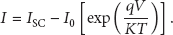
Solar energy harvesting is one of the most common ways of employing ambient energy sources, supporting or replacing battery power supplies. Solar cells are used to convert the sunlight into direct electrical current, using the photovoltaic effect. The output current of a photovoltaic cell is mainly dependent on its terminal voltage and the light intensity, irradiating the cell [20]. The current-voltage (IV) and power-voltage (PV) characteristic equations of the photovoltaic cell can be described from the equivalent circuit shown in Figure 3 [21]. Consider






Equivalent electrical circuit of a photovoltaic cell.
IV and PV curves of a photovoltaic cell.
3.1.2. Maximum Power Point Tracking
An energy harvesting model is highly efficient with the use of MPPT techniques. Any model designed with MPPT tracker extracts the maximum power from the transducer and delivers it to the load and storage device, such as battery, in our case. During modeling of a transducer, an adaptively controlled voltage regulator tries to keep the load resistance approximately equal to the source resistance [22]. The most suitable MPPT techniques for solar energy harvesting are fuzzy logic control, current sweep, IMPP-VMPP computation, state-based MPPT [23], and neural networks [24].
3.1.3. DC-DC Converter
A DC-DC converter is an essential part of the energy harvesting and management model. It is used to obtain a regulated and maximum DC voltage for the load. Its choice depends upon the source of energy used as well as on the storage device. The DC-DC converter used in this model is switch mode based [25].
3.1.4. Load
The energy harvested and stored in the rechargeable battery (RB) is used to operate the load, which is any small electronic device or transceiver [26] of a communication node. The load characteristics play an important and unavoidable role. The main users of the harvested energy in any model are processor of the device and/or transceiver, which sends and receive the data. A processor of a device operates in sleep active mode [27] and the transceiver acts as transmitter and/or receiver. The necessary condition for operation of a transceiver by harvesting source is given as

4. Analytical Model
The energy arrival at a harvesting node in a solar natural environment is best modeled as a stochastic process due to the random nature of sunlight [28]. Each node operates with ambient energy and the battery remains in reserve and can be used only when ambient energy is not available or too low to operate the transceiver. The accumulated ambient energy, after conversion into electrical energy, is shifted directly to the node's transceiver through a DC-DC converter for its transmission and reception process and remaining energy is transferred to the storage device (battery) through an electronic relay for charging. This process continues until the ambient energy is below a certain level
The model is analytically described as follows. Let the output power of the harvesting device (solar cell) of the model attached with any node U during time interval 








5. Numerical Discussions and Simulations
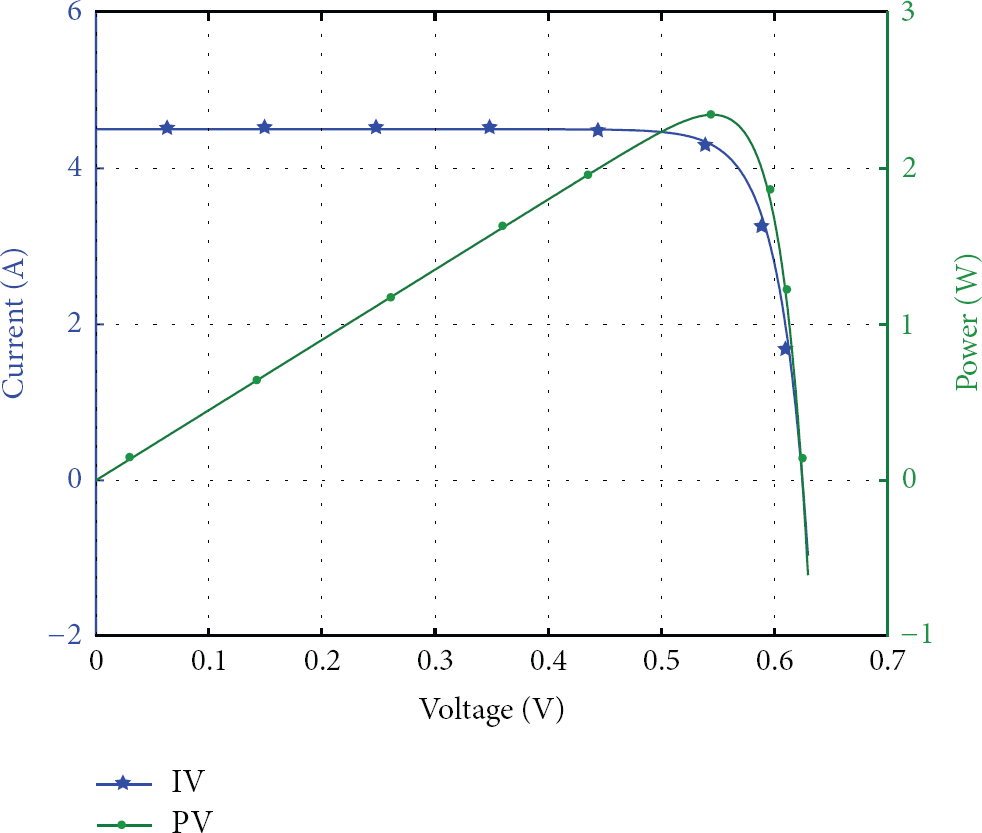
By using (6), the IV characteristics curve of a solar cell at standard temperature

IV curve of a photovoltaic cell.
The maximum power is achieved from the plot between voltage and power shown in Figure 6, also known as PV curve of a solar cell. It is clear from the plot that power of solar cell increases with the increase in voltage, until a point arrives at

PV curve of a photovoltaic cell.
The IV and PV curves vary for different values of irradiance 
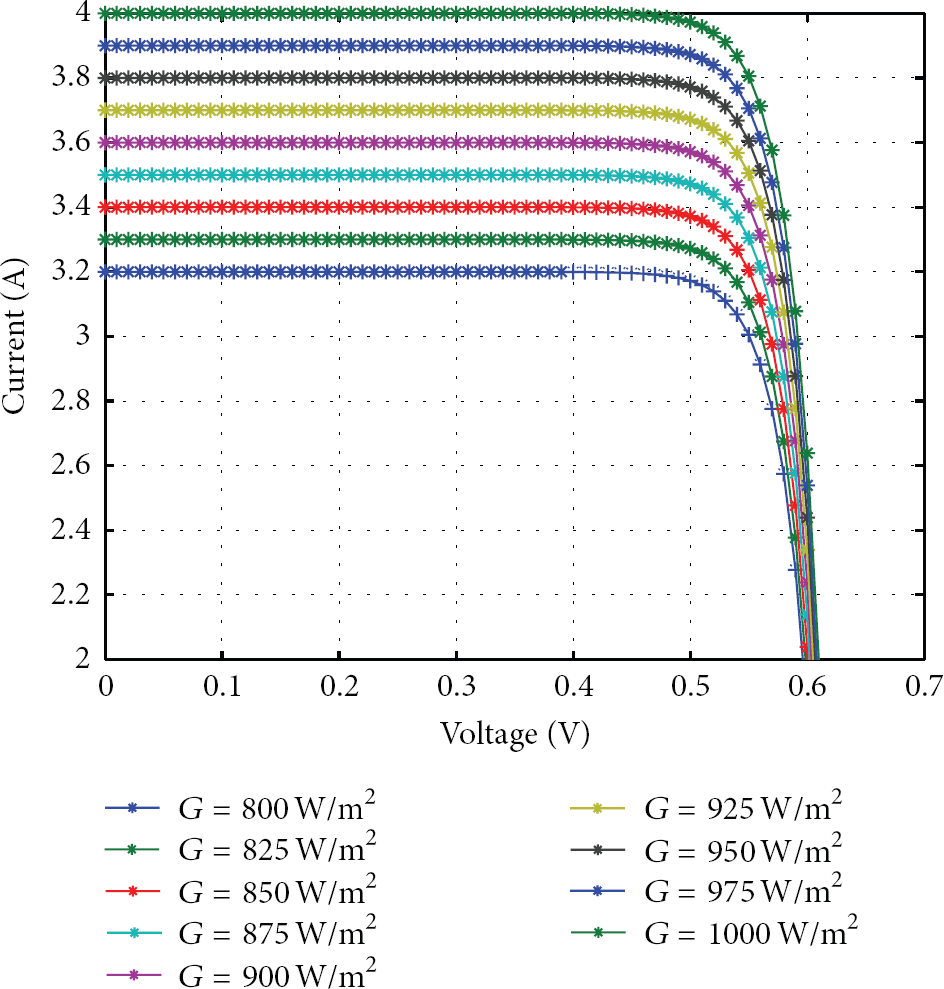
IV curve at different values of G.
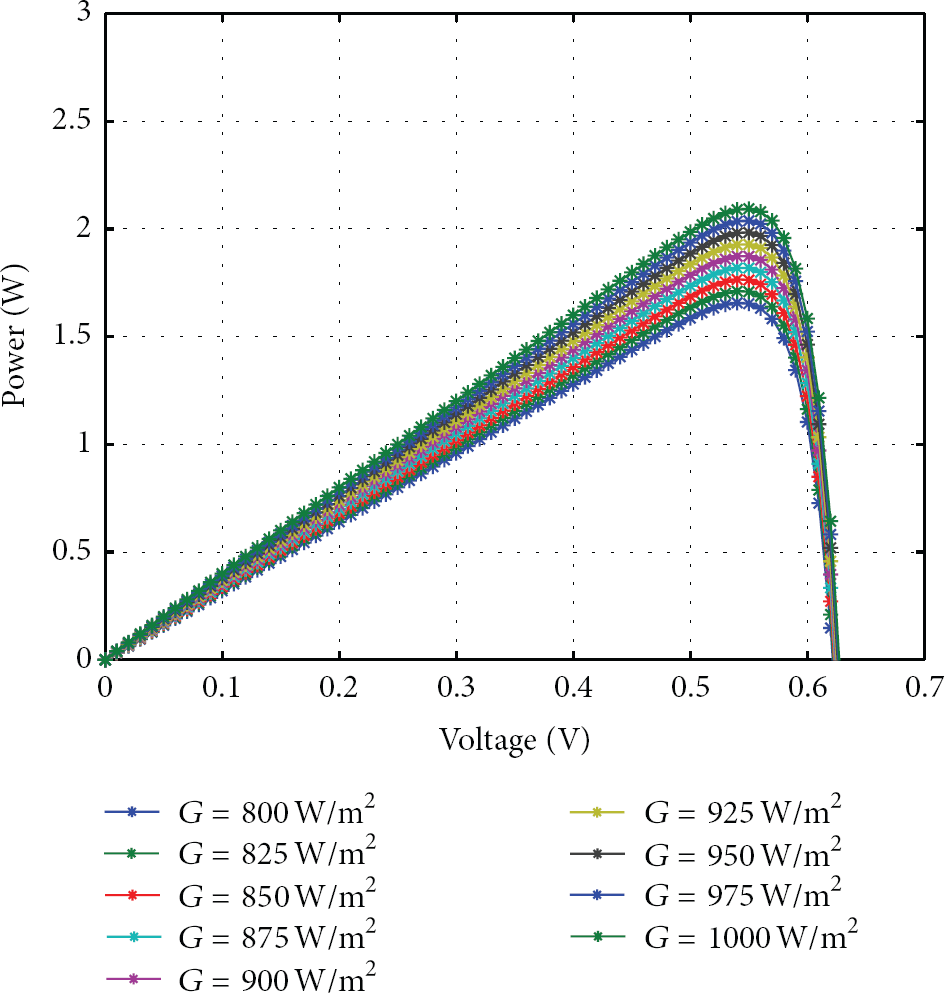
PV curve at different values of G.
The plot in Figure 7 depicts that the value of short circuit current
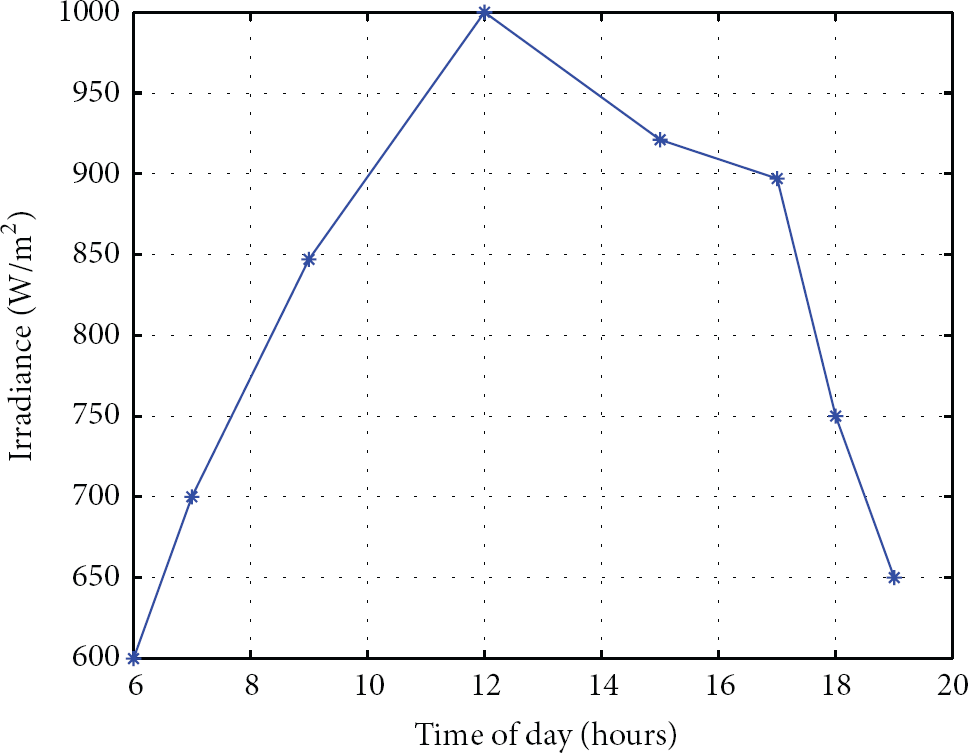
Irradiance against time of a solar day.
The irradiance level increases as the Sun continues its journey to peak point. It is clear from the plot that the irradiance level is smaller in the morning hours and keeps on increasing as the Sun rises up in the sky. This increase in irradiance level continues till about 12:00 p.m., when the irradiance level reaches to its maximum value being equal to a standard value

Maximum current versus different values of G.
As shown in the analytical model, the surplus energy is transferred to the storage device, so the battery power varies with the irradiance levels, as shown in Figures 11 and 12.

Battery power versus different values of G in the morning hours.
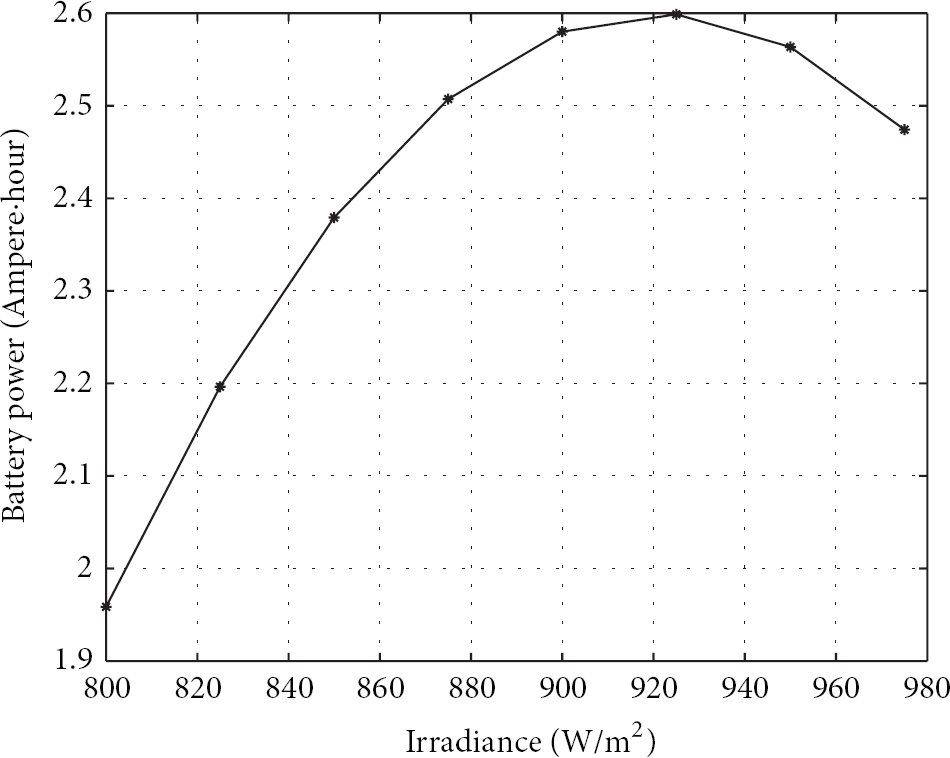
Battery power versus different values of G after 12:00 p.m.
In the morning hours, the value of G is small and the maximum power extracted by MPPT from EHD is also less than the power required for the load (transceiver's operation). During this period, the power of storage device is used along with the harvesting power for the transceiver's operation. The battery power decreases initially with the increase in irradiance level, till the maximum power achieved crosses the power limit required to run the operation of a transceiver. After this point, the power of the storage device increases. Until again the maximum power achieved falls below the power required for load. When the Sun sets the load is shifted on the storage device and its power starts consuming continuously.
The plot in Figure 13 shows the power values of SD against hours of the day. In the morning hours from 6:00 a.m. to 8:00 a.m., the battery power reduces as it is used for the load's operation along with harvested energy. When the Sun rises, the value of harvested power increases and ultimately the battery power also increases. The plots show that this increase in power continues till about 4:00 p.m. In the evening, this value again reduces, as it is evident from the plot.

Battery power versus hours of a day.
6. Conclusion
As the environmental energy is randomly distributed over all the nodes of a wireless network, therefore, an energy harvesting model along with energy management system is proposed. The analytical behavior of the model is also described. Some numerical simulations are presented to show the characteristics for IV and PV parameters. The proposed model is simple and efficiently manageable in order to obtain a better performance of the network in a perpetual fashion. This also assures the connectivity and long life of the network. In the future, the energy management algorithm on network layer will be proposed.
Footnotes
Conflict of Interests
The authors declare that there is no conflict of interests regarding the publication of this paper.
Acknowledgments
The research of the second author is supported in part by the Natural Sciences and Engineering Research Council of Canada (NSERC). The research of the first and seventh author is supported in part by HEC Grant no. 1-308/ILPUFU/HEC/2009-609. The authors are grateful to the anonymous referees for their helpful and constructive comments.