




Abstract
For a two-dimensional (2D) cellular-cored sandwich panel heat exchanger, there exists an optimum cell size to achieve the maximum heat transfer with the prescribed pressure drop when the length is fixed and the two plates are isothermal. However, in engineering design, it is difficult to find 2D cellular materials with the ideal cell size because the cell size selected must be from those commercially available, which are discrete, not continuous. In order to obtain the maximum heat dissipation, an innovative design scheme is proposed for the sandwich panel heat exchanger which is divided into multiple stages in the direction of fluid flow where the 2D cellular material in each stage has a specific cell size. An analytical model is presented to evaluate the thermal performance of the multistage sandwich panel heat exchanger when all 2D cellular materials have the same porosity. Also, a new parameter named equivalent cell size (ECS) is defined, which is dependent on the cell size and length of cellular material in all stages. Results show that the maximum heat dissipation design of the multistage sandwich panel heat exchanger can be converted to make the ECS equal to the optimal cell size of the single-stage exchanger.
1. Introduction
The sandwich panels with two-dimensional (2D) cellular material cores have emerged as one of the most weight efficient structures, which can provide access for multifunctional applications, such as combined load bearing and active cooling or heating [1–3]. A fluid flowing through the open channels is capable of removing a heat flux impinging on one or both faces. These designs might be suitable for many (aerospace and naval) applications, which require the simultaneous ability to sustain high heat flux while supporting pressure or structural loads.
Many researches have been made on heat exchange and multifunctional property analysis and design of the sandwich panels. One of the main objectives of researches is to achieve an efficient and near-optimal design for specific single-functional or multifunctional applications by changing the cell-wall thickness, cell sizes, cell topology (shape), or their combination [4–13]. For example, Lu et al. [4–7] proposed an analytical model used for mainly discussing the heat transfer property and structural load capacity of cells of various cross-sectional shapes, including hexagonal and triangular, and presented the optimum design under different conditions. Based on the structural topology optimization concepts of material distribution, Wang and Cheng [8] took the relative density and aperture distributions of cellular material as two classes of design variables to represent the configuration of the honeycomb heat exchanger and optimally designed these variables for maximal heat exchanger efficiency. McDowell et al. [9–11] used numerical methods to optimize the size and topology of a cellular heat exchanger while considering both the heat dissipation characteristics and the structural load capacity. Muzychka [12] studied the heat transfer performance of various channels including circular, under a given volume and pressure condition. These proposed designs focused on the cross-sections of two-dimensional cellular materials.
In fact, the design along the direction perpendicular to cross-section also has benefits for heat dissipation in two-dimensional cellular materials. According to previous research [4, 5, 13], a 2D cellular-cored sandwich panel used as a heat exchanger can be regarded as a single pipe as detailed in Section 3.1. A single pipe realizes cooling or heating by absorbing or releasing energy of the inner fluid. Under isothermal boundary conditions and a constant mass flow rate [14], the heat dissipation of the pipe increases with the increase in pipe length until the temperature of inner fluid is equal to the temperature of the pipe wall, as shown in Figures 1(a) and 1(b).

The heat dissipation performance of constant flow single pipe under isothermal boundary condition. (a) Schematic illustration of fluid temperature distribution along the flow direction. (b) Schematic illustration of heat transfer rate along the tube length. (c) Schematic illustration of pressure distribution along the flow direction. (d) Schematic illustration of heat transfer rate with tube length in a defined power.
As the pipe length increases gradually, the increase of heat transfer decreases gradually while the pressure drop is still linear growth, as shown in Figure 1(c). If given a certain pump power, then there should be a proper length for the pipe to get the maximum heat transfer as shown in Figure 1(d). This also implies that if given a certain length of the pipe, there should also be an optimum pipe diameter to achieve maximum heat dissipation. Thus, for the 2D cellular-cored sandwich panel heat exchanger, there also exists an optimum cell size for a given set of conditions.
In addition, in engineering practice the cell size of any cellular heat exchanger is limited to those sizes that are commercially available. Other sizes including any cell sizes and complex cell geometries could be manufactured to special order but would be very expensive. So given a certain length of the heat dissipating structure, it may be difficult to find an ideal cell size from those that are commercially available. To overcome this difficulty, an idea is proposed in this paper which is to improve the heat dissipating efficiency by adjusting the cell size along the flow length. This idea is inspired by the heat dissipation in a single pipe. The curve in Figure 1(b) shows that when a pipe is long enough, the fluid in the parallel tubes nearly does not absorb any heat at the back of the pipe. Therefore, a reasonable thought for improving its heat dissipation property is to accelerate the speed of fluid by reducing the flowing resistance at the back of the pipe. This thought can be implemented through combining the parallel pipes at the back, as shown in Figure 2. So it is very significant to study the optimum configuration of 2D cellular materials with different cell sizes in the direction of flow.

Schematic diagram of two-stage parallel pipes.
The research described in this paper is composed of an innovative structural design scheme for the sandwich panel heat exchanger where it is divided into multiple stages in the direction of fluid flow and the cellular material in each stage has a specific cell size and where the optimum heat dissipation through the multistage configuration of cellular materials with different cell sizes is determined. The overall structure of this paper is as follows. In Section 2, the problem description of a multistage 2D cellular-cored sandwich panel heat exchanger is given. In Section 3, an analytical model is presented to predict the heat transfer performance of the exchanger with an isothermal boundary condition. In Section 4, an example is presented to show the efficiency of the multistage design, and, finally, the results and conclusions are summarized.
2. Problem Description
Consider the problem shown in Figure 3; the multistage 2D cellular material core is used as a sandwich heat exchanger with length L, width W, and height H. The flat schematic diagram of a multistage 2D cellular heat exchanger is shown in Figure 4. It is assumed that the heat dissipation structure is divided into m stages; the length of each stage, respectively, is L1,L2,…, L m , and the classification coefficient, respectively, is α1,α2,…,α m ; they satisfy

where L is the total length in the fluid flow direction.

Prototype design of 2D cellular-cored sandwich panel heat exchanger [13].
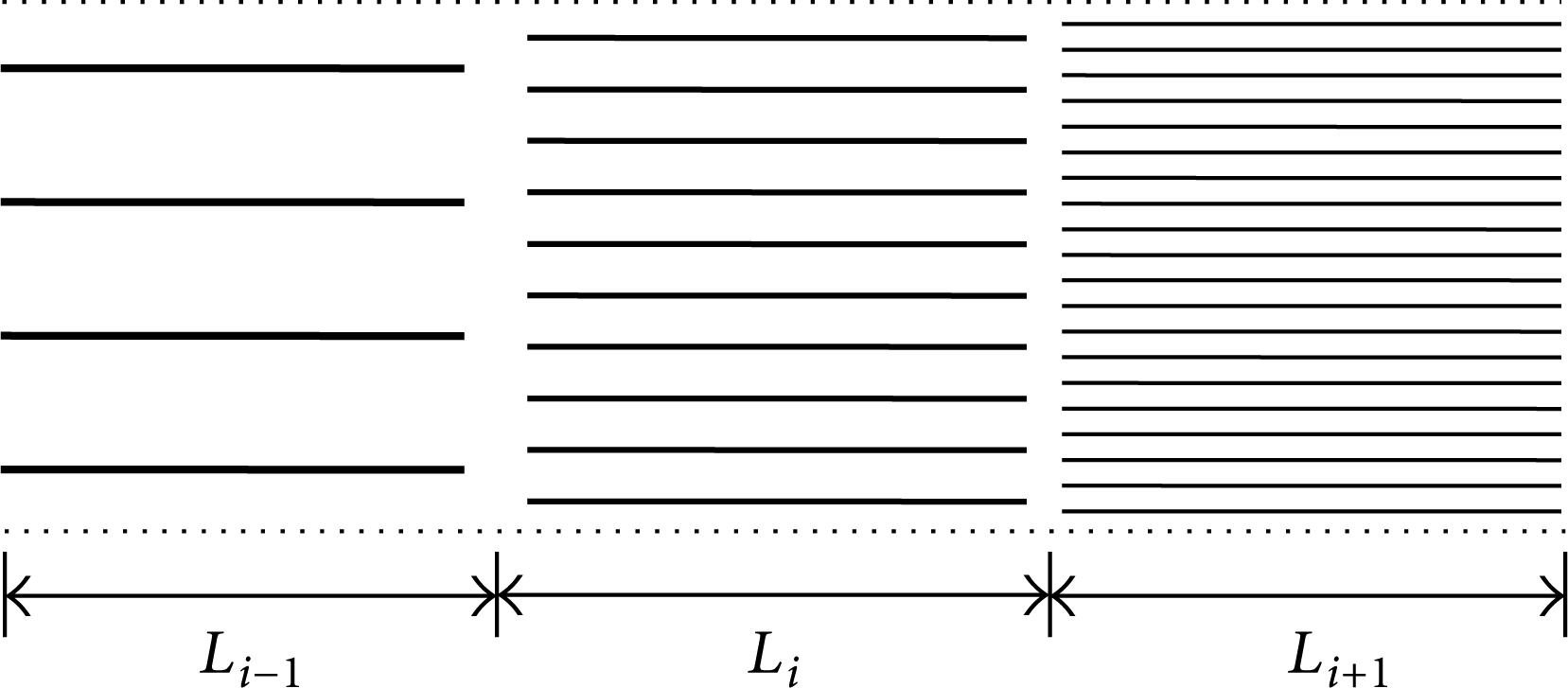
Flat schematic diagram of multistage 2D cellular core material.
At the same time, the porosity of the cells in each stage is assumed the same and the cell size of each stage is l1,l2,…, l m , and then they satisfy the relationship
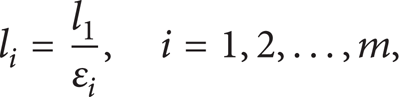
where ε i is the ratio of the cell size in 1-i th stage to ith stage.
Both plates of the sandwich panel are isothermal with uniform temperature T w and the two sides of the sandwich are thermally insulated. The cooling fluid, with inlet velocity u0 and inlet temperature T0, is forced to flow through the cells under the pressure drop Δp. The goal is to obtain the optimum heat dissipation through the multistage configuration of two or more types of two-dimensional cells with different cell sizes when the length of actual heat exchanger is fixed. Let ρ f , vf, μ f , and cp denote the fluid density, kinematic viscosity, shear viscosity, and specific heat capacity, respectively. In addition, the usual assumption is made that steady state laminar flow and constant thermal properties of the fluid and solid materials exist.
3. Heat Dissipation Analysis
In our previous work, the transfer matrix method was used to predict the heat transfer performance of a 2D cellular-cored sandwich heat sink [13, 15]. In this section, the results obtained by the transfer matrix method are reanalyzed, and then the analytical model is developed for evaluating the heat dissipation performance of a multistage 2D cellular-cored sandwich panel heat exchanger.
3.1. Single-Stage 2D Cellular-Cored Sandwich Panel Heat Exchanger
In the transfer matrix method, there are similar analysis procedures for all the cell topologies, such as triangle, square, or hexagonal. The only difference is that they have different analytical cells. Six typical cell topologies and the corresponding analytical cells are shown in Table 1. The detailed analytical procedure is referenced in [13, 15]. The results are presented here.
Six typical cell topologies and the corresponding analytical cells.
The total heat dissipation, Q, from the 2D cellular-cored sandwich panel heat exchanger is

where L* is the characteristic length given by

The parameters in (3) and (4) are described as follows: ks is the thermal conductivity of the solid wall, kf is the thermal conductivity of cooling fluid, ρ is the porosity of the 2D cellular materials, t is the thickness of the cell wall, l is the cell size, and Nu is the Nusselt number. For typical metal honeycombs having the cell size in millimeters, the laminar assumption is applicable and the variation of Nu within the entrance length can be ignored because the practical length of the cell duct is much greater than the entrance length [3]. The local heat transfer coefficient h can be denoted by the following expression:

where ca, cn, and cw are the proportionality coefficients dependent on the cell topology and their values are shown in Table 2.
Proportionality coefficients for six different cell topologies.

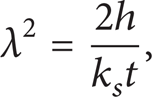
The parameter λ is defined as
Φ(λ, l) is defined as

and they are obtained by the expression

where n is the cell number in the height direction.
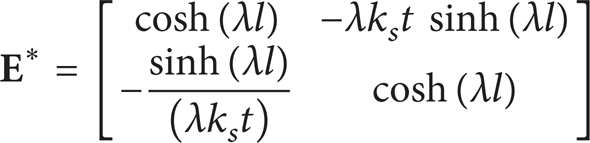
and the transfer matrix
The transfer matrix

Upon first examining expressions (3) and (4) it may be difficult to comprehend that a 2D cellular-cored sandwich panel heat exchanger could be analyzed as a single pipe. In order to clarify this idea, the reanalysis follows.
We define

Then the characteristic length becomes

The height of sandwich structure can be expressed as

where ch is a coefficient of cell geometry and its value can be found in Table 2 and n is the cell number in the height direction. The prescribed pressure drop Δp can be described as

and the value of fRe can also be found in Table 2.
Using (3)–(6) and (10)–(13), we have

Defining

Equation (14) can be rewritten as

If β2 was independent from the cell size l, the cellular core can be regarded as a single pipe with a hydraulic diameter l and length L with a defined pressure drop because (18) displays a similar physical relationship. From expressions (10) and (17) it seems that β2 is related with cell size l. In fact, it is independent of cell size l. The conclusion will be correct if we showed that t/l, Φ(λ, l) are independent of cell size l. The simple proof can be shown as follows.
The cell-wall aspect ratio t/l can be expressed as follows [5]:

where ct is the proportionality coefficient dependent on the cell topology and the values can be seen in Table 2. The next step is to analyze Φ(λ, l). We define

Combining (5)–(6) and (19), we get

So x is a function with respect to the relative density. The transfer matrix

where A, B, C, and D are functions with respect to x.
The square of

And the cube of
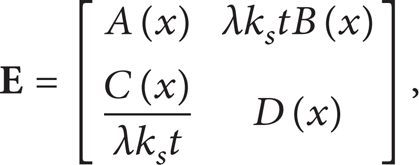
Equations (23)–(24) indicate that the n power of

So we conclude that ϕ21 and ϕ21 are functions with respect to x. Then, (7) becomes

so Φ(λ, l) can be expressed as Φ(ρ) and it is independent of the cell size l.
Combining the expressions from (10), (17), (19), and (26), we can conclude that β2 is independent of the cell size l.
3.2. Multistage 2D Cellular-Cored Sandwich Panel Heat Exchanger
Neglecting the effect of flow divergence between adjacent stages, the temperature difference between the boundary temperature T w and the mean fluid temperature T f (x) of the flow in each stage can be expressed as follows [13]:

Because the inlet temperature in (i + 1) th stage is equal to the outlet temperature in ith stage

the outlet temperature in mth stage can be written as

Then the total heat transfer, Q, of a multistaged heat exchange structure is

According to the law of mass conservation, the total mass flow ratio in each stage is the same and so the mass flow ratio of a channel in each stage satisfies

where Δp i is the pressure drop in the ith stage and must satisfy the following condition:
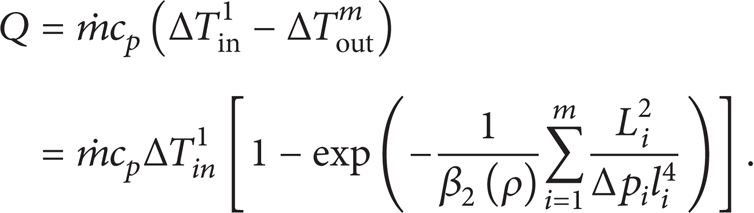
Combining (3), (4), and (13), we have

wherein

Substituting (33) into (30), the total thermal exchanger efficiency can be expressed as follows:

If the equivalent cell size (ECS) is defined as

then the total thermal exchange efficiency can be rewritten as

Fortunately, (37) has the same expression as (18), which can be regarded as the heat dissipation of single-stage structure with the ECS
4. Example and Discussion
In order to show the potential benefits of the multistage sandwich panel heat exchanger, an example is given and the hexagonal cellular material is selected as core.
The dimensions of the heat exchanger, the boundary conditions, and properties of the solid material and cooling fluid are shown in Table 4. Assume there are only two sizes of cellular material available: one is 2.5 mm and the other is 1.0 mm.
All the parameters for the given examples.

The Design Example of a Multistage Sandwich Panel Heat Exchanger. To begin, according to (37), we can obtain the relationship curve between the total heat transfer and cell size as shown in Figure 5. The ideal cell size and the corresponding maximal heat dissipation are also given as follows: l* = 1.54 mm and Q(l*) = 80.95 W.

The curve of the total heat dissipation versus the cell size when the pressure drop is fixed.
Second, if the two-stage cellular-cored sandwich panel structure was adapted, l1 = 2.5 mm and l2 = 1.5 mm, some parameters can be obtained by (4). Consider
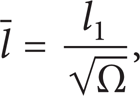
Then, the optimal heat dissipation design can be obtained by making the ECS
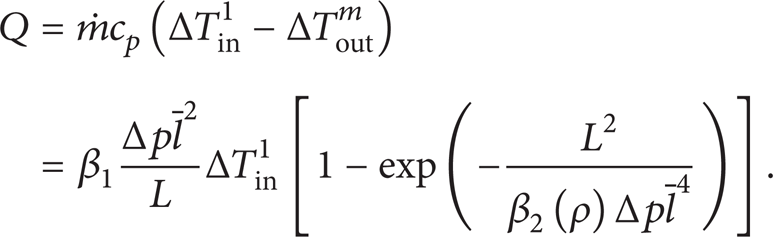
The design of the two-stage cellular-cored sandwich panel structure is finished.
Comparison with Single-Stage Sandwich Panel Heat Exchanger. If the single-stage sandwich panel heat exchanger was adopted and a different cell size from the optimal value is selected, the total heat dissipation will have a deviation from the maximal heat dissipation. In order to describe the deviation, a new parameter is defined as follows:


where l* is the optimal cell size value.
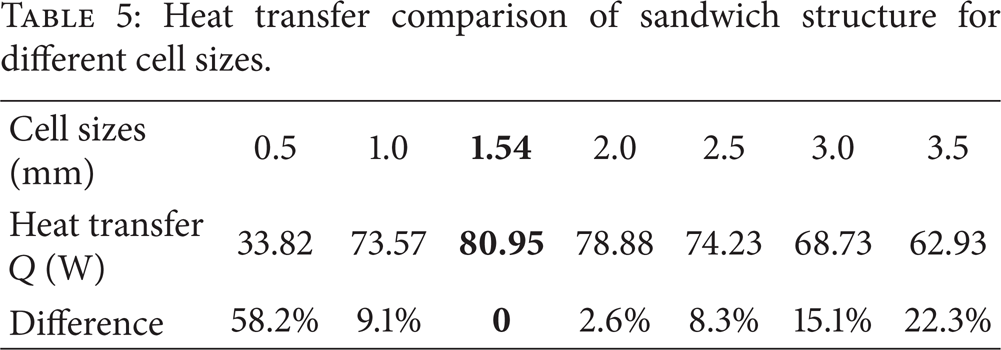
The deviation from the optimal design for a number of different cell sizes is shown in Figure 6, and the detailed data are listed in Table 5. Results show that cell size is sensitive to the total heat dissipation. For example, if the optimal cell size is 1.54 mm and if the selected cell size is less than the optimal cell size, say 1.0 mm, the deviation will be 9.1%. If a smaller cell size was selected, say 0.5 mm, the deviation will increase to 58.2%. If a commercially available cell size exists that closely matches the optimal size of 1.54 mm, then the deviation can be neglected.
Heat transfer comparison of sandwich structure for different cell sizes.

The deviation from the optimal design for different selected cellular material cell sizes.
5. Conclusion
In this paper, an innovative structural design scheme is proposed for the sandwich panel heat exchanger where it is divided into multiple stages in the flow direction and the 2D cellular material in each stage has a specific cell size. Then, an analytical model is presented to evaluate the thermal performance of a multistage sandwich panel heat exchanger when all of the 2D cellular materials have the same porosity. The study shows that
the maximum heat dissipation of the sandwich panel heat exchanger for a given length can be obtained through the multistage configuration of cellular materials with different cell sizes in in the direction of flow,
by introducing the definition of equivalent cell size (ECS) the maximum heat dissipation design of a multistage sandwich panel heat exchanger can be converted to make the ECS equal to the optimal cell size of a single-stage exchanger.
Conflict of Interests
The authors declare that there is no conflict of interests regarding the publication of this paper.
Footnotes
Acknowledgments
The work is supported by the National Key Basic Research (973) Program of China (Grant no. 2011CB610304), National Science Foundation of China (Grant no. 11332004), and CATIC Industrial Production Projects (Grant no. CXY2013DLLG32). The financial support is gratefully acknowledged.