




Abstract
Cognitive radio system is an innovative technology in the wireless communication that has the capability to smartly communicate with each other by opportunistically exploiting the vacant spectrum of primary users. In this work we present a new idea of sidelobe suppression applicable for cognitive users on transmitter and receiver sides. In case of spectrum sharing with the primary users by suppressing the side-lobes at the transmitter and receiver side, the cognitive users will be able to increase the throughput without cooperating the permissible interference temperature limit of the license spectrum. We suggest two generalized sidelobe cancellers (GSCs) that operate in parallel. The first GSC planned to attain the two conflicting objective at the same moment: firstly maximize the cognitive users self throughput; secondly minimize the interference generated by cognitive users at each primary receiver. The second GSC generates two main beams at the positions of the highest amplitude sidelobes of the first one. The values of main beams are equal to the two sidelobe peaks. The subtraction of the outputs of the two GSCs, results in the suppression of the highest pair of sidelobes. This process is repeated iteratively to result in an adaptive algorithm. Simulation results are there to provide the effectiveness of the proposed algorithm.
1. Introduction
Adaptive beamforming is a spatial coding technique which is establish in the current era for signal detection and estimation. This technique has applications in several fields such as wireless communications, radar, sonar, seismology, and medical imaging [1–4]. In the communication system, uplink and downlink beamforming utilizes the frequency division duplex (FDD) mode [5] from mobile to the base station and base station to mobile. However, uplink and the downlink established the channel vectors which are dissimilar from each other owing to the exercise of diverse frequency. Links from the cognitive transmitter to receiver or from primary transmitter to the respective receiver are random and attempt to exercise the reciprocity property in the time division duplex (TDD) mode.
Cognitive radios exploit the adaptive beamforming for efficient utilization of spectrum in spectrum sharing environment. Cognitive radio is an innovative form of software defines radio. A novel concept of cognitive radio is given in [6, 7]. Cognitive radio has the capability of operating the spectrum as soon as the primary spectrum is vacant and resolving the problem of scarcity due to the ample boost of wireless devices. Cognitive radio senses the radio environment and adjusts the communication parameters according to requirements [8]. In case of spectrum sharing, the cognitive user coexists with the licensed user with the condition that it will not cause any sort of disturbance for them. There is a predefined signal-to-interference-to-noise ratio (SINR) for primary users. The cognitive user has to keep the signal level below the noise margin of the primary users. With this constraint the cognitive user will be able to increase the throughput by using the concept of beamforming; that is, it focuses the beam toward the cognitive user, both at the transmitter and receiver side and places the nulls towards the primary users. Hence it will not disturb the primary users. In fact it will be hidden to them and will be visible only to the respective target of cognitive users. Cognitive radio utilizes beamforming techniques to generate main beam along the direction of cognitive user and nulls towards primary users as discussed in [9, 10]. The cognitive user will be effective only when it cleverly occupied the vacant spectrum efficiently [11, 12] in accordance with the latest spectrum sharing or accessing technique. The spectral efficiency of the spectrum drastically boosts whenever the primary and the cognitive users concurrently share the spectrum via underlay or overlay scenario. It is assumed that the location of the primary as well as the cognitive user is available to the transmitter. Prior knowledge of the location compel the transmitter to focus the main beam toward the potential receiver and place the nulls towards the primary users [13]. Same concept will be valid on receiver side which will focus toward transmitting cognitive radio user.
In case of abrupt movement of primary user in the region of high sidelobes, the quality of service of cognitive user will be degraded during the adaptation process as is clarified in [14]. The cause of interference to the other users is due to the high sidelobes levels in transmitting mode. Moreover in receiving mode, the receiver picks up interfering signals and increases the noise floor level in the receiver. Spectrum sharing in cognitive radio badly exaggerated owing to interference. The quality of service of the primary network degraded due to the cognitive radio transmission power. Conversely the cognitive radio receiver reject the interference coming from the primary user consequently the cognitive radio system successfully decodes the respective cognitive user signal. In addition, cognitive system in the receiving mode recognized the presence of the primary user in the same locality. Therefore, the cognitive system intelligently changes the direction, on the bases that the primary is already in active mode in the spectrum and save the primary user from interference. The other factor which can avoid the interference of cognitive to the primary user is that cognitive user has to limit their transmission power [15]. In the transmission mode cognitive users use the orthogonal beamforming and spawn no interference in the direction of primary user. This is obligatory that the interference power received at each PU should stay below its interference temperature [16, 17]. The direction of arrival in the multipath scenario is a difficult task in cognitive radio whenever the cognitive system operates at low noise level. Therefore, it is inflexible to estimate the precise DOAs of CR users at base station. The recital of adaptive beamformer distorted significantly owing to the imperfect knowledge of the array response [18–25]. Consequently, we require robust adaptive beam-formers for the cognitive radio system to direct main beams towards CR users as DOA information of other CR users are inaccurate.
Generalized sidelobe canceller (GSC) is a popular method in this regard to suppress the sidelobes so that the decodable process becomes efficient at the cognitive receiver. There exist numerous approaches to suppress the sidelobes including the iterative procedure for adaptive beamforming with suppressed sidelobes. The different techniques such as adaptive array processing are discussed in [26–28]. These approaches use the quadratic beam pattern constraints and try to limit the deviations from the desired pattern. Diagonal loading method and penalty function technique [29] are also the approaches to control sidelobes. The drawback of these techniques is that they do not guarantee the sidelobe levels below the desired limit. A second-order cone programming approach was proposed in [30]. Here, in order to control the sidelobe level, multiple quadratic inequality constraints, outside the main beam pattern area, are used. This technique is complicated with no standardized method to opt for steering vectors outside the main beam area. Moreover, bunch of steering vectors has to be used from said area to guarantee the sidelobe levels below the desired limit. Another technique with sparse constraint on beam pattern is presented in [31]. This technique, just like [30], utilizes a lot of steering vectors from the direction of arrival range [
In this work, we compare the algorithm [32] where the efficiency of the array increases by not only suppressing the noise and interference but also by suppressing the sidelobes. The sidelobes in [32] are suppressed up to the level of −30 dB, while in the proposed algorithm we suppress the sidelobe up to the level of −41 dB. We propose two GSCs which work in parallel for sidelobe suppression in cognitive radio environment. One is meant for the cognitive user generating the main beam in that direction and the nulls along the directions of primary users. It has been assumed that the direction of primary and the cognitive users is available to both the transmitter and receiver. The second GSC is auxiliary one that generates two main beams at the positions of the highest amplitude sidelobes of the first one. The values of these main beams are adjusted to be equal to these two sidelobe peaks. The subtraction of the outputs of the two GSCs causes the suppression of the highest pair of sidelobes.
The primary and the secondary user share the spectrum, maneuvering the beam in the direction of the secondary user and rejecting the signal coming from the primary user. Since, this technique detects the presence of the primary user's in the spectrum; consequently, it changes the direction and set aside the system from interference. In the transmitting mode the nulls are generated in the direction of the primary user, while in the receiving mode minimize the average receiving power at the cognitive receiver. Hence, as a result the primary and the cognitive user share the spectrum in response to the suppression of sidelobes, steering the beam in the direction of cognitive users and placing the nulls in the direction of primary users. In the transmission mode, the efficiency of the GSC increases at low SNR which is near to optimal level, but with gradual increase of SNR it inter into the linear and saturation region. As a result, in the cognitive radio scenario, it shows the good result at the low SNR, while in the high SNR it performance degraded. In other word, at low SNR the nulls are deep and the sidelobe levels are low. However, when the SNR move up, the Sidelobe level increases along with the nulls in the linear and saturation region. In the linear and saturation region, the performances of the system degraded but at low SNR level the GSC show the optimum result in transmission mode. Consequently, the implementation of the proposed idea in spectrum sharing environment, the cognitive system will intelligently boost the throughput without negotiation on the permissible interference limit of the primary users.
The rest of the paper is organized as follows. In Section 2, the background contains mathematical modeling of the problem which is followed by the proposed method. Section 3 contains proposed method, Sections 3.1 and 3.2 contain N-side-lobe suppression and Cognitive Radio Model Using Adaptive Beamforming in Transmitting-Receiving Mode. Section 4 is the simulation section, followed by Section 5 which contains conclusions. The following is the notation used throughout the document.
2. Background
(a) Signal Model. Consider a uniform linear array of M antenna elements with inter element spacing

Uniform linear array of M elements.
This array is implicit to receive K number of far field narrowband signals. The output of individual antenna element

These outputs are combined together to form the output vector

Similarly

These K signals are assumed to be uncorrelated to each other and hence
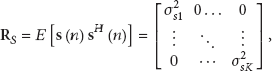
where
Consider the angle of arrival

where
These vectors can be placed in a single matrix


or equivalently as

In the above equation

where
The correlation matrix
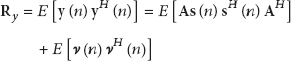
or equivalently by

In realistic situation, the estimate of autocorrelation matrix

(b) GSC. Figure 2 shows the way to find out the adaptive weights. For linearly constraint multiple variable (LCMV) beamformer, the adaptive weights are found by the constraint minimization of the term,

where


Adaptive beamformer.
The LCMV beamformer generates a single beam with unit gain which is equivalent to minimum variance distortion less response (MVDR) beamformer. For this case
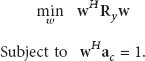
Here
The GSC converts constrained problem of LCMV beamformer into unconstrained one. The block diagram of GSC as given by [34] is being redrawn here in Figure 3, which consists of upper branch and lower branch. The weight vector

The weight vector
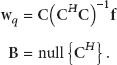
The optimized adaptive weight vector

That is,

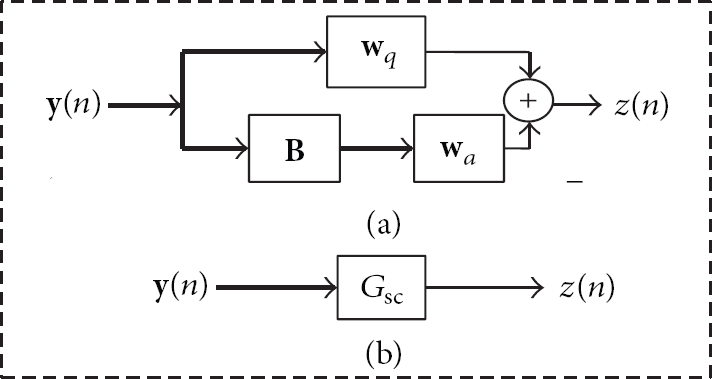
Generalized sidelobe canceller (GSC). (a) Block diagram of GSC. (b) Equivalent diagram of (a).
3. Proposed Method
Our proposed approach consists of two GSCs connected in parallel, instead of a single one, as shown in Figure 4.
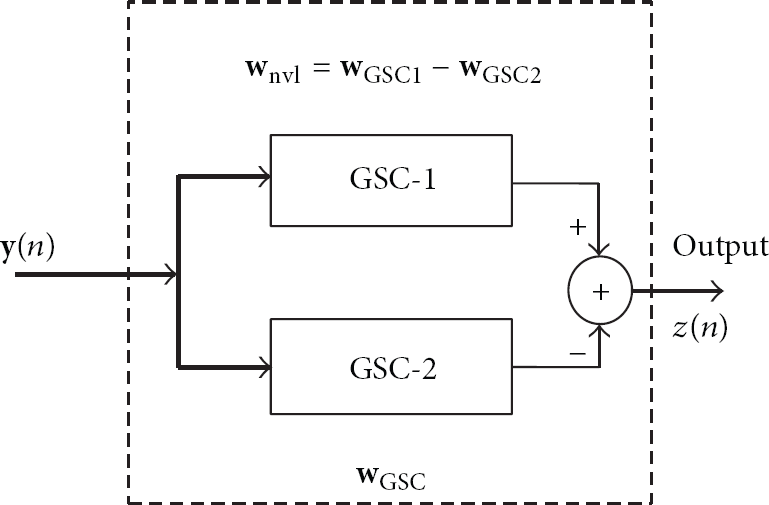
Proposed technique for sidelobe suppression in cognitive radio.
In order to limit the sidelobe at the specific level in (15), the contemporary approaches entail the following multiple quadratic inequality constraints outside the main beam pattern area

where ε is the set sidelobe level and

On the other hand, the proposed approach uses the same minimization problem with the same equality constraint as in (15) and (21); that is,
But instead of a number of inequality constraints as in (21), it uses only as many equality constraints as the sidelobes to be suppressed by observing the sidelobes in (15). The proposed approach works in two steps. In the first step of the relation (15), where constrained one is converted into unconstrained. GSC-1 is used for this purpose.

and hence
In the second step, sidelobes of GSC-1 are suppressed. Steering vectors, at angles
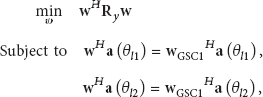
where
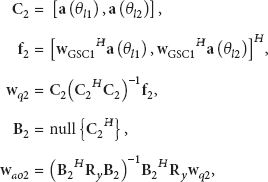
and hence
The overall weight vector
Now, in order to suppress the next pair of sidelobes while preserving the previous suppression, GSC-3 is used in the same manner as GSC-2 and weights of the proposed beamformer will be as given below; that is,

In this way all the sidelobes are suppressed. In case of odd number of sidelobes, the auxiliary beamformer with single constraint, that is, auxiliary GSC with single beam corresponding to single sidelobe, can be used. After complete suppression of sidelobes, beamformer with weights
GSC-1. GSC-1 selects the main beam along the cognitive user direction. The role of this GSC is the same as given by the GSCs described in Section 2. That is, it works independent of the GSC-2. In fact it is unaware of the presence of the second one.
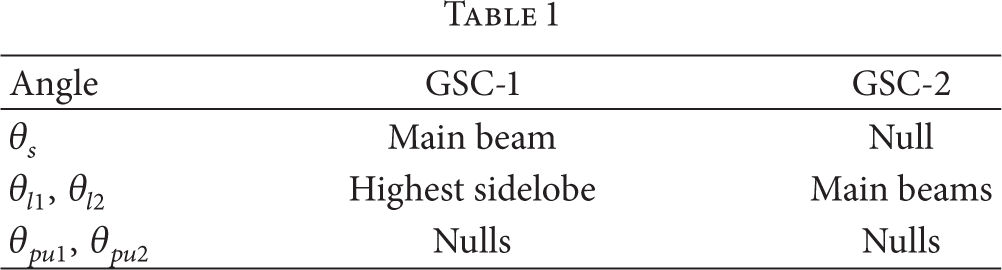
GSC-2. GSC-2 works in parallel to GSC-1; however, it is adaptive with the parameters taken from the output of GSC-1. Therefore, GSC-2 is totally dependent on the output of GSC-1 and remains in observe state until the output of first appears and is analyzed. It has nulls at the same positions as that of first one, that is, along primary users. It has an additional null at the main beam position of GSC-1. Apart from these nulls, the GSC-2 also produces two beams. The positions of the beams are kept exactly the same as that of the positions of the sidelobes of GSC-1, taken from the analysis of its beam pattern, and the heights of the beams are also kept the same as that of the heights of the sidelobes GSC-1. The simulated outputs of GSC-1 and GSC-2 for a pair of sidelobe suppression are given here in Figure 5 to visualize the concept.

(a) GSC-1 output power. (b) GSC-2 output power. (c) Overall output power with suppressed sidelobe pair.
The GSC-2 output, in this case, has to be taken ideally by considering GSC-1 output of a typical case. Next step is the subtraction of the output of GSC-2 from GSC-1 and in this case, the overall output power will look as in Figure 5(c). The two highest (selected) sidelobes are completely eliminated in this case. The position of nulls, sidelobes, and main beam for the case of GSC-1 and GSC-2 are also given in Table 1 for comparison.
The following remarks are highlighted corresponding to the proposed method.
Remark 1.
The overall positions of the main lobe and nulls will not be disturbed in the new setup.
Remark 2.
The main beams of GSC-2 have been placed at the same positions as that of the sidelobes of GSC-1 to be suppressed. Their heights are also kept the same as that of GSC-1 in the new setup to nullify their outcome. The overall result will be the suppression of sidelobes.
Remark 3.
The exact position and peak value of sidelobe can be found by scanning the output power pattern of the GSC-1 which is used in next setup for main beams of GSC-2.
3.1. N-Sidelobe Suppression
The same idea can be extended for the suppression of N-sidelobes, where N is an arbitrary number. The suppression can be carried out in parallel as well as in serial mode.
3.1.1. Parallel Setup
In this case the output power pattern of GSC-1 is scanned for the N-pairs of sidelobes, instead of single one. In case of the number of sidelobe pairs greater than N, the largest N-pairs may be considered for suppression. The proposed setup in this case will be as shown in Figure 6. In this case, the cancellation of N-sidelobe pairs will be done parallel in single iteration.

Parallel setup for sidelobe suppression.
3.1.2. Serial Setup
In this case, the initial setup presented in Figure 4 will be used. However, instead of single scan, it will be repeated for N-times. That is, the output power pattern of GSC-1 is scanned repeatedly in cycles. The largest sidelobes are located and suppressed in each cycle. The process is repeated for N-cycles to suppress N-pairs of sidelobes.
3.2. Cognitive Radio Model Using Adaptive Beamforming in Transmitting-Receiving Mode
A conceptual diagram of cognitive system in the paradigm of spectrum sharing is specified in Figure 7. Adaptive beamforming suppresses the interference at the cognitive base station (CBS); however, signal suppression of the primary takes place due to the interference suppression techniques. Cognitive base station (CBS) is equipped with linear array. The linear array consists of multiple antenna elements and steers the beam in the direction of the cognitive user having the channel gain, while rejects the signal coming from the direction of the primary users. The linear array as discuss above is used in the cognitive radio system model at the base station. when Cognitive system used the interweave technique or opportunistically occupied the primary channel, the switch in the model closed and steer the beam in the direction of the secondary user while it generate the nulls in the direction of the primary users. The iterative procedure is an effective technique to suppress the sidelobe at the CBS. In the receiving mode, when the sidelobes are suppressed, the interference temperature limit [16] will not be increased and the decoding capability of the cognitive user will be increased. The capacity of the system increases due to the reduction of frequency reuse distance and increase of SINR. In the receiving beamforming as discussed in (21), the beams received at the receiver are measured by minimizing the mean output power of the array, subject to unit response of the desired cognitive radio user and generate nulls in the direction of primary as well as the other cognitive users. According to the Figure 7, the cognitive system consists of the multiple antennas at the cognitive transmitter. The primary base station and the primary user consist of single antenna element. Hence the channel matrix is developed from cognitive base station to the cognitive user, while the channel vector developed from the cognitive to the primary user. As a result, this system acts at a time as the transceiver for primary as well as cognitive system. The steering vector of (5) in the paradigm of the cognitive radio is

Therefore, the channel response [15] of the vector from cognitive base station to cognitive user is given as

where α = path loss,

where

Cognitive radio model using adaptive beamforming in transmitting-receiving mode.
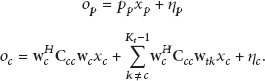
The signal to interference plus noise ratio for the primary as well as cognitive user is written as


The weights of transmitted and received beamforming are distributed amongst cognitive radio users. Mean output power minimization and maximization of SINR are the two accessible techniques which are used in the receive beamforming mode. By solving the (21) in the receiving beamforming mode, the weights are optimized to minimize the mean output power and as an outcome the self-interference of the cognitive user trims down. To maximize the SINR we solve (31) for optimizing the weights in the receiving mode keeping in view that the interference occurred due to the fact that the cognitive user is not consider, so both the receive beamforming scheme has the equal performance. In the transmission mode, at low SNR the performance of the GSC show optimal value, however, with gradual increase of SNR it inter into the linear and saturation region. Thus, in the cognitive radio scenario, it shows the good result at the low SNR, while in the high SNR it performance degraded. In other word, at low SNR the nulls are deep and the sidelobe levels are low. Whenever, the SNR increases, the sidelobe level increases along with the nulls in the linear and saturation region and the performance degrades. Therefore, the implementation of spectrum sharing in cognitive radio using GSC with suppressed side-lobes, will intelligently boost the throughput without negotiation on the permissible interference limit of the primary users.
4. Simulation Results
Simulations have been carried out in MATLAB for testing the performance of proposed method. We assumed a uniform linear array of 16 omnidirectional sensors with interelement spacing
Example 4.
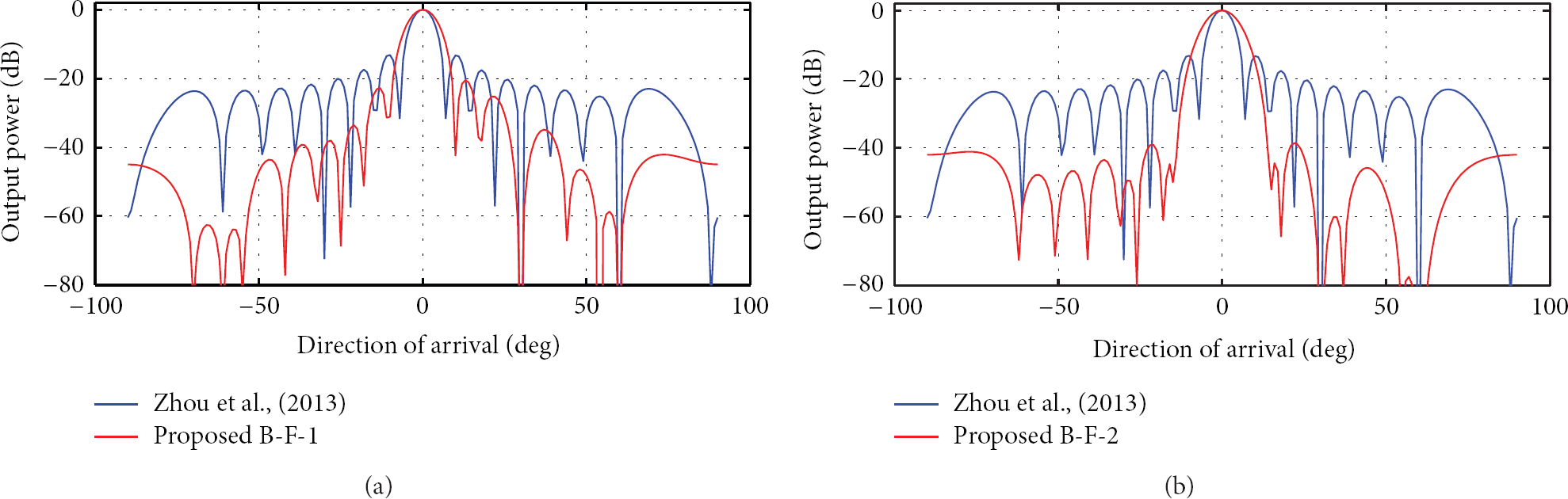
In this example one cognitive user and two primary users are considered. The cognitive user is taken at

Proposed beamformer with first pair of sidelobe suppression: Example 4.

Proposed beamformer with two pairs of sidelobe suppression: Example 4.
Example 5.
Here we have considered one source of interest at

Example 6.
The performance of two algorithms in terms of output SINR versus the SNR for the signals given in Example 4 is shown in Figure 12. The performance of [32] and the proposed algorithm is for suppression of 10 and 20 generation sidelobes and is represented as proposed beamformer-1 and proposed beamformer-2, respectively. The formula for output SINR is as given in [35] and [33] and is averaged for a set of fifty weight vectors.
Consider

Here

Output SINR versus SNR of proposed beamformers for 10 and 20 generation sidelobe suppressions: Example 6.
Example 7.
The performance of two algorithms in terms of output SINR versus the number of snapshots for the signals given in Example 4 is shown in Figure 13. SNR = 0 for this case. The performance of proposed algorithm for 10 generation sidelobe suppression is represented as “proposed beamformer-1” and for 20 generation sidelobe suppression is represented as “proposed beamformer-2” and is shown along with [32] and optimal performance in Figure 13.
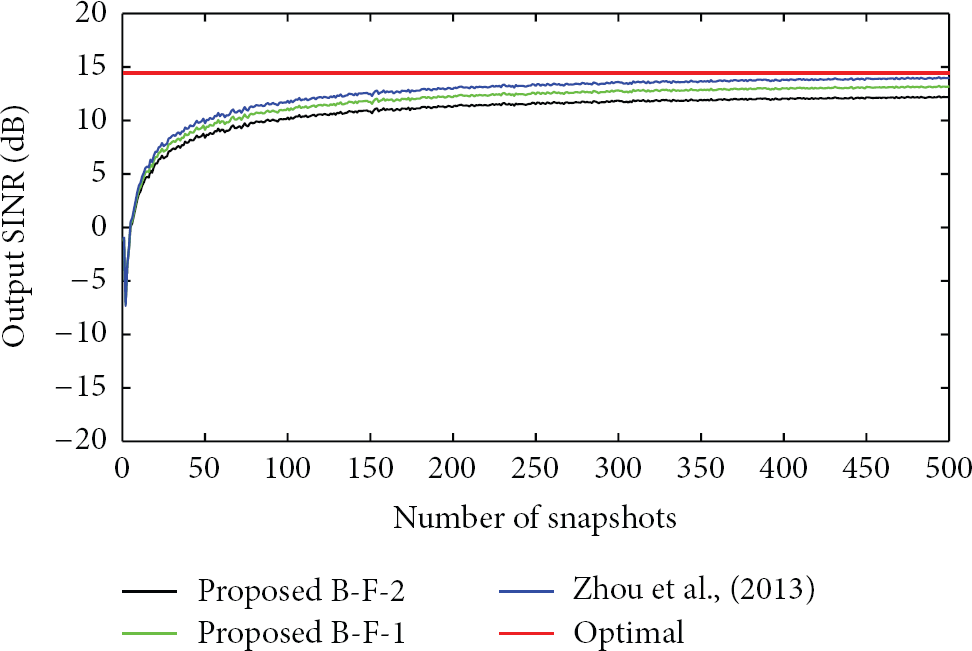
Output SINR versus number of snapshots for 10 and 20 generation sidelobe suppressions: Example 7.
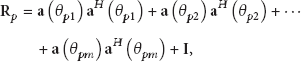
In order to use GSC in transmission mode, cognitive direction is taken as
where
The optimization problem for transmitter can be expressed as

In the Figure 14, we show the beam pattern for GSC in the transmitting mode using a ULA of 16 elements with CU while the primary users

Beam pattern for GSC in transmission mode.
Output SINR versus SNR plot of GSC is shown in Figure 15. It can be seen from the figure that for SNR ≤ 15 dB, the performance of GSC is close to optimal, while output SINR saturates for SNR > 30 dB. Three values of SNR have been selected; that is, one is close to optimal performance which is 15 dB, second one is 25 dB which is from the linear region but deviated from the optimal, while the last one is 35 dB and is from saturation region. The corresponding beam pattern for these values of SNR is shown in Figure 16. Figures 16(a), 16(b), and 16(c) show the beam pattern for SNR equal to 15, 25, and 35 dB, respectively. It can be seen that for Figure 16(a), the performance is very good in the context of main beam sidelobes and null depth because SINR versus SNR is close to optimal. According to Figure 16(b), side-lobe level increases, while the null depth decreases. SINR although lie in linear region but diverge from optimal. In Figure 16(c) the pattern is badly distorted because SINR versus SNR lies in saturation region. From the above discussion, it is clear that the performance of GSC is close to optimal for lower values of SNR. Since cognitive radio required low power compare to primary users. It is therefore evident that GSC will perform well for cognitive radio.

SNR versus SINR.

(a), (b), and (c).
5. Conclusion
A new beamformer with suppressed sidelobes has been proposed by using transmit-receive beamforming in cognitive radio. The technique observes the sidelobes of a beamformer and then suppresses them. It is clear from simulation results that the proposed algorithm has excellent performance for sidelobe suppression. The sidelobes can further be suppressed iteratively which is the additional feature of this algorithm. The proposed algorithm shows better performance for SINR versus SNR and its curve is close to ideal for larger range of SNR. The SINR versus number of snapshots shows a little performance degradation and this price is small as compared to the achievements. Simple to implement and efficient to suppress the sidelobes are the main features of this technique. Apart from simplicity, another important feature of this approach is that the GSC-2 does not require all the steering vectors outside the main beam pattern. In the future this technique can be extended for a number of cognitive users simultaneously by generating multiple beams. In the transmission mode, the performance of the GSC at low SNR is near to optimal. Although the implementation of this technique is complicated, it is efficient and increases the data rate and range. In the future, with the development of the nanotechnology, adaptive beamforming with suppressed sidelobes will be used in the cognitive radio for sharing the spectrum with diverse channel.
Footnotes
Conflict of Interests
The authors declare that there is no conflict of interests regarding the publication of this paper.