




Abstract
Formation permeability distribution is important in the oil industry since it is a key tool in forecasting oil production performance, a matter of primary concern to oilfield operators. However, the direct problems of reservoir analysis are limited in practice by a lack of input parameters such as reservoir vertical heterogeneity. Therefore, inverse problem modeling is important to achieve reservoir vertical heterogeneity using production profiles, which are always known for existing reservoirs. In this way, what has occurred inside a reservoir can be understood by applying reservoir output in the reverse model. Because formation permeability can frequently be represented by a normal distribution and can describe heterogeneity and water production capability, an inverse problem of formation permeability was modeled to study reservoir vertical heterogeneity and reservoir production performance based on oil-water two-fluid flow theory and optimization problems. Moreover, through establishing an objective function, we obtained an optimal solution for water production rate. Finally, one case is simulated by this model and good results achieved, which are compatible with production and experimental data.
1. Introduction
In recent years, interesting research on formation permeability distribution and two-fluid flow modeling has been growing in conventional numerical reservoir simulation for the oil industry since it is a key to oil production performance, which in turn determines project profitability. In addition, the two-fluid model is used widely in other disciplines. For example, such modeling for particle-fluid fluidization is used in smoothed particle hydrodynamics [1], implementation of macroscale pseudoparticle modeling in gas-solid flow [2], and the study of large-scale direct numerical simulation (DNS) in gas-solid flows [3]. In reservoir analysis, a fast streamline-based computation method of sensitivity coefficients of fractional flow rate was studied based on inversion of dynamic production data in 2003 [4] and a method of subsurface inverse modeling was realized based on single-phase transient flow in 2011 [5]. Oil-water production can be simulated in the model as soon as the required parameters are defined in the forward two-phase model. However, it has been found that oil-water production is mostly governed by reservoir vertical heterogeneity, which is normally difficult to define [6, 7]. Therefore, inverse problem modeling must be done to achieve reservoir vertical heterogeneity using production profiles, which are always known for existing reservoirs. Thus, we can understand conditions inside a reservoir by applying reservoir output (e.g., oil-water production) in the reverse model. This provides a basis for estimating future production performance of a reservoir, which is very important to the reservoir operator.
At present, the study of the vertical permeability distribution is important for improving oil-driving efficiency and oil recovery. To investigate relevant problems in reservoir engineering, most studies rely on forward problems of seismic interpretation, logging interpretation, and core sampling experiments and combine these with mathematical statistics for a solution. As a result, many complex technologies and additional time will be needed [8–10]. In addition, there is always a large error between calculation of the water production rate and historical rate in most reservoir water cut analysis [11, 12]. On the contrary, the process of the internal rules and exterior influence can be explored by the observed phenomenon and the result of the evolution, which can be called inverse problem process. Actually the studies of inverse problems have been spread over every field of the modern society in recent years such as oriented design, geophysical prospecting, and numerical simulation [13–16].
Using the grid modeling method and optimization problems of water production rate, an inverse problem model was constructed based on formation permeability and two-phase flow. This facilitates not only research into the permeability distribution and injection profile, but also oil and water production analysis. This approach can provide a reference for heterogeneity by researching whether the vertical permeability distribution always obeys normal distribution. In Section 2.1, an objective function is established and optimal solution of water production rate is obtained, in order to reduce the error between the calculated production rates and historical water production rates in the inverse model. In Section 2.2, we infer the oil-water two-phase plane radial flow mathematical model and give a special definition of saturation called “frontier” saturation. Section 3 describes research into the inverse problem model of reservoir permeability when its logarithmic function obeys a normal distribution, and related theories and methods are introduced. Section 4 provides definitions and establishes the steps of productivity analysis for the fluid-producing edge in the reservoir grid model. A case study is used for reservoir analysis in Section 5, and conclusions are drawn in Section 6. Finally, an inverse problem model between water production rate and heterogeneity was established, which not only can calculate water and oil production but also can show the physical phenomenon of injection profile.
2. Mathematical Models of Oil-Water Two-Phase Plane Radial Flow
2.1. Reservoir Profile Model
As shown in Figure 1, a reservoir profile grid model was established for describing relevant physical processes. This is the model supporting our research.

Reservoir profile grid model.
The research model focuses on a minimum-differential problem between calculated and historical water production rates, to investigate the inverse problem mathematical model and optimization problems of water production and formation permeability distribution. The problem can be reformulated as the following optimization problem:

The mathematical model for researching the water saturation x in the fluid-producing edge is as follows:

where G is a functional relation of water saturation which can be obtained from a set of experimental data S w and F w (S w ), which can be denoted by other experimental data between ΔS w and Δf w when re ≤ rwf.
Actually, we can describe water production rate at different times based on a specified time step for a more convenient study of reservoir production. Therefore, the above problem can be done in a simplified consideration. In vector space C
n
(R
n
), we can obtain

The model will contain the Buckley-Leverett theory of two-phase flow and establishes the oil-water two-phase plane radial flow function [17] for establishing an inverse problem model of reservoir permeability in each longitudinal grid layer, and the model will also show the displacement of frontier saturation and solution of the water production rate.
2.2. Derivation of Oil-Water Two-Phase Theory Based on Plane Radial Flow
Using the Buckley-Leverett theory of two-phase flow, without considering factors of gravity and capillary pressure, we established the oil-water two-phase plane radial flow mathematical model
We suppose the liquid flow rule is a plane radial flow from reservoir limit to well and choose a volume unit in the streamline vertical direction, as shown in Figure 2.

Plane radial flow model unit.
Relying on the seepage principle [18], we have the flow equation:

The flow volume of the volume element in dt time is


Inflow volume of the volume element is

According to the Buckley-Leverett theory for oil-water two-phase flow in time Δt:Qin = Qout.
From (6) and (7), we have q·df w ·dt = ϕ·2πh·rdr·dS w , as follows:
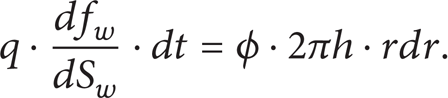
Defining

We obtain

Because of
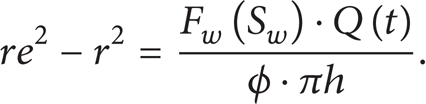
For the reservoir profile grid model, the plane radial flow model of the grids in each longitudinal layer yields

A special definition of saturation “S
w
f”: from the water cut function curve f
w
= f
w
(S
w
f) and selecting the point of irreducible water saturation as a fixed point and joining any other point on the curve, with constructing function


Frontier saturation diagram.
We can calculate the front position of water driving in each grid layer at different times from (13).
3. Research on Whether the Inverse Problem Model of Formation Permeability Logarithmic Function Always Obeys Normal Distribution
If the formation permeability logarithmic function distribution
According to the 3σ principle, or a normal distribution curve, if P (μ-3σ-a<X ≤ μ + 3σ + a) = 1, there are left and right endpoints on the curve. The left endpoint is logK
min
or μ-3σ-a on the X-axis, and the right endpoint is logK
max
or μ + 3σ + a on that axis, and so forth: a>0 (
According to the area superposition principle of a normal distribution curve [19]: selecting

Area-dividing distribution function with equal steps.
By the area superposition principle of the normal distribution and establishing an initial value σ of that distribution, and so forth, X0 = logK
min
, X
n
= logK
max
, p = n + 1. F(X
j
) is a cumulative distribution function of the normal distribution [20]. Using equal step size ΔX to subdivide the probability curve, the area summation of every closed figure S
j
= F(X
j
)-F(Xj–1), X
j
= ΔX·j + X0, K
j
= exp(X
j
) and longitudinal strata thickness of each layer h
j
= h·S
j
. If we use equal area ΔS to subdivide for probability curve, the area summation of every closed figure is S
j
= F(X
j
)-F(Xj–1),
Relying on the distribution

We can differentiate production and calculate liquid production Q j in each layer at different times according to
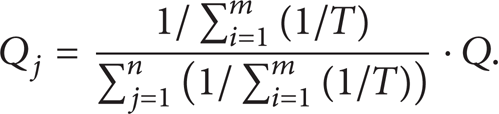
We obtain the front position of water driving rwf j as derived from (13) and (15).
When re ≤ rwf j and solving the inverse function of (12) and calculating water saturation of the fluid-producing edge, then S w = G(F w (S w )), and so forth, i = 1. If re>rwf j , then S w i,j = S0, and so forth, i = 1.
When we have the water saturation (S w ) [26] of each layer, relying on the function f w = f w (S w ), the water cut for longitudinal each layer f w (S w 1,j ) is calculated. Ultimately, oil production Q o j and water production Q w j are obtained. The corresponding mathematical model is
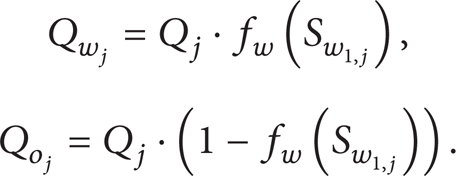
When we obtain the oil and water production in each layer, the total water production rate can be calculated at the fluid-producing edge according to
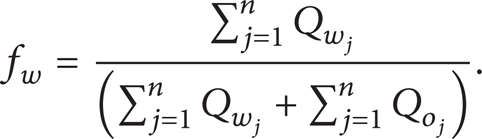
Relying on the results of (17) and the objective function (1) as a determinant of the optimization problem, the optimal calculation water production rate fw is found at different times. The standard deviation σ and distributions
4. Fluid-Producing Edge Productivity Analysis for Reservoir Profile Model
4.1. Parameter Definitions
Water saturation of grid (S w i,j ): the center of each grid corresponds to water saturation.
Water saturation of the fluid-producing edge (x = S w 1,j ): the water saturation of the grid is next to the fluid-producing edge in each layer.
Water production rate of grid (f w (S w i,j )): the center of each grid corresponds to the water production rate.
Water production rate of the fluid-producing edge (f w (S w 1,j )): the water cut of the grid is next to the fluid-producing edge in each layer.
4.2. Productivity Analysis for Fluid-Producing Edge
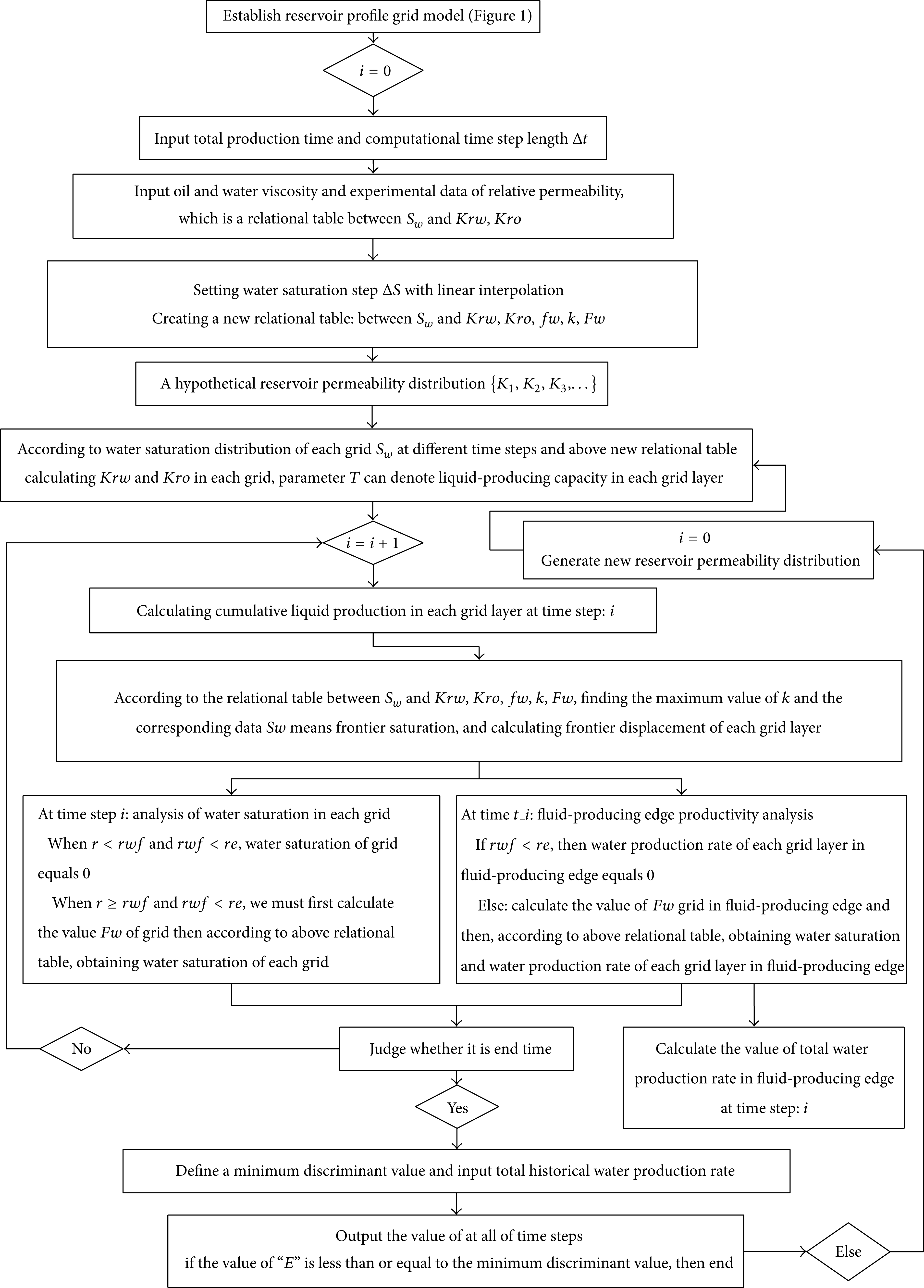
To calculate the water cut of the fluid-producing edge at different times, we can use the following steps.
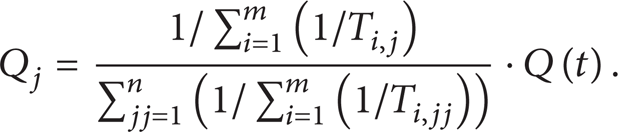
Step 1. Counting total fluid production of each vertical layer at different times,
Step 2. In each grid layer, we obtain the derivative of water production rate in the fluid-producing edge from (13), when re ≤ rwf j

Step 3. Solving a functional relation between S and F w : x = S w 1,j = G(F w (x)), we obtain the value of S w 1,j (S w 1,j = S0 when re>rwf j ).
Step 4. Relying on S w 1,j and the functional relation f w = f w (S w ), we obtain the value of f w (x) j in each grid layer.
Step 5. When we have the value of f w (x) j , oil and water production can be calculated in each grid layer from the following:

Step 6. Total oil-water production and total calculated water production rate of the fluid-producing edge can be calculated as follows:

Step 7. Find the optimal solution of water production rate and put all results of the calculated water production rate into the objective function (1) in the inverse mathematical model. If the result of water production rate does not meet corresponding requirements, modify the parameters as required and repeat the above steps until the optimal solution of that rate is obtained.
4.3. The Flow Diagram for Calculating Water Production Rate
See Figure 8.
5. Example Application for Reservoir Analysis
5.1. A Set of Reservoir Physical Property Data and Production Data
Reservoir Data. Reservoir radius re = 150 m; oil viscosity μ
o
= 2.4 mpa·s; water viscosity μ
w
= 0.9 mpa·s; reservoir thickness h = 50 m; average permeability
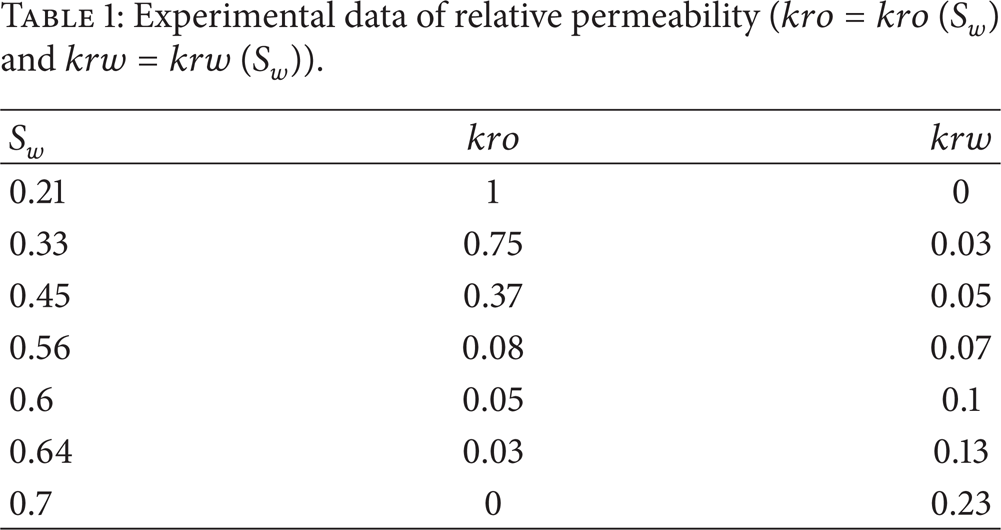
Experimental data of relative permeability (kro = kro (S w ) and krw = krw (S w )).
Geologic description.

Production data:
total computing time Time = 4000 d.
Production Data. Total computing time Time = 4000 d.
In the reservoir profile grid model based on Figure 1, time steps ΔT = 60 d; average partition total m = 20; partition total n = 20. See Tables 3 and 4.
Average liquid production data of reservoir.

Total historical water production rate.

5.2. Results
The front position of water driving based on the reservoir profile grid model at different times is shown in Figures 5 and 6 (blue indicates water; the border of blue and red is the front position of water driving in each grid layer).

Front position of water driving (180 days).

Front position of water driving (3000 days).
Relying on the objective function (1), we can obtain the calculated water production rate versus the historical rate, which can provide a basis for calculation (Figure 7).
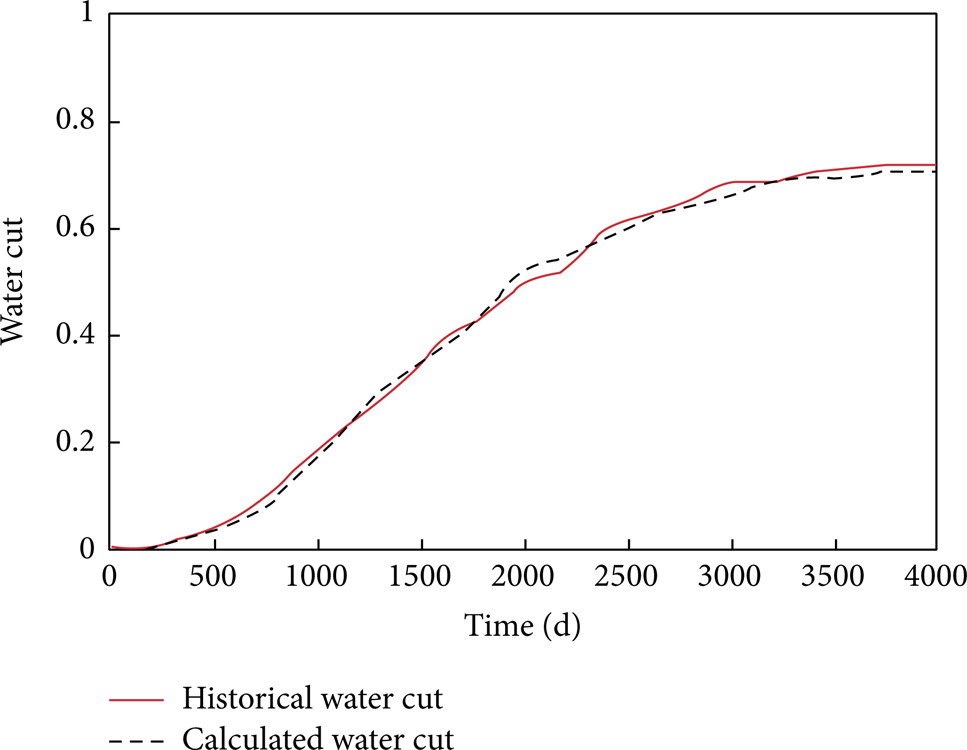
Comparison of water production rate.
According to above results, we can learn that a good history matching effect of water production rate can be obtained from a set of suitable permeability distribution and other relevant data.
6. Conclusions
Relying on the above inverse problem model and the definition of normal distribution, we expect that the different variance distributions will correspond to their own normal distributions. If the standard deviation increases, the volatility of its normal distribution will be greater per the definition of standard deviation. This will lead to different permeability distributions, and the distribution curve can describe heterogeneity. The approach also determines liquid production, water production, and the integrated water production rate of the entire liquid outlet of each individual formation. Combined with the objective function, this produces a set of optimum normal distributions via the optimization solution method.
Finally, oil production and water production rates can be determined in the inverse problem model by analysis of changes of water driving location. The goal of constructing an inverse problem mathematical model according to historical dynamic production data can be realized. This permits the study of reservoir heterogeneity, prediction of dynamic production performance, and observation of the water flooding front position.
Footnotes
Nomenclature
Conflict of Interests
The authors declare that there is no conflict of interests regarding the publication of this paper.
Acknowledgments
The authors gratefully thank the referees for their valuable suggestions and the support of Canada CMG Foundation.