




Abstract
Thermal performance of a cylindrical heat pipe is investigated numerically. Three different types of water based nanofluids, namely, Al2O3 + Water, Diamond + Water, and Multi-Wall Carbon Nano tube (MWCNT) + Water, have been used. The influence of using the simple nanofluids and MWCNT nanofluid on the heat pipe characteristics such as liquid velocity, pressure profile, temperature profile, thermal resistance, and heat transfer coefficient of heat pipe has been studied. A new correlation developed by Bakhshan and Saljooghi (2014) for viscosity of nanofluids has been implemented. The results show, a good agreement with the available analytical and experimental data. Also the results show, that the MWCNT based nanofluid has lower thermal resistance, higher heat transfer coefficient, and lower temperature difference between evaporator and condenser sections, so it has good thermal specifications as a working fluid for use in heat pipes. The prepared code has capability for parametric studies also.
1. Introduction
Heat pipe is a device for transferring heat with high heat conduction ratio. It transfers heat energy by vaporization and condensation of a fluid with little temperature reduction. A heat pipe has three sections in general including evaporator, adiabatic, and condenser sections. When the heat reaches evaporator, the fluid evaporates and it forms a different pressure in the pipe. The different fluid pressure causes the vapor to move through the pipe and reach condenser. In condenser section, the vapor condenses and its latent heat releases and then the fluid returns from inside wick by capillary pressure to evaporator section. This study has been conducted to show the effect of using three water-based nanofluids (water + Al2O3, carbon nanotube + water, and water + diamond) on the heat operation of heat pipe. We also applied a new correlation for viscosity of nanofluids developed by Bakhshan et al. [1, 2].
A mathematical model of a cylindrical heat pipe using TiO2, CuO, and Al2O3 nanofluids was solved analytically by Shafahi et al. [3]. The thermal performance of cylindrical heat pipes utilizing the above nanofluids as the working fluid has been investigated. They obtained the velocity, pressure, temperature, and maximum heat transfer limit for different nanoparticle concentration levels and sizes. Their results show that the thermal performance of a heat pipe is improved and temperature gradient along the heat pipe and thermal resistance across the heat pipe are reduced when nanofluids are utilized as the working fluid.
Do and Jang [4] investigated a mathematical model which was developed for quantitatively evaluating the thermal performance of a water-based Al2O3 nanofluid heat pipe with a rectangular grooved wick. Their results show that thin porous coating layer formed by nanoparticles suspended in nanofluids is a key effect of the heat transfer enhancement for the heat pipe using nanofluids. Also, the effects of the volume fraction and the size of nanoparticles on the thermal resistance of nanofluid heat pipes were studied. Furthermore, the experimental results showed that the thermal resistance of the nanofluid heat pipe tended to decrease with increasing the nanoparticle size.
Liu et al. [5] carried out an experimental study on the application of nanofluids in an inclined miniature grooved heat pipe using water-based CuO nanofluid as the working fluid. The working fluid consisted of CuO nanoparticles with a diameter of 50 nm and pure water. The experimental results showed that, with increasing the inclination angle, the heat transfer coefficient of the evaporator and the condenser section will increase. The evaporation heat transfer coefficient and the condensation heat transfer coefficient of the inclined heat pipes increase about 60–100% comparing with that of the horizontal heat pipe using the nanofluid. Furthermore, the experimental results showed that the evaporation and the condensation heat transfer coefficient of the inclined heat pipes increase about 60–80% comparing with that of the horizontal heat pipe using water. They considered that the maximum heat fluxes of the inclined heat pipes vary little compared with that of the horizontal heat pipe.
Liu and Zhu [6] carried out an experimental study on the application of nanofluids in a heat pipe using deionized water-based CuO nanofluid as the working fluid. The nanofluid consisted of CuO nanoparticles with a diameter of 50 nm. The wall temperature distributions and the total heat resistance of the heat pipe utilizing a nanofluid as the working fluid and effect of the nanoparticles mass concentration on the heat transfer in the evaporator and condenser have been investigated. The experimental results showed that average wall temperatures of the heat pipe for the nanofluid are lower than those for deionized water and both the heat transfer coefficients of the evaporator and the condenser increase with the increase of the mass concentration. Also they showed that the maximum heat flux increases with the increase of the mass concentration when the mass concentration is less than 1.0 wt.% and the total heat resistance of the heat pipe decreases when substituting the 1.0 wt.% CuO nanofluid for deionized water.
Mousa [7] investigated the effect of nanofluid concentration on the performance of circular heat pipe. The effect of filling ratio, volume fraction of nanoparticle in the base fluid, and heat input rate on the thermal resistance is investigated. Their results showed that, by increasing the concentration of the nanofluid, the thermal performance of heat pipe can be decreased.
Thuchayapong et el. [8] studied the capillary pressure effect on the performance of a heat pipe numerically with finite element method. They simulated the heat transfer and fluid flow at two-dimensional and steady state and showed that the capillary pressure gradient inside the wick at the end of the evaporator section was very large as a result of fast liquid motion, thus providing efficient heat transfer through convection.
Li and peterson [9] analyzed the heat pipe evaporator with a fully saturated wick operation. They used a practical quasi-three-dimensional numerical model in a square flat evaporator of a loop heat pipe with a fully saturated wicking structure. They solved the governing equations for the heat and mass transfer (continuity, Darcy, and energy) in 3D space. They compared the numerical results with experimental data and showed the local heat transfer mechanism is revealed.
Peng et el. [10] studied the oscillating heat pipes numerically with using finite element modeling. An Euler predictor-corrector method with convergence check has been used by them to solve the oscillation and the temperature distribution within each fluid plug. They showed that OHP is a parametrically excited nonlinear thermomechanical system and latent heat transfer provides the driving force for the oscillation, and sensible heat transfer induced by forced convection contributes more than 80% of the total heat transfer rate.
Chen et al. [11] tested the use of nanofluids in the copper wire-bonded flat heat pipe experimentally. They used the water, ethanol, and nanofluids as working fluids and studied the influences of the working fluid, the operating temperature or operating pressure, the wire diameter, and the space gap between two wires on the thermal performances of the heat pipe. They showed that using nanofluid as working fluid can improve the heat transfer performance of the heat pipe and the best heat transfer performance of heat pipe is achieved at the concentration of 1.0 wt.%.
Asirvatham et al. [12] used silver-water nanofluid in the screen mesh wick heat pipes. They tested the heat pipe for heat inputs ranging from 20 W to 100 W in five steps, which is suitable for removing heat from power transistors in electronics and processors in computers. They studied the effects of various operational limits and test parameters such as heat inputs, volume fraction, vapor temperature on the thermal resistance, and evaporation and condensation heat transfer coefficients experimentally. They observed reduction in thermal resistance of 76.2% for 0.009 Vol% concentration of silver nanoparticles and achieved the result with the use of nanoparticles enhances the operating range of heat pipe by 21% compared with that of DI water.
In this research, with implementation of a new correlation for viscosity of nanofluids developed by authors (Bakhshan et al. [1, 2]) and using a new nanofluid (MWCNT) as working fluid in the cylindrical heat pipes, the thermal performance of it has been studied numerically. The thermal performance of heat pipe parameters such as the liquid pressure, temperature distribution, heat pipe wall temperature, heat pipe temperature difference, and heat pipe heat transfer coefficient and thermal resistance of it are investigated at different heat inputs and operating conditions.
2. Mathematical Modeling
The geometry used here is shown in Figure 1 schematically. A conventional cylindrical heat pipe with a constant conductance with fully saturated annular porous wick has been used. It has three zones: evaporator, adiabatic section, and condenser. The simulation has been donned in two-dimensional and steady state, so the governing equations are continuity, momentum, and energy for both region of vapor and liquid. Also, the fluid flow has been assumed laminar and incompressible.

Cylindrical heat pipe schematic.
2.1. Governing Equations for Vapor Flow
Continuity is as follows:

R-momentum is as follows:

z-momentum is as follows:

Energy equation is as follows:

2.2. Governing Equations for Liquid Flow
For porous media in the wicking material, Darcy's law has been utilized as follows.
R-momentum is as follows:
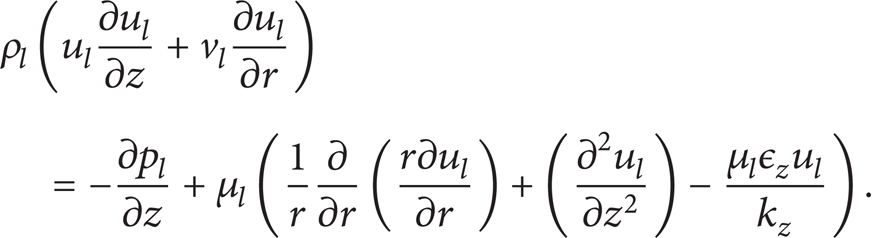
Z-momentum is as follows:

Energy equation is as follows:

The values of the source terms applied to evaporator and condenser sections with considering the phase change phenomenon are

In the above equations, the effective thermal conductivity is combined with conductivity of nanofluid and saturated wick and is calculated from the following equation [13]:

where knf is the conductivity of nanofluid and is calculated from

For calculating the viscosity of conventional nanofluids the model developed by Bakhshan and Saljooghi [1] has been used and is

where a,b,c are constants and a = −5.161804, b = −3.0904269e–8, and c = 6.1825371, respectively.
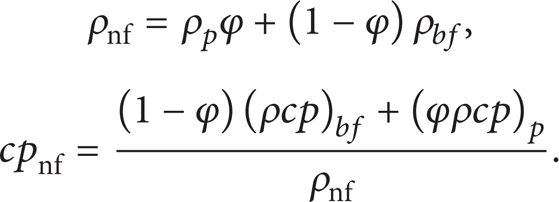
Density and heat capacity of nanofluids can be calculated from the following equations:
2.3. Boundary Condition
The radial vapor and suction velocities at the sections of heat pipe are

The vapor-liquid interface temperature for all sections is calculated using Clausius-Clapeyron formula as follows:

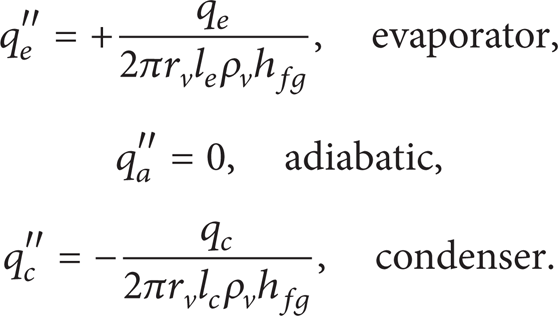
The value of the heat flux over each section of the pipe can be calculated using the following formulas:
3. Results and Discussion
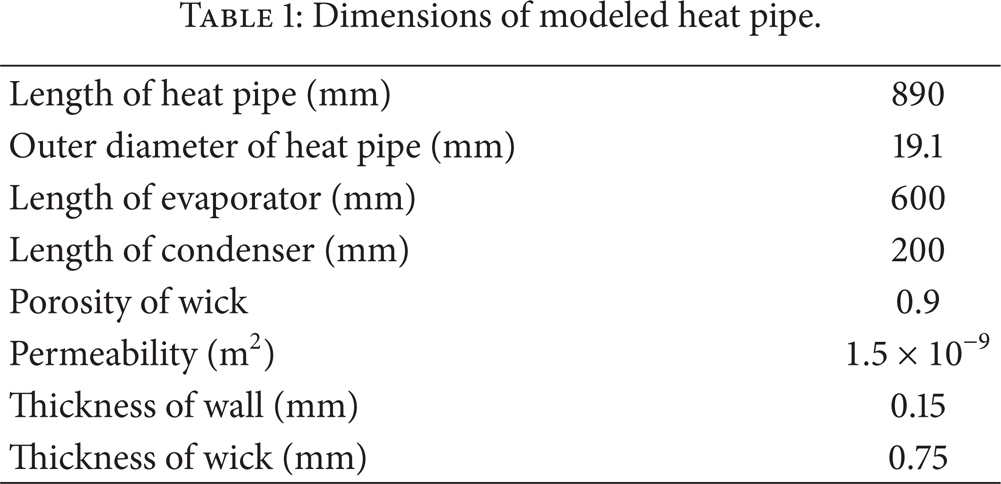
The dimensions of the considered model for heat pipe are shown in Table 1. The heat pipe has a total length of 89 cm. The condenser has a length of 20 cm, while the evaporator and adiabatic sections are 60 cm and 9 cm in length, respectively. The outer radius of the heat pipe is taken as 9.55 mm, the inner radius as 9.4 mm, and the vapor core radius as 8.65 mm. It should be noted that the dimensions used here are just nominal.
Dimensions of modeled heat pipe.
In the present study, three different types of water-based nanofluids, namely, Al2O3 + water, diamond + water, and multiwall carbon nanotube (MWCNT) + water, have been considered. In what follows, the influence of simple nanofluids and MWCNT nanofluid as working fluid on the thermal characteristics of heat pipe such as liquid velocity, pressure profile, temperature profile, thermal resistance, and maximum heat transport capacity is investigated. For validation, the pressure and temperature results of simulation were compared with analytical results given by Shafahi et al. [3] at Re = 10. These comparisons are shown in Figures 2 and 3. This comparison shows that our simulation results have good agreement with analytical results with using the conventional nanofluids as working fluid. With this accuracy, our developed code has been modified for implementation of multiwall carbon nanotube (MWCNT) with water as working fluid. Also it has capability for parametric studies.
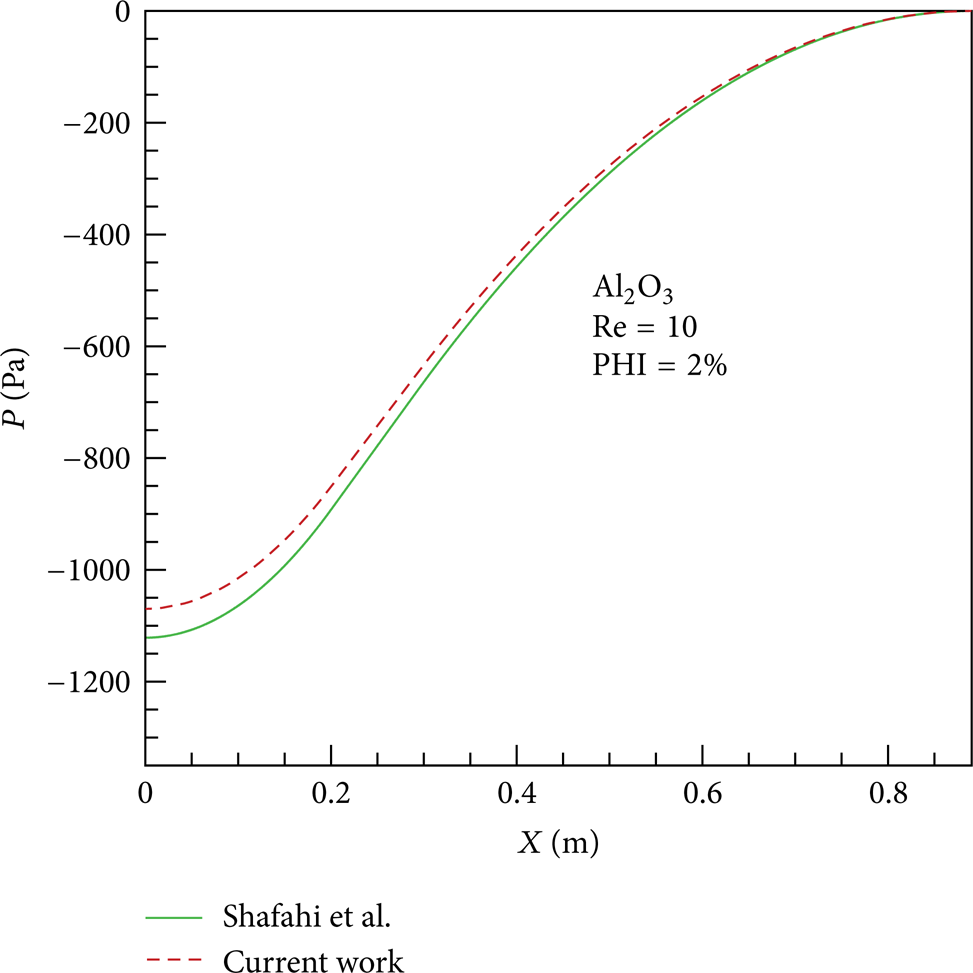
Comparison of the liquid pressure distribution with analytical result by Shafahi et al. [3] at Re = 10.
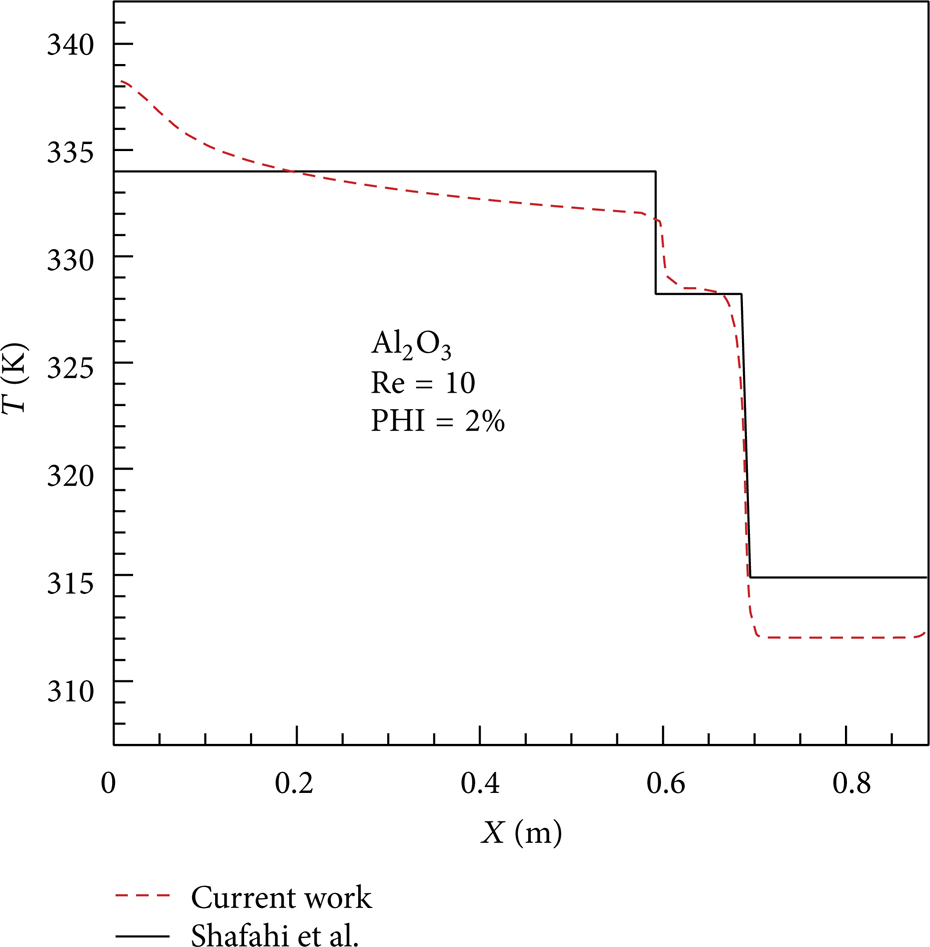
Comparison of heat pipe temperature distribution with analytical results given by Shafahi [3] at Re = 10.
The thermophysical properties of used nanofluids at specified volume fraction of nanoparticles are shown in Table 2. Figure 4 shows the heat pipe temperature variation through the heat pipe axis, for different working fluid at constant input heat. Temperature variation through the heat pipe axis is the same for all working fluid in general, so the temperature difference at the initial and end of heat pipe is higher for nanofluids in comparison with pure water and the MWCNT nanofluid has better performance in comparison with others at the same constant power for all. Because the MWCNT nanofluid has higher thermal conductivity, the temperature difference between evaporator and condenser is higher than other fluids and it makes that MWCNT nanofluid a suitable working fluid for heat pipes.
Properties of different materials at ϕ = 0.921%.


Heat pipe temperature distribution. q = 1180 w.
Figure 5 displays the liquid pressure distribution. With respect to the liquid pressure, it can be seen that the pressure gradient decreases as the MWCNT nanofluid is used as working fluid. It is observed that pressure distribution along the heat pipe changes when the working fluid is changed to the MWCNT nanofluid. This behavior is due to the opposite roles played by density and viscosity, both growing with using the MWCNT in the water. Physically, an increase in density reduces the liquid velocity which in turn results in a lower shear stress. In contrast, an increase in viscosity increases the shear stress, and this can be seen in Figure 6. The maximum liquid velocity decreases with adding the carbon nanotubes within the working fluid. This is due to an increase in the liquid density in the presence of carbon nanotubes. As a result of this increase in the nanofluid density, a slower flow is observed.
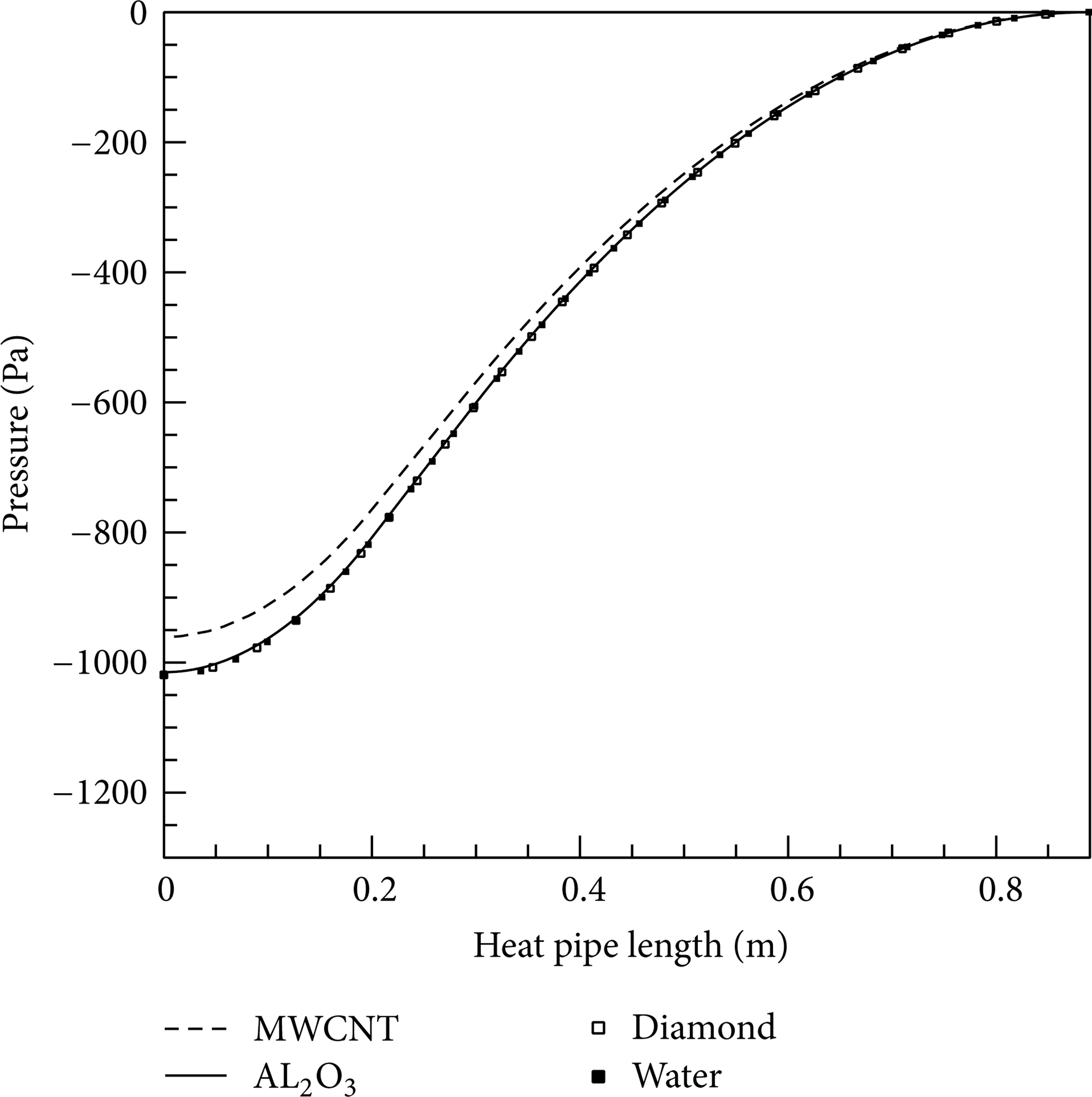
The effect of different nanoparticle materials on the liquid pressure; q = 1180 w.

The effect of different nanoparticle materials on the liquid velocity at q = 1180 w.
The MWCNT based nanofluid has minimum value of velocity and pure water has its maximum value and this is consistent with temperature difference and density of both fluids.
The temperature difference between evaporator and condenser sections of heat pipe is important parameter in designing it because it shows the heat pipe capability of removing the considered heat load. The variation of this parameter with heat loads is shown in Figure 7. With increasing the heat loads, the temperature difference between evaporator and condenser will increase. The variation of temperature difference trend is the same for all working fluids, but the MWCNT nanofluid has minimum temperature difference in all heat loads. It can be seen that for constant temperature difference between condenser and evaporator the use of a nanofluid especially water-based MWCNT nanofluid as a working fluid allows the heat pipe to operate under a larger heat load. A MWCNT nanofluid based heat pipe is able to dissipate more heat without experiencing increasing the wall temperature and this makes it suitable working fluid for using in heat pipe.

The effect of heat loads on the heat pipe temperature difference.
The variation of heat transfer coefficient at the condenser section of heat pipe versus heat loads is shown in Figure 8. It can be seen that the MWCNT based nanofluid has higher heat transfer coefficient in comparison with pure water and other conventional nanofluids and this is another reason that makes it a very suitable working fluid for use in heat pipes.

The variation of heat transfer coefficient at the condenser section at different heat loads.
The overall heat pipe thermal resistance is a key parameter for comparing the heat pipes performance with different working fluids. Thermal resistance of heat pipe is calculated from the following equation:

where


The thermal resistance variation of heat pipe versus heat loads is shown in Figure 9, and the MWCNT based nanofluid has lower thermal resistance in comparison with other simple nanofluids, and this is good for having higher thermal efficiency of heat pipes that using the MWCNT based nanofluids.

The variation of thermal resistance with heat loads with different nanofluids.
4. Conclusion
Thermal performance of a cylindrical heat pipe is investigated numerically with using nanofluids. Three different types of water-based nanofluids, namely, Al2O3 + water, diamond + water, and multiwall carbon nanotube (MWCNT) + water, were considered. The influence of conventional nanofluids and MWCNT based nanofluid on the heat pipe characteristics such as liquid velocity, pressure profile, temperature profile, thermal resistance, and heat transfer coefficient of heat pipe is studied. The results show that the MWCNT based nanofluid has lower thermal resistance, higher heat transfer coefficient, and lower temperature difference between evaporator and condenser sections and it is suitable working fluid for use in heat pipes. Also we used our developed correlation for viscosity of nanofluid that has been published earlier.
Footnotes
Nomenclature
Conflict of Interests
The authors declare that there is no conflict of interests regarding the publication of this paper.