




Abstract
The availability of smart sensors equipped CMOS cameras made it possible to capture and transmit multimedia data ubiquitously. The real-time performance is essential in many applications including surveillance and healthcare monitoring in multimedia sensor networks (MSNs). One of the real-time performance indicators is to transmit the packets within their deadline. Furthermore, in information-rich, battery-powered, and resource-constrained MSNs, it is a challenging problem to extend network lifetime decreasing communication cost. In previous researches, periodic message exchange for neighbor information maintenance leads to reducing network lifetime. This paper presents a power-aware data transmission for real-time communication in MSNs. The proposed scheme not only provides real-time performance, but also conserves energy consumption through efficient transmission and without periodic message exchange. The simulation results show the effectiveness of the proposed scheme in achieving the desired deadline success ratio and prolonging the network lifetime.
1. Introduction
Advances in microelectromechanical systems (MEMS) technology and wireless communications have put forward the development of smart sensors which handle the various kinds of data and consist of sensing, data processing, and communicating components [1]. The camera-equipped sensors, a kind of smart sensor, are deployed in the target area for collaborative multimedia data processing. Multimedia sensor networks (MSNs) are identified as a dominant research area and have contributed to progress in military and environmental applications such as remote and distributed video-based surveillance, environmental and structural monitoring, and industrial process control [2].
It is imperative that data transmission in such applications meets real-time constraints. The image and video data captured by the sensors should be delivered to the control center within the predetermined time, that is, deadline. As shown in Figure 1, a smart sensor detects the enemy attack and then reports the information to control center through multihop communication. Many real-time routing protocols have been proposed for considering deadline satisfaction or the end-to-end delay to report the time critical data [3, 4]. The performance is usually referred to as a quality of service (QoS) requirement [5, 6]. Most real-time routing protocols have taken account of the end-to-end delay by means of summing up the whole links delay in each path. This causes much wasteful processing and much overheads with respect to route maintenance and delay measurement.

An illustration of multimedia sensor networks.
The consideration of the peculiarities of MSNs such as information-rich data, limited power, hardware constraints, dynamic network topology (easy to die due to limited battery or mobile sensors), and large-scale deployment has posed many challenges such as energy-aware routing protocols in the design and management of MSNs. Above all, the extension of network lifetime through improvement of energy efficiency is a critical design issue in most routing protocols for MSNs. In MSNs compared to the traditional sensor networks, image and video data is much bigger than the scalar data such as temperature, pressure, humidity, or location of objects. Due to the inherent constrains of MSNs and the requirement for real-time applications, it is vital to improve energy efficiency for data delivery through minimizing communication overheads. Communication overheads are involved in periodic message exchange for route discovery and maintenance.
Geographic routing which forwards packets only based on the location of itself, its neighbors, and the destination sets out to remove communication overhead in conventional routing brought by route discovery and maintenance or topology updates. Instead of route discovery and maintenance, it is required to collect the location information of all its direct neighbors [7, 8]. However, it is inevitable to exchange messages periodically to obtain the neighbor information. In contrast, flooding, a reactive technique with reliability, seems to be a good candidate for data transmission because it does not involve neighbor information maintenance, complex route discovery, and expensive topology updates. The flooding, a simple data transmission, suffers from the broadcast storm problem which leads to network lifetime depletion [9]. To solve the broadcast storm problem, several schemes have been proposed to reduce the redundancy in flooding mechanisms [10]. However, these algorithms either perform not good enough to reduce redundant transmissions or require each node to maintain one-hop or two-hop neighbor information using additional message exchange such as control message or HELLO message [11–13]. We have rethought of the periodic message exchange with respect to the overall energy consumption influencing on network lifetime.
In [14], author proposed a data transmission scheme enhancing real-time performance by increasing the deadline satisfaction ratio per unit energy consumption of time-sensitive packets. It improved energy efficiency by flooding but effectively constrained energy consumption by controlling the scale of flooding, that is, flooding only when necessary. If unicasting meets the distributed subdeadline at a hop, CFlood aborts further flooding even after flooding has occurred in the current hop. However, author did not address the energy consumption owing to periodic HELLO message exchange for neighbor information maintenance. As mentioned above, it is required to consider both real-time performance and energy consumption in MSNs.
In this paper, we put forward a power-aware data transmission for real-time communication in MSNs in two aspects. (1) Real-time performance: the proposed scheme transmits data within the deadline by estimating end-to-end delay. Delay is proportional to the number of intermediate (forwarding) nodes on the transmission path between a source and SINK. In order to improve real-time performance, the proposed scheme provides the greedy forwarding which maximizes the distance between consecutive nodes on transmission path. Furthermore, the proposed scheme transmits data based on the neighbor information to enhance real-time data delivery. The information is maintained up to date at the nodes by piggy-backing during transmission. (2) Energy conservation: the proposed scheme decreases the communication overhead in building and maintaining neighbor information with simple data transmission such as a constrained flooding. The constrained flooding screens redundant data transmission and is aware of residual energy for deciding next node called the forwarding node. Therefore, the proposed scheme extends network lifetime through balancing energy consumption. The objective of the proposed scheme not only provides real-time data delivery meeting the deadline but also extends the network lifetime through energy conservation.
Packets are transmitted to SINK within their deadline for real-time communication. The end-to-end delay is bounded to sum the one-hop delay. Each intermediate node on a transmission path can independently decide the one-hop delay using node information piggy-backed in the packet.
To build up the neighbor information efficiently, this is, without periodic message exchange, we introduce a simple and efficient data dissemination mechanism in the beginning as follows: the proposed scheme transmits data based on a constrained flooding-based mechanism which brings down the redundant transmission by reducing the number of the forwarding nodes. The proposed scheme provides the greedy forwarding maximizing the distance between consecutive forwarding nodes. It causes improved real-time performance because delay is proportional to the number of nodes on transmission path between source and SINK.
To extend network lifetime, if delay is bounded in the time requirement, it is considered the residual energy of the node which becomes the forwarding node. Consequently, the proposed scheme provides real-time data delivery extending network lifetime. The energy conservation derived from excluding periodic neighbor information exchange, decreasing the number of the forwarding nodes, and balancing the energy consumption caused by the forwarding node decision considering the residual energy of the nodes. The balanced energy consumption leads to distributing data transmission somewhat evenly and prolonging the network lifetime.
The rest of the paper is organized as follows. Section 2 introduces the related work. Section 3 illustrates the network model and definitions. In Section 4, we present a power-aware data transmission for real-time communication in MSNs. In Section 5, we analyze the simulation results of the proposed scheme by using NS-3. Finally, we conclude the work in Section 6.
2. Related Work
Due to the above peculiarities of the networks, various routing protocols are proposed to provide QoS such as deadline success ratio, delay, and conservation of energy.
Researchers have continuously suggested real-time routing protocols in wireless sensor networks (WSNs). SPEED [15] is a real-time routing protocol in WSNs. It maintains the neighbor information and considers the end-to-end delay requirement taken in the method to sum up each links’ delay. This leads to much wasteful calculation and overhead. It has not comprehensively taken the energy consumption into account. MMSPEED [16] provides the packet forwarding based on the probability distribution function and achieves the reliability by transmitting multiple copies of the packet. It does not consider the residual energy of each node. As a result, imbalance of energy distribution happens, which is to reduce the network lifetime.
Considering the properties of network, researchers have proposed various energy efficient routing protocols such as geographic routing and simple data transmission mechanisms, for example, flooding-based data transmission. Geographic routing does not require the route discovery or maintenance, which leads to conserve energy. It forwards the packet using the location [7, 8]. However, the routing protocol exchanges the neighbor information (location) instead of route maintenance. It causes communication overheads.
There are many researches to improve the flooding efficiency. The location-aided flooding to reduce the number of redundant retransmission has proposed in [11]. It improves the energy efficiency by exploiting the location information. As a result, it prolongs the network lifetime. Another efficient flooding scheme has been introduced in [12]. It improves the performance with decreasing the amount of neighbor information. In the suggested algorithm, the number of hops to maintain in each node is limited to one hop. In [13], it provides both guaranteed data delivery and good bound on the number of forwarding nodes based on the partial two-hop neighbor information. In the flooding based data transmission, it cannot avoid the communication overhead caused by neighbor information maintenance.
An energy efficient flooding mechanism providing the real-time performance has been proposed in [14]. It achieves a higher deadline satisfaction ratio; however, the energy consumption due to periodic HELLO message exchange was not considered. Therefore, the periodic HELLO message exchange causes node depletion. Network dies due to the depleted node. The lifetime of a sensor network is most commonly defined as the time to the first node failure. In MSNs, it is crucial to data delivery failure.
Compared to previous researches, we provide a power-aware data transmission scheme for real-time communication. The deadline success ratio provides real-time performance. In addition, we improve network lifetime with power-aware data transmission without periodic control message exchange and with balancing energy consumption considering residual energy. We consider comprehensive communication cost concerning not only actual data transmission but also periodic control message exchange such as HELLO message for neighbor information maintenance. We could not afford to exclude periodic message exchange overheads with respect to the total communication cost because it is more crucial to prolong the network lifetime in MSNs which spends much more energy to deliver the multimedia data relatively much larger than scalar data in the traditional sensor networks. In this paper, we propose a real-time data transmission scheme without periodic control message exchange, which leads to energy conservation and then extending of network lifetime.
3. Network Model and Definition
3.1. Network Model
We assume a homogeneous MSNs architecture. The nodes are densely and randomly deployed in MSNs. We assume that all nodes in the network are equipped with the global positioning system (GPS) or distributed location services [16]. All the camera sensor nodes are aware of their own locations. They are assumed to know the location of SINK. In general, most of imaging processing systems require the location information about the camera sensor nodes in MSNs. All nodes are static and the transmission range of all nodes is initialized by R. We assume multihop communication. The distance between node
3.2. Definition
We define neighbor, forwarding candidate set, and forwarding node in the proposed scheme as follows.
Definition 1 (neighbors (NBR)).
Let
Definition 2 (forwarding candidate set (FCS)).
Let
Definition 3 (forwarding node (FWD)).
Let
As shown in Figure 2, a node (

FCS and FWD model.
From Figure 2, we introduce how NBR, FCS, and FWD work together. A node (
Furthermore, the forwarding packet from
4. Power-Aware Data Transmission for Real-Time Communication in MSNs
We present a power-aware data transmission for real-time communication in MSNs. The proposed scheme transmits packets meeting their deadline. To provide real-time performance and conserve energy consumption, we design the data transmission scheme based on delay estimation (Algorithm 2) without periodic control message exchange. The proposed scheme decreases the redundancy in flooding-based operation by means of reducing the number of the forwarding nodes and greedy forwarding that transmits packet to the node closest to SINK. In the proposed scheme, the node broadcasts the packet; however, one node
The proposed scheme does not exchange periodic control message to collect the neighbor information. The node caches the estimated delay time of neighbors when it receives a forwarding packet from the neighbors. In the beginning of communication, the proposed scheme (Algorithm 5) builds up the neighbor information with a constrained flooding-based mechanism. After a while, it enhances the real-time performance using the neighbor information as depicted in Figure 3.

Transmission progress of proposed scheme.
Our proposed scheme consists of three components.
Waiting time computation and delay estimation: computing the waiting time before forwarding; the waiting time of each node is different according to residual energy and distance to SINK and estimating delay to SINK based on one-hop neighbor information in the transmitted packet.
Forwarding decision: forwarding the packet provides real-time performance.
Neighbor information update: for communication, neighbor information is updated.
As shown in notations section the notations with a brief description are used in the proposed scheme.
4.1. Waiting Time Computation
The nodes forward the incoming packet after the waiting time. Each node will have different waiting time,
(1) (2) (3) (4) (5) (6) (7) TimeWait = (8) (9)
(1) DelayOneHop = TimeRcv − TimeTrans + TimeWait (2) HopsExpected = (3)
If the residual energy is between the high threshold of energy and the low threshold value of energy, then the waiting time,
The value of α is a configurable parameter that is set to any value between 0 and 1. α assigns relative weights to distance to SINK and residual energy. The forwarding decision can be distance-based or energy-based depending on the value of α. For example, the value of α close to 0 favors the distance-based forwarding decision. Figure 4 demonstrates delay performance under different values of α. The distance-based forwarding decision shows better performance than the energy-based forwarding decision in Figure 4. Figure 5 shows average energy consumption under different values of α when the depleted nodes happen in the network. Average energy consumption is not quite different according to the value of α. Therefore, the appropriate value of α is less than 0.5 with respect to better delay performance.
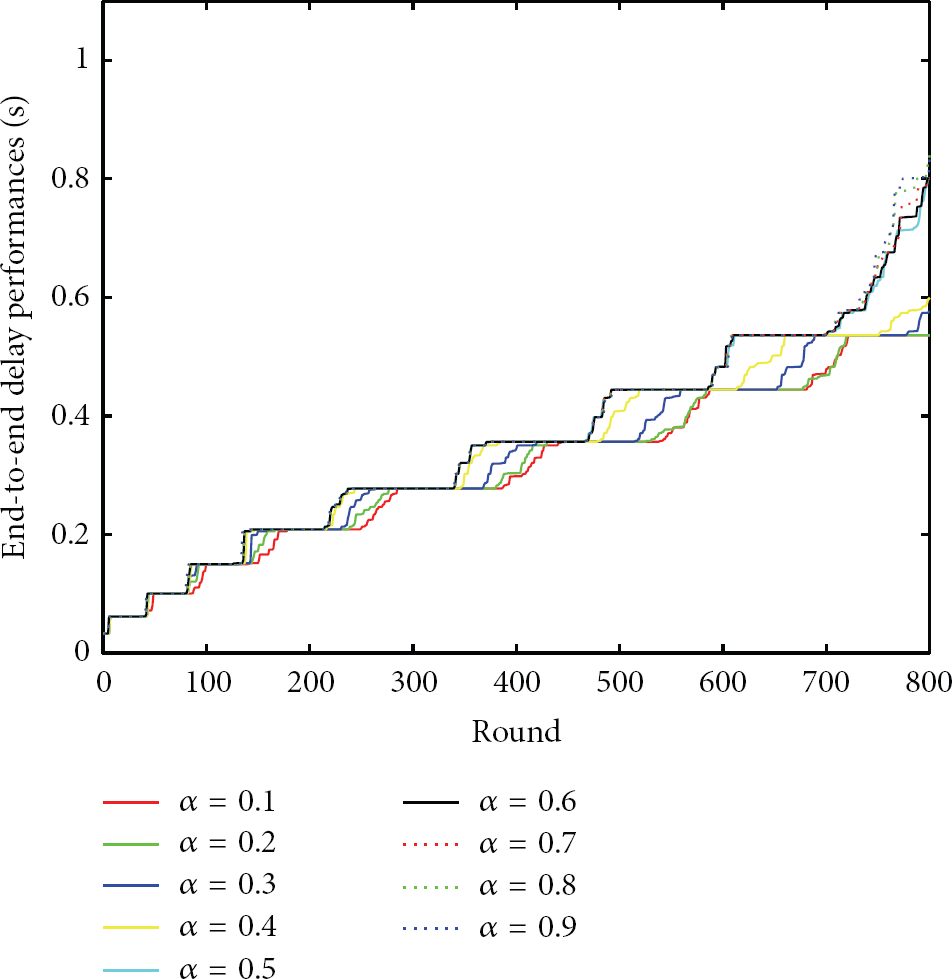
End-to-end delay performance under different α.

Average energy consumption under different α.
As a result of the simulation, the delay and energy performance are better when the value of
4.2. Delay Estimation
For the computation of estimated delay (

where TimeRcv is the time when upstream node receives the last bit of packet to the physical link and TimeTrans is the time when downstream node transmits the first bit of packet to the physical link. TimeWait is the duration that the packet is waited on the upstream node before transmission. Therefore, once upstream node successfully receives the packet, the node measures the elapsed time from transmission of downstream node to reception of upstream node. The total estimated delay time between node

where

When the node
Furthermore, the node

The estimated delay is replaced with the actual delay in each round.
4.3. Forwarding Decision
As we mentioned earlier, the proposed scheme makes the forwarding decision on receiver-side without periodic control message exchange such as neighbor information. One of receivers becomes the forwarding node according to Algorithm 3. As described at line 5 in Algorithm 1,
(1) (2) DiscardPacket (3) (4) (5) (6) ⊳ Update the estimated delay using the actual delay (7) (8) (9) ⊳ Waiting in the packet list before forwarding (10) (11) TimeWait = TimeWait/2 (12) (13) (14) ⊳ Update the estimated delay using the actual delay (15) AbortPacket (16) (17) (18) EstimateDelay (19) SetupForwardingMode (20) ComputeWaitingTime (21) (22) (23) FowardPacket

An example of illustrating forwarding decision.
4.3.1. Out of Range
When the receiver locates out between −60 degree and +60 degree from the line of sender to the sink, in this case most forwarding packet from the forwarder could not be received because there are high chance that the forwarder could locate close to the line from forwarder to sink node. Therefore the received packet will be discarded without receiving forwarding packet and comparing the sequence number of that packet.
4.3.2.
Receives the Packet from the FWD(
)
If the sequence number of the received packet is same as the packet that the receiver sent before, then the receiver is the original sender of the packet. Therefore, the packet can be regarded as the acknowledgment (ACK) signal from the first receiver, which means the packet was forwarded without hole. The packet can be used to compute the round trip latency time.
4.3.3. FCS(
) Receives the Packet from the FWD(
)
If the sequence number of the received packet is same as the packet the node received before, then other nodes already forwarded the packet. In addition,
4.3.4. NBR(
) Receives the Packet from the
When the node receives the packet, it computes the transmission delay time,
4.3.5.
Receives the Packet Whose
Is 1 (AID)
It means one of NBR(
If there is no packet with same sequence number or
4.4. Hole Management
If the sender cannot receive any forwarding packet which can be used as acknowledgment during the maximum waiting time after sending a packet, there is no node within the transmission range. It is called a hole. There can be two approaches to deal with hole. First, the sender increases the transmission range twice and retransmits the packet. Secondly, the sender,
4.5. Neighbor Information Update
When the node
When other nodes which received the packet whose
By doing this step, every node can use the estimated delay time which reflects actual delay time partially from second packet. As more packets flow, the estimated delay time reflect more actual delay time. Eventually every node involved in the transmission will use the actual delay time as its estimated delay time.
In order that the algorithm here operates, the packet header should have some fields including Deadline,

Packet header format in proposed scheme.
5. Performance Evaluation
5.1. Simulation Environment
In this section, we evaluate the proposed scheme in NS-3 v.3.19. According to [17], the energy consumption model is as follows:

where
The simulation parameters are described in Table 1.
Network parameters used in the performance evaluation.

5.2. Performance Metrics
We evaluate the following performance metrics.
Deadline success ratio is defined as the ratio of the number of successfully delivered packets which reach SINK within the deadline to the total number of packets transmitted.
Average energy consumption includes average energy dissipation for communication, computation, and sensing energy dissipation.
We will evaluate the performance by comparing our scheme with the related works, CFlood [14] and MMSPEED [16], using neighbor information exchanged periodically.
5.3. Simulation Results
5.3.1. Average Energy Consumption
The energy consumption is the most important for the sensor networks. As shown in Figure 9, our scheme performs better than the data transmission scheme with exchanging control message periodically. The average energy consumption is closely related to network lifetime. The larger the average energy consumption is, the shorter the network lifetime is. It illustrates that average energy consumption result bigger difference between our scheme and the scheme with periodic control message exchange. α is a configurable parameter that is set to 0.1, 0.2, and 0.3 as explained in Section 4. In our scheme, the distance-based forwarding decision when α is close to 0 performs better than CFlood and MMSPEED. The energy consumption performance can be maintained when the number of nodes increases in Figure 9. Figure 10 shows that our scheme yields good energy conservation performance according to end-to-end deadline. Therefore, our scheme not only provides real-time performance, but also prolongs network lifetime without periodic control message exchange.
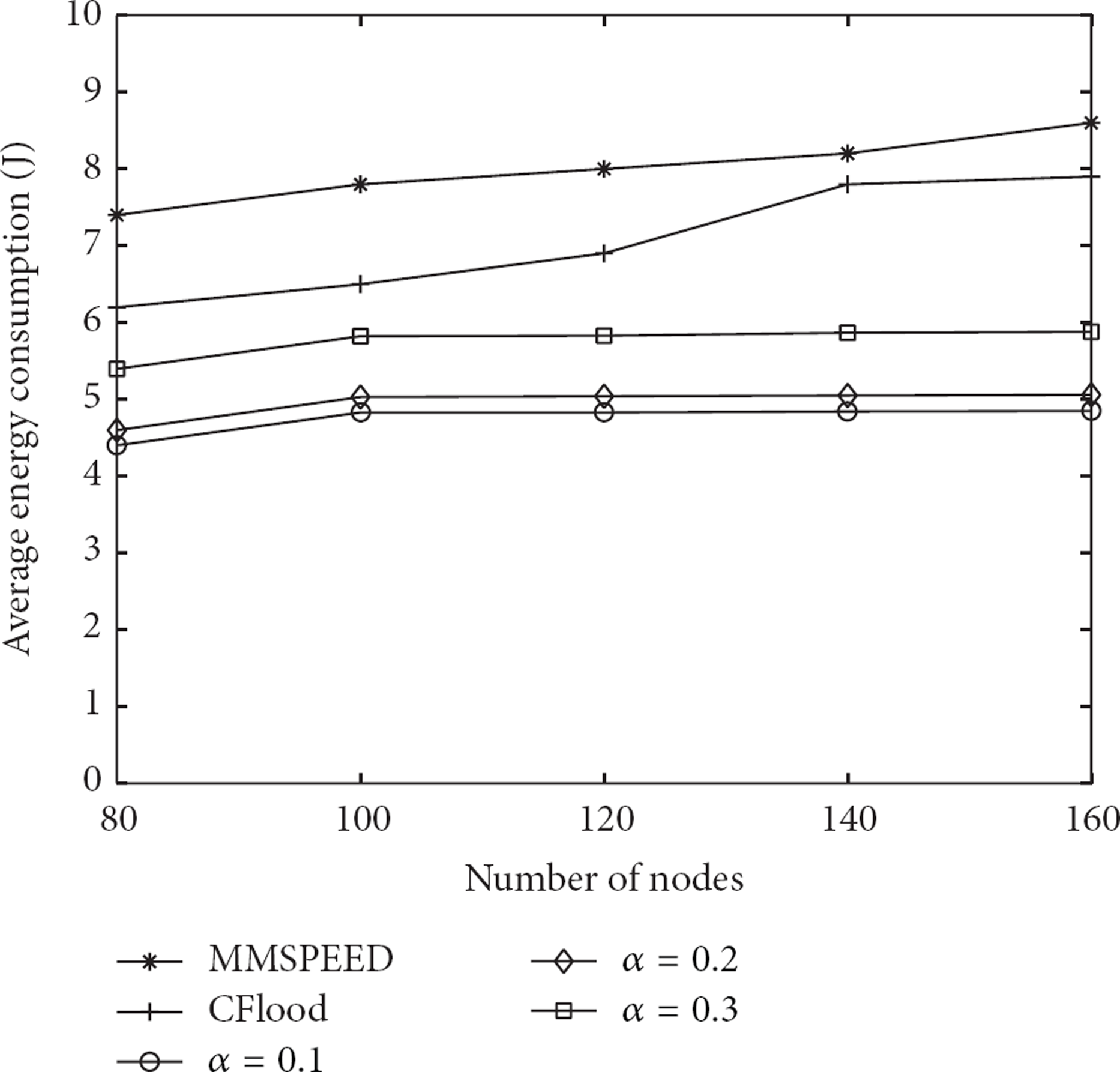
Energy consumption impacted by number of nodes.

Energy consumption impacted by end-to-end deadline.
5.3.2. End-to-End Deadline Success Ratio
The end-to-end deadline is critical in the real-time communication. Figure 11 shows end-to-end deadline success ratio for our scheme and the data transmission scheme such as CFlood and MMSPEED. Figure 11 shows the performance for node density. Our proposed scheme meets the tolerated latency independent from node density and good performance without periodic message exchange when it is compared with the CFlood and MMSPEED. Figure 12 illustrates end-to-end deadline success ratio according to the required deadline. The total time of the simulation is 4,000 seconds. α is a configurable parameter that is close to 0 such as 0.1, 0.2, and 0.3. The distance-based forwarding decision enhances the real-time performance. Our scheme yields an acceptable performance without periodic control message exchange (Algorithm 4).
(1) Deadline = Deadline − DelayOneHop (2) (3) ModeTrans = 0 ⊳ I can forward (4) (5) ModeTrans = 1 ⊳ need Aid, I cannot forward (6) (7) (8)
(1) timer ← TimeWait (2) AddpacketInthePacketList (3) (4) timer ← timer − 1 (5) (6) TransmitPacket

Packet deadline success ratio impacted by number of nodes.
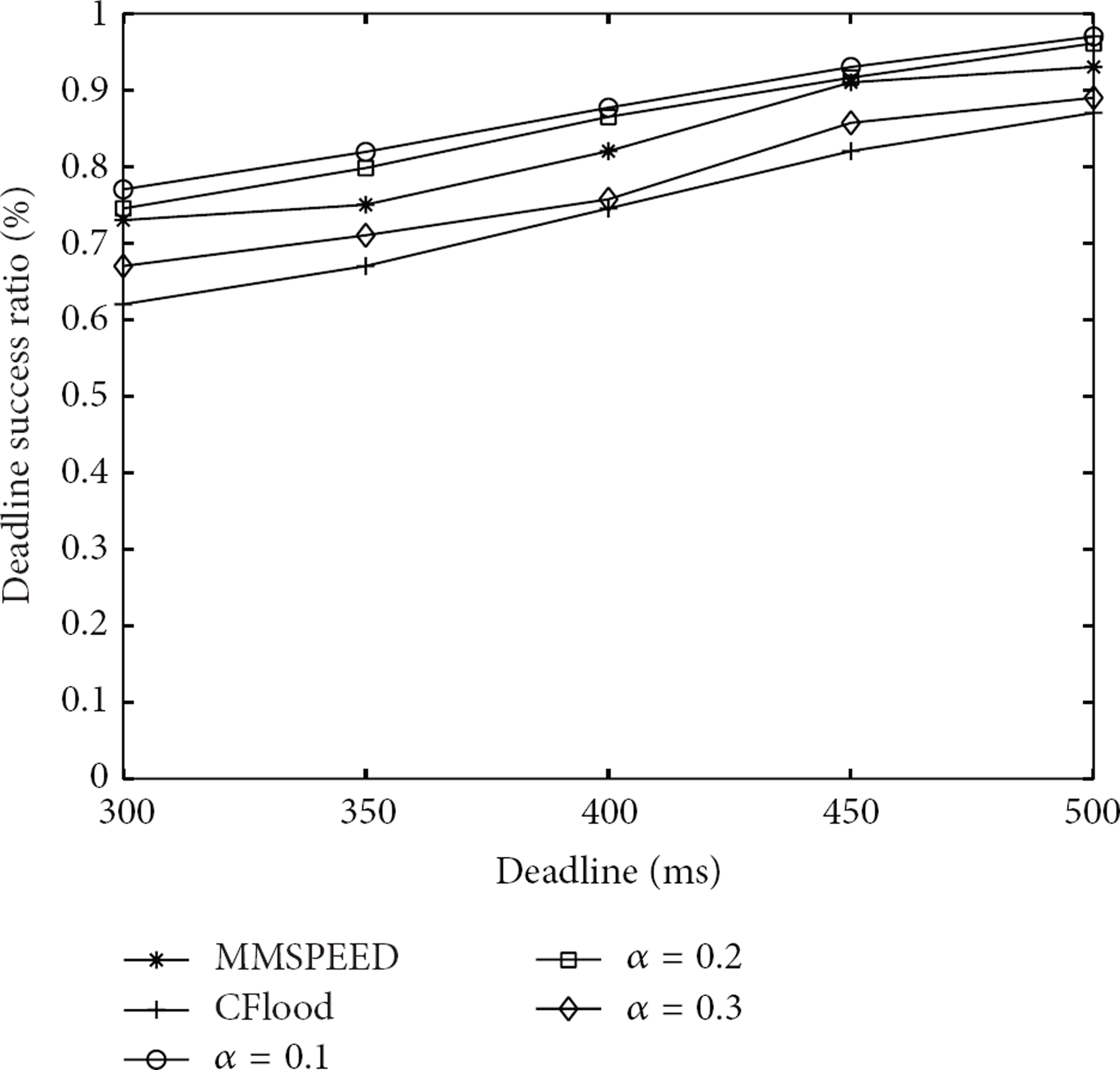
Packet deadline success ratio impacted by end-to-end deadline.
6. Conclusion and Future Work
In this paper, we present and evaluate a power-aware data transmission for real-time communication in MSNs. It is designed to provide real-time performance delivering multimedia data within the predetermined time (deadline) through delay estimation and greedy forwarding. In addition, it improves the energy conservation without periodic control message exchange and the constrained flooding-based data transmission. In contrast to previous schemes, the proposed scheme builds up neighbor information using the transmitted packet instead of periodic message exchange. Consequently, the proposed scheme conserves the energy consumption and, therefore, extends network lifetime, which is one of crucial design issues in MSNs. Simulations show that the proposed scheme performs good with respect to the deadline success ratio compared to the existing schemes.
There are some issues that remain to be studied. We have not considered the mobility of the nodes including camera sensor nodes and SINK. The network mobility should be taken into account in accordance with the recent researches and characteristic of real-time application in MSNs. In addition, it is desirable to adapt data transmission by applying data aggregation to decrease the amount of information-rich data such as image, video, and multimedia data. Finally, the security is a demanding issue with respect to the application such as surveillance and health-care monitoring which deal with the important data.
Footnotes
Notations
Conflict of Interests
The authors declare that there is no conflict of interests regarding the publication of this paper.