




Abstract
Linear analytical study on the mechanical sensitivity in large deflection of unsymmetrically layered and laterally loaded piezoelectric plate under pretension is conducted. von Karman plate theory for large deflection is utilized but extended to the case of an unsymmetrically layered plate embedded with a piezoelectric layer. The governing equations thus obtained are simplified by omitting the arising nonlinear terms, yielding a Bessel or modified Bessel equation for the lateral slope. Depending on the relative magnitude of the piezoelectric effect, for both cases, analytical solutions of various geometrical responses are developed and formulated via Bessel and modified Bessel functions. The associated ultimate radial stresses are further derived following lamina constitutive law to evaluate the mechanical sensitivity of the considered plate. For a nearly monolithic plate under a very low applied voltage, the results are in good agreement with those for a single-layered case due to pure mechanical load available in literature, and thus the present approach is checked. For a two-layered unsymmetric plate made of typical silicon-based materials, a sound piezoelectric effect is illustrated particularly in a low pretension condition.
1. Introduction
Piezoresistive or piezoelectric devices have long been utilized as microsensors and actuators. Many of their advantages like high-energy capacity, rapid operation, and high efficiency in energy consumption [1] have made them become very viable options for meeting the need of engineering practice. In fabrication, however, they are often made up with a sensing or an actuating diaphragm on top of a substrate. Thus, a multilayered and possibly even unsymmetric configuration in thickness is very common for this type of members. The typical examples may include silicon-based pressure sensors with [2] or without a center boss [3] developed in the early days. A similar recent case is the study of geometrically nonlinear axisymmetric responses of a thin circular plate conducted by Kapuria and Dumir [4], in which the isotropic core layer is sandwiched between two piezoceramic layers. Another example is the work of Fernandes and Pouget [5] that investigated the structural responses of a composite plate embedded with a piezoelectric actuator, wherein a piezoelectric patch was eccentrically bonded to the composite plate. Due to the multilayered configuration, residual stresses often arise following the process of microfabrication. One possible cause is the mismatch in the coefficients of thermal expansion between different layers, among many other reasons [6–8]. This may result in warpage or premature failure, though, on the other hand, the residual stress-induced buckling can also be one of the most commonly used mechanisms in residual stress measurement [9]. For a miniaturized sensing device made of silicon-based materials, a similar issue is the initial tension induced due to stretching and packaging during a microfabrication or a micromachining process [10]. The negative effects include the appearance of severe variation of physical behavior around a clamped edge, that is, the so-called “boundary layer” [11] or edge effect, the onset of nonlinearity, and the possible degradation in pressure sensitivity [12]. Obviously, taking into account the effect of initial tension in the study of structural behavior of this type of members is of essential importance.
In practical operation, miniaturized devices of this type may undergo a large deflection condition. To characterize their structural behavior thus requires a more advanced theoretical approach beyond classical lamination theory that is based on Kirchhoff hypothesis. In literature, quite a few previous studies have been presented in this regard. The earliest work is likely due to Voorthuyzen and Bergveld [10] that investigated the problem of large deflection for a monolithic sensing plate. A more rigorous study for the same problem was carried out later by Sheplak and Dugundji [11] with the illustrations of both linear analytical and nonlinear numerical solutions for various geometrical and structural responses. As to structures involved with piezoelectric layers or materials, Pai et al. [13] considered geometric nonlinearities in modeling the problem of large deflection of laminated plates embedded with integrated piezoelectric actuators and sensors. Liu et al. [14] analytically solved the problem of free vibration of piezoelectric coupled moderately thick circular plate, based on Mindlin's plate theory.
In view of previous works, it is seen that a linear study can offer an informative insight and an approximate solution for a nonlinear problem. It may provide a better convenience in the early design stage if a handy and analytical solution for the original physical problem is available. The present study is thus motivated and aimed to analytically explore the mechanical sensitivity of a prestressed and unsymmetrically layered piezoelectric plate in large deflection due to lateral load. von Karman's plate theory for large deflection is employed, similar to Yang et al.'s [8], but extended to an unsymmetrically layered case including a piezoelectric layer. The nonlinear governing equations were derived, first, in terms of nondimensional lateral slope and radial force resultant. A simplified linear problem is considered, by dropping the existing nonlinear terms, giving rise to a Bessel or modified Bessel equation for the lateral slope. These equations were solved analytically by imposing the boundary conditions of the problem. The related geometrical responses were further derived and the lamina constitutive law was employed to formulate the outermost radial stresses and thus the mechanical sensitivity. The presented analytical solutions were implemented mainly with two-layered unsymmetric plates of typical silicon-based layer materials. For comparison, however, a nearly monolithic layered case under a very low applied voltage was considered first. Various different applied voltages and a wide range of initial tension ranging from nearly zero (a plate mode) to almost infinity (membrane mode) were taken into account for a thorough parametric study.
2. Problem Formulation and Linear Analytical Solution
A clamped and unsymmetrically layered plate including a piezoelectric layer (polarized in the z-direction) is under an in-plane pretension, N0, a uniform lateral load, p
z
= p0, and an applied voltage, V, across the piezoelectric layer of thickness h1 = h
P
as shown in Figure 1. The governing equations can be formulated, first, in terms of lateral slope, w,
r
; in-plane force and moment resultants, Nαs and Mαs (α = r,θ); and lateral shear force resultant, Q
r
. For lateral loading after pretension, the planar force resultants can be expressed in an incremental form; that is,

where B
CT
= 3B
r
Cα + T
a
,

where ξ = r/a; W = w/h; θ = dW/dξ; Ψ = dθ/dξ;
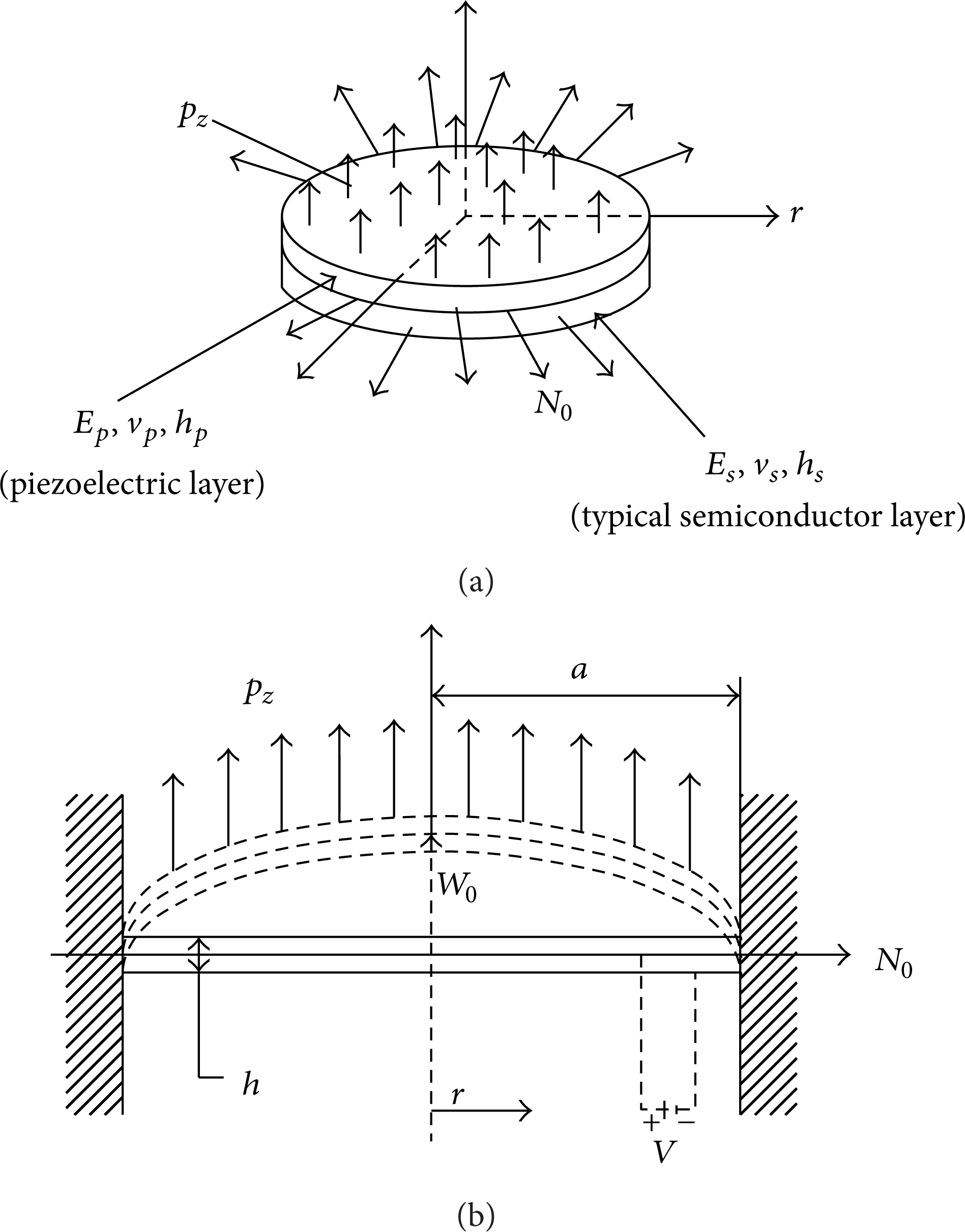
Prestressed layered plate under lateral load.
In order to have a primary insight, a simplified linear case for the posed problem is considered, by neglecting all the arising nonlinear terms. This gives rise to a linear differential equation for the lateral slope, θ. Depending on the sign of the term, k2-N r p a2/D r , it can be rewritten as either a modified Bessel or a standard Bessel equation. For the former case (k2-N r p a2/D r >0), the equation reads as

where
Imposing the clamped edge boundary condition and considering the asymptotic behavior of the modified Bessel functions, the solution for lateral slope (θ) can be analytically obtained. The associated lateral deflection (W) and curvature (Ψ) can then be derived by a subsequent integration and differentiation, respectively. Thus,


where I
i
(ξ) is the modified Bessel function of first kind (order i). By definition, mechanical sensitivity is the ratio between the maximum radial stress and the applied lateral pressure,

where
3. Numerical Remarks
For demonstration, only two-layered unsymmetric plates, [Si/Poly-Si] (L a ) and [SiO2/Poly-Si] (L b ), were implemented, simulating a nearly monolithic plate and a typical 2-layered plate, respectively. For both plates, the material properties (Young's modulus and Poisson's ratio) and layer thickness are listed in Table 1. The radii of the plates (a) are all taken to be 40 times of the total thickness (h). The magnitudes of initial tension and applied voltages are adopted from those considered by previous studies; that is, k = 1, 5, 10, 20, 50 [11]; and V = 1, 5, 10, and 20 (volt) [16]. For the L a -plate under a slight applied voltage, V = 1.0 (volt), that is, a nearly pure mechanical load condition, lateral slopes for various pretensions are shown in Figure 2. The solutions agree well with those of Sheplak and Dugundji [11], regardless of the magnitude of pretension and thus the presented approach is checked. The results of mechanical sensitivity are further checked against those obtained using the formulation of Saini et al. [15], as displayed in Figure 3. Again, a good agreement is reached, despite the visible but insignificant deviation when a very low pretension (k = 1) is considered. The solution reveals a parabolic radial variation when a very low pretension is considered. As the pretension increases, the variation becomes more moderate in the radial direction. Nevertheless, a severe variation always exists around the clamped edge. The higher the pretension is, the more acute the variation around the clamped edge is illustrated. This obviously is in accordance with the solutions of lateral slope shown in Figure 2, where a similar abrupt variation around the clamped end is illustrated when a very high pretension is applied. In other words, a plate behavior still prevails around the clamped edge in this case, although most of the central area has behaved in a membrane mode [11].
Material properties of the layers of considered plates.


Lateral slope for L a -plate, V = 1 volt.

Mechanical sensitivity for L a -plate, V = 1 volt.
The results of mechanical sensitivity for both plates, under various applied voltages and initial tensions, are presented in Figures 4, 5, 6, 7, and 8. Under a moderate applied voltage (V = 1∼10 volt) and a low pretension, it is seen that mechanical sensitivity shows a parabolic variation in the radial direction with positive values over the central area but negative beyond about ξ = 0.6. As the pretension gradually increases, in this case, the radial-wise variation becomes alleviated, yielding asymptotically a nearly constant value over most of the central area and an abrupt variation around the clamped edge, similar to the aforementioned scenario in lateral slopes. Thus, membrane behavior reveals an even wider central area and plate behavior concentrates very narrowly in the vicinity of the clamped edge, as pretension becomes greater. The greater the applied voltage is, the higher the overall magnitude for mechanical sensitivity is illustrated, by comparing the solutions in Figures 4, 5, and 6. In addition, it is seen that mechanical sensitivities for the two plates are distinct from each other but only up to a moderate magnitude of pretension. In the case when an extremely large pretension is applied, however, the deviation appears to vanish regardless of the magnitude of applied voltage, indicating a stronger effect by the initial tension, compared to the effects of piezoelectricity and deviation in layer moduli.

Mechanical sensitivity for L a - and L b -plates, V = 1 volt.
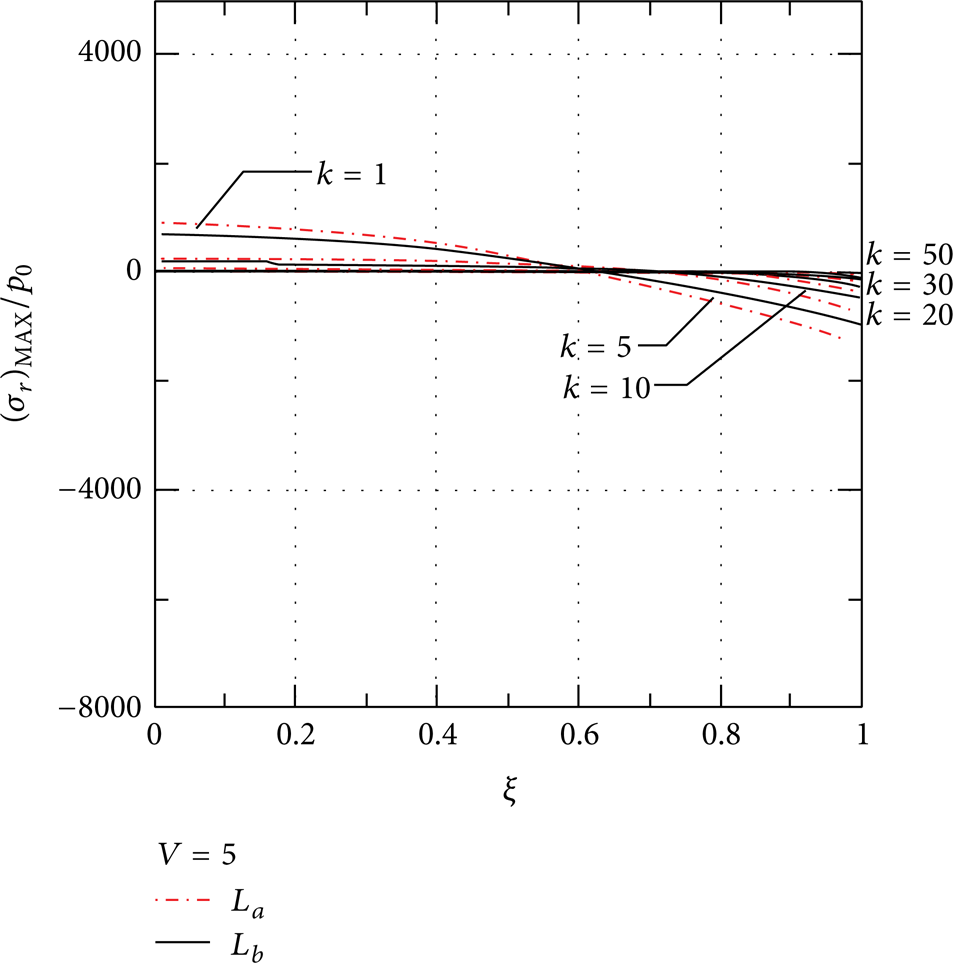
Mechanical sensitivity for L a - and L b -plates, V = 5 (volt).
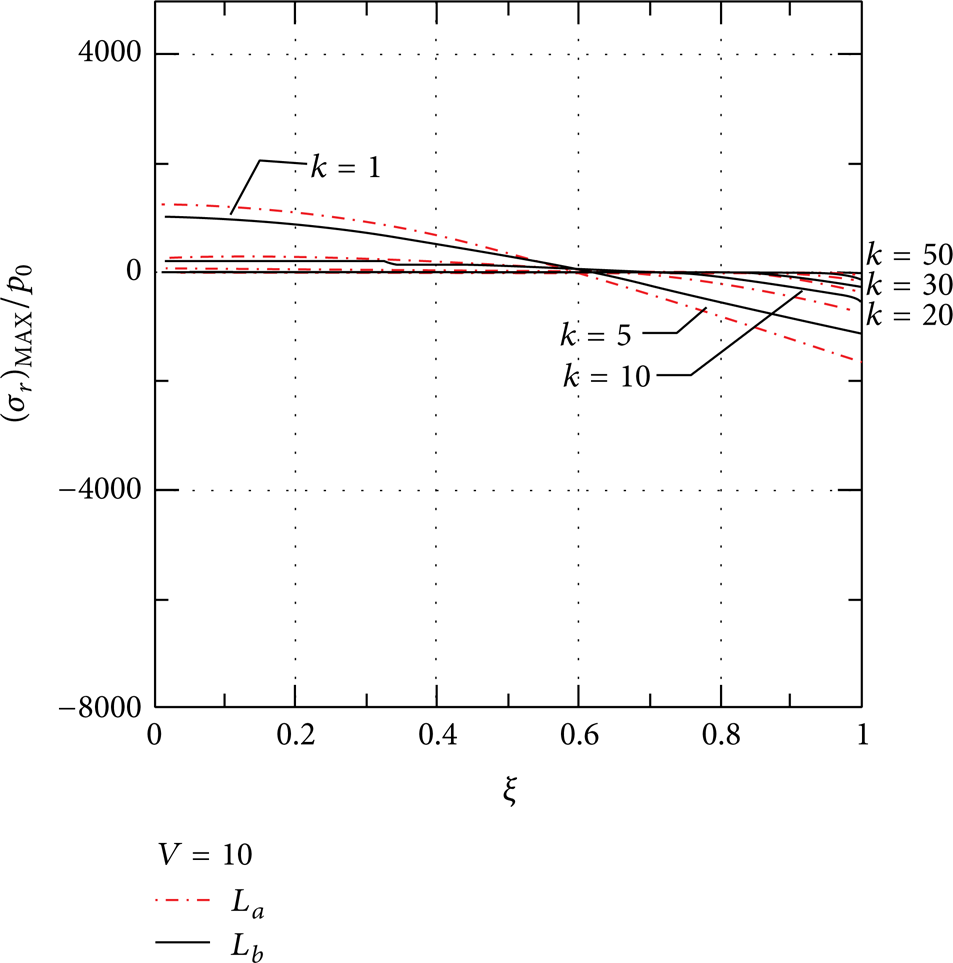
Mechanical sensitivity for L a - and L b -plates, V = 10 (volt).

Mechanical sensitivity for L a - and L b -plates, V = 20 (volt).

Mechanical sensitivity for L a - and L b -plates, V = 30 (volt).
In a very low pretension condition (k = 5), however, the parabolic variation under a low applied voltage may shift to a trigonometric curve as the voltage is increasingly applied. This can better be illustrated by Figure 9 for the L a -plate and Figure 10 for the L b -plate, showing the mechanical sensitivities under various applied voltages in this case. The values shift from positive magnitudes to become negative over the central area while it is simply the opposite close to the clamped boundary, when a very high voltage (V = 30 volt) is applied. This may likely be due to the inapplicability of linear analytical solution in such a high applied voltage condition, and thus a nonlinear approach is required to solve for the present large deflection problem. Comparatively, however, piezoelectric effect for both plates appears to decay very rapidly as the pretension is just substantially strengthened. This can be illustrated by Figures 11 and 12 for k = 5 and 10, respectively, for the L a -plate and Figures 13 and 14 for the same pretensions for the L b -plate. For both plates, although mechanical sensitivity for various applied voltages may be distinct from one another when k = 5 (Figures 11 and 13), they seem to have become almost identical when pretension is raised up to k = 10 (Figures 12 and 14).

Mechanical sensitivity for L a -plates, k = 1.

Mechanical sensitivity for L b -plates, k = 1.
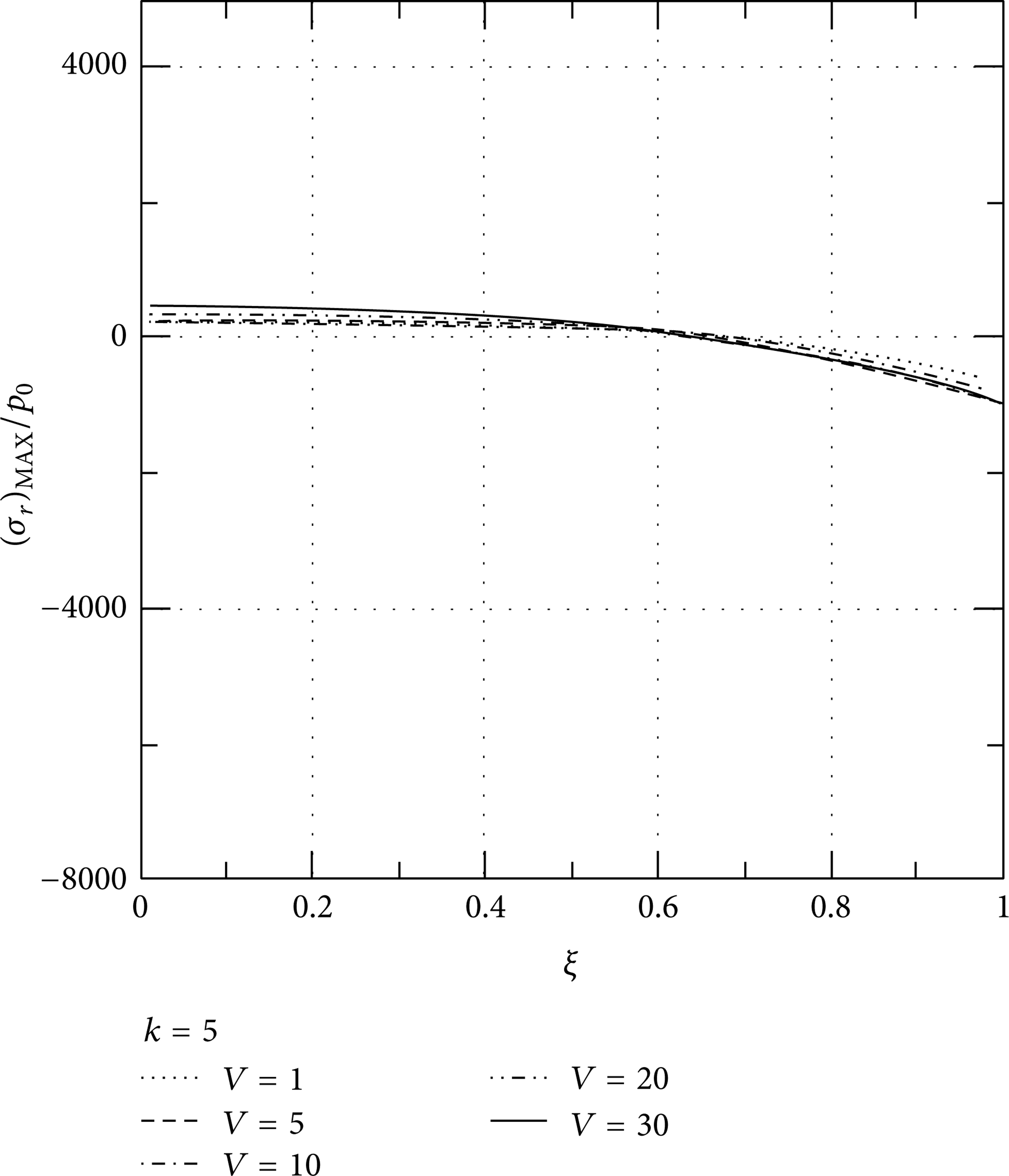
Mechanical sensitivity for L a -plates, k = 5.

Mechanical sensitivity for L a -plates, k = 10.
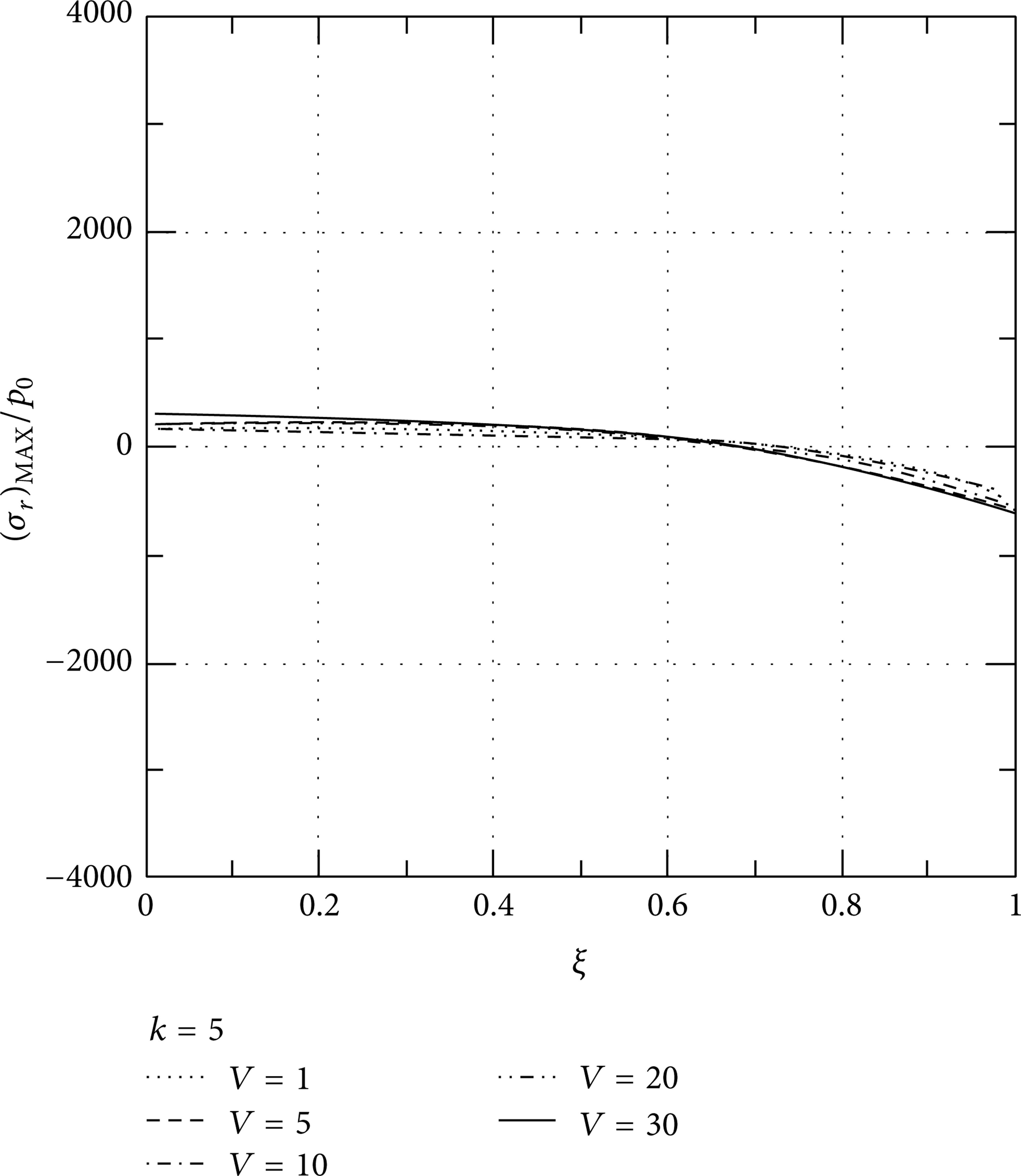
Mechanical sensitivity for L b -plates, k = 5.

Mechanical sensitivity for L b -plates, k = 10.
4. Conclusions
Mechanical sensitivity in large deflection of a prestressed and unsymmetrically layered plate including a piezoelectric layer due to lateral load is studied. Analytical solutions for the simplified linear problem were successfully formulated in terms of either modified Bessel or Bessel functions, depending on the relative magnitude of the piezoelectric effect. For a nearly monolithic plate under a very low applied voltage, the results correlate well with those under pure mechanical loading in theliterature, and thus the developed approach is checked. The solutions for typical unsymmetrically layered plate show that piezoelectric effect tends to be apparent only up to a moderate pretension. Beyond a threshold magnitude, however, the pretension tends to become dominant, yielding an identical variation for the radial variation of mechanical sensitivity, regardless of the magnitude of applied voltage and deviation in layer modulus between different layers.
Footnotes
Nomenclature
Conflict of Interests
The authors declare that there is no conflict of interests regarding the publication of this paper.
Acknowledgments
The support offered by Chung-Hua University through a campus Grant (no. CHU-100-E-01) is acknowledged. Special thanks are also given to graduate students Mr. J. Z. Kang, J. Y. Dzung, and J. J. Chang for revising most of the illustrations.