




Abstract
A numerical model is developed to simulate combined natural convection and radiation heat transfer of various anisotropic absorbing-emitting-scattering media in a 2D square cavity based on the discrete ordinate (DO) method and Boussinesq assumption. The effects of Rayleigh number, optical thickness, scattering ratio, scattering phase function, and aspect ratio of square cavity on the behaviors of heat transfer are studied. The results show that the heat transfer of absorbing-emitting-scattering media is the combined results of radiation and natural convection, which depends on the physical properties and the aspect ratio of the cavity. When the natural convection becomes significant, the convection heat transfer is enhanced, and the distributions of Nu R and Nu c along the walls are obviously distorted. As the optical thickness increases, Nu R along the hot wall decreases. As the scattering ratio decreases, the Nu R along the walls decreases. At the higher aspect ratio, the more intensive thermal radiation and natural convection are formed, which increase the radiation and convection heat fluxes. This paper provides the theoretical research for the optimal thermal design and practical operation of the high temperature industrial equipments.
1. Introduction
The combined heat transfer of the radiation and natural convection in the participating (absorbing-emitting-scattering) media is an important problem in the many fields of building and industry, including the boiler, furnace, building thermal comfort, and solar reactor.
In the recent decades, the combined natural convection and radiation heat transfer has received the prominent interest and wide-spread research due to the wide industrial applications. Research on the numerical solution of heat transfer and fluid flow phenomena, where radiative heat transfer has an essential contribution, becomes a key aspect for the employment of CFD simulation, which always involve the solution of the Navier-Stokes equations (NSE) and the radiative transfer equation (RTE). Saravanan and Sivaraj [1] made a fundamental theoretical study to understand the interaction of surface radiation and natural convection in an air-filled cavity with a centrally placed thin heated plate. Sun et al. [2] studied the effects of radiation interchanges amongst surfaces on the transition from steady, symmetric flows about the cavity centerline to complex periodic flows. Mondal and Li [3] theoretically studied the effect of volumetric radiation on natural convection in a square cavity by using lattice Boltzmann method (LBM) with nonuniform lattices. Hou and Wu [4] used the integral equations of intensity moments to study the cases of a cold medium exposed to diffuse irradiation at the left boundary, and the results obtained by solving integral equations were in excellent agreement with those obtained by the Monte Carlo method and the discrete ordinates (DO) method. Salinas [5] presented an inverse analysis for temperature field estimation in a two-dimensional gray media by using the DO method with a multidimensional scheme. Moufekkir et al. [6] adopted a hybrid thermal lattice Boltzmann method to analyze the natural convection and volumetric radiation in a tilted square enclosure. Bouali et al. [7] studied the coupled heat transfer by the radiation and natural convection in an inclined rectangular enclosure. Saury et al. [8] experimentally studied the natural convection in an air-filled cavity at large Rayleigh numbers and correlated the Nusselt numbers. Choi and Kim [9] carried out a comparative analysis of thermal models in the lattice Boltzmann method for the simulation of natural convection in a square cavity. Liu et al. [10] presented the numerical results of airflow and combined convective and radiative heat transfer in the slot-vented room with the radiant floor heating unit.
For many industrial applications, the gas with the particles suspended in it is usually regarded as the absorbing-emitting-scattering media, including the flue in the waste heat boiler. Such gas always shows the different radiation properties and hence the heat transfer under high temperature. When the temperature difference is high enough, the natural convection is significant. As a result, the complex energy transfer occurs in these industrial applications. The radiative heat transfer in the participating medium also received the wide research. Mahapatra et al. [11] studied the interaction of mixed convection in two-sided lid driven differentially heated square enclosure with radiation in presence of participating medium and found that the influence of radiation on mixed convection was more sensitive for buoyancy-opposing flow than buoyancy-aiding flow. Capdevila et al. [12] numerically studied the turbulent natural convection in a tall differentially heated cavity filled with air (Pr = 0.7) with nonparticipating and participating grey media. Le Dez and Sadat [13] provided an analytical solution to the internal radiative field inside an emitting-absorbing gray semitransparent medium at radiative equilibrium, enclosed in a square cavity bounded by hot and black surfaces. Moufekkira et al. [14] numerically studied natural convection and volumetric radiation in an isotropic scattering medium within a heated square cavity using a hybrid thermal lattice Boltzmann method. The maximum heat transfer rate was obtained when the surfaces of the enclosure walls were regarded as blackbodies. Lari et al. [15] studied the effect of radiative heat transfer on natural convection heat transfer in a square cavity containing participating gases under normal room conditions. Mischler and Steinfeld [16] developed a numerical model with Monte Carlo method to simulate solar radiation transfer of Fe3O4 suspended particle between the two infinite plates and compared radiation transfer of Mie scattering and isotropic scattering particles, as well as the temperature distribution under the direct radiation and diffusion radiation. Hirsch and Steinfeld [17] analyzed a 3D nonisothermal nongray absorbing-emitting-scattering gas/particle suspension directly exposed to concentrated solar irradiation in a reactor, coupling conduction/convection heat transfer and chemical kinetics. Kim and Lee [18] studied the radiation transfer of absorbing-emitting-scattering particles in a 2D square cavity. Pessoa-Filho and Thynell [19] found that the heat loss near the wall is greater under conditions of the backward scattering phase function, moderate optical thickness. The effects of the phase function and reflectivity on the temperature field of linear anisotropic scattering and isotropic scattering in square cavity were studied by Hao et al. [20].
However, the above researches did not consider the combined heat transfer of convection and radiative heat with regard to the influence of scattering medium. Few of the existing literature focused on the combined results of radiation heat transfer and natural convection heat transfer in the absorbing-emitting-scattering media with respect to the various radiation properties (including optical thickness, scattering ratio, and scattering phase function) and the shape of cavity. Therefore, the underlying mechanism of the combined heat transfer of radiation and natural convection is not completely understood, especially for the absorbing-emitting-scattering media.
In this paper, a 2D numerical model with the discrete ordinate method is developed to calculate the combined heat transfer of the radiation and natural convection of the gray and absorbing-emitting-scattering medium in a 2D square cavity. The natural convection is included based on Boussinesq assumption by considering density variation with the temperature. The effects of Rayleigh number, optical thickness, scattering ratio, scattering phase function, and aspect ratio of square cavity on the combined heat transfer are discussed. This paper provides the theoretical research for the optimal thermal design and practical operation of the high temperature industrial facilities.
2. Mathematical Model
In this study, a 2D square cavity as shown in Figure 1 is considered, in which the length is L and the height is H. The hot wall (i.e., Wall 1) is of the constant higher temperature T h , while the cold wall (i.e., Wall 3) is of constant lower temperature T c . Wall 2 and Wall 4 are adiabatic walls. The surface of each wall is assumed as the gray surface. The flow is caused by the natural convection due to the buoyancy, which is assumed as the steady laminar flow. The medium in the cavity is considered as gray and absorbing-emitting-scattering gas. The variation of density with the temperature is included by considering Boussinesq assumption and the other physical properties are constants. The phase functions of the medium (ISO, F1, F2, B1, and B2) are calculated by Legendre polymerizations [18], in which the ISO means isotropic scattering; F1 and F2 mean forward scattering, and B1 and B2 mean backward scattering.
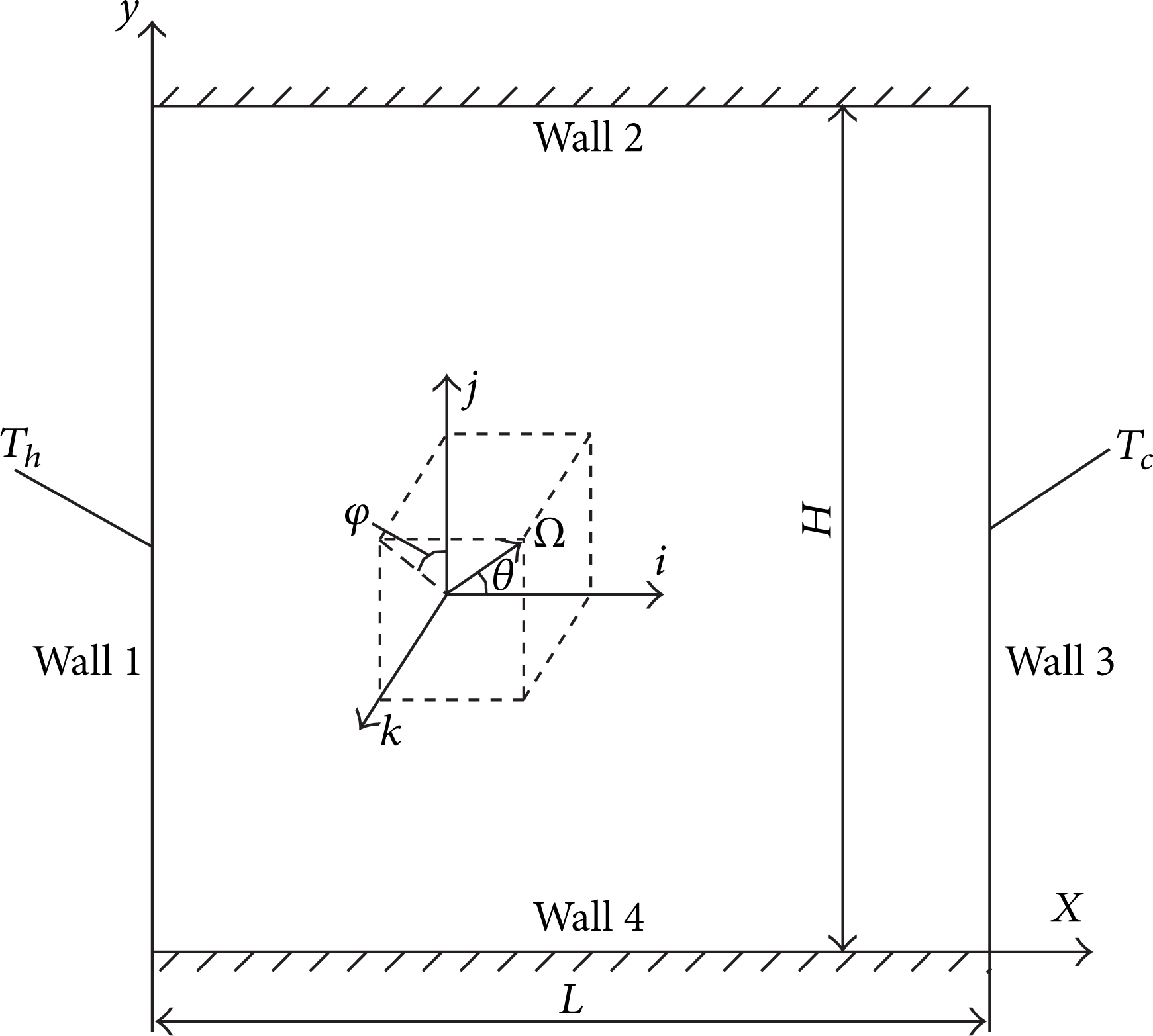
Physical configurations and coordinate systems.
The governing equations in nondimensional forms with respect to the Cartesian (x-y) coordinate are given as follows:



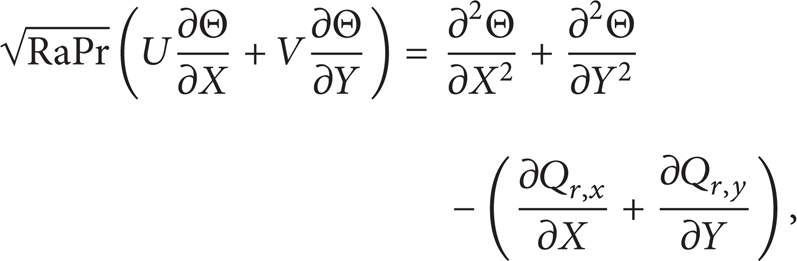

where the nondimensional physical variables are given as follows:
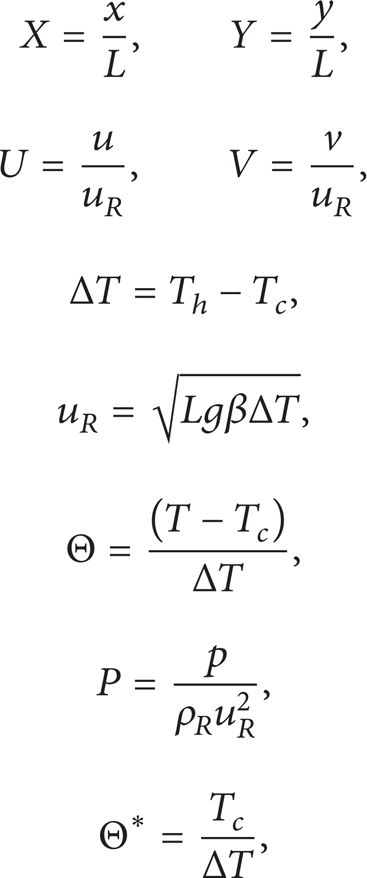
where u and v are, respectively, the x- and y-direction velocities; T is temperature; p is pressure; L is length; g is gravitational acceleration; ρ R is density; β is expansion coefficient.
The total heat flux in non-dimensional form is the sum of the nondimensional radiative heat flux Q r and nondimensional convection heat flux Q c as

where qr is radiation heat flux. The radiation intensity in nondimensional form is calculated as
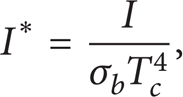
where I is radiation intensity. The radiation properties including extinction coefficient κ, absorption coefficient as, optical thickness τ, and scattering ratio ω are calculated as
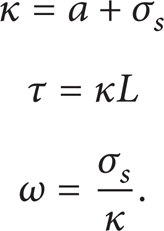
The Planck number Pl, Prandtl number Pr, and Rayleigh number Ra are defined as

where cp is the specific heat; k is thermal conductivity; μ is dynamic viscosity.
The aspect ratio is calculated as

The boundary condition of the problem is defined as follows.
Every wall is no-slip wall:

3. Numerical Considerations
The differential equations are iteratively solved based on the finite control-volume method by compiling a FORTRAN computer code. In this model, SIMPLE algorithm is used to solve N-S equation (1)–(4), and DO model is used to solve equation of radiative transfer (5), which are solved iteratively subject to the boundary conditions (12). SIMPLER algorithm detailed by Partankar [21] is applied to handle pressure-velocity coupling problem, and then the temperature is calculated. A grid of 100 × 100 (x × y) with the compressed grid adjacent to the wall is used in the computation domain. The cases with the finer grid are tested and the results show the very good agreement with the selected grid system, and thus the grid independent solution can be obtained. The converged solution is obtained when the following convergence criteria are satisfied for the dependent variables:

4. Results and Discussions
In the sector, the results of numerical calculation of the combined heat transfer of natural convection and radiation of absorbing-emitting-scattering medium in the square cavity are presented. Unless otherwise specified, the default parameters in this study are given as follows: dimension parameters of squares L = 0.1, AR = 1; hot wall temperature T h = 1275 K, cold wall temperature T c = 500 K, Ra = 105, Pr = 0.7, Pl = 0.1, τ = 1, ω = 0.5, scattering phase function F2, and ε w = 1.
4.1. The Effects of Rayleigh Number
Figure 2 shows the distribution of nondimensional temperature in the cavity under the different Rayleigh number Ra. It can be found that when Ra is at a lower level (Ra = 104), the natural convection in the cavity is insignificant, and hence the isotherm distribution is almost vertical. When Ra increases (e.g., Ra = 105 and 106), the natural convection gradually increases due to the more significant buoyancy in the cavity. The medium adjacent to the cold wall is cooled and thus flows downward, while the medium adjacent to the hot wall is heated and thus flows upward. As a result, a clockwise flow circulation is formed. Under this flow pattern, the isotherm is obviously distorted and more horizontal isotherm is observed. As a result, the natural convection has the great effects on the temperature distribution, and heat transfer in the cavity.
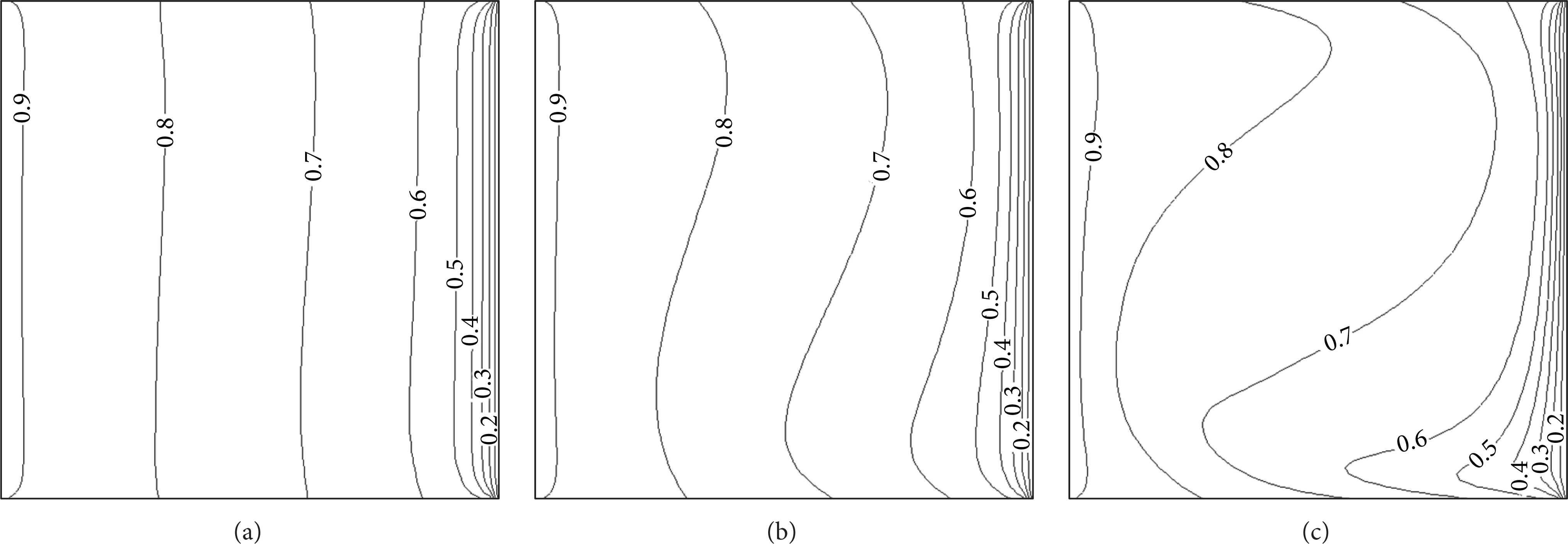
The distribution of non-dimensional temperature in the cavity under the different Rayleigh number Ra (a) Ra = 104, (b) Ra = 105, (c) Ra = 106.
In order to find the reasons, Figure 3 shows the distribution of radiation Nusselt number NuR and convection Nusselt number Nu c along the hot and cool walls for the cases shown in Figure 2. The Nu is defined as

For natural convection

For thermal radiation

where ε W is the emittance at the wall; Iin,W* is the radiation intensity at the wall. It is clear from Figure 3 that Nu R is in the range of 600–830 along the hot wall and 220–320 along the cold wall, while Nu c is in the range of 14–21 along the hot wall and 12–38 along the cold wall. Therefore, Nu R along the walls for all the cases is much higher than Nu c , which indicates the radiation heat transfer is the prevail way of energy transfer in the cavity. Nu R has the peak value near the central section of the wall and decreases towards the end. Nu c has quite high value at both ends of the walls because the temperature of the top and bottom adiabatic walls (Wall 2 and Wall 4) changes under the radiation heat transfer. The medium adjacent to the hot wall is cooled by the top and bottom walls, while the medium adjacent to the cold wall is heated by the top and bottom walls. As a result, Nu c at the ends increases rapidly. When Ra is at a lower level of 104, Nu R and Nu c are almost symmetrical distribution along the midpoint wall. As the Ra increases (e.g., Ra = 106), however, Nu R and Nu c are significantly distorted and become asymmetry due to the effects of the natural convection. At Ra = 106, Nu R and Nu c of the lower half part of hot wall increase. This is because the temperature in lower half part of the cavity and Wall 4 decreases due to the natural convection, and hence the outward radiation from lower half part of the hot wall increases with a result of the high temperature gradient for the medium in this region. At Ra = 106, Nu R and Nu c of the upper half part of cold wall increase due to the natural convection. The temperature in upper half part of the cavity and Wall 2 increases due to the natural convection, and hence the incoming radiation received by the upper half part of the cold wall increases, resulting in the high temperature gradient for the medium in this region.

The distribution of radiation Nusselt number Nu R and convection Nusselt number Nu c along the hot and cool walls (a) hot wall and (b) cold wall.
4.2. The Effects of the Radiation Properties of the Medium
The radiation transfer is characteristically different from the convection heat transfer and depends on the properties of the medium including phase function, scattering amplitude, and optical thickness. In this section, the effects of the radiation properties on the radiation and natural heat transfer are discussed.
Figure 4 shows the nondimensional temperature distribution at the different locations (Y = 0.2, 0.5, and 0.8) in cavity under the different optical thicknesses τ (τ = 0, 0.1, 1, and 10). Note the case at τ = 0 is regarded as the transparent medium. For comparison, the case without radiation is also considered. It is found that the temperatures at all the locations for the case without radiation are lower than the temperatures for the other cases, which indicates that radiation can improve the effective heat transfer in the cavity. For optically thick medium (τ>1), the attenuation of radiation along the propagation direction (x-direction) becomes obvious. As a result, the temperature gradient along the propagation direction is more significant, as compared to the cases with optically thin medium (τ<1). Due to the effects of the natural convection, the temperature distribution is distorted. In the part near the hot wall, the temperature for optically thick medium is higher than the optically thin medium. However, in the part near the hot wall, the temperature for the case without radiation and optically thin medium may become higher.

The nondimensional temperature distribution at the different locations in the cavity under the different optical thicknesses.
Figure 5 shows the distributions of Nu R and Nu c along the hot wall and cold wall for the cases shown in Figure 4. It is found that Nu R along the hot wall for the transparent medium (τ = 0) is smaller than the optically thin medium (τ = 0.1, 1). The average Nu R along the hot wall for τ = 0, 0.1, and 1 are, respectively, 700, 857, and 753. This is because the transparent medium cannot receive heat directly through the radiation but just receive the heat from the walls through the natural convection. The radiation from the hot wall enhances the heat transfer inside the cavity and increases the temperature at the other walls, and then walls heat the transparent medium under the natural convection. With the increasing of optical thickness, Nu R along the hot wall decreases. For example, for τ = 10, the average Nu R along the hot wall is 222, which are even significantly lower than the transparent medium. This is because the energy radiated from the hot wall is rapidly attenuated in optical thick medium along the propagating direction. As a result, the medium near the hot wall absorbs the more energy and increases its temperature, which leads to the smaller net thermal radiation emitted from the hot wall. On the other hand, the radiation heat flux towards to the cold wall through the optical thick medium also decreases, and thus the Nu R along the cold wall decreases as the optical thickness of medium increases. The average Nu R along the cold wall for τ = 0, 0.1, 1, and 10 are, respectively, 478, 401, 291, and 80. Due to the effects of the natural convection, the Nu c distributions along the hot wall and cold wall are obviously asymmetry, which is coincident with temperature distortion shown in Figure 4. For the case without radiation, the Nu c at the end of wall decreases, which is significantly different from the cases with radiation. This is because the top wall and bottom wall are not affected by the radiation and hence the natural convection heat transfer is impaired. With the increase of optical thickness, the Nu c along the hot wall firstly increases and then decreases, for example, the Nu c for τ = 1 is higher than the other cases (τ = 0, 0.1, and 10), while the Nu c along cold wall monotonously increases, for example, the Nu c for τ = 10 is higher than the other cases (τ = 0, 0.1, and 1). The average Nu c along the hot wall for τ = 0, 0.1, 1, and 10 is, respectively, 7.0, 7.9, 14.8, and 10.1; the average Nu c along the hot wall for τ = 0, 0.1, 1, and 10 is, respectively, 10.4, 11.8, 16.8, and 18.2. The phenomena are the combined results of radiation heat transfer and natural convection heat transfer. For the optically thick medium (τ = 10), the radiation is attenuated faster along propagation direction, and more heat is absorbed by the medium and more intense natural convection occurs, which usually leads to the higher temperature gradient along the propagating direction with the smaller temperature differences at the hot wall and the larger temperature differences at the cold wall (as shown in Figure 4).

The distributions of Nu R and Nu c along the hot wall and cold wall for the cases under the different optical thicknesses: (a) hot wall and (b) cold wall.
Figure 6 presents the nondimensional temperature at the different locations (Y = 0.2, 0.5, and 0.8) in the cavity under the different scattering ratio (ω = 0.1, 0.5, and 0.9). As compared to the case with ω = 0.5, the temperature gradient along x-direction for the case with ω = 0.5 is greater, while temperature gradient along x-direction for the case with ω = 0.9 is smaller. Along the center line (Y = 0.5), the temperature for ω = 0.1 is higher in the front part (X<0.5) and lower in the back part (X>0.5). The phenomenon is caused by the coupled results of the radiation and natural convection. With the decrease of ω, the absorption capacity of medium increase, the less thermal radiation emits forwards; so the temperature of the front part increases due to the more heat absorption, while the temperature of the back part decreases due to the more attenuation in the medium. As the scattering ratio is lower, the radiation heat flux along x-direction decreases faster and the temperature changes along x-direction become more obvious, which decreases the thermal radiation emitted from the hot wall and absorbed by the cold wall.
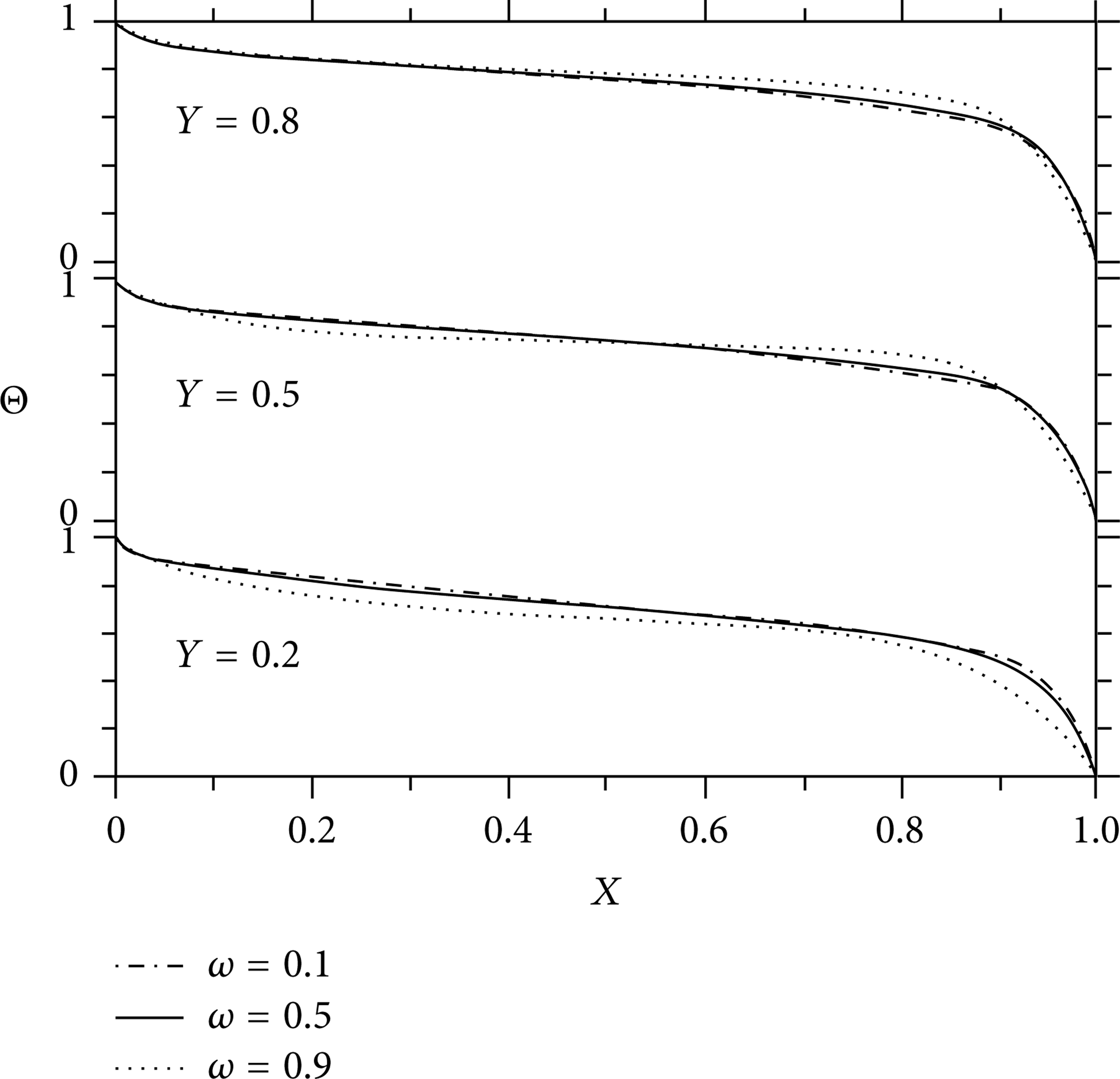
The nondimensional temperature at the different locations (Y = 0.2, 0.5, and 0.8) in the cavity under the different scattering ratio (ω = 0.1, 0.5, and 0.9).
Figure 7 shows the distributions of Nu R and Nu c along the hot wall and cold wall for the cases shown in Figure 6. With the decrease of the scattering ratio, Nu R along the hot wall and cold wall decrease (as shown in Figure 7). The average Nu R along the hot wall is, respectively, 687, 753, and 785 for ω = 0.1, 0.5, and 0.9, while the average Nu R along the cold wall is, respectively, 260, 291, and 339. Under the lower scattering ratio, the temperature changes of the medium between cold and hot walls are more significant, then the temperature gradients near the hot and cold walls are larger, which in turn increase Nu c along the walls (as shown in Figure 7). The average Nu c along the hot wall is, respectively, 16.7, 14.8, and 8.8 for ω = 0.1, 0.5, and 0.9, while the average Nu c along the cold wall is, respectively, 19.5, 16.8, and 11.9.

The distributions of Nu R and Nu c along the hot wall and cold wall for cases under the different scattering ratio: (a) hot wall and (b) cold wall.
Figure 8 shows the distributions of the nondimensional average temperature along x under the different scattering phase functions (ISO, F1, F2, B1, and B2). It shows that temperature differences between all the cases are not very obvious. As compared to the isotropic scattering medium, the temperatures for the backward scattering media (B1, B2) are higher in the front part of the cavity (X<0.5) and the temperatures of the forward scattering media (F1, F2) are higher in the back part of the cavity (X<0.5). This is because the more thermal radiation transmits forwards in the forward scattering medium, and the less thermal radiation is scattered to the surrounding medium.

The average temperature distribution along X under different phase functions.
4.3. The Effects of Aspect Ratio of the Cavity
Figure 9 shows the distributions of Nu R and Nu c along the hot wall and cold wall for the cases with the different aspect ratios at AR = 0.5, 1, and 2. As shown in this figure, the average Nu R along the hot wall is, respectively, 541, 753, and 845 for AR = 0.5, 1, and 2, while the average Nu R along the cold wall is, respectively, 255, 291 and 325. The average Nu c along the hot wall is, respectively, 11.0, 14.8, and 16.4, for AR = 0.5, 1, and 2, while the average Nu c along the cold wall is, respectively, 16.4, 16.8, and 17.2. At the higher aspect ratio (AR = 2), Nu R and Nu c along the walls are higher. This is because the more thermal radiation emitted from the hot wall to the cold wall due to the higher view factor, and the more intensive natural convection is formed at the higher aspect ratio.

The distributions of Nu R and Nu c along the hot wall and cold wall for the cases with the different aspect ratios: (a) hot wall and (b) cold wall.
5. Conclusion
In this paper, a numerical model is developed to simulate combined radiation and natural convection of various absorbing-emitting-scattering media in a 2D square cavity based on the discrete ordinate (DO) method and Boussinesq assumption. The effects of Rayleigh number, optical thickness, scattering ratio, scattering phase function, and aspect ratio of square cavity on the behaviors of heat transfer are studied. The following conclusions are obtained.
Nu R is in the range of 600–830 along the hot wall and 220–320 along the cold wall, while Nu c is in the range of 14–22 along the hot wall and 12–38 along the cold wall. The Nu R along the walls is much higher than Nu c because radiation heat transfer is the main way of heat transfer. When the natural convection becomes significant, the convection heat transfer is enhanced, and the distributions of Nu R and Nu c are obviously distorted.
With the increasing of optical thickness from 0.1 to 10, Nu R along the hot wall decreases from 857 to 222, because the thermal radiation from the hot wall is rapidly attenuated in optical thick medium along the propagating direction, which leads to the smaller net thermal radiation emitted from the hot wall. The radiation heat flux towards the cold wall through the optical thick medium decreases, and thus the Nu R along the cold wall decreases from 478 to 80 as the optical thickness of medium increases from 0 to 10.
As the scattering ratio increases from 0.1 to 0.9, the average Nu R along the hot wall increases from 687 to 785, and Nu R along the cold wall increases from 260 to 339. At the smaller scattering ratio, the radiation heat flux along the propagating direction decreases faster and the temperature changes become more obvious. As a result, the thermal radiation emitted from the hot wall and absorbed by the cold wall decrease, leading to the lower Nu R along the hot wall and cold wall.
As compared to the isotropic scattering medium, the temperatures for the backward scattering media (B1, B2) are higher in the front part along the propagating direction and the temperatures of the forward scattering media (F1, F2) are higher in the back part.
At the higher aspect ratio, the more intensive thermal radiation and natural convection are formed at the higher aspect ratio, which increase the radiation and convection heat fluxes. As the aspect ratio increases from 0.5 to 2, the average Nu R along the hot wall increases from 541 to 845, and Nu c increases from 11.0 to 16.4.
Conflict of Interests
The authors declare that there is no conflict of interests regarding the publication of this article.