




Abstract
Mobile wireless sensor networks (MWSNs) comprise a collection of mobile sensor nodes with confined and finite resources. They commonly operate in hostile environments such as battle fields and surveillance zones. Owing to their operating nature, MWSNs are often unattended and generally are not equipped with tamper-resistant tools. With little effort, an adversary may capture the nodes, analyze and replicate them, and surreptitiously insert these replicas at strategic locations within the network. Keeping in view of the above, this paper places an emphasis on this aforementioned attack, known as node replication attack in MWSNs. Specifically, the current state-of-the-art of node replication attack in MWSNs is discussed, where this paper provides a detailed description of various existing detection and prevention mechanisms in literature with an aim to provide better understanding of the factors that need to be considered when designing defence mechanism of node replication attack. A detailed categorization of various detection techniques is provided in the paper with critical discussion on each categorization with respect to its advantages, disadvantages, and various constraints. To conclude the paper, a number of parameters are selected for comparison and analysis of all the existing detection schemes in the literature.
1. Introduction
Wireless sensor network (WSN) is a collection of small sensors which are occupied with small processor and memory wireless modem and limited battery or power supply. Owing to the recent advancement of tiny embedded systems, WSN has become one of the key technologies in various applications such as security, environment monitoring, medical machinery, food protection, agriculture fields, energy control, inventory management, water measurement, industry, and building automation [1]. In general, WSNs can be divided into two types, namely, structured and unstructured WSNs.
While a structured WSN may consist of a well-planned architecture and network management (e.g., well-defined topology in a fixed network or centralized infrastructure), unstructured WSN may involve a collection of enormous number of sensor nodes which has an opaque network management. Mostly, sensor nodes in unstructured WSN are deployed in an unplanned manner and noncentralized infrastructure (or commonly referred to as distributed). The sensors are then left unattended to execute their functions (e.g., monitoring).
Security is regarded as one of the most challenging issues in WSN [2, 3]. Over the years, various researches have been carried out to address security issues in WSNs. Routing [4, 5], node localization [6, 7], time synchronization [6], and data aggregation [7, 8] are some of the common WSN functions that are vulnerable to malicious security attacks. Various new types of attacks targeting WSNs [9] have been identified such as Sybil and wormhole attacks [10], physical layer attacks [11], sink hole and Hello flooding attack [12], and clone attack.
Owing to the advancement of robotics and microchips technology, a sensor node may also possess mobility functions. One can easily imagine the challenges and impact of mobility on WSNs, notably, on the security aspect of the network. For example, due to huge number of mobile sensor nodes in unstructured WSNs, it may require more complex network protection in order to ensure organizing connectivity and detection of failures in the network. In fact, methods that have been proposed for static WSNs may not be directly applicable to be implemented in mobile WSNs (MWSNs).
In this paper, our major focus is on node replication or clone attack in MWSNs. In general, clone attack is considered as application independent security threat [8], where sensor nodes will be fully controlled by the attackers in the network, and it is presumed as original or legitimate sensor nodes. In clone attack, advisory (normally human) will capture the original node from the network or system, reproduce it by using the information of secret credentials such as codes, identity and cryptographic resources, and then send these clone nodes back to the network [3]. The attacker then can monitor the whole network communication, control the WSN, and insert false information, jamming the signals, changing the formation of cluster, handle the different protocols and disable the function of WSN, and so forth [13]. Moreover, due to unshielded nature and nodes’ movements in MWSNs, detection of clones can be very challenging and it is more difficult to differentiate between legitimate and illegitimate nodes. According to Parno et al. [14], an advisory could create many replicas based on sensor nodes’ information, stored data and memory (like identity, keys, or stored codes, etc.) just within little time by using readily available tools to compromise the node.
As stated earlier, node mobility in MWSN introduces additional complexity to static WSN, and therefore it is more challenging to detect node replication or clone attack in MWSN compared to the conventional WSN. Previously, Zhu et al. [3] have reviewed the security threats of clone attacks and existing detection procedures. They have discussed various strengths and weaknesses of existing clone detection methods in both static and mobile WSN. This encourages and motivates us to devise our paper in such a way that it offers a comprehensive guidance and recommendation to readers about existing replica detection methods in MWSN environment. Accordingly, this review paper will provide overview information, understanding, and assistance for researcher, inventors, and developers about clone detection method in MWSN. With regard to clone attack, several considerations and assumptions are made about the attacker.
An attacker has cleverness, activeness, and effectiveness commanding features; therefore, it can setup replica of mobile node [15]. Furthermore it has the capability to surreptitiously capture genuine sensor nodes [14].
An attacker can generate copies or clones of nodes by using cryptographic material which is attained from the captured node. In addition, an attacker can monitor and control the captured node as well as clone nodes at any instant of time.
The major objective of an attacker is to save its clones from any detector since if any clone is found; it may need to initiate a revoke procedure for the clones. Once detected MWSN may initiate a checking method to figure out other clones in the network [16].
Attacker is much prevailing and have the capability to threaten the nodes that will probably behave as witness nodes. Therefore, it can be considered that tamper resistant mobile nodes in MWSN may not be able to survive with smart attacker. Moreover the clones have moving ability, and thus detection process can be very challenging.
The remainder of this paper is organized as follows. Section 2 provides an overview of common security goals of MWSNs. Clone attack in WSN and MWSNs is discussed in Section 3. Section 4 presents the existing clone attack detection schemes, followed by their comparison in Section 5, research challenges and issues in Section 6, effect of different parameters on efficient replication attacks detection in Section 7, and discussion in Section 8. The paper is concluded in Section 9.
2. Impact of Clone Attacks on WSN Security
WSN shares some commonalities with a typical computer network, but it also possesses unique security requirements of its own. The requirements of WSN may encompass both the typical network requirements and the unique requirements suited solely to WSNs. Common security goals such as data confidentiality, authenticity, availability, and others are therefore critical in WSN. For the benefits of the readers, some of the common security requirements are listed and discussed in the following subsections [17]. Moreover, the impact of clone attacks on WSN security requirements will also be discussed.
2.1. Data Confidentiality
Data confidentiality is one of the most prominent issues in WSN security. This feature ensures that data or information transmitted across WSN can be accessed only by the authorized parties. In general, a sensor network should protect their readings or data from being exposed to its neighbors. Some applications such as military application may require nodes to communicate highly sensitive data, therefore it is utmost important to ensure data confidentiality by initiating a secure channel in the WSN. The common solution to protect sensitive and confidential information is to encrypt the information or message with a secure key. Public sensor information, such as sensor identities and public keys, should also be encrypted to some extent to protect against traffic analysis attacks [18, 19]. Clone attack brings up a new dimension to data confidentiality. By having clones in the network, it is obvious that the data confidentiality can be easily violated. A clone can simply impersonate a valid node, and all the data intended to the victim node will be sent to the clone.
2.2. Data Integrity
Confidentiality may prevent an adversary from stealing data or information, but yet it does not protect them from being altered. Data integrity in WSN means that the transmitted data can only be modified by authorized parties or only in authorized ways. This feature ensures that the received data is not altered in transit by an adversary. Nevertheless, the main issue in clone attacks is that the data is altered by clone which has a valid ID. To prevent this from happening can be very challenging. Some form of encryption or hashing can be used to achieve data integrity, but this approach can be limited since the clone possesses a valid ID.
2.3. Authentication
In WSN, authentication ensures that the communicating nodes are the authentic nodes. It is a central security requirement in many administrative tasks. In WSN, an adversary may insert irrelevant redundant messages; therefore, the receiver needs to ensure that the received message is originated from legitimate sources. In clone attack, the features of replicated nodes (or clones) are identical to the original ones; therefore, it is challenging to identify replica. Authentication can be achieved via symmetric mechanism: the sender and the receiver share a secret key to compute the message authentication code (MAC) of all communicated data. WSN can also use asymmetric key (public and private keys) to provide authentication. However, due to the use of genuine keys by clones, most of the existing detection methods are not capable of detecting replicated nodes.
2.4. Availability
A secure WSN should guarantee that the network resources will always be accessible to the authorized parties. This can be achieved through availability requirement where it ensures the survivability of network services to authorized parties when needed despite malicious denial of service (DoS) attacks. Achievement of message protection depends on the sensor network assets. In addition to DoS which is commonly originated by other nodes, network assets should also be protected from unnecessary complex key management process. This process will severely affect energy conservation and reduces network lifetime, thereby violating the availability requirement [18, 20].
2.5. Freshness
In general, data freshness indicates the current status of the data; it suggests that the data is recent (or old). Data freshness can ensure that no old messages have been replayed, that is, no repeated old message by attacker [19]. Besides data, freshness is also applicable to session key. Every session key is new (i.e., it has not been repeated individual of the contributors) between the participants would ensure security in a key establishment procedure. With regard to data or session key freshness, a clone can easily affect these features by manipulating the transmission of the data or key, which leads to replay attack.
2.6. Scalability and Self-Organization
As mentioned earlier, WSN may involve an enormous number of nodes, in the order of 10 to 10,000 nodes, of which at most a small number (
3. Clone Attacks in Static and Mobile WSN
3.1. Clone Attacks in Static WSN
In general, replication of things can be done in minimum time period, and it is same with clone attacks in WSN. Figure 1 illustrates how node replication attacks can be initiated and generated inside WSN. As WSN are unattended and cannot prepare and operate with the Tamper resistant hardware, the attacker can easily capture some nodes and after getting the identity, secrets keys, code, or cryptographic material, attacker can reprogram the node and again send theses replicated nodes into the network. As the behavior of WSN is unattended, adversary can easily obtain the node. After collecting the information (e.g., secret key, node's identity, features, and data stored) and reprogramming it, he can again send it to the network. From one node, attacker can generate more copies of the same node.
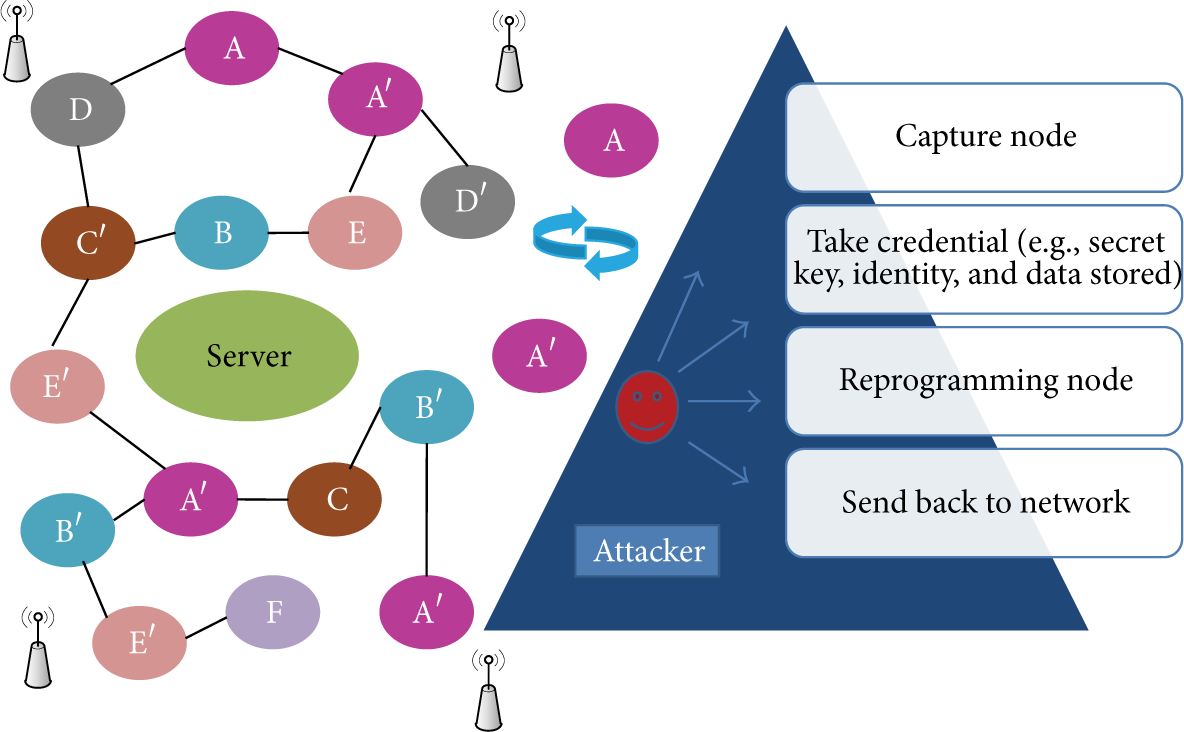
Scenario to generate node replicas in WSN.
Figure 1 depicts that A is the original node and
3.2. Clone Attacks in MWSN
A specific group of WSN mobility performs a major and essential behavior in the implementation of the different functions known as mobile wireless sensor network (MWSN) [23]. Nowadays, WSN mobility has become a major and an essential topic in the research area. Transportability was primarily considered to comprise many issues that are required to be resolved, like connectivity, coverage, and energy consumption, to name a few, even though WSN deployments were not at all conceptualized to be completely stationary. Conversely, current and modern studies view mobility in a most positive and sympathetic light [24]. Instead of complicating the tasks of replica detection, it has been established that the beginning of mobile application can determine or sort out the major issues of replication detection [25]. Furthermore, mobility authorizes sensor nodes to follow traveling mechanism for example, chemical clouds, transportation, and packages [26]. The main and important issues for MWSN are necessary requirement designed for localization. The mobility nodes are capable of sustaining a secure range from the fire boundary, in addition to present information and updates to fire fighters that point out where that boundary is at a certain time.
A MWSN is one which observes wildfire. The sensors of mobile can follow it, and also turn away from its path, as the fire spreads. By creating multiple communication pathways, mobility also enables to maintain data integrity and larger channel capacity, and minimize the number of hops message [27]. Basically, the sensor nodes are spread against atmosphere point and they arrange a multihop mesh system planning. Every sensor node networks has the potential of gathering messages and routing information to base stations as peer-to-peer. The mobility node is actually a better and improved sensor node. Not only does it has the entire abilities and capacities of the stationary sensor node, but it also conceives mobile nodes by accumulating a convenient and manageable automation base. A base station is operated to overpass connection to one more network or system, for example, Internet [28]. Figure 2 demonstrates the procedure to generate replicas in the MWSN, that is, based on how attacker compromise the mobile nodes, and after changing the information sends them again back into network for malicious activities. Figure 2(a) shows the mobile nodes deployment in MWSN, Figure 2(b) shows attacker compromise the mobile node and after changing the information send again back into network for malicious activities, and Figure 2(c) shows original and replicas mobile nodes presence with same features in MWSN. The red color shows the presence of replica and it is considered that for MWSNs the replicated nodes are mobile. Therefore, it is too challenging to differentiate the replica among original nodes in MWSN due to the mobility features.

Procedure to generate replica in MWSN. (a) Mobile nodes deploy in MWSN. (b) Attacker compromise the mobile node and after changing the information send again back into network for malicious activities. (c) Original and replicas mobile nodes with same features in MWSN.
3.3. WSN and MWSN Comparison
In discussing MWSN, it is extremely essential to look at major differences of the static WSN verses MWSN from various aspects like localization, dynamic network topology, power consumption, and network sink [23]. Table 1 tabulates several major differences between static and mobile WSN with respect to replication attacks. The comparison shows that the performance behavior of the MWSN as compared to WSN in terms of localization, dynamic network topology, power consumption, and network sink. In systems that are light or put out of place, or once static nodes, dead mobile sensors nodes can maneuver to join or tie the vanished or weak communication and monitoring pathways. With static WSN this task is not achievable because the information or facts from dead, cut off or detached nodes would basically vanish. Correspondingly, when setup sinks are immobile, sensors nodes nearer to the base station will die more rapidly. So, they should transfer more information or data communication earlier than those nodes that are auxiliary apart. This problem can be resolved and the life duration of the network can be upgraded by utilizing mobile base stations [29]. The main benefits of MWSN as compared to WSN are better coverage, improved tracking, higher channel capacity, and improved energy efficiency.
Comparison of static and mobile wireless sensor network with respect to clone attacks.

4. Node Replication Attacks Detection in MSWN
Several strategies have been proposed for detecting clone attacks in MWSN. Figure 3 illustrates existing clone detection mechanisms in MWSN. In general, the detection methods can be divided into two main categories, namely centralized and distributed. These two methods will be discussed in details in the next subsections.

The overview of all work done in field of detection of clone attacks in MWSN. SPRT: sequential probability ratio test [30, 31], XED: extremely efficient detection [33], EDD: efficient distributed detection [34], SEDD: storage efficient distributed detection [34], UTLSE: unary time location storage and exchange [35], MTLSD: multitime location storage and diffusion [35], SHD: single hop detection [37].
4.1. Centralized Method
In mobile node replication attack centralized detection, nodes send all their information to a single point, for example, base station for decision making and to gather information (after receiving the claim, base station checks the scenario by comparison: if two mobile sensors nodes with identical identity exist in the system with different location, it can easily identify the replica node). Weakness of this strategy is one or single failure point. Since all replica nodes are checked at one point, the failure to detect the replica (i.e., due to single point of failure) will allow the attacker to control the whole network. Another drawback of using single point for detection is that it is slow because every node will be waiting for their turns (i.e., it can build congestion because of the long queue) which creates delay in the network. The following are researches on centralized method.
(1) Fast Detection of Mobile Node Replication Attack with Speed Based (SPRT). Ho et al. [30, 31] proposed a fast detection of mobile node replication attack technique to detect replica. It is based on checking and comparing the speed of the node at centralized point (base station) by using sequential probability ratio test. It is based on random walk where null hypothesis (not clone node) sets the lower limits and alternate hypothesis (clone node) sets the upper limits with each observation. As the replica mobile sensor node speed would not be quicker than the network estimated speed, base station computes the speed of the adjacent claims. If the speed exceeds the system configured speed, it indicates that there are a minimum of two nodes with similar identity lies in the network. Three major terms essential to estimate the accomplishments of the proposed method are (i) number of claims: number of claims needed for the base station to make the decision that the node has been cloned or not, (ii) false positive: it is the probability of error that an original node is misidentified as a clone node, and (iii) false negative: it is the probability of error that a clone node is misidentified as an original node.
The limitations of adversary strategies to evade node detection mechanism analytically are explained by this method. It also discusses the boundaries of a class attack approach where the adversary manages the activities in a class of clone nodes. In this paper, the authors proposed a quantitative analysis on the limit of the total time in support of which class of clones can evade detection and secure information. They also present a design of the communication involving the detector plus the attacker as a repeated game and find Nash equilibrium [30, 31]. The adversary's optimal achievements at rest are deeply limited by the sequence of detection and isolation as shown by Nash equilibrium. Also accomplished simulations based on movement attack approach in which the adversary supposed clones accidentally move in the network and under a still position attack scenario in which he keeps his clones from moving to escape detection. The conclusion of these simulations explains that the technique rapidly detects node clone attacks in WSN with mobility.
(2) A New Protocol Detection of Mobile Node Replication Attack with Key Based. Deng and Xiong [32] proposed a new protocol for detection of clones node attacks in MWSN. This scheme is based on Bloom filter and polynomial based key predistribution, depending on the fact that clones cannot lie about their genuine identifiers and every sensor node gathers the number of pairwise key. Replicas node can be easily detected by considering the scenario, if number of pairwise keys exceeds a certain threshold. Basically this protocol performs the detection of node replica in three phases, first is initialization of the node, second is establishment of pair-wise key and third is detection of replica node. In first phase (initialization of the node), the key server randomly generates a bivariate symmetric polynomial over a finite field before nodes are deployed. After the nodes deployment, the second phases starts, that is, establishing the pairwise key. Each node generates a report and sends it to the base station (central point). Report is basically based on node ID and Bloom filters count. Final phase starts at base station, where Bloom filter gathers the number of pairwise key established by each node. It would be a replicated node, if node's pairwise keys exceed the threshold.
4.2. Distributed Method
In mobile node replication attack, distributed detection is not based on centralized point like base station. Basically, this method randomly selects a witness node to claim the message or location depending on scenario for detection of node replicas attacks. Distributed method is divided into three main categories; (i) witness based, (ii) neighbor based, and (iii) group based methods. The followings are research on distributed method.
(1) Resilient against Node Replication Attacks (XED) in MWSN. Yu et al. [33] proposed a protocol XED (eXtremely Efficient Detection) based on remember and challenge method to detect the replica node in MWSN. By observing the situation when two nodes are within the range of communication, they generate and exchange the random number and store the node ID in the memory by using a table. During the exchange of random number, if the node cannot answer the random number or answer with a wrong random number, then replica can be detected efficiently. If two nodes re-meet again, the random number is saved in the memory and will be replaced by new random number. According to this strategy, location information is not important. Special feature of extremely efficient detection (XED) is that it has the ability to detect the clone sharply at per move. XED proposed the scheme in order that when one mobile node approaches to other mobile node, they interchange random numbers to ensure that there is no prior approach. Alternatively, the random numbers are interchanged at accessible time when the mobile node demands the mobile nodes number. When the mobile node cannot answer or answers a wrong value that does not equal to the value in the memory, it declares the recognition of a clone. It is observed when the clone node meets the legitimate nodes, the clone node can repeatedly assume that they meet with each other before. Similarly, the clones are also detected, if the legitimate nodes have evidence that they never met before.
(2) Efficient and Distributed Detection of Node Replication Attacks (EDD and SEDD) in MWSN. Yu et al. [34] proposed the efficient Distributed Detection (EDD) and Storage Efficient Distributed Detection (SEDD) protocols for detecting the replica nodes in MWSN. EDD and SEDD have the following features.
Distributed detection: instead of including base station, EDD and SEDD can be oppositely aligned through the mobile node clones attacks within a distributed technique.
Individual detection: every mobile node within the EDD and SEDD technique is capable of distinguishing clones on its own.
Network-wide revocation avoidance: clones revocation can be accomplished through every mobile node by exclusively flooding the revocation communication to the whole system.
Efficiency and effectiveness: the EDD and SEDD methods can recognize the clones by means of higher recognition efficiency.
Furthermore, communication overhead is
(3) Mobility-Assisted Detection of Replication Attacks (UTLSE and MTLSD) in MWSN. Deng et al. [35] proposed two mobility assisted protocols UTLSE and MTLSD (unary time location storage and exchange and multitime location storage and diffusion) that are designed for recognizing node clone attacks among MWSNs. As both protocols (UTLSE and MTLSD) are encounter based, hence this strategy does not necessitate some routing signaling message, which means after seeing two definite nodes together, message will be exchanged. UTLSE allocates a duty to every witness to capture precise pair of more nodes. Entire witnesses store only single time location claim in support of every caught mobile node and as they meet with one and another they exchange the information to detect the clones. According to UTLSE two or more nodes interchange their time location claim when they encounter each other. The reserve claim is based on time location and until an encounter, the witness does not transmit the claim (time location), if witness node is not present in the communication range.
On the other hand, MTLSD assumes every observer reserves multi time location requests in favor of each caught mobile nodes. Moreover it familiarizes additional collaboration among witnesses to enhance the detection proficiency. These two protocols are basically established as encounter support. The messages are generated and sent for detecting clones mobile sensor nodes only when two or more nodes meet with each other. MTLSD strategy is based on improving the performance of detection of the replica nodes and witness keeps multitime location requests for observed mobile sensor nodes. MTLSD offers excellent flexibility for detection replica with low communication overhead, by gathering the time location claims information of observed nodes and broadcasting messages to witnesses.
(4) Patrol Detection of Replica Attacks in MWSN. Wang and Shi [36] proposed patrol detection for node replica attacks in WSN. Two types of detection methods namely stationary and mobile mode have been proposed. They employed mobile sensor nodes as patrollers that are divided in various zones in sensor networks to detect clones sensor nodes. If multiple sensors mobile nodes among dissimilar areas have an identical identity (ID), in that case the entire nodes with the identity (ID) will be considered a clone or compromised node. Furthermore, it will also be considered as clone attack, and will check the condition when a mobile sensor node travels with a high speed as compared to the designated greatest speed. The networks patrolled by the mobile sensor nodes and their declared messages are sent to sensors. From the patroller, the sensors obtain all their secret material at the processing round, or in addition, in the next round it will be eliminated from the network. The network should be initialized first by assuming that in the early stage there are no attacks. At least two mobile nodes will be patrolled to every sensor node. After getting the position information data, the static node holds the mobile nodes that patrolled it as the anchor nodes. Every round is categorized into different levels, and in each level, to broadcast its claim message, a patroller will shift towards zone.
Patrol node will analyze the position of sensor node and its distance after getting the claim; if the distance exceeds the signal range, it will recognize that the claim is not right one. In other case it will check the ID of claiming node by letting “a legitimate ID only has one location”. After this it will generate the list of messages in white-list (white-list saves the claims of originals nodes) and blacklist (blacklist save the claims of replica nodes), and revokes the replica's identity by denying to divide confidential source and spreading its double messages reply to more or further mobiles nodes. If the clones are deployed in a zone where a patrol node gathers their message reply at a patrol level, after he receives the second reply and the distance is higher between the two locations then the patroller can revoke them promptly. Rather, if the clone's reply is acquired by various patrol nodes, then they will be originating by interchange messages of patrollers or the base station. Firstly an original mobile patroller will hold and wait for the reply after he arrives at a new location and sends his claim in time interval T, after the patrol broadcasts his claim as there is a static cycle interval. This will occur if the attacker clones nodes and compromises the patrol node. Consequently, if the patroller node moves and changes its location in time, then it can be assumed that two nodes with the same identity (ID) currently lie in the network. Also it needs to be kept in mind that mobile patroller cannot move quicker than the system-configured maximum speed. Patrol Detection is not a quick detection because it depends on many steps for detection (speed check, patrol claim, storing the data in white list and black list form and comparison on distance based).
(5) Detection Node Replication Attacks in Mobile Sensor Networks: Theory and Approaches. Zhu et al. [3] proposed two replica detection schemes (Token based and statistics based) for detecting node clones attacks in MWSNs. In token based authentication strategy, the replicas do not cooperate (nonconspiring case) and occasionally broadcast to the ever sensing region a time-stamp by a broadcast authentication protocol through the base station. After hearing the time-stamp, the broadcast declares the starting of detection round, and a genuine mobile node randomly selects a secret seed and through the previously received tokens empties its local storage. Node replica detection is based on two phases, first is token exchange phase and second is a mutual authentication phase. They will exchange a token with each other, after first meeting of a mobile node with the other mobile node, and will store the tokens in memories. When these nodes meet again in the detection procedure, every node will ask the other node for the previously exchanged token. After getting the right answers, every node believes that the other is original node (authenticated). If no token or wrong token is exchanged, every node can easily detect the clone or replica node.
In statistics based detection scheme, node replicas are based on each other cooperation. Node can be replica node if a sensor node is seen repeatedly multiple times by other mobile sensors nodes. Each node holds a step counter “T” and also its acquaintance list existing the n Boolean variables. It increases the counter T by
(6) Single Hop Detection of Node Clone Attacks (SHD) in MWSN. Lou et al. [37] proposed single hop detection (SHD) for detection of node replication attacks in MWSN. Major features of this method are: To a certain extent, mobility is commercial to sweep over in clone detection. Mobility of node is not seen as an evil property in SHD (single hop detection). Huge numbers of proposed solutions are considered for static wireless sensor networks, most of them are location based witness detection schemes. Due to mobility factor these methods are not suitable for MWSNs. The procedure is valid even if at zero delay clone nodes can contact with each other and the protocol is powerful towards clones colluding attack. In single hop distance, as the name suggests, complete information exchange happens. Consequently, the protocol detection will locate position even if there is no trustworthy communication route between distant node pairs, which is to be expected to occur in a routing attack. This scheme is totally distributed. Node replica attack detection is analyzed to an extended version of mobility based analytical outcomes under well known mobility models like random direction, random way point and routing problem, and so forth with the help of this protocol.
In first scenario (fingerprint claim), sign list of the neighbor node is made by every node. This signed list is basically the operation of SHD (single hop detection) and depends on physical node (neighborhood community). Its specific feature is that single hop neighbor node list is provided as WSN (for communication with each other, it is important to know their neighbors). SHD protocol lies in the single hop neighbors, which are extremely robust (across node is intriguing and is capable of detecting the replica attacks using two scenarios, the claim for fingerprints and the verification of fingerprint).
(7) Localized Algorithms for Detection of Node Replication Attacks in Mobile Sensor Networks. Yu et al. [38] proposed two detection algorithms (XED and EDD) for detection of node replication attack technique in MWSN. The benefits of the proposed algorithms include: localized detection; efficiency and effectiveness; network-wide synchronization avoidance; network-wide revocation avoidance. This localized algorithm consists of two methods: (i) extremley efficient detection (XED) and (ii) efficient and distributed detection (EDD).
Extremley efficient detection (XED): basically, the main concept behind XED is exchanging the random number between nodes (i.e., if a node meets another node before time and exchange the random number, then, when these nodes meet again, they will ask or exchange the random number). In XED, the author assumes that the clones cannot collude with other nodes. Furthermore, the whole switched messages should be retained unless precisely noted. The XED method is self-possessed in two steps: one is offline step and the other is online step. The first phase is accomplished before sensor deployment while the second phase is accomplished after deployment by every node. The capability and strength of XED depends on the theory that the clone nodes do not conspire with other nodes. When clones can interconnect with each other, the clone node can transfer the latest received random numbers with the other clones every time. This would be harmful for detecting clones because several clone nodes are capable of answering with the right random number to encounter original nodes.
Efficient and distributed detection (EDD): the main concept behind EDD is to note the observations of the maximum number of times one node encounters another node in a fixed time interval that should be limited with high probability. The minimum number of times one node encounters the clones with the identical identity should be greater than a threshold throughout the similar time interval. By noting these assumptions, if every single node can distinguish between these two scenarios, it has the capability to recognize the clones. EDD also considers that the clones can conspire with other nodes. Furthermore, the whole switched messages should be retained unless precisely noted. The EDD detection method is self-possessed in two phases: an offline phase and an online phase. The offline phase is accomplished before sensor deployment. The objective is to compute the factors, with the length T of the time interval and the threshold are used to see the difference between the original nodes and the clones. The online phase will be accomplished by every node at every move. By comparing the threshold with the resultant number of encounters, every node checks whether the encountered nodes are clones or not.
5. Comparison of Existing Approaches
With regard to replication attacks detection, all existing approaches have some limitations which affect their efficiencies. Some of the limitations of preliminary methods are highlighted here and are summarized in table form for comparison. Table 2 shows the comparison summary of all detection methods in MWSNs in terms of the communication cost, memory cost, fast detection, and NDFD (nondeterministic and fully distributed) [15] parameters. All replica node detection solutions come up with unique analysis, motivation and techniques, and every scheme has some positive and negative aspects. On this basis, we cannot say which strategy is the best one. Security is a great and major issue in MWSN, and to resolve node replication requires fast and efficient detection. Otherwise attacker can easily capture or monitor the whole network and can use it for malicious activities.
Performance of node replication attacks strategy in mobile wireless sensor network.

NDFD: nondeterministic and fully distributed; SPRT: sequential probability ratio test; XED: extremely efficient detection; EDD: efficient distributed detection; SEDD: storage efficient distributed detection; UTLSE: unary time location storage and exchange; MTLSD: multitime location storage and diffusion; SHD: single hop detection; n: number of nodes; d = degree of neighbor nodes; k: total number of zones;
As mentioned in the above section, the centralized methods (i.e., SPRT and a new protocol) depend on base station. The centralized approach has the advantage over the distributed method that it can detect replica in fast manner (i.e., SPRT method) as it depends only on one point check. But this also can be a disadvantage in case of single point failure. The fast node replica attacks detection uses sequential analysis (SPRT) has been proposed in [30, 31]. Basically, their approach depend on the fact that the original mobile nodes should not have more speed than system maximum speed and replica will move much faster as they have to take the position. Therefore, if mobile nodes’ speed exceeds the speed of the system, then there is a probability that two nodes of identical identity are present in MWSN. SPRT relies on sequential hypothesis of speed check of each mobile node, if it exceed the certain threshold it would be replica. There is probability that replica can lie in certain threshold, then, it is considered that replica is also mobile. Moreover the speed measurement tool is expensive one and it cannot be implemented easily in the networks.
In [32], the authors have proposed a new protocol for detection of node replication attacks in MWSN. Their theory is based on idea of Bloom filters and polynomial based pairwise key predistribution, which elaborates the concept that clone cannot exist into real identifier and pair wise keys of every node. Clones are identified by checking the threshold, if the number of pair wise keys is beyond the threshold, clones exist. This new protocol for replica detection is another centralized method in which it is not confirmed that the replica node will tell their keys to the base station and if value exceeds the certain threshold, it will also affect the original node and would be very harmful for network. It is also necessary to detect the replica by observing false positive and negative.
To resolve single point of failure issue, distributed approach has been proposed. The extremely efficient detection (XED) [33] is proposed and its working principle is based on the idea of exchanging the random numbers at different locations (remember and challenge strategy). Accordingly, if mobile node did not exchange the right random number or number did not match, then it would ensure the presence of replica in the network. XED is not a fast detection as it depends on the node meeting (i.e., mobility impact) with each other and exchanging the random numbers. This process can create delay in detection procedure, thus would be dangerous for network as it will be vulnerable against an intelligent attacker. As mentioned in [33], replicas do not cooperate and communicate with mobile nodes and it may present in the network because it can easily set up secret channel and involve itself to perform malicious activities.
The EDD (efficient and distributed detection) and SEDD (storage efficient and distributed detection) [34] are based on the observations that the number of times the mobile node encounters with other nodes should be less in a defined time period. The EDD approach depends on two steps, offline and online. The first step is performed before deployment and the second step is for every mobile node per move. The SEED approach has been proposed to overcome the storage overhead and time period problem in EDD. Accordingly, every mobile node only monitors the subset instead of all in limited time period. EDD approach depends on node meeting and utilizing maximum memory to store the information. This cannot be applicable for real life scenario in the network at huge level. On the other hand, SEDD sort out the problem of memory by considering the monitor set but it still needs high storage. Furthermore, it will also depend on the time when two nodes will meet with each other so it is not a quick detection.
The replica detection approaches, unary time location storage and exchange (UTLSE) and multitime location storage and diffusion (MTLSD), have been proposed in [35]. They have used the idea of the exchange of the time location claims of each encountered node within communication range. If the witness node itself is a replica node, then it would be still harmful for the network as in this scheme the witness node is randomly selected. Furthermore, it is again time consuming to wait when a node will interact with other node and will exchange the information with each other. Attacker can take advantage of the delay in the detection scheme, which is a dangerous security threat.
Another theory and approach on replica detection is token based method. The token based (i.e., compromised nodes do not cooperate) node replica detection method has been proposed in [39]. Accordingly, when mobile node meets another node, they will interchange the tokens and will save them in memories. In the similar detection period, every node will inquire for the token previously exchanged, and a wrong answer will indicate the replicated node. Furthermore, they also have proposed the detection concept of cooperation with every node. Therefore if mobile node is seen again several times, it is hint for presence of replica. This scheme will not work as replica nodes can also exchange the token and generate the protocol exists by name only. By observing this, if the attacker is very active and intelligent, he can set up a secret channel of replica node. Patrol detection [36] of node replication attack detection has been proposed for two scenarios, namely, for mobile and stationary modes. Both scenario depends on the concept that if two or multiple mobile nodes at different location have identical identity, these nodes will be considered as replicas. Furthermore, if patroller (mobile node) speed exceeds the mentioned speed, it will also be an indication of replication attacks. After that patrol (mobile node) will check the distance, and if it less than the signal range, it will save the message in white list and save the replica identity in blacklist. Hence, there is probability of replica (i.e., two or multiple nodes with identical identity), if mobile node known as patroller changes the location and moves in period (T,
The Single Hop Detection (SHD) [37] approach proposed for replica detection states that at random time interval mobile node cannot lie in different neighborhood groups. This approach is based on fingerprint claim and verification. Accordingly, when two nodes meet and exchanges the lists of witness node, if there are two fingerprints claims with identical identity and key with diverse neighborhood groups, this indicates the presence of replica. SHD technique is based on the fingerprint claim and considers the witness for claiming the node. It will create a problem if the witness node itself a clone node. Two node replica detection methods based on localized (XED and EDD) have been elaborated in [38]. The advantages of localized algorithm involve the features as (i) localized detection, (ii) efficiency and effectiveness, (iii) network wide synchronization avoidance, and (iv) network wide revocation avoidance. This approach uses concept of challenge and response, which is different from other existing methods. Furthermore, in contrast to the current methods for replication attacks detection, it also reduces the storage overhead.
6. Research Challenges and Issues
Nowadays, mobile sensor nodes are commonly used in different activities (like military, weather, medical and agriculture and so on) and have a great security concern. As in MWSN, the detection of node replication attack is distant changed, but more complex and challenging than in WSN. Conventionally, it is a great concern to resolve the threat in sensor network from advisory. The attacker can easily do the following tasks in minimum time duration:
monitor the whole network communication,
control the WSN,
insert false information,
jam the signals,
change the formation of cluster,
handle the different protocols,
disable the function of network,
misuse of the mobile nodes for malicious activities.
Figure 4 illustrates the challenges related to replica detection in MWSN. There is a probability that if the mobile replica is not detected quickly and accurately, it would be very harmful to the network. This is because in a minimum time period, the attacker can capture the information of entire network. Therefore, a quick, accurate and efficient detection is required to eliminate the replicas from network.

Security challenges of node replicas in wireless sensor network.
7. Effect of Different Parameters on Efficient Replication Attacks Detection
7.1. Detection Accuracy
The probability of detection accuracy of a mobile replica is calculated when there are two or multiple nodes with the same ID (identity) in the MWSN. Successful node replica detection is known as true positive, whereas incorrect detected replica detection in MWSN is known as false positive. False negative means that the replicated node is not detected as replica, thus reducing the efficiency effectiveness of the replica detection methods. The detection procedure should have high true positive rate (clone nodes are detected successfully) and low false positive rate (normal node is accused as a clone).
7.2. Communication Overhead
The probability of energy that mobile node consumes in sending and receiving messages by mobile nodes. The communication cost for detection replicas should be satisfactory and high.
7.3. Memory Overhead
Every mobile node has to store the information, check and conduct the comparison for clones’ attacks detection (i.e., if same node identity is found). Therefore, each node should have efficient node's memory to store the data or information (i.e., node Identity, node key, location, etc.).
7.4. Detection Rate (Fast or Slow)
The detection rate probability refers to detection of the danger attack in a limited time period. The probability of detection periods shows that proposed method identified the replicas in quick, effective and efficient manner. Otherwise, there would be a possibility that an attacker can take advantage of the late detection to capture the whole communication.
7.5. Energy
Energy is also an important parameter in replica detection because an attacker needs high energy to monitor the whole network. Similarly, the energy of the mobiles node should be efficient to perform the detection and mitigation process for replication attacks.
8. Discussion
Mobility is latest topic in detection of node replication attacks and is important in the field of WSN. For MWSN it is considered that the attacker is also mobile. Attacker can capture the whole data in their memories, as in the proposed study it is discussed that every time the sink is not present, the sensor nodes cannot transmit sensed data on their own. Authors in [40] have provided overview of replication attacks in static and mobile WSN. It is also explained in [41] that if the sinks do not lie in the sensor network within certain time period, mobile attacker wanders around the WSN to adjust a subset of sensors nodes. The time period for adjusting subset is very small in duration as it lies along two consecutive details of sink's gathering. Therefore, it is very complicated to pluck the adjusting node as well as replica node in the network. Another major problem in the mobility is when mobile attacker follows the technique to capture the node. This technique, known as group mobility strategy, states that only one representative can communicate through original ones, and as mobile nodes mostly travel in the form of groups, they can get the information about received token or meeting. Algorithm 1 shows the general scenario to generate the node replication attacks in MWSN.
represents the all mobile nodes in MWSN, N is the Mobile Wireless Sensor Network, replica of original node, T is simulation time and random time after deployment.
(1) (2) (3) (4) (5) Replica Detected (6) Return (0); (7) (8) (9) (10) Generate (11) Deploy (12) (13) Replication Attack (14) Return (2); (15) End
As replica node behaves efficiently and independently, they would have met with many nodes until another loop starts for detection; thus, while interacting and communicating with each other, they can get all the information (identity, key, secrets, etc.). Some parameters can be controlled or improved by minor modification, for example, false data can be inserted using the methods of authentication [42–45]. Protocols for protected data aggregation are utilized to inhibit security threats through interrupting aggregation [46–49]. Moreover different methods have been discussed for safe localization and time synchronization protocols from the advisory [48, 50–56]. In [48] effective protocols have been proposed for protection by estimated calculations, assessment regarding the network's size and more mobile nodes values due to less estimation. Mobile replica's attacks in MWSN are very challenging and a serious security threat. Thus, it is really important to deal with this difficult security task and to design a new detection technique that can resolve this security issue with efficient work, fast detection, low communication and memory cost. Algorithm 2 shows the effect of fast and slow detection. It shows that the first step is the deployment nodes in MWSN and the examination of the node's status to find out whether it is a replicated one or not. If it is not a clone mobile node then obviously the network would be protected. On the other hand, if replica is found then there is a security threat to the MWSN. The next step is to check the detection rate of the proposed scenario. Therefore, network protection can be divided into two stages: fast detection and slow detection.
Fast detection: it depends on the detection techniques used to detect the replica's attacks in MWSN. The network would be protected from malicious activities very efficiently, if it implements a fast, quick, speedy and rapid detection approach. Nowadays, the main focus is to propose quick detection technique for mobile's node replication attack.
Slow detection: we observed that there are number of proposed approaches in the field of replica's detection attacks in MWSN, but they are not using fast detection method. Subsequently, if the detection is slow and takes time, there is a chance that an attacker can control the whole network communication for malicious activities during that detection period. Slow detection rate also relies on two phases: Firstly, the replicated node attack is dangerous one and secondly, the replicated node attack is not dangerous. If the attack is not dangerous, then the network would be protected from attacker's harmful threats even after the slow detection rate. On the other hand, if the attack is a dangerous, then the network would not be protected and it will be very dangerous and challenging to the networks security.
replication attacks. If N represents the Mobile Wireless Sensor Network, simulation time, replica and replication attacks.
(1) (2) (3) (4) (5) Return (0); (6) (7) (8) (9) Network not protected (10) Return (2); (11) (12) Return (4); (13) (14) Attacker achieved his target (15) Return (9); (16) (17) Return (4); (18) End
9. Conclusion
This paper provides the overview of existing and recently proposed detection strategies of clone attacks in MWSN. Moreover, the strengths and weaknesses of all the proposed methods have been discussed in detail and summarized in a comparison table. The latest study on node replication attacks highlights the entire picture of the current challenging and dangerous security threats present in MWSNs. These security problems need to be resolved so it can be implemented on real life scenario, with efficient energy, low communication cost, less memory and fast detection.
Footnotes
Conflict of Interests
The authors declare that there is no conflict of interests regarding the publication of this paper.