In recent years, fractal is widely used everywhere and escape time algorithm (ETA) became the most useful fractal creating method. However, ETA performs not so well because it needs huge computations. So, in this paper, we first present an improved fractal creating algorithm by symmetrical radius of set. Meanwhile, we use distributed cooperative method to improve classic ETA into parallel system, which is called distributed cooperative ETA (DCETA). Secondly, we present the proof of fractal property in set with exponent , which concludes its threshold and symmetrical property. Finally, computational result shows correctness of the novel DCETA, which shows better computational effectiveness and lower waste.
1. Introduction
Since Mandelbrot has presented M set (Mandelbrot's set), fractals have been soon used everywhere [1]. Nowadays, generalized M sets become representatives of chaotic dynamics. We present M set in Definition 1 and set in Definition 2 as follows [2]. In Definition 1 is defined in (1).
Definition 1.
Then, when we reform to in (2), definition of set is presented in Definition 2. Consider
Definition 2.
.
Nowadays, many scholars research deeply in set with many kinds of exponents. In fact, we know that the dynamics system set is generalization of M set, and classic M set is actually set.
Then, because the structure of set is complex, we use escape time algorithm (ETA) to create its fractal. The algorithm ETA compares to a given large number N of all points c. Admittedly, a point c is in set when the iteration time is more than another given number M. To explain it, we present the escape time algorithm in Algorithm 1.
Algorithm 1: Escape time algorithm (ETA).
Step 1.
Let T = escape threshold, I = max iterated number.
Assuming = 0 is iterated times of points c.
Set = c as (z) (0) of points c.
Step 2.
For all points c in complex plane,
While and
. f().
Step 3.
Color all points c by different .
In Algorithm 1, if , the iterations of z are convergent; else are divergent.
In fact, Algorithm 1 is an approximate algorithm because M and N cannot be determined. For example, if there exists a point c makes and and , we will find different results when . So we cannot make sure the point c is convergent or not for ETA in these two conditions. Another problem is that when the iteration exponent is negative or complex number with negative real part, the iteration value is often changed from greatly large to greatly low or opposite. It is hardly to use ETA in this condition. So a strict proof is necessary to be given, which is used to prove convergence and divergence of set in complex plane with .
Then, there is another problem in fractal creating algorithms, that is, the huge time cost. Assuming the displayed area contains points, which need to compute I times in the worst condition (I is maximum iteration times), we know that the computational times . This is a huge number and it needs huge time to be processed. So we have to use a distributed cooperative algorithm to decrease the computational times.
For years, distributed cooperative algorithms are widely used in many areas, which indeed decrease time cost by using multiprocessors instead of single processor. Today, researchers usually use multicomputers to construct a cooperative system. Furthermore, parallel and distributed system is always used for transportation [3], estimation [4], optimization [5], and localization [6] in engineering area. Admittedly, we call them distributed cooperative transportation/estimation/optimization/localization algorithms.
In fractal area, there are many initial iterated functions with complex structure [7, 8]. So we have to use novel iterated method to process them [9]. Admittedly, distributional method is an effective method to decrease the computational time, just like parallel and cloud environment [10, 11].
In this paper, in order to decrease huge time cost which comes from fractal creating algorithms of set, we present a distributed cooperative algorithm under a parallel system at first. We create set with both classic ETA and novel DCETA to validate the correctness of DCETA. Besides, in order to validate the positive of DCETA, the parallel experimental results are also presented and analyzed.
Second, we prove that set has strongly symmetrical properties with phase angles. In this case, we decrease the iterated time further. Meantime, we analyze these results and find the parallel properties of this distributional algorithm. It is also experimented in DCETA and the experimental results also validate our conclusions.
In conclusion, in this paper, we firstly present a separate method to reform ETA into distributional environment. Meanwhile, we analyze this novel algorithm with experimental results. Secondly, we research in properties of set and find self-symmetrical regions with phase angles. Then, we present a separate method to reform ETA into distributional environment. Meanwhile, we analyze this novel algorithm with experimental results. The results also validate properties of set. Finally, some Julia sets are created to validate containable properties between set and the corresponding Julia sets.
The remainder of the paper is organized as follows. We proved properties of set when in Section 2. Moreover, we have their parallel experimental results and analysis in Section 3. Finally, Section 4 summarizes the main results of the paper.
In this paper, k is a negative integer, i and n are positive integers, c is a complex number, T and I are positive real numbers.
2. Distributed Cooperative ETA with Fractal Symmetrical Property
In order to run ETA in distributed system, we use SIMC in the distributional method in Algorithm 2.
Algorithm 2: DCA of ETA.
Primary node
(i) For all task nodes
Send group message (, f) to task nodes;
in the message, = (, ) × (, ) denotes iterated area, and function f
dotes the iterated mapping
(ii) While all task nodes send its result
Connect all sub-images and display it;
(iii) Finished;
Task nodes
(i) If primary node send message (, f)
Use ETA to create sub-image by compute all points in this area with iterated function f;
(ii) Send sub-image to primary node;
Finished;
Not as usual as other cooperative algorithm, DCA creates the final image with the hidden cooperative multitask nodes, which provides a part of the final image. So we cannot find the cooperative relation in DCT. In our experiment, by these two distributed cooperative methods which are presented, the parallel system is constructed with 3 same PCs. In this system, one PC is the primary node and other two are task nodes. Then, all subresults are connected in the primary node as the final result.
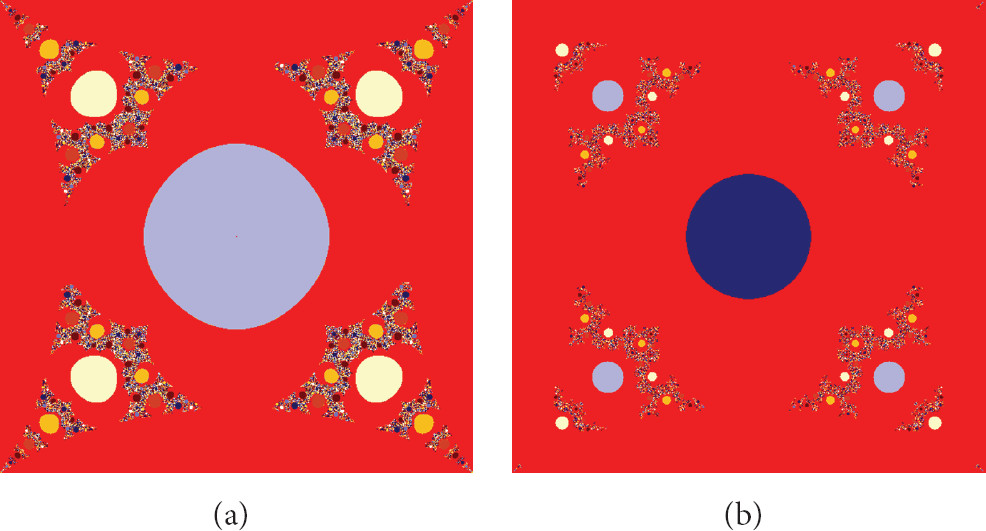
In this paper, we use and −4 to process the experiment and compute a sector with center (0, 0) and radius . For example, when , the original and improved fractal is presented in Figure 1 (with no larger than threshold 10 and no lower than threshold 0.1). Similarly, the original and improved fractal is presented in Figure 2 (with no larger than threshold 10 and no lower than threshold 0.1) when . In these figures, Theorems 4 and 6, Lemma 5, and Inference 2 are validated. In detail, we find the symmetrical property from the general views of Figures 1-2, and they validate Lemma 5 and Inference 2. Then, the escape areas are all similar-round with the escape points in Figures 1-2. They validate Theorem 4. Additionally, we have the farthest fractal area to validate Theorem 6.
Fractal of set by original (10) and improved (0.1) threshold ().
Fractal of set by original (10) and improved (0.1) threshold ().
In this paper, the two worker nodes compute results of the area with modality of polar coordinates. In the area, , and , where denotes number of the two worker nodes. We present Figures 3-4 to validate the conclusion we given. In Figure 3, we present the two fractal image created by two worker nodes. In Figure 4, we present the remainder of whole set. Then, we find that the pseudoescape lines are the symmetry axes of set. Moreover, Figure 5 is similar to Figures 3-4. It is presented to validate our conclusion with .
Fractal of set by the two worker nodes ().
Corresponding fractal of set in the two worker nodes ().
Original and corresponding fractal of set by the two worker nodes .
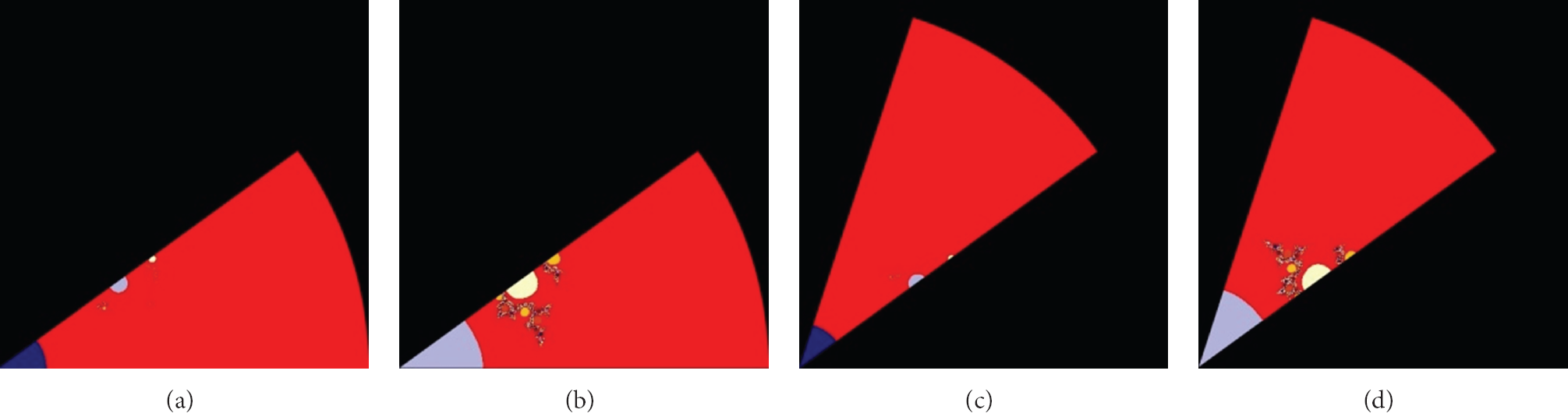
Then, the basic computational area is presented in Figures 6(a)-6(b) and 7(a)-7(b), which are corresponding to and . Moreover, their symmetrical fractals of pseudoescape line are presented in Figures 6(c)-6(d) and Figures 7(c)-7(d). In these figures, (a) is the original computational area with original threshold, (b) is the improved computational area with improved threshold, and (c) and (d) are the symmetrical areas with corresponding axis pseudoescape lines. Meantime, in these two examples, the expected displayed area is (−1.2, 1.2) × (−1.2, 1.2). So radius of the computational sector is about 1.697.
Fractal of the computational area by original and improved threshold ().
Fractal of the computational area by original and improved threshold .
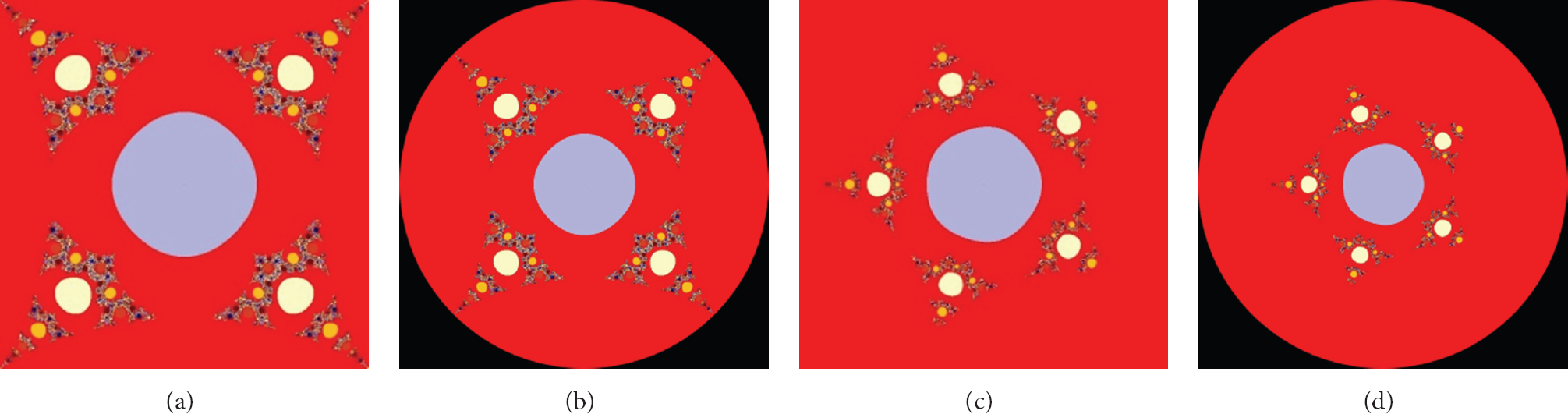
Finally, Figure 8 presents the symmetrical properties of set by the two thresholds, and we validate Theorems 6 and 7 with Figures 6, 7, and 8.
Fractal of sets by xOy and polar coordinates with two thresholds .
3. Proof of Fractal Property in Set
3.1. Correctness of the New Threshold
In this paper, we study properties when k is a negative integer from (2). At first, we give threshold and convergent properties of set by Theorem 3.
Theorem 3.
set contains whole complex plane except countable points.
Furthermore, when , we reach Inference 1, which presents escape points of set.
Inference 1.
Origin is the only escape point of set when .
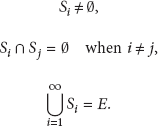
In this way, we can analyze these countable escape points of set. So when we let E = , we know that is a partition of E, where is a solution of . It is because of the following:
Then, when we reach Theorem 4 to find all escape points which are attracting, we will found the structure of set.
Theorem 4.
All escape points of set are attracting.
Proof.
Firstly, (4) is applied to compute all escape points of set:
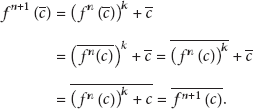
Generalizing (4) to infinite, we have (5). It means that c is an escape point. However, using , we have (6). It means that c is similar to a periodic point. Meantime, in this paper, a point c is called pseudoperiodic point when it reaches (4)–(6):
So when applying (7), we have (8) to reach its derivative:
Admittedly, infinite is attracting fixed point, and zero is pseudo-2 periodic point.
So when applying (10) into (9), we have (11) when is even or (12) when is odd:
So when or , (10) is infinite, and computational result of (11) is zero. Moreover, it is admittedly that computational result of (12) is zero. So we know these pseudoperiodic points are all attracting.
Moreover, we know that escape points of set are all attracting from Theorem 4. So when we use a threshold T as the threshold, we know that can also be used as a threshold in the fractal generation.
When assuming that radius of the approximately circle is ε. So we have (13) from the newer threshold:
In this case, we know that sets also can be separated to parts, which differ from each other with phase angle .
From Lemma 5 and Inference 2, we find the separation of clearly by fractal symmetry of set. In our distributional strategy, is divided into parts, which differ from each other with phase angle . In this case, we separate set to n nodes. The ith node computes area with phase angle and we only compute area with phase angle . The other area is same as the computational area and can be collaged with it.
Then, we have Theorem 6 to present the farthest “escape point” of origin, which denotes the displayed area of set.
Theorem 6.
In Algorithm 1, the farthest pseudoescape point of origin is at the line .
Proof.
Without loss of generality, we assume a point as a farthest escape point. Then, we find that has the lowest modulus than any other points with modulus r in the following by using mathematical induction.
(a) Let ; is lower than other points with modulus r, where and phase angle of is same as c. Its proof is in the following.
Admittedly, reach its lowest value when ; applying it into (20), we find the lowest value is
(b) Let and assuming that is lower than other points with modulus r, where and phase angle of is same as c.
(c) Let ; | is lower than other points with modulus r, where and phase angle of is same to c. Its proof is in the following.
Assuming that
we have
So, when , we have | which is the lowest of all points with modulus r.
Summarizing (a)–(c), we prove that is lowest when its modulus is lower than T in Algorithm 1. Then when we apply Theorem 3, we have threshold of these pseudoescape points which are determined by . So c is farther from origin when is lower.
In this way, we know that set has farthest pseudoescape points, which are at lines for . In this paper, we use radii to name these lines. Then, we use Theorem 7 to present their symmetrical properties.
Theorem 7.
for all points with .
Proof.
Using mathematical induction, first, let ; we have
Then, let , and assuming
we have
Summarizing (25)–(27), we have that for all n. In other words, set is symmetry with the real axis.
Then, when applying Lemma 5 and Inference 2, we know that set is symmetric with phase angle . It means
Moreover, it is admittedly that or . So we have (29) by (19), (26), and (28):
In this case, we know that these pseudoescape lines are all symmetrical lines of set. So the ratio of computational area is reduced to with original displayed area. In conclusion of Section 3.2, we know the correctness of symmetrical property in set.
4. Conclusion
In this paper, we analyze set with formula by using distributed cooperative algorithm. We present an algorithm DCETA to improve classic ETA to a distributed parallel system, and this novel fractal creating method has lower computations. With experimental results, we validate our conclusions.
Then, we proved the fractal property of set, which contains the correctness of the novel threshold and the fractal symmetrical properties. These novel properties are improvements of [12, 13].
Since we have already studied some special set with many methods [14], and used set in many other areas, in the next step, first, we will find some properties of set, which can enhance understanding of set. Then, we will use properties of set into distributed parallel system to enhance its effectiveness and robustness.
Footnotes
Conflict of Interests
The authors declare that there is no conflict of interests regarding the publication of this paper.
Acknowledgments
The authors wish to thank the anonymous reviewers for their helpful comments in reviewing this paper. This work is supported by grants from Programs of Higher-level talents of Inner Mongolia University (nos. 125126, 115117), Scientific Projects of Higher School of Inner Mongolia (no. NJZY13004), Scientific Research Fund of Hunan Provincial Education Department (no. 12B023), and National Natural Science Foundation of China (nos. 61261019, 61262082).
References
1.
MandelbrotB. B.The Fractal Geometry of Nature1982San Francisco, Calif, USAW. H. Freeman
2.
FalconerJ.Fractal Geometry: Mathematical Foundations and Applications20032ndNew York, NY, USAJohn Wiley & Sons
3.
SandersonA. C.A distributed algorithm for cooperative navigation among multiple mobile robotsAdvanced Robotics19971243353492-s2.0-0032313997
4.
HaoX. C.WuJ. Z.ChienC. F.GenM.The cooperative estimation of distribution algorithm: a novel approach for semiconductor final test scheduling problemsJournal of Intelligent Manufacturing201311310.1007/s10845-013-0746-x
5.
NecoaraI.ClipiciD.Efficient parallel coordinate descent algorithm for convex optimization problems with separable constraints: application to distributed MPCJournal of Process Control201323324325310.1016/j.jprocont.2012.12.012
6.
LiuS.CheX.-J.WangZ.-X.Existence domain analysis and numerical algorithm of fixed point for generalized function T(x)Acta Electronica Sinica20113910228222872-s2.0-81355134863
7.
LiuS.FuW.ZhaoW.ZhouJ.LiQ.A novel fusion method by static and moving facial captureMathematical Problems in Engineering20132013650392410.1155/2013/503924
8.
LiuS.WangZ.Fixed point and fractal images for a generalized approximate functionJournal of Computer-Aided Design and Computer Graphics20092112174017442-s2.0-74049152322
9.
LiuS.CheX.WangZ.Improvement of escape time algorithm by no-escape-pointJournal of Computers201168164816532-s2.0-8005165972910.4304/jcp.6.8.1648-1653
10.
LiuM.LiuS.FuW.Distributional escape time algorithm based on generalized fractal sets in cloud environmentChinese Journal of Electronics. In press
11.
LiuS.FuW.DengH.LanC.ZhouJ.Distributional fractal creating algorithm in parallel environmentInternational Journal of Distributed Sensor Networks20132013828170710.1155/2013/281707
12.
ChenN.ZhuW.Constructed general high-order Mandelbrot fractal images and symmetrical escape time algorithmJournal of Northeastern University: Natural Science173225229
13.
LiuX.ZhuW.Constructed M-set and filled J-set by accelerative escape time algorithm of combinationJournal of Northeastern University: Natural Science184413416
14.
LiuS.ChengX.LanC.Fractal property of generalized M-set with rational number exponentApplied Mathematics and Computation201322066867510.1016/j.amc.2013.06.096