




Abstract
Condition monitoring of hydraulic systems has been using automatic control in industrial system. In this paper, a sensor network based intelligent control is proposed for efficient solenoid valve identification. The detection system learns to detect the change of output pressure of multipoints that represent a more complicated task. Linear correlation analysis is introduced for feature extraction, which allows for a significant reduction in the dimension of original data without compromising the change detection performance. Implemented as an agent identifying the valve types under measurement, the support vector machine classifier achieves a significant high accuracy in identification and an increase in deployment efficiency. Experimental results prove that the system is feasible for application designs and could be implemented on technological platforms.
1. Introduction
In industrial field, the automatic control of hydraulic system could be introduced to facilitate the working process [1]. However, failures inevitably occur at the most inconvenient time creating both technical and financial restrictions. Condition monitoring of hydraulic hardware shows great promise as an effective approach to manage the dynamic performance of hydraulic components [2, 3]. Generally, condition monitoring of hydraulic systems contains the real-time measurement of pump, cylinder, valve, and so forth. Currently, condition monitoring is slowly replacing the common practice of regular preventative maintenance whereby the component is replaced at predetermined intervals before it breaks down [4]. It clearly helped if the performance of the components and hence the hydraulic circuit can be predicted, particularly in the presence of fault conditions [5]. Thereby, researchers are ongoing to maintain the working process of fluid power systems.
For current hydraulic systems, electromagnetic directional valves (solenoid valves), which are involved with leak reduction technology, miniaturized mechanical elements, and fast electronic components, are faster and more accurate than the former valves [6]. Particularly, it is a critical control component in hydraulic control systems [7, 8]. The working parameter of a solenoid valve contains neutral function, working pressure, action mode, and so forth. The neutral function often forms the direction flowing and it is the area which is currently receiving the least attention. From the monitoring point of view, the working performance of solenoid valves would be detected from the desire to initially concentrate on the neutral function. On the other hand, wrong recognition or use of neutral function may lead to severe operation inefficiency as well as huge replacement costs. Therefore, identification of neutral function can be introduced to transform the characteristic into to quantitative state.
For all types of condition monitoring systems, online multipoint monitoring is the most advanced one [9]. The ability to deploy a recognition process and then clarify the internal structure and deduce faults is the ultimate goal of an engineer. For identifying the neutral function, data acquisition and signal processing systems are crucial. Online data acquisition provides the greatest flexibility since the output pressure of different ports can be rapidly known to the operator. It is quite common for data to be obtained using hand-held instruments that are connected to appropriate test points [10]. Further, multisensing systems are now commonplace and make the transition to online monitoring relatively easy to accommodate [11]. In addition, more systematic and comprehensive methods also include failure modes and effects analyses, risk and criticality analyses, data mining methods, and prognosis techniques [12–14].
According to the aforementioned issues, aiming at conditioning the working performance of solenoid valves, we have developed a neutral function recognition system based on multisensing. In this system, sensors for output pressure acquisition are distributed at multipoints. With parameters of interests extracted, recognition model was set up for matching neutral function of different types of solenoid valves. The model also serves as a useful training package whereby existing or potential neutral functions can be inserted and the change in performance can be noted. Accordingly, the determination of neutral function would thereby provide a path to working performance monitoring.
The paper is organized as follows: A model for neutral function identification is developed in Section 2. Section 3 illustrates the working procedure of the proposed multisensing scheme and preprocessing algorithm. In Section 3, we briefly review the existing condition monitoring methods and propose a new algorithm. The methodology within this study is based on machine learning. In Section 4, the experiment is depicted, which highlight the feasibility of the method. We draw the conclusion in Section 5.
2. System Description
For electromagnetic directional valves, several different performances could be detected or monitored, like reversing performance, leakage performance, pressure loss, median function identification, and so forth [15]. In this study, we thus focus on the recognition of three-position four-way valve (a kind of most commonly used electromagnetic directional valve); through it, we can acquire some universal test methods to monitor electromagnetic reversing valve.
A sensor network is built up in our test. The hardware frame diagram of the condition monitoring system is shown in Figure 1. In this study, Zigbee based communication modules are employed. We obtain the pressure data of the four ports and the limit the information of the cylinder using the sensor node. Each sensing unit consists of pressure sensors and one router for signal sending; all these units could be hard wired to the testing target around the plant. For each testing point, working parameters are collected through one coordinator and processed afterward. To indicate different types of valves in practical use, we employ two kinds of solenoid valves with four sensing units within this network. We consider a sensing region that contains multiple detecting nodes, which deliver information based on wireless sensor network. Output of the system is the movement of the solenoid. All the data can be transferred to the computer terminal for display, storage, and further analysis.

Hardware frame diagram of condition monitoring system.
Within this multisensing system, we totally have nine parameters to monitor (Table 1). According to Figure 2, sensing devices are connected to the monitoring points to cover the complete system. Each side of the target valve has a solenoid “a” and a solenoid “b” fixed. The output pressure of port P, T, A, and B can be monitored by four pressure sensors
Sensors distribution.


Monitoring points of the system.
3. Preprocessing Based on Linear Correlation Analysis
The schematic of the neutral function identification scheme is shown in Figure 3. It consists of three subsystems. Raw data were exactly obtained from pressure sensors, which were combined with solenoids condition as well as the position of the cylinder for data fusion. Therefore, segmented data could be applied to feature selection algorithm. The internal features were extracted for characterizing different working conditions. For the purpose of optimizing the processing procedure, we tend to simplify the data set through the linear feature transformation algorithm. For on line condition monitoring, machine learning concept could be implemented; hence, data were then analyzed using statistical bases established within the recognition model. Various parameters would be interpreted using a set of rules gained from mathematical analysis.
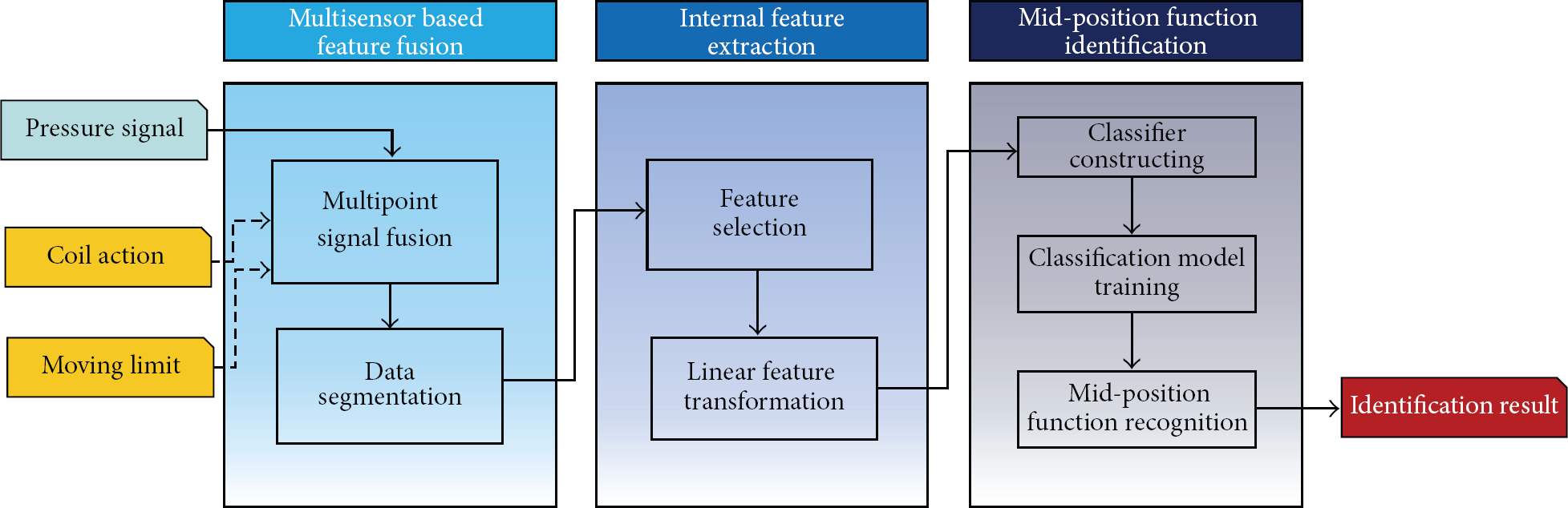
Neutral conditions identification process.
Feature extraction is a significant process of obtaining distinctiveness from time series data sets. Aiming at discriminating the reference class from other classes, feature selection can be considered as a data-compression process which removes irrelevant information and preserves relevant information from the raw data [16]. Typically, feature extraction approach applied to raw signals precedes the classification procedure. In this case, the condition of the valve can be divided into six phases for feature selection (Figure 4): (1) solenoid on left engaged; right unengaged, (2) solenoid on left engaged; left/right limit reached, (3) left/right limit reached; solenoid on left unengaged, (4) solenoid on right engaged; left unengaged, (5) solenoid on right engaged; left/right limit reached, and (6) left/right limit reached; solenoid on right unengaged.

Working position of solenoid valve.
Due to the curse of dimensionality, a robust classifier is hard to be built and the computational cost is prohibitive. So, dimensionality reduction is proposed to remove the irrelevant information and extract relevant features. The commonly used methods to reduce dimension can be categorized into linear (e.g., PCA, MDS, and LDA) and nonlinear (e.g., LLE, ISOMAP, Laplacian Eigenmap, KPCA, and KDA) methods [17]. Since we prefer to gain the natural relationship of different features, we introduce the linear correlation analysis [18]. Therefore, the method to compute maximal linearly independent subset of a matrix is presented as follows.
Supposing 
then the set
Meanwhile,
Obviously, a maximal linearly independent subset of
Three elementary row operations are usually used to find a maximal linearly independent subset of vector set transform the transpose of two row vectors; multiply a row vector by a constant k; regulate one row vector by plus another row vector c times.
After getting the maximal linearly independent subset, r eigenvectors of vector
4. Neutral Conditions Identification with SVM
The features of solenoid valves can be extracted by computing the maximal linearly independent subset, and then they were breathed into a classifier. In this paper, we employed support vector machine (SVM) to recognize different neutral function of valves.
Support vector machines, developed from statistical learning theory, are supervised learning models with associated learning algorithms that analyze data and recognize patterns, used for classification and regression analysis [20, 21]. SVM had successfully been used in many fields and received satisfactory results, such as bioinformatics recognition, regression analysis, and function approximation [22, 23]. In this paper, we aim at pattern identification of valves. A function, deduced from available examples, is used as a classifier to identify neutral conditions of solenoid valves.
The basic SVM takes a set of input data and predicts, for each given input, which of the two possible classes forms the output. Intuitively, a good separation has the largest distance to the nearest training data point of any class, since, in general, the larger the margin, the lower the generalization error of the classifier (Figure 5).

Classification of two classes by SVM.
Given a set of training vectors 
The parameters w and b are defined on the basis of a primal optimization problem:
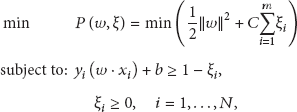

By introducing Lagrange multipliers 
Then, the task reduces to the following optimization problem to maximize (5) in 

By substituting (6) and (7) into (5), the decision function of SVM model can be derived as

5. Experimental Results
It is essential to establish that the model is sufficiently accurate. The conditioning model can be satisfactorily identifying the neutral function of the target valve. Experiments were conducted in order to validate the model developed in this research. In the present study, we monitor the effect of multipoints pressure in real time of nine types of solenoid valves (Figure 6). The pressure of each type of valve within one working stroke is shown in Figure 7. According to different acquisition units in Figure 2, the working phases can be indicated by line “a,” “b,” “

Experimental types of valves.

Pressure outputs of different valves.
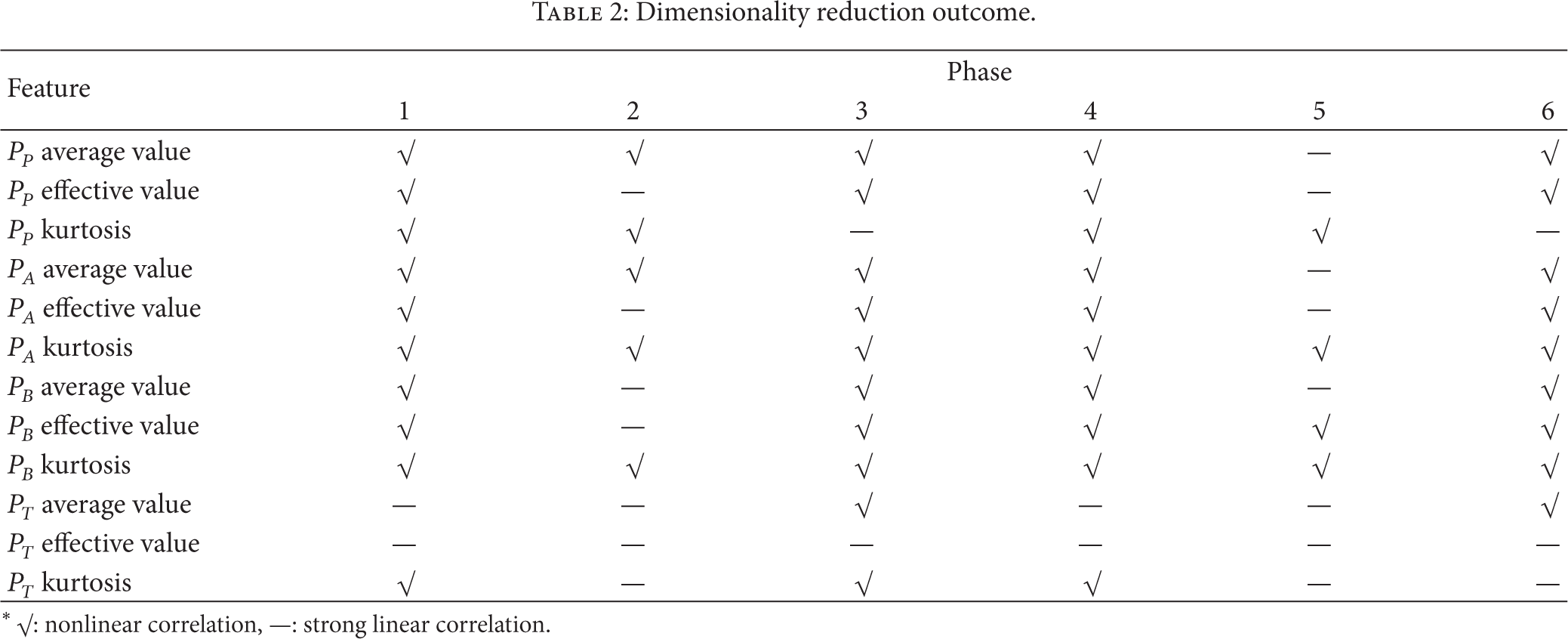
Considering the complexity of the data from one solenoid valve, the dimensionality reduction algorithm was therefore employed. We applied the linear correlation analysis to feature variables to distill the essential characteristics. For this application, new sample sets were obtained to represent original pressure information. According to Table 2, features of strong correlation were excluded; thus, we got an array of fifty within it.
Dimensionality reduction outcome.
An autonomic neutral conditions identification framework is typically made up of a data training part and a testing part. For all the 193 sets of samples, the former 100 were for classifier training and the latter for testing. The objective of our work is to construct a classifier for valve type identification. Features representing the pressure of multipoints were memorized in matrix and sent to the classifier. For the training part, we got an optimal c of 4 and g of 0.5 through cross-validation (Figure 8).

SVM parameter selection results.
In Figure 9, we summarize the classification performance results achieved by trained SVM classifier. The testing accuracy is as high as 100%. The running time of the identification program is 4.9 ms, which can definitely meet the need of condition monitoring system.
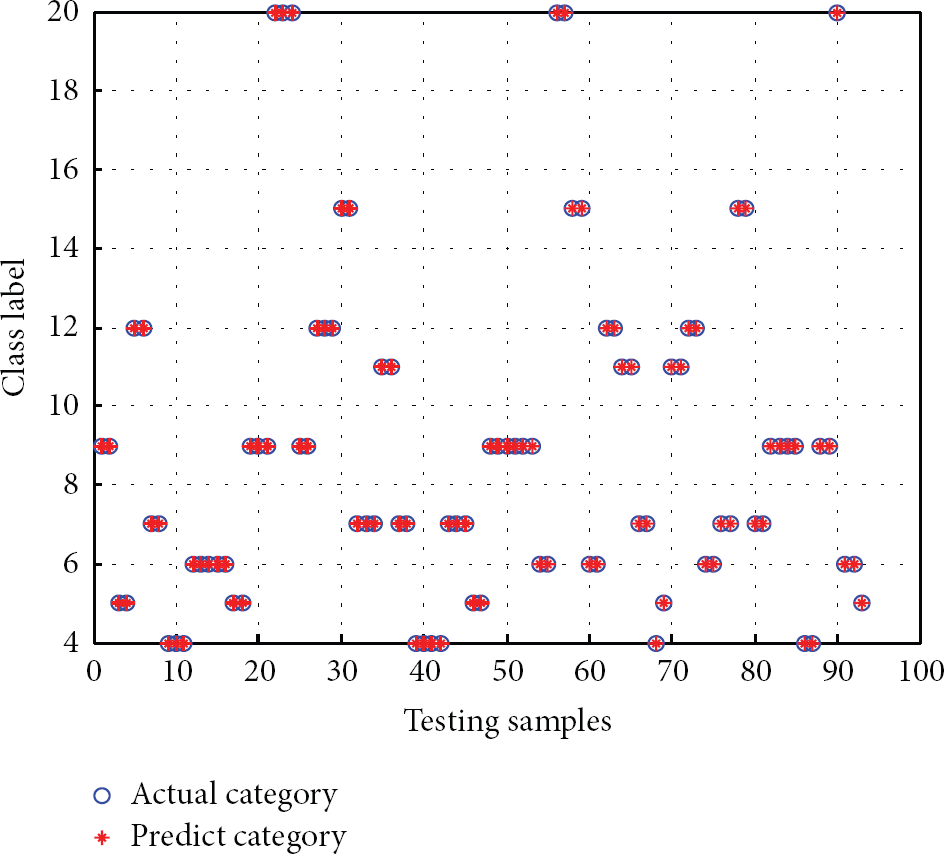
Actual and predict modes of testing samples.
The success of our system in achieving these requirements can be attributed to two strategies: (1) multisensor fusion improved classification accuracy; producing stable decisions for quick transition recognition and (2) dimensionality reduction algorithm during feature extraction process categorized data into the optimal sample sets for the construction of the classifier. Such design, although strict, allows the control engineers to make use of well-established multisensing theory to perform solenoid valve identification.
6. Conclusion
In this study, we developed a multipoint sensing based condition monitoring system that could automatically identify neutral function of solenoid valve types. This methodology is able to identify the valve types from each port's pressure. To summarize, this paper has suggested a multisensing methodology of linear correlation analysis based preprocessing of input and a SVM based automatic classifying of working parameters. The results have demonstrated this system's precision. Further, the model can be easily implemented and cause lower maintenance cost of the complex electromechanical system. With the architecture of sensor networks, the proposed system offers a convenient and cost-effective approach to identify the neutral functions of solenoid valves.
In our system, output of multipoint is applied to the monitoring module. The dimensionality reduction method simplified the recognition based on linear correlation analysis. We were also able to decide the classifier with the optimization of parameters that can identify the type of solenoid valves automatically. In a neutral function recognition experiment, the accuracy rate reached 100%. Therefore, this methodology can successfully be applied to other condition monitoring procedures.
However, this method is not able to test the neutral function under other moving conditions because it is applied only when the action of the valve follows the six-phase motion sequences in our experiment. As such, this method has limitations. Hereafter, a more comprehensive methodology for multiworking modes could be required for monitoring moving conditions in general.
Footnotes
Conflict of Interests
The authors declare that they have no conflict of interests regarding the publication of this paper.
Acknowledgments
This work is partially supported by Aviation Fund no. 2012ZD51055 and Fundamental Research Funds for the Central Universities no. YWF-13-T-RSC-100. Special appreciation should be given to Research Centre of Fluid Power Transmission and Control, Beihang University, for the sake of their selfless help.