




Abstract
Multilevel evaluation indicator system for spacecraft assembly safety was built, considering six aspects: operators, process equipment, operating environment, operation types, objects to be operated, and emergency measures. Based on that, a grey-fuzzy comprehensive evaluation approach was proposed to support the spacecraft assembly safety evaluation. In the approach, analytic hierarchy process and grey degree were applied to construct weight matrix, and the principle with which the appropriate memberships could be determined was taken as a basis for creation of grey-fuzzy comprehensive evaluation matrix. The docking assembly, a typical stage in spacecraft assembly process, was taken as the case study to evaluate its safety level by the proposed grey-fuzzy comprehensive evaluation method, and it was confirmed that the result is coherent with the reality of the accident statistics. The evaluation results can be utilized as a technical basis for developing safety and protective measures, perfecting risk management, and furthermore lowering the risk to minimize economic loss and behind-schedule of project.
1. Introduction
Spacecraft assembly process includes multiple activities of system integration, such as assembly, test, and experiment [1]. It is the high precision of spacecraft itself that raises a stringent requirement of preventing products from damage even slightly in those activities. Once there are abnormal conditions which probably have irreversible effects on products in the process, huge economic losses will be caused irrevocably. Recently, engineers have made requirements and formulated a series of standards on spacecraft assembly process [2–5] to ensure a lower risk. However, research on safety analysis, assessment, and risk management is so insufficient that the unfavorable phenomena still occurred from time to time, such as instability of product quality and behind-schedule of project, which bring up an enormous economic cost. One of the most well-known mishaps is that the satellite NOAA-N Prime was badly damaged in 2003 while being worked on at the Lockheed Martin Space Systems factory. The satellite fell to the floor as a team was turning it into a horizontal position, and repairs to the satellite cost $135 million [6]. Therefore, enhancing the study of safety assessment will absolutely possess an important significance for improving both the technological situation and management of safety in spacecraft assembly process.
There are plenty of qualitative, quantitative, or even hybrid methods of safety assessment [7], which have been commonly used in all kinds of industries, specifically for evaluating risk in manufacturing process. For example, Silvestri et al. [8] proposed a method of safety improve risk assessment (SIRA) by integrating the conventional aspects of the popular failure mode, effects, and criticality analysis (FMECA) procedure with economic considerations in order to take into account the risk and to minimize the total safety costs in manufacturing systems.
Fuzzy comprehensive evaluation (FCE) method preferably actualizes the quantification of comprehensive evaluation which is a system engineering featured by complexity and uncertainty and thoroughly reflects the condition of the evaluated object [9]. It has been, so far, broadly used for risk evaluation in manufacturing [10], nuclear [11], chemical [12], and construction [13, 14] industries.
However, due to a limited data record or collection regarding spacecraft assembly process, it is somewhat hard to achieve scientifically meaningful conclusions about risk assessment when using only conventional statistical or parameter-estimation methods. Aiming at this point, a hybrid method of fuzzy mathematical and grey model, based on the characters of spacecraft assembly process, is more promising for adoption; the evidence is that there are numerous and complex influencing factors with reference to the safety of spacecraft assembly process, many of which have the characteristics of fuzziness and incompleteness of information; that is, the spacecraft assembly process has both fuzziness and grey character. Furthermore, the literature review indicates that there has been precursory research about combination of fuzzy mathematics and grey theory. Liu and Zhang [15] constructed a hazard-risk assessment model and a grey hazard-year prediction model (GHYPM) by integrating recent advances in the fuzzy mathematics, grey theory, and information spread technique. Ma et al. [16] applied fuzzy Delphi method and grey Delphi method to quantify experts’ attitudes to road safety. Sharma et al. [17, 18] discussed a risk ranking approach based on fuzzy and grey relational analysis to prioritize failure causes.
While the previous studies have demonstrated the successful applications of fuzzy mathematics and grey theory (even to hazard risk analysis), little attention was paid to the development of an integrated hazard-risk assessment and risk factor priority identification by combining aspects that might contribute to the total risk level, specifically for spacecraft assembly process, covering human factors, machines and devices and environmental factors, and so forth. Therefore, a grey-fuzzy comprehensive evaluation method, based on safety evaluation indicator system of spacecraft assembly, is presented to evaluate the safety level of assembly process. The evaluation results can be utilized as a technical basis for developing safety and protective measures, perfecting risk management system, and furthermore lowering the accident risk to minimize economic loss and behind-schedule of project.
2. Influencing Factors Analysis and Safety Evaluation Indicator System
Spacecraft assembly process is a typical complex system engineering process, as it can be regarded as being composed of humans, of machines, of environment, and of the interaction among them. There are many factors involved in the spacecraft assembly process, which can be divided into six types: operators, process equipment, operating environment, operation types, objects to be operated, and emergency measures. The factors were described by a preliminary classification model shown in Figure 1; furthermore, considering the characteristics of operation task specifically in general assembly of spacecraft (such as satellite), the six types of influencing factors were elaborated into subfactors, respectively. The role of the classification model is essential in thinking about what factors (or subfactors) could potentially contribute to the risk. Based on the three-leveled classification model, an evaluation indicator system can be built.

Factors influencing spacecraft assembly safety.
The factor “operators” was broken down into the following subfactors: number of operators, continuous working period, operating posture, experience and knowledge, health, working strength, assignment, and collaboration [19, 20].
The factor “process equipment” was broken down into the following subfactors: integrity of equipment, progressiveness of equipment, routine maintenance, preventive maintenance, safeguards, and means of rolling over.
The factor “operating environment” was broken down into the following subfactors: visibility, reachability, workspace, and type of working face.
The factor “operation types” was broken down into the following subfactors: precision requirement of docking/disassembly, number of operating faces in docking/disassembly, number of screws, and number of tools.
The factor “objects to be operated” was broken down into the following subfactors: optical sensitivity, precision requirement, antistatic requirement, and vulnerability.
The factor “emergency measures” was broken down into the following subfactors: emergency equipment and tools and emergency action plan.
According to the identified factors and their subfactors, the three-leveled evaluation indicator system for spacecraft assembly safety was given in Table 1. At the top level it is the indicator representing the total safety level of assembly. At the second level it is basic factors set, defined as X = (x1,x2,…, x6). The third level is made up of the element factors, which are subfactors derived and classified from their respective “father factor,” defined as

Evaluation indicator system of spacecraft assembly safety.

3. Grey-Fuzzy Comprehensive Safety Evaluation Method Oriented to Assembly Process
3.1. Determination of Weight Coefficient
Weight coefficient indicates the grey-fuzzy relationship between factors and general safety level; that is, the weight and grey value of factors relative to upper level.
First of all, fuzzy hierarchy process (AHP) method [21, 22] was adopted into the indicator system to obtain the weight coefficient of factors. Relative importance judgment (represented by Levels 1–9) of factors to be evaluated was given by experts, in terms of engineering experience, which was utilized to establish comparison judgment weight matrix. The results are shown in Table 2.
Weight and ranking of influencing factors of spacecraft assembly process.

Next, in order to introduce grey value into evaluation, the sufficiency degree of information was divided into five levels: highest, higher, average, lower, and lowest, corresponding to the grey value of {0–0.20, 0.21–0.40, 0.41–0.60, 0.61–0.80, 0.81–1.00}. The degree is assigned according to actual circumstances when applied. In this paper, since the weight coefficients had passed the consistency check, the point grey value of relative weight was suggested to be 0.
Based on the calculation result in Table 2, the weight matrix of basic factors relative to top level was obtained and shown below:

The weight matrix of element factors relative to basic factors was shown below:

3.2. Construction of Evaluation Matrix
The factor set of safety evaluation for spacecraft assembly process was shown in Table 1, and the comment set was divided into five levels supposed as

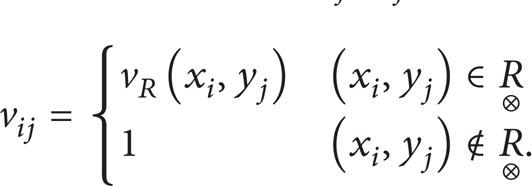
The evaluation matrix indicates the grey-fuzzy relationship between factor set and comment set. The fuzzy membership and grey value of factors in comment set are determined based on the influence ability of evaluation factors and sufficiency degree of information. The evaluation matrix was supposed below:

where
3.3. Grey-Fuzzy Comprehensive Evaluation
The kernel of grey-fuzzy comprehensive evaluation is the reasonable selection of synthesis grey-fuzzy model, and the purpose is to retain as much evaluation information as possible. According to fuzzy mathematic, there are four alternative operational models of fuzzy part:
Model I: the main factor determination model M(∧,∨);
Model II: the outstanding main factor model M(•,∨);
Model III: the outstanding main factor model M(∧,⊕);
Model IV: the weighted mean model M(•, +).
When the main factor dominates in the evaluation, Model I, Model II, and Model III will be available, whereas all factors can be covered and utilized based on weight in Model IV. In this paper, Model IV was selected as the fuzzy part, thus a bounded product M(⊗, +) as the grey part.
The evaluation result at the first level is

The evaluation result at the second level is

In conclusion, the evaluation result depends on the principle of maximum degree of fuzzy membership. When there is more than one with the maximum degree, the minimum grey value will be taken into account for the result.
4. Safety Evaluation to the Phase of Spacecraft Docking Assembly
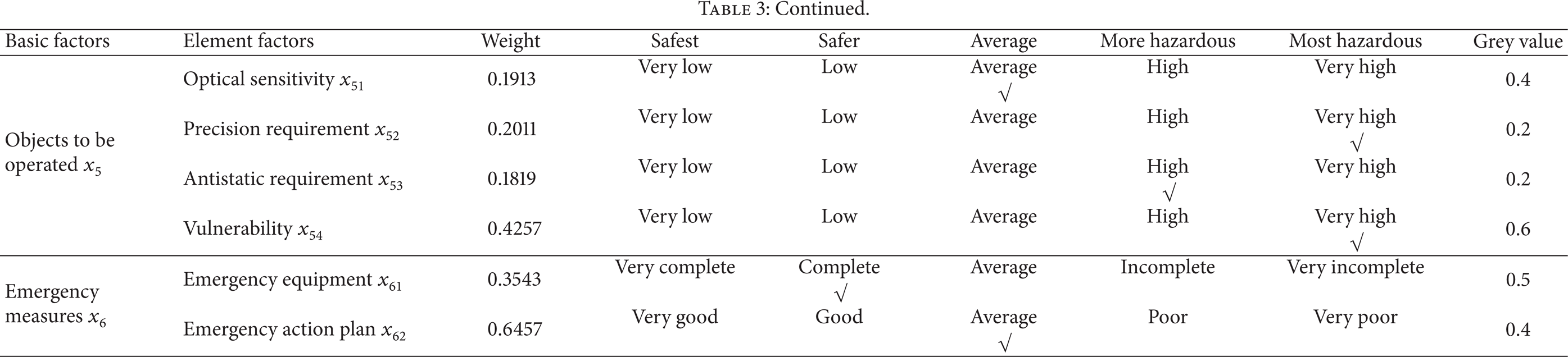
The phase of spacecraft docking assembly was taken as a case to demonstrate the feasibility of grey-fuzzy comprehensive evaluation method to process safety. The basic information and calculation result of weight and grey value are shown in Table 3.
Calculation result of weight and grey value in the phase of spacecraft docking assembly.

Evaluation matrixes relative to basic elements x1, x2, x3, x4, x5, x6 were calculated and shown below, respectively,

The evaluation results at the first level for x1∼x6 are shown below:

The evaluation result is

According to the principle “maximum fuzzy membership and minimum grey value,” conclusion can be drawn that the phase of spacecraft docking assembly in the case is at level “Most hazardous,” which was confirmed to be consistent with the fact of existing statistical data and analysis regarding accidents.
5. Conclusions
A methodology of grey-fuzzy comprehensive evaluation was proposed, based on fuzzy mathematics and grey theory and according to the characteristics of spacecraft assembly process, to evaluate the general safety level of the process. The major findings of this study were summarized as follows.
The safety evaluation indicator system of spacecraft assembly was constructed in a hierarchical structure. The general safety level of the process occupies the top level of the structure, under which six basic factors and twenty-seven element factors were set. The evaluation indicator system, completely integrating the consideration for the aspects covering human, machine, and environment in assembly process, is of significance to evaluate the general safety level more exactly and identify the priority of influencing factors more rationally.
Since the characteristics of the data for spacecraft assembly process have both fuzziness and grey property, multilevel grey-fuzzy comprehensive evaluation model was presented based on the hierarchical safety evaluation indicator system, so as to ensure the precision and objectivity of the evaluation result.
The case of application to docking assembly process of a typical satellite corroborates that the proposed approach of grey-fuzzy comprehensive evaluation is feasible as well as reasonable, and the result of case study is consistent with what has been observed in engineering practice. In addition, weights of indicators determined by the approach illuminate the contribution of each to the top-level indicator. The calculation result pointed out “operators” is the most critical factor to the spacecraft assembly process. Thus, it was suggested that the measures, such as strengthening operators training and management, should be given the higher priority to improve the safety level more effectively.
Conflict of Interests
The authors declare that there is no conflict of interests regarding the publication of this paper.