




Abstract
In cognitive radio (CR) ad hoc networks, spectrum efficiency and energy efficiency are vitally important because spectrum availability is opportunistic in nature and mobile CR nodes usually have limited energy. Aiming to improve network throughput along with improving spectrum and energy efficiencies, this paper proposes a channel-slot aggregation diversity based slot reservation (CADSR) scheme by which each CR node can utilize multiple slots in different channels simultaneously and efficiently utilize the power control mechanism with only a single CR transceiver. The proposed scheme dynamically assigns channel-slots to CR nodes using the diversity technique according to the topology density of the network and the bandwidth requirement, allowing CR nodes to join and leave the network at any time in a distributed way. A dynamic frame length expansion and shrinking scheme has also been introduced that improves the slot utilization. Extensive simulation results show that the proposed mechanism achieves significant performance improvement in network throughput, energy efficiency, and end-to-end delay.
1. Introduction
Cognitive radio (CR) technology has been proposed for improving the spectrum efficiency by allowing unlicensed users, referred to as CR users, to utilize dynamically the temporarily vacant spectrum of the licensed band assigned to primary users (PUs) without harmful interference or collisions to them [1]. In cognitive radio ad hoc networks (CRANs) there is no central controlling unit, while all the CR users are independent to join and leave the network at any time and, hence, a good coordination mechanism is required to allocate resources for smooth operation.
The uncertain availability of the radio spectrum imposes exceptional challenges in CRANs. The distributed multihop architecture, the dynamic network topology, and the spectrum availability varying in time and space domain are some of the critical factors [1, 2]. Due to these, CR users experienced the performance degradation by the activity of PUs. Since PU activity varies both in frequency and time domain, incorporating diversity technique in developing coordinating mechanism for CRANs can provide an effective solution in order to address this challenge.
In CRANs with multiple channels, channel aggregation (CA) has been proposed as an effective approach to improve the spectrum utilization. In CA, CR users are capable of aggregating multiple contiguous or noncontiguous channels that are unused by PUs to support high data rate services [3, 4]. IEEE 802.22 wireless regional area network (WRAN) standard supports CA technique to aggregate up to 3 contiguous TV channels to meet the high data rate requirements [5, 6].
In mobile ad hoc networks, energy conservation is of prime importance where nodes are battery powered with limited energy. A key challenge in such networks is how to prolong the lifetime of the networks. In order to lengthen the network lifetime and to improve the energy efficiency, energy-efficient scheme, which consumes less energy, is essential [7].
In CRANs, network throughput, spectrum efficiency, and energy efficiency are vital important performance measures. Naturally, the network throughput of wireless networks can be improved by increasing the transmit power. However, in CRANs, it is not true and will degrade the spectrum and energy efficiencies. The mutual interference and packet collisions are unavoidable in CRANs due to distributed nature. In this network, if one node increases the transmit power, its neighbor nodes will suffer more serious interference and hence neighbor nodes can only transmit with lower rates, which will degrade the network throughput. Moreover, high transmit power will cause more packet collisions, which is harmful to the network throughput. In addition, when the throughput gain cannot match the power consumption, increasing transmit power will also cause the degradation of spectrum and energy efficiencies [8]. On the other hand, with low transmit power communication may fail due to short coverage range and spectrum resources will be underutilized. Thus, power control mechanism, which allows wireless nodes, to vary transmit power level to transmit packets, play important roles to improve the network performances in terms of network throughput, spectrum efficiency and energy efficiency.
Time division multiple access (TDMA) is a conventional wireless communication technique that has the ability to provide the collision-free packet transmission regardless of the traffic load. Each frequency band is divided into several timeslots. A set of such periodically repeating timeslots is known as the frame. Each node is assigned one or more timeslots in each frame, and the node transmits only in those slots. The TDMA approaches usually use the fixed number of timeslots in a frame. This works well for static networks. The primary drawback of such reservation-based TDMA schemes is that they waste the timeslots reserved for those nodes that have no packets to transmit [9]. However, in CRANs, some CR nodes may not have always messages to transmit. In such cases, the timeslots dedicated to them remain unused, which degrades the network performance. Moreover, since CR nodes are mobile, if a CR node moves out of its coverage range, its assigned slots will remain unused. Again, it should be allocated slot(s) in the frame being used in the new area where it moves. However, use of a fixed number of timeslots in a frame may not handle such situations effectively as there may be the shortage of timeslots.
For addressing all these issues and to achieve the aforementioned goals, in this paper, we propose a channel-slot aggregation diversity based slot reservation scheme, called CADSR, for cognitive radio ad hoc networks. The proposed diversity technique is based on the well-known software-defined radio that allows each node to simultaneously utilize a group of channel-slots with only one CR transceiver. Power control mechanism along with doze mode operation is adopted to improve the spectrum and energy efficiencies. Furthermore, the proposed method efficiently utilizes the channel bandwidth by assigning unused slots to new CR users and enlarging the frame length when the number of slots within the frame is insufficient to support the demand of neighboring CR users. An effective frame recovery method is also presented that shrinks the frame length in an efficient way.
The rest of the paper is organized as follows. Section 2 describes the related work. The system model is presented in Section 3. The proposed diversity based scheme is described in Section 4. We present the performance evaluation using computer simulation in Section 5, and finally in Section 6 we conclude the paper.
2. Related Work
In CRANs, medium access control (MAC) protocols are responsible for dynamically accessing the opportunistic channel for packet transmission. Designing an efficient MAC protocol for CR networks is a challenging issue. One of the most important targets in cognitive MAC protocol design is how to efficiently use available channels and limited power budget to increase the network throughput [2, 10, 11]. Many researchers suggested several ways of improving the spectral efficiency in CR networks to mitigate the spectrum scarcity crisis by balancing the underutilized license bands and overutilized unlicensed bands [12–14].
In CR networks, channel aggregation techniques have been proposed in many MAC protocols. A number of research works proposed recently on CA to improve spectrum utilization in CRNs can be found in [4, 15, 16]. Several CA strategies were proposed and analyzed in the literature, where CR users aggregate a constant or variable number of channels. In order to efficiently utilize available channel resources, which vary dynamically with time and locations, under limited power resources, we propose, in this paper, a diversity technology called channel-slot aggregation diversity.
There have been many studies for applying TDMA to ad hoc networks. However, most of them do not take into account the autonomous behaviors of the mobile nodes, and thus they cannot assign slots for new incoming nodes. Dynamic TDMA resource allocation concept emerged to overcome this drawback. Dynamic TDMA improves slot utilization of the scheme by dynamically deallocating unused slots and allocating new slots when necessary. Many TDMA based dynamic slot assignment schemes have been proposed for ad hoc networks [17–24].
The unifying slot assignment protocol (USAP) proposed in [17] considers the autonomous behaviors of new users and assigns a frame to each user. Each frame has a fixed number of slots. It reserves the first slot of each frame for signaling. It allows nodes to assign a slot dynamically using the reserved slot, but slot utilization is very low due to its fixed frame length. Moreover, when the network expands, the channel utilization becomes low due to a large number of unassigned slots. USAP multiple access (USAP-MA) proposed in [18] improves USAP by reducing the number of unassigned slots taking into account the number of users in the network topology. It utilizes an adaptive broadcast cycle to change the frame length and frame cycle dynamically. However, this method does not indicate when to change the frame length or how to select a slot to be assigned to a new user. Furthermore, the use of this method also wastes an excessive number of slots and results in lower channel utilization.
A dynamic TDMA slot assignment (DTSA) approach based on USAP has been proposed in [19]. This method takes into account more autonomous behaviors of users in a multi-hop ad hoc network. However, the channel assignment method is still preplanned, where a slot is preassigned to each user. The preassigned slot is not released even when the user has no data to transmit. Therefore, it results in lower channel utilization. Furthermore, this approach cannot provide more slots when a user requires them to deal with burst traffic.
An evolutionary-dynamic TDMA slot assignment protocol (E-DTSAP) for ad hoc networks has been proposed in [20]. According to the topology density of the network and the bandwidth requirement, the E-DTSAP protocol changes the frame length and the transmission schedule dynamically. Moreover, it allows the transmitter to reserve one or more unscheduled slots from the set of unassigned slots in its neighborhood by coordinating the announcement and confirmation with the neighboring users up to two hops away. However, this protocol is for single channel and mobility of nodes is not considered in this proposal. Moreover, a dynamic frame length expansion and recovery method, called dynamic frame length channel assignment (DFLCA), has been proposed in [21]. This strategy is designed to make better use of the available channels by taking advantage of the spatial reuse concept. However, this scheme is also designed for single channel network.
A self-stabilizing TDMA (STDMA) scheme was proposed in [22], where the slots are divided in a hierarchical manner. First, blocks of timeslots in a frame are divided among the cluster heads of the clusters. Cluster heads then assign their allocated timeslots among the member nodes. Doing so, this approach prevents the possible interferences among the transmissions of nodes in different clusters. However, the STDMA approach uses a fixed number of timeslots and hence may fall in shortage of slots when the number of member nodes increases. It may not make efficient use of unused slots too, causing unwanted delay in the network.
A fast dynamic slot assignment scheme, called F-DSA, is proposed in [23] to reduce timeslot access delay for a newly arrived node in ad hoc networks. F-DSA simplifies the slot assignment process by using minislots to share control packet for short periods. However, overhead in this scheme is high. An adaptive TDMA slot assignment protocol (ATSA) is proposed in [24] for vehicular ad hoc networks. ATSA divides different sets of timeslots according to vehicles moving in opposite directions. When a node accesses the networks, it chooses a frame length and competes with a slot based on its direction and location to communication with the other nodes.
We have proposed a dynamic slot reservation scheme based on channel-slot aggregation diversity technique for cognitive radio mobile ad hoc networks. Proposed CADSR scheme successfully overcomes the shortcomings of the other existing mechanisms (a preliminary version of this scheme can be found in [25]), where each node is allowed to simultaneously utilize a group of channel-slots with only one CR transceiver. In this scheme power control mechanism along with doze mode operation is adopted to further improve the spectrum and energy efficiencies. Furthermore, the frame length is dynamically enlarging and shortening based on the number of nodes and the traffic demand. The proposed method works in such a way that it minimizes the contentions, the number of packet losses, and the queuing delay, which ensures very good network performance.
3. System Model
We consider an energy-constrained CR ad hoc network comprised of N CR nodes (users). Suppose that CRAN contains one common control channel (CCC) and L orthogonal frequency data channels (indexed by
Summary of various symbols and variables:
c: the speed of light f: channel frequency d: distance between the transmitter and the receiver j: common available channel K: system loss factor L: number of channels M: number of primary users (PUs) N: number of CR users Q: number of packets R: transmission rate SINRth: threshold for signal to interference plus noise ratio T: number of timeslots α: the path loss coefficient
We assume that PUs randomly choose channels from the channel pool for their data transmissions and usage of each channel is modeled as an independent and identically distributed renewal process with ON (or active) and OFF (or idle) states. In ON state, PU is active (present) and the channel cannot be used by CR users. On the other hand, in OFF state, PU is inactive (absent) and CR users can utilize the channels without causing any harmful interference to PUs. The activity sates of l channels at time t in any location within the area are given as

Let the duration of ON and OFF states for l channels be exponentially distributed with the mean

The number and the locations of the PUs are considered unknown to the CR users. A link can be made between two CR users, if there exists one or more common channel available to both users. We assume that all CR users are equipped with a single half-duplex CR transceiver, which consists of a reconfigurable transceiver and a scanner. The CR transceiver is based on the software-defined radio so that it can realize channel-slot aggregation, which allows the CR users to use multiple channels with different transmit power simultaneously.
For accessing a channel, a CR user must sense channels first and can access the channels only if any of these L channels is not being used by PUs. Any efficient spectrum sensing scheme proposed in the literature can be used to detect the locally available channels. As we mainly focus on designing how CR users efficiently access and utilize limited spectrum resources to improve the performance of CRANs, such as throughput, spectrum efficiency, and energy efficiency, we assume that CR users can obtain reliable sensing results at the end of the sensing period.
In the CR network, a total number of L channels are shared by PUs and CR users. Every PU occupies only one channel while a CR user may aggregate multiple channels by channel-slot aggregation technique. We assume that the arrivals of PUs and CR users are subject to independent Poisson distributions with arrival rates
We consider that CR node exchanges control packets with maximum power

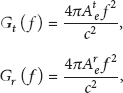
4. Proposed CADSR Scheme
The channel access mechanism of the proposed channel-slot aggregation diversity based slot reservation (CADSR) scheme is shown in Figure 1. The system time is divided into frames. A frame consists of a sensing window, an ad hoc traffic indication messages (ATIM) window, and a communication widow. The synchronization of the CR users is done with the help of periodic beaconing. In sensing window (sensing phase), every CR user carries out channel sensing to get the spectrum opportunity. In ATIM window (reservation phase), all CR users tune their radio interfaces to the control channel (CH0) and transmit/receive control packets for resource reservation. It is noted that during ATIM window only the control channel is used. Control packets exchanging is based on a kind of CSMA/CA protocol. In communication window (data transmission phase), CR users transmit/receive their traffic by using all
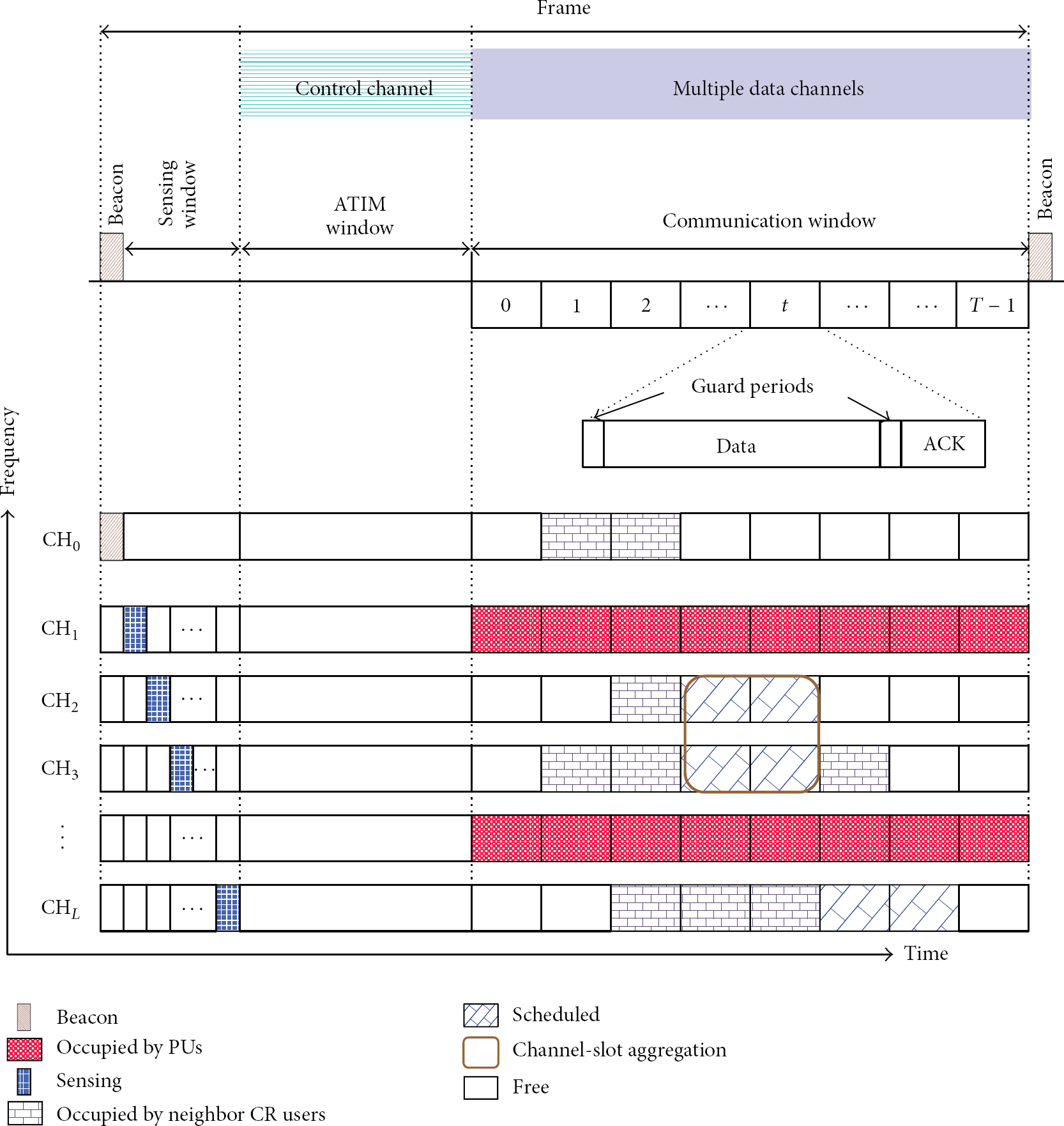
Frame structure and channel access mechanism of the proposed CADSR scheme for CR ad hoc networks.
We assume that CR users are synchronized by a periodic beacon signal, so that all nodes begin their beacon interval at the same time. Whenever a CR user wants to join in a network, it first listens to beacon signal for at least one frame interval on the control channel to synchronize itself with that network. If it does not hear any beacon signal in that period, it starts sending periodic beacon signal assuming itself to be the first node in the network. The beacon signal is carrying the local time of a node. Similar to the timer synchronization function (TSF) of the IEEE 802.11 MAC protocol [29], a node only updates its time if the time carried in a received beacon signal is faster than its own local time.
A channel-slot pair is defined as the “communication segment”. The communication segment (we can say segment later on for simplicity) for timeslot t ( Occupied: the segment is being used by other transmissions (PUs or other CR users). Free: the segment is unassigned and idle. Scheduled: the segment is selected by the source-destination pair for packet transmission in a particular link. This state might become the occupied state after a confirmation process.
A PU randomly selects the channel; therefore, a PU can choose an unused channel or the channel occupied by a CR user. However, a CR user randomly selects the channel from among those which are free from PU activities. A forced termination occurs whenever a PU preempts a CR user. Force termination depends on the number of users and the number of remaining channels. If there are fewer channels than required, CR users will be blocked whenever they arrive. However, PU will be blocked only when all the channels are fully used by other PUs. If channel handovers are allowed, a preempted CR user will immediately move to an unused channel. Hence, a forced termination occurs in case there is no channel to handover.
4.1. Frame Structure
The frame of the proposed CADSR scheme has three parts: a sensing window, an ad hoc traffic indication messages (ATIM) window, and a communication widow. As CADSR scheme follows slotted mechanism, clock synchronization is needed among CR users, which is done with the help of periodic beaconing. Sensing part is using to get the spectrum opportunity through spectrum sensing. ATIM part is used for resource reservation through exchanging control packets. Finally, CR users exchange their data packets by using reserved segments in the communication part. Communication window is time slotted with T slots in each frame, which is dynamically adjusted when the frame does not have enough channel-slots to support new neighboring connections or there are too many empty channel-slots. The proposed scheme controls the expansion and recovery of unassigned channel-slots by dynamically changing the frame length according to the traffic load and the number of CR users in the contention area. Here, the contention area is defined for each CR user as the set of CR users that can cause collisions by sending packets to another, that is, CR users within two hops away from the host. The detailed frame and slot structures of the scheme are shown in Figures 1 and 2.
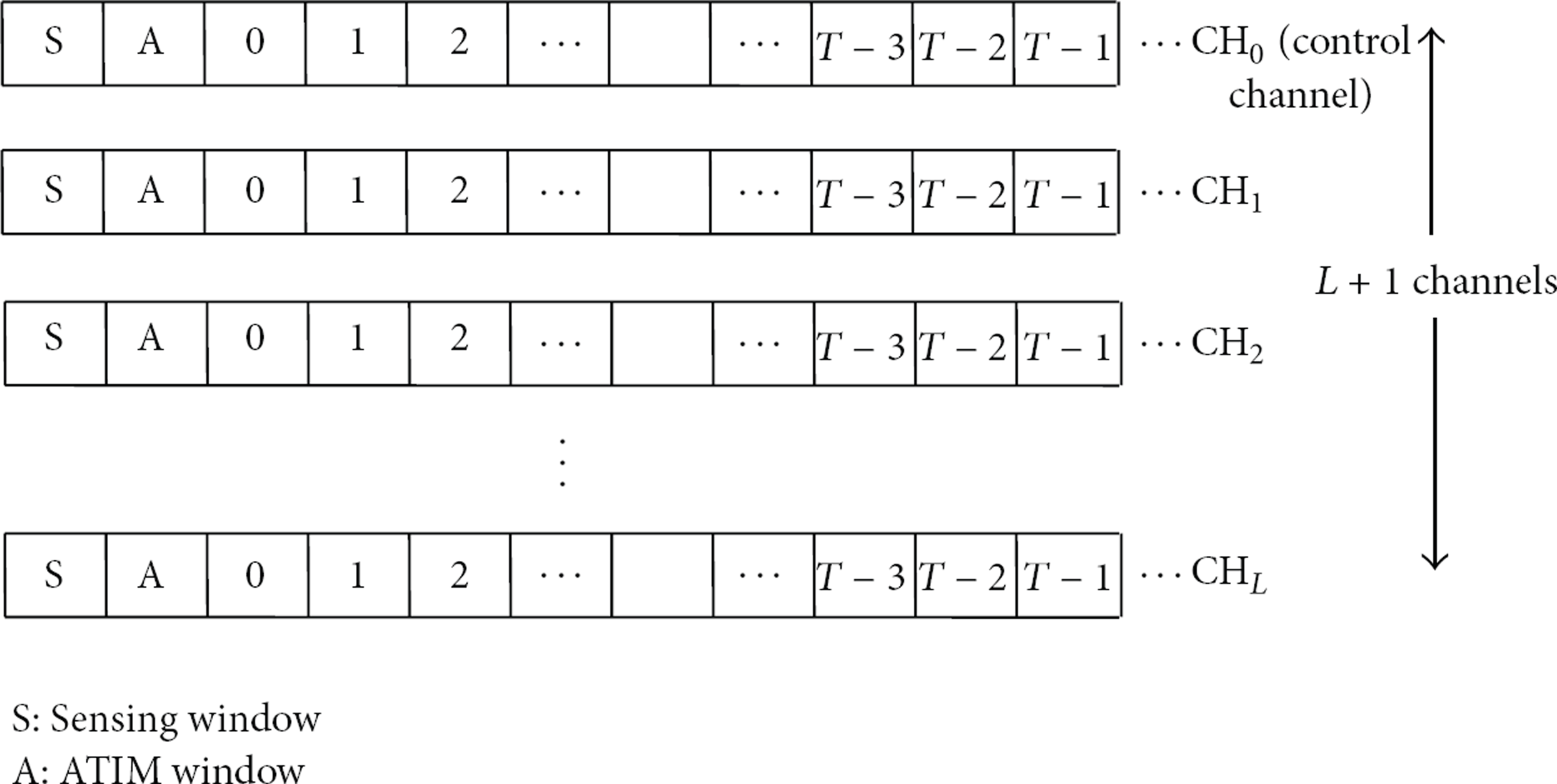
Frame format of the proposed CADSR scheme.
4.2. Channel-Slot Aggregation Diversity
Diversity technique has been widely used in wireless ad hoc networks to improve the network throughput. There are three main diversity techniques available in the literature: channel diversity, link diversity, and multiradio diversity, respectively, that can efficiently improve the network throughput [30–32]. However, some drawbacks in these diversity techniques prevent the network throughput from being further improved. In particular, channel diversity and link diversity only use one channel for packet transmissions, and thus they cannot sufficiently utilize available channel resources. Although multi-radio diversity can use multiple channels simultaneously, mobile nodes need to be equipped with multiple radios, which will increase the implementation cost and power consumption.
The goal of this paper is to develop an efficient scheme to improve the network performances in terms of throughput, spectrum efficiency and energy efficiency, for energy-constraint CRANs. In order to achieve this goal, we adopted channel aggregation technique in time-slotted channel access mechanism, which we termed as channel-slot aggregation, and propose a diversity technique, called channel-slot aggregation diversity. The proposed diversity technique allows CR node to select a group of channels from multiple available channels, which are free from PUs activity, and allocate the upper-bounded transmit power for the selected channels based on the channel qualities and suffered interferences. The CR node then can use the CA technology to utilize the selected group of channels simultaneously and reserve multiple slots based on the traffic demand for data transmission and transmit multiple data packets during one transmission process. Compared with the existing diversity schemes, our proposed channel-slot aggregation diversity based slot reservation scheme can efficiently utilize multiple channel-slots simultaneously with limited energy, which can improve the network performance and reduce the implementation cost as well as the power consumption.
4.3. Operation of the CADSR Scheme
In the CADSR scheme, each node maintains one data structure named list of usage segment (LUS), which will be dynamically updated in order to maximize each node's throughput subject to the ongoing transmissions of other CR nodes cannot be interfered. The LUS records six entries for each channel: (i) “Channel Index l”; (ii) “Frame Length”; (iii) “PU Status”; (iv) “Neighbor Status”; (v) “Received Interference
Traffic is indicated with three-way handshakes. Nodes that have packets to transmit indicate traffic by sending ATIM packets on the control channel in the ATIM window. For transmitting packets, a CR user should first reserve segments. The segment reservation is achieved by exchanging control packets between the sender and the receiver. The control packet exchange mechanism is based on a kind of CSMA/CA protocol. There are three control packets, namely ATIM, ATIM-ACK, and ATIM-RES, that are used for segment reservation. After successful three-way handshakes, a group of segments and transmission rate can be determined. Then, the source and destination node pair can finish their data transmissions on the selected segments. The transmission process of the control message exchange is described as follows, where U and V represent the source and destination node.
(1) Sending ATIM Packet. U first overhears on the CCC. If the CCC is busy, then U chooses a back-off time and defers its transmission. Otherwise, if the CCC is idle for a duration of one distributed inter-frame space (DIFS) after the backoff time, an ATIM packet that contains the LUS of U will be sent to V.
(
2) Sending ATIM-ACK Packet. If V successfully receives the ATIM packet, then it compares its LUS with that of U by performing an OR operation to generate a combined LUS for the link between nodes U and V. If common available channels exist that can be used by the node pairs, the channel power gain of the node pairs on the CCC is represented by

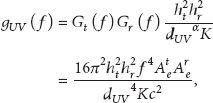

( 3) Sending ATIM-RES Packet. If node U successfully receives the ATIM-ACK packet, then an ATIM-RES packet that contains the same information with the ATIM-ACK packet is sent to node V. The purposes of sending the ATIM-RES packet are twofold: it can be used to confirm the successful reception of the ATIM-ACK packet and it can also notify the neighbor nodes of U to update the information recorded in their LUSs.
( 4) Transmitting Data Packets. After exchanging control packets, U and V switch to the corresponding channels and finish their packet transmission according to the power and segment allocated for them. During the data transmission phase, a CR user, which has successfully reserved a (group of) specific timeslot on a (group of) specific channel to send or receive a packet, first switches to the decided channel and transmits or waits for the data packet in that slot(s). If a user receives a unicast packet, it sends back an ACK in the same timeslot. A CR user that does not send (or receive) a data packet in a specific timeslot can go to doze mode for power saving. If the source node does not receive ACK, it will consider the packet transmission unsuccessful. When a packet transmission is unsuccessful, the packet can be retransmitted after random backoff time. If the number of retransmissions exceeds the predefined limit, the packet is dropped.
(
5) Overhearing of ATIM-ACK or ATIM-RES Packets. CR nodes that overheard ATIM-ACK or ATIM-RES packets need to update their LUSs. Suppose node pairs U and V will transmit Q packets with the transmission rate R, and the power allocations are


4.4. Dynamic Channel-Slot Assignment
We have developed an efficient scheme for dynamic channel-slot assignment for CRANs. Our proposed scheme controls the number of unassigned slots by dynamically changing the frame length according to the traffic loads and the number of CR users in the contention area. When a new CR user detects a conflict, it solves the conflict by listening and collecting assigned channel-slot information of the CR users in the contention area. Our proposed scheme improves the channel spatial reuse and maximizes the network throughput. The channel-slots assignment of CADSR scheme is performed according to Algorithm 1.
(1) w listens to the LUS transmitted from other CR users in its contention area. (2) w sets its frame length as the maximum frame length among its neighbors. (3) w updates its LUS information by listening to the LUS transmitted from its neighbors. (4) channel-slot aggregation diversity technique. (5) (6) m = the CR user using the highest number of slots among the neighbors of w. (7) (8) w requests m to release one channel-slot. (9) (10) w doubles its frame length, and the copies information from the former frame to the latter part of the doubled frame and using the empty channel-slot created. (11) (12) (13)
Let us consider the (communication) segment, that is, channel-slot pair
The neighboring nodes of node B update their states by overhearing the ATIM-ACK message and obtain the current segment usage information. After receiving the ATIM-ACK packet from node B, node A updates its states based on the selected segments and changes the segment states from Scheduled to Occupied. Finally node A sends an ATIM-RES packet containing the same list of selected segments to node B. By overhearing the ATIM-RES packet, neighboring nodes of node A update their states to obtain the current segment usage information.
4.5. Frame Recovery
A limitation in most of the slot allocation protocol is that the frame length, set as a power of 2, may expand very quickly when there are many users in the network. Some nodes may be disconnected from the network for a number of reasons such as turning their radio transceiver off, energy exhaustion, and moving away. In order to handle this situation the proposed scheme treated a node to be “disconnected” if it is not exchanging any message for a number of contiguous frames. When many connections end their transmissions and corresponding slots are released, some users in the network are likely to contain long frames with many unused slots.
The frame recovery method in the CADSR scheme improves the efficiency of the frame. When a channel-slot in the frame is released after not receiving anything for a duration of time, the CR user checks its channel-slots assignment information to see if half or more of the slots in the frame are unreserved. If this situation occurs, the CR user immediately releases the unused slots. Then, it sends a request control packet for frame recovery to the neighbors. The neighbors try to assign slots for it after they receive this type of request packet, and they confirm the accepted request made by the recovery requesting CR user. Then, they send a response control packet to their neighbors notifying them of their update. This method significantly increases the frame efficiency. The frame recovery of CADSR scheme is performed according to Algorithm 2.
(1) (2) w sends a request packet for frame recovery to its neighbors. (3) The receiving neighboring CR users try to update their channel-slots information and reschedule the channel-slots they were using previously. (4) The neighboring CR users send a confirmation packet.
5. Performance Evaluation
The effectiveness of the proposed CADSR scheme is validated through simulations. This section describes the simulation environment, performance metrics, and experimental results. To evaluate CADSR scheme, we developed a packet-level discrete-event simulator written in C++ programming language, which implements the features of the protocol stack described in this paper. We have evaluated the performance of the CADSR scheme in comparison with T-MAC [27] and F-DSA [23].
5.1. Simulation Setting
We consider a circular area with radius of 500 m. There are M stationary PUs being distributed uniformly within the circle. The PUs operate on L channels according to their own multichannel protocol. The details of PU operation are beyond the scope of this paper. We just model the PU activity as an ON/OFF process. A PU in ON state occupies a channel and it does not use any channel in OFF state. The ON and OFF durations of a PU are exponentially distributed with the mean of 100 s, respectively (i.e., the activity factor is 0.5), unless noted otherwise. A newly activated PU randomly chooses a channel among channels that are not used by other PUs. The sensing range of a PU is set to 250 m. An active PU is assumed to be perfectly detected by a CR user within the sensing range. Moreover, it is also assumed that the CR user being out of sensing range does not disturb the active PU. Thus, all CR users in the sensing range of an active PU cannot exploit the channel occupied by the PU. When a PU activates newly on a channel, the CR users exploiting the channel switch the communication segments on the channel to other free segments. This channel switching delay is set to 80 μs. The summary of simulation parameters is listed in Table 1 whereas Table 2 shows the various timings of the MAC frame usage in the simulation.
Summary of simulation parameters.

Various timings of the MAC frame.

The CR network is composed of 100 users (denoted by N), unless noted otherwise. In a simulation run, their initial locations are uniformly distributed within the circle. An example of random deployment scenario of PUs and CR users is shown in Figure 3. A CR user moves to a random direction selected in

Example of random deployment scenario: 100 CR users and 10 PUs within a circular area with a radius of 500 m.
The maximum transmission power of a CR user is set to 100 mW. We consider the path loss and shadowing as the propagation model. The channel gain is calculated by
5.2. Performance Metrics
The following performance metrics are used to evaluate the proposed scheme.
Network Throughput. It is the total number of successfully received bits per second by all destinations in the CRANs. Average End-to-End Packet Delay. It is average latency incurred by the data packets between their generation time and their arrival time at the destinations. Energy Efficiency. It is the total number of bits transmitted per unit of power consumption. The larger the value is, the more efficient the transmit power is. Blocking Probability of CR Users. It is the probability of blocking CR users by PUs whenever they arrive because of the insufficient spectrum resources.
5.3. Simulation Results
Figure 4 shows the comparison results of the network throughput of CADSR scheme with other protocols as a function of the number of flows. We can see that, when the number of flows increases, CADSR offers significantly better performance than all other protocols. When the network is saturated, CADSR achieves about 52% more throughput than T-MAC and about 154% more than F-DSA protocol. The main reason of the higher throughput is that the CADSR scheme uses the channel-slot aggregation diversity technique, which can help CR nodes efficiently and sufficiently utilize available resources opportunistically for data transmissions. Moreover, the appropriate number of channel-slots that the CR nodes use and the corresponding power allocations can be dynamically adjusted by the proposed power and channel-slot allocation scheme. Moreover, CADSR scheme dynamically adjusted the frame length when needed and can efficiently increase the data transmission rate and thus improve the average network throughput. Furthermore, because of the power control mechanism of our proposed scheme, the mutual interference among neighbor CR nodes is reduced and the channel spatial reuse efficiency is improved, which are also promoting the improvement of the network throughput.

Comparison of average network throughput of CADSR scheme with other protocols.
Figure 5(a) presents the comparison of average end-to-end packet delay of the protocols by varying the number of flows. When network load increases, there are many requests for slot allocation; our proposed CADSR scheme dynamically enlarges the frame size to accommodate more CR users' request. CADSR assigns contention-free multiple channel-slots to CR users that achieve higher throughput and lower delay as well. When the load increases, queuing delay is raised. The queuing delay makes the performance of each protocol worse. However, the data traffic is split into multiple channel-slots in the case of CADSR scheme. Therefore, the average end-to-end packet transmission delay of CADSR is increased slowly according to the increment of the number of flows.

(a) Comparison of average end-to-end delay of CADSR scheme with other protocols as a function of the number of flows. (b) Comparison of average end-to-end delay of CADSR scheme with other protocols as a function of the maximum speed.
Figure 5(b) shows that the average end-to-end packet delay increases by the increase of speeds of the mobile CR nodes. However, the proposed CADSR scheme faces significantly lower delay as compared to other protocols.
Figure 6 shows the comparison of average network energy efficiency of CADSR scheme with other protocols in terms of the number of flows. From this plot, we can observe that the network energy efficiency of the proposed CADSR scheme outperforms the other protocols, although the energy efficiency of our proposed scheme reduces when the number of flows is larger than six. The reason of the improvement of energy efficiency in the proposed scheme is because of the utilization of diversity technique along with multiple power control mechanisms. With this proposed approach, multiple channel-slots can be sufficiently utilized with appropriate data transmission rate. Moreover, mutual interference among CR neighbor nodes can be restrained. Furthermore, adapting doze mode operation is also promoted to improve energy efficiency.

Comparison of average network energy efficiency of CADSR scheme with other protocols.
Figure 7 shows the blocking probability of CR users in terms of the arrival rate of PUs. From this figure, we can observe that blocking probability of CR users is increasing with the increasing value of arrival rate of PUs, which is justified. When the arrival rate of PUs is high, more channels are used by PUs and remaining resources for CR users are getting low and, consequently, blocking probability is getting high. The effect of the tolerance level,

Blocking probability of CR users in terms of arrival rate of PUs.
Figure 8 shows the impact of channel-slot aggregation on network throughput. From this figure, it has been observed that network throughput is increasing when the number of channel-slot aggregation is getting high. However, the rate of increasing is not the same. For example, the throughput of the 4-slot case is about 60% higher than 2-slot case. On the other hand, the throughput of the 8-slot case is only about 14% higher than the 4-slot case. This is because of the impact of PUs and the shortage of available resources, which is insufficient to aggregate the required number of channel-slots.
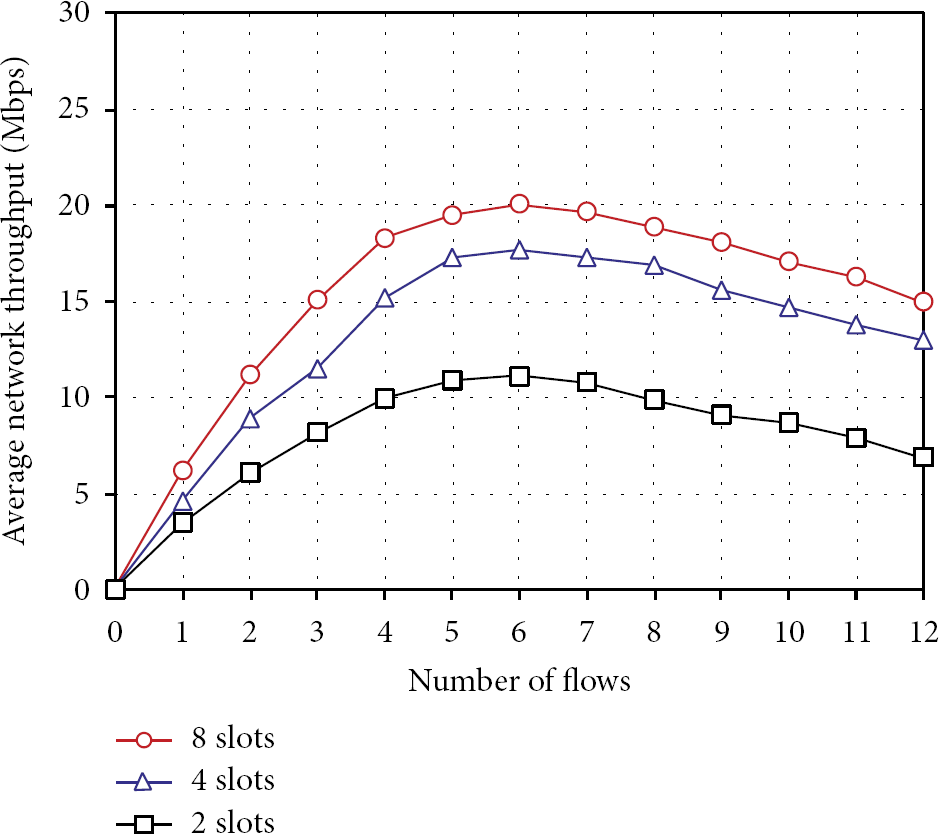
Impact of channel-slot aggregation on network throughput.
6. Conclusion
In this paper, we have proposed a channel-slot aggregation diversity based slot reservation scheme, called CADSR, for cognitive radio ad hoc networks. The proposed scheme can change the frame length and the transmission schedule dynamically according to the number of CR users and the bandwidth requirement for the contention area. This method utilizes the channel-slots in an efficient way through the proposed diversity technique and thus increases the channel utilization. Our scheme can effectively assign slots to CR users when a CR user joins and leaves the network. When a connection is released in the network, the frames in many of the CR users may contain a large number of unassigned slots. In such cases, our frame recovery method decreases the amount of unused slots by allowing the CR users to release the unused slots and shrink their frames.
CADSR scheme can efficiently increase the data transmission rate and thus improve the average network throughput. The proposed scheme achieves aggressive energy savings through multiple power saving mechanisms that give higher-energy efficiency. Moreover, because of the power control mechanism of our proposed scheme, the mutual interference among neighbor CR nodes is reduced and the channel spatial reuse efficiency is improved, which are also promoting the improvement of the network throughput, energy efficiency, and spectrum efficiency. Furthermore, through the dynamic frame size and the efficient allocation of channel-slots, CADSR shows low end-to-end packet delay. Extensive simulations confirm the efficiency of the CADSR scheme compared to other protocols and demonstrate its capability to provide high throughput, low end-to-end delay, and high energy efficiency.
In this study, we have considered the fixed length of ATIM window in reservation phase that may limit the channel utilization. The frame length (including the ATIM window) can be dynamically adjusted with smart window size adjusted rule. In future, CADSR scheme can be extended with dynamic ATIM window along with dynamic communication window based upon the network traffic load to achieve higher system throughput. Furthermore, we have considered a single CRAN exploiting the spectrum of PU opportunistically. However, two or more CRANs can simultaneously use a spectrum. The slot reservation problem for the coexistence environment of multiple CRANs can be another future research issue.
Footnotes
Conflict of Interests
The authors declare that there is no conflict of interests regarding the publication of this paper.
Acknowledgment
The authors would like to extend their sincere appreciation to the Deanship of Scientific Research at King Saud University for its funding of this research through the Research Group Project no. RGP-VPP-281.