




Abstract
Uninterrupted internet services are need of the day and their demand will increase in future by manifold. However, providing uninterrupted services under heterogeneous networks environment is a challenging task. One of the major challenges in this regard is the management of handover system between various networks. This paper proposes a handover management scheme by dividing the total coverage area of the base station (BS) or access point (AP) into three different zones (strong, average, and weak zones), respectively, on the basis of receive signal strength indication (RSSI) to provide fast vertical handover support in heterogeneous wireless networks. Furthermore, a new event is proposed and added to the IEEE 802.21: media independent handover (MIH) standard to integrate the functionality of multithreshold. The proposed scheme is implemented in NS2 and it is shown that our scheme provides a superior performance over the previous methods used for similar purposes.
1. Introduction
Handover management is one of the most important tasks under the wireless networks which have received a great attention from many researches in recent years [1, 2]. Various algorithms have been proposed by researchers with the aim to transfer sessions between networks without losing connection and data.
A handover process starts by a mobile node (MN) when it receives weak RSSI from a BS/AP. After getting weak signals from the current BS/AP, an MN starts searching for available networks. The handover time is mainly dependent on the scanning delay of the available networks. Furthermore, an optimum network can be selected for handover from the available networks on the basis of price, security, transmission rate, and quality of service (QoS).
Due to aforementioned constraints, using different technologies for wireless communication leads to different problems such as selection of best network for handover, incompatibility among different networks, and handover delay. To overcome problem of moving across different networks, an efficient handover management scheme is needed. When an MN leaving from one BS to another, it first executes a discovery mechanism for searching nearby BSs and then MN makes a connection to it. This delay can be minimized by adjusting different factors like RSSI, data rate, available bandwidth, and signal to interference and noise ratio (SINR) from a BS [3, 4].
In 2008, International Telecommunication Union-Radio Sector (ITU-R) defines new specifications for 4G standard called International Mobile Telecommunication Advanced (IMT-Advanced). IMT-Advanced supports 100 Mbits/s for high mobility connections and 1 Gbits/s for low mobility connections [5].
As the data rate increases in this new standard, new technology starts participating in the long run of new access technology modifications. Moving around different access technologies becomes a problem because of compatibility issues between these networks.
The IEEE 802.21 MIH standard was published in 2008 for seamless handover between networks of the same type and also networks of different types [6]. The MIH standard consists of different services like media independent information service (MIIS), media independent event service (MIES), and media independent command service (MICS). MIIS server is used for supporting various information services that can provide available networks within a geographical area.
After publishing of IEEE 802.21 standard, a lot of research works have been carried out in modifying it for different improvements [7–10]. The standard is experimentally tested on test beds in [11]. A recommendation is made by MIH standard for an MN is that it must be installed with all of the interfaces necessary for accessing these networks. The integration of link layers and upper layers is made through different triggers used in MIH standard [12]. When an MN detects a new network, it triggers a particular in event. The current BS of the MN performs a specific action on sensing the trigger of MN.
Recently, much research work is done on purifying the MIH standard [13–15]. The MIH standard has still many problems that can be addressed like: (1) high handover time is needed if the MIIS server is located many hops away, (2) time required for handover process is very short if the number of handovers is frequent in a handover region, and (3) failure of a hop requires alternate routes to MIIS server which can increase handover time.
In the MIH standard, an MN initiates handover when it receives RSSI below the predefined threshold. The time necessary for handover is constant even if the MIIS server is located many hops away. When an MIIS server is located many hops away, a longer time is required for an MN to get the information of the available networks. If an alternate route available to MIIS server consists of many hops in case of route failure, the time required for handover will be increased and it can lead to the breaking of connection during handover in the worst case.
In order to provide an efficient solution to above problems, this paper proposes an efficient handover scheme in which a BS collects information of available networks for an MN in advance. An MN does not wait for more time in a handover region for collection of information of available network. Now, whenever an MN needs the information of available networks, it will be available one hop away from it.
The rest of the paper is organized as follows. Literature review is presented in Section 2. The proposed scheme is explained in Section 3. Simulation results are presented in Section 4, and finally conclusion is given in Section 5.
2. Related Work
Recently, researchers have shown much interest in minimizing handover delay in wireless networks for fast handover [16]. In traditional approaches, a border between different networks is ignored, while focus is remain only on the handover strategies. Different techniques have been presented in past for better and fast handover [17, 18].
A border between two BSs or APs is a region where the probability of handover is high. As the networks are growing rapidly, load on a single MIIS server is increased. This problem is identified in [19] with a solution of dividing the network in different mobility zones. Each mobility zone is connected with a zone MIIS server which is further connected to a local MIIS server. And further, this local MIIS server is connected to a global MIIS server. This technique reduces access load on the MIIS server by dividing MIIS server functionalities into a sub-MIIS servers. However, frequent handovers in overlapping region from multiple MNs can lead to overflow of MIIS server cache and breaking of connection from an AP.
A technique to balance the number of handovers in a high probable region is used in [20]. The proposed scheme assumes a border zone between two networks and then connects one or more mobility anchor points (MAP) to border zone. Further, as long as an ongoing session continues an MN is connected with one particular MAP inside a border zone. Connection with a single MAP during border zone effectively reduces the handover in a particular zone. A vertical handover technique based on data rate is presented in [2]. This technique efficiently adjusted traffic load of different networks for smooth handover from one network to another.
A scheme based on finding best point of attachment (PoA) for handover has been proposed in [21]. The decision of best PoA is taken on the basis of RSSI and SINR of available networks. A BS obtains the information of RSSI and SINR and then passes it to the resource manager. The resource manager decides the best available network by generating a report called Report_Best_PoA. The report is sent to the MN for handover.
Mobile IP version 6 (MIPv6) cannot support two connections at the same time. A scheme based on adding a new entity called “added entity” (AE) has been proposed in [22]. This new entity can enable MIPv6 to support two connections at the same time. When an MN is going to handover from one network to another, then one of its connections is attached with current network and another makes a connection with the new network with the help of proposed AE.
The handover across heterogeneous networks is performed by collecting information of link layers and maps this information to a generic one by providing compatibility of an MN from one link layer device or interface to another link device or interface [23]. A media independent handover function (MIHF) is responsible for processing and modifying information obtained from different events and passes it to the upper layers. This exchange of different events is carried out by different media independent handover services. These services are called service APs (SAP) [24].
All of the techniques available in the literature enable handover routine when an MN crosses a particular threshold of RSSI. The area for handover defined in IEEE 80.21 is not enough to handle maximum number of handovers in an area of frequent handovers. When an MN detects a new network with strong RSSI in the available premises, then it sends a link going down event message to the current BS. The BS makes another event message and sends it to the Media independent server (MIIS) for collecting information of available networks. If the MIIS server is away by many hops from the BS, then it takes a long amount of time for a response from MIIS server. There are other cases when the probability of handover in a particular area is high. In such situations, handling handover is difficult for an access network (AN).
3. Proposed Multilevel Threshold Scheme
3.1. Basic Concept of Proposed Scheme
The overall goal of the MIH standard is to provide handover management in heterogeneous networks. The MIH standard uses different events messages to control the process of handover management. These events messages are used by an MN for communication with a BS/AP and also by AP/BS for communication with an MN, new AP/BS, and MIIS server. We propose a new event message (MIH_LINK_INFO) and add this event message to the existing MIH standard.
The purpose of adding this new event message is to integrate a new functionality of multithreshold into the MIH standard. The total coverage area by each BS/AP is divided into three zones, that is, strong (Z 1), average (Z 2), and weak (Z 3) zones, respectively, on the basis of RSSI. In addition, we define three different thresholds, denoted by
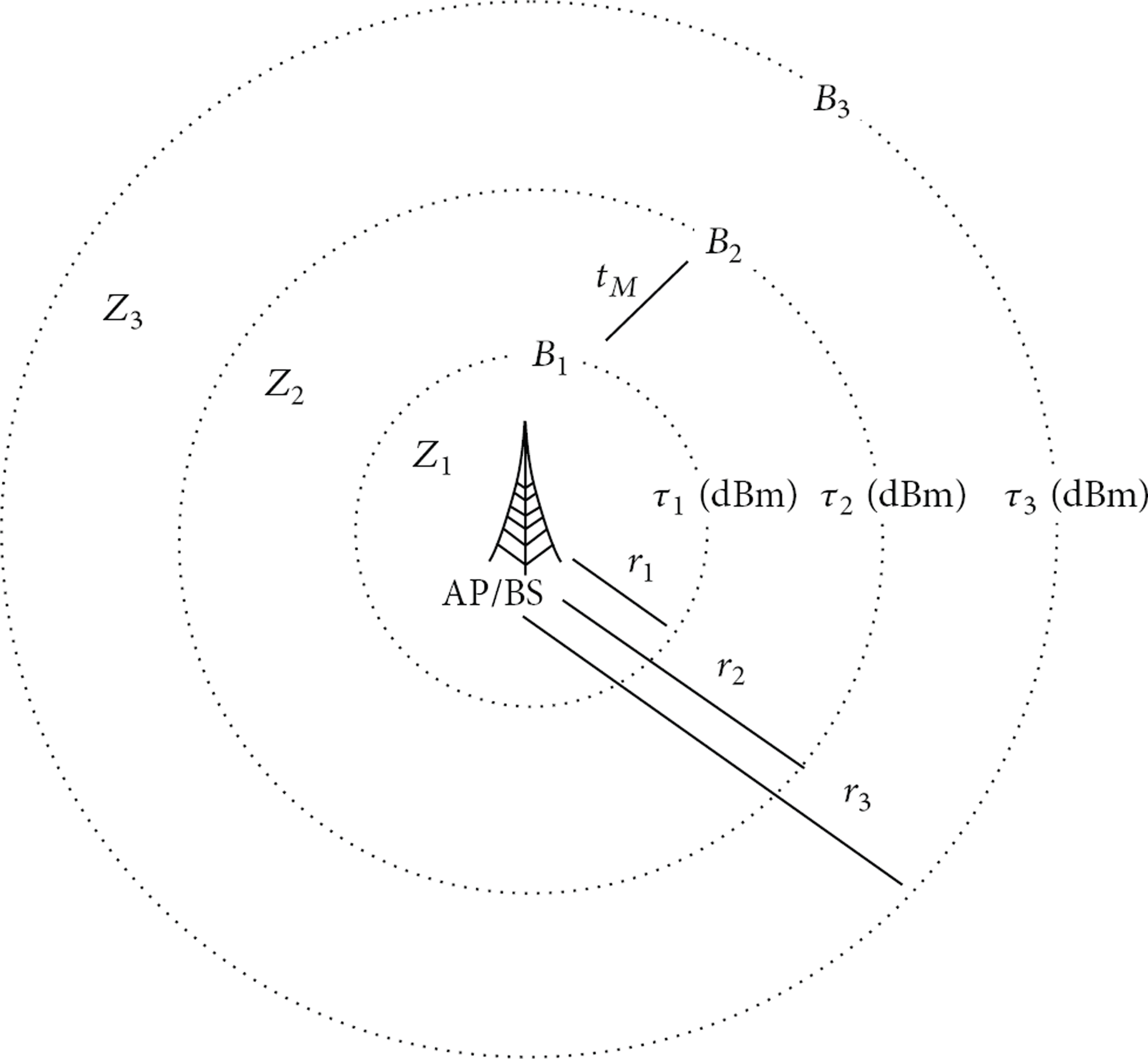
Division of zones with three different thresholds of RSSI.
When the MN approaches the boundary B 1 while moving in the coverage area of a BS/AP, it generates the new MIH_LINK_INFO event message and sends this event message to the current BS/AP. When BS/AP gets this event message, it sends an information packet to the MIIS server for getting information of available BSs/APs. After it gets reply from MIIS server, it sends the information of available BS/AP to MN upon approaching the boundary B 2. MN makes a connection with the new BS/AP and terminates the connection with old BS/AP. When the MN gets the boundary B 3, it indicates successful completion and termination of connection with the old network.
3.2. The Proposed Scheme
This section describes the proposed scheme and its working mechanism, such that how it reduces the handover time required for an MN moving over heterogeneous networks.
Actually, we are only interested in
MN MAC address;
MAC address of the associated BS;
unique event identifier.
The MN MAC address is used by BS for identifying MN and saved for further processing when the MN approaches the boundary B 2.
This event message is broadcast over the network, and a BS can use its MAC address for identifying whether the event message is for this BS or not. If a BS gets an event message and it is not for this BS, it simply discards the event message. In the MIH, every event message has a unique identifier; a BS can process an event message on the basis of event message's identifier. BS receives an event message from an MN; it checks the information and forwards this event to the MIIS server on the basis of available information. MIIS server generates a response in the form of event message that sends the information of the new BS to the old BS. Upon receiving the event message by the old BS, the old BS extracts the new BS ID from the event message and generates a handover information table which is composed of three attributes: ID of the MN generating MIH_LINK_INFO event message, expiration time (denoted by
Consider two cases to justify necessity of
In both cases, when
Let

When the MN approaches the boundary B 2 while moving from one network to another, the entry of the MN will be deleted from handover information table. By this strategy, buffer of BS is dynamically updated for supporting the maximum number of handovers and MNs.
When the MN gets to the boundary
To elaborate the handover triggering procedure in our scheme, a scenario is illustrated in Figure 2. When the MN gets to the boundary B 1, it sends MIH_LINK_INFO event to AP/BS. This AP/BS is further connected to the gateways (GW) of the AN. MIIS server is available in core network, and the core network gateway is connected to the Internet. Directed arrows in Figure 2 show the flow of data in a particular direction.

Operation of the proposed scheme.
Furthermore, we divide the handover region into three parts: handover starting point, nearby BS info point, and successful handover point. These points are synchronized between MN and BS using flags in the header of the packet. When the MN crosses a point, it switches on the required flag in a packet after that point. This synchronization is used for identification of successful handover. Now, the proposed scheme can efficiently perform fast handover even if the available handover region is small enough. And utilizing the effect of these points, we can design a topology for future networks.
4. Simulations and Results
The proposed scheme is compared with the existing MIH standard. We used a simulation scenario which consists of one universal mobile telecommunications system (UMTS) network (consists of 5 BS) and one Wi-Fi network (consists of 20 APs). Initially, an MN is attached to the UMTS. Then, the MN performs a handover from UMTS to Wi-Fi network. First, an MN performs a handover form UMTS to WiFi using the MIH standard events. Secondly, the MN performs a handover using the proposed scheme. Finally, different number of handovers is performed from Wi-Fi to UMTS network. Simulation scenario is shown in Figure 3, where each scenario uses different number of MNs.

Simulation scenario.
The MIIS server is placed a number of hops away from both networks. Four different scenarios were tested with different number of hops. The MIIS server is 2, 3, 6, and 9 hops away, respectively, in four scenarios. Similarly, MNs moving in different directions were tested. Different numbers of handovers were performed by different number of MNs. Table 1 represents some important parameters used in the simulation. Handover time, delay, throughput, and network load were measured for different scenarios against the number of MNs, the number of handovers and simulation time, respectively.
Simulation parameters.

Figure 4 depicts the comparison of the proposed scheme against the MIH standard in terms of the average handover time taken by different MNs. We can see that the proposed scheme efficiently reduces the handover time taken by an MN. It is also observed, from this experiment as the number of MNs increases, that the handover time taken by MIH standard also increases linearly. For example, the proposed scheme reduces the handover time by 25% or 15% when the numbers of nodes are 35 or 50, respectively. This improvement is mainly because the handover information required by the MN during handover process is available one hop away and hence the MN requires less time to obtain this information from the current BS/AP.

Handover time as the number of MNs is varied.
Figure 5 delineates the comparison of the proposed scheme against the MIH standard in terms of the average throughput. We tested 50 MNs having the simulation time of 2 hours in which different numbers of handovers are performed at once. We reduce the packet size from 512 bytes to 256 bytes in order to simulate the proposed scheme for longer period of time. For the sake of clarity, we use boxes at the places where handover is performed. It is shown that the proposed scheme experiences less packet loss as compared with the MIH standard that results in higher throughput. In addition, the proposed scheme also smoothly retains the throughput by redirecting the traffic from the old BS to the new BS in an efficient manner at the time when handover occurs. On the other hand, MIH standard take a significant amount of time to redirect the traffic from the old BS to the new BS.

Throughput performance.
Figure 6 depicts handover delay of the proposed scheme against the MIH standard as the number of hops is varied. Handover delay in 2, 3, 6, and 9 hops scenarios is shown in Figure 6. It is seen that the handover delay increases as we increase the number of hops between a BS and an MIIS server. A high delay time is observed as the number of hops is increased from 6 to 9 in the MIH standard. But, in the proposed scheme, the handover delay is approximately constant since the information is always available one hop away from an MN.

Handover delay with different number of hops.
Figure 7 illustrates the handover delay required by MN when the network load increases. In case of proposed scheme, the increase in handover delay is very low as compared to MIH standard. The proposed scheme obtains the available information of new network when the MN gets to the boundary B 1. The time required for handover when MN gets to boundary B 2 is very less in case of proposed scheme. Therefore, the proposed scheme performs better even if the network load increases due to increase in number of handovers by high number of MNs. Figure 7 also depicts that as the number of MNs in a particular region increases; then the proposed scheme shows better result in case of handover latency against the MIH standard.

Handover delay as the network load varied.
5. Conclusions and Future Work
When an MIIS server is many hops away from a BS/AP, it requires long time to discover a new network in the MIH standard. The proposed scheme brings the information of the new network closer to the MN and can significantly reduce the time for discovering new network than the standard MIH. A more sophisticated scheme can be designed while using the previous handover information for future handovers by an MN.
The threshold mechanism used in MIH standard is not enough to perform better in case of high network load and MNs. The triggering mechanism used by MIH standard is also not supportable when the number of MNs increases. Our proposed scheme performs better in case of both high network traffic and MNs.
The experimental results show that the proposed scheme saves 10% to 35% of the handover time as compared with the MIH standard. Furthermore, bringing the information of new BS from MIIS server to the associated BS is possible over only one hop in the proposed scheme. Similarly, the results and simulation show that, as the number of MNs is increasing, the handover delay and time are slightly increasing in case of proposed scheme. The packet loss ratio is significantly reduced which shows the accuracy of the proposed scheme. The network load is increasing as more numbers of MNs are injected in the scenario, but in case of proposed scheme, the network load remains balanced and tolerable. This trade-off between different parameters shows that the proposed scheme performs better than the MIH standard and it can be easily adopted for the next generation of networks.
Footnotes
Conflict of Interests
The authors declare that there is no conflict of interests regarding the publication of this paper.
Acknowledgments
This work was supported by the IT R&D Program of MSIP/KEIT (10041145, Self-Organized Software Platform (SoSp) for Welfare Devices). This work was supported by the BK21 Plus Project (SW Human Resource Development Program for Supporting Smart Life) funded by the Ministry of Education, School of Computer Science and Engineering, Kyungpook National University, Republic of Korea (21A20131600005).