




Abstract
Topology construction and control is a vital technique in wireless sensor networks. In this paper, based on small-world and scale-free concepts of complex network theory and considering the characteristics of wireless sensor network, a topology model with small-world and scale-free concepts for heterogeneous sensor network is presented. This work is achieved by applying heterogeneous sensors and preferential attachment mechanism. Furthermore, the topology evolution algorithm is designed. Finally, we simulate the network characteristics, and simulation results are consistent with the theoretic analysis and show that topologies of wireless sensor network built by this model have small-world and scale-free feathers and can significantly improve energy efficiency as well as enhance network robustness, leading to a crucial improvement of network performance.
1. Introduction
Wireless sensor network (WSN) consists of spatially distributed autonomous sensors to monitor physical or environmental conditions, such as temperature, sound, vibration, pressure, motion, or pollutants, and to cooperatively transmit their data through the network to a sink node. Today WSNs are more and more widely used in a variety of industrial and consumer applications, such as industrial process monitoring and control, machine health monitoring, environment and habitat monitoring, health care applications, home automation, and traffic control [1].
In military and warfare applications, WSNs are deployed in hostile monitoring environment and the sensor node is with limited energy support. Energy exhaustion and natural damage of some sensor nodes often lead to the failure of the whole network. Construction and control of topology as a vital technique plays an important role to conquer these problems in WSNs. The main purpose of construction and control of topology is to achieve a higher communication quality, have efficient energy use and strong robust topology through power control, have important network node selection, remove unnecessary communication links, and so on.
Most topology models are based on some network theories such as random graph theory and complex network theory. The complex networks widely exist in real world such as electrical power grids, global transport networks, coauthorship and citation networks, and so on. As an interdisciplinary research area, complex networks arouse worldwide attention [2–4]. Two most typical network models in complex network theory are small-world network and scale-free network [4, 5]. The small-world network has two independent structural features: (i) a small average shortest path length and (ii) a large clustering coefficient [6]. By applying small-world theory in topology construction of WSNs, the network performance will be improved in querying data efficiency, energy efficiency, network lifetime, and so forth [7]. A scale-free network is a network whose node's degree follows a power law distribution, and the scale-free topology characteristics have a higher robustness to endure the random failure [8]. However, few people study how to construct WSN topology with small-world and scale-free characteristics at the same time.
In this paper, considering the characteristics of WSNs, such as residual energy, degree saturation, and maximum communication radius of sensor, a topology model with small-world and scale-free concept (TMSSC) is proposed based on wireless heterogeneous sensor networks, and the topology evolution algorithm is designed. Topology constructed by this model not only has higher energy efficiency and transmission efficiency but also has higher robustness to endure the random failure.
The rest of the paper is organized as follows. Section 2 in this paper introduces the background of small-world networks and scale-free networks and their application in WSNs. Section 3 describes the TMSSC model and its algorithm, and also the network characteristic is analyzed. Finally, the simulation results analysis and conclusion are, respectively, presented in Sections 4 and 5.
2. Related Works
2.1. Small-World Networks in WSNs
Two main characteristics of small-world network are small average shortest path length and large clustering coefficient, which are the most important factors affecting the network performance. Helmy proposed a small-world concept wireless network through randomly adding a little of logical links to WSNs [9]; this leads to a small average shortest path length of networks, and then he proved that small-world network phenomenon also exists in wireless networks with spatial properties.
Based on the results of Helmy [9], Cavalcanti et al. improved the connectivity of wireless ad hoc networks by using small-world characteristics [10]. A few of sensor nodes with high energy and strong communication capability called H-sensor are introduced in this paper. Results show that H-sensors can improve the connectivity of networks significantly.
Research results by Chitradurga and Helmy [11] show that the average path length can significantly be decreased by adding shortcuts in the network. Specially, the length of shortcut just needs to be 25% to 40% of the diameter of a network with 1000 uniform distribution of sensor nodes; the average shortest path length of the modified network can reach 60% to 70% as that of original one.
Hawick paid attention to network coverage, fault tolerance, and sensor network lifetime by applying small-world theory [12]. Results show that adding a few of random links among sensor nodes can not only decrease the average path length but also decrease the number of isolated clusters, which lead to a great improvement of network coverage and lifetime.
2.2. Scale-Free Networks in WSNs
As the recent research focus, scale-free networks in WSNs are mostly improved by BA network model, which was proposed by Barabási and Albert [4]. This model is based on two important characteristics:
growth: the scale of the network is expanding; preferential attachment: the new node is more inclined to join with those nodes with higher degree.
BA scale-free network did not take spatial properties into consideration, so many scholars improved this model. For example, Saffre et al. [13] proposed an algorithm to build network topology with scale-free concept using local geographic information of sensor. Literature [8] proposed a topology evolution of WSNs among cluster heads by random walkers. Topology built by this model has a scale-free characteristic and better robustness, but this paper takes little consideration in communication features of WSNs, which might lead to a limited utility.
3. TMSSC Topology Evolution Model
In this section, we firstly introduce the topology model with small-world and scale-free concept (TMSSC) in heterogeneous wireless sensor networks, which consist of large number of sensors (L-sensor) and a small portion of super sensors (H-sensor). Firstly, some model assumptions are introduced. Then, we define some concepts and notations which may be used. Finally, the TMSSC topology evolution model is proposed and the algorithm is designed. Also, the dynamic characteristics of topology analysis are shown in this section.
3.1. Model Assumption
In our model, we assume the sensor networks consist of large portion of L-sensors and small portion of H-sensors. The H-sensors are equipped with high energy and strong communication capability and can communicate with H-sensor and L-sensor by using the different radios, respectively, in which one radio is responsible for long-distance communication and one is responsible for short-distance communication as equipped on the L-sensors.
In order to keep the symmetry of the network after adding H-sensor in WSNs, we assume that if an H-sensor

Finally, we assume that the network topology management mechanism is achieved by using clustering. Clustering topology has the advantages in topology management, energy use, data fusion, and so on. This paper employs the HEED clustering algorithm which takes into consideration both the residual energy and communication cost [14]. So we assume that TMSSC topology model is built by using the cluster head nodes.
3.2. Definitions and Notions
3.2.1. Same Directed Angulation towards Sink
Same directed angulation towards sink
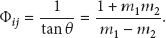
If node

Topology construction of H-sensors with different connection mechanism: (a) connect with probability
3.2.2. Other Definitions
Degree Communication radius L: the communication radius of L-sensor is Residual energy
3.3. Design of Model and Algorithm
Based on the above definitions and assumptions, we propose the TMSSC topology evolution model according to “preferential attachment” mechanism. The model is described as follows.
3.3.1. Growth
Initially the network just contains a small scale topology which consists of
3.3.2. Preferential Attachment
If the new node is an L-sensor, what should be taken into account are energy balance, the degree saturation, and communication radius. Thus, the probability

If the new node

In order to implement this model, we design the algorithm pseudo code of TMSSC topology evolution model, which is shown in Algorithm 1. This algorithm eliminates the clustering process. More details about clustering algorithm are presented in [14].
Algorithm of TMSSC (1) V = RandomGenerate(N); (2) (3) (4) (5) broadcastHelloPacket( (6) receiveNeighborInformation(); (7) (8) (9) (10) (11) (12) (13) (14) (15) (16) (17) (18)
3.4. Dynamic Analysis of Topology Evolution
According to mean-field theory [15], we assume that

Since the continuity of


Here we assume that a few nodes have reached the saturation value of degree


4. Network Features and Simulation Results
4.1. Simulation Assumptions
In the simulation, we use a network with a total of
4.2. Small-World Features Evaluation
In this section, we evaluate the average minimum effective path length
In each generated topology, we evaluate the average minimum effective path length and the average clustering coefficient of the network. After n simulations, we obtain the average of these n results. The values
Figure 2 illustrates the average minimum effective path length and the clustering coefficient of the network when changing the value of the probability p. We find that the average minimum effective path length and clustering coefficient are not changed when probability
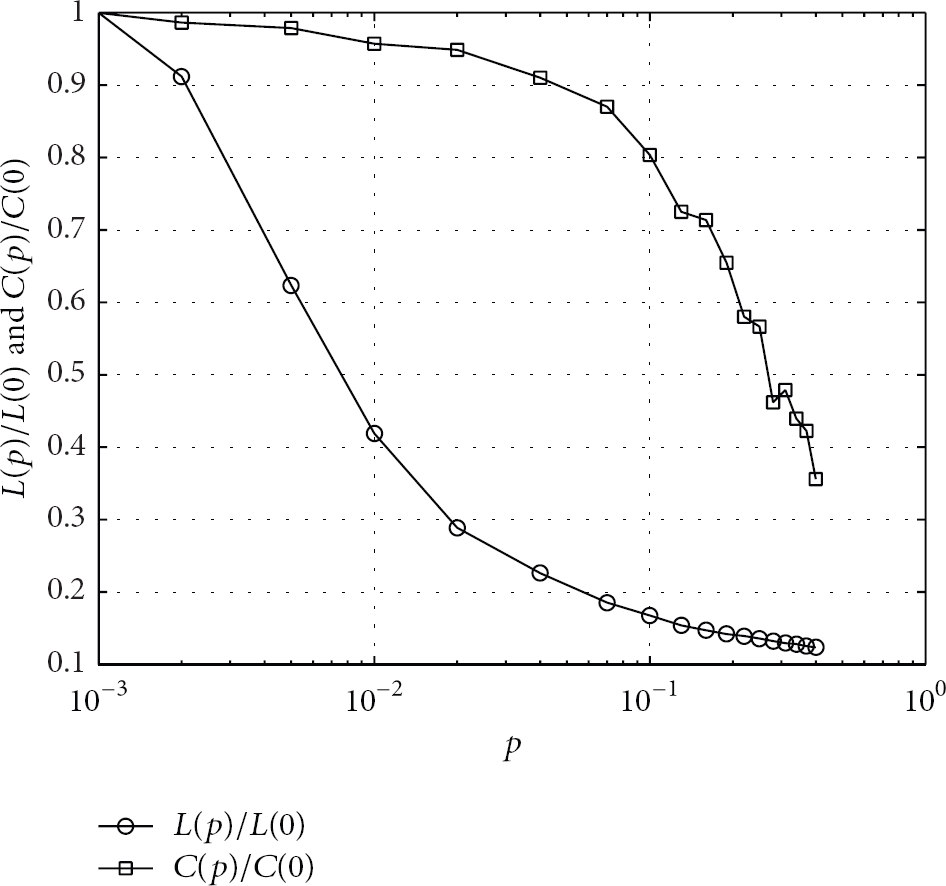
Small-world features of topology built by TMSSC in the simulation, where
4.3. Scale-Free Features Evaluation
We find that when

Degree distribution of topology built by TMSSC in the simulation: (a) degree distribution with
Figures 3(a) and 3(b) illustrate the degree distribution of the network, which show that most of the nodes in the network have small degree. For example, the degree of
Figures 3(c) and 3(d) illustrate the above degree distribution in double logarithmic coordinates; we find that the degree distribution of networks built by TMSSC approximately obeys the power law distribution, and this agrees with the dynamic analysis results. In other words, the networks built by TMSSC have scale-free features.
4.4. Network Performances
4.4.1. Energy Efficiency
Compared with the BA model, TMSSC takes into consideration the energy balance. So, WSNs built by TMSSC perform a higher energy efficiency than the networks built by BA model under the same conditions. Under same assumptions with Section 4, we evaluate the energy efficiency by the survival nodes percentage by the BA and TMSSC model. In each deployed network, a random initial energy is given to each node. We build the two different topologies by TMSSC and BA model and run the network simulation, respectively. Every

The contrast of energy efficiency in simulation: (a) energy efficiency of networks built TMSSC and BA model and (b) energy efficiency of networks built by TMSSC with
According to Figure 4(a), we illustrate that the survival nodes percentage changes over running time. We find that the TMSSC is better than the BA model. When it runs at
4.4.2. Network Robustness
According to the analysis in Section 3, the topology built by TMSSC is with a scale-free feature. Networks with this characteristic have a higher robustness to resist the random node failures. In this section, we investigate the network robustness by using the concept of largest effective component S, which defines the largest component containing sink node in a WSN. We use the ratio

The robustness of networks built by BA and TMSSC model; the probability of H-sensor in TMSSC is
Figure 5 shows that networks built by TMSSC have a better performance on robustness against random node failures than BA model, and the robustness is improved by increasing H-sensors. In addition, this curve shows that the generated network has the characteristic of scale-free network. After randomly removing a little fraction of nodes, the network works well. When
5. Conclusion
In this paper, we firstly present a topology model with small-world and scale-free concepts for heterogeneous sensor networks, and this model is achieved by the preference attachment mechanism and the heterogeneous sensor networking. Secondly, we design the topology evolution algorithm and give a dynamic analysis of topology evolution. Finally, we give an extensive simulation to evaluate the topology characteristics and network performances. Simulation results agree with theoretic analysis and show that WSNs topology built by this model has the small-world and scale-free characteristics. Also, the generated sensor networks by this method have higher energy efficiency and the stronger robustness against the random node failures and can highly improve the network performance.
Footnotes
Conflict of Interests
The authors declare that there is no conflict of interests regarding the publication of this paper.
Acknowledgments
This work is partially supported by the National Natural Science Foundation of China under Grant nos. 71271165 and 61373174, the State Key Laboratory of Complex Electromagnetic Environmental Effects on Electronics and Information System under Grant nos. CEEME2012k0207B and CEEME2014k0302A, Grant no. 2011C14024 from Science and Technology Department of Zhejiang Province Program, and Grant no. 2010R50041 from Key Innovation Team of Science and Technology Department of Zhejiang Province.