




Abstract
Ti-6Al-4V joints are employed in nuclear engineering, civil industry, military, and space vehicles. Laser beam welding has been proven to be promising, thanks to increased penetration depth and reduction of possible defects of the welding bead; moreover, a smaller grain size in the fusion zone is better in comparison to either TIG or plasma arc welding, thus providing an increase in tensile strength of any welded structures. In this frame, the regression models for a number of crucial responses are discussed in this paper. The study has been conducted on 1 mm thick Ti-6Al-4V plates in square butt welding configuration; a disk-laser source has been used. A three-level Box-Behnken experimental design is considered. An optimum condition is then suggested via numerical optimization with the response surface method using desirability functions with proper weights and importance of constraints. Eventually, Vickers microhardness testing has been conducted to discuss structural changes in fusion and heat affected zone due to welding thermal cycles.
1. Introduction
A unique combination of good mechanical and physical properties is better when using titanium alloys; moreover, resistance to erosion and corrosion provides additional grounds for use in chemical aggressive conditions [1]. In particular, titanium alloy Ti-6Al-4V accounts for more than half of all titanium tonnage in the world and no other titanium alloy is deemed to threaten such a dominant position [2]. Ti-6Al-4V is hence widely employed in aerospace [3] for turbine disks, compressor blades, airframe and space capsule structural components, rings for jet engines, pressure vessels, rocket engine cases, helicopter rotor hubs, fasteners, and engine exhausts [1]; medical and surgical devices are also produced [4].
Strengthening is achieved through heat treatment or thermomechanical processing, although the best combination of properties results from solution heat treatment and rapid quenching and aging.
TIG and plasma arc have been investigated in the literature [5, 6] to join Ti-6Al-4V; nevertheless, in comparison with traditional technologies, laser [7–9] and electron beam welding [10] received increasing interest in aerospace engineering as to reduce the dimensions of both the fusion zone and the heat affected zone [6, 9, 10]. In this field, past research has focused on CO2 lasers [11, 12]; also, attempts have been made with Nd:YAG lasers [13, 14] but few works have dealt with fibre [9] and disk-laser sources [15, 16] which are expected to provide even better beam quality and efficiency in comparison with traditional laser systems [17–19].
Nevertheless, it has been proven that gas shielding is crucial for bead protection in order to obtain sound joints [6, 11, 16], given that titanium is prone to oxidation when in fused state. Therefore, a specific device to protect the joint must be considered [20]. As discoloration of the bead is evidence of oxidation taking place during welding, visual inspections are generally conducted to preliminarily assess the effectiveness of bead shielding. With respect to the assisting gas, which is additionally required to the purpose of metal plume removal, it has been shown that deeper penetration is achieved when considering helium instead of argon, thanks to the higher ionization potential of the former [11].
It has been shown that a specific threshold irradiance of 104 W/mm2 must be overcome for conduction to key-hole transition [15]. Then, special care must be taken to comply with international standards [21]; to this purpose, different approaches have been proposed in the literature, involving neurofuzzy models for the prediction of the imperfections [22] or the method of the desirability function upon development of the regression models [23].
Concerning the mechanical features, it has been reported that a significant reduction in ductility can occur as a consequence of pore formation. In particular, as few as 2% total porosity yields an 85% decrease in the ultimate tensile strength of the joint, compared with the base metal [13]. In addition, due to fusion and recrystallization, the hardness in the fusion zone is affected [24]. A decrease is noticed when using TIG welding [4], whilst an increase has been reported when using laser beams [11, 16]. The difference is due to lower heat input and higher solidification rate which produces greater benefits in comparison with conventional techniques.
In this work, the results of welding of 1 mm thick sheets in square butt configuration are presented. The main effects of the governing parameters on the responses are investigated; a number of regression models are developed in order to predict certain geometrical features; a numerical optimization is conducted with the method of the desirability function to suggest a proper processing condition which has been eventually discussed in terms of hardness and microstructure.
2. Experimental Procedure
The nominal chemical composition of the referred alloy [1] is given in Table 1. As bead shielding is crucial in order to obtain sound joints when processing titanium alloys, a specific device to protect the joint must be considered. The device (Figure 1) consists of a side diffuser and a grooved box for top- and back-side shielding, respectively [24].
Nominal chemical composition of Ti-6Al-4V (wt.%).

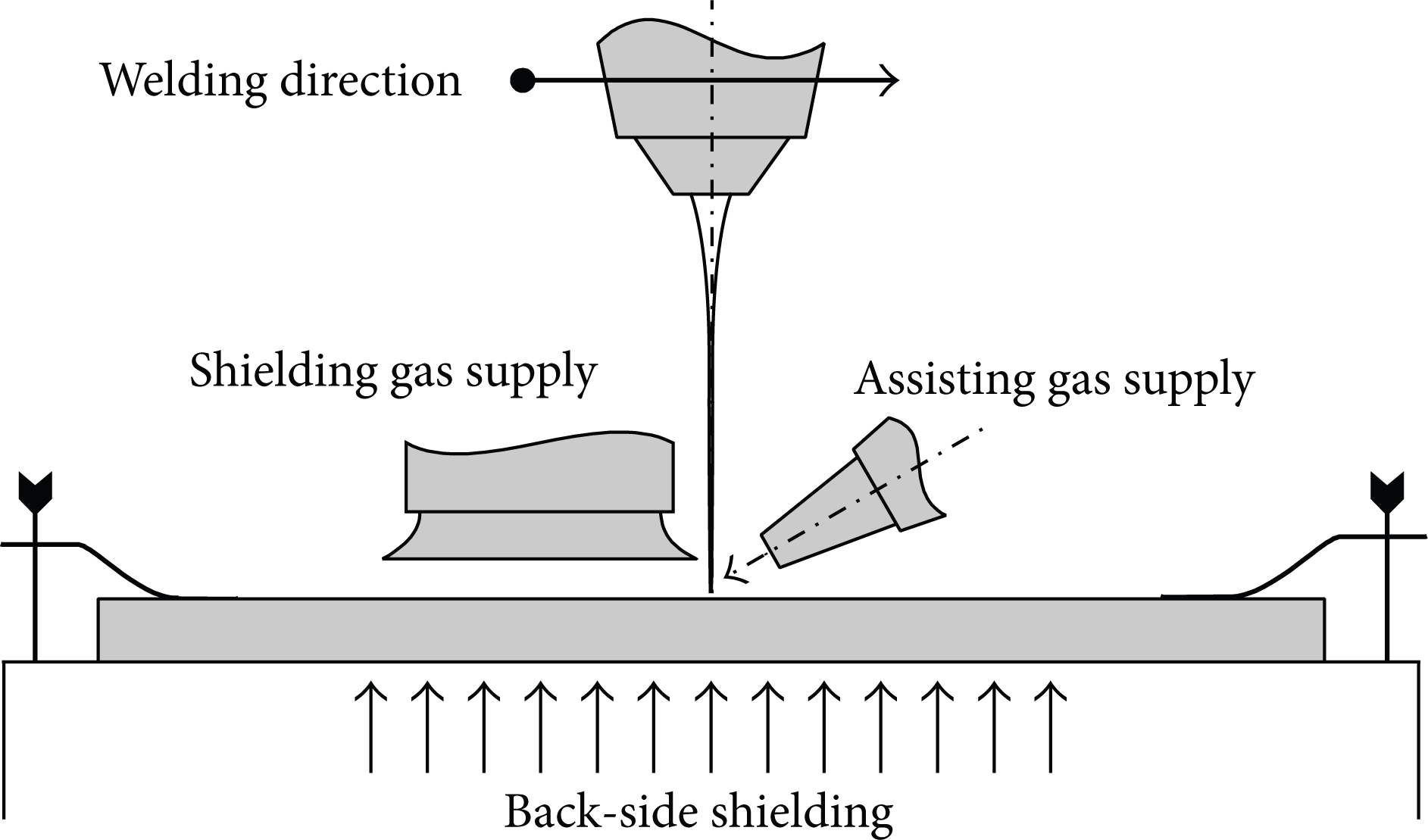
System set-up.
A number of preliminary trials in the form of both butt welding and bead-on-plate tests have been performed at different gas flow rates; eventually, visual inspections have been conducted to evaluate the effectiveness of the welding set-up. Helium for plume removal has been supplied via a leading nozzle at a flow rate of 20 L/min; argon at a flow rate of 50 L/min has been considered for back-side shielding.
Among all of the possible governing parameters of the process, a proper choice is based on the literature and past experience. Laser power P and welding speed s are primary factors as they determine the rate of energy input to the workpiece, so they definitely must be taken into consideration in the study. In addition, successful laser welding requires the optimization of other parameters such as the size and the location of the focal spot. Hence, defocusing f has been included in the experimental plan, being the distance of the focal point with respect to the top surface; in particular, defocusing is intended to be positive or negative when the focal point locates above or beneath the top surface, respectively.
The range for power in the experimental plan has been decided so that the specific threshold irradiance for conduction to key-hole transition would be overcome. Sensible values for welding speed have been found via preliminary trials in the form of bead-on-plate tests aiming at producing full penetration with no significant drop-through on the lower surface, thus matching the requirements as defined in the referred standard [21]. Factorial experiments have been planned. A three-level experimental plan with power P, speed s, and defocusing f as governing factors has been arranged in a Box-Behnken scheme (Figure 2) with three replications of the central point so as to improve the estimation of model curvature [25]; factor levels for each parameter are listed in Table 2.
Testing levels for each governing factor.


Three-level Box-Behnken design.
This plan is suitable for generating second order models and, unlike a face-centred central composite design, is rotatable. A random test procedure has been arranged both to allocate the sheets and to produce the specimens, so that the observations are independent random variables, aiming at reducing systematic experimental variation. Joining in square butt welding configuration has been performed in continuous wave emission; 100 mm long welding beads have been produced. The main technical data of the welding system are listed in Table 3.
Welding system technical data.

Butt samples have been crosscut perpendicularly to the welding direction and then polished to a mirror finish with SiC paper and grinding diamond paste on polishing cloths. Three crosscuts, namely, at 25%, 50%, and 75% of the total weld length, were examined for each weld. Chemical etching has been performed using hydrofluoric acid (48%, 10 mL), nitric acid (65%, 15 mL), and water (75 mL) at room temperature in order to highlight the bead boundaries and the microstructure in the cross section [1].
3. Results and Discussion
Visual inspections have been conducted in order to check the effectiveness of the device for bead shielding. Beads are found to be uniform, smooth, and silvery. No longitudinal bending and only limited angular distortion, which are reported to occur when welding thin sheets via typical TIG processes, have been observed. A comprehensive view of the cross sections is given in Figure 3.

Cross sections for each welding condition in a Box-Behnken scheme.
Significant necking of the fusion zone at mid-thickness is found. No macropores are noticed. Based on the general aspect of the welding bead, two groups of geometric responses have been chosen to be investigated. In the first group, the responses concerning the bead shape (Figure 4) are included: the crown width (CW), the necking width (NW), the root width (RW), and the area of fusion zone (FZ) are considered. In addition, for the purpose of this work, HAZ has been intended to be as the area at both sides of the fusion zone. In the second group, possible imperfections (Figure 5) as suggested by the referred specification [21] are included, as special care must be taken for welding defects which could result in bead rejection at quality checks. With respect to this issue, the evaluation included right and left undercut (UC), reinforcement (R), right and left shrinkage groove (SG), and excessive penetration (EP) at the key-hole root.

Bead profile in the cross section.

Possible imperfections in the cross section.
Average responses among three cross sections for each tested condition are given in Table 4; quality checks have been conducted for all of the cross sections.
Average values of geometric responses for each testing condition.

All of the beads are in fully penetrative condition; Class A quality has been met for the imperfections with reference to international standards for fusion welding of aerospace applications [20], where requirements are given in terms of maximum allowed value for each imperfection, namely, 70 μm for both UC and SG and 330 μm for R and EP. Misalignment was also found to comply with specification.
4. Analyses of the Responses
The effects of the governing parameters on bead geometry are discussed via main effect plots (Figure 6). Welding speed and defocusing have the highest influence. Moreover, the responses increase with increasing power or decreasing speed, as expected, since a higher thermal input, being the power to speed ratio, results. Concerning the effect of the focus position, the region affected by the laser beam increases with increasing defocusing. As a consequence, each geometric response increases with respect to conditions of negative defocusing or focused beam. Nevertheless, this effect is far less significant on RW.
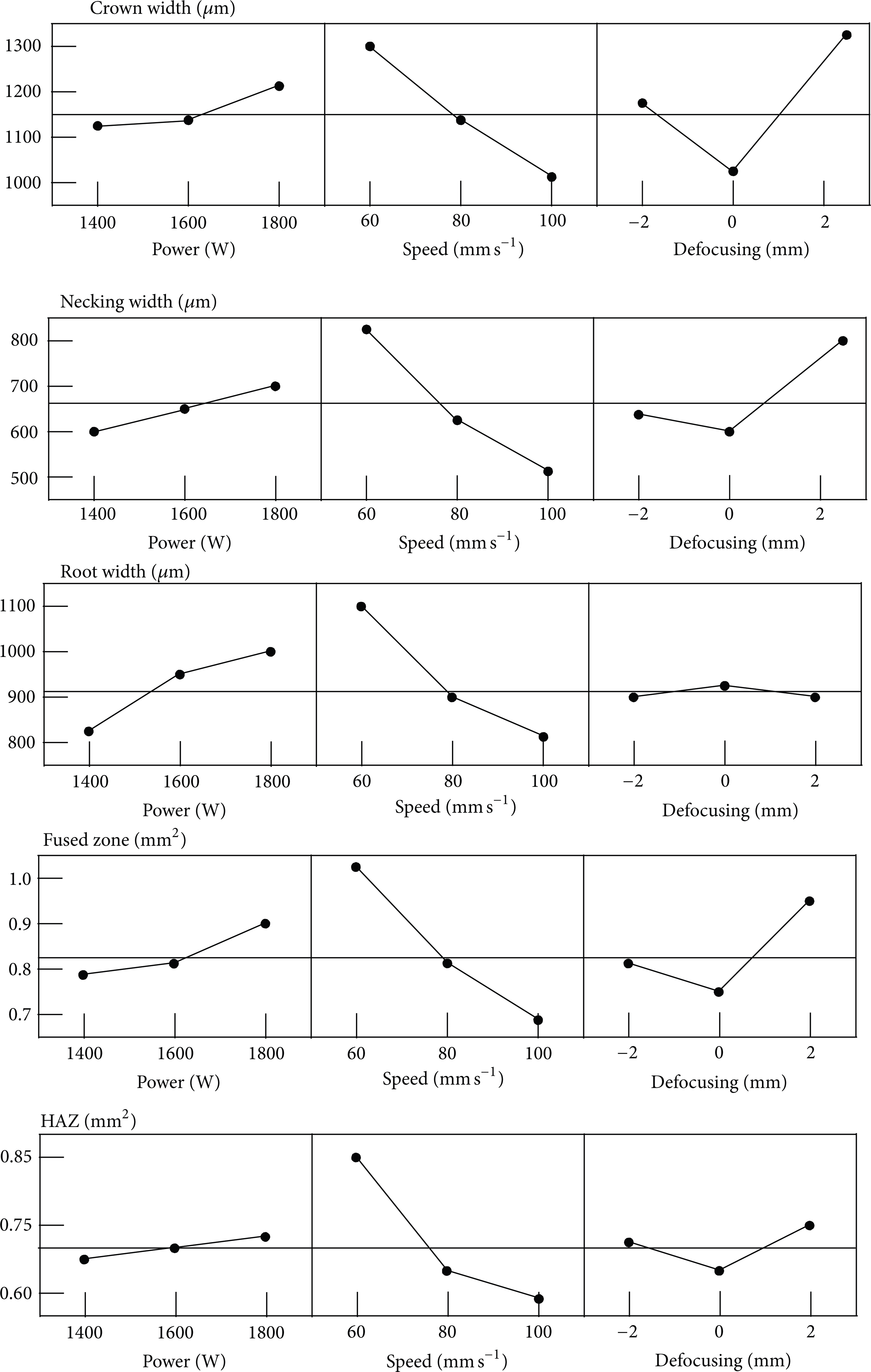
Main effects plot for the responses.
5. Optimization
Polynomials have been fitted to the experimental data to obtain the regression equation of the responses. Reinforcement, shrinkage groove, undercut, and excessive penetration did not show significance due to random influence of the assisting gas, so the corresponding models have been neglected. The regression equations have been found for FZ and HAZ. In order to provide a synthetic description of the bead profile, two shape factors have been considered: SF1 being the NW to CW ratio and SF2 being NW to RW ratio. The response surfaces which showed statistical significance in the analysis of variance are given in the following:

For each response surface, the corresponding P values and adjusted R-squared factors to assess the reliability of the model are listed in Table 5. The optimization has been conducted referring to the area of the fusion zone, the area of heat affected zone, and the shape factors. Minimization has been required for both the extent of the fusion zone and the heat affected zone.
P values and adjusted R-squared factors for each response surface.

Aiming at producing an ideal geometry with reduced necking, hence maximum NW, maximization has been required for the shape factors, although higher importance has been awarded to the constraints involving FZ and HAZ. Under these constraints, the optimization of the process has been conducted using the desirability function. A solution with a power of 1400 W and a speed of 100 mm/s with negative defocusing of 1.5 mm has been found, with and an overall desirability of 87%.
6. Assessment of the Optimum
The suggested optimum condition has been considered to produce three new beads to be crosscut so as to check the welding quality level, as well as to compare the actual responses to the predicted values of the models. Moreover, Vickers microhardness testing along the welding bead has been performed to investigate the microstructure after welding thermal cycles.
Three cross sections have been considered for each weld. Measurements of each response with the exception of the imperfections which have been reported to have random nature as discussed in the previous section resulted in low standard deviation, in the order of 10−2 among the cross sections, thus suggesting that welding of the optimum has been performed in condition of stability. The requirements for stringent quality have been met for imperfections in each cross section again; average values are given in Table 6.
Average values of geometric responses for the suggested optimum.

With respect to the predicted values of the responses, the following percentage errors were measured for the responses which had been considered at the optimization stage: 19% for the extent of the fusion zone, 0.4% for the heat affected zone, 2.3% for SF1, and 7.9% for SF2.
Vickers microhardness tests have been conducted to assess the features of the welding bead; indentations have been made at mid-thickness of the workpiece [26]. An indenting load of 0.300 kgf has been used for a dwell period of 10 s; a 120 μm step has been used between two consecutive indentations. Three cross sections have been investigated; the resulting average trend of hardness is shown in Figure 7 with corresponding whiskers for each given position along the bead. Maximum hardness has been found at the centre of the bead: the fusion zone, in fact, mainly consists of acicular α′ martensite as a consequence of diffusionless transformation of the original β phase, while a mixture of α′ and primary α phases is found in the heat affected zone.

Vickers microhardness trend in the cross section for the suggested optimum.
An average value of 332 HV0.3 resulted in the base metal, with an average increase to 369 HV0.3 in the HAZ and to 398 HV0.3 in the fusion zone, where a maximum value of 410 HV0.3 has been found. The increase in hardness as obtained with laser welding is deemed to be reason of improved strength of the welding bead, although proper tensile tests are needed for the assessment.
7. Conclusions
Welding of 1 mm thick sheets of Ti-6Al-4V titanium alloy in butt welding configuration has been investigated. The process has been performed in continuous wave emission using a thin disk-laser source. A proper device for bead protection has been used to shield the bead and prevent oxidation. With the combination of factors and levels in the domain of investigation, no longitudinal bending and only limited angular distortion have been observed; no macropores have been noticed in the cross sections; Class A quality requirements have been met for defects such as undercut, shrinkage groove, reinforcement, and excessive penetration.
Welding speed and defocusing have been found to play the highest influence on the responses. Moreover, each geometric response increases with increasing power or decreasing speed; positive defocusing produces an increase as well, except for root width, with respect to negative defocusing or focused beam.
The numerical optimization has been conducted; minimization has been required for both the extent of the fusion zone and the heat affected zone, whereas maximization has been considered for the necking to crown width ratio and for the necking to root width ratio. A solution with a power of 1400 W and a speed of 100 mm/s with 1.5 mm of negative defocusing and an overall desirability of 87% has been found. The suggested optimum condition has been considered to produce three new welding beads which gave comforting matching with the model. Compared with the base metal, an increase in hardness in the fusion zone and in the heat affected zone has been noticed as a consequence of the formation of α′ martensite. Future works will deal with testing the optimum via tensile and fatigue tests.
Conflict of Interests
The authors declare that there is no conflict of interests regarding the publication of this paper.