




Abstract
This paper establishes an improved NDIF method for the eigenvalue extraction of two-dimensional acoustic cavities with arbitrary shapes. The NDIF method, which was introduced by the authors in 1999, gives highly accurate eigenvalues despite employing a small number of nodes. However, it needs the inefficient procedure of calculating the singularity of a system matrix in the frequency range of interest for extracting eigenvalues and mode shapes. The paper proposes a practical approach for overcoming the inefficient procedure by making the final system matrix equation of the NDIF method into a form of algebraic eigenvalue problem. The solution quality of the proposed method is investigated by obtaining the eigenvalues and mode shapes of a circular, a rectangular, and an arbitrarily shaped cavity.
1. Introduction
The authors developed the nondimensional dynamic influence function method (NDIF method) for extracting highly accurate eigenvalues and eigenmodes of arbitrarily shaped membranes and acoustic cavities [1, 2]. Later, the authors extended the NDIF method to membranes with high concavity [3] and plates with various boundary conditions [4–7]. In the NDIF method, as in the boundary element method (BEM) [8], a field problem is solved on its boundary along which nodes are distributed. The distinct feature of the NDIF method is related to the fact that no interpolation functions between the nodes are required, so that the basic collocation method is employed to satisfy a given boundary condition. This approach enables us to reduce a large amount of numerical calculation induced due to the interpolation functions and, as a result, to obtain highly accurate eigenvalues.
On the other hand, the weak point of the NDIF method is that its final system matrix depends on a frequency parameter, unlike in the finite element method (FEM) [9]. In general, the final system matrix equation of FEM has a form of algebraic eigenvalue problem [10] and as the result its system matrices are independent of the frequency parameter. Recently, to overcome this weak point for the NDIF method, the authors employed a modified approach of expanding the nondimensional dynamic influence function in a Taylor series for free vibration analysis of membranes with arbitrary shapes [11]. In this paper, the modified approach [11] is extended for eigenmode analysis of two-dimensional acoustic cavities with general shapes.
Common methods for extracting eigenvalues of an arbitrarily shaped acoustic cavity are the finite element method and the boundary element method [8, 9]. It is well known that BEM has the advantage of discretizing only the boundary of the domain of interest unlike FEM. However, there was the limitation that system matrices involved in BEM depend on a frequency parameter before the innovative work of Nardini and Brebbia [12]. In 1982, Nardini and Brebbia succeeded in formulating a final system matrix equation in BEM as a form of algebraic eigenvalue problem and opened new horizons in the BEM research [12]. Since then, BEM researches have focused on improving the accuracy of eigenvalues. Kirkup and Amini introduced a practical way of reducing the nonlinear eigenvalue problem to a standard generalized eigenvalue problem through a polynomial approximation [13]. Ali et al. presented a historical and critical review of BEM in acoustic eigenvalue analysis [14]. Provatidis tested different types of basis functions for more accurate eigenvalues of two-dimensional acoustic cavities using the dual reciprocity/boundary element technique [15]. Recently, Wang et al. investigated approximation functions such as RBF (radial basis functions) and TPS (thin plate spline functions) in the dual reciprocity BEM for accurate acoustic eigenvalue analysis [16]. Gao et al. presented accurate solutions for eigenvalue analysis of three-dimensional acoustic cavities using BEM with the block Sakurai-Sugiura method [17].
Many researchers have studied new numerical methods for more accurate eigenvalue analysis than FEM and BEM. For instance, the NDIF method [1–7], which was developed by the authors, offers much more accurate eigenvalues than FEM. For acoustic cavities with simple shapes having no exact solution, a great deal of analytical or semianalytical research has been performed to increase the accuracy of eigenvalues and eigenmodes. Amir and Starobinski studied a method for calculating the eigenmodes of two-dimensional cavities having two axes of symmetry by computing wave propagation in waveguides of arbitrarily changing cross section [18]. Willatzen and Voon solved quasianalytically a triaxial ellipsoidal acousticcavity with walls using the Frobenius power-series expansion method [19]. Koch computed acoustic resonances in rectangular two-dimensional deep shallow open cavities [20]. Lee presented a semianalytical approach to solve the eigenproblem of an acoustic cavity with multiple elliptical boundaries by using the collocation multipole method [21]. Although analytical and semianalytical methods such as abovementioned methods [18–21] give highly accurate solutions, there is the limitation that they are not applicable to arbitrarily shaped acoustic cavities. In this paper, a simple and practical approach, which is applicable to arbitrary shapes and offers a highly accurate solution, is proposed by extending the authors' previous research [11].
2. Theoretical Formulation
2.1. Review of the Nondimensional Dynamic Influence Method
The original NDIF method [2] for acoustic eigenproblems is reexamined before the development of an improved theoretical formulation. As shown in Figure 1, imagine a waveform that spreads circularly outward from the center point

where

where

Waveform that spreads circularly outward from the center
If the physical consideration that sound pressure is bounded at the center point

which is a governing differential equation of eigenvalue problems.
In an infinite acoustic field shown in Figure 2, N nodes are distributed along the fictitious contour (the dotted line) of which the shape is exactly the same as the boundary of the cavity of interest. Next, we consider that N waves, of which the forms are given by the nondimensional dynamic influence functions, spread circularly from each of the nodes. Then, the pressure at field point

which also satisfies the Helmholtz equation (3) because each of the nondimensional dynamic influence functions does. Thus (4) can be employed as a trial solution for solving the eigenfield of the finite-sized cavity represented by the dotted line in Figure 2.

Two-dimensional acoustic cavity depicted by the dotted line in an infinite acoustic field.
The unknown coefficients
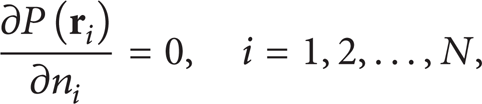
where ni denotes the normal direction from the boundary at

Equation (6) can be written into the system matrix equation:

where the elements of the system matrix
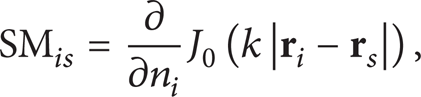
and the elements of the column vector
It may be seen in (7) and (8) that the elements of the system matrix
2.2. Improved Formulation of the NDIF Method
First, (6) is rewritten as

The Bessel function of the first kind of order 1 J1 in (9) is expanded in a Taylor series [22] as follows:

where M denotes the number of terms of the series and
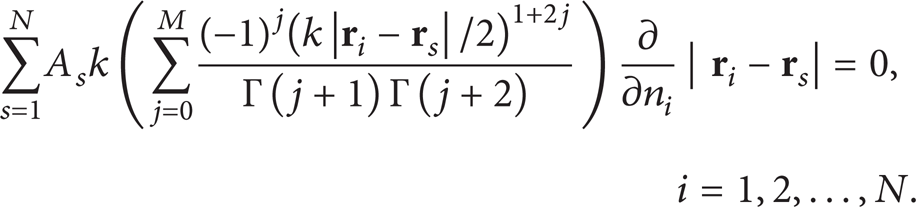
As the first step to extract a system matrix equation having a form of algebraic eigenvalue problem, (11) is rearranged in

For simplicity, (12) is rewritten in

where

Next, (13) is rewritten as a form of polynomial equation with respect to Λ by removing the first summation as follows:

Resolving (15) in factors yields
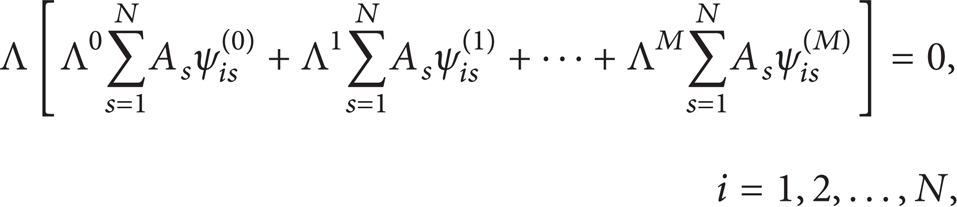
which is divided into

Equation (17) denotes that the first eigenvalue is equal to zero for an acoustic cavity with a rigid-wall boundary condition. The higher eigenvalues may be obtained by changing (18) into a form of algebraic eigenvalue problem. For this purpose, (18) is first expressed in the simple matrix equation:

where the elements of matrix

Equation (19), which is called the higher order polynomial eigenvalue problem [24], may again be changed into the algebraic eigenvalue problem [10] as follows:

where the system metrics

and the vector

Note that the newly obtained final system matrices

3. Verification Examples
The validity and accuracy of the proposed method are shown in numerical tests of circular, rectangular, and arbitrarily shaped acoustic cavities.
3.1. Circular Acoustic Cavity
The proposed method is first applied to a circular acoustic cavity of unit radius where the exact solution [23] is known. As shown in Figure 3, the boundary of the circular cavity is discretized with 16 nodes for the proposed method. Eigenvalues obtained by the proposed method using
Eigenvalues of the circular cavity obtained by the proposed method, the exact method, the NDIF method, and FEM (parenthesized values denote errors (%) with respect to the exact method).


Circular acoustic cavity discretized by 16 boundary nodes.
In addition, mode shapes produced by the proposed method using 16 nodes for M = 20 are presented in Figure 4 and they agree well with those given by the exact method [23], which are omitted in the paper. Note that white regions in the mode shapes are nodal lines, at which the pressure has a minimum value.

Mode shapes produced of the circular cavity by the proposed method using 16 nodes for M = 20.
On the other hand, the accuracy of an eigenvalue obtained by the proposed method can be verified by plotting its mode shape. If the plotted mode shape does not satisfy exactly the given boundary condition (the rigid-wall boundary condition), it may be said that the eigenvalue is not accurate and larger number of nodes and series functions are required to improve its accuracy.
3.2. Rectangular Acoustic Cavity
In this section, a rectangular acoustic cavity with dimensions 1.2 m × 0.9 m is discretized with 24 nodes as shown in Figure 5, where the location and the corresponding normal directions are illustrated. Since the rectangular cavity has 4 corners unlike the circular cavity, the normal directions at the corners are approximately determined by the sum of the two normal vectors for the edges adjacent to each corner.
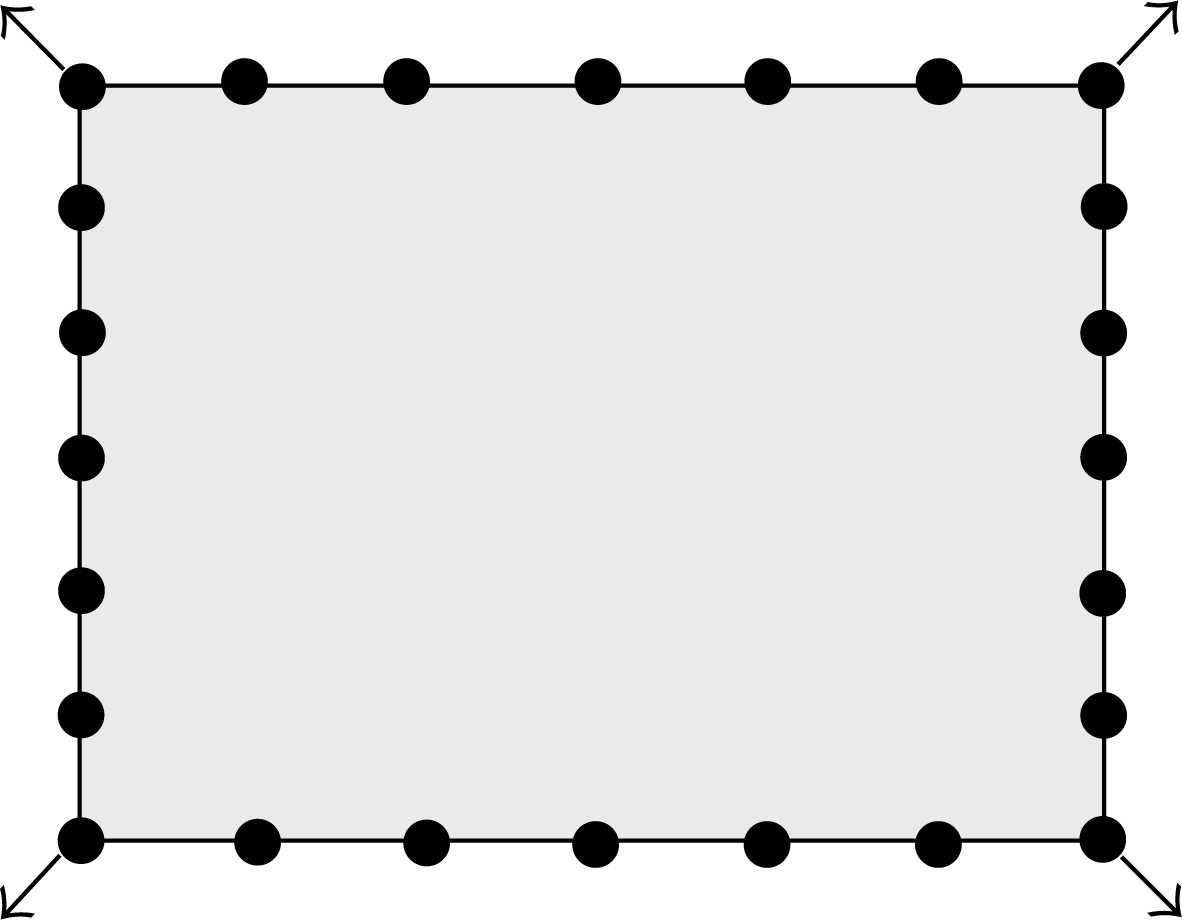
Rectangular acoustic cavity discretized by 24 boundary nodes (the 4 arrows denote the normal directions of the corner nodes).
In Table 2, eigenvalues obtained by the proposed method are compared with those computed by the exact method [23], the NDIF method, and FEM (ANSYS). It may be said that the proposed method using 24 nodes for M = 20 gives accurate eigenvalues within 0.03% error. However, it is noted that the eigenvalues by FEM using 2500 nodes have much larger errors than those by the proposed method. On the other hand, the reason that the sixth eigenvalue by the proposed method has some error unlike that by the NDIF method is that the Bessel function (10) is approximately expanded in a Taylor series.
Eigenvalues of the rectangular cavity obtained by the proposed method, the exact method, the NDIF method, and FEM (parenthesized values denote errors (%) with respect to the exact method).

Figure 6 shows mode shapes obtained by the proposed method, which agree well with those by the exact method [23], which are omitted in the paper.

Mode shapes of the rectangular cavity obtained by the proposed method using 24 nodes for M = 20.
3.3. Arbitrarily Shaped Acoustic Cavity
An arbitrarily shaped cavity whose boundary is composed of a semicircle of unit radius and two equilateral edges
Eigenvalues of the arbitrarily shaped cavity obtained by the proposed method, the NDIF method, and FEM (parenthesized values denote errors (%) with respect to FEM using 1571 nodes).


Arbitrarily shaped acoustic cavity discretized by 16 boundary nodes (the 3 arrows denote the normal directions of the corner nodes).
On the other hand, Figure 8 shows mode shapes obtained by the proposed method, which are in good agreement with those by FEM (ANSYS), which are shown in Figure 9 [2].

Mode shapes of the arbitrarily shaped cavity obtained by the proposed method for using 16 nodes for M = 20.

Mode shapes of the arbitrarily shaped cavity obtained by FEM [2].
4. Conclusion
An improved NDIF method is proposed to more efficiently extract eigenvalues and mode shapes of arbitrarily shaped acoustic cavities. It is revealed that the proposed method yields highly accurate eigenvalues, which converge to the exact solution, and it gives much more accurate eigenvalues than FEM using a large number of nodes thanks to its concise formulation. It is expected that the method presented in the paper can be extended to accurately analyze multiply connected two-dimensional cavities and three-dimensional cavities. Note that the NDIF method does not give accurate results for concave membranes and acoustic cavities [3]. To overcome this problem, a subdomain method of dividing the concave region of interest into several convex regions will be developed in future research.
Conflict of Interests
The authors declare that there is no conflict of interests regarding the publication of this paper.
Footnotes
Acknowledgment
This research was financially supported by Hansung University.