




Abstract
Two-dimensional Green's functions for a line heat source applied in the fluid and pyroelectric two-phase plane are presented in this paper. By virtue of the two-dimensional general solutions which are expressed in harmonic functions, six newly introduced harmonic functions with undetermined constants are constructed. Then, all the pyroelectric components in the fluid and pyroelectric two-phase plane can be derived by substituting these harmonic functions into the corresponding general solutions. And the undetermined constants can be obtained by the interface compatibility conditions and the mechanical, electric, and thermal equilibrium conditions. Numerical results are given graphically by contours.
1. Introduction
Green's functions play an important role in both applied and theoretical studies on the physics of solids. They are a basic building block of a lot of further works. For example, Green's functions can be used to construct many analytical solutions of practical problems. They are also very important in the boundary element method as well as the study of cracks, defects, and inclusions.
For purely elastic or thermoelastic solids, Green's functions had been well investigated and a great deal of work can be found in the literature. Lifshitz and Rozentsveig [1] and Lejček [2] derived Green's functions when a vertical point force acts on the surface of an anisotropic elastic half space by using the Fourier transform method. Elliot [3], Kröner [4], and Willis [5] studied Green's functions by using the direct method. Sveklo [6] studied Green's functions by using the complex method. Pan and Chou [7] studied Green's functions by using the potential function method. In these solutions, the loads can be vertical or horizontal with respect to the boundary plane. When the thermal effects are considered, Melan and Parkus [8] presented Green's functions for a point heat source on the surface of a semi-infinite body. Sharma [9] gave Green's functions of transversely isotropic semi-infinite thermoelastic materials in integral form. Nowacki [10] presented Green's functions for a point heat source in the interior of an infinite body. Yu [11] investigated Green's function for two-phase isotropic thermoelastic materials. By virtue of the general solution of Chen et al. [12], Hou et al. [13] constructed Green's function for a point heat source acting in the infinite, semi-infinite, and two-phase transversely isotropic thermoelastic materials. Besides, Berger and Tewary [14], Kattis et al. [15] obtained two-dimensional Green's functions for the anisotropic thermoelastic materials.
For piezoelectric material with electromechanical coupling, Green's functions have also received much attention. For the dislocation, crack, and inclusion problem in anisotropic piezoelectric solids, Deeg [16], Wang [17], Benveniste [18], Chen [19], and Chen and Lin [20] expressed Green's function in the form of integral representation by using the transform techniques. Pan [21] derived two-dimensional Green's functions of infinite, semi-infinite, and two-phase material by the complex function method. Gao and Fan [22] also gave two-dimensional Green's functions of semi-infinite material. Pan and Tonon [23] and Pan and Yuan [24] derived Green's functions of infinite and two-phase material. With regard to the special case of transversely isotropic piezoelectric material, Sosa and Castro [25], Lee and Jiang [26], and Ding et al. [27] studied two-dimensional Green's functions of infinite, semi-infinite, and two-phase material. Wang and Chen [28] and Zikung and Bailin [29] obtained Green's function for point loads acted on the surface of semi-infinite piezoelectric material. Dunn [30] gave Green's function of infinite piezoelectric material by using Radon transformation. Ding et al. [31] and Dunn and Wienecke [31] obtained Green's functions for the infinite, semi-infinite, and two-phase piezoelectric material in terms of elementary functions, which were employed to study the inclusion problem [32].
When the thermal effects are considered, Qin and Mai [33] derived a series of two-dimensional Green's functions for the anisotropic pyroelectric material with cracks, holes, and inclusions. Chen [34] derived a compact three-dimensional general solution for transversely isotropic pyroelectric materials. In this general solution, all components of the pyroelectric field are expressed by four harmonic functions. Based on this general solution, Chen et al. [35] derived three-dimensional Green's function of transversely isotropic pyroelectric material with a penny-shaped crack. Xiong et al. [36] obtained two-dimensional Green's functions for the semi-infinite pyroelectric material under a line heat source. Hou et al. [37–39] obtained three-dimensional Green's functions for the infinite, semi-infinite, and two-phase pyroelectric material under a point heat source.
In the electrical and mechanical engineering, it is needed not only to study the heat transfer between solid and solid but also to study the heat transfer between solid and fluid (including liquid and gas). In these cases, the mutations of material properties on the interface will result in obvious interface effects. So it is valuable to study the interface effects between solid and fluid as well as those between solid and solid. Green's functions for a line heat source in a fluid and pyroelectric two-phase plane are the fundamental problem in this area. To the authors’ knowledge, some literatures are concentrated on the heat transfer between solid and solid [33, 39, 40], while the literature on heat transfer between solid and fluid is little reported.
Under this background, two-dimensional Green's functions for a line heat source acting in the fluid and pyroelectric two-phase plane are studied in this paper. For completeness, the governing equations and corresponding general solutions which are expressed with harmonic functions are introduced in Sections 2 and 3. Based on these general solutions, six new harmonic functions with undetermined constants are constructed in Sections 4 and 5 for a line heat source acting in the interior of fluid and pyroelectric two-phase plane. All the corresponding pyroelectric components can be obtained by substituting these functions into the general solutions after determining the constants by the interface compatibility conditions and the mechanical, electric, and thermal equilibrium conditions of a rectangle containing the line heat source. Numerical examples are presented at last. All stress components, electric displacement components, and temperature increment are shown graphically by contours.
2. General Solutions for the Orthotropic Pyroelectric Material
If all components are independent of coordinate y, one has the so-called two-dimensional or plane problem. In two-dimensional Cartesian coordinate (x, z) with x- and z-axes parallel with the principal axes of orthotropic pyroelectric material, the constitutive relations are in the form of
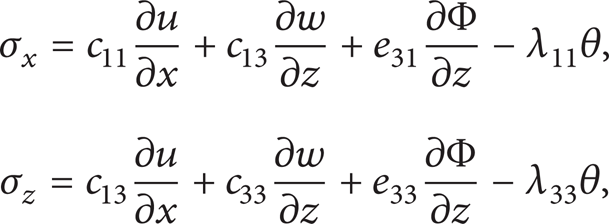
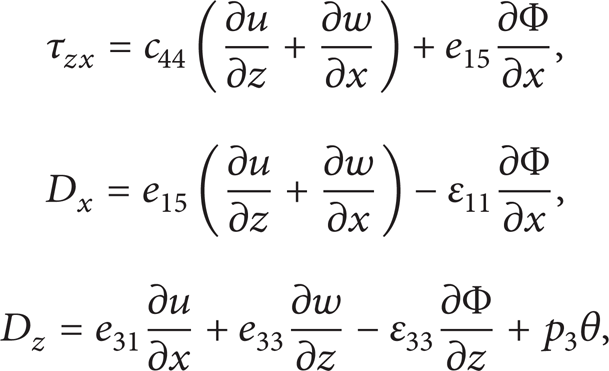
where u and w are components of the mechanical displacement in the x and z directions, respectively; σ ij and D i are the components of stress and electric displacement, respectively; Φ and θ are the electric potential and temperature increment, respectively; c ij , e ij , ε ij , λ ij , and p3 are the elastic, piezoelectric, dielectric, thermal modules, and pyroelectric constants, respectively.
In the absence of body forces and free charges, the mechanical, electric, and heat equilibrium equations are

where β11 and β33 are the heat conduction coefficient of pyroelectric material in the x and z directions, respectively.
By virtue of the method of Chen [34], the two-dimensional general solution of (1a)–(2) can be obtained as follows:


where

and z
j
= s
j
z (j = 1, 2, 3, 4),



where α jm (m = 1, 2, 3) are the same constants defined in Chen [34]. It should be noted that the general solutions given in (3a) and (3b) are only valid for the case when the eigenvalues s j (j = 1, 2, 3, 4) are distinct, which is the most common case.
3. General Solutions for the Fluid
In two-dimensional Cartesian coordinate (x, z), the constitutive relation of electric field in fluid is

where ε is the dielectric constant of fluid. The electric and heat equilibrium equations of fluid are

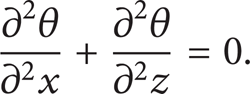
Substitution of (7) into (8) yields

For the convenience to construct the solution, two functions ψθ and ψΦ are introduced, which are parallel with the ψ j in the general solution of (3a) and (3b) for the pyroelectric material. The general solutions of (9) and (10) can be expressed in form of
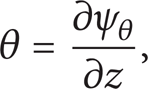

where the functions ψθ and ψΦ satisfy the following harmonic equations:

Substitution of (12) into (7) yields

Comparing the general solutions of pyroelectric material and fluid in (3a), (3b), (11), (12), and (14), one can find that the temperature increment in (11) of fluid phase can be treated as a degenerate case of that in (3a) and (3b) of the pyroelectric phase, while the electric potential and electric displacements in (12) and (14) of fluid phase cannot be treated as a degenerate case of the pyroelectric phase. This is because the electric field and mechanical field are coupled and the three eigenvalues s j (j = 1, 2, 3) in the general solution of (3a) and (3b) for pyroelectric phase cannot be degenerated.
By virtue of general solutions in (3a), (3b), (11), (12), and (14), which are expressed in harmonic equations, Green's functions for a line heat source applied in the fluid and pyroelectric two-phase plane will be studied in the following sections.
4. Green's Functions for a Line Heat Source Acting in the Pyroelectric Material
Figure 1 shows the fluid and orthotropic pyroelectric two-phase plane in the two-dimensional Cartesian coordinate (x, z) with the interface z = 0 being parallel with the principal axes of orthotropic pyroelectric material. A line heat source H is applied in the interior of pyroelectric material and acts at the line (0, h).
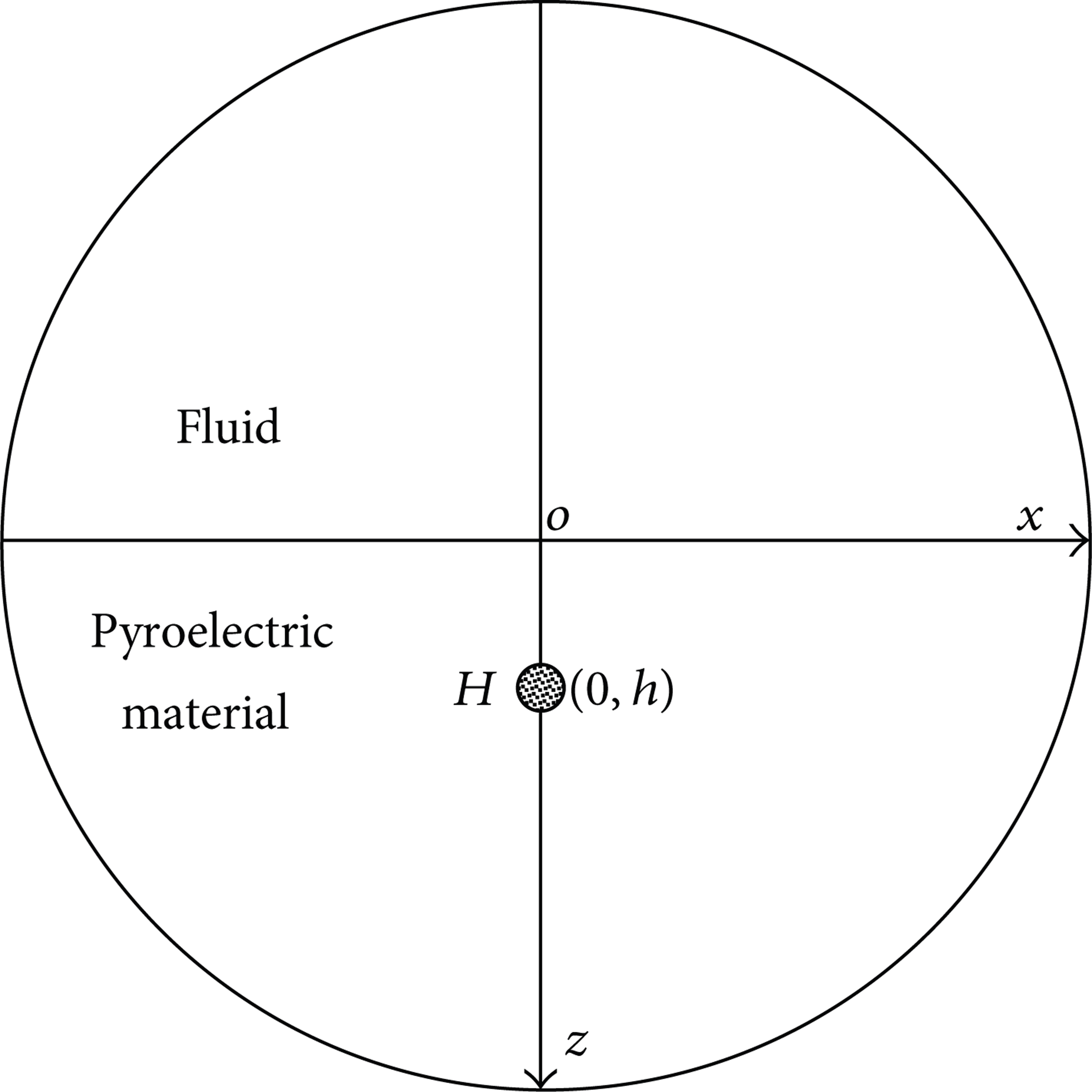
A fluid and pyroelectric two-phase plane applied by a line heat source of strength H in the interior of pyroelectric material.
The interface between the fluid and pyroelectric material is free, so that the corresponding compatibility conditions on the interface z = 0 are in the form of



where
For future reference, a series of denotations are introduced as follows:

In the pyroelectric material z ≥ 0, the harmonic functions can be assumed as

where
Substitution of (17) into the general solution in (3a) and (3b) yields the expressions of coupled field as follows:
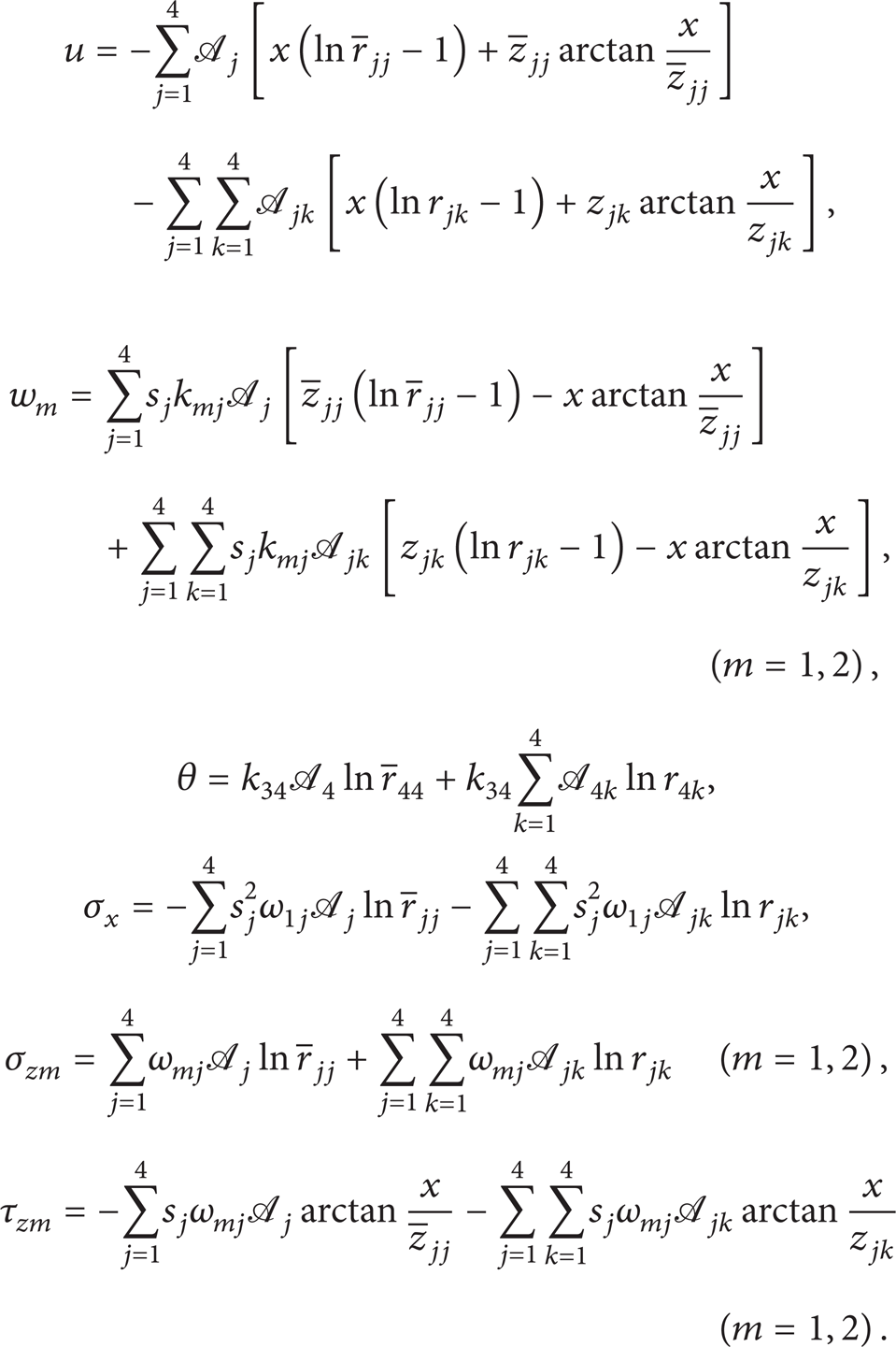
In the fluid z ≤ 0, the harmonic functions ψθ and ψΦ can be assumed as


where
Substitution of (19) and (20) into general solutions in (11), (12), and (14) yields
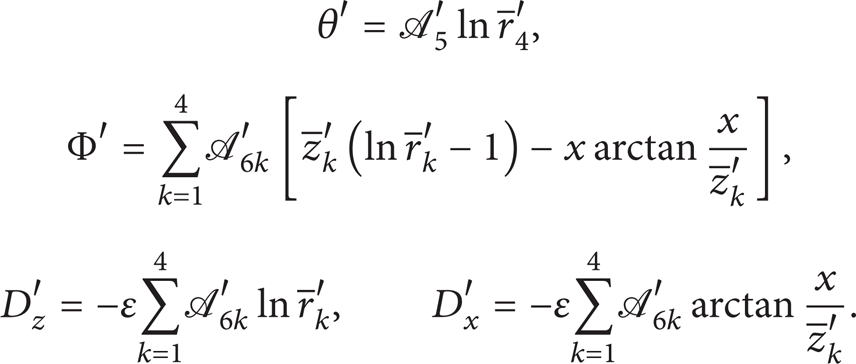
Consideration of the continuities on plane z = h for w
m
and τ
zm
, whose expressions in (19) contain the function of


Substitution of ω mj in (6b) into (23) gives


By virtue of (22), (24a) and (24b) can be simplified to one equation as follows:

When the mechanical, electric, and thermal equilibriums for a rectangle of a1 ≤ z ≤ a2 (a1 < h < a2) and − b ≤ x ≤ b are considered (Figure 2), three additional equations can be obtained:


A rectangle containing the line heat source H in the interior of pyroelectric material.
Some useful integrals are listed as follows:

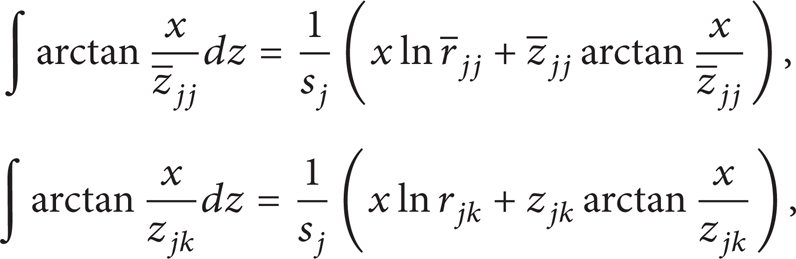


It is noted that integral in (27d) is not continuous at z = h for the function

Substituting (18) into (26a) using integrals in (27a) and (27b), one can obtain

where


That is, (29) and (26a) are satisfied automatically.
Substituting (18) into (26b) using

where


Thus,

When the coupled field in interface z = 0 is considered, one has

Substitution of (18) and (21) into compatibility conditions in (15a), (15b), and (15c) using








Thus,
5. Green's Functions for a Line Heat Source Acting in the Fluid
Figure 3 shows the fluid and orthotropic pyroelectric two-phase plane in two-dimensional Cartesian coordinate (x, z) with the interface z = 0 being parallel with the principal axes of orthotropic pyroelectric material. A line heat source H is applied in the interior of fluid and acts at the line (0, h).
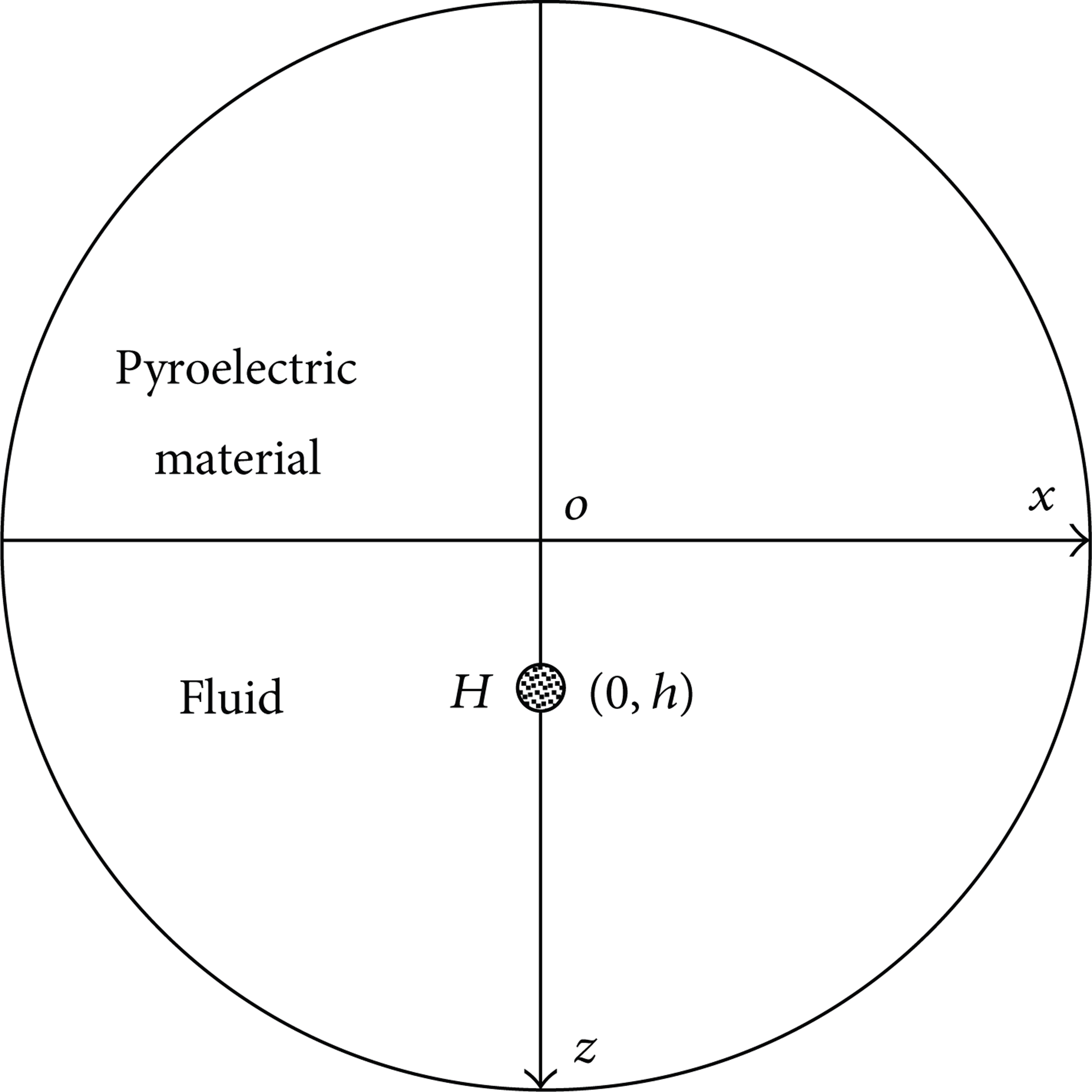
A fluid and pyroelectric two-phase plane applied by a line heat source of strength H in the interior of fluid.
The interface between the fluid and pyroelectric material is free, so that the corresponding compatibility conditions on the interface z = 0 are in the form of


where
For future reference, a series of denotations are introduced as follows:

where s j ′ (j = 1, 2, 3, 4) are the eigenvalues of pyroelectric material z ≤ 0.
In the pyroelectric material z ≤ 0, the harmonic functions can be assumed as

where
Substitution of (43) into the general solution in (3a) and (3b) yields the expressions of pyroelectric field as follows:

In the fluid z ≥ 0, the harmonic functions ψθ and ψΦ can be assumed as

where
Substitution of (45) into general solutions in (11), (12), and (14) yields
When the electric and thermal equilibriums for a rectangle of a1 ≤ z ≤ a2 (a1 < h < a2) and − b ≤ x ≤ b are considered (Figure 4), two additional equations can be obtained:


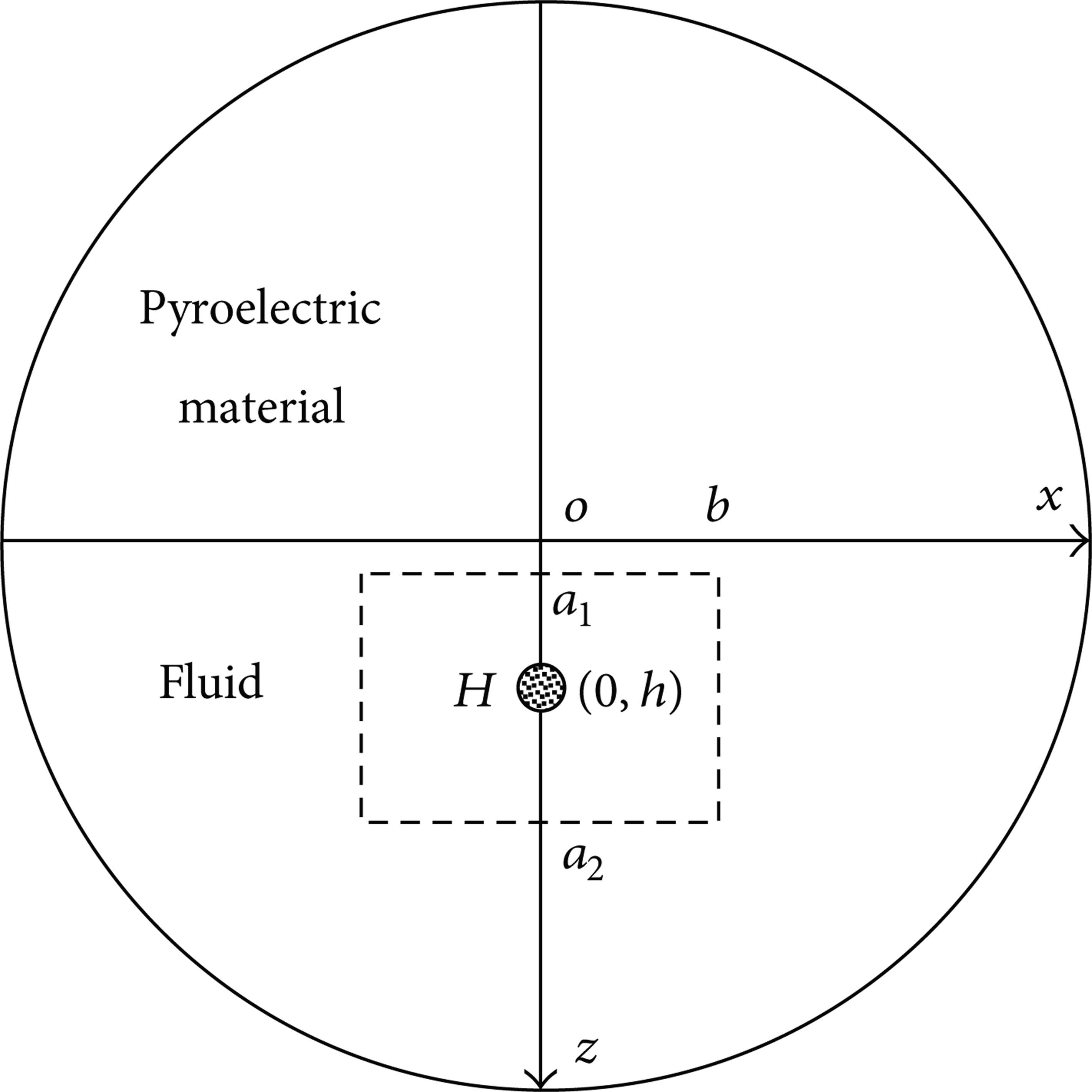
A rectangle containing the line heat source H in the interior of fluid.
Some useful integrals are listed as follows:


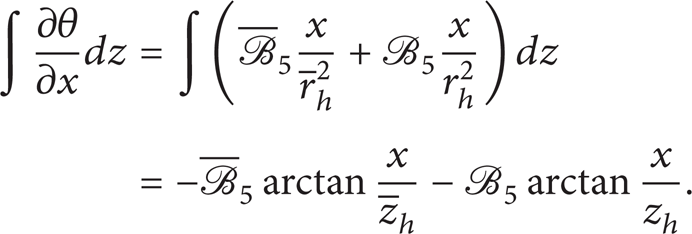
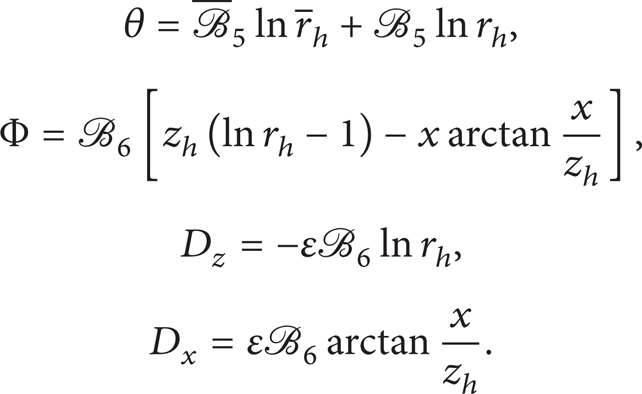
It is noted that integral (48d) is not continuous at z = h for the function

Substituting (46) into (47a) using integrals in (48a) and (48b), one can obtain

where

That is, (50) and (47a) are satisfied automatically.
Substituting (46) into (47b) using integrals in (48c), (48d), and (49), one can obtain

where
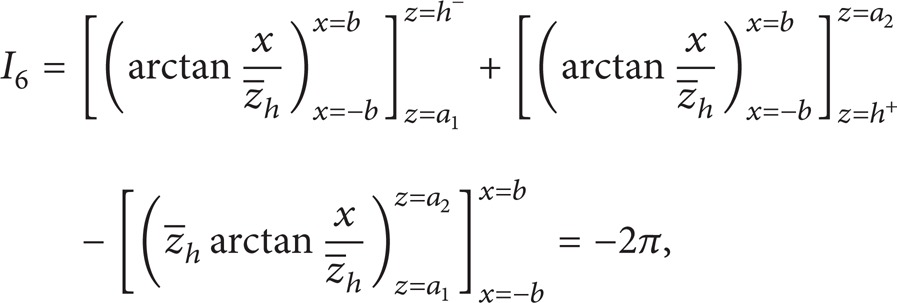

Thus,

When the coupled field in interface z = 0 is considered, one has

Substitution of (44) and (46) into compatibility conditions in (41a), (41b), and (41c) using (55) yields
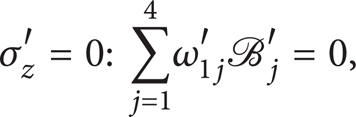


Thus,
6. Numerical Results
Numerical calculation based on the obtained solution will be done and the corresponding contours of the components will be plotted in this section. Based on these contours, one can study the coupled fields in this fluid and pyroelectric two-phase plane, especially the interface effect between the fluid with pyroelectric material. And this can contribute to the analysis and design of pyroelectric devices. The material properties of cadmium selenide [38] and electrical properties of air are used (dielectric constants of air are ε = 8.85 × 10⁻¹² C2N−1 m−2).
The following nondimensional components are used in the figures:

where α r and T r are the thermal expansion coefficient and reference temperature, respectively.
In this case, (33) and (54) should be rewritten in the following nondimensional form:

where δ is a nondimensional line heat source defined as follows:

Here let δ = 1. And the different heat conduction coefficients β = 0.01, 0.1, 1, 10, 100 WK−1 m−1 of the fluid are taken to show its influence on the distributions of the coupled components.
6.1. Results for a Line Heat Source Applied in the Pyroelectric Material (Cadmium Selenide)
The contours of nondimensional electric displacement
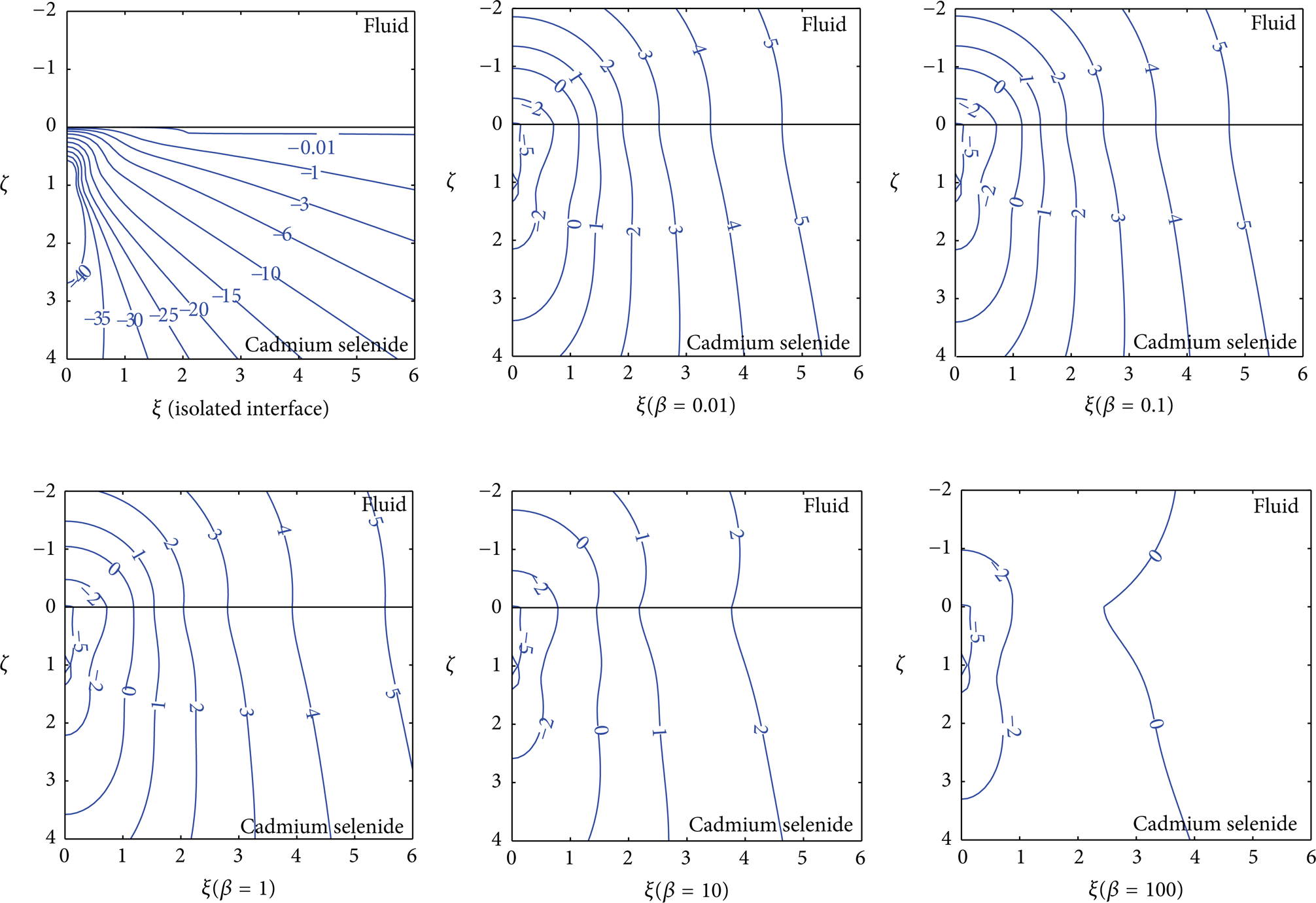
Contour of nondimensional electric displacement Dζ × 102 under a line heat source of strength δ = 1 at line (0, 1) in the interior of cadmium selenide.

Contour of nondimensional normal stress σζ × 102 under a line heat source of strength δ = 1 at line (0, 1) in the interior of cadmium selenide.
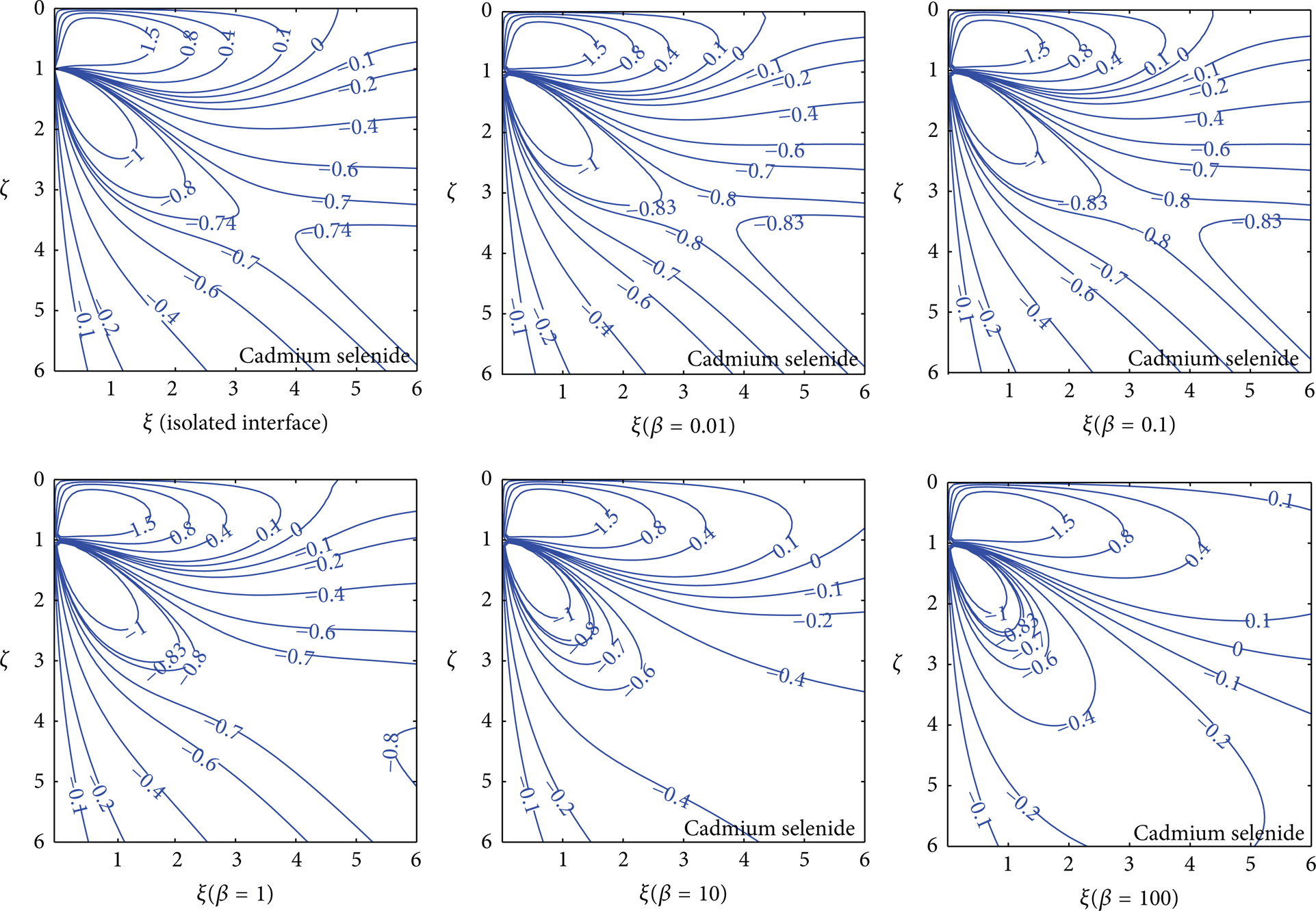
Contour of nondimensional shear stress τζξ × 102 under a line heat source of strength δ = 1 at line (0, 1) in the interior of cadmium selenide.
Figure 5 shows the contour of nondimensional electric displacement Dζ × 102 for the line heat source acting in the cadmium selenide. One can find that the contour in the case of isolated interface is much different from those in the case of nonisolated interface. In addition, it can be found that the electric displacement is continuous at the interface and satisfies the compatibility conditions on the interface in (15a), (15b), and (15c). On the contrary, the gradient of electric displacement is discontinuous at the interface and this is caused by the interface effect between the fluid and pyroelectric material. It can also be found that this interface effect is much more obvious when the heat conduction coefficient of the fluid becomes large. The distributions of electric displacement are also obviously different for the different heat conduction coefficient of the fluid.
Figures 6 and 7 show the contours of nondimensional stresses σζ × 102 and τζξ × 102 for the line heat source acting in the cadmium selenide. One can find that the contour in the case of isolated interface is little different from those in the case of nonisolated interface. It can be found that these two stresses are continuous at the interface and satisfy the compatibility conditions on the interface in (15a), (15b), and (15c). In addition, the distributions of two stresses are not obviously different for the different heat conduction coefficient of the fluid. This notifies us that the stress field can be obtained from the simplified case of isolated interface while the electric displacement cannot be obtained by this simplified case.
6.2. Results for a Line Heat Source Applied in the Fluid (Air)
The contours of nondimensional electric displacement

Contour of nondimensional electric displacement Dζ × 102 under a line heat source of strength δ = 1 at line (0, 1) in the interior of fluid.
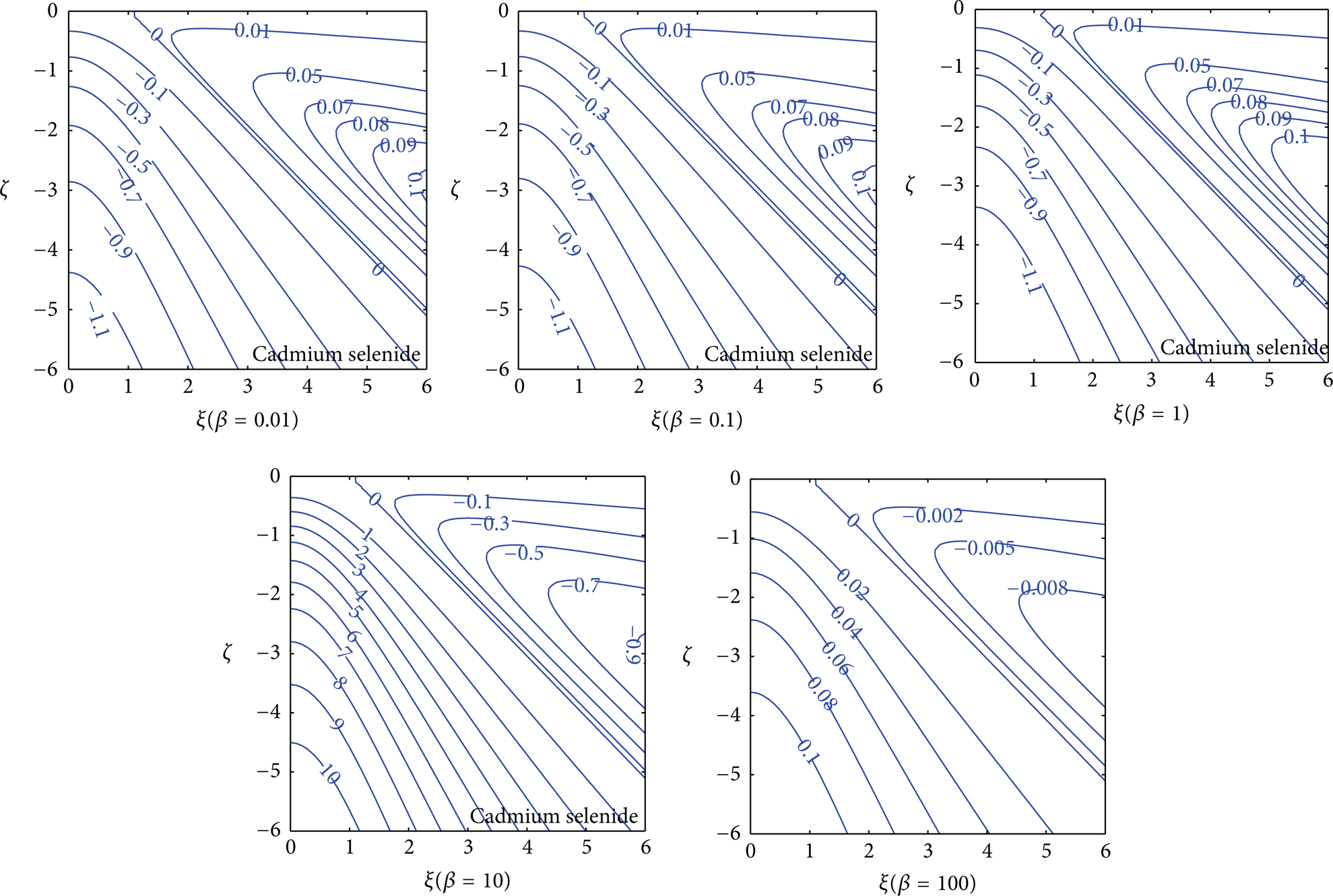
Contour of nondimensional normal stress σζ × 102 under a line heat source of strength δ = 1 at line (0, 1) in the interior of fluid.

Contour of nondimensional shear stress τζξ × 102 under a line heat source of strength δ = 1 at line (0, 1) in the interior of fluid.
Figure 8 shows the contour of nondimensional electric displacement Dζ × 102 for the line heat source acting in the fluid. It can be found that the electric displacement is continuous at the interface and satisfies the compatibility conditions on the interface in (15a), (15b), and (15c). On the contrary, the gradient of electric displacement is discontinuous at the interface and this is caused by the interface effect between the fluid and pyroelectric material. It can also be found that this interface effect is much more obvious when the heat conduction coefficient of the fluid becomes large. The distributions of electric displacement are also obviously different for the different heat conduction coefficient of the fluid. In addition, it can be found that the electric displacement will be in the largest state when the heat conduction coefficient β approaches 10 WK−1 m−1. These characteristics can be used to design the pyroelectric sensors with the high sensitivity.
Figures 6 and 7 show the contours of nondimensional stresses σζ × 102 and τζξ × 102 for the line heat source acting in the fluid. It can be found that these two stresses are continuous at the interface and satisfy the compatibility conditions on the interface in (15a), (15b), and (15c). In addition, the distributions of two stresses are obviously different for the different heat conduction coefficient of the fluid. Similar to the electric displacement, these two stresses will be in the largest state when the heat conduction coefficient β approaches 10 WK−1 m−1. It is known that the heat conduction coefficient of cadmium selenide is 9.0 WK−1 m−1, so this phenomenon may be connected to this material constant. And these characteristics can be used to design the pyroelectric actuators with the desired performance.
7. Conclusion
Six harmonic functions in (17), (19), (20), (43), and (45) are constructed and two-dimensional Green's functions for a line heat source acting in the interior of fluid and pyroelectric two-phase plane had been presented in this paper. Based on the principle of superposition, the obtained Green's functions can be used to derive the coupled field for an arbitrary heat loading, which widely exists in engineering. In addition, the obtained Green's functions are essential in the boundary element method as well as the study of cracks, defects, and inclusions. Because the obtained solutions are expressed explicitly in terms of elementary functions, it is convenient to use them. Typical numerical examples are presented. Some valuable conclusions for the interface effect are obtained. This work can serve for the accurate analysis and design of the pyroelectric devices, as well as many engineering practices related to the studies of the interaction between the fluid and pyroelectric material.
Conflict of Interests
The authors declare that there is no conflict of interests regarding the publication of this paper.
Footnotes
Acknowledgments
The authors thankfully acknowledge the financial support from National Natural Science Foundation of China (no. 51107110) and Zhejiang Provincial Natural Science Foundation of China (Grant no. LY13E07004).