




Abstract
This paper is concerned with the steady flow of a Maxwell fluid between two porous disks rotating with the same angular velocity about noncoincident axes normal to the disks. An exact solution to the problem depending on the Deborah number, the suction/injection velocity parameter, and the Reynolds number is obtained. It is shown that the core of fluid tends to rotate about the z-axis that characterizes the line in equal distance to the two axes of rotation when the Deborah and Reynolds numbers increase and a thinner boundary layer occurs in the region adjacent to the top disk when the axial velocity of fluid that is based on the suction/injection velocity parameter is upward. In addition, an approximate solution is presented for small Deborah numbers. The comparison between the exact and approximate solutions is given and found to be in excellent agreement.
1. Introduction
Non-Newtonian fluids have obvious importance in the industry and engineering. Hence, the interest in the flow analysis of non-Newtonian fluids has increased considerably during the past few decades. The constitutive equations of non-Newtonian fluids such as polymer solutions, greases, melts, muds, emulsions, paints, jams, soaps, shampoos, and certain oils are more nonlinear and of higher order than the Navier-Stokes equations. Because of the difficulty to suggest a single model which exhibits all properties of non-Newtonian fluids, there are many constitutive equations proposed. The non-Newtonian fluids are mainly classified into three types, that is, differential, rate, and integral. The simplest subclass of rate type fluids is the Maxwell model. This model is capable of describing relaxation time phenomena. The properties of polymeric fluids can be explored by the Maxwell model for small relaxation time. However, in some more concentrated polymeric fluids, the Maxwell model is also useful for large relaxation time. Maxwell fluids include glycerin, toluene, crude oil, flour doughs, and dilute polymeric solutions.
While there are a large number of solutions that form the basis of several viscometers and rheometers, only a few of them are actually dynamically possible. One such motion is the flow that occurs in an orthogonal rheometer consisting of two parallel disks rotating with the same angular velocity about noncoincident axes. This instrument was originally developed by Maxwell and Chartoff [1]. In this domain, Abbott and Walters [2] obtained an exact solution for the flow of a Newtonian fluid. They also carried out a perturbation analysis in the case of a viscoelastic fluid. Later, Berker [3] showed that there is the existence of an infinite number of nontrivial solutions to the Navier-Stokes equations in the orthogonal rheometer. This motion falls under the category of “pseudo-plane motions”. A single solution requires a symmetric flow for both noncoaxial and coaxial rotations. In the case of coaxial rotation, the solution corresponds to the rigid body motion. Rajagopal and Gupta [4] both established an exact solution for the flow of a second-grade fluid between eccentric rotating disks and studied the stability of this flow. Rajagopal [5] also studied the problem for a second order fluid whose normal stress moduli do not obey the relations α1 ≥ 0 and α1 + α2 = 0. Rajagopal [6] showed that the motion represented by Berker [7], who considered the solutions that are not axially symmetric when the disks rotate about a common axis, is one with constant stretch history. This result was also established, independently, by Goddard [8]. Later, Rajagopal and Wineman [9, 10] examined this problem for a special subclass of the K-BKZ type. Rajagopal et al. [11] obtained numerical solutions for the Currie model of the K-BKZ fluid. The flow was extended to fourth order fluid by Kaloni and Siddiqui [12]. Bower et al. [13] studied a more general class of K-BKZ fluids which exhibits shear thinning. Zhang and Goddard [14] reexamined the flow in the paper by Rajagopal et al. [11]. In a similar manner, Dai et al. [15] studied the flow of a Currie fluid in detail. Rajagopal [16] obtained an exact solution for the flow of an Oldroyd-B fluid. Al Khatib and Wilson [17] investigated the flow of Bingham fluids in an orthogonal rheometer. Other extensions of this type of flow to a Burger fluid and to a generalized Burger fluid were studied by Ravindran et al. [18] and Le Roux and Patidar [19]. A detailed list of references about the flow of non-Newtonian fluids in an orthogonal rheometer can be found in [20–22]. We also refer the reader to the studies by Fetecau et al. [23] and by Shahid and Rana [24] for flows of Maxwell fluids.
Although the flow equations of non-Newtonian fluids are more subtle in comparison with the Newtonian fluids, some investigators are engaged in obtaining analytical solutions for flows of non-Newtonian fluids. In this paper, an exact solution corresponding to the steady flow of a Maxwell fluid between two porous disks rotating with the same angular velocity about distinct axes is obtained. The results obtained for the velocity field depending on the Deborah number, the suction/injection velocity parameter, and the Reynolds number are presented. Also, an approximate solution for small Deborah numbers is given. It is shown that the approximate solution has an excellent agreement with the exact solution.
2. Basic Equations and Solution
The flow field of problem is bounded by two porous disks located at z = ± h. The top disk rotates about the z′-axis and the bottom disk rotates about the z″-axis with the same angular velocity Ω. The distance between two rotating axes is

Flow geometry.
The Cauchy stress tensor


where p denotes the pressure,
The governing equations are


where ρ is the density of fluid.
We seek a solution for the velocity field which is of the form

where u, v, and w are the x, y, and z-components of the velocity, respectively, and w is a constant as a result of (5). The direction of w is upward, so w0 is taken to be positive.
The corresponding boundary conditions are taken to be
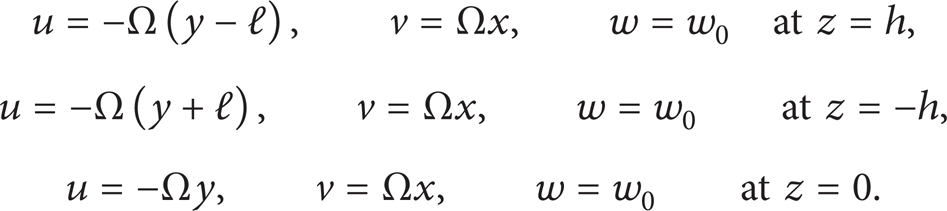
The conditions for f(z) and g(z) from (6)–(7) are

It is natural to assume that the extra stress tensor





where a prime denotes differentiation with respect to z. The solution of (14) gives S zz = Cexp(− z/(λw0)), where C is a constant. We will investigate the possibility of a solution to the steady problem in which C = 0 [25] (also see [26–28] for unsteady flows). Furthermore, we note that S zz is zero for a Newtonian fluid.
We obtain the following equation by using (11) and (13):

where
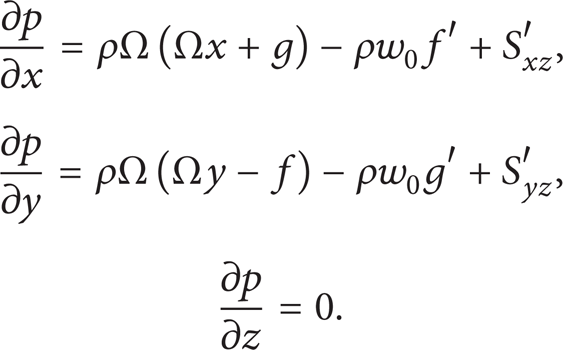
Using (16), we obtain

Combining (15) and (17), we have

where E is a constant that can be determined from the boundary conditions. Let us define the following nondimensional quantities:
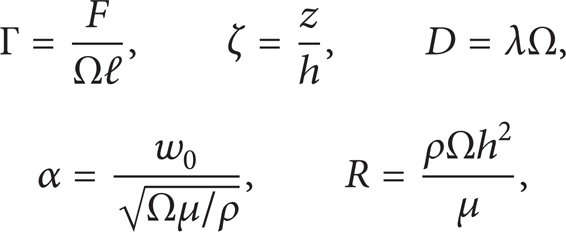
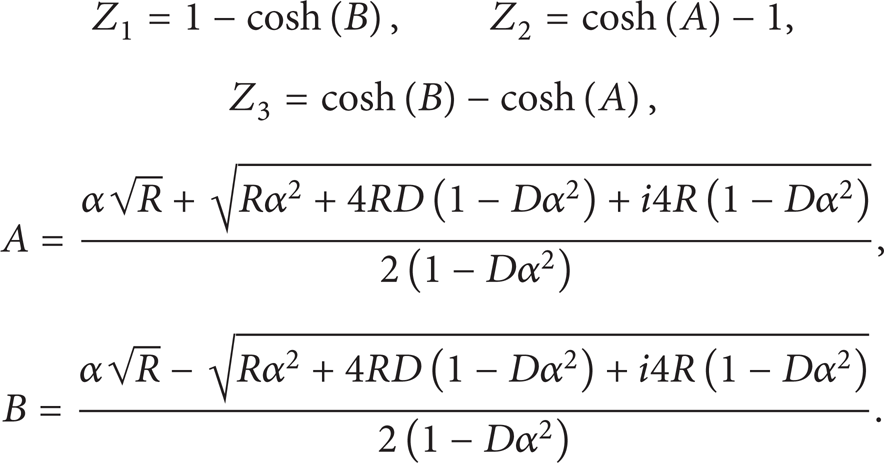
where D is the Deborah number, α is the suction/injection parameter, and R is the Reynolds number. The solution of (18) with the conditions Γ(± 1) = ± 1 and Γ(0) = 0 is

where
Figures 2–4 illustrate the variations of

Variation of

Variation of
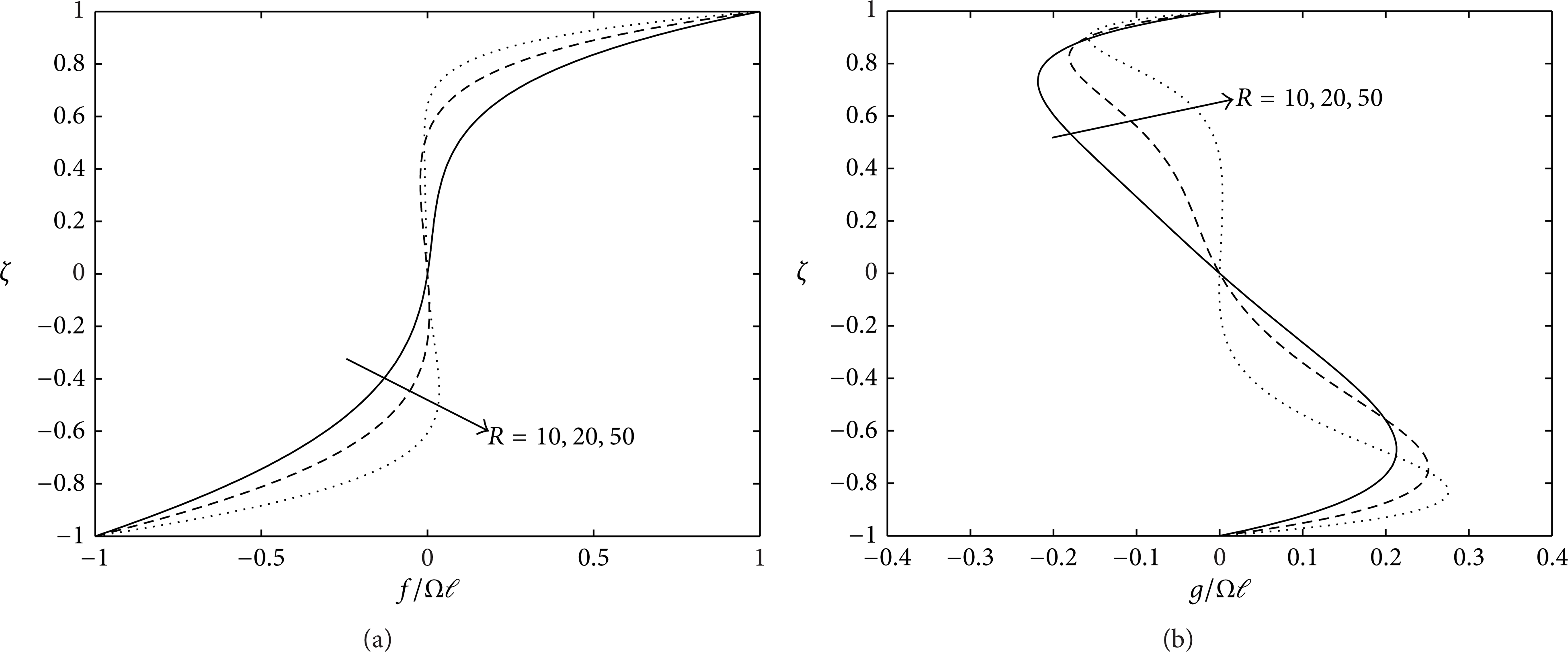
Variation of
3. Solution for Small Deborah Numbers
In this section, our interest is to find a solution corresponding to small Deborah numbers and to compare with the exact solution. We expand the unknowns in terms of the Deborah number in the form
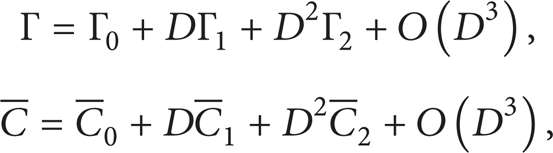
where

The appropriate conditions are

The solutions to (23) subject to (24) are

where

Figures 5, 6, and 7 depict the real and imaginary parts of Γ0, Γ1, and Γ2 for α = 0.2 and R = 20.

Variation of Re(Γ0) and Im(Γ0) with ζ (α = 0.2, R = 20).

Variation of Re(Γ1) and Im(Γ1) with ζ (α = 0.2, R = 20).

Variation of Re(Γ2) and Im(Γ2) with ζ (α = 0.2, R = 20).
Table 1 is constructed to see the agreement between the exact and approximate solutions. From this table, an excellent agreement is observed for small values of the Deborah number.
Comparison of exact and approximate solutions (ζ = 0.8, α = 0.2, R = 20).

4. Results and Discussion
When two porous disks rotate about distinct axes with the same angular velocity Ω, there exists a single point about which the fluid layer rotates as a rigid body with the angular velocity Ω in each z = constant plane and the axial component of velocity becomes constant as a result of the continuity equation in the entire flow domain. The coordinates of this point mentioned are given by x = − g(z)/Ω and y = f(z)/Ω for − h ≤ z ≤ h. Since the axial velocity of fluid is chosen in the z-direction, the top disk is subjected to a uniform suction whereas there is a uniform injection at the bottom disk.
The exact solution of the velocity field is presented for a Maxwell fluid which represents a model of non-Newtonian fluids and the results are obtained with the help of Figures 2–4. Figure 2 shows the effect of the Deborah number that is a measure of the relaxation time. It is shown that the fluid behaves like an elastic material for large Deborah numbers. Figure 3 illustrates the variation of suction/injection velocity parameter that is based on the axial velocity of fluid. It is seen that its increase leads to a boundary layer at the top disk. Figure 4 is devoted to examine the effect of the Reynolds number. It is observed that the thickness of boundary layers near the top and bottom disks decreases with the increase of Reynolds number.
5. Conclusions
In this paper, the steady flow of a Maxwell fluid between two porous disks rotating with the same angular velocity about noncoaxial axes is studied. The main observations of the performed analysis are presented below.
When the Deborah number increases, the fluid layers in the central region of fluid tend to rotate about the z-axis. The curves about which the fluid layers rotate are closer to the z-axis in the region near the top disk. Increasing the Deborah number gives rise to thin boundary layers. The space curves whose points have only the axial velocity component are longer for a Newtonian fluid.
When the suction/injection velocity parameter increases, the space curves get closer to the z-axis in the region adjacent to the top disk. It is observed that this parameter causes the thinning of the boundary layer near the top disk.
An increase in the value of the Reynolds number shows that the space curves in the core region coincide with the z-axis. This means that the fluid layers having the axial velocity w0 rotate with the angular velocity Ω about the z-axis in the middle region. The increase of the Reynolds number brings about the boundary layers developing on both disks.
One of the most important results in this paper is that the problem produces an exact solution despite the non-Newtonian character of fluid under consideration. In order to compare with the exact solution, an approximate solution for small Deborah numbers is derived. It is shown that both the solutions have an excellent agreement.
Conflict of Interests
The author declares that there is no conflict of interests regarding the publication of this paper.
Footnotes
Acknowledgments
The author would like to express his sincere thanks to the referees for their valuable comments and suggestions.