Healthcare service sector is one of the major applications of Wireless Sensor Networks (WSNs) acknowledged as Wireless Medical Sensor Network (WMSNs). It deploys tiny medical sensor-nodes (MS-nodes) on the body of the patient to sense crucial physiological signs which can be accessed and analyzed by registered medical professionals. Recently, Khan et al. analyzed Kumar et al.'s scheme proposed for healthcare applications using WMSNs and observed that the scheme is susceptible to many security weaknesses if an adversary extracts the information from the lost smart card of some user. The adversary can access patient's physiological data without knowing actual password, can deceive medical professionals by sending fake information about patients, can guess the password of a user from the corresponding smart card, and so forth. Besides, the scheme fails to resist insider attack, lacks user anonymity and the session key shared between the user and the MS-node is insecure. To overcome these problems, we propose an improved user authentication scheme for healthcare applications using WMSNs. We show that the scheme is free from the identified weaknesses and excels in performance and efficiency scheme.
1. Introduction
Healthcare sector is witnessing a transition from traditional human-labor-dependent services to technology-based smart services. This changeover is the outcome of Wireless Medical Sensor Networks (WMSNs), a transmission technology employed by medical professionals (like nurses, doctors, etc.) to obtain the information like blood pressure, pulse rate, body temperature, ECG of the patients. This is achieved by deploying tiny MS-nodes like blood pressure sensors, pulse oximeter, body temperature sensors, and ECG electrodes on the body of patient. The MS-nodes sense physiological information from patient's body and then transmit it to the professionals in a wireless manner. Consequently, it cuts the cost of the human labor required for the purpose and facilitates the health professionals to observe and treat the patients as and when required. But patient's personal medical data may be misused by adversaries like corrupt persons, personal enemies, health insurance professionals, and so forth. Thus, there is need for the security of WMSNs to ensure access to patient's physiological information only to the authorized health professionals. Employing a user authentication scheme is a suitable method to achieve the desired security and establish a secure, efficient, and reliable healthcare environment via WMSNs.
After the development of simple user authentication schemes like [1–6], schemes for Wireless Sensor Networks (WSNs) [7–13] have also attracted a large community of researchers. Some work has also been proposed for healthcare applications using WSNs [14–17]. In 2012, Kumar et al. [18] observed that most of the schemes proposed for WSNs such as [9, 10, 12, 13] fall short to provide security and also require heavy computational load and high communication cost. They proposed a user authentication scheme using WMSNs for healthcare applications and called it an Efficient-Strong Authentication Protocol (E-SAP) [18]. They claimed that their scheme achieves mutual authentication between the user and the MS-node and also establishes session key between them. They found their scheme finer than other existing protocols concerning cost, performance, and security. Subsequently, Khan et al. [19] identified that the scheme of Kumar et al. suffers from many security problems if an adversary extracts the information from the stolen smart card of some user. As a consequence, the scheme is exposed to user impersonation attack and insecure session key generation between user and MS-node. They showed that the scheme does not go with the authors’ claim as the mutual authentication between user and MS-node does not imply properly and an adversary can compute the session key to be established between. They also pointed out password guessing attack, insider attack, and MS-node impersonation attack on it. They found that if the identity of any user is revealed, it gives chance to many unauthorized/illegal persons to gain the personal medical data of patients and thereby generates problems for an authorized professional.
We feel that in addition to resist the prevalent threats, a user authentication scheme for WMSN should also provide user anonymity. Therefore, we propose a user anonymous authentication scheme using WMSNs eradicating the identified weaknesses of Kumar et al.'s scheme. We aim to provide perfect mutual authentication and secure session key generation between the active participants of the authentication protocol in the scheme. The rest of the paper is arranged as the description follows for the subsequent sections. Section 2 briefly explains the architecture of WMSN and its benefit in healthcare applications. Kumar et al.'s scheme is reviewed in Section 3. Section 4 gives review of the analysis of Kumar et al.'s scheme by Khan et al. The proposed scheme is illustrated in Section 5 along with its security analysis and performance comparison in presented by Sections 6 and 7, respectively. To end with, Section 8 gives the conclusion of this paper. In this paper, we use professional and user interchangeably.
2. Architecture of WMSN and Its Benefits in Healthcare Services
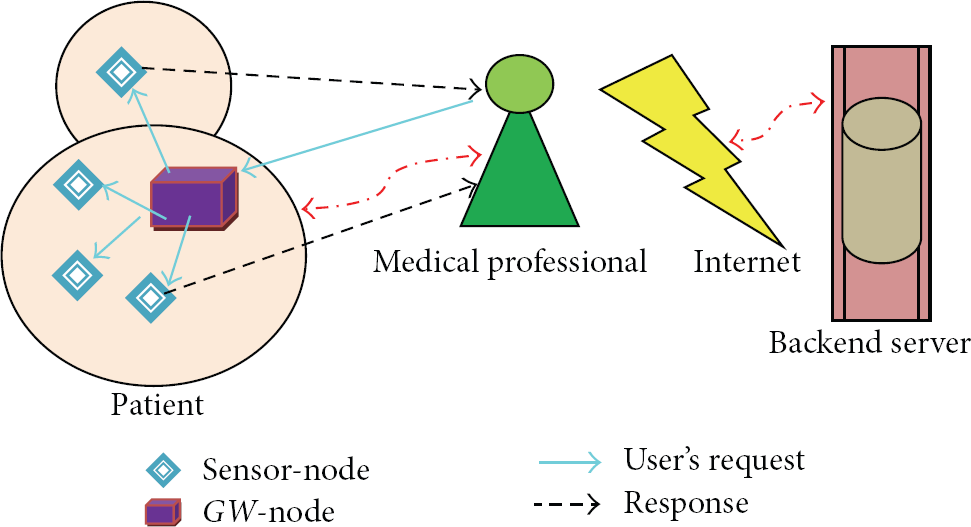
The architecture of the Wireless Medical Sensor Network is depicted by Figure 1. There are four parties involved in the user authentication protocol employing WMSN as described below:
Users: medical professionals like nurses, doctors, and so forth, looking for physiological data of the patient via WMSN.
MS-nodes: tiny sensors like temperature sensor, pulse oximeter, and so forth, deployed on the body of the patients.
GW-node: a powerful master node which plays the role of the registering authority and acts as an interface between the user and the MS-node.
Patients: they are under vigilance of medical professionals by means of MS-nodes for treatment.
First three participants are the active parties of the user authentication scheme. MS-nodes are tiny sensor having low processing power, limited computational capabilities, and limited energy and storage capacity [20]. GW-node is a powerful node with sufficiently large processing power, computational capabilities, and energy and storage capacity [20]. A user registers itself to the GW-node to become a valid user of the system. Whenever a user (medical professionals) wishes to obtain the physiological data of the patient, he transmits request message to the GW-node. Afterwards, the GW-node verifies the legitimacy of the user, if satisfied then it directs the desired MS-node(s) to answer to the user's request.
Architecture of WMSN.
Benefits of WMSN in providing healthcare services are as follows:
Improvement in healthcare services,
Uninterrupted monitoring of patients,
Saving human labor, time, and money,
Protecting sensitive and private medical data of the patient from various adversaries.
3. Review of the Scheme Proposed by Kumar et al.
Initially, the GW-node chooses three secret keys denoted as J, Kand Q, each of 256 bits. The GW-node also shares a secret key with all deployed MS-nodes by means of some key agreement method [21, 22]. The scheme has five phases each of which are described in succession. But before giving detail of each phase of the scheme, we summarize the notations and description used throughout the paper in Notations.
3.1. User Registration Phase
The user (professional) U registers itself to the GW-node in registration center of the hospital, in the following manner:
user submits his chosen identity and password to GW-node using a secure channel;
on receiving , the GW-node computes and ;
GW-node stores intoa SC and issues to U, where Kis a long-term secretkey of the GW-node.
3.2. Patient Registration Phase
A patient has to register itself in registration center of the hospital [23]. Patient submits her/his name to the registration center. On receiving patient's name, the registration center chooses a suitable medical sensor kit (i.e., MS-nodes and GW-node) according to the disease of the patient and assigns medical professionals (users). Then the registration center transmits the identity of the patient along with medical sensors kit information to the assigned professionals/users. Finally, a technician deploys MS-node on the body of the patient.
3.3. Login Phase
A professional logs in to the GW-node in order to gain patients’ medical data via WMSN. The user inserts her/his SC into the smart card reader and inputs and . Then the SC performs the following:
It calculates and compares with the stored . For , the smart card continues further and else ends this session.
It generates a random nonce M to compute .
It sends login request to the GW-node with as the current timestamp.
3.4. Authentication Phase
On receiving the login request from the professional, the GW-node verifies the authenticity of Uand computes a message to transmit to the desired MS-node in the following manner:
It acquires current timestamp and, for , discards the login request; otherwise it proceeds further.
It decrypts as to obtain . Also, it decrypts as to obtain .
It then computes and verifies the equivalences , , and , if all the three equivalences hold, then it believes the login request to come from U; otherwise it terminates the login session.
It acquires , another current timestamp and computes . Then, the GW-node sends to the MS-node.
When the MS-node receives from the GW-node, it performs the following steps:
It acquires current timestamp and, for , discards the received message; otherwise it continues further.
The MS-node performs the decryption and obtains to make sure that the request has come from the legal GW-node.
It compares with and with , and if any of these fail to match, then it discards the message; otherwise it continues further.
It computes session key . Then it acquires , another current timestamp, and computes . The MS-node sends to the user.
When U receives from the MS-node, its SC performs the following steps:
It acquires current timestamp and, for , discards the received message. Or else, it proceeds further.
It computessession key . Then it performs the decryption and obtains and . It compares with , and with M; if both the equivalences hold only, then the session key is assumed to be established securely.
3.5. Password Change Phase
U can change her/his password through the following stepwise procedure:
U inserts her/his into the terminal and inputs and .
Then computes and compares with . If both the values match allows the user to enter a new password, otherwise discards the process.
U enters new password .
computes and then replaces with .
4. Review of the Analysis of Kumar et al.'s Scheme
This section presents a review of the security problems of Kumar et al.'s scheme identified by Khan et al. [19]. This analysis is based on the assumption that an adversary can recover [24, 25] the information stored in smart card.
If extracts values from the lost of a user, then he holds the master key K which is stored in the of each user (professional). Consequently, the scheme becomes vulnerable to different attacks described as follows.
4.1. User Impersonation Attack
Having master key K in hand, can impersonate any user of the system to obtain patient's physiological information. To impersonate U, the attacker intercepts the login request of U and decrypts as to obtain . Now acquires a current timestamp and a random nonce . Then computes and sends to GW-node. Clearly this message will successfully go through GW-node authentication test as it contains valid values and fresh values .
4.2. Lacks User Anonymity
can obtain the hashed value of the identity of any user by decrypting the first component of the login request. For instance, if intercepts the login request of U, then he can obtain by decrypting using K. Having hashed value of user's identity in hand, can guess the corresponding identity of U. Thus, the scheme fails to provide user anonymity.
4.3. Password Guessing Attack
We further extend the above two threats to a more harmful vulnerability. If successfully guesses the identity of the user from whose smart card he extracts the secret key K, then he can guess the password of U. For this, guesses as the probable password, computes , and verifies if . If so, it implies success of in guessing the of U. In fact, it is complete violation of security since holds user's along with user's identity and password so he can behave as the legal user U.
4.4. Illegal Logged-In Users Using Legal Identity
can guess the identity of any user as described in Section 4.2; he can misuse for crafting other damage to the security of the scheme as described below.
applies for her/his registration by submitting and , where is a random password chosen by .
In return, the GW-node provides a with and .
The role of password in the login-authentication procedure of the scheme is up to confirming the legitimacy of the user by her/his smart card. From then on, only user's identity is used to authenticate U at the GW-node. As a result, there are two pictures.
can successfully log in as the legal user U with the received . inserts her/his into the terminal and inputs and . Once and are verified, computes and sends the login request to the GW-node. Clearly, the GW-node considers it as a valid login request from the legitimate user U since it is computed using valid in .
has open option to distribute the user's identity among malicious persons interested to obtain patient's private health data in an illicit way. These persons can register themselves in similar manner as just explained in the previous scenario and can access data through MS-node. can also distribute the values in place of among these persons. Then it is possible to impersonate U as described in Section 4.1. In case such an illegal access is detected by the system, it will raise a question on the credibility of the valid user (medical professional) whose identity is misused by .
4.5. Insecure Session-Key
can compute the session key to be used between a user and a MS-node during a particular session. Suppose recovers the values out of of the intercepted login request of U. Then he attempts to guess the identity as described in Section 4.2 and uses timestamp from the corresponding intercepted login request . Then can easily compute the session key to be used by U and the MS-nodewith identity . Hence, the shared session key is insecure and can decrypt the confidential messages communicated between MS-node and U.
4.6. MS-Node Impersonation Attack
An active attacker having secret key K obtained from a lost or stolen SC can perform decryption of ’s for as many users as he wants. As a result, he can obtain the hashed value like of all the target users. Next, can guess the identity for each and tabulates the values . After that, can impersonate the MS-node to deceit legitimate users as explained below.
As finds a login request on the network, he intercepts and blocks it and quickly decrypts to see if included in it is present in the table maintained or not. If not then it relays the login request to GW-node.
But if exists in the tabular record, then keeps the login request blocked and uses from the record, values from current decryption, and from login request; quickly computes .
It computes and sends to U, where is the current timestamp chosen by .
Obviously L will qualify the verification test at the user side as it consists of valid and fresh timestamp .
It is noticeable that , the common session key is computed by U and but U believes it to be confidential between him and the MS-node. Moreover, can misguide the user doctor by sending fake data about the patient. Consequently, the patient may receive false treatment, thus denying the goal of healthcare through WMSN.
4.7. Lacking of Mutual Authentication between (i) MS-Node and GW-Node, (ii) U and MS-Node
In Kumar et al.'s scheme, after verifying the login request of U, GW-node computes and sends an ensuring message to the required MS-node. Undoubtedly, the equivalence confirms the legality of GW-node to MS-node but reverse is not achieved. Thus, GW-node has no way to ensure itself of connecting with real MS-node. Hence, mutual authentication between MS-node and GW-node is not achieved in the scheme.
Besides, the authors claim that their scheme achieves mutual authentication between MS-node and user U. Mutual authentication between U and MS-node is established using the session key . But as shown in Sections 4.5 and 4.6, can compute and impersonate , respectively. Therefore, mutual authentication between U and MS-node is not achieved in the scheme.
4.8. Insider Attack
For convenience people use the same password for more than one application. During registration phase of the scheme, user submits her/his password plaintext to GW-node. So, the system administrator at the GW-node easily comes to know the password of each user and he can use it to impersonate U at servers, where U is registered with the same password. Although authors assume the hospital registration center as a trusted authority, we think that often the trustworthy breaches the trust. Therefore, plaintext password should not be submitted to any second party.
5. The Proposed Scheme
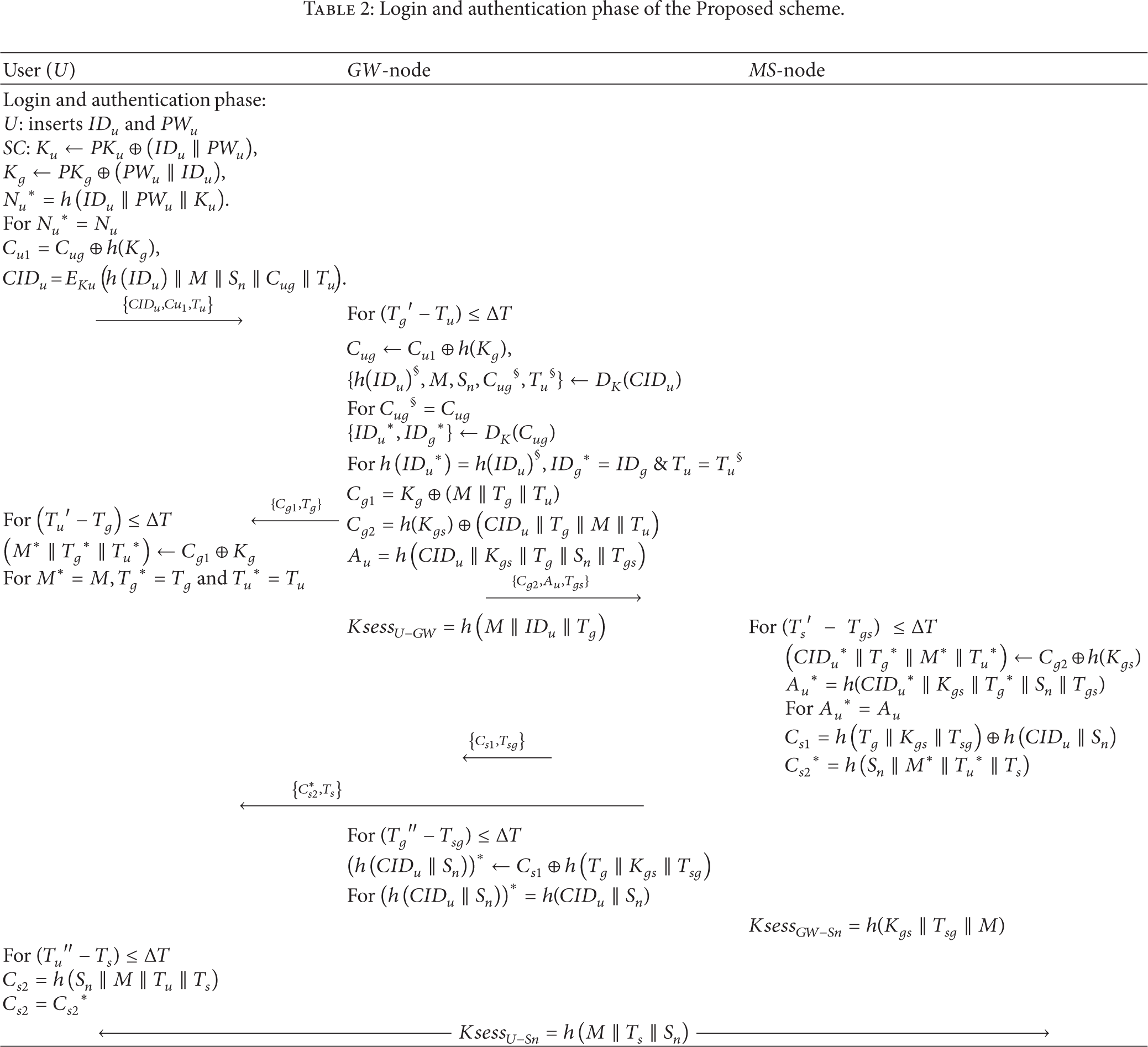
The proposed scheme has the same number of phases as in Kumar et al.'s scheme. Each of the phases is detailed below along with Tables 1, 2, and 3. The GW-nodekeeps only one master secret key K (length 256 bits). Besides, the GW-node shares a secret key with MS-nodes using some key agreement method [21, 22].
User registration phase of the Proposed scheme.
User (U)
GW-node
User registration phase:
Chooses
Chooses
Inserts , , and in so that
Login and authentication phase of the Proposed scheme.
User (U)
GW-node
MS-node
Login and authentication phase: U: inserts and SC: , , . For , .
For
, For For &
For For and
For
For
For For
For
Password change phase of the Proposed scheme.
User (U)
Smart card (SC)
Password change phase: U: inserts and
SC: ,
, . For
,
and . and
5.1. User Registration Phase
The user (professional) U registers itself to the GW-node in registration center of the hospital, in the following manner.
User choses her/his identity and submits it to the GW-node using a secure channel.
On receiving the GW-node computes , , and .
GW-node stores into a and provides along with values to U through the secure channel.
On obtaining and , the user U chooses his password and computes , , and . Finally, U inserts , , and in , so that .
5.2. Patient Registration Phase
This phase is identical to that in Kumar et al.'s scheme so we avoid its explanation here.
5.3. Login Phase
A professional logs in the GW-node in order to gain patients’ medical data via WMSN. The user inserts her/his into the smart card reader and inputs and . Then the SC performs the following.
It retrieves , and computes . For it continues further; otherwise it stops the session.
It generates a random nonce M and computes and .
sends as login request to GW-node, where is the current timestamp.
5.4. Authentication Phase
When the login request from U is received by the GW-node, it executes the following steps.
It acquires current timestamp and, for , discards the login request; otherwise it proceeds further.
It retrieves and decrypts as to obtain and . It verifies the equivalence , and if correct, then it decrypts as to obtain and .
It then computes and verifies the equivalences , , and = , if all the three equivalences hold then believes the login request to come from U; otherwise terminates the login session.
It acquires as current timestamp, computes =, and sends to U. It acquires as another current timestamp and computes and . Then, the GW-node sends to the MS-node.
On receiving from the GW-node, U verifies the legitimacy of GW-node as follows.
It checks if ; if so, it dumps the session; otherwise it continues further.
It obtains and verifies the equivalence , , and ; if each holds, then GW-node is authenticated; otherwise it terminates the login session.
After this mutual authentication, U and GW-node compute , as the session key.
On receiving from the GW-node, the MS-node performs the following operations.
It checks if ; if so, terminates the session; otherwise it proceeds further.
It obtains , computes , and compares with . The equivalence verifies the legitimacy of the GW-node and hence of U.
It acquires as current timestamp, computes , and sends to the GW-node. Also it computes , where is another current timestamp of MS-node. Then, the MS-node sends to U.
On receiving from the MS-node, the GW-node performs the following operations.
It checks if ; if so, terminates the session; otherwise it proceeds further.
It obtains , computes , and compares it with . The equivalence verifies the legitimacy of MS-node.
After this mutual authentication, GW-node and MS-node compute , as the session key.
On receiving from the MS-node, U performs the following.
It checks if ; if so, it dumps the session, otherwise it proceeds further.
It computes and compares it with , and for the authenticity of MS-node is verified.
After this mutual authentication, U and MS-node compute , as the session key.
5.5. Password Change Phase
U can change her/his password in the following manner. For this, U inserts her/his into the terminal, inputs her and , and opts to change his password. Then the following steps are performed to update a new password.
retrieves , and computes . If , then it proceeds further after asking for new password; otherwise it discards the password change request.
U enters new password .
computes , , and .
replaces , , and with , , and , respectively.
6. Analysis of the Security of the Proposed Scheme
This section, examines the security of the proposed scheme. We will display that the proposed scheme is secure under the same assumption subject to which Kumar et al.'s scheme is attackable. The assumption is that an attacker can extract [24, 25] the information stored inside smart card.
6.1. Resisting User Impersonation Attack
To impersonate as the user, has to compute a valid login request. Suppose obtains the lost smart card of U and extracts the values stored in it. Though is involved in both the components and of the login request, but without , , and computation of these components is incomplete. To recover from , the attacker needs to know of user's identity and password. On the contrary, to obtain from or , the attacker should hold or , respectively. Further, it is not feasible to obtain or from due to noninvertible nature of hash function. Thus, the scheme resists user impersonation attack.
6.2. Providing User Anonymity
If intercepts the login request of U, then he needs to obtain by decrypting . But neither knows nor can recoverit by extracting information from the lost smart card of some user; say U. To take out from , the attacker should know user's identity and password. In fact, key required to encrypt/decrypt is not stored directly in user's smart card and is different for each user. Therefore, cannot obtain and guess the identity as in Kumar et al.'s scheme. On the other hand, to procure identity from , , or is infeasible. It requires knowledge of keys and to gain out of or , respectively. Moreover, one-way property of hash function does not allow extraction of out of . Therefore, cannot gain the identity of a user and hence the scheme provides user anonymity.
6.3. Resisting Password Guessing Attack
In order to guess U's password from obtained from the lost SC of U, the attacker requires knowledge of and . As described in Section 6.2, cannot gain the identity of a user either from the lost smart card of a user or from an intercepted login request. Besides, is not available as plaintext in U's and is not obtainable from without having exact values of and . Thus, the scheme resists password guessing attack.
6.4. Resisting Illegal Logged-In Users Using Legal Identity
Since it is not possible to guess or know the identity of a logging user, cannot register itself to the GW-node with legal identity and fake password . Hence cannot harm the security of the scheme by misusing the identity. As a result, the scenario of many illegal users logged in with legal identity of a registered user is not possible in the proposed scheme.
6.5. Providing Secure Session Key between Every Pair of the Participating Entities
The proposed scheme establishes session key between every pair of participating entities. Session key between U and GW-node is which depends on three values M, , and . Although user's identity is fixed, M and are different for each session imparting dynamic nature to . However is available in from the open network but cannot compute without having M and . Session key between GW-node and MS-node is which is dynamic because of fresh timestamp and one time usable random number M. Although is fixed but is known only to the GW-node and the MS-node so no one except these two entities can compute the valid . Moreover, cannot procure M from without knowing ; from without knowing ; and from due to noninvertible nature of hash function. Session key between U and MS-node is which an attacker cannot compute without knowing M. Thus, the scheme establishes independent and secure session keys between every pair of the participating entities.
6.6. Resisting Sensor-Node Impersonation Attack
In order to impersonate the MS-node, should be able to compute the response messages sent by it to the GW-node and U. To compute and the knowledge of and is required, respectively. Since is shared secretly by GW-node with MS-node using some key agreement method [21, 22] and its computation involves master secret key K and identity of the GW-node, cannot access or compute . Further is not retrievable from , , and without knowing and , respectively. Moreover, one-way property of hash function prohibits extraction of from . Hence cannot impersonate the MS-node to make fool of the user and GW-node.
6.7. Providing Mutual Authentication between Every Pair of the Participating Entities
At each of the three ends, any received message undergoes at least two-step verification test to verify the authenticity of the sender. For every message, firstly timestamp is checked for freshness followed by one or more equivalences holding tests. The proposed scheme achieves mutual authentication between U and GW-node by exchange of messages and . When GW-node receives from U, in addition to timestamp freshness test, the equivalences , , and are required to guarantee the legitimacy of U. Similarly, for received by U from GW-node, the equivalence , , and should essentially hold to prove the validity of the GW-node.
Mutual authentication between the GW-node and the MS-node is achieved through the messages and . Corresponding to the message , the equivalence is imperative to confirm the legitimacy of GW-node and hence of U to MS-node. On the other hand, only the designated MS-node can compute and the authorized GW-node can retrieve correct from as the computation and retrieval involves use of hence mutually authenticate the entities to each other.
As just discussed, U is authenticated to the MS-node via message with which GW-node is verified. Finally, the legitimacy of MS-node is ensured to U by means of the equivalence . In this way, our scheme provides perfect mutual authentication.
6.8. Resisting Insider Attack
During registration phase, U submits only his identity to the GW-node at the hospital registration center. The GW-node provides secret keys and to the user. Then using his chosen password and identity , the user U itself computes and embeds and as and , respectively. Finally, U inserts , , and in . Since the insider of the system never receives user's password, privileged insider attack is not applicable on the scheme.
7. Performance Analysis of the Proposed Scheme via Comparison
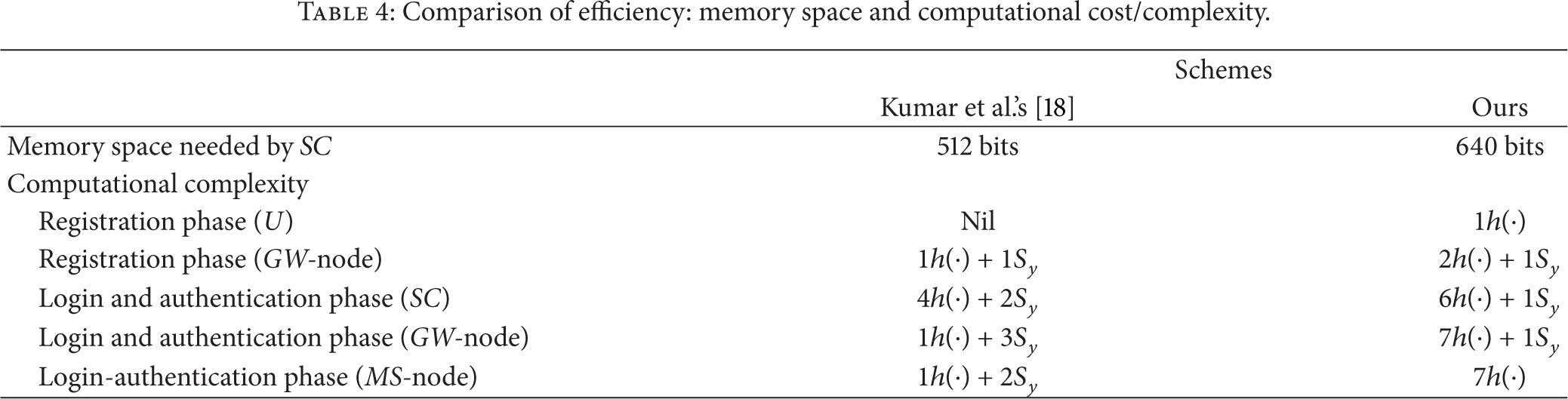
Now, we compare our scheme with Kumar et al.'s scheme [18] to present a comparative analysis of its performance and efficiency. Table 4 is about memory space required by smart card and computational complexity/cost in both the schemes. Table 5 exhibits the performance of both the schemes. For convenience, we assume that the identity , password , random numbers , timestamps , and outputs of one-way hash function are 128-bit long.
Comparison of efficiency: memory space and computational cost/complexity.
Provides GW-node and MS-node mutual authentication
No
Yes
Provides U and MS-node mutual authentication
No
Yes
Establishes secure session key between U and GW-node
No
Yes
Establishes secure session key between GW-node and MS-node
No
Yes
Establishes secure session key between U and MS-node
No
Yes
Table 4 shows that the memory space required by the smart card in Kumar et al.'s scheme and the proposed scheme is 512 bits and 640 bits, respectively. Further, it is noticeable that our scheme adds some hash functions but remarkably cuts the number of time consuming symmetric cryptography operation at each of the three ends. The most important aspect is that there is no symmetric operation required at low powered MS-node. However, it is apparent from Table 5 that with extra memory capacity of 128 bits in smart card and some extra hash functions, the proposed scheme achieves higher performance. The most significant feature of our scheme is the establishment of mutual authentication and session key between every pair of the three participating entities.
8. Conclusion
A secure and efficient user authentication scheme is essential to offer reliable and proficient healthcare services via WMSNs. This work is motivated by the security problems of Kumar et al.'s scheme for healthcare services using WMSNs. In this paper, we have designed a user authentication scheme to eradicate the security problems of Kumar et al.'s scheme. Our scheme is user anonymous and is free from risks occurring due to loss of smart card of a user. It defies insider attack and password guessing attack. The most important feature of the scheme is that it establishes mutual authentication and provides session key between every pair of the participating entities, that is, user, GW-node, and MS-node.
Footnotes
Notations
Conflict of Interests
The authors declare that there is no conflict of interests regarding the publication of this paper.
Acknowledgment
The authors would like to extend their sincere appreciation to the Deanship of Scientific Research at King Saud University for its funding of this research through the Research Group Project no. RGP-VPP-288.
References
1.
WangY.-Y.LiuJ.-Y.XiaoF.-X.DanJ.A more efficient and secure dynamic ID-based remote user authentication schemeComputer Communications20093245835852-s2.0-5964908324810.1016/j.comcom.2008.11.008
2.
KhanM. K.KimS.-K.AlghathbarK.Cryptanalysis and security enhancement of a ‘more efficient & secure dynamic ID-based remote user authentication scheme’Computer Communications20113433053092-s2.0-7875164278810.1016/j.comcom.2010.02.011
3.
KumarM.GuptaM. K.KumariS.An improved efficient remote password authentication scheme with smart card over insecure networkInternational Journal of Network Security2011133167177
4.
KumariS.GuptaM. K.KumarM.Cryptanalysis and security enhancement of Chen et al.'s remote user authentication scheme using smart cardCentral European Journal of Computer Science201221607510.2478/s13537-012-0003-y
5.
KhanM. K.KumariS.GuptaM. K.More efficient key-hash based fingerprint remote authentication scheme using mobile deviceComputing201310.1007/s00607-013-0308-2
6.
KumariS.KhanM. K.Cryptanalysis and improvement of ‘a robust smart-card-based remote user password authentication scheme’International Journal of Communication Systems201310.1002/dac.2590
7.
WongK. H. M.YuanZ.JiannongC.ShengweiW.A dynamic user authentication scheme for wireless sensor networks1Proceedings of the IEEE International Conference on Sensor Networks, Ubiquitous, and Trustworthy ComputingJune 2006Taichung, Taiwan3183272-s2.0-3384545833610.1109/SUTC.2006.1636182
8.
TsengH.-R.JanR.-H.YangW.An improved dynamic user authentication scheme for wireless sensor networksProceedings of the 50th Annual IEEE Global Telecommunications Conference (GLOBECOM ′07)November 2007Washington, DC, USA9869902-s2.0-3934909319610.1109/GLOCOM.2007.190
9.
DasM. L.Two-factor user authentication in wireless sensor networksIEEE Transactions on Wireless Communications200983108610902-s2.0-6294913077410.1109/TWC.2008.080128
10.
VaidyaB.RodriguesJ. J. P. C.ParkJ. H.User authentication schemes with pseudonymity for ubiquitous sensor network in NGNInternational Journal of Communication Systems2010239-10120112222-s2.0-7795638857910.1002/dac.1097
11.
KhanM. K.AlghathbarK.Security analysis of ‘two-factor user authentication in wireless sensor networks’6059Proceedings of the 4th International Conference on Information Security and Assurance (ISA ′10)June 2010Miyazaki, Japan5560Lecture Notes in Computer Science
12.
KhanM. K.AlghathbarK.Cryptanalysis and security improvements of ‘two-factor user authentication in wireless sensor networks’Sensors2010103245024592-s2.0-7795549542710.3390/s100302450
13.
HeD.GaoY.ChanS.ChenC.BuJ.An enhanced two-factor user authentication scheme in wireless sensor networksAd-Hoc & Sensor Wireless Networks20101041112-s2.0-78650459565
14.
SaleemS.UllahS.YooH. S.On the security issues in wireless body area networksJournal of Digital Content Technology and Its Applications200933178184
15.
UllahS.KwakK. S.Body area network for ubiquitous healthcare applications: theory and implementationJournal of Medical Systems20113551243124410.1007/s10916-011-9787-x
16.
UllahS.HigginsH.BraemB.LatreB.BlondiaC.MoermanI.SaleemS.RahmanZ.KwakK. S.A comprehensive survey of wireless body area networks—on PHY, MAC, and network layers solutionsJournal of Medical Systems2012363106510942-s2.0-7795553716410.1007/s10916-010-9571-3
17.
ChungW.-Y.Multi-modal sensing M2M healthcare service in WSNKSII Transactions on Internet and Information Systems201264109011052-s2.0-84860122221
18.
KumarP.LeeS.-G.LeeH.-J.E-SAP: efficient-strong authentication protocol for healthcare applications using wireless medical sensor networksSensors2012122162516472-s2.0-8485757836510.3390/s120201625
19.
KhanM. K.KumariS.SinghP.Cryptanalysis of an ‘efficient-strong authentication protocol (e-sap) for healthcare applications using wireless medical sensor networks’KSII Transactions on Internet and Information Systems201375967979
20.
CallawayE. H.Wireless Sensor Networks, Architectures and Protocols2003Boca Raton, Fla, USATaylor & Francis
21.
ChenC.HeD.ChanS.BuJ.GaoY.FanR.Lightweight and provably secure user authentication with anonymity for the global mobility networkInternational Journal of Communication Systems201124334736210.1002/dac.1158
22.
PingZ. L.YiW.An ID-based key agreement protocol for wireless sensor networksProceedings of the 1st International Conference on Information Science and Engineering (ICISE ′09)December 2009Nanjing, China254225452-s2.0-7795276075910.1109/ICISE.2009.263
23.
LinX.LuR.ShenX.NemotoY.KatoN.SAGE: a strong privacy-preserving scheme against global eavesdropping for ehealth systemsIEEE Journal on Selected Areas in Communications20092743653782-s2.0-6734925301810.1109/JSAC.2009.090502
24.
KocherP.JaffeJ.JunB.Differential power analysisProceedings of the 19th Annual International Cryptology Conference on Advances in Cryptology (CRYPTO ′99)1999Santa Barbara, Calif, USA388397
25.
MessergesT. S.DabbishE. A.SloanR. H.Examining smart-card security under the threat of power analysis attacksIEEE Transactions on Computers20025155415522-s2.0-003656640810.1109/TC.2002.1004593