




Abstract
The random movement of nodes makes the dynamic topology structure be one of the most important characteristics in wireless multihop communication network, which makes the description and quantization of the dynamic property the very foundation of the design, simulation, and measurement for this kind of network. The distributions of the link duration and the topology duration will be derived and verified by simulations. Then, the topology flapping sensing method has been put forward based on TTL. Finally, the probability model of the topology stability in the measurement time has been established and calculated based on network tomography for wireless mobile multihop communication network in this paper. Simulating results verify the correctness and efficiency of the approach, which will provide the technique basis of research on the dynamic property and end-to-end measurement for wireless mobile multihop communication network.
1. Introduction
A wireless mobile multihop communication network is a self-configuring infrastructureless network of mobile devices connected by wireless links, with a typical example as mobile ad hoc network (MANET), vehicle ad hoc network (VANET), wireless sensor network (WSN), and so on. Each device in such a kind of network is free to move independently in any direction and will therefore change its links to other devices frequently. Each must forward traffic unrelated to its own use and therefore be a router. The primary challenge in building a wireless mobile multihop communication network is equipping each device to continuously maintain the information required to properly route traffic, which is quite difficult since the topology caused by nodes movement keeps changing [1, 2]. Relevant studies indicate that the overall performance of wireless mobile multihop communication network is closely related to the adaptability of the network protocol to the dynamic property. The description and quantization of the dynamic property are the foundation of design, simulation, and measurement for wireless mobile multihop communication network [3]. The topology duration is always adopted to measure the dynamic property in relevant researches [4]. Luo et al. have made analysis of four common moving model link distributed functions and pointed out by both theoretical and simulating way that the distribution would never be described by a simple probability distributed function [5]. With a longer route, the link duration distribution would approach an exponential distribution, which has been verified by [6]. The work in [7] established a relational model of route and link duration. The inconsistency of probability distributed function, however, appeared when the length of route is 1.
The network tomography is the science of inferring performance characteristics of the network interior by correlating sets of the end-to-end measurements [8]. The strength of protocol and the forwarding nodes being independent are quite appropriate for wireless mobile multihop communication network. Generally, the network tomography problems can be approximately described by a linear model as
2. Mathematical Model
The network tomography is usually adopted on the premise of the fixed or already-known network topology [11, 12]. However, the nodes random movement raises new limitations for the network tomography in wireless mobile multihop communication network [13], since the false route information to sense the topology flapping by data measurement and to make further deduction by the obtained information before or after the topology changing, to shorten the measuring time to make the probability of topology flapping acceptable when the topology changing is imperceptible.
Let


3. Topology Flapping Sensing
The impact of the dynamic property on network tomography inferring result will be alleviated effectively by sensing the topology flapping according to the hop changes of the detecting packets. The probability η of the topology flapping sensed by detecting packets is equivalent to the probability of the path length changing when the route changes. TTL is usually adopted in Internet [17], and recent researches have indicated that 80% of changes in end-to-end path are caused by the changes of the route length. Few studies, however, are carried out in wireless mobile multihop communication network. η has a close relationship with the length of paths, the probability of connections, and the number of nodes. The global estimation of η will be obtained by random waypoint model [18]. Simulating results in walking speed scenes indicate that η is inversely proportional to the connection probability as shown in Figure 1. That is mainly because the average path length is large with a small connection probability and the probability of an equal route length in two successive selections will be small. Comparing with the connection probability, η is weakly correlated with the number of nodes though appearing as an inverse proportion as well. Therefore, to sense the topology flapping by the TTL changes of the detecting packets is an effective way for wireless mobile multihop communication network with a sensing rate over 50%.

Topology flapping sensing rate by TTL in a typical wireless mobile multihop communication.
4. Dynamic Property Analysis
The definitions of the link and the route duration have been given out in [19, 20], where the one lying on the connectivity graph level has been adopted in this paper. The meaning of some main parameters will be defined as follows.
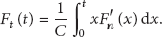
The topology duration is the time interval between all links from each source to each destination being established and one of them is being interrupted. The route duration is the special case of the topology duration with the number of the source node and the destination node is 1 for both. The frequency distributed function of the topology duration denoted as The time distributed function of the topology duration denoted as
It can be noticed that the frequency distributed function and the time distributed function are describing the probability of duration in different viewpoints and they satisfy the relationship as shown in (3), where
4.1. Link Duration
The link duration is an important parameter to measure the dynamic property of wireless mobile multihop communication network. Since the link duration equals the time taken by two nodes passing through the coverage of each other, the value only depends on the relative velocity of these two nodes and their communication radius. Accordingly, it is necessary to derive the probability distributed function of the link duration for the random waypoint model. The mobility model of wireless mobile multihop communication network should satisfy the following assumptions:
The probability distribution of the link duration equals the product of the probability distribution of the link duration


Since the velocity of

Relationship between
So there will be


Assume the link between
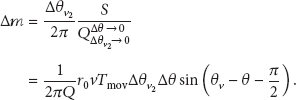


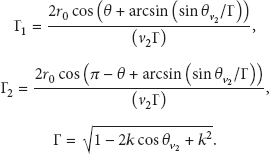
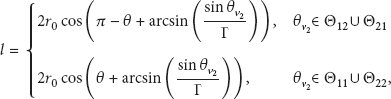

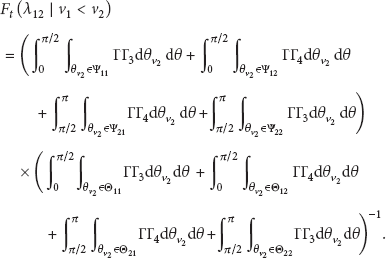

Calculation for connecting times for
4.2. Number of Topology Links
The topology duration has a close relationship with the number of links in wireless ad hoc network. The more links exist, the shorter the average topology duration will be. Assume that the set of source nodes is

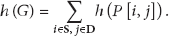


Probability distributed functions of the path length with
4.3. Topology Duration
Simulations based on NS2.34 have been carried out to analyze the relationship between the topology duration and the wireless mobile multihop communication network parameters in this paper.
In walking speed scenes, the set of source nodes and destination nodes will be selected randomly with (1)
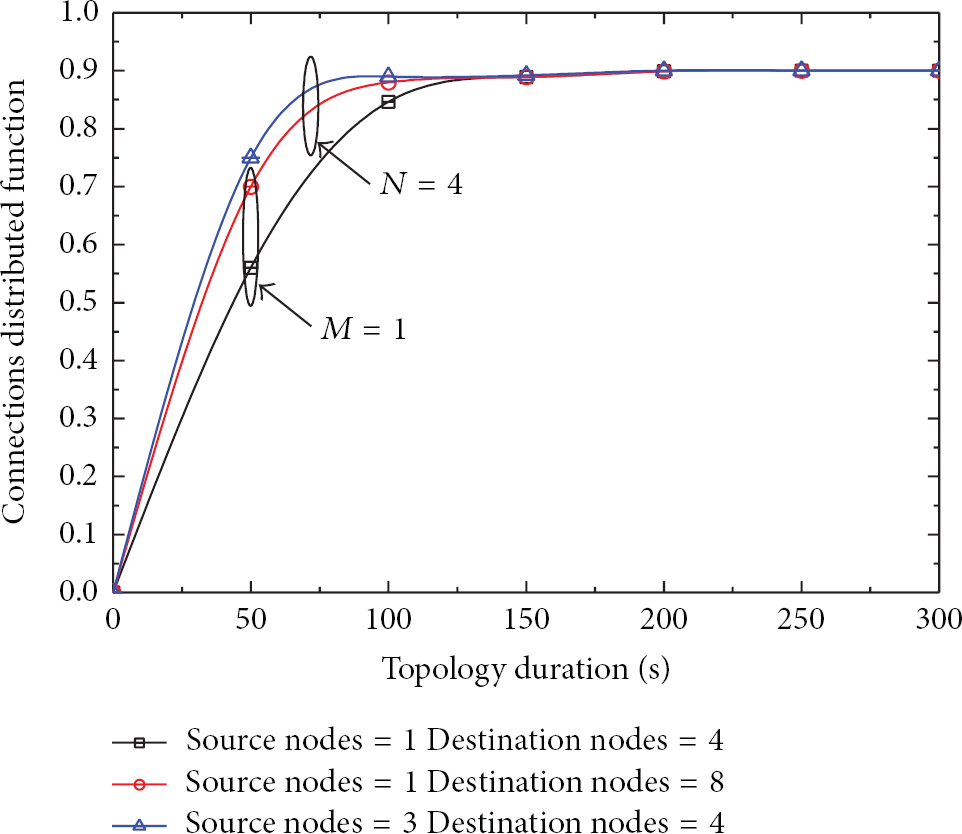
Continuous distributed function of topology duration.
Since the length of path depends on the number of nodes and the probability of connections, they have a direct impact on the network topology duration. Simulations will make the measurement time, the source node, and destination node be selected randomly in each walking speed scene, and the results can be seen in Figures 7 and 8.

Impacts of number of nodes on topology duration with

Impacts of nodes connecting rate on topology duration with
The topology duration equals the smallest remaining time of all links duration after the topology is being completely set up. This is because the links setting up time may be different. When the last one ξ is being established, other links may hold for some time. Assume that the rest ratio of other links

Relationship between the topology duration and the link duration.
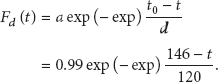
Therefore, the distribution of topology duration can be represented as follows:



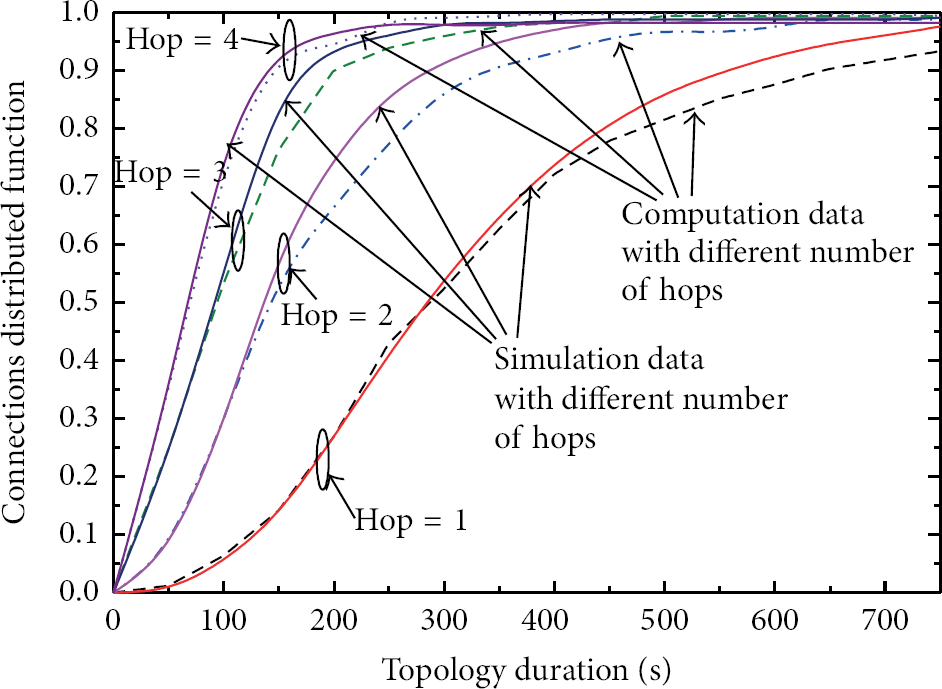
Continuous distributed function of the topology duration.
That is because
there are errors existing in topology duration statistics caused by limited simulating duration; there is an approximate calculation in the link duration fitting function.
In process of calculating the measurement time constraint, the value on small duration of the topology duration function has been mainly adopted so as hardly to produce any severe impacts.
5. Measurement Time Constraints
The simulations are performed in walking speed scenes with TTL method to sense the topology changing in order to obtain the correct rate α in the measurement duration constraint
Relationship between
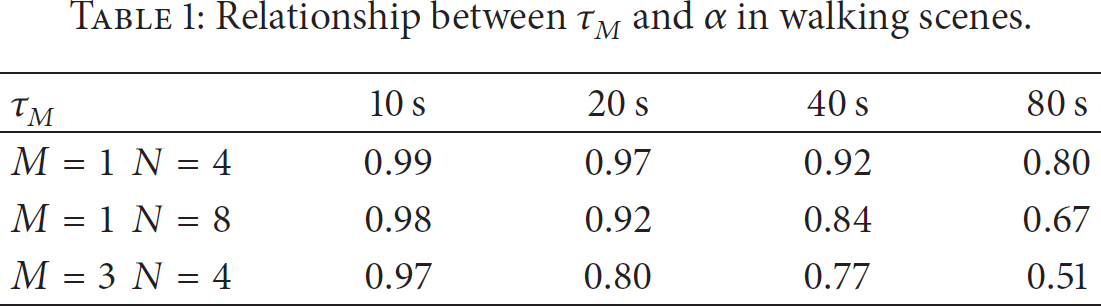
Since the topology sensing rate with
The calculation formula for the average α should be derived with the source nodes and the destination nodes being randomly selected. Assume that the paths from the source nodes to the destinations are independent based on the simulation results above, and, based on (1), there will be


There are four ways to improve the value of α based on (24) and (25): firstly, to reduce the network size; secondly, to reduce the number of detecting packets so as to shorten the measurement duration; thirdly, to increase the detecting packets sending rate; finally, to adopt multisource measurement instead. The former three have deficiencies in themselves, so the optimization based on the network reality will be needed. The disadvantage of reducing the network size is that it will reduce the number of links inferred by measurement, which will be better to restrict the number of nodes from several to ten. To reduce the number of detecting packets to some certain value will bring a fast increasing error range for the inferring result. To increase the packets, sending rate will change the link performance, and the sending rate should lie in 5%~10% of the network data stream rate. The last method with multisource measurement will reduce the measurement duration because many source nodes carrying out the measurement at the same time will improve the efficiency.
6. Conclusions
Wireless mobile multihop communication network has been regarded as an important step to realize the ubiquitous communication world. The dynamic topology makes the network being organized flexibly adapt to more general environment but will have an impact on packets transmitting performance. We have focused on the topology flapping in wireless mobile multihop communication network to obtain the description and quantification for dynamic properties based on network tomography. Combining the theoretical derivation and simulation verification, the dynamic property has been investigated systematically, and a novel method to sense the topology flapping based on TTL has been proposed in this paper. Simulation results show a better sensing rate. The network tomography has been introduced in wireless mobile multihop communication network, through which the calculating model for the probability distributed function of the network topology stability has been established and simulated in wireless mobile multihop communication network in walking speed scenes. The experimental results with both simulation and calculation demonstrated the effectiveness of the proposed model. Future work will concentrate on the algorithm universality and environment adaption.
Footnotes
Conflict of Interests
The authors declare that there is no conflict of interests regarding the publication of this paper.
Acknowledgments
This work was supported by the National Natural Science Foundation of China under Grant no. 61302074, Specialized Research Fund for the Doctoral Program of Higher Education under Grant no. 20122301120004, China Postdoctoral Science Foundation under Grant no. 2012M520778, Natural Science Foundation of Heilongjiang Province under Grant no. QC2013C061, Heilongjiang Province Postdoctoral Science Foundation under Grant no. LBH-Z12217, Research Foundation of Education Bureau of Heilongjiang Province under Grant no. 12531480, and the Youth Science Fund Project of Heilongjiang University under Grant no. QL201110.