




Abstract
A simple semitheoretical method for calculating two-phase frictional pressure gradient in horizontal circular pipes using asymptotic analysis to develop a robust compact model is presented. Two-phase frictional pressure gradient is expressed in terms of the asymptotic single-phase frictional pressure gradients for liquid and gas flowing alone. The proposed model can be transformed into either a two-phase frictional multiplier for liquid flowing alone (ϕl2) or two-phase frictional multiplier for gas flowing alone (ϕg2) as a function of the Lockhart-Martinelli parameter, X. Single-phase friction factors are calculated using the Churchill model which allows for prediction over the full range of laminar-transition-turbulent regions and allows for pipe roughness effects. The proposed model is compared against published data to show the asymptotic behavior. Comparison with other existing correlations for two-phase frictional pressure gradient such as the Chisholm correlation, the Friedel correlation, and the Müller-Steinhagen and Heck correlation, is also presented. Comparison with experimental data for both ϕl and ϕl versus X is also presented. At the end of the paper, the present asymptotic model is also extended to minichannels and microchannels.
1. Introduction
In the present study, new two-phase flow modeling is proposed, based upon an asymptotic modeling method to overcome the disadvantages of the separate cylinders model of two-phase flow where the liquid and gas phases are assumed to flow independently of each other in two separate parallel circular cylinders. The separate cylinders model of two-phase flow was introduced first by Turner [1]. Since then, it had appeared in a number of texts such as those by Wallis [2], Carey [3], and Brennen [4]. The equations of ϕ l 2 and ϕ g 2 are [5, see Appendix A]


This general form of ϕ l 2 in (1) and ϕ g 2 in (2) has five different conditions as follows.
m = n = 0.25. This represents turbulent liquid-turbulent gas flow type (Re l > 2000 and Re g > 2000).
m = 1, n = 0.25. This represents laminar liquid-turbulent gas flow type (Re l < 2000 and Re g > 2000).
m = 0.25, n = 1. This represents turbulent liquid-laminar gas flow type (Re l > 2000 and Re g < 2000).
m = n = 1. This represents laminar liquid-laminar gas flow type (Re l < 2000 and Re g < 2000).
m = n = 0. This represents constant friction factor liquid-gas flow type.
Table 1 shows the expressions of ϕ l 2 and ϕ g 2 for different flow conditions, respectively.
Expressions of ϕ l 2 and ϕ g 2 for different flow conditions.
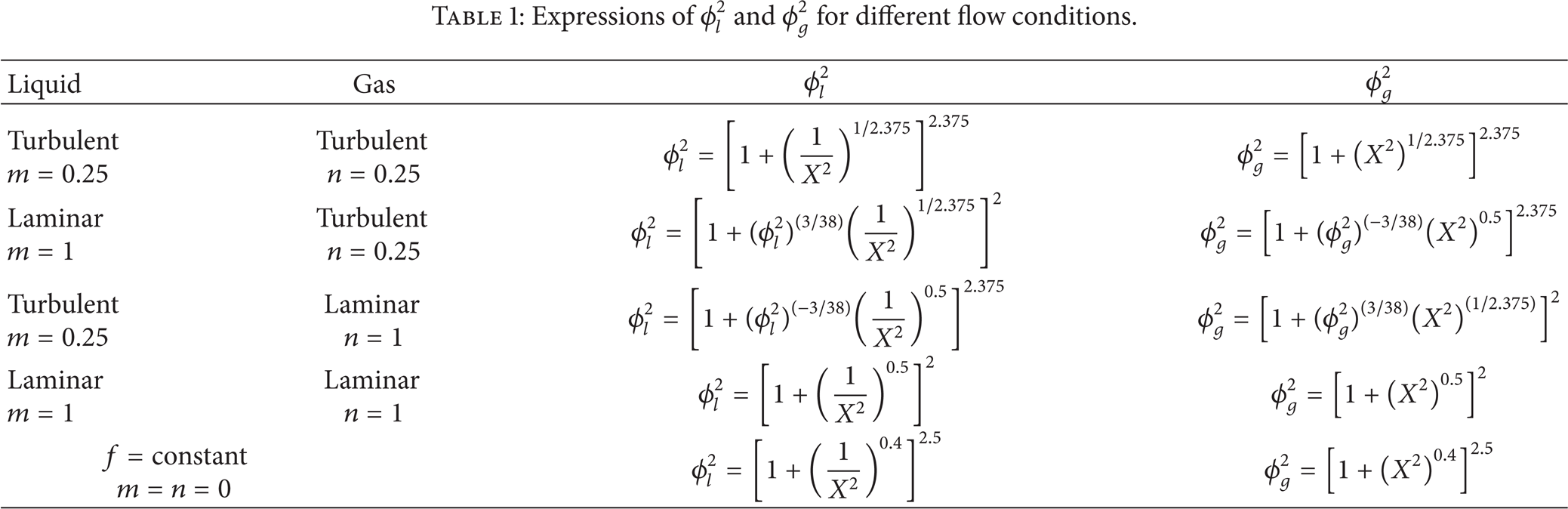
From Table 1, it is clear that the expressions of ϕ l 2 and ϕ g 2 are implicit for liquid-gas laminar-turbulent flow or turbulent-laminar flow. These implicit expressions can be solved by means of computer algebra systems like Maple software [6]. The authors confirm that that there is not any financial gain related to writing Maple software as [6] in the present paper.
The main disadvantage of the separate cylinders model for two-phase flow is not taking into account the important frictional interactions that occur at the interface between liquid and gas, and, needless to say, it would simply neglect the nature of two-phase flow because the liquid and gas phases are assumed to flow independently of each other in two separate parallel circular cylinders. Also, the values of the Reynolds number for the liquid and gas phases are important because these values determine the flow condition and hence the suitable expression for this flow condition. In addition, the obtained expressions are implicit for liquid-gas laminar-turbulent flow or turbulent-laminar flow [5].
In the current study, two-phase frictional pressure gradient is expressed in terms of the asymptotic single-phase frictional pressure gradients for liquid and gas flowing alone. Asymptotes appear in many engineering problems such as steady and unsteady internal and external conduction, free and forced internal and external convection, fluid flow, and mass transfer. Often, there exists a smooth transition between two asymptotic solutions [7–10]. This smooth transition indicates that there is no sudden change in slope and no discontinuity within the transition region.
The asymptotic analysis method was first introduced by Churchill and Usagi [7], in 1972. After this time, this method of combining asymptotic solutions proved quite successful in developing models in many applications [10]. Recently, it has been applied to two-phase flow in circular pipes [5, 11], minichannels, and microchannels [5, 12]. Moreover, Awad and Butt have shown that the asymptotic method works well for petroleum industry applications for flows through porous media [13], liquid-liquid flows [14], and flows through fractured media [15].
In the asymptotic model, the dependent parameter y has two asymptotes. The first asymptote is y0, which corresponds to very small value of the independent parameter z. The second asymptote is y∞, which corresponds to very large value of the independent parameter z. The two asymptotes y0 and y∞ can be expressed as follows [7–10]:

The two asymptotes y0 and y∞ are based on analytical solution. They consist of a constant, which has a positive real value. The two constants are called c0 as z → 0 and c∞ as z → ∞. The values of the two exponents i and j are often 0, 1, 1/2, 1/4, and 1/3 [7–10].
From analytical, experimental, or numerical methods, it is known that y frequently transitions in a smooth manner between the two asymptotes y0 and y∞.
For the case of two-phase frictional pressure gradient in horizontal pipes, the two asymptotes y0 and y∞ increase with increasing values of z, and the solution y is concave upwards. This trend is also found in the case of external free and forced convection from single isothermal convex bodies.
Since y0 > y∞ as z → 0, so the solution y is concave upwards, and the two asymptotes y0 and y∞ can be combined in the following method [7–10]:
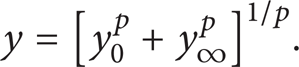
The parameter p is a fitting or “blending” parameter whose value can be determined in a simple method. The effect of the parameter p in (4) is only important in the transition region. The results for small and large values of the independent parameter z remain unchanged with changing the parameter p.
To determine a value of p, there are a number of methods as discussed by Churchill and Usagi [7]. For example, we can select an intermediate value of z = zint corresponding or near to the intersection of the two asymptotes for which y(zint) is known from analytical, experimental, or numerical methods. Using (3) and (4), we can write for the intermediate value of z = zint,

Although the fitting or “blending” parameter p is unknown, it can be calculated by numerical methods for solving a nonlinear equation or by means of computer algebra systems like Maple release 9 software [6].
In the present study, p is chosen as the value, which minimizes the root mean square (RMS) error, eRMS, between the model predictions and the available data. The fractional error (e) in applying the model to each available data point is defined as

For groups of data, the root mean square (RMS) error, eRMS, is defined as

If p is a weak function of the mass flow rate, or mass flux of either the liquid phase or the gas phase, a single value may be chosen which best represents all of the available data for two-phase frictional pressure gradient.
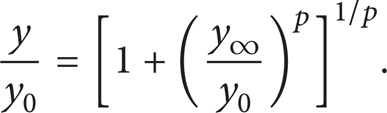
The approximate solution y is often presented in a form, which is based on one of the two asymptotes y0 and y∞. For example, if the approximate solution y is presented in terms of the asymptote y0, then the model can be expressed as follows [7–10]:
On the other hand, if the approximate solution y is presented in terms of the asymptote y∞, then the model can be expressed as follows [7–10]:

1.1. Asymptotic Modeling in Two-Phase Flow
Using the asymptotic analysis method, two-phase frictional pressure gradient
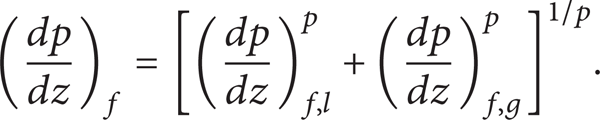
Equation (10) reduces to
The principal advantages of the asymptotic analysis method over the separate cylinders model formulation [1] are twofold. First, all four Lockhart-Martinelli flow regimes can be handled with ease, since the separate cylinders model formulation [1] leads to implicit relationships for the two mixed regimes. Second, since the friction model used is only a function of Reynolds number and roughness, broader applications involving rough pipes can be easily modeled.
If the two-phase frictional pressure gradient

Equation (11) can be expressed in terms of a two-phase frictional multiplier liquid flowing alone in the pipe (ϕ l 2) as follows:

On the other hand, if the two-phase frictional pressure gradient

Equation (13) can be expressed in terms of a two-phase frictional multiplier for gas flowing alone in the pipe (ϕ g 2) as follows:
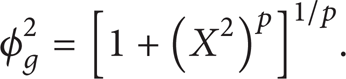
It is clear that (12) and (14) are similar to the separate cylinders model formulation [1] for constant friction factor (1/p = 2.5) or when both liquid and gas are either turbulent (1/p = 2.375) or laminar (1/p = 2). Also, (12) and (14) are still explicit for liquid-gas laminar-turbulent flow and turbulent-laminar flow.
1.1.1. Single-Phase Frictional Pressure Gradient Equations
The single-phase frictional pressure gradient can be related to the Fanning friction factor in terms of mass flow rate of both the liquid phase and the gas phase as follows:

Equation (15) can be written in terms of mass flux and mass quality as follows:

The model that was developed by Churchill [16] is introduced to define the Fanning friction factor. When a computer is used, the Churchill model equations [16] are more recommended than the Blasius equations [17] to define the Fanning friction factor [18]. The Churchill model was a correlation of the Moody chart [19]. Churchill's correlation spanned the entire range of laminar, transition, and turbulent flow in pipes. The Churchill model equations that define the Fanning friction factor are

The Reynolds number equations can be expressed in terms of mass flow rate of both the liquid phase and the gas phase or mass flux and mass quality as follows:

2. Results and Discussion
Examples of two-phase frictional pressure gradient in horizontal pipes for published data of different pipe diameters are presented to show features of the asymptotes, asymptotic analysis, and the development of simple compact models. At the end of the paper, the present asymptotic model is also extended to minichannels and microchannels.
2.1. Comparison of the Present Asymptotic Model with Data
Figure 1 shows comparison of the present asymptotic model [11] with Dukler's data [20] for air-water flow in a smooth horizontal pipe at d = 2 in. (50.8 mm). The frictional pressure gradient is represented as a function of the liquid mass flow rate on log-log scale for the gas mass flow rate values of 7.8, 23.3, 81.8, 381, and 1103 lbm/hr (3.54, 10.57, 37.1, 172.82, and 500.32 kg/s), respectively. For the same value of the gas mass flow rate, the frictional pressure gradient increases with increasing liquid mass flow rate. Also, the frictional pressure gradient increases with increasing gas mass flow rate at the same value of the liquid mass flow rate. Equation (10) represents the present asymptotic model [11]. It can be seen that the present model with fitting parameter p = 1/3.9 represents Dukler's data in a successful manner. The root mean square (RMS) error, eRMS, is equal to 12.11%. The worst agreement is obtained for data points with an absolute error (e) of 23.34%.

Comparison of the Asymptotic Model with Dukler's Data [20].
Comparison of different models such as Chisholm [21], Chisholm [22], Friedel [23], and Müller-Steinhagen and Heck [24] as well as the present asymptotic model [11] with p = 1/3.9 with Dukler's data [20] is shown in Table 2.
Comparison of different models with Dukler's data [20].

As a brief on these different models, Chisholm [21] developed equations in terms of the Lockhart-Martinelli correlating groups for the friction pressure drop during the flow of gas-liquid or vapor-liquid mixtures in pipes. His theoretical development was different from previous treatments in the method of allowing for the interfacial shear force between the phases. Also, he avoided some of the anomalies occurring in previous “lumped flow.” He gave simplified equations for use in engineering design for both two-phase frictional multiplier for liquid flowing alone in the pipe (ϕ l 2) and two-phase frictional multiplier for gas flowing alone in the pipe (ϕ g 2) as a function of the Chisholm constant (C) and the Lockhart-Martinelli parameter (X). The values of C were dependent on whether the liquid and gas phases were laminar or turbulent flow. The values of C were restricted to mixtures with gas-liquid density ratios corresponding to air-water mixtures at atmospheric pressure. The different values of C are given as C = 20 for turbulent-turbulent flow, C = 12 for laminar liquid-turbulent gas flow, C = 10 for turbulent liquid-laminar gas flow, and C = 5 for laminar-laminar flow. He compared his predicted values using these values of C and his equation with the Lockhart-Martinelli values. He obtained good agreement with the Lockhart-Martinelli empirical curves.
Chisholm [22] showed that his previous equation in [21] for predicting the friction pressure drop during two-phase flow was an unsatisfactory form for use with evaporating flows as
Friedel [23] proposed a method in terms of the multiplier (ϕ lo 2). He developed his correlation and fit it with 25000 data points. The smallest pipe diameter in the Friedel database was 4 mm. His correlation included both the gravity effect by Froude number (Fr) and the effect of surface tension and the total mass flux by Weber number (We). Friedel [23] proposed a method in terms of the multiplier (ϕ lo 2). He developed his correlation and fit it with 25000 data points. The smallest pipe diameter in the Friedel database was 4 mm. His correlation included both the gravity effect by Froude number (Fr), and the effect of surface tension and the total mass flux by Weber number (We).
Müller-Steinhagen and Heck [24] suggested a new correlation for the prediction of frictional pressure drop in two-phase flow
2.2. ϕ l and ϕ g versus Lockhart-Martinelli Parameter (X) in Circular Pipes
Figure 2 shows ϕ l versus Lockhart-Martinelli parameter (X) for turbulent-turbulent flow for different working fluids in a smooth horizontal pipe of different diameters at different conditions using the present asymptotic model and the first six data sets in Table 3. Equation (12) represents the present model with different values of p as shown in Table 3.
Values of the asymptotic parameter (p) in circular pipes at different conditions.

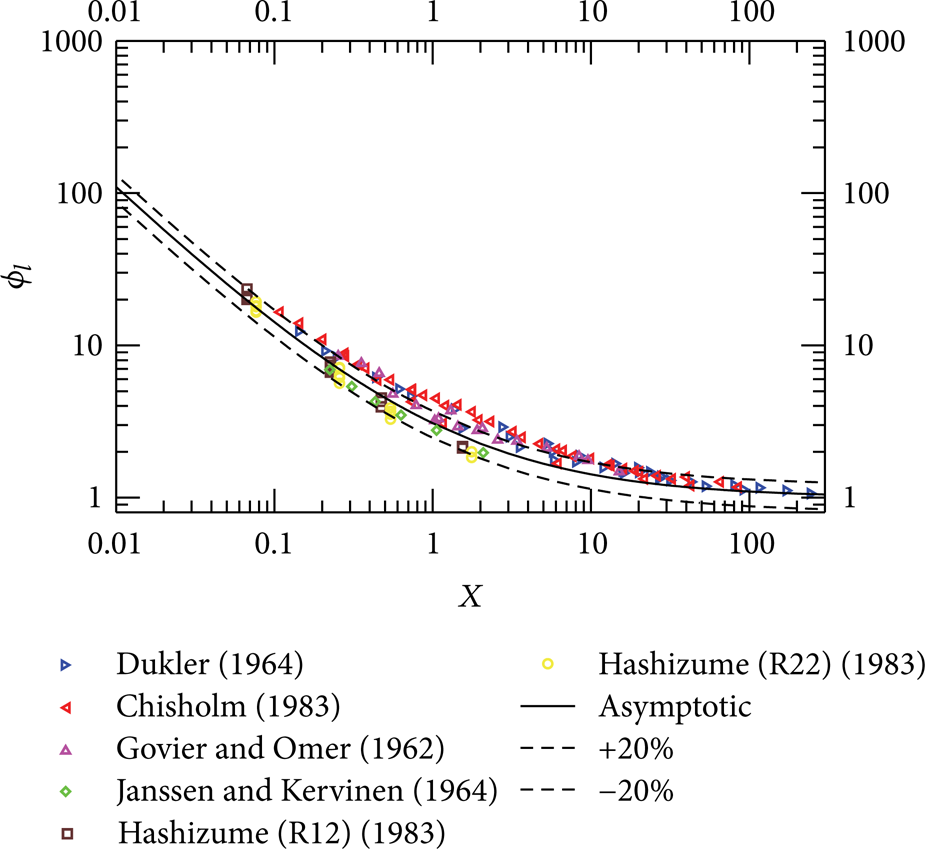
ϕ l versus X for different sets of data in circular pipes.
Figure 3 shows ϕ g versus Lockhart-Martinelli parameter (X) for turbulent-turbulent flow for different working fluids in a smooth horizontal pipe of different diameters at different conditions using the present asymptotic model and the last two data sets in Table 3. Equation (14) represents the present model with different values of p as shown in Table 3.
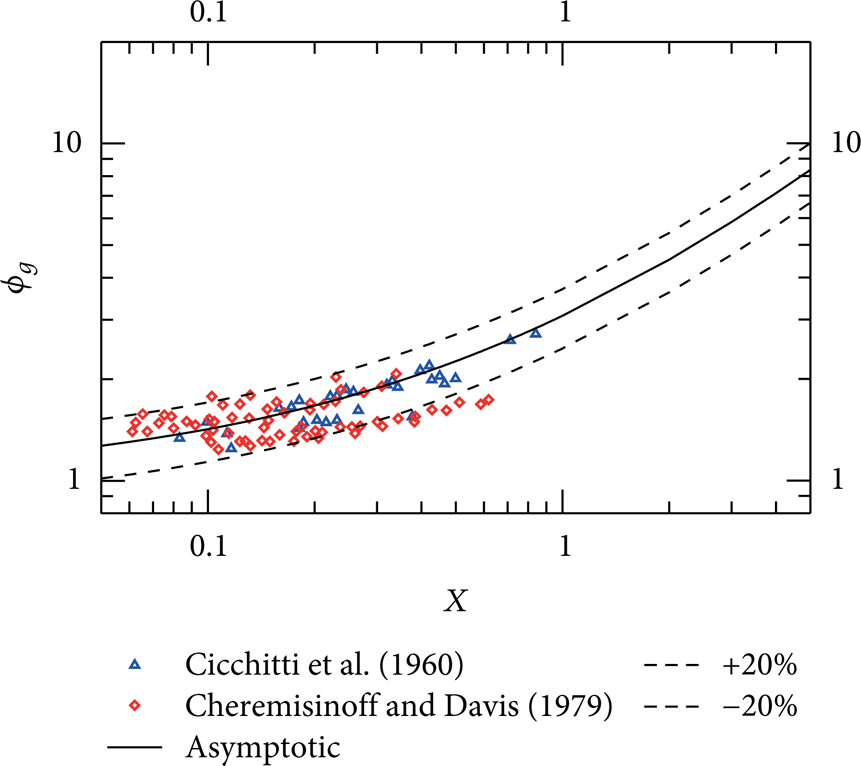
ϕ g versus X for different sets of data in circular pipes.
To have a robust model, one value of the fitting parameter (p) is chosen as p = 1/3.25. When p = 1/3.25, the root mean square (RMS) error eRMS = 23.80%. Figure 2 shows ϕ l versus X for the first six data sets in Table 4 while Figure 3 shows ϕ g versus X for the last two data sets in Table 3 with p = 1/3.25. It can be seen that there is a good agreement between the present asymptotic model and the different data sets in Figures 2 and 3.
Values of the asymptotic parameter (p) in minichannels and microchannels at different conditions.

2.3. ϕ l and ϕ g versus Lockhart-Martinelli Parameter (X) in Minichannels and Microchannels
In this section, the present asymptotic model is also extended to minichannels and microchannels using the same published data sets in [34]. Figure 4 shows ϕ l versus Lockhart-Martinelli parameter (X) for laminar-laminar flow for different working fluids in smooth minichannels and microchannels of different diameters at different conditions using the present asymptotic model and the first three data sets in Table 4. Equation (12) represents the present model with different values of p as shown in Table 4.
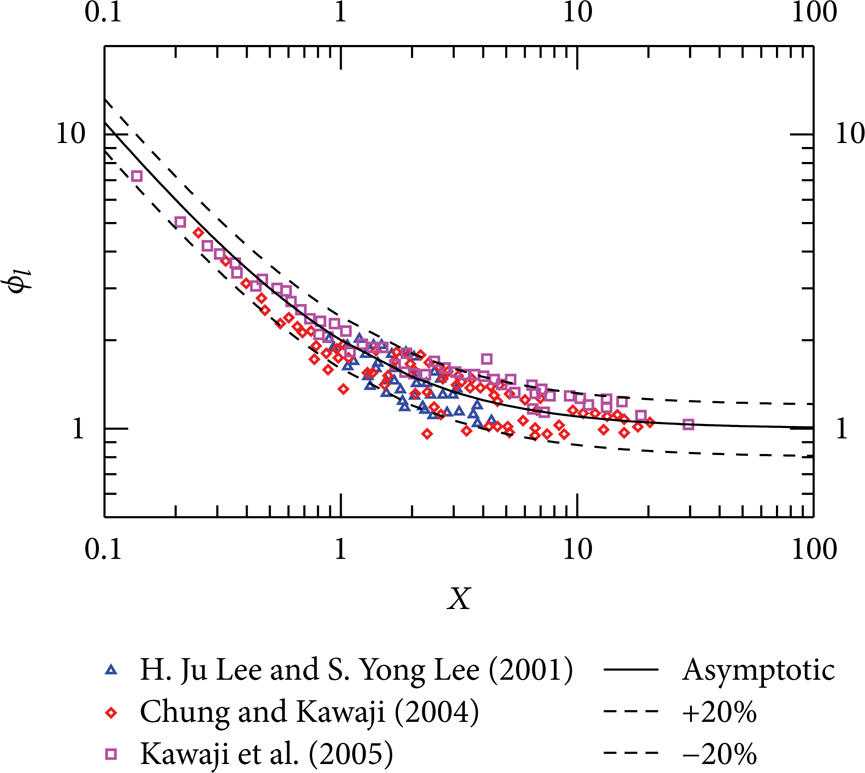
ϕ l versus X for different sets of data in minichannels and microchannels.
Figure 5 shows ϕ g versus Lockhart-Martinelli parameter (X) for laminar-laminar flow for different working fluids in smooth minichannels and microchannels at different conditions using the present asymptotic model and the last two data sets in Table 4. Equation (14) represents the present model with different values of p as shown in Table 4.

ϕ g versus X for different sets of data in minichannels and microchannels.
To have a robust model, one value of the fitting parameter (p) is chosen as p = 1/2. When p = 1/2, the root mean square (RMS) error, eRMS = 17.14% or 15.69% if the two lower points of Ohtake et al. data [33] are not taken into account. Figure 4 shows ϕ l versus X for the first three data sets in Table 4 while Figure 5 shows ϕ g versus X for the last two data sets in Table 4 with p = 1/2. It can be seen that there is a good agreement between the present asymptotic model and the different data sets in Figures 4 and 5.
3. Summary and Conclusions
New two-phase flow modeling is proposed, based upon an asymptotic modeling method. The main advantage of the asymptotic modeling method in two-phase flow is taking into account the important frictional interactions that occur at the interface between liquid and gas because the liquid and gas phases are assumed to flow dependently of each other in the same pipe. Also, the values of the Reynolds number for the liquid and gas phases are not important because the Churchill model [16] that spanned the entire range of laminar, transition, and turbulent flow in pipes is introduced to define the Fanning friction factor. In addition, the obtained expressions of ϕ l 2 and ϕ g 2 are explicit for all flow conditions. The only unknown parameter in the asymptotic modeling method in two-phase flow is the fitting parameter (p). The value of the fitting parameter (p) corresponds to the minimum root mean square (RMS) error, eRMS, for any data set. To have a robust model, one value of the fitting parameter (p) is chosen as p = 1/3.25 for large diameter (macroscale) and p = 1/2 for small diameter (microscale). The difference between the values of p = 1/3.25 for large diameter (macroscale) and p = 1/2 for small diameter (microscale) can be due to the effect of diameter (d) on p.
Footnotes
Appendix
In the appendix, a generalization of the separate cylinders model of two-phase flow will be presented to include laminar liquid-turbulent gas flow and turbulent liquid-laminar gas flow that were not presented in the literature. In the separate cylinders model of two-phase flow, the liquid and gas phases are assumed to flow independently of each other in two separate parallel circular cylinders of radii r le and r ge , respectively. The radius of the actual pipe is r o , and its area is the sum of the area of the separate cylinders.
The gas and liquid volumetric fractions are given as follows:
The pressure over any cross-section of the two-phase flow is assumed to be constant so that the two-phase pressure gradient is the same for each phase. Due to this assumption, the separate cylinders model of two-phase flow is not valid for gas-liquid slug flow that gives rise to large pressure fluctuations [1]. The pressure gradients in the imagined cylinders are therefore both equal to the two-phase frictional pressure gradient in the actual pipe.
The pressure gradient in the separate cylinder of radius r ge carrying the gas phase is given by
For the gas flowing alone through the actual pipe of radius r o , the frictional pressure gradient is given by
Using the assumption that the pressure gradient in the imagined cylinder of radius r ge is equal to the two-phase frictional pressure gradient in the actual pipe of radius r o and using the definition of ϕ g 2, we obtain
The pressure gradient in the separate cylinder of radius r le carrying the liquid phase is given by
For the liquid flowing alone through the actual pipe of radius r o , the frictional pressure gradient is given by
Using the assumption that the pressure gradient in the imagined cylinder of radius r le is equal to the two-phase frictional pressure gradient in the actual pipe of radius r o and using the definition of ϕ l 2, we obtain
The definition of X 2 is given by
Nomenclature
Conflict of Interests
The authors certify that they have no actual or potential conflict of interests including any financial, personal, or other relationships with other people or organizations within three years of beginning the submitted work that could inappropriately influence, or be perceived to influence, their work.
Acknowledgment
The authors acknowledge the financial support of the Natural Sciences and Engineering Research Council of Canada (NSERC) through the Discovery Grants Program.