




Abstract
Cruising sensor nodes have an attractive application in monitoring liquid-based industrial environments. A cruising sensor node, equipped with various sensors, is self-propelled so that they can “cruise” to specified area to gather scientific data. The cruising sensor network consists of an array of such cruising nodes to perform collaborative monitoring task over a given area. A reliable and high-speed underwater acoustic (UWA) communication scheme is necessary for node-to-node communication. Most of the industrial liquid reservoirs are confined spaces, including large oil tanks and nuclear storage ponds. The communication in confined underwater space will suffer more severe multipath interference caused by numerous reflections from boundaries. Conventional orthogonal frequency-division multiplexing (OFDM) technique has poor performance in this channel. Instead, spread spectrum orthogonal frequency-division multiplexing (SS-OFDM), which applies spread spectrum technique into OFDM, has better performance in such severely multipath fading underwater channels. However, the spread spectrum process causes a huge waste in the spectrum efficiency. In order to enhance the transmission efficiency, a mapping sequence spread spectrum OFDM (MSSS-OFDM) method is proposed in this paper. The simulation and experimental results show that our scheme is a robust and spectrum efficient communication method for confined underwater space.
1. Introduction
A cruising sensor network takes charge of monitoring liquid-based industrial environments such as large oil tanks, nuclear storage ponds, and drinking water reservoirs. The cruising sensor network consists of an array of submerged nodes equipped with sensors to gather scientific data in collaborative monitoring missions. The nodes are self-propelled so that they are able to “cruise” to specified area for more detailed message. When executing the task, the cruising sensor nodes need to communicate with each other to cowork together and send data to central station back. Therefore, a robust and high-speed underwater acoustic (UWA) communication scheme is needed.
UWA communication is widely used in many applications of underwater exploration activities [1]. Almost all the existing research on UWA communication concentrates on spacious areas such as seas and lakes. However, most of the industrial liquid environments in practice are confined. Unlike the multipath interference generated from surface and floor reflections in the sea, the reflections are from all directions in confined underwater space. Therefore, the confined underwater channel is characterized by a long delay spread with slight attenuation.
The researchers have made huge efforts to eliminate the intersymbol interference (ISI) caused by multipath arrivals. Direct sequence spread spectrum (DSSS) technique has gained considerable attention in UWA communication not only for its low interception probability and inherent interference rejection, but also for its relative immunity from multipath interference [2–4]. In DSSS modulation, the original signal is multiplied by a pseudo-noise (PN) code to perform spread spectrum process. The received signal is despread using the same spreading code. Due to the strong autocorrelation property of the spreading code, the multipath arrivals longer than one chip of the spreading code can be suppressed greatly.
Orthogonal frequency-division multiplexing (OFDM) has been drawing the attention recently, featuring its strong antimultipath and low complexity properties [5–7]. In OFDM modulation, a high-speed transmitted data stream is divided into a number of low rate ones which are transmitted over a certain number of subcarriers. Moreover, the OFDM structure is simple due to modulation and demodulation process can be implemented by fast Fourier transform (FFT).
Both DSSS and OFDM have great potential to combat multipath interference in UWA communication. We have proposed applying spread spectrum OFDM (SS-OFDM) scheme, which combines spread spectrum and OFDM technique, to address the severe frequency selective fading in confined UWA channels [8]. The simulation and experimental results show that the bit error rate (BER) performance of SS-OFDM has significantly better outcome than conventional OFDM scheme. SS-OFDM requires much fewer subcarriers and significantly shorter cyclic prefix (CP) to eliminate the ISI. Therefore, SS-OFDM shows a robust communication scheme in confined UWA channels. Although the shorter CP in SS-OFDM contributes to enhancing the data rate, the spread spectrum process jeopardizes the system bandwidth and reduces spectrum efficiency [9]. A PN code with length N will cause the bandwidth efficiency dropping to
Our research aims at enhancing the bandwidth efficiency of SS-OFDM scheme. M-ary spread spectrum is widely used to improve the data rate of spread spectrum scheme [10, 11]. M-ary-SS-OFDM system can be constructed when M-ary spread spectrum modulation is applied in SS-OFDM. In the system,
In this paper, we adopt mapping sequence spread spectrum (MSSS) scheme in SS-OFDM system to construct MSSS-OFDM system. In an MSSS system, three bits can be transmitted at the same time by transforming the three DSSS signals into one mapping sequence [12]. The mapping sequence has great correlation property with the DSSS signals. In the receiver, each transmitted signal can be demodulated with its own spread spectrum sequence. Thus the system data rate is tripled compared to DSSS system. We evaluate the performance of our proposed MSSS-OFDM scheme both in experiment and simulation with a heavy reverberation channel. Results show that the proposed scheme can provide a spectrum efficient and robust UWA link.
This paper is organized as follows. After the introduction in Section 1, Section 2 introduces and analyzes the MSSS-OFDM structure. The simulation and experimental results are demonstrated in Section 3 and Section 4, respectively. At last Section 5 leads us to the conclusions of this paper.
2. System Description
The system structure of DSSS-OFDM has been described in detail in [8]. In this section, firstly, the proposed MSSS-OFDM scheme will be introduced and analyzed in detail. Then, we compare the antimultipath performance of DSSS-OFDM and MSSS-OFDM.
2.1. Mapping Sequence SS-OFDM
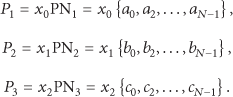
The transmitter block diagram of MSSS-OFDM system is shown in Figure 1. The source data stream is firstly converted to M parallel data streams. Then the parallel data are divided into


The transmitter structure of MSSS-OFDM system.
The mapping sequence


Let T denote the MSSS-OFDM symbol duration and

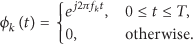

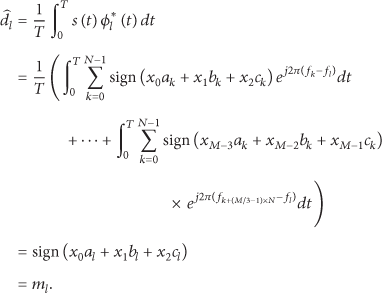


From the structure of MSSS-OFDM, we can conclude that the system data rate is tripled compared to DSSS-OFDM by transforming three parallel modulated signals into one mapping sequence. Moreover, comparing the structure of MSSS-OFDM with DSSS-OFDM, the receiver structure remains the same and the mapping process in the transmitter does not complicate the system.
2.2. Antimultipath Performance Analysis
We have analyzed the antimultipath performance of DSSS-OFDM system in [8]. Now we review this process briefly. The time domain expression of a DSSS-OFDM signal is given by


In MSSS-OFDM system, we also consider the first item in (8). The demodulated sequence of the multipath influenced signal is


So far we can conclude the advantages of the proposed MSSS-OFDM scheme.
Compared to DSSS-OFDM system, MSSS-OFDM can merge every three parallel data streams into one stream. Although longer cyclic prefix is needed, the total data rate can be greatly enhanced without increasing the computational burden. Compared to M-ary-SS-OFDM system, MSSS-OFDM is more suitable for spectrum efficiency improvement of SS-OFDM system with short PN sequences.
3. Simulation Studies
In this section, we introduce the self-designed channel model for confined underwater space at first. Then relevant simulation has been done to evaluate our proposed scheme with different parameter settings.
3.1. Channel Model
Usually, in an UWA channel, a physical discrete multipath channel can be modeled as

The simulation concerns a typical confined underwater channel. Random channel variation is not taken into account because most confined underwater spaces are static without surface wave disturbance. Sound speed can be taken as a constant c in confined underwater space. For underwater spaces with regular shape, path lengths can be calculated using plain geometry. Let

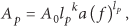

We can develop the channel model by using ray theory for a given geometry and signal frequency. Image-source method is adopted to calculate the channel parameters of a 15 m cubic underwater space in this simulation. In our proposed model, there are more than 140 paths and the maximum time delay is more than 50 ms.
3.2. Simulation Results
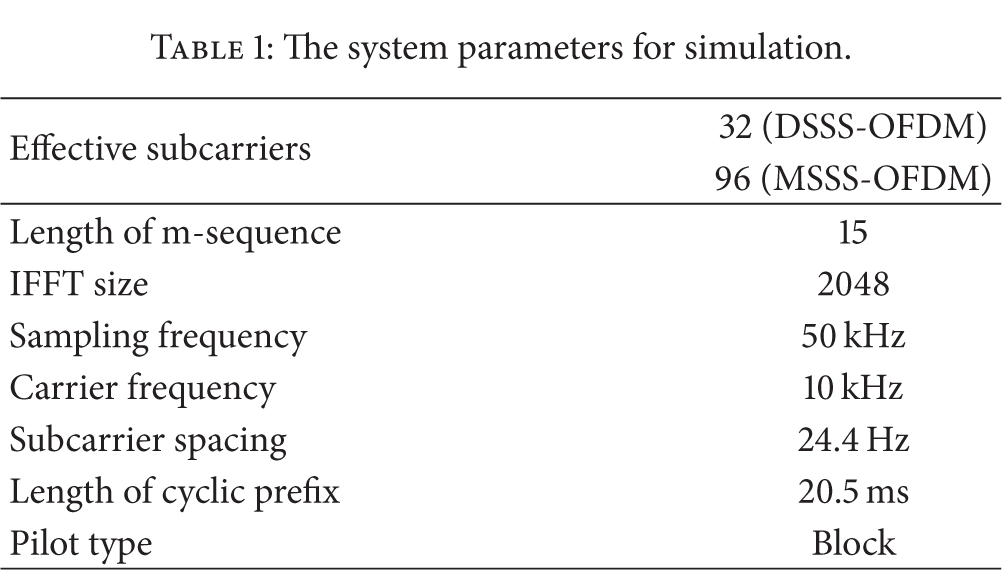
The performances of three schemes including OFDM, DSSS-OFDM, and MSSS-OFDM in the channel described above are tested. The main parameters of the system are listed in Table 1. QPSK is used for mapping the data and m-sequence is adopted as the spreading code. Figure 2 shows the bit error ratio (BER) performance of OFDM, DSSS-OFDM, and MSSS-OFDM. We can see that MSSS-OFDM can greatly improve the system performance in confined UWA channels compared to OFDM. Although the BER performance is slightly poorer than DSSS-OFDM, MSSS-OFDM can enhance the system data rate by three times.
The system parameters for simulation.

BER performance of OFDM, DSSS-OFDM, and MSSS-OFDM.
Figure 3 shows the system performance of MSSS-OFDM with different lengths of m-sequence. The system performance increases as the length of m-sequence elongates. The MSSS-OFDM system with 31-chip m-sequence has nearly the same BER performance as DSSS-OFDM system with 15-chip m-sequence. Although the m-sequence is twice the length of that in DSSS-OFDM, in MSSS-OFDM the overall data rate can be enhanced by 1.5 times.

BER performance of MSSS-OFDM with different lengths of PN sequence.
4. Pool Experiment
4.1. Experimental Environment
For the experiment, we use a cube-shaped test tank with side length of 1.5 m. The transmitter and receiver are deployed in opposite corners of the tank, which is a typical confined underwater space. The channel condition is very harsh because no sound absorption approach is adopted. An LFM signal of 100 ms with frequency swept from 30 kHz to 80 kHz is transmitted to measure the channel. By calculating the crosscorrelation functions between the transmitted and received signal, the channel response can be shown in Figure 4. As evident, the channel is characterized by strong multipath interference. The maximum multipath delay is more than 50 ms.

The channel response of the test tank.
4.2. Experimental Results
We compare three schemes including DSSS-OFDM, MSSS-OFDM, and M-ary-SS-OFDM. The parameter settings are the same in all schemes. The carrier frequency is 50 kHz and sampling frequency is 500 kHz. The modulation is implemented using IFFT with size of
Performances of three schemes with different length of m-sequence.

Compared to the original m-sequence, the mapping sequence losses
Performance of MSSS-OFDM with different length of cyclic prefix.

In order to further improve the system performance, turbo code is adopted as the error correcting code in both schemes to construct DSSS-COFDM and MSSS-COFDM. The coding rate is
Performance of DSSS-COFDM and MSSS-COFDM with different length of m-sequence.

5. Conclusions and Future Work
The DSSS-OFDM method, which combines direct sequence spread spectrum and OFDM, is a robust communication scheme for cruising sensor network in confined underwater space. However, the spread spectrum process decreases the bandwidth efficiency of the system. In order to build a spectrum efficient communication scheme, we investigated the application of mapping sequence spread spectrum scheme as the spreading process to construct an MSSS-OFDM scheme. The MSSS-OFDM scheme can transmit three data signals at same time by transforming three spreading signals into one mapping sequence. There is no need to change the receiver structure and computational complexity is not increased in the proposed scheme. The simulation and experimental results show that it is a robust and spectrum efficient communication scheme in confined underwater channels.
As the point-to-point communication technique is well studied, the future research will focus on building an underwater network in confined space. One of the basic DSSS techniques known as code division multiple access (CDMA) allows several users to share a band of frequencies, which will be the starting point of our future work.
Footnotes
Conflict of Interests
The authors declare that they do not have any commercial or associative interest that represents a conflict of interests in connection with the paper they submitted.
Acknowledgments
This work has been supported by the National Natural Science Foundation of China under Grant no. 61304244 and Tianjin Research Program of Application Foundation and Advanced Technology (13JCYBJC18000 and 13JCZDJC35400).