




Abstract
It is possible to generate electricity by utilizing medium-temperature geothermal sources in various closed cycles. These geothermal power plants are very important and valuable as they utilize the sources which have low exergy. In recent years, medium-temperature sources that are around 150°C are used widely for electricity generation. In this study, performance of a supercritical binary power plant, that uses such a geothermal source, is analyzed to find the optimum turbine inlet pressure that maximizes power generation. In this power plant different working fluids are analyzed to find the appropriate fluid that maximizes power generation and efficiency. The observed working fluids are R134a, isobutane, R404a, n-Butane, and R152a. The performance of the plant is calculated with these fluids separately and it is found that the best fluid for performance is R152a for pure fluid and R404a for mixture fluid.
1. Introduction
Most of the geothermal sources around the world provide low- and medium-temperature geofluid. Consequently generating electricity with these resources has become popular in recent years and binary ORC power plant project numbers have increased rapidly. As known, most of the binary geothermal power plants operate under Rankine cycle principles.
According to August 2011 statistics, there are 235 geothermal binary turbines in 15 countries around the world. The total installed capacity of these plants is nearly 708 MWs. Although percentage of binary turbines is 40% of all geothermal turbines in the world, this is only 6.6% of total installed geothermal capacity as these turbines generate small power. Average capacity is 2.3 MW per turbine [1].
In subcritical Rankine cycle, heating process occurs in low temperature. In particular in conventional power plants, the temperature difference is too much that causes big exergy loss as the flame temperatures reach around 1500–2000°C. This fact decreases thermal efficiency of the Rankine cycle significantly. Besides that in subcritical cycle, most of the heat is absorbed in boiling and temperature does not rise during this process (constant temperature heat input). These disadvantages can be overcome by using supercritical Rankine cycle. In supercritical cycle, heat input raises the fluid temperature continuously that decreases the temperature difference between the working fluid and the heating medium. This phenomenon allows small exergy loss and higher thermal cycle efficiency. Supercritical conditions that enhance the conventional power plant efficiency also increase the efficiency of the geothermal power plant that uses low-temperature geofluid.
In the literature, there are numerous studies about the supercritical ORC cycles [2–5]. Most of them investigate optimum cycle operating parameters [6–9] and the best suitable working fluids [6, 7, 10, 11]. Some studies are directly related with low-temperature geothermal resources and geothermal power plants [9, 12, 13].
In this study, optimum operating conditions of a supercritical binary geothermal power plant are determined by analyzing the plant performance. The results are compared with the power plant which is actually the same type but operated in subcritical conditions to find the performance improvement. Additionally, optimum supercritical pressures are calculated for different working fluids.
In Figure 1, subcritical and supercritical Rankine cycles of the binary cycle for the same turbine inlet temperature are presented. The working fluid is R134a. The figure is representative.
Subcritical Rankine cycle: 1-2′-3′-4′-1.
Supercritical Rankine cycle: 1-2-3-4-1.
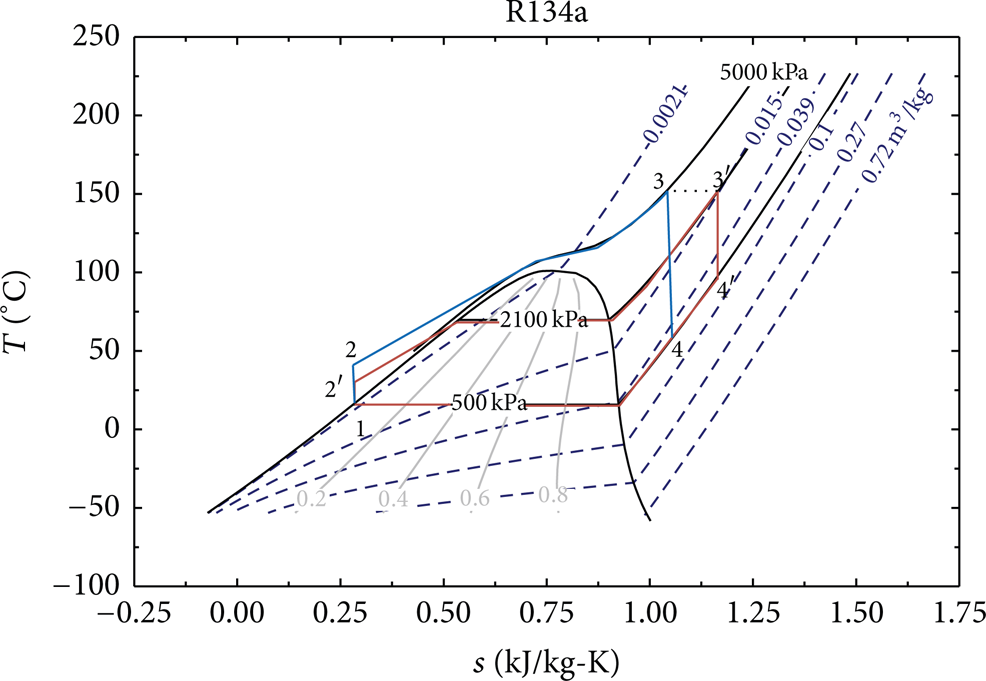
T-s diagrams of subcritical and supercritical Rankine cycles.
In binary power plants, preheating and evaporating take place in heat exchangers. In this analysis, it is assumed that counter-flow heat exchangers are used. Heat transfer in ORC heat exchanger in subcritical and supercritical conditions is displayed in Figure 2.

Heat transfer diagram of a subcritical and supercritical binary power plant heat exchanger.
The area between the cooling curve of the geothermal fluid and warming curve of the working fluid is irreversibility of the heat transfer process. If heat transfer takes place in supercritical conditions, this area will be smaller. Consequently, irreversibility of the heat transfer process will be lower (Figure 2).
Nowadays, most of the geothermal binary power plants are designed and operated at subcritical conditions. However, performance of these plants would be higher, if they were designed for supercritical conditions.
In this study, the performance improvement of a subcritical geothermal binary power plant is evaluated if it is switched to supercritical cycle. Calculated performance parameters are generated power, thermal efficiency (1st law efficiency), working fluid flow rate, and cooling water flow rate. These parameters have been evaluated for alternative working fluids; the best working fluid has been selected and optimal operating pressures have been determined.
As known, the main advantages of the subcritical cycle are low equipment cost due to low operating pressures and small pressure losses due to low pump power.
The main advantage of the supercritical cycle is the low exergy loss in heat transfer process as the temperature is not constant during evaporation. Therefore, thermal efficiency is higher.
Geothermal power plants generally utilize geofluid which is between 100°C and 180°C. A geothermal power plant in USA-Alaska is commissioned lately that uses a source at 73°C. This power plant generates 200 kW [14].
In Table 1, properties of some working fluids that are used in binary geothermal power plants are presented.
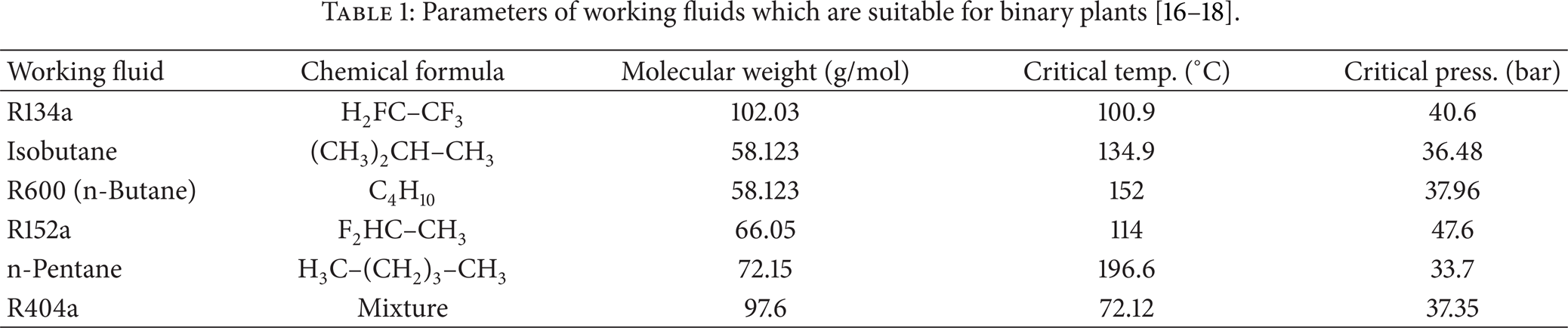
There is a relation between the working fluid molecular weight and the turbine size. If a working fluid with higher molecular weight is used, the turbine size will be smaller and there will be less turbine stages. This fact is important for the turbine cost. As an example, if n-pentane is used, the turbine will be smaller and the number of stages will be less for this working fluid as its molecular weight is high [15]. Thus, it is economical considering the turbine cost. However its critical temperature is high, it is not appropriate for the supercritical power plants which use 150°C source.
2. Materials and Method
Schematic diagram of the computer based model that was developed to analyze the binary power plant is presented at Figure 3. In this power plant, geofluid is used as the heat source to warm the working fluid. This process occurs in the heat exchanger. The working fluid becomes superheated at the heat exchanger. Then it expands through the turbine and condenses in the condenser. After that it is pumped to operating pressure and sent to heat exchanger again. The computer based model is developed by the EES software [18]. The performance of the power plant with various working fluids can be analyzed by using this software.
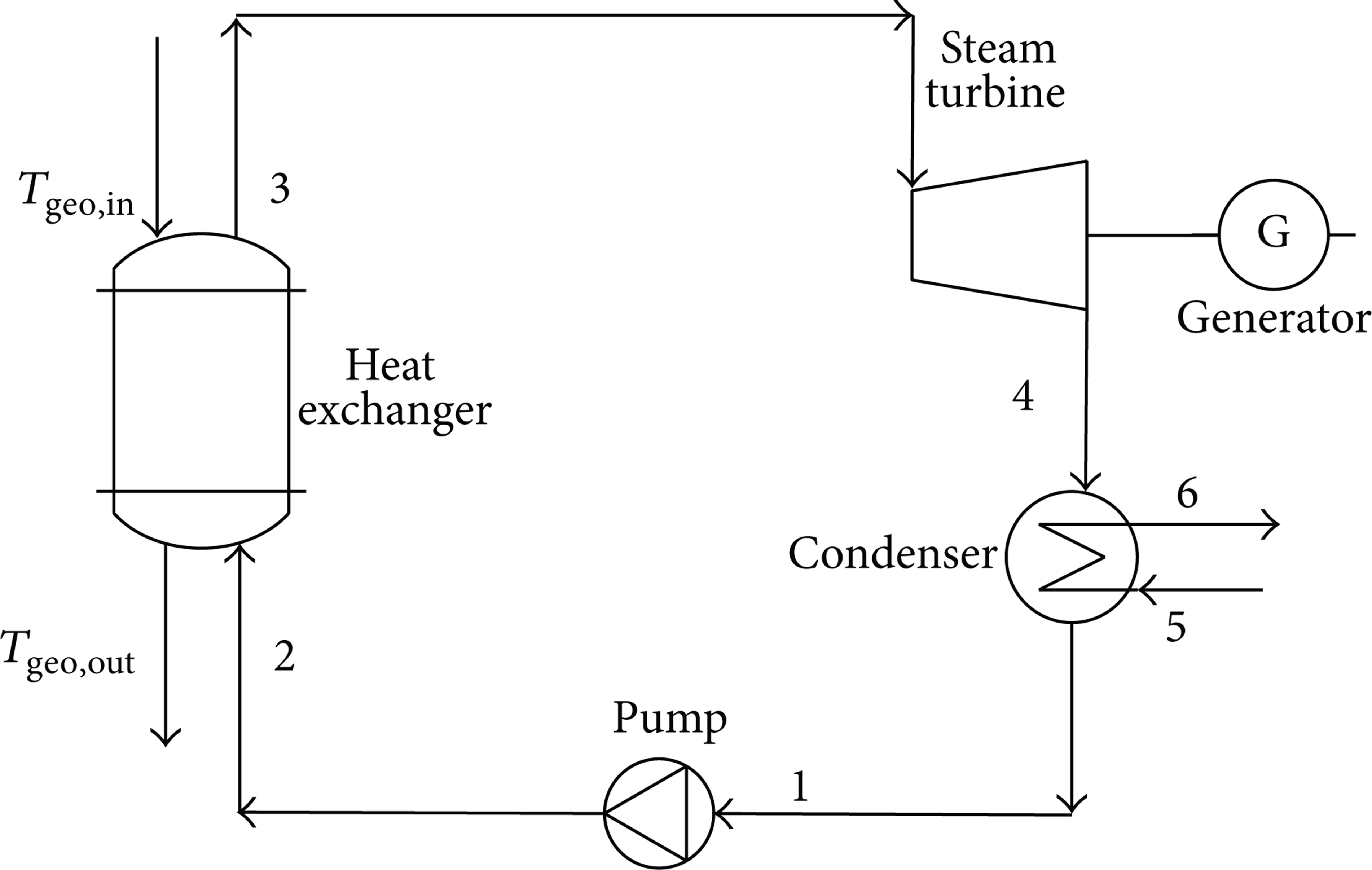
Schematic diagram of basic binary geothermal power plant.
The input values for analysis are listed and presented in Table 2. Geothermal source temperature is picked as 150°C because there are plenty of sources in earth at that temperature.
The input data of computer analysis.

Thermodynamic equations that are used in the analysis are taken from literature. They are shown below [19].
Pump specific power is

Turbine isentropic efficiency is

The thermodynamic equilibrium between the geothermal brine and the working fluid in the heat exchanger may be written as follows:

Heat rejected from the cycle is

Heat transferred to working fluid from geothermal water is

Pump power consumption is

Power generated in turbine is

Net cycle power is

Cycle thermal efficiency is

Condenser duty is

Basic binary power plant performance parameters are net power, thermal efficiency, working fluid mass flow, cooling water mass flow, and net power per unit cooling water mass flow. The change of these parameters is observed, when different working fluids are used in subcritical and supercritical conditions.
In this study, a new performance parameter is introduced for binary power plants which use wet cooling towers. This parameter is “required cooling water mass flow per unit net power (
The T-s diagram of the model power plant that utilizes R134a as working fluid is shown in Figure 4.

Temperature-entropy diagram of the binary cycle which uses R134a as working fluid.
In the analysis, optimal turbine inlet pressure is considered as the pressure that provides maximum net power, maximum efficiency, and minimum required cooling water flow.
Also in the analysis, subcritical performance and supercritical performance of the power plant with different working fluids are observed. The analyzed working fluids are R134a, isobutane, R404a, n-Butane, and R152a.
2.1. The Results of the Analysis
The analysis results are presented in this section. Table 3 displays performance of the binary power plant with different working fluids, under subcritical conditions. If the cycle operates between 500 kPa and 2100 kPa (subcritical), the cycle with R152a provides the maximum power: 9205 kW. The cycle which uses n-Butane gives 8845 kW, cycle with R134a produces 8580 kW, cycle with isobutane produces 8522 kW, and cycle with R404a produces 8470 kW outputs. The cycle that utilizes R152a has become the most efficient cycle with 12.23% thermal efficiency. Other working fluids come after that, respectively, n-Butane, R134a, isobutane, and R404a. Cycle that uses isobutane as working fluid provides the highest specific net power with 56.508 kJ/kg. R152a cycle has the lowest required cooling water mass flow rate per unit net power (0.1713).
Operation characteristics of working fluids at subcritical pressures.

Figure 5 shows the net power versus cycle maximum pressure diagram for different working fluids. The results reveal that binary cycle with R404a has the maximum power generating potential with a 150°C geothermal source. For power generation capability, R152a, R134a, isobutane, and n-Butane come after R404a.

The variation of net power produced in the power plant according to the turbine inlet pressure.
According to Figure 5, the optimum pressure value that allows maximum power is 8,667 kPa for R404a. Net power at this pressure is 13,751 kW.
Figure 6 displays the thermal efficiency versus cycle maximum pressure diagram. The maximum thermal efficiency can be assured again with R404a. The ranking for efficiency is R404a, R152a, R134a, isobutane, and n-Butane.
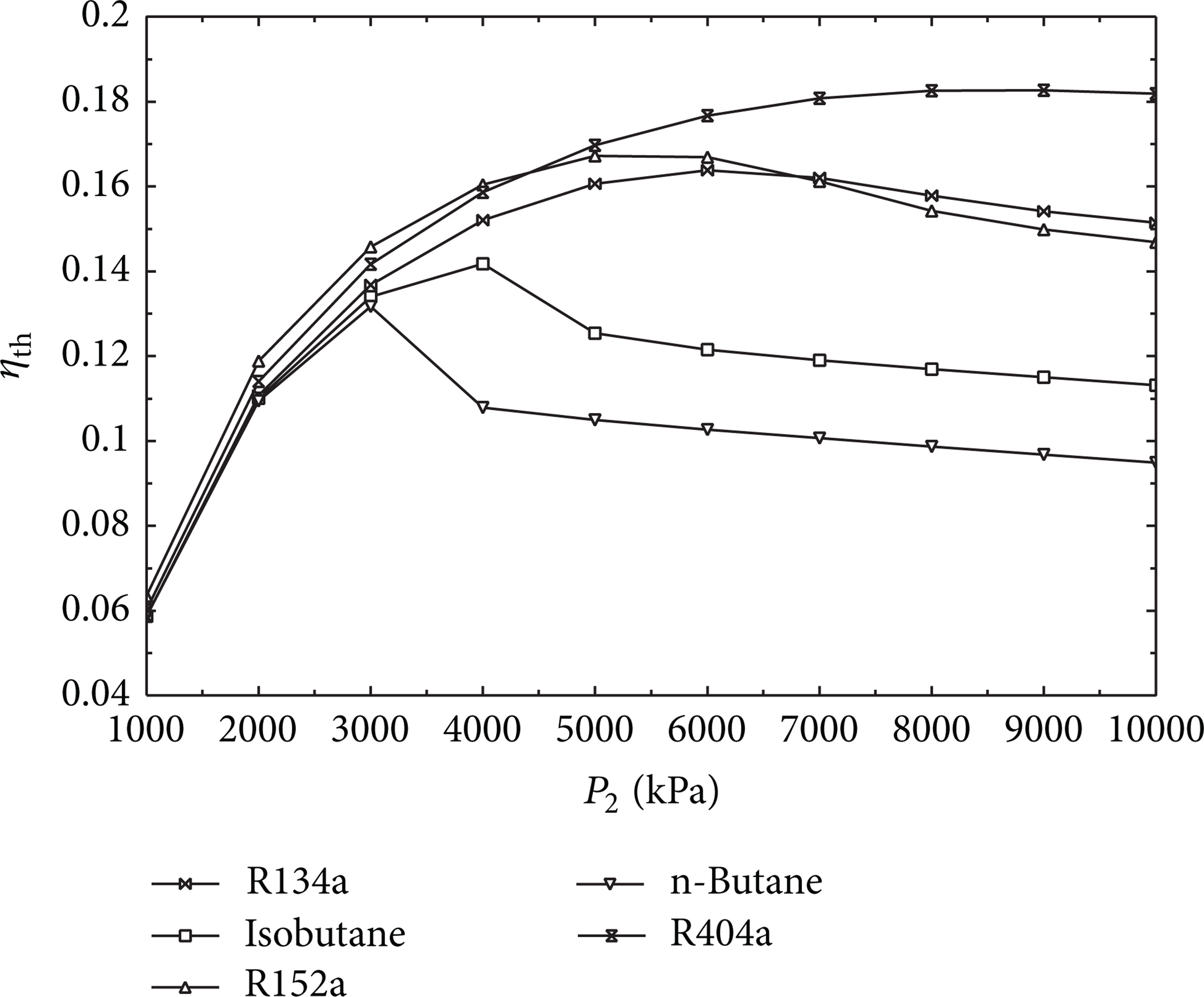
The variation of power plant thermal efficiency according to the turbine inlet pressure for selected working fluids.
In Figure 6, the pressure that makes the thermal efficiency maximum is 8,667 kPa for R404a. At that pressure, thermal efficiency is 18.27%.
Various hydrocarbons are used as working fluids in binary power plants. Therefore, cost of the working fluid can be considered as a design criteria. Required working fluid flow rates according to cycle maximum pressures are shown in Figure 7. Flow rates of all selected working fluids increase with higher turbine inlet pressures.
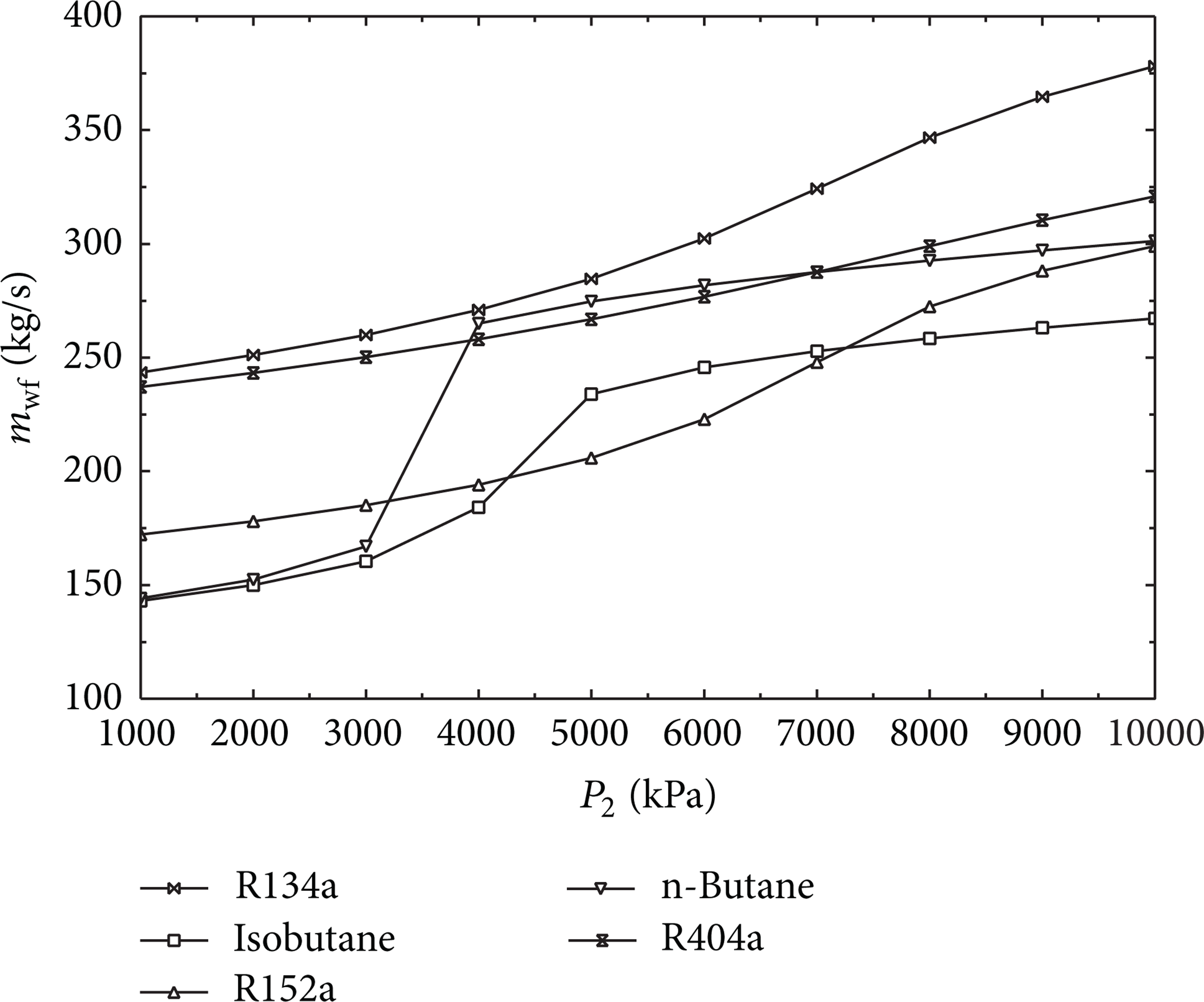
The variation of working fluid flow in the power plant according to the turbine inlet pressure for selected working fluids.
Maintaining desired condenser pressure is very crucial for power plants. In addition, providing required cooling water is also important for condensing steam. Most of the geothermal power plants are far away from cooling water resources. As a result cooling with air is common for binary geothermal power plants. On the other hand, summer and winter air temperatures differ significantly. Thus, there is a huge performance difference between summer and winter time. Even day and night temperature differences can highly affect the plant performance.
One of the optimization criteria is the optimal turbine inlet pressure that provides minimum cooling water flow rate. In this manner, the relation between cooling water flow and cycle maximum pressure in basic binary power plant with different working fluids is observed. The results are displayed in Figure 8.

The variation of cooling water flow in the condenser according to the turbine inlet pressure for selected working fluids.
According to Figure 8, the cycle with working fluid R404a needs minimum cooling water flow for unit power generation. After R404a, R152a is the second, R134a is the third, isobutane is the fourth, and n-Butane is the fifth for this fact. As a result, R404a should be considered for power plants that have poor cooling water resources.
In Table 4, net power output, thermal efficiency, working fluid flow rate, cooling water flow rate, and required cooling water per unit power that are calculated at optimal turbine inlet pressure for selected working fluids are presented.
Optimum turbine inlet pressures and other operation parameters at optimum pressure for working fluids.
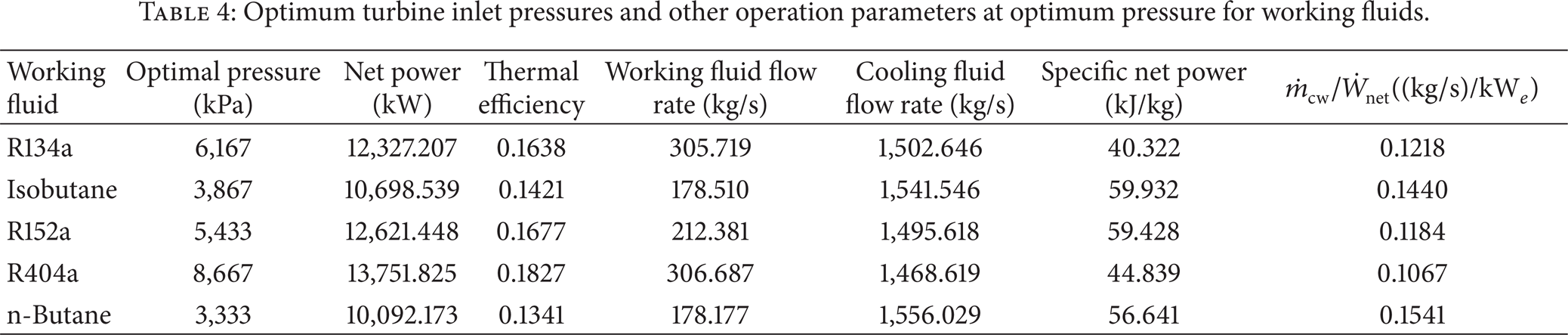
Table 4 indicates that maximum specific net power is achieved by using isobutane at optimum pressures. R152a, n-Butane, R404a, and R134a come after isobutane for this criterion. Maximum power, 13751 kW, is generated by utilizing R404a, with the same inlet conditions. Maximum thermal efficiency, that is, 18.27%, is also obtained with R404a.
Table 5 reveals the performance increase of the power plant that occurs when subcritical cycle is switched to supercritical conditions. The biggest power increase occurs in the plant that uses R404a, that is, 62.34%. Thermal efficiency also increases most at the cycle that utilizes R404a. The rise is the same, 62.40%. The efficiency boost is 43.68% for R134a, 37.12% for R152a, 25.53% for isobutane, and 14.12% for n-Butane. Table 5 also displays decrease of cooling water flow and increase of working fluid flow rates. Here turbine inlet temperature is constant.
Performance variation parameters of the supercritical binary geothermal power plant with selected working fluids.

represents decrease.
In Table 5, it is observed that R404a which is actually a mixture performs better than pure fluids. Main reason for that is the heat transfer between geofluid and fluid mixture (working fluid) is better that decrease irreversibility of the heat transfer process. Therefore, binary power plants can give the highest performance if they are operated under supercritical conditions and if an appropriate mixture is selected as working fluid.
2.2. Sensitivity Analysis
100–150°C geofluid resources are generally utilized with binary power plants. Flash type geothermal power plants can be used for resources that are higher than 150°C. In this section, performance of the supercritical binary power plant is calculated assuming that it utilizes 130°C, 140°C, 150°C, and 160°C geofluid. Computer based model has been used to perform calculations.
According to the results obtained, when the geofluid temperatures increase, optimum turbine inlet pressure, which makes the net power maximum, also increases (Figure 9). Other performance parameters also increase with temperature increase as can be seen in Figures 10, 11, 12, 13, and 14. However, the cooling water requirement per unit energy produced decreases with the increase of geofluid temperature as can be seen in Figure 15.
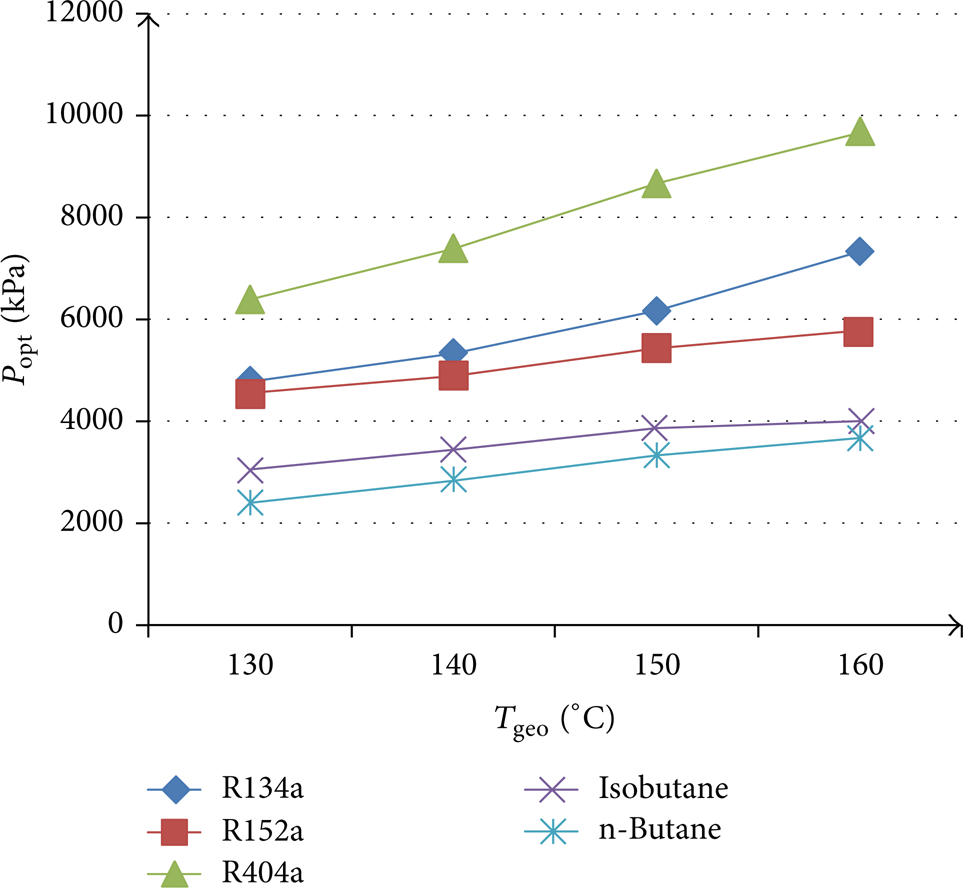
The variation of optimum turbine inlet pressures for each working fluid according to geothermal fluid temperatures.
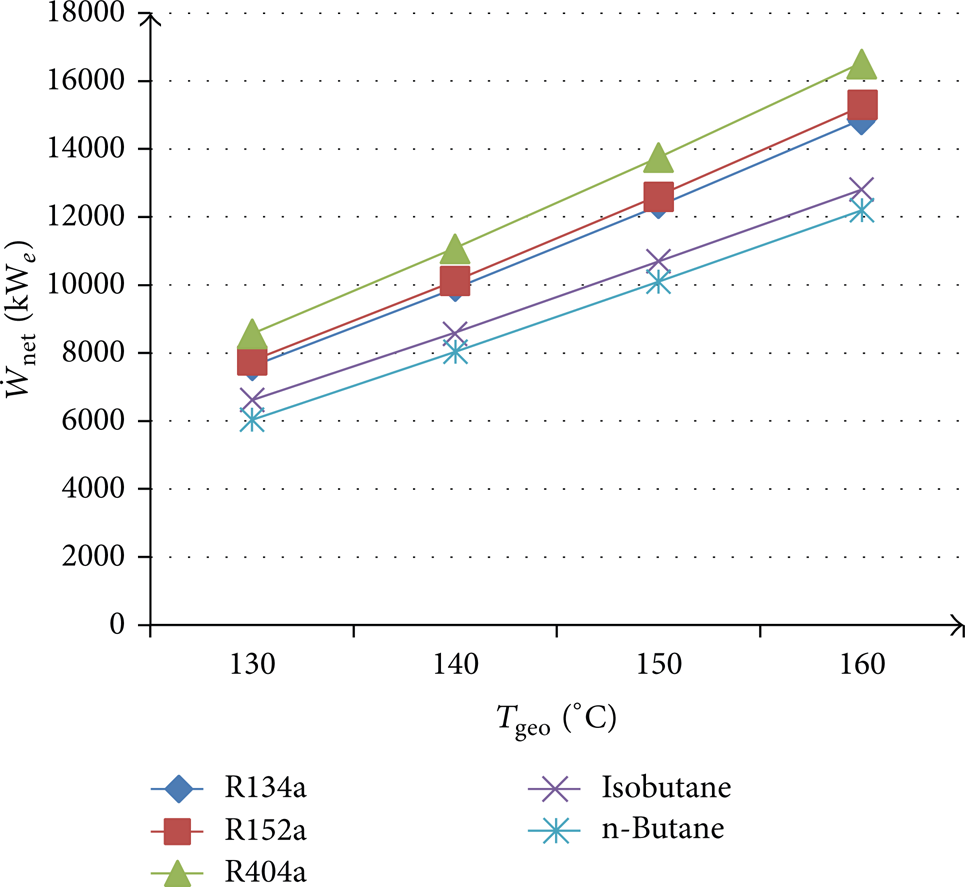
The variation of net power outputs for each working fluid according to geothermal fluid temperatures.

The variation of thermal efficiencies for each working fluid according to geothermal fluid temperatures.

The variation of working fluid mass flow rates for each working fluid according to geothermal fluid temperatures.
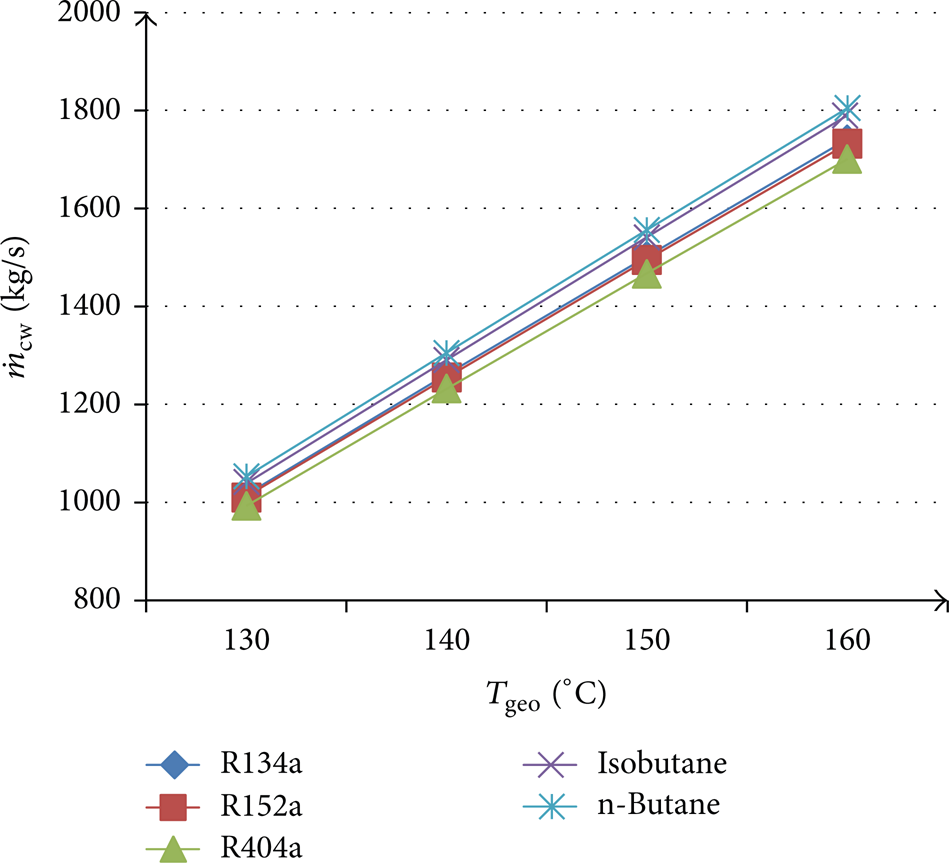
The variation of cooling water mass flow rates for each working fluid according to geothermal fluid temperatures.
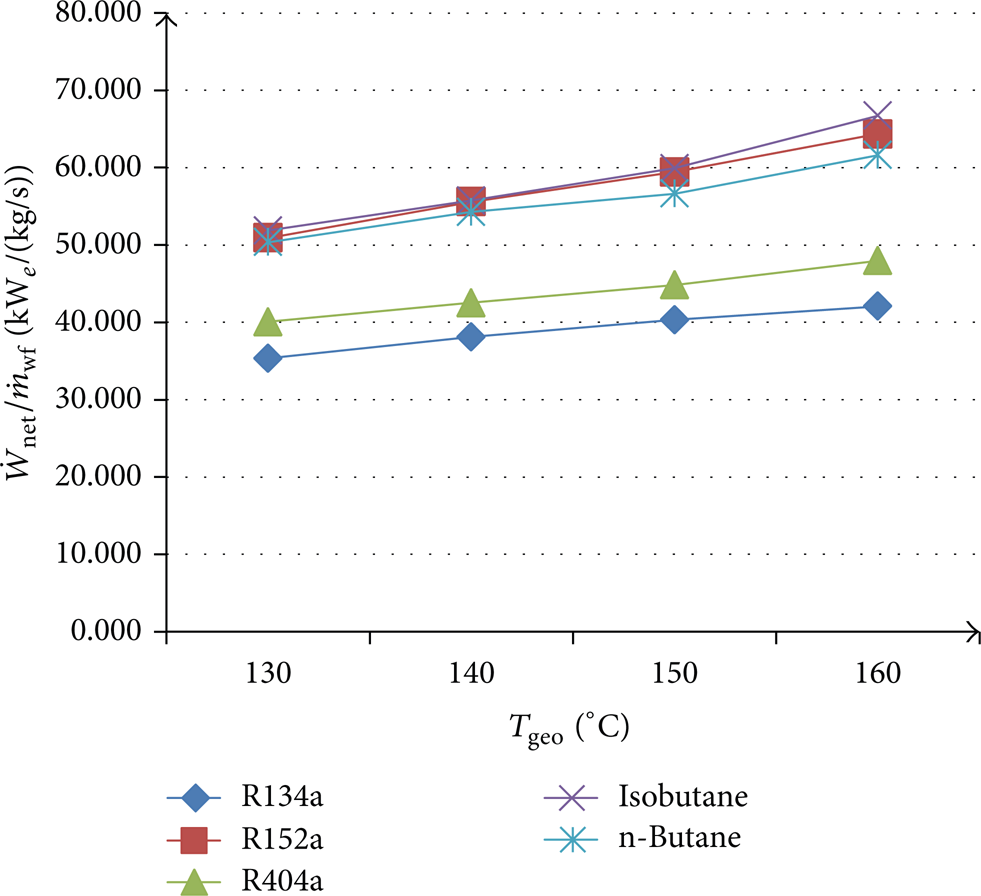
The variation of specific power outputs for each working fluid according to geothermal fluid temperatures.

The variation of specific cooling water requirements for each working fluid according to geothermal fluid temperatures.
2.3. Economic Evaluation
The most convenient parameter to determine which fluid shows better performance is the cost of unit electricity production (g). The alternative with the least cost of production of electricity is the most convenient alternative from economical point of view. Unit cost of electricity production in geothermal power plants is calculated with the following equation:

Here for a constant load factor the unit cost of electricity production decreases when the amount of electricity production increases. Selecting the most convenient fluid and operating the power plant at optimum operating conditions will make the electricity production maximum and the unit cost of electricity generation minimum. The selection of the most convenient fluid and the values of optimum operation parameters affect directly the cost of investment. However to determine how these parameters affect the cost of investment is a difficult and complex problem. Therefore such analysis might be the subject of another study.
3. Conclusions
In this study, performance of the basic binary plant that operates at subcritical conditions is analyzed with different workıng fluids. After that, optimum turbine inlet pressures (cycle higher pressure) are determined under supercritical conditions. The turbine inlet temperature is kept constant. Performance improvement of switching to supercritical conditions is revealed.
Analyses show that maximum power in optimal operating pressure is obtained by using R404a. The second suitable working fluid is R152a. Some articles are proposed to R152a for working fluid of supercritical ORC [7, 11]. When R404a is selected as the working fluid of the supercritical binary power plant, 13,751 kW power is generated in ideal conditions if the operating pressure is 8667 kPa. In subcritical conditions the same power plant can generate 8470 kW with the same working fluid. This reveals that there is 62.34% difference between subcritical and supercritical cases. Maximum thermal efficiency is also obtained by using R404a. In ideal conditions the maximum efficiency is 18.27%. Again difference between subcritical and supercritical cases is 62.4%. According to analysis, the basic binary cycle which uses R404a has the lowest required cooling water flow rate per power produced.
In this paper, five working fluid candidates have been selected for supercritical binary power plants that have 150°C geofluid. These are R134a, isobutene, R152a, R404a, and n-Butane. In this study, it is revealed that maximum power and maximum thermal efficiency can be obtained by using R404a.
It is interesting to note that the gas with maximum electricity generation is achieved with R404a. This gas is the mixture of R125, R143a, and R134a. The gas R404a which was used in the analysis is 44% R125, 52% R143a, and 4% R134a. As can be seen, using new gas mixtures in binary plants instead of pure work fluids reduces the irreversibility coming from the heat transfer and the power plant shows better performance. New investigations can be on this direction.
How the performance of different geothermal fluids with different geothermal fluid temperatures will be was investigated and, as a result, it was found that when the geofluid temperatures increase, optimum turbine inlet pressure, net power produced, necessary work fluid flow, and energy produced for unit work fluid amount increase. However, the cooling water requirement per unit power produced decreases.
Footnotes
Nomenclature
Conflict of Interests
The authors declare that there is no conflict of interests regarding the publication of this paper.
Acknowledgment
The authors would like to thank to Professor Dr. Bahri Sahin for all technical helping and considerations.