




Abstract
Industrial wireless sensor networks (IWSNs) have become a viable solution for diverse application. However, commercial products and real-world deployments of IWSNs are faced with harsh reliability, real time, and predictability issues. The problem is more challenging in the narrow process industry. A novel two-tier wireless network consisting of subnetworks (FNs) and a backbone (BN) in the field is proposed in this paper. Along exploring time and frequency diversity, we present an optional polling slots allocation method in the FN to maximize communication reliability and integrity. Since time slots are scarce in the communication network for narrow process, we design a slot-reuse strategy with time slots consumption of
1. Introduction
Employing wireless communication technologies, we can quickly and easily deploy field instruments to temporarily or permanently monitor the status of equipment, process trends, locate assets, and then control the process [1]. Wireless technologies have been identified as an attractive option for industrial and factory automation. As the application and real-world deployments, IWSNs have become a viable solution for diverse application areas, including factory automation, building automation, and energy distribution system. The process automation has experienced generation of technology advancement. Wireless technology is regarded as a paradigm shifter in the process industry.
IWSNs have several advantages over traditional wired systems, including self-organization, rapid deployment, flexibility, and their inherent intelligent-processing capability. However, to realize the envisioned industrial applications and hence taking the advantages of the potential gains of WSNs, the effective wireless communication link, which can address the unique challenges posed by IWSNs, is required [2]. Effective communication in industry is characterized by concurrent demands on reliability, real time, and predictability, which is more challenging in process automation. Reliability is of importance in industrial large-scale production process, and communication errors can cause significant production outages [3]. At the same time, the data transmitted in field networks is only valid in a short time due to the nature of automation. If the data is delivered too late, it is of limited use even harming on process. On the other hand, the transmissions of data over wireless communication links are severely subject to a number of disturbances, in terms of the interference level perceived at destination, and dynamics of wireless links over time and space due to obstructive and noisy industrial environment.
Over the years, along with a considerable improvement of wireless communication technologies (e.g., the IEEE 802.11 wireless LAN and the IEEE 802.15.x wireless PAN), solutions specifically designed for the process automation have been put forward by commercial products and IEC (International Electrotechnical Commission). The most remarkable example is wireless HART (WH), which is the first wireless field bus based on an open standard (IEEE 802.15.4) designed for process measurement and control applications [4]. WH was officially released in September 2007, including several features to provide availability of wireless communication and networks in industrial process. Figure 1 shows the architecture of WH. The basic elements of a typical WH network include field devices (FDs), access point (AP), gateways (GW), and network manager (NM). FDs attach to the plant process and act as sensor, controller, or actor. GW and AP connect host applications with FDs. NM is responsible for configuring the network and scheduling and managing communication among WH devices.

Example of wireless HART network infrastructure.
Drawing upon the key insights and lessons learned from real-world industrial applications, the WH standard specifies the following salient features designed to meet the stringent reliability, real time, and predictability requirements of process automation: multipath communication, redundant routes, multichannel frequency hopping, TDMA (time division multiple access) transmission, and centralized network management architecture. The network manager disseminates a global transmission schedule based on TDMA strategy to field devices, and then communication is conducted slot by slot to ensure communication predictability and real time. Employing mesh network topology and reserved slots, WH has the redundancy communication, in which a communication route is composed of at least two radio signal transmission links between adjacent nodes [5]. The networks using the channel hopping communication method can resend the message in other frequency channels to recover errors of communication even. Another well-known solution, ISA100.11, includes similar technical features to WH.
Integrating communication technology into the real-world industrial process environment, WH and ISA SP100.11 have been applied in many process automation systems. However, above solutions cannot run efficiently for narrow process industries. Figure 2 shows a narrow process system of 2050 mm hot strip mill production line in Baosteel in China. The whole hot strip mill process contains sequent process sections from the functional and physical point of view, such as reversing rougher R1, reversing rougher R2, finishing mill, and laminar cooling. In the typical solution, as wireless HART and ISA100.11, all FDs form a mesh network, and process data is forwarded to the control center slot by slot by employing TDMA scheduling. In this kind of narrow process industries, for example, a packet delivering over N hop mesh network in WH needs at least

A narrow process: process system of 2050 mm hot strip mill production line in Baosteel, China.
Our observation is that industrial large-scale production is usually divided into several process zones for control separately, and data transfers requirement between FDs takes place more in the same zone other than in different ones. Bounding relevant FDs in the same FNs will reduce convergecast over BN and improve real time effectively. More important, relevant FDs exchanging data within the same subnetwork is a path to provide single loop integrity, process integrity, and truly distributed control [6, 7]. Starting from such observation, we propose a novel IWSN for narrow process industry, in which a two-tier network is employed in the field. The FDs are divided into clusters according to process zones, and a series of clusters constitute a network chain. The cluster head polls the FDs periodically. The cluster head and the rest FDs formulate a star topology network in each cluster. A multihop multichannel BN network is constructed with cluster heads and APs, over which the polled packets are forwarded to the GW. In this paper, we design slots allocating strategies and multicycle scheduling scheme to improve communication reliability in the two-tier IWSN.
Communication reliability is an important issue in IWSNs. With mesh topology being absent, retransmission is a key knob to improve communication reliability in FNs. Time slots are important communication resources and must be employed efficiently. In the traditional wired and wireless process automation systems, slots are allocated to FDs averagely [8]. From the system viewpoint, average allocating transmission trials may not be efficient. For example, time slots may be used luxuriously over high quality links, while low quality links suffer from data delivering failure for using up attempt trials. In the FN for a zone, the reliability will refer to system performance. A process variable is updated when a slave is polled successfully before its deadline. Only when all variables in a zone are available can the process be reconstructed well and truly [7]. We say the communication in a FN is reliable and integrated when all variables are updated. Different from traditional average allocating slots strategy, an optional slots allocating scheme is presented to maximize system communication reliability and integrity in this paper.
It is more challenging to forward the process data to the GW reliability over a multihop BN. In a multihop network, it is considered reliable if and only if, for each FD except the AP, it has two children to forward its packet to the GW [5]. According to WH standard, at least
The rest of this paper is organized as follows. In Section 2, system model and formulation are given. Section 3 presents an optional slots allocating solution to maximize communication reliability and integrity with given number of slots in the FN. In Section 4, we construct convergecast routing graph and present a slots-reuse solution in the BN. In Section 5, a multicycle scheduling strategy for polling and convergecast is presented. Section 6 gives a further discussion on FNs based industrial wireless system. Finally, we conclude the paper.
2. System Model and Motivation
Adopting WH for narrow process, we propose a two-tier IWSN. We consider that a network consists of

Example of an IWSN for narrow process automation.
Let
finding an optional polling slots sequence
constructing convergecast routing graph and a slots-reuse strategy to achieve the same communication reliability of WH in the BN;
finding a multicycle schedule scheme for polling and convergecast to reduce the workload over the BN.
We assume the following.
Time is synchronized and slotted based on TDMA strategy. Each time slot allows the transmission of a single packet and the associated link level acknowledgement, which is named as a transaction.
The system can use a maximum of 16 parallel channels. Strategy based on adaptive frequency hopping runs in the BN and FNs.
3. Optional Polling Slots Allocation
We consider monocycle polling strategy in
3.1. Communication Link and Reliability
Without loss of generality, we consider that a
We assume that links are unreliable with independent erasure events following Bernoulli model. The presence of a sublink

where
3.2. The Metric of Communication Reliability and Integrity
Let
Communication reliability and integrity are an important issue for process automation [7]. As mentioned previously, bounding FDs of a zone in the same FN is a path to provide loop integrity and process integrity. We try to poll all slaves successfully other than only one to improve system integrity. Just as the compensation of temperature and pressure on the flow measure, only when all variables are available can the accurate result be calculated. The slaves should be polled fairly in a FN. We adopt proportional fair scheduling (PFS) to address this problem. A scheduling policy is proportionally fair, if and only if the sum of the logarithmic average user throughput is maximized after the scheduling decision [9]:

where
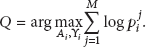
Formula (3) can be equivalently expressed as

By maximizing
3.3. Optional Polling Slots Allocation for Application
In formula (4), the PFS is degenerated to joint select slot-channel policy. The problem is a nonlinear integer programming problem. Theoretically, we can get globally optimal solution, for example, through integer programming box in MATLAB, which is computationally time-consuming to solve practical problem, and it is difficult to apply this solution to the engineering practice.
We study the scheduling strategy of allocating

where

We consider that

We introduce an ordering
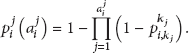
The problem (4) can be rewritten as
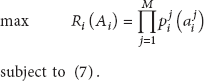
Now, the problem (4) is converted into a conventional resource allocation problem. The optimal resource allocation can be solved by defining a marginal returns utility:


Since the link utilities are strictly concave, the optional allocation consists of the
(1) Input M slaves and corresponding prima reliability P, maximal slots (2) Output slots allocated sequence (3) (4) For (5) {calculate (6) (7) (8) (9) } (10) Caculate (11) Return
We consider that two slots are available for each slave averagely. Channels failing successively for two polling cycles will be removed from the channel sequence (white list) in practical implementations and communication loss probability is less than

Reliability and integrity in a FN.
4. Convergecast over the BN
We focus our attention on convergecast from a set of FNs to the GW over the BN. Reliability is specially challenging for packets delivering over long and narrow process hop by hop. As mentioned early, retransmission is a major control knob against communication failure. Since slots are scarce communication resources for the multihop BN, we employ channel hopping technique based on TDMA strategies to improve resource utility of time and frequency to improve convergecast reliability.
4.1. Network Planning and Network Connectivity
A FN is small-scale, low data rate network. With nominal transmit power of 10 dBm, the nominal non-line-of-sight receiver distance is 75 meters and line-of-sight distance is 200 meters. A typical process plant unit is no more than a football field, which is about 100 by 50 meters [12]. As mentioned earlier, large-scale production is usually divided into many process zones. According to the size of zones, most FDs in a FN are able to cover adjacent zones unit with single hop communication.
Of course, the inherent unreliability of wireless links makes radio network planning a fundamental step that must be carried out prior to actual deployment for process automation. Virtual radio planning is based on the prediction of wireless link quality. Prediction can be supported by independent radio measurement campaigns over typical environments. Since the traditional use of sensors in industrial environments was in monitoring industrial equipment, a group of sensors are placed manually and then clustered for the purpose. For narrow process automation, FDs in a long assembly line are composed of FNs, which may cover each assembly. It is necessary to deploy FNs properly and deliberately to achieve high connectivity. New wireless repeaters will be added to improve the coverage according to requirement. In a general way, most FDs in a FN can cover adjacent zones unit.
4.2. Reusing Slots to Improve Routing
Consider a multihop multipath communication shown in Figure 5(a). The node n1 does not communicate directly with node n3, and added communication slot is used to relay data to n2. Node n1 employed another path for delivering data when no acknowledgement is received from n2, and added two slots in the superframe are reserved. Obviously, some slots are used luxuriously. If the delivering in primary path is successful, slots of redundant path are wasted, and the slot3 has no chance to exert. Improvement is possible if we reallocate the slots. In Figure 5(b), added retransmission time slot is reserved in primary path. After two failed transmissions to n2, n1 will deliver data to r1 in slot3. Following that, r1 has chance to relay the data to n3 in slot4.

Motivated example for improved routing with slots reuse.
4.3. Master Sets Selection and Convergecast Reliability Factor Calculation
FDs in a FN being able to cover adjacent zones unit, we get a strongly connected weighted directed graph
We want to maximize the convergecast reliability as well as polling reliability when we construct convergecast routing graph
(1) Input directed graph (2) Output (3) (4) While (5) Find (6) if (7) if (8) for all master (9) Sort its edges (10) Choose the first two master according to (11) (12) add to (13) end if (14) end if (15) end while (16) Construct (17) return
We define the convergecast reliability factor for a master as the reliability for delivering from the master to GW, which represents convergecast force. The factors for BN are calculated as shown in Algorithm 3. We construct a reversed graph
(1) Input directed graph (2) Output (3) Construct (4) for (5) select (6) (7) (8) (9) end for (10) return
Let communication reliability probabilities behave as Rayleigh distribution on [1%~75%]; set the number of FNs from 2 to 19. We calculate the convergecast reliability and compare the result with the case with two disconnected paths. The number of time slots consumed is the same

Reliability over the BN.
5. Multicycle Scheduling
We consider scheduling a set of transactions in FNs and the BN. In the proposed system, bandwidth is limited in BN. The master runs convergecast and polling schedule. We hope to reduce the load of BN network to improve feasibility in scheduling and alleviate the burden of masters.
5.1. Problem Formulation
As described above, we denote the set of transactions

In order to guarantee the freshness of temporal data,

This is a nonlinear programming problem. We adjust the scheduling sequence and develop a heuristic algorithm to address the problem [14].
5.2. Interference Avoiding and Channel Sets Allocation
Interference and collision must be avoided when the Γ is scheduled. Interference may come not only from nodes transmitting on the same channel that are not far enough from the receiver but also from nodes transmitting on the adjacent channel if they are very close. In fact, even though channels are not overlapped, recent research shows that some cross-channel interference actually takes place between adjacent channels due to spurious emissions.
In general, diversity, such as channel diversity, time diversity, and space diversity, can help to avoid interference mentioned above. According to the spatial characteristics of narrow process, we propose a simple approach shown in Figure 7 to address the problem. Firstly, available channels are parted into two groups, named odd channel set and even channel set; then adjacent FNs in different zones select different sets. Each follows sequence rules with order or reverse. All channels are available for the BN in order not to violate WH standard. Forwarding to the GW within four hops is forbidden in the BN and interference avoiding is natural when convergecast runs correctly.

Channel sets allocation.
5.3. Shortest-Validity-First (SVF) Schedule and Adjustment
SVF produces an approximate solution for multicycle schedule. It is proved that deadline monotonic scheduling acts as an optimal strategy constrained with

The low limit is selected to reduce the load of BN. Furthermore, we try to rearrange Γ to decrease the factor
For all
For all
Algorithm 4 presents the framework of multicycle schedule in the system. In WH, the supported update rates should be defined as
(1) Input (2) Output B, E (3) for (4) {adjust( (5) (6) Do (7) for (8) (9) }while (10) (11) }
6. Further Discussion on FNs Based Industrial Wireless System
To cover the narrow process efficiently with FDs, we propose a FNs based IWSN. In this section, we present the further discussion on the system architecture.
6.1. Performance Benefits in Reliability and Availability
Comparing to traditional DCS systems, polling and control loops can be deployed in the same FN, which provides fewer points of failure. Polling and control in FNs will keep the process running even with the absence of the BN network and HMI. The increased MTBF (mean time between failures) combined with the reduction in data transfers required substantially increases reliability and availability. The overall reduction in network traffic also increases network availability.
6.2. Performance Benefits in Real Time
Generally, wireless sensors, actuators, and controllers for a loop are in the same subnet FN, and they communicate with each other directly without forwarding. The time of message processing, sending, and receiving is very small; we have the loop latency as
6.3. Performance Benefits in Flexibility and Reconfiguration
Polling and control in FNs mean not only increased reliability, availability, and real time but also increased flexibility. In FNs, control function blocks may be performed in FNs which are not attached to upper network. Remodeling function can be deployed with an appropriate configuration of field devices and data transfer in FNs. These are considerations that must be undertaken by the designer of the system. Since function block can be executed in different devices in a FN, even in different FNs, which can be configured to take advantage of parallel computations, FNs can also be integrated into process automation with tropism to ubiquitous computing or ubiquitous automation [16, 17].
7. Conclusion
We have studied the IWNS for the process automation in this paper. To meet the requirement in narrow process industry, we present an IWSN based on FNs and BN. Aiming to improve reliability and integrity in the FN, an optional slots allocation solution constrained with available slots is presented. We construct a N-hop BN in which each master has two paths for convergecast with time slots consumption of
Footnotes
Conflict of Interests
The authors declare that there is no conflict of interests regarding the publication of this paper.
Acknowledgments
This work was partially supported by the Ministry of Science and Technology of China under National Basic Research Project 2010CB731803 and by NSF of China under Grants 61221003, 61290322, 61174127, 61273181, and 60934003.