




Abstract
CO2 emission from the transport sector attracts the attention of both transport and climate change policymakers because of its share in total green house gas emissions and the forecast of continuous growth reported in many countries. This paper takes the urban transport in Beijing as a case and builds a system dynamics model for analysis of the motorization trend and the assessment of CO2 emissions mitigation policy. It is found that the urban transport condition and CO2 emissions would be more serious with the growth of vehicle ownership and travel demand. Compared with the baseline do-nothing scenario, the CO2 emissions could be reduced from 3.8% to 24.3% in 2020 by various transport policies. And the policy of controlling the number of passenger cars which has been carried out in Beijing and followed by some cities could achieve good results, which may help to increase the proportion of public transit to 55.6% and reduce the CO2 emission by 18.3% compared with the baseline scenario in 2020.
1. Introduction
Climate change is one of the most serious environmental problems the world has to face today. Most of the observed increase in global average temperatures since the mid-20th century is very likely due to the observed increase in anthropogenic Green House Gas (GHG) concentrations. Carbon dioxide (CO2) is the most important anthropogenic GHG which represents 77% of total anthropogenic GHG emissions [1].
Transport sector significantly contributes to the CO2 emissions growth in many countries and accounts for 22% of global CO2 emissions from the statistics of IEA [2]. This report also shows that the fast emissions growth was driven by emissions from the road sector, which increased by 52% since 1990 and accounted for about three quarters of transport emissions in 2011. In China, transport contributed 628.8 Mt of CO2 emissions and accounted for 7.9% of the total CO2 emissions from fuel combustion, and the road sector accounted for 79.5% of the transport CO2 emissions. Global demand for transport appears unlikely to decrease in the foreseeable future; the WEO 2013 [3] projects that transport fuel demand will grow by nearly 40% by 2035. And in China, the WEO 2013 New Policies Scenario projects that emissions from the transport sector will continue to grow, accounting for 13% of total emissions in 2035.
In many cities, this problem is intensified with the continuous development of urban economy and acceleration of motorization process. For example, in Beijing, the total daily trip volume has risen by 89.0% from 2001 to 2012, and the number of vehicles in 2012 is 3.1 times as many as the number in 2001 [4]. Traffic congestion adversely affects urban mobility and becomes a major issue affecting everyone's quality of life [5]. Existing infrastructure cannot cope with rapid increase in the number of motor vehicles, and congestion is spreading over larger areas and in turn exacerbating CO2 emissions. In order to reduce the effect of motorization and to limit emissions from transport sector, policy makers should implement measures to encourage or require improved vehicle efficiency. Policies that encourage a significant shift from cars to public transportation [6] and to lower-emission modes of transportation can also help to optimize the structure of urban transport modes.
As an important tool to support policy experiments, system dynamics (SD) methodology which is proposed by Forrester [7] can not only arrange and describe the complicated relationships in macroscopic urban transport system, but also predict the system changes under different scenarios to examine and recommend policy decisions [8]. SD approach which consists of dynamic models embracing information feedbacks can deal with dynamic process and simulate the development trends of transport systems. SD methodology has been applied extensively to the studies related to environment and policy assessment, such as regional environmental planning and management [9], sustainability assessment of urban transport policy [10], water resource planning [11], atmospheric emissions modelling [12], CO2 mitigation in intercity passenger transport [13], simulation of the tax policy to reduce the CO2 emissions in the residential sector [14], sustainable land use planning and development [15], urban planning process toward stabilizing carbon dioxide emissions from cities [16], comprehensive analytical approach for policy analysis [17], and CO2 emission reduction policies based on system dynamics method in traditional industrial region [18].
This paper analyzes the motorization process in China, and then a SD model is designed for scenario analysis of urban traffic conditions and CO2 emissions. The complex relationships between the various components in the transport system are reflected in the SD model considering the socioeconomy, urban transport demand, urban transport supply, CO2 emissions, and policies. The SD model could simulate the urban traffic condition and the CO2 emissions under different scenarios with alternative government policies. The findings are expected to assist in the process of government's policy decision to make the urban transport development sustainable.
2. Motorization Development Trend of Urban Transport
The road transport sector is one of the fastest growing GHG emission sources in China, and motor vehicle is the major source of China's urban emissions [19]. During the past decades of years, one of the most important characteristics of the urban development in big cities of China is the urban motorization. According to the previous four household travel surveys in Beijing in 2010, the travel demand is 4.3 times as many as that in 1986, and the proportion of motorization trip (excluding walk) has increased to 80.7% in 2010 from 33.5% in 1986, which is mainly due to the fast increase of car trip rising to 34.2% from 5.0%, which is shown in Figure 1. Although the public transport has received great investment in the infrastructure development and got continuous growth of passenger volume, the trip proportion of bus remains stable with a little increase from 26.5% in 1986 to 28.2% in 2010. However, the rail transit has entered into the rapid development stage after 2006 with a trip proportion increase of 9.8% from 1986 to 2010, which has become the main factor in increasing the proportion of public transport from 28.2% in 1986 to 39.7% in 2010 [20].

Traffic structure (excluding walk) of previous household travel survey in Beijing.
During the motorization process and the change of trip mode structure, the main driving force is the increase of vehicle ownership with the rapid economy development. The vehicle ownership increased from 103.8 thousand to 4809 thousand in the period of 1980 to 2010 at an average annual rate of 13.8%, with the increase of GDP from 13.9 billion yuan to 1377.8 billion yuan at an average annual rate of 16.7% and the GDP per capita from 1544 yuan to 75084 yuan at an average annual rate of 14.0% [21]. Since the implement of “Interim Provisions for Controlling the Number of Passenger Cars” in Beijing, the growth of the number of vehicles has slowed down, with an increase rate of only about 4% from 2011 to this day. Nonetheless, the increase rate of the number of private vehicle still remains at about 10%. Figure 2 shows the GDP per capita and vehicle ownership development and the change of car trip proportion in transport mode structure.

GDP per capita and vehicle ownership development from 1980 to 2012.
As can be seen from Figure 2, the motor vehicle ownership and GDP per capita in Beijing show simultaneously growing trend. Annual data is chosen from the Beijing statistical yearbook during the period from 1980 to 2010 without the data after 2010 affected by the provisions for controlling the number of passenger cars, in order to calculate the correlation coefficient ρ between the GDP per capita and vehicle ownership:
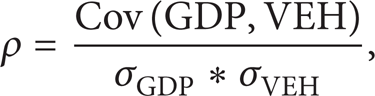
where GDP is the gross domestic product per capita, VEH is the vehicle ownership, Cov(GDP, VEH) is the Covariance between GDP and motor vehicle ownership, and σGDP and σVEH are the variance of GDP per capita and variance of vehicle ownership, respectively.
Taking different time intervals, the calculation results are shown in Table 1. The GDP per capita and vehicle ownership show very strong correlation during the whole period, and become more and more obvious during the continuous development period.
Correlation coefficients of GDP per capita and vehicle ownership.

The very strong positive correlation between the relationship of GDP per capita and motor vehicle ownership indicates that they are keeping pace with each other in the development; namely, with the economy continuing growth in future, the increase of motor vehicle ownership reveals the rigid development tendency on the whole in Beijing. Therefore, in order to reduce the influence of the urban motorization on CO2 from urban traffic emissions, effective policies are required to control the use of car and encourage a significant modal shift from private transport to public transport to make the structure of urban transport modes more rational and sustainable.
3. System Dynamics Model
A SD model has been designed for scenario analysis of urban traffic conditions and CO2 emissions to support policymakers, planners, and other strategic planning for transport system and environmental protection in China. This study aims to extend current studies to obtain several possible scenarios under different growth paths of various driving factors including the socioeconomy, urban transport demand and supply, transport intensity, CO2 emissions, and related policies.
In this paper, the urban transport modes consist of public transport and private transport which have great relationships to motorization and CO2 mitigation, including bus, rail transit (underground and DLR), taxi, and car. The purpose is to analyze the road transport operation with different transport mode structure under several policy scenarios and assess the effects of urban transport development on CO2 emissions. The time horizon of the model is from 2005 to 2020, and the baseline year 2005 in which the third household travel survey was made in Beijing is used for validation. Figure 3 shows the interactions and relationships between the sectors at a macro level. The details of the contents and structures are described as follows and some important stock-flow diagrams are presented, respectively.

Relationships between sectors at macro level.
3.1. Socioeconomy Sector
The socioeconomy sector mainly contains the economy and population state variables which are primary drivers leading to the increases in the vehicle ownership and transport demand [22]. According to the Beijing Statistics Bureau, the population increased from approximately 9.9 million people in 1985 to 15.3 million people in 2005 with an increase of 55.5%, the trip volume demand during this period increased from 9.39 million to 29.2 million per day. As mentioned previously, the vehicle ownership also had a fast increase with the economy growth. The population is defined as the permanent population of Beijing, and the GDP is defined as the gross domestic product of Beijing [21].
3.2. Transport System Sector
The transport system sector consists of car transport, bus transport, taxi transport, road supply, and transport intensity. Different policies on private and public transport are carried out to improve the transport condition and reduce environmental influence of the system. In this SD model, the transport condition is evaluated by the transport load which is the ratio of the transport intensity and road supply. The peak hour transport intensity is defined as the vehicle turnover during the period of peak hours within a certain space scope, and the road supply is defined as the urban road capacity including different road grades. The detailed structure and information flows are presented in the stock-flow diagram in Figure 4.

Flow diagram of the system dynamics model.
Road transport intensity mainly takes into account the impacts of cars, taxies, and buses, all of which will be converted into the standard vehicles for calculation, and the mitigation of road turnover by rail transit is also considered. Vehicle turnover of different transport mode depends on the number of vehicles, average trip or operating distance per time, and average trip or operating frequency per day. In addition to the impacts of each transport mode, the road transport intensity is influenced by the transformation between private and public transport mode. According to the transport conditions and policies, the transformation inclination between private and public transport is collected by a stated preference survey which reveals the acceptance degree of different policies [23]. Therefore, even with the increase of vehicles ownership, traffic intensity can be adjusted by the trip or operating parameter and the transformation preference.
Road capacity is defined as the design vehicle turnover of a certain road grade in the network scale. Under the ideal conditions, the average speed is 60 km/h and average traffic flow on each lane is 1500 veh/h. Road length is converted to the single-direction lane length according to the number of lanes contained in different road grades by taking into consideration the reduction factor of intersection to the transport capacity and the impact of the interference correction coefficient of lanes. Figure 4 shows that the road supply system consists of expressway, major arterial road, minor arterial road, branch road, and neighbourhood street, and the capacity mainly depends upon the road grade structure, road length, and lane capacity.
Different traffic load will result in different road traffic congestion status, and the most intuitive reaction is the change of average vehicle speed in the urban road network. Due to different width and number of different levels of roads, the one-way lane standard road length could be translated considering the different road level and the capacity reduction of intersection. Table 2 shows the relationship between speed and space headway under the condition of saturation and continuous traffic volume and the theoretical capacity considering various reduction factors [24].
The lane theoretical capacity calculated by space headway.

When the urban road traffic load is set as 1, the corresponding average speed in urban road network is 60 km/h. Depending on different speeds and headways, as well as correspondence between the traffic density and speed, the average speed curve corresponding to the different traffic loads in the road network could be shown in Figure 5 through the fitting analysis.

The relationship of average speed and traffic load.
The relationship of average speed Y and traffic load X is

The correlation R2 is 0.9913 with a high fitting degree and thus could calculate the average speed of the road network and CO2 emissions corresponding to different urban road traffic load.
For policy assessment and scenario evaluation, historical data from the authoritative sources during 1980 to 2005 is used to support the urban transport system. Annual data of urban transport passenger volume, transport network, and proportion of different transport modes are taken from “Beijing Statistical Yearbook” [21]. The trip or operating parameters come from the third household travel survey in Beijing [20].
3.3. CO2 Emissions Sector
CO2 emissions are evaluated by the transport average speed determined by the urban transport condition. The speed-emission factor coefficients are calculated according to the vehicle speed emission factor database [25] in grammes per kilometer to average speed, for different types and engine size of vehicles and in all the categories of European emission standards from pre-Euro I to Euro IV. Emission factors for CO2 refer to “ultimate CO2,” referring to all the carbon in the fuel emitted at the tailpipe as CO2, CO, unburned hydrocarbons, and particulate matter which ultimately have the potential in forming CO2. In this model, CO2 emission is defined as follows and the detailed structure and information flows are presented in the stock-flow diagram in Figure 6:

where CO2 is the total CO2 emissions, E j is the CO2 emission factor coefficients of vehicle j of a certain engine size and Euro emission standard, measured in g/km, Q ij is the vehicle j ownership of district i, T i is the average trip rate of district i, and D i is the average trip distance of district i.

Flow diagram of CO2 emission sector.
4. Transport Policy Scenarios and Simulation Analysis
Along with the increase of vehicle ownership and the related emissions, pressure is growing on policy makers to tackle the issue with a view to providing sustainable transport. Various transport policies may finally result in different transportation conditions with different transport mode structures, such as transport investment policy, public transport priority policy, and traffic demand management policy. So far, direct efforts to reduce GHG emissions can be found with regard to vehicle emissions, and related policies have been carried out with the compulsory implementation of Euro standards for motor vehicles.
In 2000 China stopped producing and selling leaded gasoline. In 2001 all new cars that entered the Chinese market began to be required to meet a Euro I emissions equivalent standard. In Beijing, in 2002, 2005, 2008, and 2013, vehicles were required to meet the Euro II, Euro III, Euro IV, and Euro V emissions standard successively. Every time the new emissions standard was put into force, the emission per vehicle would be reduced by 50% [26]. Since April 2006, Chinese consumers who buy large cars with engines larger than four liters are required to pay a consumption tax of 20%, while more efficient cars enjoy considerably lower tax, which is a clear incentive to buy efficient and environmentally friendly cars. Beijing also makes efforts to disuse the old vehicles produced before 1992, and some policies which have indirect influence on the CO2 emissions also can be found, such as the bus only way build from 1997 to increase the speed of public transport, the decrease in ticket price of bus and rail transport to attract the passenger from private transport, adjusting the parking price according to different districts and time in 2002 and 2011 to release the traffic press in city centre, the implementation regulation for temporary provision on number control of small passenger car in Beijing from December in 2010, and the research on the road congestion charge in recent years.
At present, according to the Transport Development Planning, Beijing has established the strategy of giving priority to the development of public transport. Therefore, we assume the basic development strategy in the future as premise: first, the infrastructure construction of public transport (including bus and rail transport) will have a great development; second, the number of taxies will be strictly controlled at the current level; and third, road construction will keep a relatively slow and stable growth speed. Therefore, based on the analysis of past transport policies, existing studies, and development planning [27], in order to assess the effect of transport policies on mitigation of CO2 emissions, five scenarios are established as follows. For policy assessment and scenario evaluation, the historical data from the authoritative sources is used to support the simulation analysis [20, 21], and some parameters of trip characteristics can be got through the SP survey [23] as input data in the model.
Policy Scenario 1. Increase the travel speed of bus and reduce the journey time by 25% after 2010 and 30% after 2015.
Policy Scenario 2. Improve the accessibility and convenience of bus network and reduce the transfer time and walking time by 15% after 2010 and 25% after 2015.
Policy Scenario 3. Raise the parking charge in city centre by 60% after 2010 and 100% after 2015.
Policy Scenario 4. Raise the fuel price by 85% after 2010 and 135% after 2015.
Policy Scenario 5. Control the number of vehicles and limit the number increase by 240 thousand after 2010.
The policies above aim at having great effects on the transformation from car to public transport and the reduction of CO2 emissions. Figure 7 shows the comparison of the simulation results under different scenarios.
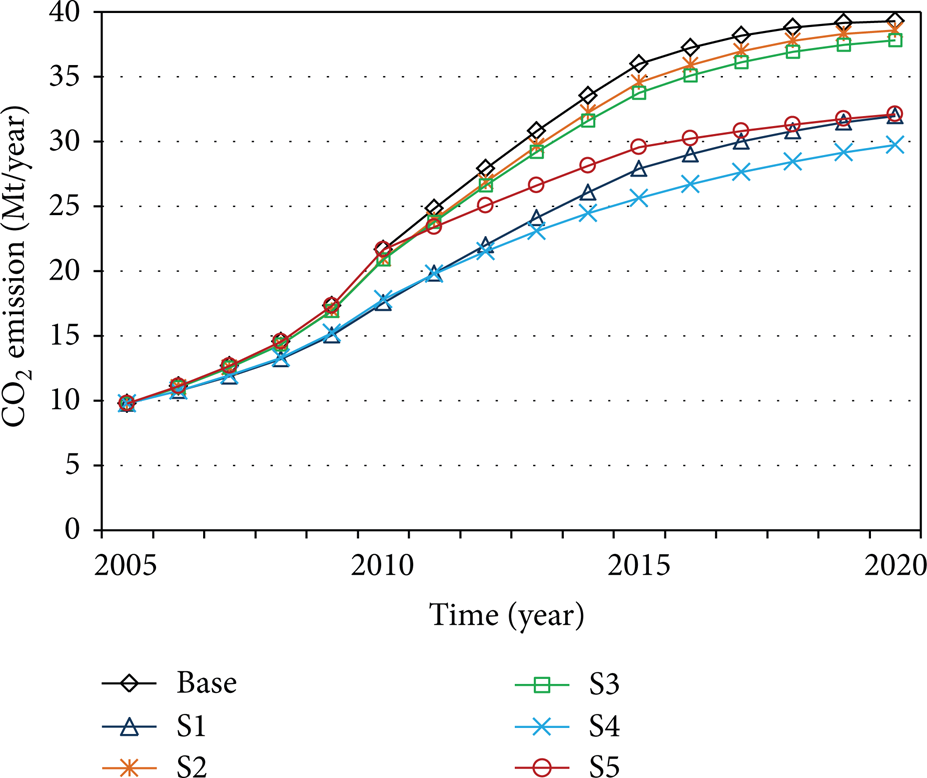
Compare of the simulation results under different scenarios.
As the vehicle ownership increases dramatically, the urban transport condition becomes more serious. The average speed would fall down gradually, but at a relatively lower rate under policy scenarios than the baseline scenario. Figure 8 shows the average growth rate per year of CO2 emission and the proportion of different traffic modes under different scenarios in 2020. The CO2 emissions would increase at a stable speed from 7.8% to 9.9% under different scenarios but may be reduced by 17.4%, 2.7%, 3.9%, 20.2%, and 10.6% average per year under the five policy scenarios compared with baseline scenario, respectively.

Comparison of proportion of different traffic modes in 2020 and average growth rate per year of CO2 emission.
The policies also contribute to the transformation to public transport and the change of transport mode structure. Compared with the baseline scenario, the proportion of car trip would be reduced about 0.4%–6.8% through different policies in 2020 and the proportion of public transit would be higher 4.7%, 0.4%, 0.8%, 6.7%, and 6.0% than the baseline scenario in 2020 under the public speed policy, bus network policy, parking price policy, fuel price policy, and car number control policy. The most effective policy is raising the fuel price, which may help to increase the proportion of public transit to 56.4% and reduce the CO2 emission by 24.3% compared with the baseline scenario in 2020. And the second effective policy is controlling the vehicle number, which may help to increase the proportion of public transit to 55.6% and reduce the CO2 emission by 18.3% compared with the baseline scenario in 2020.
5. Model Verification and Sensitivity Analysis
To verify the system dynamics model, the transport mode share which is important to CO2 emission is chosen to compare with the survey data from Beijing Household Travel Survey Report [20].
Table 3 shows the results that all variables have errors within 10%; therefore, the model is reasonable and the model precision could satisfy the demand of policy analysis.
Model verification results.

The policies proposed above consider the public speed policy, bus net policy, parking price policy, fuel price policy and the car number control policy, and various policies may have different effects on the CO2 emissions which can be compared by the sensitivity analysis. The calculation equation is as follows:

where S is the sensitivity of a specific parameter in year t; CO2EM is the CO2 emissions; X is policy parameter influencing CO2 emissions; and ΔCO2EM and ΔX are the increase or decrease of CO2 emissions CO2EM and parameter X.
The most important parameter influenced by the policies is the car transfer rate which means the transfer rate from private to public transport in the model. We assume the parameter will increase by 5% every five years during the period from 2005 to 2020. The sensitivity values are calculated of each policy through (4), and the result shows that the fuel policy is the most sensitive and effective policy on the reduction of CO2 emissions.
6. Conclusion
Facing more and more serious transport and environment problems in big city like Beijing in China, this paper analyses the continuously rapid motorization process and builds a system dynamics model for simulating the development trend of urban transport condition and CO2 emissions for a time span of 15 years. Possible policies are chosen to evaluate the effects on the reduction of CO2 emissions from transport sector.
According to the simulation results, the average speed would fall down gradually with the dramatic growth of vehicle ownership and travel demand, but at a relatively lower rate under policy scenarios than the do-nothing baseline scenario. The CO2 emissions would increase at a stable speed and may be reduced from 2.7% to 20.2% average per year under the five scenarios with transport policies. Compared with the baseline scenario without any specific policy in 2020, the proportion of car trip would be reduced about 0.4%–6.8% through different policies, the proportion of public transit would increase to 56.4%, and the CO2 emission could be best reduced 24.3% by raising the fuel price. And the controlling of the number of passenger cars could also achieve good result, which may help to increase the proportion of public transit to 55.6% and reduce the CO2 emission by 18.3% compared with the baseline scenario in 2020.
Conflict of Interests
The authors declare that there is no conflict of interests regarding the publication of this paper.
Footnotes
Acknowledgments
This research is supported by the National Natural Science Foundation of China (71201008), National Basic Research Program of China (2012CB725406), and the Fundamental Research Funds for the Central Universities of China (2013JBM054).