




Abstract
A three-dimensional (3D) orthogonal frequency division multiplexing (OFDM) system with peak-to-average power ratio (PAPR) reduction method for the wireless sensor networks (WSNs) is presented. The transmit power of wireless nodes in an ad hoc network is strictly limited. Thus, high PAPR of the 3D OFDM system is a possible drawback when it is considered as a physical layer transmission scheme for the WSNs. Here, we propose an improved partial transmit sequence (PTS) technique to reduce PAPR of the OFDM system with 3D modulation formats. In the proposed algorithm, the components of 3D signals are assigned to different subblocks using a diagonal rule (DR), increasing randomness of the signals in the disjoint subblocks forcibly. As a result, the proposed method reduces PAPR of the 3D OFDM system significantly without increase in computational complexity. Hence, the proposed algorithm makes the 3D OFDM system be a possible candidate for a physical layer transmission scheme in future WSNs.
1. Introduction
Nowadays, internet of things technique has been developed rapidly. Some transmission scenarios of wireless network have extensive applications such as wireless ad hoc and sensor networks [1, 2]. The wireless sensor networks (WSNs) as a member of internet of things are being concerned closely. To build a framework for the protocol of three-dimensional (3D) WSNs, a lot of researches on developing new emerging applications and technical specifications are going on in the world. To accommodate various services in the 3D WSNs, many practical issues have to be discussed. A flexible digital communication scheme for the physical layer is one of the issues. According to the required characteristics, available resources, and restricted constraints such as data rate, bandwidth, and power control, several transmission schemes can be a challenging technique for realizing the distributed sensor networks. As a possible candidate for practical transmission of data in the physical layer of the 3D WSNs, orthogonal frequency division multiplexing (OFDM) is considered in this paper.
The OFDM has been studied extensively ([3, 4], and the references therein) as a reliable and high-rate digital transmission method. It is well-known to have high spectrum efficiency as well as robustness against the adverse effects of multipath fading that are one of the main causes of significant performance degradation in wireless communication environments. With elaborate use of the guard interval, intersymbol interference (ISI) can be removed completely [5]. Due to such desirable characteristics, the OFDM has already been exploited to realize a physical layer transmission scheme for high-rate wireless networks such as IEEE 802.11 series [6] and IEEE 802.15.3 [7].
Recently, an OFDM system with 3D signal mappers (called 3D OFDM in this paper) has been introduced [8]. Here, 3D signal constellations are exploited as a signal mapper. To modulate a lot of 3D subcarrier signals at the same time, a 2D inverse discrete Fourier transform (IDFT) (or a 2D fast Fourier transform for reduction of computational complexity) is adopted. Such a new OFDM system has been proved to have better symbol error performance than the conventional 2D one. In addition, some higher-level 3D signal constellations having a lattice structure have also been presented to realize high-quality and high-rate wireless communications [9].
In general, both transmitter power and receiver sensitivity are important measures of a data transmission system in the WSNs. This implies that power consumption of the nodes in wireless ad hoc networks tends to be extremely limited. By the central limit theorem, amplitudes of the modulated OFDM signals have a complex Gaussian density function. Thus, signals with very high peak power can be generated by the IDFT modulation. High peak-to-average power ratio (PAPR) is an obstacle for practical applications of the OFDM system. In the case of 3D OFDM, the overlapping of sinusoidal signals is increased in modulation, which results in higher PAPR than the conventional 2D OFDM system. Therefore, an appropriate PAPR reduction method should be developed to realize the high-quality wireless networks.
In the several previous studies on the OFDM system, a number of PAPR reduction algorithms such as amplitude clipping, selective mapping (SLM), coding, and partial transmit sequence (PTS) have been proposed [10–15]. The clipping method, which is the simplest way in concept, limits the peak amplitude of transmitted signals to a certain threshold value. However, it is difficult to control the out-of-band radiation caused by intermodulation after transmit filter. In addition, a careful choice of clipping threshold has to be required [10]. In a coding scheme, a set of specially designed data streams which have low peak power is transmitted [11, 12]. We can select and fix a set of codewords which possibly guarantees PAPR of the transmitted signals lower than a specific value. The number of subcarriers is generally much larger than the codeword length. Since the codeword length is not long enough, some codewords can be transmitted repetitively. It has been proved in [12] that every repetition of the same codeword increases PAPR of the OFDM system by 3 dB. In PTS scheme, all subcarriers are divided into several disjoint subblocks. Each subblock is modulated independently and multiplied by a phase rotation factor to generate different signals carrying the same information. Consequently, a final transmit sequence is made with an optimal combination of modulated subblock signals and a set of phase rotation factors. Though the PTS scheme requires more computational complexity than others, it can reduce the PAPR without any signal distortion [13, 14].
In this paper, a diagonal-rule (DR) algorithm combined with PTS technique is proposed to reduce PAPR of the 3D OFDM system. It is well known that three kinds of subblock partition schemes (SPSs) such as interleaved, adjacent, and pseudo-random methods have been employed to assign subcarrier signals into disjoint subblocks. In the proposed scheme, DR of signal distribution is followed to generate each subblock based on the conventional SPS methods. Since the pseudo-random SPS generally provides the best PAPR reduction performance from the three partition methods, a key feature of the proposed DR SPS is to generate the subblocks closed to a pseudo-random distribution. Simulation results show that the proposed DR-PTS scheme can reduce the PAPR of 3D OFDM system significantly. Especially, the new algorithm with the DR interleaved scheme has remarkable improvement as compared to the adjacent and pseudo-random method. Both computational complexity and searching procedure keep the same as the conventional PTS technique.
The remainder of this paper is organized as follows. In Section 2, the 3D OFDM system is introduced briefly, and the definition of PAPR is given. In Section 3, we show how the conventional PTS technique with subblock partition methods can be applied to the 3D OFDM system. The proposed DR based PTS scheme is also explained in detail. The results of computer simulation and their analysis will be discussed in Section 4. Finally, some concluding remarks are drawn in Section 5.
2. The 3D OFDM System
In a 3D OFDM system, a 3D signal constellation is exploited to map a binary sequence to the corresponding symbol. Each symbol in a 3D modulation format can be represented as a column vector
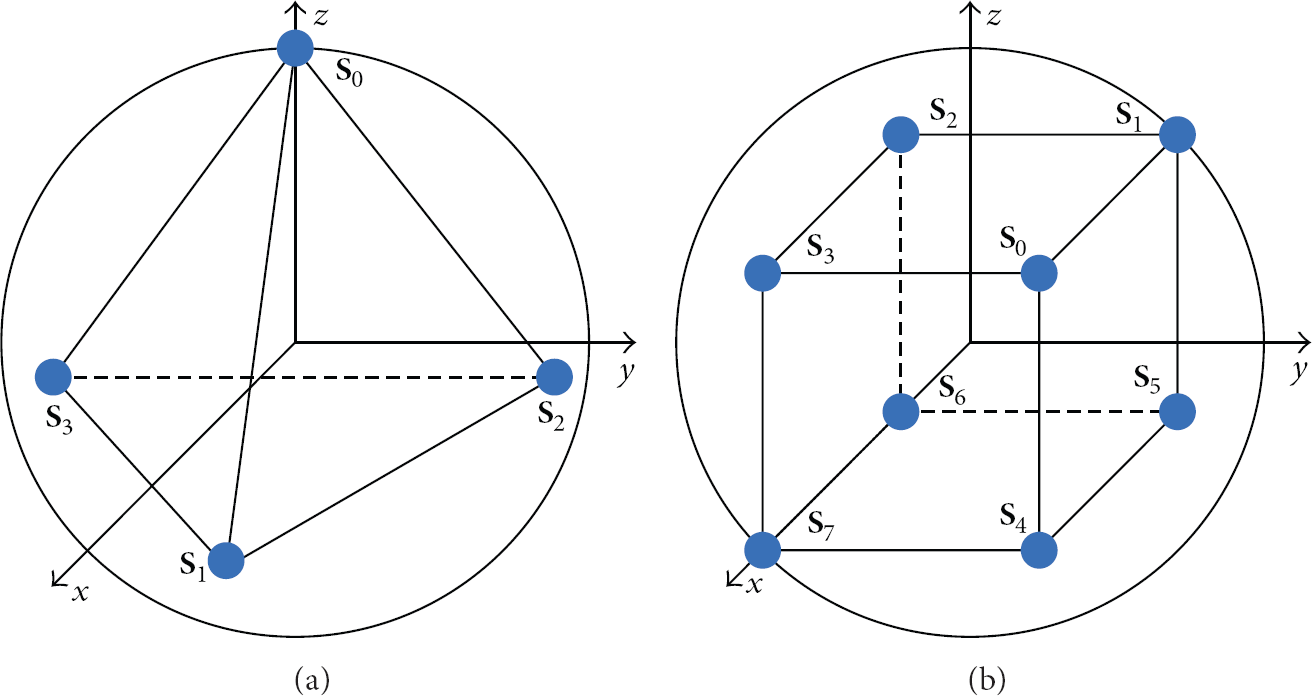
An example of the typical 3D signal constellations (a) M = 4 (b) M = 8.
Thus, a baseband signal of the 3D OFDM in the frequency domain can be represented as a

To modulate the OFDM symbol in (1) generating time domain signals, a 2D IDFT is exploited. For the practical implementation, a 2D inverse fast Fourier transform (IFFT) algorithm is used to alleviate the computational complexity [16]. Then, the modulated 3D OFDM symbol is represented as

PAPR of the transmitted signals in a 3D OFDM system can be defined as


Due to the 2D IDFT modulation, there may be more numbers of adding up the amplitude of sinusoidal signals. It possibly results in increased PAPR of the 3D OFDM as compared with that of the conventional one. It is, therefore, an appropriate PAPR reduction algorithm for the 3D OFDM system is highly required.
3. PTS Technique
3.1. The 3D OFDM System with the PTS Technique
A simplified block diagram of the transmitter part of the 3D OFDM system with PTS scheme is illustrated in Figure 2, where S/P is serial-to-parallel converter. Here, the input binary sequence is at first converted into a


A simplified block diagram of a 3D OFDM system with the PTS technique.
In order to convert the modulated baseband signal

After the 2D IFFT modulation, the 3D OFDM signals are synthesized as a linear combination of the subblocks weighted by a set of phase rotation factors. Therefore, the transmitted 3D OFDM signal can be expressed as


3.2. The Conventional SPS
In the PTS technique, performance of PAPR reduction depends largely on the subblock partitions. In general, there are three major partition schemes which are interleaved, adjacent, and pseudo-random subblock partitions. To apply the conventional SPS to a 3D OFDM symbol consisting of N subcarriers, we take a data packet containing three components into account. To give an easy explanation about the concept, a 3D OFDM signal with 32 subcarriers is demonstrated in Figure 3 as an example. The solid circle and the solid square denote the signal components on each axis and the data packet representing modulated 3D signals, respectively. With the conventional methods, the 32 subcarriers shown in Figure 3 are partitioned into the three different ways as illustrated in Figure 4. Here, the number of subblocks is set to

An example of the 3D OFDM signal.

An example of the conventional SPS methods: (a) interleaved, (b) adjacent, and (c) pseudo-random.
3.3. The Proposed Diagonal Rule Method
To reduce PAPR of the 3D OFDM system efficiently, we proposed a new partition method based on DR as shown in Figure 5, where an empty circle represents a zero-padded subchannel.

Diagonal subblock partition methods: (a) interleaved, (b) adjacent, and (c) pseudo-random.
It is known that the pseudo-random subblock partition provides the best PAPR reduction performance from the three SPSs mentioned previously. In the proposed method, each of the 3D signal components is assigned to a different subblock diagonally to make the number of superposition in column IFFT as low as possible. It implies that randomness of the 3D signals on each column is increased forcibly.
4. Performance Analysis
To evaluate the proposed DR-PTS method, computer simulation has been carried out. In the presented 3D OFDM system, we assume that the number of subcarriers is

The CCDFs of PAPR of the 2D and 3D OFDM systems with the conventional PTS.

The CCDFs of PAPR of the 3D OFDM system with the DR-PTS.
According to the subblock partition methods, PAPRs of the 3D OFDM system and those of 2D one are plotted in Figure 6. The CCDFs of both systems without PAPR reduction algorithm are also presented as a reference. As it can be expected, the 3D OFDM system has higher PAPR than the conventional 2D one. When no reduction algorithm is applied, the 3D OFDM system has around 0.8 dB larger PAPR than the conventional 2D system. Though PAPR of the 3D OFDM system can be reduced by the conventional PTS techniques, it is still relatively high as compared to that of the 2D system.
When the conventional interleaved SPS method is exploited, PAPR of the 3D OFDM system can be improved about 2.7 dB at
PAPRs of the 3D OFDM system with the proposed DR-PTS and the conventional PTS technique are compared in Figure 7. The proposed DR-based partition algorithm further reduces PAPR of the system. Especially, the DR-based interleaved SPS can reduce PAPR of the 3D OFDM system around 3.7 dB at
5. Conclusions
To facilitate new emerging applications and services in the 3D wireless networks, a flexible data transmission scheme for the physical layer is to be developed. As a possible candidate, the OFDM system with 3D signal constellations is considered in this paper. To control the transmitted signals having very high peak amplitude, a PTS technique based on diagonal subblock partition is proposed and its performance is analyzed. The key feature of the proposed algorithm is to assign the components of 3D signals into different subblocks diagonally. It makes randomness of the signals in the disjoint subblocks increased forcibly while the computational complexity remains almost the same as the conventional algorithm. Computer simulation verifies that the proposed DR-based PTS scheme improves PAPR of the 3D OFDM system significantly. When the DR-based interleaved partition is exploited, performance gain of the proposed algorithm over the conventional one is around 1.0 dB at
Footnotes
Conflict of Interests
The authors declare that there is no conflict of interests regarding the publication of this paper.
Acknowledgments
Zhenxing Chen was partly supported by the Scientific Research Foundation (SRF) for the Returned Overseas Chinese Scholars (ROCS), Grant funded by the State Education Ministry (SEM) (no. 47), and also supported in part by the Fundamental Research Founds for National University, Grant funded by the China University of Geosciences (Wuhan) (no. CUG130607). Seog Geun Kang was supported by Basic Science Research Program through the National Research Foundation of Korea (NRF) funded by the Ministry of Education (no. 2013-013013) and the same Program of the NRF funded by the Ministry of Education, Science, and Technology (MEST) (no. 2011-0009443).